2A547-JKS50APulse oximeter
Guangdong HealthTree Medical Technology Co., Ltd.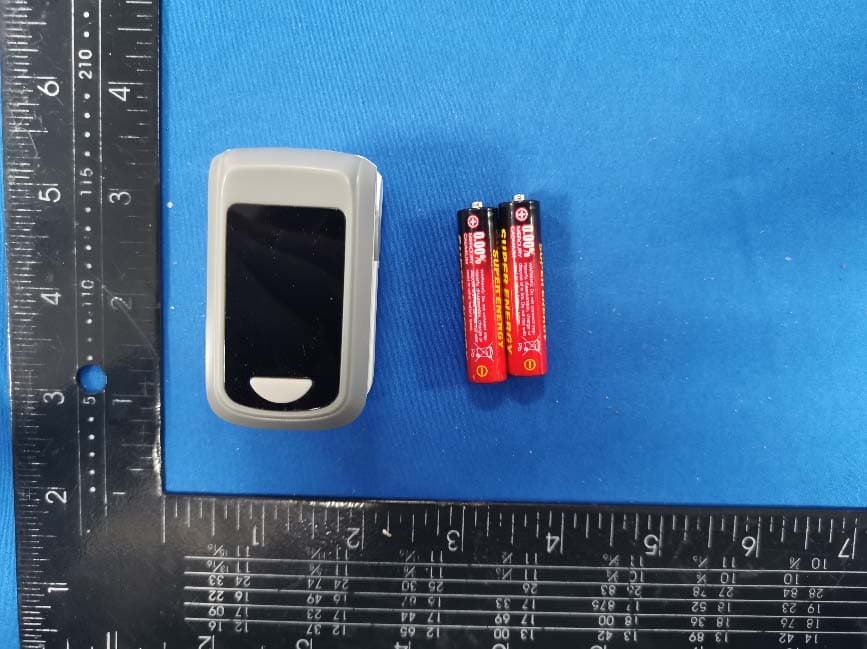
Click to zoom
Application Details
- Equipment Class
- DTS - Digital Transmission System
- Date of Grant
- Apr 06, 2022
- Application Purpose
- Original Equipment
- Date of Application
- Apr 06, 2022
- Equipment Note
- Pulse oximeter
- Frequency Range
- 2402.00000000 - 2480.00000000
- Country
- China
Documents & Files
Document Text
Text extracted from the exhibit documents filed with the FCC. Open a document above to read the original.
Users Manual
Operator’s Manual Fingertip Pulse Oximeter General Description The measurement of oxygen saturation of arterial blood (also known as pulse oxygen saturation, usually shortened as SpO 2 ) adopts the principles of light spectra and volume tracing. The LED emits lights with two specific wavelengths, which are selectively absorbed by oxygenated hemoglobin and deoxyhemoglobin. The optical receptor measures the changes in the light intensity after the light passes the capillary network and estimates the ratio of oxygenated hemoglobin and the total hemoglobin. Precautions for use ◼ Explosion hazard. Do not use the oximeter in the presence of flammable anesthetics mixture with air, oxygen, or hydrogen. ◼ When the oximeter is in use, there should not be any great power appliances as high voltage cables, X-ray machine, ultrasound equipment and electrizer in use nearby. ◼ Keep the oximeter away from dust, vibration, corrosive substances, explosive materials, high temperature and moisture. ◼ This oximeter for sports or aviation use only. ◼ The oximeter should be handled with care so as to avoid shocks and falls. ◼ When the oximeter is in use, it must be ensured the batteries have sufficient capacity; otherwise there might be such phenomena as starting-up abnormalities or inaccurate measurement data, etc. ◼ Please do not use such pointed objects as pen point or nails for pressing operation, otherwise it might cause permanent damage to the surface of the keyboard. ◼ To ensure accurate performance and prevent device failure, do not expose the oximeter to extreme moisture, such as direct exposure to rain. Such exposure may cause inaccurate performance or device failure. ◼ Do not conduct SpO 2 measurement on the finger smeared with nail polish, otherwise this will lead to unreliable measurement results. ◼ Please do not open the enclosure. The enclosure shall only be opened by the authorized person. ◼ In order to have more accurate measurements of SpO 2 and PR, the oximeter should be used in quiet and comfortable environment. ◼ Follow local ordinances and recycling instructions regarding disposal or recycling of the device and device components, including batteries. Intended Use This product is intended for sports and aviation use only. It should not be used to diagnose or treat any medical condition . Operation Instructions 1. Install two AAA batteries into battery cassette before closing its cover. 2. Nip the oximeter, then insert one of fingers into the rubber hole of the oximeter before releasing the oximeter, and your nail surface must be upward. 3. Press the function button once on front panel. 4. Your finger and body do not tremble during measuring. 5. Read corresponding data in only one direction on the display screen. ① Indication of screen brightness ② Indication of pulse intensity ③ SpO 2 Plethysmogram ④ Indication of battery capacity ⑤ Pulse rate reading ⑥ SpO 2 reading ⑦ PI reading Battery Installations 1. Press the button down on the back panel of oximeter and push the battery cover horizontally along the arrow shown as below: 2. Install the two AAA batteries into battery cabin in correct polarities. 3. Close the battery cover. Notes: ◼ Pay attention to the correct polarities terminals of the battery, which are marked with plus and minus signs. Do not install the battery in the direction of the spring. ◼ Please remove the battery if the oximeter will not be used for long time. Maintenance 1. Use a soft cloth dampened with either a commercial, nonabrasive cleaner, or a solution of 70% alcohol in water, lightly wipe the surfaces of the oximeter. 2. The most commonly used hospital cleaning agent and non-corrosive detergents can be used for cleaning the oximeter, but please be careful that many types of detergents must be diluted before use; Please use them according to the directions of the manufacturers of the detergents. 3. Avoid using alcohol-based, amido or acetone-based detergents 4. The casing of the oximeter should be kept from the contamination of filth and dirt, and it can be wiped with non-velvet soft cloth. When cleaning, do not spill the liquid onto the instrument. Ensure no liquid is allowed to enter the inside of the oximeter. 5. It is forbidden to use such grinding materials as wire brush or metal polishing agent, because these materials may cause damage to the panels of the oximeter. 6. Please do not soak the oximeter in liquid. 7. Under normal circumstances, it is unnecessary for the oximeter to have special maintenance, and cautions must be exercised on the following points during the use of the oximeter: ◼ Please use the oximeter in the environment according to the requirements of the performance criteria. ◼ Avoid contacts with organic solutions, dusts or corrosive gases. Product Specifications ◆ Measurement specifications SpO 2 Measuring Range 0~100% Resolution 1% Accuracy At 70~100%, ±2%; At 0~69%, unspecified Data update period <13 s PR Measuring Range 25~250 bpm Resolution 1 bpm Accuracy ±1% or ± 1 bpm, whichever is greater Data update period < 13 s % 100 lobin deoxyhemog bin oxyhemoglo hemoglobin oxygenated % SpO 2 + = ◆ Battery specifications Type Voltage two AAA alkaline battery 1.5 Volts DC (per battery) The oximeter uses two 1.5 V A AA type batteries and a set of new batteries can be used for more than 18 hours, depending on concrete battery types. ◆ Environmental specifications Operation Temperature +5°C~+40°C Atmospheric Pressure 700hPa~1060hPa Relative Humidity ≤85% Transport and Storage Temperature -20°C~+55°C Atmospheric Pressure 500hPa~1060hPa Relative Humidity ≤93% ◆ Physical specifications Weight about 21g (exclude battery) about 54g (include battery) Dimensions 57mm(length) × 33mm(width) ×30mm(height) ◆ Sensors specifications Wavelength Pulse oximetry sensors contain LEDs that emit red light at a wavelength of approximately 660 nm and infrared light at a wavelength of approximately 905 nm. The total optical output power of the sensor LEDs is less than 15 m…
Text truncated - open the document above for the full version.
Attestation Statements
Guangdong HealthTree Medical Technology Co., Ltd. Model Difference Model : JKS50A, JKS50B,JKS50C All the models are the same circuit and RF module, except the mode names. Regards Sincerely, Client’s signature: Client’s name / title : Jing Liu/ Manager Contact information / address: B710A,7F,zone B plant,No.8 Gangle Road, Tangjiawan Town, high tech Zone, Zhuhai, Guangdong,
Cover Letter(s)
Guangdong HealthTree Medical Technology Co., Ltd. 3/30/2022 Eurofins Electrical and Electronic Testing NA, Inc. 914 West Patapsco Avenue Baltimore, MD 21230 RE: CONFIDENTIALITY REQUEST FOR (Pulse oximeter/ # AND FCC ID: 2A547-JKS50A To Whom It May Concern: This letter serves as an official request for confidentiality under sections 0.457 and 0.459 of CFR 47. We have requested that the - Block Diagram - Schematics - Operational Description required to be submitted with this application be permanently withheld from public review. The above documents are company proprietary information that could never get into the possession of your competition. Please contact me if there is any information you may need. Sincerely, Client’s signature: Client’s name / title : Jing Liu/ Manager Contact information / address: B710A,7F,zone B plant,No.8 Gangle Road, Tangjiawan Town, high tech Zone, Zhuhai, Guangdong,
Cover Letter(s)
Guangdong HealthTree Medical Technology Co., Ltd. 3/30/2022 Eurofins Electrical and Electronic Testing NA, Inc. 914 West Patapsco Avenue Baltimore, MD 21230 RE: LETTER OF AGENT AUTHORIZATION To Whom It May Concern: We, the undersigned, hereby authorize (Shenzhen CTA Testing Technology Co., Ltd.) to act on our behalf in all matters relating to application for equipment authorization, including the signing of all documents relating to these matters. We also hereby certify that no party to the application authorized hereunder is subject to the denial of benefits, including FCC benefits, pursuant to Section 5301 of the Anti-Drug Abuse Act of 1988, 21 U.S.C.853(a). This agreement expires one year from the current date. Sincerely, Client’s signature: Client’s name / title : Jing Liu/ Manager Contact information / address: B710A,7F,zone B plant,No.8 Gangle Road, Tangjiawan Town, high tech Zone, Zhuhai, Guangdong
ID Label/Location Info
0.2cm*1.2cm
RF Exposure Info
RF Exposure evaluation FCC ID: 2A547-JKS50A 1.1. Applicable Standard According to §1.1307(b)(1), systems operating under the provisions of this section shall be operated in a manner that ensures that the public is not exposed to radio frequency energy level in excess of the Commission’s guidelines. According to §1.1310 and §2.1093 RF exposure requirement KDB447498 v06: Mobile and Portable Devices RF Exposure Procedures and Equipment Authorization Policies 1.2. Requirement According to KDB447498 D01 General RF Exposure Guidance v06 Section 4.3.1 Standalone SAR test exclusion considerations: “Unless specifically required by the published RF exposure KDB procedures, standalone 1-g head or body and 10-g extremity SAR evaluation for general population exposure conditions, by measurement or numerical simulation, is not required when the corresponding SAR Test Exclusion Threshold condition, listed below, is satisfied. These test exclusion conditions are based on source-based time-averaged maximum conducted output power of the RF channel requiring evaluation, adjusted for tune-up tolerance, and the minimum test separation distance required for the exposure conditions.22 The minimum test separation distance is determined by the smallest distance from the antenna and radiating structures or outer surface of the device, according to the host form factor, exposure conditions and platform requirements, to any part of the body or extremity of a user or bystander (see 5) of section 4.1). To qualify for SAR test exclusion, the test separation distances applied must be fully explained and justified by the operating configurations and exposure conditions of the transmitter and applicable host platform requirements, typically in the SAR measurement or SAR analysis report, according to the required published RF exposure KDB procedures. When no other RF exposure testing or reporting is required, a statement of justification and compliance must be included in the equipment approval, in lieu of the SAR report, to qualify for the SAR test exclusion. When required, the device specific conditions described in the other published RF exposure KDB procedures must be satisfied before applying these SAR test exclusion provisions; for example, handheld PTT two-way radios, handsets, laptops & tablets etc.23 “ [(max. power of channel, including tune-up tolerance, mW)/ (min. test separation distance, mm)] · [√f (GHz)] ≤ 3.0 for 1-g SAR and ≤ 7.5 for 10-g extremity SAR, where: • f (GHz) is the RF channel transmit frequency in GHz • Power and distance are rounded to the nearest mW and mm before calculation • The result is rounded to one decimal place for comparison • 3.0 and 7.5 are referred to as the numeric thresholds in the step 2 below The test exclusions are applicable only when the minimum test separation distance is ≤ 50 mm and for transmission frequencies between 100 MHz and 6 GHz. When the minimum test separation distance is < 5 mm, a distance of 5 mm according to 5) in section 4.1 is applied to determine SAR test exclusion. 1.3. Manufacturing tolerance GFSK (Peak) Channel Channel 0 Channel 19 Channel 39 Target (dBm) 1.0 1.0 1.0 Tolerance ±(dB) 1.0 1.0 1.0 Page 2 of 2 2. Evaluation Result Evaluation Results Band/Mode f (GHz) Antenna Distance (mm) RF output power (including tune-up tolerance) SAR Test Exclusion Threshold SAR Test Exclusion dBmmW BT 2.450 5 2.0 1.58 0.49<3.0 Yes 3. Conclusion The measurement results comply with the FCC Limit per 47 CFR 2.1093 for the uncontrolled RF Exposure and SAR Exclusion Threshold per KDB 447498 v06 .....................End of Report.........................
Test Report
Shenzhen CTA Testing Technology Co., Ltd. Room 106, Building 1, Yibaolai Industrial Park, Qiaotou Community, Fuhai Street, Bao’an District, Shenzhen, China Shenzhen CTA Testing Technology Co., Ltd. Room 106, Building 1, Yibaolai Industrial Park, Qiaotou Community, Fuhai Street, Bao’an District, Shenzhen, China Tel:+86-755 2322 5875 E-mail:[email protected] Web:http://www.cta-test.cn FCC PART 15 SUBPART C TEST REPORT FCC PART 15.247 Report Reference No. ..................... : FCC ID. ........................................... : CTA22032802001 2A547-JKS50A Compiled by ( position+printed name+signature) .. : File administrators Kevin Liu Supervised by ( position+printed name+signature) .. : Project Engineer Kevin Liu Approved by ( position+printed name+signature) .. : RF Manager Eric Wang Date of issue ..................................... : Mar. 29, 2022 Testing Laboratory Name .............. : Shenzhen CTA Testing Technology Co., Ltd. Address ............................................ : Room 106, Building 1, Yibaolai Industrial Park, Qiaotou Community, Fuhai Street, Bao’an District, Shenzhen, China Applicant’s name ............................ : Guangdong HealthTree Medical Technology Co., Ltd. Address ............................................ : B710A, 7F, zone B plant, No. 8 Gangle Road, Tangjiawan Town, high tech Zone, Zhuhai, Guangdong, China Test specification ...........................: Standard ........................................... : FCC Part 15.247 Shenzhen CTA Testing Technology Co., Ltd. All rights reserved. This publication may be reproduced in whole or in part for non-commercial purposes as long as the Shenzhen CTA Testing Technology Co., Ltd. is acknowledged as copyright owner and source of the material. Shenzhen CTA Testing Technology Co., Ltd. takes no responsibility for and will not assume liability for damages resulting from the reader's interpretation of the reproduced material due to its placement and context. Equipment description ................... : Pulse oximeter Trade Mark ....................................... : N/A Manufacturer .................................... : Guangdong HealthTree Medical Technology Co., Ltd. Model/Type reference....................... : JKS50A Listed Models .................................. : JKS50B,JKS50C Modulation ....................................... : GFSK Frequency .......................................... From 2402MHz to 2480MHz Ratings ............................................. : DC 3.0V From Battery Result................................................ : PASS Report No.: CTA22032802001 Page 2 of 33 Shenzhen CTA Testing Technology Co., Ltd. Room 106, Building 1, Yibaolai Industrial Park, Qiaotou Community, Fuhai Street, Bao’an District, Shenzhen, China Tel:+86-755 2322 5875 E-mail:[email protected] Web:http://www.cta-test.cn T E S T R E P O R T Equipment under Test : Pulse oximeter Model /Type : JKS50A Listed Models : JKS50B,JKS50C Applicant : Guangdong HealthTree Medical Technology Co., Ltd. Address : B710A, 7F, zone B plant, No. 8 Gangle Road, Tangjiawan Town, high tech Zone, Zhuhai, Guangdong, China Manufacturer : Guangdong HealthTree Medical Technology Co., Ltd. Address : B710A, 7F, zone B plant, No. 8 Gangle Road, Tangjiawan Town, high tech Zone, Zhuhai, Guangdong, China Test Result: PASS The test report merely corresponds to the test sample. It is not permitted to copy extracts of these test result without the written permission of the test laboratory. Report No.: CTA22032802001 Page 3 of 33 Shenzhen CTA Testing Technology Co., Ltd. Room 106, Building 1, Yibaolai Industrial Park, Qiaotou Community, Fuhai Street, Bao’an District, Shenzhen, China Tel:+86-755 2322 5875 E-mail:[email protected] Web:http://www.cta-test.cn Contents 1 T E S T S T A N D A R D S .................................................................. 4 2 S U M M A R Y ............................................................................. 5 2.1 General Remarks 5 2.2 Product Description 5 2.3 Equipment Under Test 5 2.4 Short description of the Equipment under Test (EUT) 5 2.5 EUT operation mode 6 2.6 Block Diagram of Test Setup 6 2.7 Related Submittal(s) / Grant (s) 6 2.8 Modifications 6 3 T E S T E N V I R O N M E N T ............................................................... 7 3.1 Address of the test laboratory 7 3.2 Test Facility 7 3.3 Environmental conditions 7 3.4 Summary of measurement results 8 3.5 Statement of the measurement uncertainty 8 3.6 Equipments Used during the Test 9 4 T E S T C O N D I T I O N S A N D R E S U L T S ............................................ 10 4.1 AC Power Conducted Emission 10 4.2 Radiated Emissions and Band Edge 11 4.3 Maximum Peak Output Power 18 4.4 Power Spectral Density 19 4.5 6dB Bandwidth 21 4.6 Out-of-band Emissions 23 4.7 Antenna Requirement 27 5 T E S T S E T U P P H O T O S O F T H E E U T .......................................... 28 6 P H O T O S O F T H E E U T ............................................................. 29 Report No.: CTA22032802001 Page 4 of 33 Shenzhen CTA Testing Technology Co., Ltd. Room 106, Building 1, Yibaolai Industrial Park, Qiaotou Community, Fuhai Street, Bao’an District, Shenzhen, China Tel:+86-755 2322 5875 E-mail:[email protected] Web:http://www.cta-test.cn 1 T E S T S T A N D A R D S The tests were performed according to following standards: FCC Rules Part 15.247: Frequency Hopping, Direct Spread Spectrum and Hybrid Systems that are in operation within the bands of 902-928 MHz, 2400-2483.5 MHz, and 5725-5850 MHz. ANSI C63.10-2013: American National Standard for Testing Unlicensed Wireless Devices KDB558074 D01 V05r02: Guidance for Performing Compliance Measurements on Digital Transmission Systems (DTS) Operating Under §15.247 Report No.: CTA22032802001 Page 5 of 33 Shenzhen CTA Testing Technology Co., Ltd. Room 106, Building 1, Yibaolai Industrial Park, Qiaotou Community, Fuhai Street, Bao’an District, Shenzhen, China Tel:+86-755 2322 5875 E-mail:…
Text truncated - open the document above for the full version.
Contact Information
Applicant
Jing Liu(Manager)
Technical Contact
Shenzhen CTA Testing Technology Co., LtdEric Wang
[email protected]+8675523225875
Room 106, Building 1, Yibaolai Ind. Park Qiaotou · Bao'an District, Shenzhen, Guangdong · China
Test Firm
SHENZHEN CTA TESTING TECHNOLOGY CO., LTD.Eric Wang
[email protected]+86 755 2322 5875
Technical Specifications
| # | Rule Parts | Frequency Range | Power Output |
|---|---|---|---|
| 1 | 15C | 2.40 GHz - 2.48 GHz | 1.56 mW |