2ACCJH129GSM/UMTS/LTE Mobile phone
TCL Communication Ltd.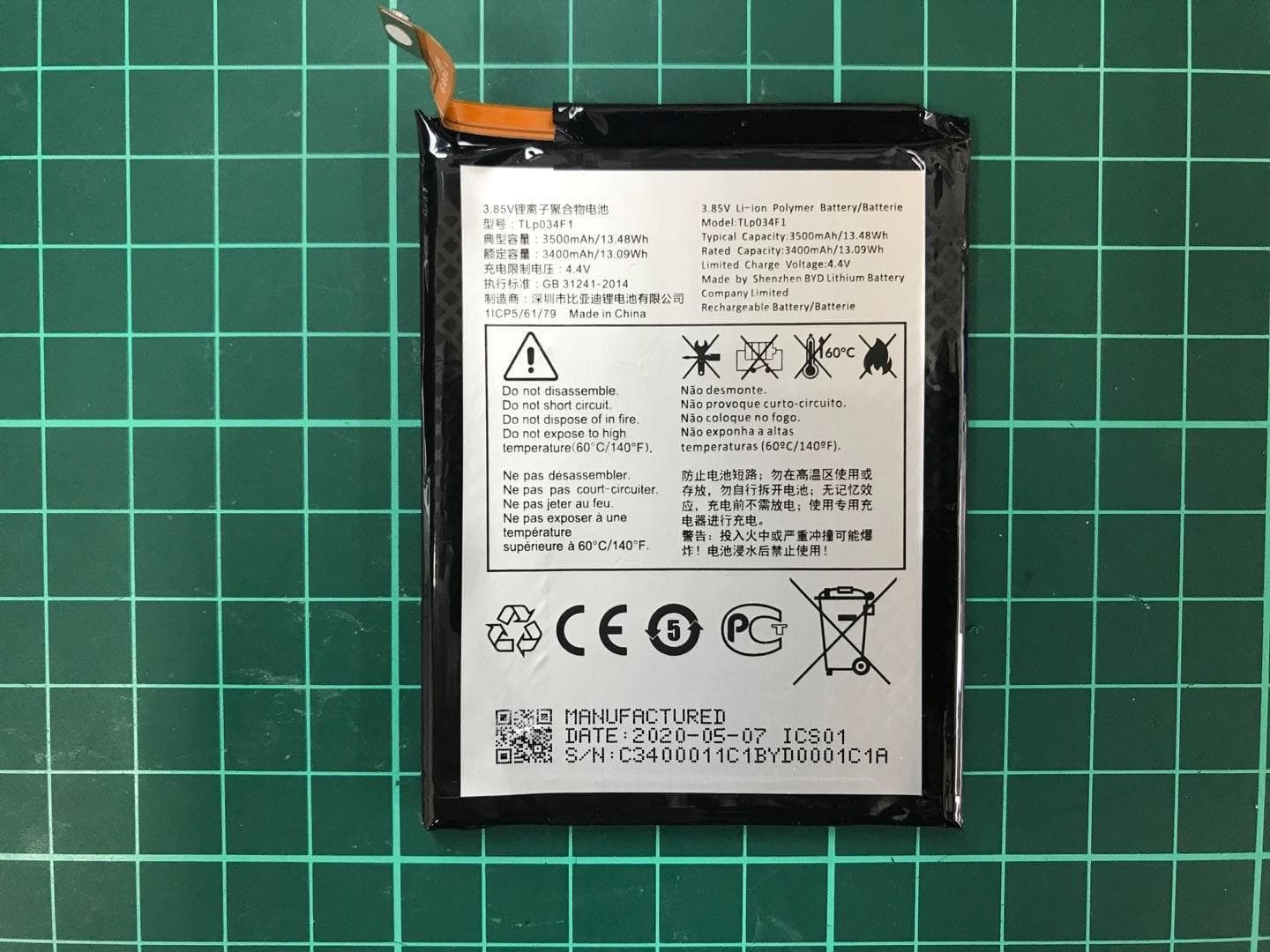
Click to zoom
Application Details
- Equipment Class
- PCE - PCS Licensed Transmitter held to ear
- Date of Grant
- Jul 09, 2020
- Application Purpose
- Original Equipment
- Date of Application
- Jul 08, 2020
- Equipment Note
- GSM/UMTS/LTE Mobile phone
- Frequency Range
- 1720.00000000 - 1770.00000000
- Company
- TCL Communication Ltd.
- Country
- China
Documents & Files
Document Text
Text extracted from the exhibit documents filed with the FCC. Open a document above to read the original.
Users Manual
Safety and Warranty Information CQF2FJ0AQAAA Alcatel AXEL TM www.sar-tick.com This device meets applicable national SAR limits of 1.6 W/kg. When carrying the device or using it while worn on your body, either use an approved accessory such as a holster or otherwise maintain a distance of 15 mm from the body to ensure compliance with RF exposure requirements. Note that the product may be transmitting even if you are not using it. To prevent possible hearing damage, do not listen at high volume levels for long periods. Exercise caution when holding your device near your ear while the loudspeaker is in use. The device contains magnets which may interfere with other devices and items (such as credit card, pacemakers, defibrillators, etc.). Please maintain at least 150 mm of separation between your phone and the devices/items mentioned above. Table of contents Safety information ............................................................................................................1 General information .......................................................................................................10 1 YEAR LIMITED WARRANTY .......................................................................................12 1 Safety information .................................. We recommend that you read this chapter carefully before using your device. The manufacturer disclaims any liability for damage, which may result as a consequence of improper use or use contrary to the instructions contained herein. • TRAFFIC SAFETY Given that studies show that using a device while driving a vehicle constitutes a real risk, even when the hands-free kit is used (car kit, headset...), drivers are requested to refrain from using their device when the vehicle is not parked. When driving, do not use your device or headphones to listen to music or to the radio. Using a headphone can be dangerous and forbidden in some areas. When switched on, your device emits electromagnetic waves that can interfere with the vehicle’s electronic systems such as ABS anti-lock brakes or airbags. To ensure that there is no problem: - do not place your device on top of the dashboard or within an airbag deployment area, - check with your car dealer or the car manufacturer to make sure that the dashboard is adequately shielded from device RF energy. • CONDITIONS OF USE You are advised to switch off the device from time to time to optimize its performance. Switch the device off before boarding an aircraft. Switch the device off when you are in healthcare facilities, except in designated areas. As with many other types of equipment now in regular use, these devices can interfere with other electrical or electronic devices, or equipment using radio frequencies. Switch the device off when you are near gas or flammable liquids. Strictly obey all signs and instructions posted in a fuel depot, petrol station, or chemical plant, or in any potentially explosive atmosphere. When the device is switched on, it should be kept at least 150 mm from any medical device such as a pacemaker, a hearing aid, or insulin pump, etc. In particular when using the device, you should hold it against the ear on the opposite side of the device, if applicable. To avoid hearing impairment, move the device away from your ear while using the hands-free mode because the amplified volume might cause hearing damage. 2 Do not let children use the device and/or play with the device and accessories without supervision. When replacing the cover, note that your device may contain substances that could create an allergic reaction. Always handle your device with care and keep it in a clean and dust-free place. Do not allow your device to be exposed to adverse weather or environmental conditions (moisture, humidity, rain, infiltration of liquids, dust, sea air, etc.). The manufacturer's recommended operating temperature range is 0°C(32°F) to 50°C(122°F). At over 50°C(122°F) the legibility of the device’s display may be impaired, though this is temporary and not serious. Emergency call numbers may not be reachable on all cellular networks. You should never rely only on your phone for emergency calls. Do not open, dismantle, or attempt to repair your device yourself. Do not drop, throw, or bend your device. To avoid any injury, do not use the device if the screen is damaged, cracked, or broken. Do not paint the device. Only use batteries, battery chargers, and accessories which are recommended by TCL Communication Ltd. and its affiliates and are compatible with your device model. TCL Communication Ltd. and its affiliates disclaim any liability for damage caused by the use of other chargers or batteries. Remember to make back-up copies or keep a written record of all important information stored in your device. 3 • PRIVACY Please note that you must respect the laws and regulations in force in your jurisdiction or other jurisdiction(s) where you will use your device regarding taking photographs and recording sounds with your device. Pursuant to such laws and regulations, it may be strictly forbidden to take photographs and/or record the voices of other people or any of their personal attributes, and duplicate or distribute them, as this may be considered to be an invasion of privacy. It is the user's sole responsibility to ensure that prior authorization be obtained, if necessary, in order to record private or confidential conversations or take a photograph of another person. The manufacturer, the seller, vendor, and/or service provider of your device disclaim any liability which may result from the improper use of the device. • BATTERY Following air regulation, the battery of your product is not charged. Please charge it first. Observe the following precautions: - Do not attempt to open the back cover. - Do not attempt to eject, replace, or open battery. - Do not puncture the back cover of your phone. - Do not burn or dispose of your phone in household rubbish or store it at tem…
Text truncated - open the document above for the full version.
Users Manual
* Compatible device and subscription may be required. Data and messaging rates may apply. Restrictions and limitations may apply. For more app information, go to https://att.com/shop/ apps. Messaging & Email Email setup 1. Swipe up from Home screen > Gmail . 2. Select Got It > Add an email address, then select an email provider. 3. Enter your account credentials, such as email address and password. Tap NEXT to continue. 4. Confirm email account settings, tap NEXT. 5. Enter your name which will be displayed on outgoing emails, tap FINISH. Text and Picture Messaging 1. From the Home screen > Messaging . 2. Tap to begin a new message. 3. In the To field, enter a number or a contact name, or tap FAVORITES or ALL CONTACTS to select a contact from the address book. 4. Tap "Add text" field and enter your text. 5. Select to send photos, videos, contact information, files, or sound recordings. 6. Tap to send the message. What else is in the box? • Alcatel AXEL™ • USB-C cable • Wall charger • Pre-installed SIM card • Safety and warranty information • SIM card pin Useful Apps* AT&T Visual Voicemail Receive voicemail messages in an email-like inbox. You can easily play and delete messages, return calls, and manage voicemail features. AT&T Smart Wi-Fi Helps make your data plan last longer. Remembers and connects to your favorite hotspots and finds more Wi-Fi options when you're on the go. myAT&T Keep track of your wireless and Internet data usage, upgrade your phone or plan, and view/pay your bill in the app. Find More Information Manage Your Account with myAT&T • On your phone: Swipe up on the Home screen > myAT&T • To access on the web: att.com/myATT Compatible device and online account required. Data and messaging rates may apply for download and app usage. Need More Help? • On your phone: Swipe up on the Home screen > Device Help • On the web: att.com/DeviceHowTo Give us a call • 611 from any AT&T wireless phone • 800.331.0500 or prepaid 800.901.9878 AXEL BC Let's get started AT&T Eco Rating 2.0 only applies to Alcatel AXEL TM . For limited factors evaluated visit att. com/EcoSpace. Wireless Emergency Alerts is a registered Trademark and Service Mark of CTIA. Alcatel is a trademark of Nokia used under license by TCL Communication Technology Holdings Limited. AXEL is a trademark of TCL Communication Technology Holdings Limited. © 2020 TCT Mobile Limited. All rights reserved. LTE is a trademark of ETSI. 4G LTE not available everywhere. Contains Lithium ion battery - recycle or dispose of properly. © 2020 AT&T Intellectual Property. All rights reserved. AT&T, the AT&T logo and all other AT&T marks contained herein are trademarks of AT&T Intellectual Property. All other marks are the property of their respective owners. CJB2FJ0AQAAAPrinted in USA 4 2.0
Cover Letter(s)
TCL Communication Ltd. 5/F, Building 22E, 22 Science Park East Avenue, Hong Kong Science Park, Shatin, NT, Hong Kong Tel: 0086-755-36611722 http://tclcom.tcl.com Date 2020-06-28 To: Federal Communications Commission, Authorization & Evaluation Division, 7345 Oakland Mills Road Columbia, MD 21046 And American Certification Body, Inc. 6731 Whittier Avenue Suite C110 McLean, VA 22101 To Whom It May Concern: CTTL (Telecommunication Technology Labs,Academy of Telecommunication Research,MIIT) is authorized to act on our behalf, until otherwise notified, for applications to American Certification Body, Inc. (ACB). We certify that we are not subject to denial of federal benefits, which includes FCC benefits, pursuant to Section 5301 of the Anti-Drug Abuse Act of 1988, U.S.C. 862. Further, no party, as defined in 47 CFR1.2002 (b) to the application is subject to denial of federal benefits, that includes FCC benefits. Thank you. Regards, Zhizhou GONG Product Certification Manager TCL Communication Ltd.
Cover Letter(s)
5/F, Building 22E, 22 Science Park East Avenue, Hong Kong Science Park, Shatin, NT, Hong Kong Tel: 0086-755-36611722 2020-06-28 Federal Communications Commission Office of Engineering and Technology Equipment Authorization Division 7345 Oakland Mills Road Columbia, Maryland 21046 Subject: Permanent Confidentiality request for FCC ID: 2ACCJH129 To Whom It May Concern, Pursuant to sections 0.457 and 0.459 of CFR 47, the applicant requests permanent confidential treatment of the following information accompanying this application: - Block Diagram - Schematics - Operational Description - BOM list/Tune-Up-Procedure The above materials contain trade secrets and proprietary information not customarily released to the public. The public disclosure of these matters might be harmful to the applicant and provide unjustified benefits to its competitors. Yours Sincerely, Zhizhou GONG Product Certification Manager TCL Communication Ltd.
Cover Letter(s)
5/F, Building 22E, 22 Science Park East Avenue, Hong Kong Science Park, Shatin, NT, Hong Kong TEL: 0086-755-36611722 2020-07-01 Federal Communications Commission Office of Engineering and Technology Equipment Authorization Division 7345 Oakland Mills Road Columbia, Maryland 21046 Subject: SHORT-TERM Confidentiality request for FCC ID: 2ACCJH129 To Whom It May Concern, Pursuant to sections 0.457 and 0.459 of CFR 47 and to avoid premature release of sensitive information prior to marketing or release of the product to the public, the applicant requests the following documents contained in this certification application be temporarily withheld from public disclosure for an initial period of 180 days: - External Photos - Internal Photos - Test Setup Photos - User manual The applicant also acknowledges that they will also provide appropriate notice to ACB should either of the following occur: a) if the applicant requires additional 45 days extension periods they will notify ACB with a new request letter at least 7 days prior to the short-term confidentiality expiration date – [Note: up to a maximum of 3 extensions only are allowed], or b) immediately notify ACB in the event the information regarding the product or the product is made available to the public. ACB will then release the documents listed above for public disclosure pursuant to FCC Public Notice DA 04-1705. Yours Sincerely, Zhizhou GONG Product Certification Manager TCL Communication Ltd.
Cover Letter(s)
Declaration of pre-install of OTT voice service We, [TCL Communication Ltd.], as the manufacturer of FCC ID: 2ACCJH129(Model: 5004R,5004C), declares that this model supports Wi-Fi Calling and only pre-installs Google DUO of OTT service with Android OS,and doesn’t support any other OTT services. We tested DUO using the software from Google according to KDB 285076 D02v03 Guidance for performing T-Coil tests for air interfaces supporting VOIP to support CMRS based telephone services. APPROVED BY: Projects Manager: Zhizhou GONG Signature: Company name: TCL Communication Ltd. Date: 2020-07-01
Cover Letter(s)
7/F, Block F4, TCL Communication Technology Building, TCL International E City, Zhong Shan Yuan Road, Nanshan District, Shenzhen, Guangdong, P.R. China 518052 TEL: 0086-755-36611722 Declaration of changes from 5004R to 5004C SOFTWARE MODIFICATIONS: Protocol Stack changes: NO MMS/STK/USAT/USIM changes: NO DM/SUPL/VT/FUMO/SWP/HCI: NO Other changes detailed: code name is different HARDWARE MODIFICATIONS: Band changes: No PCB Layout changes: No Main components changes: Antenn a Base Band Transceive r ASM Power Amplifier Tx SAW Filter Rx SAW Filter Duplex er GSM850 NO NO NO NO NO NO NO NO GSM900 NO NO NO NO NO NO NO NO GSM1800 NO NO NO NO NO NO NO NO GSM1900 NO NO NO NO NO NO NO NO UMTS1900 NO NO NO NO NO NO NO NO UMTS1700 NO NO NO NO NO NO NO NO UMTS850 NO NO NO NO NO NO NO NO LTE 2 NO NO NO NO NO NO NO NO LTE 4 NO NO NO NO NO NO NO NO LTE 5 NO NO NO NO NO NO NO NO LTE 12 NO NO NO NO NO NO NO NO LTE 14 NO NO NO NO NO NO NO NO LTE 30 NO NO NO NO NO NO NO NO LTE 66 NO NO NO NO NO NO NO NO Bluetooth NO NO NO NO NO NO NO NO WiFi NO NO NO NO NO NO NO NO NFC NO NO NO NO NO NO NO NO FM changes: NO Other components changes: LCD/ Speaker/ Vibrator changes: NO Other changes detailed: MECHANICAL MODIFICATIONS: Use new metal front/back cover or keypad: NO Mechanical shell changes: Whole size of EUT: NO Distance of Ear reference point to bottom of handset: NO Other trinkets to change the surface of handset: NO Other changes detailed: APPROVED BY: Project Manager: 史睿 Signature: Date: 2020-4-15
External Photos
2ACCJH129 5004R 5004C CAC3400011C1 CAC3400011C1 CBA0059AGAC5 CBA0059AGAC5 CDA0000124C2
ID Label/Location Info
setting-system-Regulatory&safety
Internal Photos
2ACCJH129 5004R 5004C
RF Exposure Info
©Copyright. All rights reserved by CTTL. SAR TEST REPORT No. I20Z60778-SEM05 For TCL Communication Ltd. GSM/UMTS/LTE Mobile phone Model name: 5004R,5004C With Hardware Version: 03 Software Version: 6G2KUDK0 FCC ID: 2ACCJH129 Issued Date: 2020-7-8 Note: The test results in this test report relate only to the devices specified in this report. This report shall not be reproduced except in full without the written approval of CTTL. The report must not be used by the client to claim product certification, approval, or endorsement by NVLAP, NIST, or any agency of the U.S.Government. Test Laboratory: CTTL, Telecommunication Technology Labs, CAICT No. 51, Xueyuan Road, Haidian District, Beijing, P. R. China 100191. Tel:+86(0)10-62304633-2512, Fax:+86(0)10-62304633-2504 Email: [email protected], website: www.caict.ac.cn No.I20Z60778-SEM05 ©Copyright. All rights reserved by CTTL. Page 2 of 224 REPORT HISTORY Report Number Revision Issue Date Description I20Z60778-SEM05 Rev.0 2020-7-2 Initial creation of test report I20Z60778-SEM05 Rev.1 2020-7-8 1.Remove frequency information of LTE Band7 on section 4.1. 2.Update the tune up of WCDMA Band2 on page29,and LTE Band2 on page30. 3.Update the tune-up power for 802.11n(20) MCS4~7 on page 52. 4.Update the duty cycle for GSM1900 low power on section 14 page 56. 5.Update test position of LTE Band12 on page 64, which is a clerical error. 6.Add headset evaluation result in Table 14.1-8, add setup photo in the file of photos. No.I20Z60778-SEM05 ©Copyright. All rights reserved by CTTL. Page 3 of 224 TABLE OF CONTENT 1 TEST LABORATORY .................................................................................................................... 5 1.1 TESTING LOCATION ........................................................................................................................................ 5 1.2 TESTING ENVIRONMENT................................................................................................................................. 5 1.3 PROJECT DATA ............................................................................................................................................... 5 1.4 SIGNATURE ..................................................................................................................................................... 5 2 STATEMENT OF COMPLIANCE .................................................................................................. 6 3 CLIENT INFORMATION ................................................................................................................ 8 3.1 APPLICANT INFORMATION .............................................................................................................................. 8 3.2 MANUFACTURER INFORMATION ..................................................................................................................... 8 4 EQUIPMENT UNDER TEST (EUT) AND ANCILLARY EQUIPMENT (AE) ................................. 9 4.1 ABOUT EUT ................................................................................................................................................... 9 4.2 INTERNAL IDENTIFICATION OF EUT USED DURING THE TEST .......................................................................... 9 4.3 INTERNAL IDENTIFICATION OF AE USED DURING THE TEST ............................................................................ 9 5 TEST METHODOLOGY .............................................................................................................. 10 5.1 APPLICABLE LIMIT REGULATIONS ................................................................................................................ 10 5.2 APPLICABLE MEASUREMENT STANDARDS ................................................................................................... 10 6 SPECIFIC ABSORPTION RATE (SAR) ...................................................................................... 11 6.1 INTRODUCTION ............................................................................................................................................. 11 6.2 SAR DEFINITION .......................................................................................................................................... 11 7 TISSUE SIMULATING LIQUIDS ................................................................................................. 12 7.1 TARGETS FOR TISSUE SIMULATING LIQUID .................................................................................................... 12 7.2 DIELECTRIC PERFORMANCE ......................................................................................................................... 12 8 SYSTEM VERIFICATION ............................................................................................................ 16 8.1 SYSTEM SETUP ............................................................................................................................................. 16 8.2 SYSTEM VERIFICATION ................................................................................................................................. 17 9 MEASUREMENT PROCEDURES .............................................................................................. 18 9.1 TESTS TO BE PERFORMED ............................................................................................................................. 18 9.2 GENERAL MEASUREMENT PROCEDURE ........................................................................................................ 20 9.3 WCDMA MEASUREMENT PROCEDURES FOR SAR ...................................................................................... 21 9.4 SAR MEASUREMENT FOR LTE ..................................................................................................................... 22 9.5 BLUETOOTH & WI-FI MEASUREMENT PROCEDURES FOR SAR .................................................…
Text truncated - open the document above for the full version.
RF Exposure Info
No.I20Z60778-SEM05 ©Copyright. All rights reserved by CTTL. Page 70 of 224 Table 14.2-6: SAR Values (WCDMA 1900 MHz Band - Head) Ambient Temperature: 22.9 o C Liquid Temperature: 22.5 o C Frequency Side Test Position Figur e No. Conducted Power (dBm) Max. tune- up Power (dBm) Measure d SAR(10g ) (W/kg) Reported SAR(10g )(W/kg) Measure d SAR(1g) (W/kg) Reporte d SAR(1g) (W/kg) Power Drift (dB) Ch. MHz 9262 1852.4 Right Touch Fig.6 22.98 23.5 0.105 0.12 0.176 0.20 0.04 Table 14.2-7: SAR Values (WCDMA 1900 MHz Band - Body) Ambient Temperature: 22.9 o C Liquid Temperature: 22.5 o C Frequency Test Position Figure No. Conduct ed Power (dBm) Max. tune-up Power (dBm) Measured SAR(10g) (W/kg) Reported SAR(10g) (W/kg) Measured SAR(1g) (W/kg) Reported SAR(1g) (W/kg) Power Drift (dB) Ch. MHz 9400 1880 Rear Fig.7 23.03 23.5 0.32 0.36 0.54 0.60 0.01 Note: The distance between the EUT and the phantom bottom is 15mm Table 14.2-8: SAR Values (WCDMA 1900 MHz Band - Body) Ambient Temperature: 22.9 o C Liquid Temperature: 22.5 o C Frequency Test Position Figure No. Conduct ed Power (dBm) Max. tune-up Power (dBm) Measured SAR(10g) (W/kg) Reported SAR(10g) (W/kg) Measured SAR(1g) (W/kg) Reported SAR(1g) (W/kg) Power Drift (dB) Ch. MHz 9538 1907.6 Bottom Fig.8 21.01 21.5 0.623 0.70 1.2 1.34 0.04 Note: The distance between the EUT and the phantom bottom is 10mm Table 14.2-9: SAR Values (WCDMA 1700 MHz Band - Head) Ambient Temperature: 22.9 o C Liquid Temperature: 22.5 o C Frequency Side Test Position Figure No. Conducte d Power (dBm) Max. tune-up Power (dBm) Measured SAR(10g) (W/kg) Reported SAR(10g) (W/kg) Measure d SAR(1g) (W/kg) Reported SAR(1g) (W/kg) Power Drift (dB) Ch. MHz 1412 1732.4 Left Touch Fig.9 22.82 24 0.12 0.16 0.185 0.24 0.18 Table 14.2-10: SAR Values (WCDMA 1700 MHz Band - Body) Ambient Temperature: 22.9 o C Liquid Temperature: 22.5 o C Frequency Test Position Figure No. Conduc ted Power (dBm) Max. tune-up Power (dBm) Measured SAR(10g) (W/kg) Reported SAR(10g) (W/kg) Measured SAR(1g) (W/kg) Reported SAR(1g) (W/kg) Power Drift (dB) Ch. MHz 1412 1732.5 Rear Fig.10 22.82 24 0.24 0.31 0.4 0.52 0.05 Note: The distance between the EUT and the phantom bottom is 15mm No.I20Z60778-SEM05 ©Copyright. All rights reserved by CTTL. Page 71 of 224 Table 14.2-11: SAR Values (WCDMA 1700 MHz Band - Body) Ambient Temperature: 22.9 o C Liquid Temperature: 22.5 o C Frequency Test Position Figure No. Conduc ted Power (dBm) Max. tune-up Power (dBm) Measured SAR(10g) (W/kg) Reported SAR(10g) (W/kg) Measured SAR(1g) (W/kg) Reported SAR(1g) (W/kg) Power Drift (dB) Ch. MHz 1513 1752.6 Bottom Fig.11 20.55 22 0.334 0.47 0.623 0.87 -0.04 Note: The distance between the EUT and the phantom bottom is 10mm Table 14.2-12: SAR Values (WCDMA 850 MHz Band - Head) Ambient Temperature: 22.9 o C Liquid Temperature: 22.5 o C Frequency Side Test Positio n Figure No. Conduct ed Power (dBm) Max. tune-up Power (dBm) Measure d SAR(10g ) (W/kg) Reported SAR(10g) (W/kg) Measured SAR(1g) (W/kg) Reporte d SAR(1g) (W/kg) Power Drift (dB) Ch. MHz 4233 846.6 Left Touch Fig.12 22.6 24 0.538 0.74 0.846 1.17 0.02 Table 14.2-13: SAR Values (WCDMA 850 MHz Band - Body) Ambient Temperature: 22.9 o C Liquid Temperature: 22.5 o C Frequency Test Position Figure No. Conducted Power (dBm) Max. tune-up Power (dBm) Measured SAR(10g) (W/kg) Reported SAR(10g) (W/kg) Measured SAR(1g) (W/kg) Reported SAR(1g) (W/kg) Power Drift (dB) Ch. MHz 4183 836.6 Top Fig.13 22.69 24 0.141 0.19 0.284 0.38 0.03 Note: The distance between the EUT and the phantom bottom is 10mm. Table 14.2-14: SAR Values (LTE Band2 - Head) Ambient Temperature: 22.9 o C Liquid Temperature: 22.5 o C Frequency Mode Side Test Positi on Figure No. Condu cted Power (dBm) Max. tune-up Power (dBm) Measured SAR(10g) (W/kg) Reported SAR(10g )(W/kg) Measure d SAR(1g) (W/kg) Reporte d SAR(1g) (W/kg) Power Drift (dB) Ch. MHz 18700 1860 1RB_Mid Right Touch Fig.14 22.36 23 0.143 0.17 0.236 0.27 -0.03 Note1: The LTE mode is QPSK_20MHz. Table 14.2-15: SAR Values (LTE Band2 - Body) Ambient Temperature: 22.9 o C Liquid Temperature: 22.5 o C Frequency Mode Test Position Figure No. Conducted Power (dBm) Max. tune-up Power (dBm) Measured SAR(10g) (W/kg) Reported SAR(10g) (W/kg) Measured SAR(1g) (W/kg) Reported SAR(1g) (W/kg) Power Drift (dB) Ch. MHz 18900 1880 1RB_Mid Rear Fig.15 22.31 23 0.405 0.47 0.7 0.82 -0.01 Note: The distance between the EUT and the phantom bottom is 15mm. No.I20Z60778-SEM05 ©Copyright. All rights reserved by CTTL. Page 72 of 224 Table 14.2-16: SAR Values (LTE Band2 - Body) Ambient Temperature: 22.9 o C Liquid Temperature: 22.5 o C Frequency Mode Test Position Figure No. Conducted Power (dBm) Max. tune-up Power (dBm) Measured SAR(10g) (W/kg) Reported SAR(10g) (W/kg) Measured SAR(1g) (W/kg) Reported SAR(1g) (W/kg) Power Drift (dB) Ch. MHz 18900 1880 50RB_Mid Bottom Fig.16 19.18 20 0.437 0.53 0.839 1.01 0.15 Note1: The distance between the EUT and the phantom bottom is 10mm. Note2: The LTE mode is QPSK_20MHz. Table 14.2-17: SAR Values (LTE Band5 - Head) Ambient Temperature: 22.9 o C Liquid Temperature: 22.5 o C Frequency Mode Side Test Positi on Figure No. Condu cted Power (dBm) Max. tune-up Power (dBm) Measured SAR(10g) (W/kg) Reported SAR(10g )(W/kg) Measure d SAR(1g) (W/kg) Reporte d SAR(1g) (W/kg) Powe r Drift (dB) Ch. MHz 20450 829 1RB_Mid Left Touch Fig.17 21.63 22.5 0.523 0.64 0.852 1.04 -0.12 Note: The LTE mode is QPSK_10MHz. Table 14.2-18: SAR Values (LTE Band5 - Body) Ambient Temperature: 22.9 o C Liquid Temperature: 22.5 o C Frequency Mode Test Position Figure No. Conducted Power (dBm) Max. tune-up Power (dBm) Measured SAR(10g) (W/kg) Reported SAR(10g) (W/kg) Measured SAR(1g) (W/kg) Reported SAR(1g) (W/kg) Power Drift (dB) Ch. MHz 20450 829 1RB_Middle Rear Fig.18 21.63 22.5 0.275 0.34 0.356 0.43 -0.18 Note1: The distance between the EUT and the phantom bottom is 10mm. Note2: The LTE mode is QPSK_10MHz. Table 14.2-19: SAR Values (LTE Band12 - Head) Ambient Temperature: 22.9 o C Liquid Te…
Text truncated - open the document above for the full version.
RF Exposure Info
No.I20Z60778-SEM05 ©Copyright. All rights reserved by CTTL. Page 49 of 224 C.4.2 Robot The SPEAG DASY system uses the high precision robots (DASY4: RX90XL; DASY5: RX160L) type from Stäubli SA (France). For the 6-axis controller system, the robot controller version from Stäubli is used. The Stäubli robot series have many features that are important for our application: High precision (repeatability 0.02mm) High reliability (industrial design) Low maintenance costs (virtually maintenance free due to direct drive gears; no belt drives) Jerk-free straight movements (brushless synchron motors; no stepper motors) Low ELF interference (motor control fields shielded via the closed metallic construction shields) Picture C.5DASY 4 Picture C.6DASY 5 C.4.3 Measurement Server The Measurement server is based on a PC/104 CPU broad with CPU (dasy4: 166 MHz, Intel Pentium; DASY5: 400 MHz, Intel Celeron), chipdisk (DASY4: 32 MB; DASY5: 128MB), RAM (DASY4: 64 MB, DASY5: 128MB). The necessary circuits for communication with the DAE electronic box, as well as the 16 bit AD converter system for optical detection and digital I/O interface are contained on the DASY I/O broad, which is directly connected to the PC/104 bus of the CPU broad. The measurement server performs all real-time data evaluation of field measurements and surface detection, controls robot movements and handles safety operation. The PC operating system cannot interfere with these time critical processes. All connections are supervised by a watchdog, and disconnection of any of the cables to the measurement server will automatically disarm the robot and disable all program-controlled robot movements. Furthermore, the measurement server is equipped with an expansion port which is reserved for future applications. Please note that this expansion port does not have a standardized pinout, and therefore only devices provided by SPEAG can be connected. Devices from any other supplier could seriously damage the measurement server. No.I20Z60778-SEM05 ©Copyright. All rights reserved by CTTL. Page 50 of 224 Picture C.7 Server for DASY 4 Picture C.8 Server for DASY 5 C.4.4 Device Holder for Phantom The SAR in the phantom is approximately inversely proportional to the square of the distance between the source and the liquid surface. For a source at 5mm distance, a positioning uncertainty of ±0.5mm would produce a SAR uncertainty of ±20%. Accurate device positioning is therefore crucial for accurate and repeatable measurements. The positions in which the devices must be measured are defined by the standards. The DASY device holder is designed to cope with the different positions given in the standard. It has two scales for device rotation (with respect to the body axis) and device inclination (with respect to the line between the ear reference points). The rotation centers for both scales are the ear reference point (ERP). Thus the device needs no repositioning when changing the angles. The DASY device holder is constructed of low-loss POM material having the following dielectric parameters: relative permittivity =3 and loss tangent =0.02. The amount of dielectric material has been reduced in the closest vicinity of the device, since measurements have suggested that the influence of the clamp on the test results could thus be lowered. <Laptop Extension Kit> The extension is lightweight and made of POM, acrylic glass and foam. It fits easily on the upper part of the Mounting Device in place of the phone positioner. The extens…
Text truncated - open the document above for the full version.
Contact Information
Applicant
Annie Jiang
Technical Contact
CTTL, Telecommunication Technology Labs, CAICTXue Zhen
[email protected]86-10-62304633
No. 52, Huayuan Bei Road, Haidian District, · Beijing · China
Test Firm
Telecommunication Technology Labs, CAICTYaqin Shen
Technical Specifications
| # | Rule Parts | Frequency Range | Power Output | Emission | Tolerance |
|---|---|---|---|---|---|
| 28 | 27 | 1.72 GHz - 1.77 GHz | 171.80 mW | 18M0W7D | 0.1 ppm |
Other Applications from TCL Communication Ltd.
2ACCJSCD002
Sep 10, 2024USB Connect 5G (NA)
Equipment Class
CXX - Communications Rcvr for use w/ licensed Tx and CBs2ACCJB227
Aug 21, 2024Smart phone
Equipment Class
DTS - Digital Transmission System2ACCJSCD005
Aug 07, 2024TCL LINKPORT IK511
Equipment Class
CXX - Communications Rcvr for use w/ licensed Tx and CBs2ACCJB224
Jul 31, 2024Tablet PC
Equipment Class
DSS - Part 15 Spread Spectrum Transmitter2ACCJB223
Jun 27, 2024Tablet PC
Equipment Class
NII - Unlicensed National Information Infrastructure TX