2ALJ6-OMSLR24AIQIONEMARS Hexapod Battle Robot
Beijing AIQI Technology Co., LTD.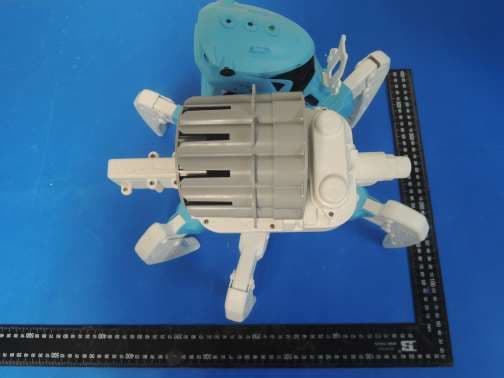
Click to zoom
Application Details
- Equipment Class
- DXX - Part 15 Low Power Communication Device Transmitter
- Date of Grant
- Apr 02, 2020
- Application Purpose
- Original Equipment
- Date of Application
- Apr 02, 2020
- Equipment Note
- ONEMARS Hexapod Battle Robot
- Frequency Range
- 2407.15600000 - 2475.15600000
- Country
- China
Documents & Files
Document Text
Text extracted from the exhibit documents filed with the FCC. Open a document above to read the original.
Users Manual
Striker Please pay attention to the striker before filling the missiles: The launcher bracket should be in a fully lowered state. If it is not lowered, press the “I” button on the remote control to lower it (see the manual for details). The striker at the bottom of the launcher's cartridge should be hidden. If the striker is extended, use the F button on the remote control to retract it. Failure to retract the striker will a ect the filling and launch of the missile. Do not use deformed or damaged missiles. The launcher's launch port is oriented in the same direction as the attack center. Align the slots on the base and insert and mount the missile launcher in place. Place the launcher above the base Load the missiles into the cartridge as shown in the figure Load the seat down into the launcher base Complete Launcher Loading Start switch Fault Cause Solution Cannot fire bullets The missile is stuck, and the launcher is not installed correctly Refer to the manual for how to fill and launch. Remove and reinstall the missile launcher in place. Replace the battery. Refer to the manual to understand how to match. Refer to the manual to find out how to properly install the armor. The battery is dead and needs to be rematched Armor is not installed correctly Not in combat mode Turn the switch to "ON" Replace the battery. Low battery The robot cannot match the remote control Armor doesn't bounce o after being hit The attack center is not working properly The robot's LED indicator flashes alternately red and green Forward Backward Lower bracket Sight Automatic presentation LED indicator Turn the head Launch missile Raise bracket Rotation alert Attack Center Installation Combat Mode Farthest attack distance Precise aiming How to avoid stuck missile What to do after stuck missile Combat Life Infrared Installation ONEMARS Hexapod Battle Robot User Manual Read this manual carefully before use, and retain it for future reference Launcher Installation Launcher Bracket Installation The launcher bracket is inserted down to the bottom at the notched portion of the top side. The top surface of the inserted launcher bracket should be aligned with the top surface. Proper installation will allow the hook at the bottom of the center to be properly connected to the sensor switch. When the attack center is not installed, the hook is loose. When installing, fasten the hook toward the front end of the attack center. Shooting skills need to be improved through practice. To hit the opponent's sight, you can start by aiming at the sticker. When playing against a master, the novice can compensate for the di erence in attack ability by practicing stickers. Each time it hits the sight, the robot shudders and an LED indicator goes o to indicate that it has been hit. After being hit three times, it will automatically shut down and exit the battle with failure. To rejoin the combat, you need to restart the battle robot. Power saving mode: If it is not operated within 5 minutes, it will automatically shut down. Press and hold the remote control F button, the missile will continuously launch until it is completely used up. The missile will shoot at a greater distance. For a single launch of a missile, you need to master the skills and timing. Press the F button and the motor starts to run, driving the weapon system to complete a series of related launch actions. The striker impinges the missile into the front-end turbine, which then spins the missile out. The key to shooting the missile farthest is to seize the opportunity. Press and hold the F button, and release it until you hear a click of the striker. In this way, the motor will reach the maximum speed, and the striker can be quickly retracted after being extended. In the case that the button pressing time is too short, the motor does not reach the maximum speed, and the missile does not shoot too far. In the case that the button pressing time is too long, the striker has entered the second launching round, and the next time the launch is made, the motor will not reach the maximum speed when the striker pushes the missile toward the turbine, and the missile will not shoot too far. In extreme cases, the striker starts to push out the missile just as the motor is grinding to a halt, which can cause stuck missile. As for the solution of stuck missile (see the manual), after a lot of practice, you can learn to catch the sound made by the striker and master the best launch time. The D button on the remote control is used to adjust the horizontal launching direction of the missile, and the I and H buttons are used to adjust the elevation angle of the vertical launching of the missile. The launching direction and elevation angle of the missile can be slightly adjusted by gently pressing the D, I and H buttons. Electronic components must not be removed. When not using the product for a long time, remove the battery from the battery case. Do not place this product near heat sources, sources of ignition, and locations where the temperature is above 60°C. Do not short-circuit this product. Do not subject this product to severe impact. Do not expose to the sun. Wipe with a wet cloth to keep clean and dry. Periodically inspect its wires, plugs, enclosures and other components for damage. When any damage is found, stop using it until it is completely repaired. The product contains smaller parts and is not suitable for children under 3 years of age. Keep away from crowd. Do not shoot people or animals. Do not use near the ear. Use only the product's original projectiles. Do not point your face at the projectile launch port at any time. Laser radiation, do not look directly at the beam. Please keep this manual for future reference. First, please refer to the detailed instructions in the manual to properly fill the missile. Second, master the timing of the launch. The correct filling of the missile and the good timing can minimize the occurrence of stuck missile. Product name: ONEMARS…
Text truncated - open the document above for the full version.
Cover Letter(s)
< Beijing AIQI Technology Co., LTD.> QF094234Page 1 of 1Revision 0 Authority to Act as Agent Date: 14.06.2019 TUV Rheinland Group 762 Park Avenue Youngsville, NC 27596 To Whom It May Concern: I appointTUV Rheinland (Shenzhen) Co., Ltd. to act as our agent in the preparation of this application for equipment certification. I certify that submitted documents properly describe the device or system for which equipment certification is sought. I also certify that each unit manufactured, imported or marketed, as defined in the FCC or Industry Canada’s regulations will have affixed to it a label identical to that submitted for approval with this application. For instances where our authorized agent signs the application for certification on our behalf, I acknowledge that all responsibility for complying with the terms and conditions for Certification, as specified by TUV Rheinland Group, still resides with Beijing AIQI Technology Co., LTD. / Room.D1203, The 11th floor,Block D, No.9 Shangdi 3rd St., Haidian District, Beijing,100085, China t For TCB applications, We certify that we are not subject to denial of federal benefits, that includes FCC benefits, pursuant to Section 5301 of the Anti-Drug Abuse Act of 1988, 21 U.S.C. 862. Further, no party, as defined in 47 CFR 1.2002 (b), to the application is subject to denial of federal benefits, that includes FCC benefits. Thank you, Agency Agreement Expiration Date:2019.12.31 By:Dandan He (Signature)(Print Name) Title:Certification ManagerTelephone:010-82157440 On behalf of :Beijing AIQI Technology Co., LTD. (Company Name)
Cover Letter(s)
{This letter must be prepared on applicant/manufacturer letterhead} Confidentiality Letter Date: <2019-11-12> Subject: Confidentiality Request for FCC ID: <2ALJ6-OMSLR24AIQI> <fill in "IC ID" or delete> Pursuant to FCC 47 CRF 0.457(d) and 0.459 and IC RSP-100, Section 10, the applicant requests that a part of the subject FCC/IC application be held confidential. Type of Confidentiality RequestedExhibit Short TermPermanentBlock Diagrams Short TermExternal Photos Short Term PermanentInternal Photos Short TermPermanentOperation Description/Theory of Operation Short TermPermanentPart List/Tune-Up Procedure Short TermPermanentSchematics Short TermTest Setup Photos Short Term PermanentUser’s Manual <Beijing AIQI Technology Co., LTD. >has spent substantial effort in developing this product and it is one of the first of its kind in industry. Having the subject information easily available to "competition" would negate the advantage they have achieved by developing this product. Not protecting the details of the design will result in financial hardship. Permanent Confidentiality: The applicant requests the exhibits listed above as permanently confidential be permanently withheld from public review due to materials that contain trade secrets and proprietary information not customarily released to the public. <Beijing AIQI Technology Co., LTD.> Short-Term Confidentiality: The applicant requests the exhibits selected above as short term confidential be withheld from public view for a period of <180>days from the date of the Grant of Equipment Authorization and prior to marketing. This is to avoid premature release of sensitive information prior to marketing or release of the product to the public. Applicant is also aware that they are responsible to notify TUV Rheinland in the event information regarding the product or the product is made available to the public. TUV Rheinland will then release the documents listed above for public disclosure pursuant toFCC Public Notice DA 04- 1705. Sincerely, By:<Dandan He> (Signature/Title)(Print name)
External Photos
Page 1 of 2 Type Designation: OMSLR24AIQI FCC ID: 2ALJ6-OMSLR24AIQI Page 2 of 2 Type Designation: OMSLR24AIQI FCC ID: 2ALJ6-OMSLR24AIQI
ID Label/Location Info
ONEBOT hexapod battle robot Model:OMSLR24AIQI FCC ID:2ALJ6-OMSLR24AIQI Manufactured by: Beijing AIQI Technology Co., LTD.
Internal Photos
Page 1 of 7 Type Designation: OMSLR24AIQI FCC ID: 2ALJ6-OMSLR24AIQI Page 2 of 7 Type Designation: OMSLR24AIQI FCC ID: 2ALJ6-OMSLR24AIQI Page 3 of 7 Type Designation: OMSLR24AIQI FCC ID: 2ALJ6-OMSLR24AIQI Page 4 of 7 Type Designation: OMSLR24AIQI FCC ID: 2ALJ6-OMSLR24AIQI Page 5 of 7 Type Designation: OMSLR24AIQI FCC ID: 2ALJ6-OMSLR24AIQI Page 6 of 7 Type Designation: OMSLR24AIQI FCC ID: 2ALJ6-OMSLR24AIQI 2.4GHz Antenna Page 7 of 7 Type Designation: OMSLR24AIQI FCC ID: 2ALJ6-OMSLR24AIQI
Test Report
Produkte Products Prüfbericht-Nr.: Test report No.: 50332228 002 Auftrags-Nr.: Order No.: 168141149 Seite 1 von 19 Page 1 of 19 Kunden-Referenz-Nr.: Client reference No.: N/A Auftragsdatum: Order date: 20.11.2019 Auftraggeber: Client: Beijing AIQI Technology Co., LTD. Room.D1204A, The 11th floor, Block D, No.9 Shangdi 3rd St., Haidian District, Beijing, 100085, China Prüfgegenstand: Test item: ONEMARS Hexapod Battle Robot Bezeichnung / Typ-Nr.: Identification / Type No.: OMSLR24AIQI Auftrags-Inhalt: Order content: FCC approval Prüfgrundlage: Test specification: CFR47 FCC Part 15: Subpart C Section 15.249 CFR47 FCC Part 15: Subpart C Section 15.207 CFR47 FCC Part 15: Subpart C Section 15.209 CFR47 FCC Part 15: Subpart B Section 15.107 CFR47 FCC Part 15: Subpart B Section 15.109 Wareneingangsdatum: Date of receipt: 29.11.2019 Please refer to photo documents Prüfmuster-Nr.: Test sample No.: A00103401416-001 to 002 Prüfzeitraum: Testing period: 02.12.2019 - 03.01.2020 Ort der Prüfung: Place of testing: TÜV Rheinland (Shenzhen) Co., Ltd. Prüflaboratorium: Testing laboratory: TÜV Rheinland (Shenzhen) Co., Ltd. Prüfergebnis*: Test result*: Pass geprüft von / tested by: kontrolliert von / reviewed by: 23.03.2020 Jonathan Li / Project Manager 23.03.2020 Winnie Hou / Technical Certif ier Datum Date Name/Stellung Name/Position Unterschrift Signature Datum Date Name/Stellung Name/Position Unterschrift Signature Sonstiges / Other: FCC ID: 2ALJ6-OMSLR24A IQI Zustand des Prüfgegenstandes bei Anlieferung: Condition of the test item at delivery: Prüfmuster vollständig und unbeschädigt Test item complete and undamaged: * Legende: 1 = sehr gut 2 = gut 3 = bef riedigend 4 = ausreichend 5 = mangelhalt P(ass) = entspricht o.g. Prüfgrundlage(n) F(ail) = entspricht nicht o.g. Prüfgrundlage(n) N/A = nicht anwendbar N/T = nicht getestet Legend: 1 = v ery good 2 = good 3 = satisfactory 4 = suf ficient 5 = poor P(ass) = passed a.m. test specifications(s) F(ail) = f ailed a.m. test specifications(s) N/A = not applicable N/T = not tested Dieser Prüfbericht bezieht sich nur auf das o.g. Prüfm uster und darf ohne Genehm igung der Prüfstelle nicht auszugsw eise vervielfältigt w erden. Dieser Bericht berechtigt nicht zur Verwendung eines Prüfzeichens. This test report only relates to the a. m. test sample. Without permission of the test center this test report is not permitted to be V04 duplicated in extracts. This test report does not entitle to carry any test mark. T ÜV Rheinland (Shenzhen) Co., Ltd., 1F East & 2-4F, Cybio T echnology Building No.1, No.16 Langshan 2nd Road, High-Tech Industrial Park North Nanshan District, 518057, Shenzhen, China http://www.tuv.com Produkte Products Prüfbericht - Nr.: Test Report No. 50332228 002 Seite 2 von 19 Page 2 of 19 Test Summary 5.1.1 ANTENNA REQUIREMENT RESULT: Pass 5.1.2 FUNDAMENTAL & HARMONICS RADIATED EMISSION RESULT: Pass 5.1.3 20DB BANDWIDTH RESULT: Pass 5.1.4 RADIATED SPURIOUS EMISSION & BAND EDGE RESULT: Pass 5.1.5 CONDUCTED EMISSION ON AC MAINS RESULT: Pass 5.1.6 RADIATED EMISSION RESULT: Pass Produkte Products Prüfbericht - Nr.: Test Report No. 50332228 002 Seite 3 von 19 Page 3 of 19 Contents 1 GENERAL REMARKS .......................................................................................................... 4 1.1 COMPLEMENTARY MATERIALS ............................................................................................. 4 2 TEST SITES ..................................................................................................................... 5 2.1 TEST FACILITIES ............................................................................................................... 5 2.2 LIST OF TEST AND MEASUREMENT INSTRUMENTS ..................................................................... 5 2.3 TRACEABILITY.................................................................................................................. 6 2.4 CALIBRATION................................................................................................................... 6 2.5 MEASUREMENT UNCERTAINTY ............................................................................................. 7 2.6 LOCATION OF ORIGINAL DATA ............................................................................................. 7 2.7 STATUS OF FACILITY USED FOR TESTING ............................................................................... 7 3 GENERAL PRODUCT INFORMATION........................................................................................ 8 3.1 PRODUCT FUNCTION AND INTENDED USE................................................................................ 8 3.2 RATINGS AND SYSTEM DETAILS ........................................................................................... 8 3.3 INDEPENDENT OPERATION MODES ........................................................................................ 9 3.4 NOISE GENERATING AND NOISE SUPPRESSING PARTS............................................................... 9 3.5 SUBMITTED DOCUMENTS .................................................................................................... 9 4 TEST SET-UP AND OPERATION MODES................................................................................. 10 4.1 PRINCIPLE OF CONFIGURATION SELECTION ........................................................................... 10 4.2 TEST OPERATION AND TEST SOFTWARE............................................................................... 10 4.3 SPECIAL ACCESSORIES AND AUXILIARY EQUIPMENT ............................................................... 10 4.4 COUNTERMEASURES TO ACHIEVE EMC COMPLIANCE ............................................................. 10 4.5 TEST SETUP DIAGRAM ..................................................................................................... 11 5 TEST RESULTS .....................................................................................................…
Text truncated - open the document above for the full version.
Test Report
Produkte Products Appendix B 50332228 002 Page 1 of 27 Appendix B: Test Results APPENDIX B: TEST RESULTS OF GENERAL 2.4GHZ.........................................................................1 APPENDIX B.1: FUNDAMENTAL & HARMONICS RADIATED EMISSION ............................................................2 30MHz - 1GHz ...........................................................................................................................2 1GHz - 18GHz ...........................................................................................................................6 APPENDIX B.2: TEST RESULTS OF 20DB BANDWIDTH ............................................................................ 12 APPENDIX B.3: TEST RESULTS OF RADIATED EMISSIONS IN RESTRICTED BANDS ......................................... 14 APPENDIX B.4: TEST RESULTS OF CONDUCTED EMISSION ON AC MAINS ................................................... 18 APPENDIX B.5: RADIATED EMISSION.................................................................................................. 20 Produkte Products Appendix B 50332228 002 Page 2 of 27 Note: Testing w as carried out w ithin f requency range 9 kHz to the tenth harmonics. The measurement results below 30MHz and 18GHz -26.5GHz w ere observed to greater than 20dB magin to the limit, so only the radiated spurious emissions f rom 30MHz to 18GHz w ere reported. Appendix B.1: Fundamental & Harmonics Radiated Emission 30MHz - 1GHz Test Report EUT Information EUT Name: ONEMARS Hexapod Battle Robot Model: OMSLR24AIQI Test Mode: TX_Low CH Test Voltage:: Fully charged battery Remark: Temp 24 Humi:45% Test Standard: FCC 15.249 Tested By: Kei Zhang Reviewed By: Terry Yin Critical_Freqs Frequency (MHz) MaxPeak (dBμV/m) Av erage (dBμV/m) Limit (dBμV/m) Margin (dB) Height (cm) Pol Azimuth (deg) Corr. (dB/m) 79.567000 9.86 --- 40.00 30.14 100.0 H 301.0 -23.8 304.025000 24.33 --- 46.00 21.67 100.0 H 63.0 -16.5 367.996500 23.35 --- 46.00 22.65 100.0 H 285.0 -14.8 575.916000 23.42 --- 46.00 22.58 100.0 H 7.0 -10.7 0 20 40 60 80 100 120 30M 5060 80100M200300400500 8001G Level in dBμV/m F re que nc y in H z Produkte Products Appendix B 50332228 002 Page 3 of 27 Test Report EUT Information EUT Name: ONEMARS Hexapod Battle Robot Model: OMSLR24AIQI Test Mode: TX_Low CH Test Voltage:: Fully charged battery Remark: Temp 24 Humi:45% Test Standard: FCC 15.249 Tested By: Kei Zhang Reviewed By: Terry Yin Critical_Freqs Frequency (MHz) MaxPeak (dBμV/m) Av erage (dBμV/m) Limit (dBμV/m) Margin (dB) Height (cm) Pol Azimuth (deg) Corr. (dB/m) 49.982000 26.61 --- 40.00 13.39 100.0 V 208.0 -18.6 55.753500 28.42 --- 40.00 11.58 100.0 V 299.0 -18.8 128.940000 10.70 --- 43.50 32.80 100.0 V 0.0 -22.1 845.188000 28.31 --- 46.00 17.69 100.0 V 200.0 -6.0 0 20 40 60 80 100 120 30M 5060 80100M200300400500 8001G Level in dBμV/m F re que nc y in H z Produkte Products Appendix B 50332228 002 Page 4 of 27 Test Report EUT Information EUT Name: ONEMARS Hexapod Battle Robot Model: OMSLR24AIQI Test Mode: TX_High CH Test Voltage:: Fully charged battery Remark: Temp 24 Humi:45% Test Standard: FCC 15.249 Tested By: Kei Zhang Reviewed By: Terry Yin Critical_Freqs Frequency (MHz) MaxPeak (dBμV/m) Av erage (dBμV/m) Limit (dBμV/m) Margin (dB) Height (cm) Pol Azimuth (deg) Corr. (dB/m) 45.811000 15.00 --- 40.00 25.00 100.0 H 160.0 -19.0 60.264000 16.09 --- 40.00 23.91 100.0 H 299.0 -19.4 304.025000 24.89 --- 46.00 21.11 100.0 H 86.0 -16.5 320.030000 24.16 --- 46.00 21.84 100.0 H 86.0 -16.1 0 20 40 60 80 100 120 30M 5060 80100M200300400500 8001G Level in dBμV/m F re que nc y in H z Produkte Products Appendix B 50332228 002 Page 5 of 27 Test Report EUT Information EUT Name: ONEMARS Hexapod Battle Robot Model: OMSLR24AIQI Test Mode: TX_High CH Test Voltage:: Fully charged battery Remark: Temp 24 Humi:45% Test Standard: FCC 15.249 Tested By: Kei Zhang Reviewed By: Terry Yin Critical_Freqs Frequency (MHz) MaxPeak (dBμV/m) Av erage (dBμV/m) Limit (dBμV/m) Margin (dB) Height (cm) Pol Azimuth (deg) Corr. (dB/m) 50.952000 25.46 --- 40.00 14.54 100.0 V 0.0 -18.6 55.753500 26.74 --- 40.00 13.26 100.0 V 206.0 -18.8 190.923000 14.92 --- 43.50 28.58 100.0 V 297.0 -19.8 728.739500 26.38 --- 46.00 19.62 100.0 V 247.0 -7.9 0 20 40 60 80 100 120 30M 5060 80100M200300400500 8001G Level in dBμV/m F re que nc y in H z Produkte Products Appendix B 50332228 002 Page 6 of 27 1GHz - 18GHz Test Report EUT Information EUT Name: ONEMARS Hexapod Battle Robot Model: OMSLR24AIQI Test Mode: TX_Low CH Test Voltage:: Fully charged battery Remark: Temp 24 Humi:45% Test Standard: FCC 15.249 Tested By: Kei Zhang Reviewed By: Terry Yin Critical_Freqs Frequency (MHz) MaxPeak (dBμV/m) Av erage (dBμV/m) Limit (dBμV/m) Margin (dB) Height (cm) Pol Azimuth (deg) Corr. (dB/m) 2407.000000 94.68 --- 114.00 19.32 100.0 H 245.0 7.0 2408.000000 --- 87.04 94.00 6.96 100.0 H 245.0 7.1 4815.000000 62.98 --- 74.00 11.02 100.0 H 134.0 13.5 4815.500000 --- 50.16 54.00 3.84 100.0 H 134.0 13.5 7220.700000 50.24 --- 74.00 23.76 100.0 H 3.0 8.7 7222.175000 --- 45.10 54.00 8.90 100.0 H 3.0 8.7 9629.375000 --- 42.02 54.00 11.98 100.0 H 192.0 10.4 9629.866667 47.90 --- 74.00 26.10 100.0 H 192.0 10.4 0 20 40 60 80 100 120 130 1G2G3G4G5G6 8 10G18G Level in dBμV/m F re que nc y in H z Produkte Products Appendix B 50332228 002 Page 7 of 27 Test Report EUT Information EUT Name: ONEMARS Hexapod Battle Robot Model: OMSLR24AIQI Test Mode: TX_Low CH Test Voltage:: Fully charged battery Remark: Temp 24 Humi:45% Test Standard: FCC 15.249 Tested By: Kei Zhang Reviewed By: Terry Yin Critical_Freqs Frequency (MHz) MaxPeak (dBμV/m) Av erage (dBμV/m) Limit (dBμV/m) Margin (dB) Height (cm) Pol Azimuth (deg) Corr. (dB/m) 2406.000000 --- 80.82 94.00 13.18 100.0 V 355.0 7.0 2407.500000 95.03 --- 114.00 18.97 100.0 V 355.0 7.1 4812.000000 --- 50.92 54.00 3.08 100.0 V 117.0 13.6 4814.500000 69.03 --- 74.00 4.97 100.0 V 160.0 13.6 7222.175000 --- 44.68 54.00 9.32 100.0 V 106.0 8.7 7222.175000 50.34 --- 74…
Text truncated - open the document above for the full version.
Test Setup Photos
Produkte Products Appendix A 50332228 002 Page 1 of 4 Appendix A: Photographs of the Test Set-Up APPENDIX A: PHOTOGRAPHS OF THE TEST SET-UP.................................................................................................................. 1 PHOTOGRAPH 1: SET-UP FOR RADIATED SPRIOUS EMISSION, BELOW 1GHZ .......................................................................................... 2 PHOTOGRAPH 2: SET-UP FOR RADIATED SPURIOUS EMISSION, ABOVE 1GHZ ........................................................................................ 2 PHOTOGRAPH 3: SET-UP FOR CONDUCTED EMISSION ON AC MAINS ................................................................................................... 3 PHOTOGRAPH 4: SET-UP FOR RADIATED EMISSION............................................................................................................................. 3 Produkte Products Appendix A 50332228 002 Page 2 of 4 Photograph 1: Set-up for Radiated Sprious Emission, below 1GHz Photograph 2: Set-up for Radiated Spurious Emission, above 1GHz Produkte Products Appendix A 50332228 002 Page 3 of 4 Photograph 3: Set-up for Conducted Emission on AC Mains Photograph 4: Set-up for Radiated emission Produkte Products Appendix A 50332228 002 Page 4 of 4
Contact Information
Applicant
Dandan He
Test Firm
TUV Rheinland (Shenzhen) Co., Ltd.Gina Yang
[email protected]86 755 8268 1497
Technical Specifications
| # | Rule Parts | Frequency Range | Power Output |
|---|---|---|---|
| 1 | 15C | 2.41 GHz - 2.48 GHz | - |
Other Applications from Beijing AIQI Technology Co., LTD.
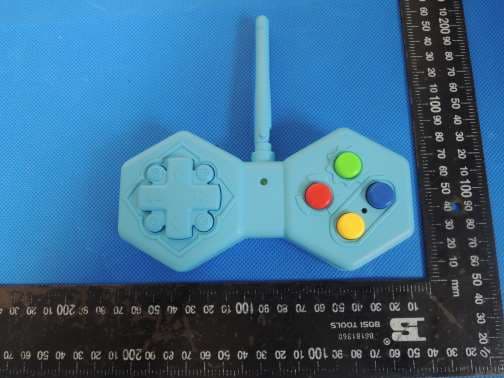
2ALJ6-OMC01AIQI
Apr 02, 2020ONEMARS Hexapod Battle Robot Remote Control
Equipment Class
DXX - Part 15 Low Power Communication Device Transmitter