2ARUDTS90303.1 Atmos Sound Bar with Wireless Subwoofer, Wireless Subwoofer
TCL Entertainment Solutions Limited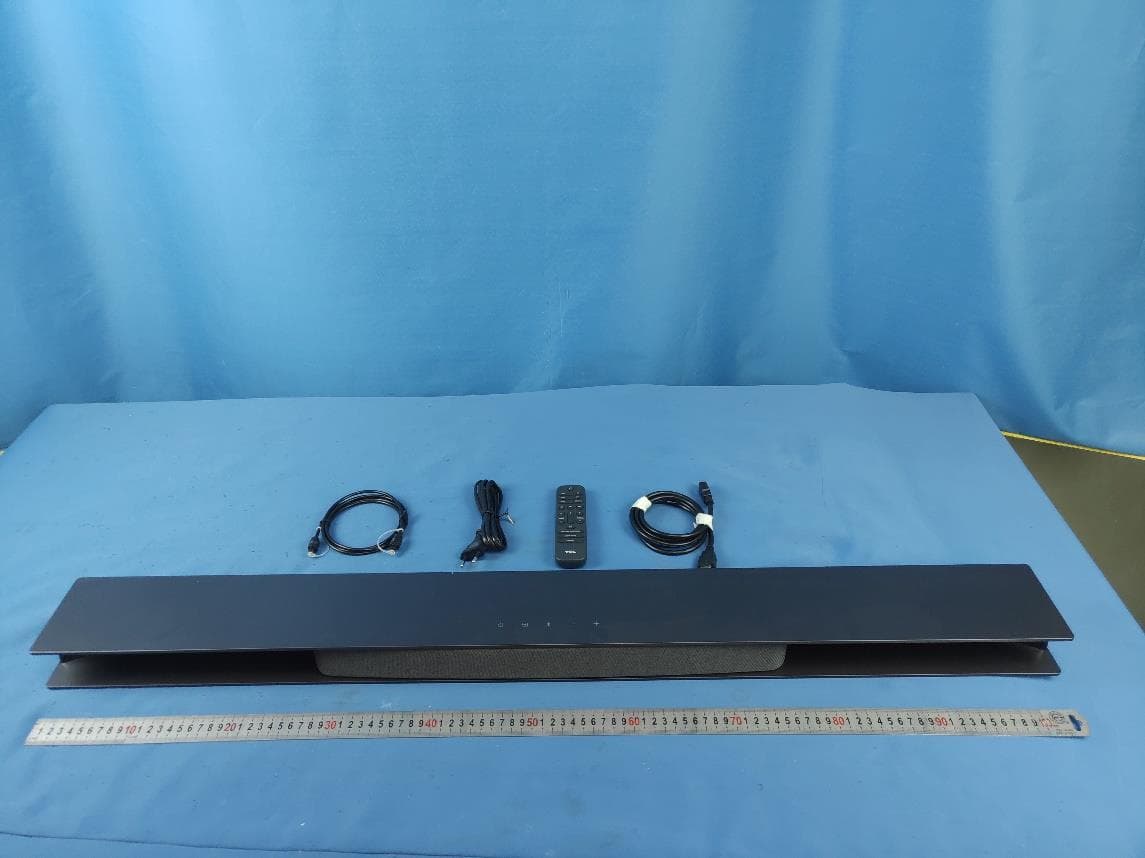
Click to zoom
Application Details
- Equipment Class
- DSS - Part 15 Spread Spectrum Transmitter
- Date of Grant
- Mar 29, 2020
- Application Purpose
- Original Equipment
- Date of Application
- Mar 29, 2020
- Equipment Note
- 3.1 Atmos Sound Bar with Wireless Subwoofer, Wireless Subwoofer
- Frequency Range
- 2402.00000000 - 2480.00000000
- Country
- China
Documents & Files
Document Text
Text extracted from the exhibit documents filed with the FCC. Open a document above to read the original.
Users Manual
Short user manual RAY.DANZ 3.1 CH Atmos Sound Bar with Built-in Subwoofer English The lightning flash with arrowhead symbol, within an equilateral triangle is intended to alert the user to the presence of uninsulated dangerous voltage within the product’s enclosure that may be of sufficient magnitude to constitute a risk of electric shock. The exclamation point within an equilateral triangle is intended to alert the user to the presence of important operating and maintenance (servicing) instructions in the literature accompanying the product. This symbol indicates that this product incorporates double insulation between hazardous main voltage and user accessible parts. When servicing, use only identical replacement parts. Warnings • To reduce the risk of fire or electric shock, do not expose this product to rain or moisture. This product should not be exposed to dripping or splashing. No objects filled with liquids, such as vases, should be placed on or near the product. • The product is unstable if it is not properly placed or mounted to the wall. Be sure to follow the wall mounting instructions provided in the user manual to ensure your safety. • Do not expose batteries to excessive heat such as sunshine, fire, and so forth. Important safety instructions Make sure you read all the safety information before you use this product. TCL Entertainment Solutions Limited bears no responsibility for accidents or damages caused by unauthorized changes, modifications or improper use of the product. CAUTION RISK OF ELECTRIC SHOCK DO NOT OPEN CAUTION: TO REDUCE THE RISK OF ELECTRIC SHOCK, DO NOT REMOVE COVER (OR BACK). NO USER-SERVICEABLE PARTS INSIDE. REFER SERVICING TO QUALIFIED SERVICE PERSONNEL. • Unplug this apparatus during lightning storms or when unused for long periods of time. • Refer all servicing to qualified service personnel. Servicing is required when the apparatus has been damaged in any way, such as power-supply cord or plug damaged, liquid has been spilled or objects have fallen into the apparatus, the apparatus has been exposed to rain or moisture, does not operate normally, or has been dropped. Cautions • To prevent electric shock, match wide blade of plug to wide slot, fully insert. • Do not place any sources of danger on the product (for example: liquid filled objects, lighted candles). • Disconnect the power cord to shut off when find trouble or not in use. The power cord shall be readily operable. • Use of controls or adjustments or performance of procedures other than those described herein, may result in hazardous radiation exposure or other unsafe operation. • The power cord/appliance coupler is used as the disconnect device, the disconnect device must remain readily operable. • The rating label is located at the bottom or back of the product. Battery precautions • Do not mix batteries (old and new or carbon and alkaline). • Do not dispose of batteries in fire or water. • Recycle or dispose of batteries as per state and local guidelines. • Danger of explosion if battery is incorrectly replaced. Replace only with the same or equivalent type. • When the remote control is not to be used for a long time (more than a month), remove the battery from the remote control to prevent it from leaking. • If the batteries leak, wipe away the leakage inside the battery compartment and replace the batteries with new ones. • Keep away the batteries from heat or moisture. • Do not carry or store batteries with other metallic objects. Doing so could cause batteries to short circuit, leak or explode. • Never recharge a battery unless it is confirmed to be a rechargeable type. Disposal of your old product and battery Your product is designed and manufactured with high quality materials and components, which can be recycled and reused. This product may contain lead and mercury. Disposal of these materials may be regulated due to environmental considerations. For disposal or recycling information, please contact your local authorities. This product contains non-removable batteries: • Do not incinerate. Batteries may explode if overheated. • For disposal or recycling information, please contact your local authorities. CAUTION: Risk of explosion if the battery is replaced by an incorrect type. CAUTION: replacement of a battery with an incorrect type that can defeat a safeguard. CAUTION: disposal of a battery into fire or a hot oven, or mechanically crushing or cutting of a battery, that can result in an explosion; CAUTION: leaving a battery in an extremely high temperature surrounding environment that can result in an explosion or the leakage of flammable liquid or gas. CAUTION: a battery subjected to extremely low air pressure that may result in an explosion or the leakage of flammable liquid or gas. Safety • Read these instructions - Read all the safety and operating instructions before operating the product. • Retain these instructions - Retain the safety and operating instructions for future reference. • Heed all warnings - Adhere to all warnings on the product and in the operating instructions. • Follow all instructions - Follow all operating and use instructions. • Do not use this apparatus near water – The appliance should not be used near water or moisture – for example, in a wet basement or near a swimming pool and the like • Clean only with a dry cloth. • Do not block any ventilation openings. Install in accordance with the manufacturer’s instructions. • Do not install near any heat sources such as radiators, heat registers, stoves, or other apparatus (including amplifiers) that produce heat. • Do not defeat the safety purpose of the polarized or grounding-type plug. A polarized plug has two blades with one wider than the other. A grounding type plug has two blades and a third grounding prong. The wide blade or the third prong are provided for your safety. If the provided plug does not fit into your outlet, consult an electrician for replacement of the obsolete outlet. • Protect the pow…
Text truncated - open the document above for the full version.
Cover Letter(s)
1(2) TCL entertainment solutions limited Attention: Certification reviewer RE: Request for Confidentiality FCC ID: 2ARUDTS9030 To Whom It May Concern: Permanent Confidentiality [Complete this section if permanent confidentiality is requested] Request to withhold permanently from public review certain portions of the application for equipment certification for the referenced FCC identifiers. This request for confidentiality is made pursuant to 47 CFR 0.457(d) and 0.459 of the FCC Rules. In particular, the following sections of the application are to be kept permanently confidential: [Select one or more of items below, as appropriate] Schematics Block Diagrams Operational Description Tune-up Procedure Parts List Internal Photos (see note) Users Manual (see note) Note 1: Internal Photos may be held confidential 1) if the circuit board or internal components are not accessible to users. For example, it is acceptable if the circuit board is enclosed in epoxy. 2) Also, it is acceptable if the device is not accessible to the public, for example, a device mounted on the top of a large tower (or in a fenced enclosure) such that it is only serviceable by professional designated technicians under a Non-Disclosure Agreement (NDA). All sales for these devices must be under a NDA restricting the disclosure of the propriety information, including internal photos. Users Manual may be held confidential only when the manual contains proprietary technical information intended for professional technicians obligated under a NDA. All sales and distribution of the user’s manual must be under a NDA that restricts the disclosure of the information. In the application cover letter requesting permanent confidentiality the following additional description and the NDA exhibit is required: 1. Describe in detail how internal photos and/or users manual information are controlled to prevent them from becoming public or disclosed to unauthorized persons. 2. Describe how public access is restricted for products serviceable by professional designated technicians. 3. A statement that all sales of the non-consumer device will be under a NDA to include third party sales and that the final user of the device is subject to the NDA. 4. Provide an example of the NDA between the grantee and a purchaser. The request for confidentiality must Note 2: For scanning receiver, the schematics, block diagrams, operational description, tune-up procedure, parts list and internal photos are always held permanently confidential. Short-term Confidentiality [Complete this section if short-term confidentiality is requested] Request to withhold from public review for a period of 45 days from the date of the Grant of Equipment Authorization and prior to marketing, certain portions of the application for equipment certification for the referenced FCC identifiers. This request for confidentiality is made pursuant to 47 CFR 0.457(d) and 0.459 of the FCC Rules. In particular, the following sections of the application are to be kept short-term confidential for a period above from the date of the grant [Select one or more of items below that are not selected in the list above, as appropriate] Schematics Block diagrams Operational Description Tune-up Procedure 2(2) Parts List Test Setup Photos External Photos Internal Photos Users Manual Rationale for request for confidentiality: We have invested considerable time and materials in research and development to produce the referenced product. Permanent confidentiality: Disclosure of the permanently confidential portions of this application to competitors would not only give them significant competitive advantages in developing similar products, but would also disclose successful implementation of unpublished, leading edge technology developed by us. Short-term confidentiality: Disclosure of the short-term confidential portions of this application during the period of importation and/or distribution would reveal key aspects of proprietary technology to competitors and diminish the value of our investment in research and development. If you have questions or need further information, please contact the undersigned. Sincerely, _________________ Ada Shi QE 2019-11-27
Internal Photos
2.4G Antenna Bluetooth Antenna WIFI Antenna
RF Exposure Info
INTERTEK TESTING SERVICES RF Exposure The equipment under test (EUT) is a Soundbar with Bluetooth, 2.4G SRD, and Wi-Fi functions. 2.4G Wi-Fi and 5G Wi-Fi share an Integral antenna to transmit and receive, but they can`t transmit at the same time. The EUT is powered by AC 100-240V~ 50/60Hz. The device will automatically discontinue transmission in case of either absence of information to transmit or operational failure. When the soundbar is absence of information to transmit or operational failure, the power supply of WIFI transmitter module will shut off, so that the EUT can’t enter the work state, so as to stop transmitting the information. For more detailed features description, please refer to the user’s manual. Standalone SAR evaluation for BT function Bluetooth Version: 5.0 BDR/EDR Antenna Type: Integral antenna. Antenna Gain: 4.25dBi. Modulation Type: GFSK, π/4DQPSK, 8DPSK. The nominal conducted output power specified: 5.0dBm (+/-3dB) The maximum conducted output power for the EUT is 6.03dBm in the frequency 2480MHz which is within the production variation. The minimum conducted output power for the EUT is 4.08dBm in the frequency 2402MHz which is within the production variation. According to FCC Part 2.1091, this unlicensed transmitting devices is categorically excluded from routine environmental evaluation for RF exposure prior to equipment authorization or use, According to the KDB 447498 and OET 65, the simple calculation as below: The source-based time averaged maximum radiated power = 5+3+4.25= 12.25dBm = 16.79mW From above data, the exposed power density at a distance (R) of 20cm from the center of radiation of the antenna for 2.4GHz WIFI band can be calculated according to OET 65 as follow: = 16.79mW/ 4πR^2 = 0.003 mW/cm^2 <1mW/cm^2 The MPE limit is 1.0 mW/cm^2 for general population and uncontrolled exposure in the 2.4GHz frequency range according to FCC Part 1.1310. As the measured power density at 20cm from the transmitter is lower than the MPE limit, the compliance to the MPE limit can be ensured by indicating the minimum 20cm separation between the transmitter's radiating structure and body of the user or nearby persons. FCC ID: 2ARUDTS9030 INTERTEK TESTING SERVICES Standalone SAR evaluation for WIFI function 2.4GHz Wi-Fi: Antenna Type: Integral Antenna. Antenna Gain: 4.25dBi. Modulation Type: BPSK, QPSK, 16QAM, 64QAM, CCK, DQPSK, DBPSK. The nominal conducted output power specified: 17dBm (Tolerance: +/-3dB). The maximun conducted output power for the EUT is 18.72dBm in the frequency 2437MHz (IEEE 802.11b) which is within the production variation. The minimum conducted output power for the EUT is 16.39dBm in the frequency 2462MHz (IEEE 802.11n-HT20) which is within the production variation. According to FCC Part 2.1091, this unlicensed transmitting devices is categorically excluded from routine environmental evaluation for RF exposure prior to equipment authorization or use, According to the KDB 447498 and OET 65, the simple calculation as below: The source-based time averaged maximum radiated power = 17+3+4.25= 24.25dBm = 266.07mW From above data, the exposed power density at a distance (R) of 20cm from the center of radiation of the antenna for 2.4GHz WIFI band can be calculated according to OET 65 as follow: = 266.07mW/ 4πR^2 = 0.053 mW/cm^2 <1mW/cm^2 The MPE limit is 1.0 mW/cm^2 for general population and uncontrolled exposure in the 2.4GHz frequency range according to FCC Part 1.1310. As the measured power density at 20cm from the transmitter is lower than the MPE limit, the compliance to the MPE limit can be ensured by indicating the minimum 20cm separation between the transmitter's radiating structure and body of the user or nearby persons. FCC ID: 2ARUDTS9030 INTERTEK TESTING SERVICES 5GHz WiFi: Antenna Type: Integral Antenna. Antenna Gain: 4.25dBi. Modulation Type: BPSK, QPSK, 16QAM, 64QAM The nominal conducted output power specified: 17dBm (Tolerance: +/-4dB). The maximum conducted output power for the EUT is 18.65dBm in the frequency 5280MHz(IEEE 802.11n-HT20) which is within the production variation. The minimum conducted output power for the EUT is 13.71dBm in the frequency 5775MHz(IEEE 802.11ac-HT80) which is within the production variation. The source-based time averaged maximum radiated power = 17+4+4.25= 25.25dBm = 334.97mW From above data, the exposed power density at a distance (R) of 20cm from the center of radiation of the antenna for 5GHz WIFI band can be calculated according to OET 65 as follow: = 334.97mW/ 4πR^2 = 0.067 mW/cm^2 <1mW/cm^2 The MPE limit is 1.0 mW/cm^2 for general population and uncontrolled exposure in the 5GHz frequency range according to FCC Part 1.1310. As the measured power density at 20cm from the transmitter is lower than the MPE limit, the compliance to the MPE limit can be ensured by indicating the minimum 20cm separation between the transmitter's radiating structure and body of the user or nearby persons. FCC ID: 2ARUDTS9030 INTERTEK TESTING SERVICES Standalone SAR evaluation for 2.4G SRD 2.4GHz SRD: Antenna Type: Integral Antenna. Antenna Gain: 4.25dBi. Modulation Type: GFSK. The nominal conducted output power specified: -21.25dBm (Tolerance: +/-3dB) The nominal radiated output power (e.i.r.p) specified: -17dBm (+/-3dB) The maximum peak radiated emission for the EUT is 79.0dBμV/m at 3m in the frequency 2479.5MHz The EIRP = [(FS*D) ^2 / 30] mW = -16.23dBm which is within the production variation. The minimum peak radiated emission for the EUT is 75.8dBμV/m at 3m in the frequency 2444.5MHz The EIRP = [(FS*D) ^2 / 30] mW = -19.43dBm which is within the production variation. According to FCC Part 2.1091, this unlicensed transmitting devices is categorically excluded from routine environmental evaluation for RF exposure prior to equipment authorization or use, According to the KDB 447498 and OET 65, the simple calculation as below: The source-based time averaged maximum radiated power = -14dBm = 0.04mW From above data, the ex…
Text truncated - open the document above for the full version.
Test Report
TCL entertainment solutions limited TEST REPORT SCOPE OF WORK FCC TESTING–TS9030, RAYDANZ REPORT NUMBER 191126031SZN-002 ISSUE DATE [REVISED DATE] 16 January 2020 [---------------------] PAGES 46 DOCUMENT CONTROL NUMBER FCC ID 247_b © 2017 INTERTEK Intertek Report No.: 191126031SZN-002 This report is for the exclusive use of Intertek's Client and is provided pursuant to the agreement between Intertek and its Client. Intertek's responsibility and liability are limited to the terms and conditions of the agreement. Intertek assumes no liability to any party, other than to the Client in accordance with the agreement, for any loss, expense or damage occasioned by the use of this report. Only the Client is authorized to permit copying or distribution of this report and then only in its entirety. Any use of the Intertek name or one of its marks for the sale or advertisement of the tested material, product or service must first be approved in writing by Intertek. The observations and test results in this report are relevant only to the sample tested. This report by itself does not imply that the material, product, or service is or has ever been under an Intertek certification program. Intertek Testing Service Shenzhen Ltd. Longhua Branch 101, 201, Building B, No. 308 Wuhe Avenue, Zhangkengjing Community, GuanHu Subdistrict, LongHua District, Shenzhen. Tel: (86 755) 8601 6288 Fax: (86 755) 8601 6751 Version: 01-November-2017 Page: 1 of 46 FCC ID 247_b TEST REPORT 101, 201, Building B, No. 308 Wuhe Avenue, Zhangkengjing Community, GuanHu Subdistrict, LongHua District, Shenzhen. Tel: (86 755) 8601 6288 Fax: (86 755) 8601 6751 www.intertek.com TCL entertainment solutions limited Application For Certification FCC ID: 2ARUDTS9030 3.1 Atmos Sound Bar with Wireless Subwoofer, Wireless Subwoofer Model: TS9030, RAYDANZ 2.4GHz Transceiver Report No.: 191126031SZN-002 We hereby certify that the sample of the above item is considered to comply with the requirements of FCC Part 15, Subpart C for Intentional Radiator, mention 47 CFR [10-1-18] Prepared and Checked by: Approved by: Winkey Wang Kidd Yang Sr. Project Engineer Technical Supervisor Date: 16 January 2020 Intertek Report No.: 191126031SZN-002 Version: 01-November-2017 Page: 2 of 46 FCC ID 247_b TEST REPORT MEASUREMENT/TECHNICAL REPORT This report concerns (check one:) Original Grant X Class II Change Equipment Type: DSS - Part 15 Spread Spectrum Transmitter Deferred grant requested per 47 CFR 0.457(d)(1)(ii)? Yes No X If yes, defer until: date Company Name agrees to notify the Commission by: date of the intended date of announcement of the product so that the grant can be issued on that date. Transition Rules Request per 15.37? Yes No X If no, assumed Part 15, Subpart C for intentional radiator − the new 47 CFR [10-1-18 Edition] provision. Report prepared by: Winkey Wang Intertek Testing Services Shenzhen Ltd. Longhua Branch 101, 201, Building B, No. 308 Wuhe Avenue, Zhangkengjing Community, GuanHu Subdistrict, LongHua District, Shenzhen. Tel: (86 755) 8601 6288 Fax: (86 755) 8601 0684 Intertek Report No.: 191126031SZN-002 Version: 01-November-2017 Page: 3 of 46 FCC ID 247_b TEST REPORT Table of Contents 1.0 Summary of Test Results ................................................................................................. 4 2.0 General Description ......................................................................................................... 5 2.1 Product Description ...................................................................................................... 5 2.2 Related Submittal(s) Grants .......................................................................................... 5 2.3 Test Methodology ......................................................................................................... 5 2.4 Test Facility .................................................................................................................. 5 3.0 System Test Configuration ............................................................................................... 6 3.1 Justification .................................................................................................................. 6 3.2 EUT Exercising Software ................................................................................................ 6 3.3 Special Accessories ....................................................................................................... 6 3.4 Equipment Modification ............................................................................................... 6 3.5 Measurement Uncertainty ............................................................................................ 7 3.6 Support Equipment List and Description ....................................................................... 7 4.0 Test Results ...................................................................................................................... 8 4.1 Radiated Test Result ..................................................................................................... 8 4.1.1 Field Strength Calculation .......................................................................................... 8 4.1.2 Radiated Emission Configuration Photograph ........................................................... 9 4.1.3 Radiated Emission ..................................................................................................... 9 4.1.4 Transmitter Spurious Emissions (Radiated) ............................................................. 12 4.2 Conducted Emission at Mains Terminal ...................................................................... 16 4.2.1 Conducted Emission Configuration Photograph ...................................................... 16 4.2.2 Conducted Emissions .............................................................................................. 16 4.3 Peak Power ...............................…
Text truncated - open the document above for the full version.
Test Setup Photos
Up to 1GHz Above 1G
Contact Information
Applicant
Amber Wang
Technical Contact
Intertek Testing Services Shenzhen Ltd. Longhua BrWilliam Chen
[email protected]86-755-8601 6288
101, 201, Building B, No. 308 Wuhe Avenue, Zhangke · Shenzhen · China
Non-Technical Contact
Intertek Testing Services Shenzhen Ltd. Longhua BrWilliam Chen
[email protected]86-755-8601 6288
Test Firm
Intertek Testing Services Shenzhen Ltd. Longhua BrHolly Ou
[email protected]+86 755 86140691
Technical Specifications
| # | Rule Parts | Frequency Range | Power Output |
|---|---|---|---|
| 1 | 15C | 2.40 GHz - 2.48 GHz | 4.01 mW |
Other Applications from TCL Entertainment Solutions Limited
2ARUDS21BW
Jun 11, 20232.1 Channel Sound Bar with Wireless Subwoofer
Equipment Class
DSS - Part 15 Spread Spectrum Transmitter
2ARUDS310WSW
Mar 23, 2023Wireless subwoofer
Equipment Class
DTS - Digital Transmission System
2ARUDS510W
Mar 22, 20235.1 Channel Sound Bar with Wireless Subwoofer and Wired Satellite Speakers
Equipment Class
NII - Unlicensed National Information Infrastructure TX
2ARUDS510WSW
Mar 22, 2023Wireless subwoofer
Equipment Class
NII - Unlicensed National Information Infrastructure TX
2ARUDS310W
Mar 22, 20233.1 Channel Sound Bar with Wireless Subwoofer
Equipment Class
DSS - Part 15 Spread Spectrum Transmitter