2AVVW-D52Electronic Shelf Label
Advantech Co., Ltd.
Click to zoom
Application Details
- Equipment Class
- DTS - Digital Transmission System
- Date of Grant
- Mar 18, 2020
- Application Purpose
- Original Equipment
- Date of Application
- Mar 18, 2020
- Equipment Note
- Electronic Shelf Label
- Frequency Range
- 2402.00000000 - 2480.00000000
- Company
- Advantech Co., Ltd.
- Country
- China
Documents & Files
Document Text
Text extracted from the exhibit documents filed with the FCC. Open a document above to read the original.
Users Manual
1.0.4 Zkong ESL System Users Manual 1. Product Introduction 1.1. Zkong ESL Software System This system is used to control the ESL picture refresh information and manage ESL、 AP and other hardware equipment. 1.2. AP AP works with ESL. PoE Power Supply:use to power the AP and connect internet. There are 2 ports. One is PoE port. It’s used to connect to AP and power the AP. The other is Lan Port. It’s used to connect internet. Model: LEO-D52 1.3.PDA PDAisusedtobindESLandcommodity. 1.4.ESL(ElectronicShelfLabel) ESLworkswhenitlocatesneartheAP. 2.AccountRelatedOperation 2.1.AcquireMerchantAdminandStoreAdminaccountonESL platform Firstly,yourcompanyprovidesyourbusinesslicensetothesalesmantoputonrecord. AfterconfirmingtheIntegrityoftheinformation,wewillcreateanewmerchant,a merchantadminaccountandapasswordofmerchantadminaccountforyour company.Thesalesmanwillhandoverthemerchantadminaccountnameand passwordtoyourcompany. 2.2.ESLplatformLogin HongKongServeLogin.OpentheBrowserandenterURL: http://esl.zkong.com:8888/.LoginwithMerchantAdminAccountnameand password. HangzhouServeLogin.OpentheBrowserandenterURL: http://esl-hz.zkong.com:8888/.LoginwithMerchantAdminAccountnameand password. 2.3.AddNewStore PS:OneMerchantcanaddseveralstores.AP,ESL,PDA,Commoditiesandtemplatesareall relatedwithstores. 1.Afterlogginginthesystem,click“Organization”-“StoresList”-”AddStore”,thenitwillpopup anAddStorepop-upwindow. 2.FillinStoreNameandotherinformation,clickConfirm. 2.4.AddNewStoreAccount 1.Click”Account”intotheAccountManagepage 2.Click”AddAccount”topopuptheAddAccountpage 3.ChoosethenewStorewejustadded 4.FillinAccountandPassword 5.ClickConfirmandthenfinishaddingtheStoreAccount 2.5.Add/EditTemplateCategoryandType TemplateCategoryandTypearetheidentificationfieldswhenCommoditymatchestemplate. PleasesetupitinadvancebecauseitwillbeusedinCommodityandTemplatemodules. 1.Click“Template”first,thenclick“TemplateType”toenterthetemplatetypemanagement page. 2.Click“addnewtemplatecategory”,thenyoucanaddcustomtemplatecategory 3.Clickthenewtemplatecategorywejustaddedtoenterthetemplatetypemanagementpage underthistemplatecategory. 4.Click“+”,thenyoucanaddtemplatetypeunderthiscategory. 2.6.ImportMerchanttemplateandmanagetemplate 1.Storetemplatemodulecanimportmerchanttemplate.Thismeansthateverytemplateadded undermerchanttemplatemodulecanbecopiedbyallstoresofthismerchant.Youcanre-use themandsavetimeforeverystorestoaddtemplatesbythemselves.(Importmerchanttemplate canbeusedonlywhenyouloginwithStoreAdminAccount.Pictureshownin3.1) 2.Templatescanbecopied,modifiedanddeleted.Thismakesthetemplatedesignmoreflexible. Butyoucan’tcopyatemplatefromoneaccounttoanother. 2.7.Loginwithstoreaccount 1.Clicktheupperrightcorneroftheloginaccount,thenclickexit.Logoutofthecurrentlogin account 2.Loginwiththestoreaccountandpasswordjustadded 3.AddStoreTemplate 3.1.SingleCommodityTemplate 1.Click"template"-"storetemplate"-"SingleCommodityTemplate"toenterthestoretemplate page 2.Click“importMerchanttemplate”andselectthemerchanttemplatetoimport. 3.Click“newstoretemplate”andeditthebasicinformationofthetemplate (1)fillinthetemplatename (2)choosethesize,resolution,colorandESLmodel. (3)selecttemplatecategoryandtemplatetype,whichareusedtomatchthecommoditieswith correspondingtype.(note:onlyiftheitemwiththesametemplatetypeisboundwiththe correspondingpricetagofthetemplate,thecorrespondingpricetagwilldisplaythetemplate) 4.Edittemplatedetails (1)addandeditpartsaccordingtorequirements (2)Whenfinished,clickthe“submit”intheupperrightcorner 3.2.Multi-CommodityTemplate 1.Click"template"-"storetemplate"-"Multi-CommodityTemplate"toenterthestoremore goodstemplatepage 2.Click“importmerchanttemplate”andselectthemerchanttemplatetoimport. 3.Click“newstoretemplate”andeditthebasicinformationofthetemplate (1)fillinthetemplatename (2)choosethesize,resolution,colorandESLmodel. 4.Edittemplatedetails (1)addandeditpartsaccordingtorequirements (2)Whenfinished,clickthe“submit”intheupperrightcorner 3.3.Segmentcodescreentemplate 1.Click"template"-"storetemplate"-"segmentcodescreentemplate"toenterthestore segmentcodescreentemplatepage 2.Click“importmerchanttemplate”andselectthemerchanttemplatetoimport. 3.Click“newstoretemplate”andeditthebasicinformationofthetemplate (1)fillinthetemplatename (2)choosethesize,resolution,colorandESLmodel. (3)selecttemplatecategoryandtemplatetype,whichareusedtomatchthecommoditieswith correspondingtype.(note:onlyiftheitemwiththesametemplatetypeisboundwiththe correspondingpricetagofthetemplate,thecorrespondingpricetagwilldisplaythetemplate) 4.Edittemplatedetails (1)addandeditbaseattributesaccordingtorequirements (2)Whenfinished,clickthe“submit”intheupperrightcorner 3.4.UnbindTemplate 1.Click"template"-"storetemplate"-"3.4.UnbindTemplate"toenterthestoreunbindtemplate page 2.Click“importmerchanttemplate”andselectthemerchanttemplatetoimport. 3.Click“newstoretemplate”andeditthebasicinformationofthetemplate (1)fillinthetemplatename (2)choosethesize,resolution,colorandESLmodel. 4.Edittemplatedetails (1)addandeditpartsaccordingtorequirements (2)Whenfinished,clickthe“submit”intheupperrightcorner 4.ImportCommoditiesinformation 4.1.downloadcommoditiesinformationtemplate Click“Commodities”--“ImportByList”--“Download” 4.2.Fillincommoditiesinformationinthetemplate 1.Open“item_export_templateexcel”Excelfile 2.everytitlewitha“*”mustbefilledin 3.DeletetheSamplecommodityinformation,fillinthecommodityinformation.Youcan’tmove, addordeletethecolgroup.Ifyoudo,theexcelfilewillbeuseless. *InstructionforfillinginEXCELfile : Allitemswithred*mustbefilledin Whenfinishfillingin,savethe“item_export_template”table. 4.3.Import“item_export_template”Commodityinformation table 1.Click"commodities"--"Importlist"--"fileimport"--"import"toselectthe “item_export_template”tablethathasalreadybeenfilledin.Andthenclickconfirmafter uploading. 2.Viewthelistpage(ifthereisnoresponsewithinoneminute,thepagewillberefreshed),and thefirstlogshowssuccess,thentheuploadingissuccessful 3.Ifthenumberofprocessingfailurenumberdisplayedi…
Text truncated - open the document above for the full version.
External Photos
FCC ID: 2AVVW-D52
ID Label/Location Info
Label Location On EUT Label FCC ID: 2AVVW-D52 Product Name: Electronic Shelf Label Model No.: LEO-D52 This device complies with Part 15 of the FCC Rules. Operation is subject to the following two conditions: (1) This device may not cause harmful interference, and (2) This device must accept any interference received, including interference that may cause undesired operation.
Internal Photos
FCC ID: 2AVVW-D52 ANT
Operational Description
version01 AdvantechCo.,Ltd. Declaration concerning Antenna Specification It is hereby declared that the product Model No.: LEO-D52 FCC ID : 2AVVW-D52 fulfills the requirement in FCC test relating to the antenna type. The device specified above confirms to the FCC recommendations for internal antenna type(s) described below: Model No. of antenna: N/A Type of antenna:PCB Antenna Gain of the antenna: 3.29 dBi Frequency range:2402-2480MHz The mounting of the antenna is fixed to the radio module and no other antenna should be used. Company name: Advantech Co.,Ltd. Address: No.1, Alley 20, Lane 26, Rueiguang Road, Neihu District, Taipei, Taiwan 11491 City:Taipei, Taiwan ZIP / Postal code: 11491 Country:China Place:ChinaDate: 2020-03-19 Signature:
RF Exposure Info
RF EXPOSURE EVALUATION According to FCC 1.1310: The criteria listed in the following table shall be used to evaluate the environment impact of human exposure to radio frequency(RF) Radiation as specified in §1.1307(b) FCC ID: 2AVVW-D52 EUT Specification EUTElectronic Shelf Label Frequency band (Operating) WLAN: 2.412GHz ~ 2.462GHz WLAN: 5.18GHz ~ 5.32GHz / 5.50GHz ~ 5.70GHz WLAN: 5.745GHz ~ 5825GHz Others: 2402-2480MHz Device category Portable (<20cm separation) Mobile (>20cm separation) Others ___ Exposure classificationOccupational/Controlled exposure (S = 5mW/cm2) General Population/Uncontrolled exposure (S=1mW/cm2) Antenna diversitySingle antenna Multiple antennas Tx diversity Rx diversity Tx/Rx diversity Max. output power0.388 dBm (0.0011W) Antenna gain (Max)3.29 dBi Evaluation applied MPE Evaluation SAR Evaluation Limits for Maximum Permissible Exposure(MPE) Frequency Range(MHz) Electric Field Strength(V/m) Magnetic Field Strength(A/m) Power Density(mW/cm 2 ) Average Time (A) Limits for Occupational/Control Exposures 300-1500----F/3006 1500-100000----56 (B) Limits for General Population/Uncontrol Exposures 300-1500----F/15006 1500-100000----130 Friis transmission formula: Pd=(Pout*G)\(4*pi*R2) Where Pd= Power density in mW/cm 2 Pout=output power to antenna in Mw G= gain of antenna in linear scale Pi=3.1416 R= distance between observation point and center of the radiator in cm Pd the limit of MPE, 1mW/cm2. If we know the maximum gain of the antenna and total power input to the antenna, through the calculation, we will know the distance where the MPE limit is reached. Measurement Result Operating Mode Channel Frequency (MHz) Measured Power (dBm) Tune up tolerance (dBm) Max. Tune up Power (dBm) Antenna Gain (dBi) Power density at 20cm (mW/ cm 2 ) Power density Limits (mW/cm 2 ) BLE 2402 -0.579-0.579±1 0.4213.290.00051 2440 -0.036-0.036±1 0.9643.290.00051 2480 0.3880.388±1 1.3883.290.00061
Test Report
Report No.: SZAWW191118016-01FCC ID: 2AVVW-D52Page 1 of 43 Code:AB-RF-05-a FCC TEST REPORT Client Name: Advantech Co.,Ltd. Address: No.1, Alley 20, Lane 26, Rueiguang Road, Neihu District, Taipei, Taiwan 11491 Product Name: Electronic Shelf Label Date: Mar. 19, 2020 Shenzhen Anbotek Compliance Laboratory Limited Report No.: SZAWW191118016-01FCC ID: 2AVVW-D52Page 2 of 43 Code:AB-RF-05-a Contents 1. General Information ............................................................................................................................................... 5 1.1. Client Information ....................................................................................................................................... 5 1.2. Description of Device (EUT) ..................................................................................................................... 5 1.3. Auxiliary Equipment Used During Test ................................................................................................... 6 1.4. Description of Test Modes ........................................................................................................................ 6 1.5. List of channels ........................................................................................................................................... 6 1.6. Description Of Test Setup ......................................................................................................................... 7 1.7. Test Equipment List .................................................................................................................................... 8 1.8. Measurement Uncertainty ......................................................................................................................... 9 1.9. Description of Test Facility ........................................................................................................................ 9 2. Summary of Test Results ................................................................................................................................... 10 3. Conducted Emission Test ................................................................................................................................... 11 3.1. Test Standard and Limit .......................................................................................................................... 11 3.2. Test Setup .................................................................................................................................................. 11 3.3. Test Procedure .......................................................................................................................................... 11 3.4. Test Data .................................................................................................................................................... 11 4. Radiation Spurious Emission and Band Edge ................................................................................................ 12 4.1. Test Standard and Limit .......................................................................................................................... 12 4.2. Test Setup .................................................................................................................................................. 12 4.3. Test Procedure .......................................................................................................................................... 13 4.4. Test Data .................................................................................................................................................... 14 5. Maximum Peak Output Power Test .................................................................................................................. 22 5.1. Test Standard and Limit .......................................................................................................................... 22 5.2. Test Setup .................................................................................................................................................. 22 5.3. Test Procedure .......................................................................................................................................... 22 5.4. Test Data .................................................................................................................................................... 22 6. 6DB Occupy Bandwidth Test ............................................................................................................................. 25 6.1. Test Standard and Limit .......................................................................................................................... 25 6.2. Test Setup ............................................................................................................................... ................... 25 6.3. Test Procedure .......................................................................................................................................... 25 6.4. Test Data .................................................................................................................................................... 25 7. Power Spectral Density Test .............................................................................................................................. 28 7.1. Test Standard and Limit .......................................................................................................................... 28 7.2. Test Setup .................................................................................................................................................. 28 7.3. Test Procedure .......................................................................................................................................... 28 7.4. Te…
Text truncated - open the document above for the full version.
Test Setup Photos
FCC ID: 2AVVW-D52 Photo of Radiation Emission Test
Contact Information
Applicant
KennyMH Tsai
Test Firm
Shenzhen Anbotek Compliance Laboratory LimitedJeff Zhu
Technical Specifications
| # | Rule Parts | Frequency Range | Power Output |
|---|---|---|---|
| 1 | 15C | 2.40 GHz - 2.48 GHz | 1.10 mW |
Other Applications from Advantech Co., Ltd.
2AVVW-D32
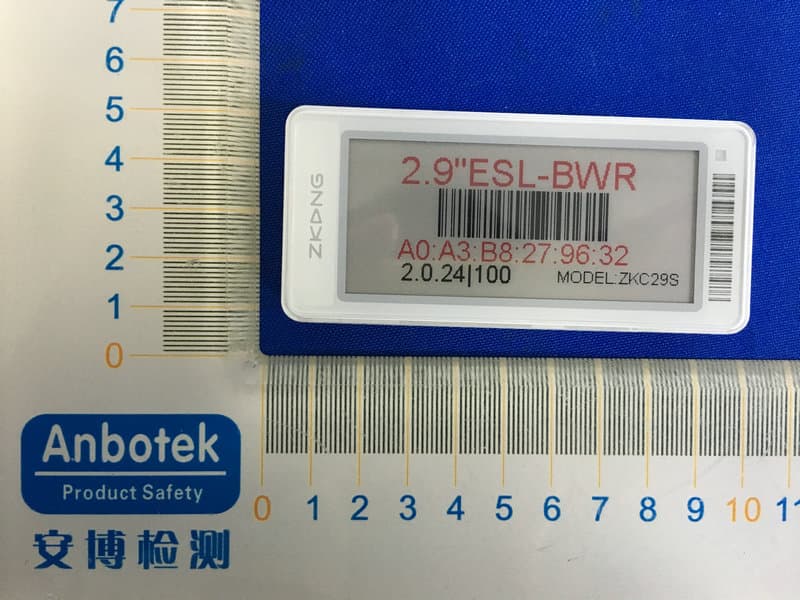
Mar 18, 2020Electronic Shelf Label
Equipment Class
DTS - Digital Transmission System