2AWFE-X9902.4G Wireless Numeric Keypad
Yehs Innovations Inc.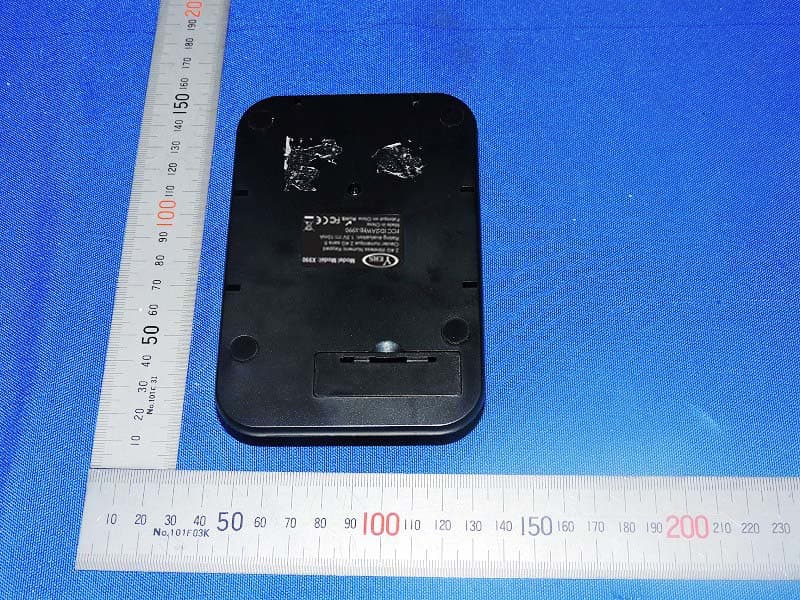
Click to zoom
Application Details
- Equipment Class
- DXX - Part 15 Low Power Communication Device Transmitter
- Date of Grant
- May 24, 2020
- Application Purpose
- Original Equipment
- Date of Application
- May 23, 2020
- Equipment Note
- 2.4G Wireless Numeric Keypad
- Frequency Range
- 2408.00000000 - 2474.00000000
- Company
- Yehs Innovations Inc.
- Country
- Canada
Documents & Files
Document Text
Text extracted from the exhibit documents filed with the FCC. Open a document above to read the original.
Users Manual
Model:SK-637AG This RF2.4GHz keyboard use one AAA alkaline batteries. The receiver is insert to USB port immediate, or by a extra USB cable. Nano receiver 2 Other Considerations 1power-saving design : When the keyboard does not take any action about 2 seconds into hibernation , press any KEY. 21 AAA dry batteries : the whole boost to 1.5V. The whole system is 1.5V system . , , InstallingtheBatteries Installthebatteriesinthekeyboard step1.Removethebatterycompartment coveronthebottomofthekeyboard bysqueezingthecoverinfromthe tabtoreleaseit . step2. Insertthebatteriesasshowninside thebatterycompartment . step3.Replacethecover Restoringfactorydefaultsettings whenyoufindthiswirelesskeyboarddoesntwork youcanmakethekeyboardinworkingconditionby restoringbacktofactorydefaultsettings ' , . 1:check the battery volume is normal; if the battery is used out,please replace new batteries. 2.inserttheUSBreceiverontotheUSBportthePC ornotebook 3. At the same time the battery into the keyboard, the keyboard LED lights flash quickly said, restore factory Settings successfully. FCC Warning Statement Changes or modifications not expressly approved by the party responsible for compliance could void the user's authority to operate the equipment. This equipment has been tested and found to comply with the limits for a Class B digital device, pursuant to Part 15 of the FCC Rules. These limits are designed to provide reasonable protection against harmful interference in a residential installation. This equipment generates uses and can radiate radio frequency energy and, if not installed and used in accordance with the instructions, may cause harmful interference to radio communications. However, there is no guarantee that interference will not occur in a particular installation. If this equipment does cause harmful interference to radio or television reception, which can be determined by turning the equipment off and on, the user is encouraged to try to correct the interference by one or more of the following measures: Reorient or relocate the receiving antenna.‐‐ Increase the separation between the equipment and receiver. Connect the equipment into an outlet on a circuit different from that to which the receiver is connected. Consult the dealer or an experienced radio/TV technician for help. This device complies with part 15 of the FCC rules. Operation is subject to the following two conditions (1) this device may not cause harmful interference, and (2) this device must accept any interference received, including interference that may cause undesired operation. PDF 文件使用 "pdfFactory" 试用版本创建 www.fineprint.cn
Cover Letter(s)
May 18, 2020 Equipment Autorisation Division Federal Communications Commission 7435 Oakland Mills Road Columbia, MD 21046 FCC ID: 2AWFE-X990 Product Name: 2.4G Wireless Numeric Keypad Request for Confidentiality Pursuant to Sections 0.457 and 0.459 of the commissions rules, we hereby request that the following documents be held confidential: Schematics Block diagram Operation description These materials contain trade secrets and proprietary information and are not customarily released to the public. The public disclosure of this information might be harmful to the company and provide unjustified benefits to our competitors. <Signature>: Name:David Yeh Title:Manager Applicant Company:Yehs Innovations Inc.
Cover Letter(s)
May Fede Auth 7345 Colu On o Bloc Distr agen subm certif defin labe For i beha for c Onta <Sig n Name Title: Applic y 18, 2020 eral Commu horization & 5 Oakland M umbia, Mary our behalf, ck B, Jun Xi rict, Shenzh nt in the p mitted docu fication is so ned in the F l identical to instances w alf, I acknow certification, ario, Canada nature>: e:David Ye Manager cant Compa unications C Evaluation D Mills Road land 21046 I appoint S ang Da Bui hen, China. preparation uments prop ought. I also Federal Com o that submit where our au wledge that still resides a eh any:Yehs ommission Division Author i Shenzhen Ti lding, Zhong (Name of A of this app perly descr o certify that mmunications tted for appr uthorized ag all responsi with Y e h Innovations ity to Act as imeway Tes gshan Park Agent comp plication for ribe the de t each unit m s Commissi roval with th ent signs th ibility for com s Innovat s Inc. s Agent sting Labora Road West pany name r equipment evice or sy manufacture ion’s regulat his applicatio he applicatio mplying with tions Inc. atories/ Zo t, Tong Le V and addres t certificatio stem for w ed, imported tions will ha on. on for certific h the terms . / 2556 Line one C, 1st F Village, Nan ss) to act a on. I certify which equip d or markete ave affixed t cation on ou and conditio e 13, Gilford Floor, nshan s our y that pment ed, as to it a ur ons d,
ID Label/Location Info
SK-637AG YEHS 00875-0637AG15330 100% 300% 1.0 消银龙+哑胶(黑底银字) 骆春花 20200516 2.4G Wireless Numeric Keypad Clavier numérique 2.4G sans fi Rating évaluation: 1.5V 10mA Model Modèl: X990 Made in China Fabriqué en Chine FCC ID: 2AWFE-X990 2.4G Wireless Numeric Keypad Clavier numérique 2.4G sans fi Rating évaluation: 1.5V 10mA Model Modèl: X990 Made in China Fabriqué en Chine FCC ID: 2AWFE-X990
ID Label/Location Info
Label Location
RF Exposure Info
RF Exposure evaluation According to 447498 D01 General RF Exposure Guidance v05 The 1-g and 10-g SAR test exclusion thresholds for 100 MHz to 6 GHz at test separation distances ≤ 50 mm are determined by: [(max. power of channel, including tune-up tolerance, mW)/(min. test separation distance, mm)] ·[√f(GHz)] ≤ 3.0 for 1-g SAR and ≤ 7.5 for 10-g extremity SAR, where f(GHz) is the RF channel transmit frequency in GHz Power and distance are rounded to the nearest mW and mm before calculation The result is rounded to one decimal place for comparison eirp = pt x gt = (EXd) 2 /30 where: pt = transmitter output power in watts, gt = numeric gain of the transmitting antenna (unitless), E = electric field strength in V/m, --- 10 ((dBuV/m)/ 20) /10 6 d = measurement distance in meters (m)---3m So pt = (EXd) 2 /30 x gt Field strength = 82.33dBuV/m @3m Ant gain =-0.6dBi ;so Ant numeric gain= 0.871 So pt={ [10 ( 82.33 /20) /10 6 x3] 2 /30x0.871 }x1000 mW =0.0589mW So (0.0589 mW/5mm)x √2.408GHz = 0.0183 <3 Then SAR evaluation is not required
Test Report
Report No.: FCC2004217 File Reference No.: 2020-05-11 Applicant: Yehs Innovations Inc. Product: 2.4G Wireless Numeric Keypad Model No.: X990 Brand Name: Test Standards: FCC Part 15.249 Test Result: It is herewith confirmed and found to comply with the requirements set up by ANSI C63.4&FCC Part 15 Subpart C, Paragraph 15.249 regulations for the evaluation of electromagnetic compatibility Approved By Jack Chung Manager Dated: May 11, 2020 Results appearing herein relate only to the sample tested The technical reports is issued errors and omissions exempt and is subject to withdrawal at SHENZHEN TIMEWAY TESTING LABORATORIES Zone C, 1st Floor, Block B, Jun Xiang Da Building, Zhongshan Park Road West, Tong Le Village, Nanshan District, Shenzhen, China Tel(+86)- 755 83448688, E-Mail:[email protected] Report No.: FCC2004217 Page 2 of 36 Date: 2020-05-11 The report refers only to the sample tested and does not apply to the bulk. This report is issued in confidence to the client and it will be strictly treated as such by the SHENZHEN TIMEWAY TESTING LABORATORIES. It may not be reproduced rather in its entirety or in part and it may not be used for adverting. The client to whom the report is issued may, however, show or send it . or a certified copy there of prepared by the SHENZHEN TIMEWAY TESTING LABORATORIES. to his customer. Supplier or others persons directly concerned. SHENZHEN TIMEWAY TESTING LABORATORIES. will not, without the consent of the client enter into any discussion of correspondence with any third party concerning the contents of the report. In the event of the improper use of the report. The SHENZHEN TIMEWAY TESTING LABORATORIES. reserves the rights to withdraw it and to adopt any other remedies which may be appropriate. Special Statement: The testing quality ability of our laboratory meet with "Quality Law of People's Republic of China" Clause 19. The testing quality system of our laboratory meet with ISO/IEC-17025 requirements, which is approved by CNAS. This approval result is accepted by MRA of APLAC. Our test facility is recognized, certified, or accredited by the following organizations: CNAS-LAB Code: L2292 The EMC Laboratory has been assessed and in compliance with CNAS-CL01 accreditation criteria for testing Laboratories (identical to ISO/IEC 17025:2005 General Requirements) for the Competence of testing Laboratories. FCC-Registration No.: 744189 The EMC Laboratory has been registered and fully described in a report filed with the (FCC) Federal Communications commission. The acceptance letter from the FCC is maintained in our files. Registration No.: 744189. Industry Canada (IC) —Registration No.:5205A The EMC Laboratory has been registered by Certification and Engineering Bureau of Industry Canada for radio equipment testing with Registration No.: 5205A. A2LA (Certification Number:5013.01) The EMC Laboratory has been accredited by the American Association for Laboratory Accreditation (A2LA). Certification Number:5013.01 Report No.: FCC2004217 Page 3 of 36 Date: 2020-05-11 The report refers only to the sample tested and does not apply to the bulk. This report is issued in confidence to the client and it will be strictly treated as such by the SHENZHEN TIMEWAY TESTING LABORATORIES. It may not be reproduced rather in its entirety or in part and it may not be used for adverting. The client to whom the report is issued may, however, show or send it . or a certified copy there of prepared by the SHENZHEN TIMEWAY TESTING LABORATORIES. to his customer. Supplier or others persons directly concerned. SHENZHEN TIMEWAY TESTING LABORATORIES. will not, without the consent of the client enter into any discussion of correspondence with any third party concerning the contents of the report. In the event of the improper use of the report. The SHENZHEN TIMEWAY TESTING LABORATORIES. reserves the rights to withdraw it and to adopt any other remedies which may be appropriate. Test Report Conclusion Content 1.0 General Details ............................................................................................. 4 1.1 Test Lab Details............................................................................................. 4 1.2 Applicant Details.............................................................................................. 4 1.3 Description of EUT .......................................................................................... 4 1.4 Submitted Sample............................................................................................. 5 1.5 Test Duration................................................................................................... 5 1.6 Test Uncertainty................................................................................................ 5 1.7 Test By......................................................................................................... 5 2.0 List of Measurement Equipment......................................................................... 6 3.0 Technical Details.......................................................................................... 7 4.0 EUT Modification............................................................................................. 7 5.0 Power Line Conducted Emission Test..................................................................... 8 5.1 Schematics of the Test....................................................................................... 8 5.2 Test Method and Test Procedure............................................................................ 8 5.3 Configuration of the EUT................................................................................. 8 5.4 EUT Operating Condition................................................................................. 9 5.5 Conducted Emission Limit.................................................................................. 9 5.6 Test Result.....................................................…
Text truncated - open the document above for the full version.
Test Setup Photos
Radiated emission test view
Contact Information
Applicant
David Yeh
Test Firm
Shenzhen Timeway Testing LaboratoriesTerry Tang
[email protected]+86-755-83448688
Technical Specifications
| # | Rule Parts | Frequency Range | Power Output |
|---|---|---|---|
| 1 | 15C | 2.41 GHz - 2.47 GHz | - |