2AWUL-J7Noise Reduction Wireless earphones
Shenzhen Pengxinfa Electronics Co., Ltd.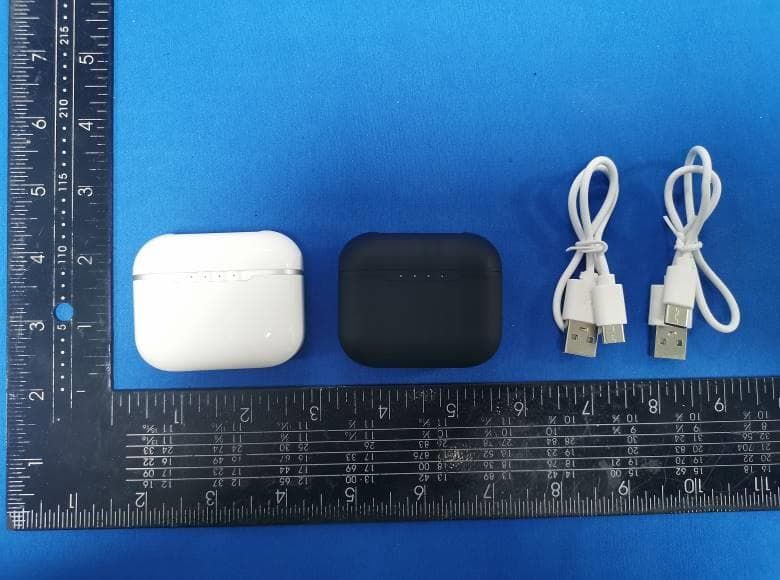
Click to zoom
Application Details
- Equipment Class
- DSS - Part 15 Spread Spectrum Transmitter
- Date of Grant
- Feb 21, 2022
- Application Purpose
- Original Equipment
- Date of Application
- Feb 21, 2022
- Equipment Note
- Noise Reduction Wireless earphones
- Frequency Range
- 2402.00000000 - 2480.00000000
- Country
- China
Documents & Files
Document Text
Text extracted from the exhibit documents filed with the FCC. Open a document above to read the original.
Users Manual
J7 Ear Phones User manual 1、Product Function introduction Multi-touch point 4 8 1 Display light/microphone 2 Microphone 3 Left ear logo 5 Earphone charging contact 4 Right ear logo 6 Battery indicator 7 Type-C charging interface 8 1 2 7 6 5 3 ① 2、 Packaging accessories 7、The basic parameters 3、Instructions for headset touch operation L Headset pairing 01 x2 Connection a.Device connection: Open your phone or other device, search for "J7", and click Connect. 02 b.The left and right earphones can be connected separately. J7 J7 Turn it off a.Put it in the charging compartment and turn it off (close the lid and the indicator light will turn off after 10 seconds) a.When the left earphone is put in, it goes from left to right (LED1 to LED4). After lighting up, it will display the battery level of the charging compartment, and then turn off the light after 10 seconds. b.When the right earphone is put in the marquee mode from right to left (LED4 to LED1), the battery level of the charging compartment will be displayed after the light is on, and the light will be off after 10 seconds. b.No work for 5 minutes, sleep shutdown c.Long press for about 5 seconds to turn on/off the ear 03 5、Charging instructions Unilateral headset charging 01 Charge both left and right ears simultaneously LR 02 Charging in the charging compartment Type-C charging port a.After opening the lid, the four lights will gradually light up at the same time, and then display the charge compartment battery level. After 10 seconds, the lights will go out. b.When the charging compartment uses the data cable to charge, from the left to the right (LED1 to LED4), each light is 25% of the power, and it is fully on. When the charging cable is unplugged, it turns on for 10 seconds and then turns off. 03 4、Earphone connection instructions A.Singles-ear mode: take out a earphone. B.Binaural mode: first turn off the BT device and take out the earphone. Touch (L) left ear 2 times and wait for 3-5 seconds, when both earphones flash blue lights, the match is successful(Please refer to the index below for specific operations ) Slowly flashing blue lights in both earphone are successful Display red and blue lights are unsuccessful b.Touch twice and wait for 3-5 seconds to pair successfully c.The second use, charging lid is opened, the headset automatically boot, automatic matching a.Take out the earphones Available equipment Product nameJ7 5.2+EDR 15m about 1 hour 5V-1A 3-4hours BT Connection distance Charging time Input Talking time Playing time4-5hours 2.4GHZ 32Ω 7-10days 50/500mah 33-38dB Frequency Impedance Standby time Battery capacity Noise reduction depth 8、Matters needing attention Safety warning Thanks for buying our J7 TWS earphone which comes with wireless stereo, left and right channel separation and HIFI sound functions. And It can be used alone or in pairs. We welcome your suggestions and comments on our products and services! Please ensure that the product is not used or stored in high temperature or humid environment to avoid affecting the product performance. Do not drop or drop the product from high altitude to avoid damage. Please contact manufacturer if there is any product problem, and don't disassemble the product for repair. Please make sure the product is fully charged before the first use;Or charge it first. Please use a brand charger or computer USB to charge the headset (note: 5V-1A charger). Stay away from WIFI and routers and other high frequency transmitting devices, which may affect the signal reception of the unit and cause the phenomenon of sound blocking and disconnection. Please use the product in an effective environment (15m) and there should be no physical barriers (such as walls, etc.) between the BT device and the headset. Please refer to Item 4 when there is no sound on one side of the earphone and the pairing of two ears is not successful(headset connection instructions) pair and connect the headset again, and the product will work normally after reconnection! a.When put earphones into the charging case to charge them, there are 4 lights show the battery capacity of the charge case,and then go out after 10 seconds R L Left ear touch x1 x2 x3 x1 x2 x3 ON OFF Long press Right ear touch Press 2 seconds Press 2 seconds Press 3 seconds Press 5 seconds Transparency, noise,normal reduction mode switch repeatedly (wait 1.5 seconds after entering a mode) ① Charging case, earphones② Charging cable③ 3 pairs of ear-tips Manual Certificate Noted ④Ear cap cue cards ⑤Certificate ⑥User manual ②③④⑤⑥ This equipment has been tested and found to comply with the limits for a Class B digital device, pursuant to Part 15 of the FCC Rules. These limits are designed to provide reasonable protection against harmful interference in a residential installation. This equipment generates, uses and can radiate radio frequency energy and, if not installed and used in accordance with the instructions, may cause harmful interference to radio communications. However, there is no guarantee that interference will not occur in a particular installation. If this equipment does cause harmful interference to radio or television reception, which can be determined by turning the equipment off and on, the user is encouraged to try to correct the interference by one or more of the following measures: Warning: Changes or modifications to this unit not expressly approved by the part responsible for compliance could void the user’s authority to operate the equipment. This equipment complied with FCC radiation exposure limits set forth for an uncontrolled environment. This equipment should be installed and operated with minimum distance 0cm between the radiator & your body. FCC Radiation Exposure Statement Reorient or relocate the receiving antenna. Increase the separation between the equipment and receiver. Connect the equipment into an outlet on a circuit different from that to which the receiver is connected. Consult the dealer or an experienced radio/…
Text truncated - open the document above for the full version.
Cover Letter(s)
CONFIDENTIALITY REQUEST for Certification Service in USA Federal Communication Commission Equipment Authorization Division, Application Processing Branch 7435 Oakland Mills Road Columbia, MD 21046 Date:<2022-2-21> Pursuant to Paragraphs §0.457 and 0.459 of the Commission’s Rules (47 C.F.R.) and Section §552(b)(4) of the Freedom of Information Act, we requests confidentiality for the following products: FCC ID Model name 2AWUL-J7 J7 For the product stated above, we request that the following information be held confidential; Exhibits Long-Term Confidentiality Short-Term Confidentiality Short-Term Confidentiality Days External Photos Internal Photos Block Diagram Schematics Test Setup Photos User’s Manual Parts List Tune Up Operational Descriptions The long-term confidentiality exhibits contain our trade secrets and proprietary information that could be of benefit to our competitors. The short-term confidentiality on the basis of ensuring that business sensitive information remains confidential until the actual marketing of our new device. If you have any questions, please feel free to contact me at the address shown below. Sincerely, Name/Title: Shalin Liang/Manager Company: Shenzhen Pengxinfa Electronics Co., Ltd. Address: 602, Building B, Nanchang First Industrial Zone, Gushu, Xixiang, Baoan District Shenzhen China Phone: 18823672028 Fax: N/A E-Mail: [email protected]
External Photos
FCC ID: 2AWUL-J7 External Photos of the EUT FCC ID: 2AWUL-J7 FCC ID: 2AWUL-J7 FCC ID: 2AWUL-J7 FCC ID: 2AWUL-J7
ID Label/Location Info
FCC ID: 2AWUL-J7 Label and Location Size: L: 3.0cm*W: 2.5cm Label and Location
Internal Photos
FCC ID: 2AWUL-J7 Internal Photos of the EUT Left Antenna FCC ID: 2AWUL-J7 Right FCC ID: 2AWUL-J7 Antenna FCC ID: 2AWUL-J7
RF Exposure Info
RF Exposure evaluation FCC ID: 2AWUL-J7 1.1. Applicable Standard According to §1.1307(b)(1), systems operating under the provisions of this section shall be operated in a manner that ensures that the public is not exposed to radio frequency energy level in excess of the Commission’s guidelines. According to §1.1310 and §2.1093 RF exposure requirement KDB447498 v06: Mobile and Portable Devices RF Exposure Procedures and Equipment Authorization Policies 1.2. Requirement According to KDB447498 D01 General RF Exposure Guidance v06 Section 4.3.1 Standalone SAR test exclusion considerations: “Unless specifically required by the published RF exposure KDB procedures, standalone 1-g head or body and 10-g extremity SAR evaluation for general population exposure conditions, by measurement or numerical simulation, is not required when the corresponding SAR Test Exclusion Threshold condition, listed below, is satisfied. These test exclusion conditions are based on source-based time-averaged maximum conducted output power of the RF channel requiring evaluation, adjusted for tune-up tolerance, and the minimum test separation distance required for the exposure conditions.22 The minimum test separation distance is determined by the smallest distance from the antenna and radiating structures or outer surface of the device, according to the host form factor, exposure conditions and platform requirements, to any part of the body or extremity of a user or bystander (see 5) of section 4.1). To qualify for SAR test exclusion, the test separation distances applied must be fully explained and justified by the operating configurations and exposure conditions of the transmitter and applicable host platform requirements, typically in the SAR measurement or SAR analysis report, according to the required published RF exposure KDB procedures. When no other RF exposure testing or reporting is required, a statement of justification and compliance must be included in the equipment approval, in lieu of the SAR report, to qualify for the SAR test exclusion. When required, the device specific conditions described in the other published RF exposure KDB procedures must be satisfied before applying these SAR test exclusion provisions; for example, handheld PTT two-way radios, handsets, laptops & tablets etc.23 “ [(max. power of channel, including tune-up tolerance, mW)/ (min. test separation distance, mm)] · [√f (GHz)] ≤ 3.0 for 1-g SAR and ≤ 7.5 for 10-g extremity SAR, where: • f (GHz) is the RF channel transmit frequency in GHz • Power and distance are rounded to the nearest mW and mm before calculation • The result is rounded to one decimal place for comparison • 3.0 and 7.5 are referred to as the numeric thresholds in the step 2 below The test exclusions are applicable only when the minimum test separation distance is ≤ 50 mm and for transmission frequencies between 100 MHz and 6 GHz. When the minimum test separation distance is < 5 mm, a distance of 5 mm according to 5) in section 4.1 is applied to determine SAR test exclusion. 1.3. Manufacturing tolerance GFSK (Peak) Channel Channel 0 Channel 39 Channel 78 Target (dBm) 1.0 1.0 2.0 Tolerance ±(dB) 1.0 1.0 1.0 π/4DQPSK (Peak) Channel Channel 0 Channel 39 Channel 78 Target (dBm) 2.0 2.0 2.0 Tolerance ±(dB) 1.0 1.0 1.0 8-DPSK (Peak) Channel Channel 0 Channel 39 Channel 78 Target (dBm) 2.0 2.0 3.0 Tolerance ±(dB) 1.0 1.0 1.0 Page 2 of 2 2. E v a l u a t i o n R e s u l t Evaluation Results Band/Mode f (GHz) Antenna Distance (mm) RF output power (including tune-up tolerance) SAR Test Exclusion Threshold SAR Test Exclusion dBm mW BT 2.450 5 4.0 2.5119 0.7863<3.0 Yes 3. C o n c l u s i o n The measurement results comply with the FCC Limit per 47 CFR 2.1093 for the uncontrolled RF Exposure and SAR Exclusion Threshold per KDB 447498 v06 .....................End of Report.........................
Test Report
Shenzhen CTA Testing Technology Co., Ltd. Room 106, Building 1, Yibaolai Industrial Park, Qiaotou Community, Fuhai Street, Bao’an District, Shenzhen, China Shenzhen CTA Testing Technology Co., Ltd. Room 106, Building 1, Yibaolai Industrial Park, Qiaotou Community, Fuhai Street, Bao’an District, Shenzhen, China Tel:+86-755 2322 5875 E-mail:[email protected] Web:http://www.cta-test.cn FCC PART 15 SUBPART C TEST REPORT FCC PART 15.247 Report Reference No. ..................... : FCC ID. ............................................ : CTA22021700301 2AWUL-J7 Compiled by ( position+printed name+signature) .. : File administrators Kevin Liu Supervised by ( position+printed name+signature) .. : Project Engineer Kevin Liu Approved by ( position+printed name+signature) .. : RF Manager Eric Wang Date of issue ..................................... : Feb. 19, 2022 Testing Laboratory Name .............. : Shenzhen CTA Testing Technology Co., Ltd. Address ............................................ : Room 106, Building 1, Yibaolai Industrial Park, Qiaotou Community, Fuhai Street, Bao‘an District, Shenzhen, China Applicant’s name ............................ : Shenzhen Pengxinfa Electronics Co., Ltd. Address ............................................ : 602, Building B, Nanchang First Industrial Zone, Gushu, Xixiang, Baoan District, Shenzhen, China Test specification ...........................: Standard ........................................... : FCC Part 15.247 Shenzhen CTA Testing Technology Co., Ltd. All rights reserved. This publication may be reproduced in whole or in part for non-commercial purposes as long as the Shenzhen CTA Testing Technology Co., Ltd. is acknowledged as copyright owner and source of the material. Shenzhen CTA Testing Technology Co., Ltd. takes no responsibility for and will not assume liability for damages resulting from the reader's interpretation of the reproduced material due to its placement and context. Test item description .....................: Noise Reduction Wireless earphones Trade Mark ....................................... : N/A Manufacturer .................................... : Shenzhen Pengxinfa Electronics Co., Ltd. Model/Type reference....................... : J7 Listed Models .................................. : N/A Modulation ....................................... : GFSK, Π/4DQPSK,8DPSK Frequency .......................................... From 2402MHz to 2480MHz Rating ............................................... : DC 3.7V From Battery and DC 5V From external circuit Result................................................ : PASS Report No.: CTA22021700301 Page 2 of 51 Shenzhen CTA Testing Technology Co., Ltd. Room 106, Building 1, Yibaolai Industrial Park, Qiaotou Community, Fuhai Street, Bao’an District, Shenzhen, China Tel:+86-755 2322 5875 E-mail:[email protected] Web:http://www.cta-test.cn T E S T R E P O R T Equipment under Test : Noise Reduction Wireless earphones Model /Type : J7 Listed Models : N/A Applicant : Shenzhen Pengxinfa Electronics Co., Ltd. Address : 602, Building B, Nanchang First Industrial Zone, Gushu, Xixiang, Baoan District, Shenzhen, China Manufacturer : Shenzhen Pengxinfa Electronics Co., Ltd. Address : 602, Building B, Nanchang First Industrial Zone, Gushu, Xixiang, Baoan District, Shenzhen, China Test Result: PASS The test report merely corresponds to the test sample. It is not permitted to copy extracts of these test result without the written permission of the test laboratory. Report No.: CTA22021700301 Page 3 of 51 Shenzhen CTA Testing Technology Co., Ltd. Room 106, Building 1, Yibaolai Industrial Park, Qiaotou Community, Fuhai Street, Bao’an District, Shenzhen, China Tel:+86-755 2322 5875 E-mail:[email protected] Web:http://www.cta-test.cn Contents 1 T E S T S T AN D A R D S ................................................................. 4 2 S U M M AR Y ............................................................................ 5 2.1 General Remarks 5 2.2 Product Description 5 2.3 Equipment Under Test 5 2.4 Short description of the Equipment under Test (EUT) 5 2.5 EUT operation mode 6 2.6 Block Diagram of Test Setup 6 2.7 Related Submittal(s) / Grant (s) 6 2.8 Modifications 6 3 T E S T E N V I R O N M E N T .............................................................. 7 3.1 Address of the test laboratory 7 3.2 Test Facility 7 3.3 Environmental conditions 7 3.4 Summary of measurement results 8 3.5 Statement of the measurement uncertainty 8 3.6 Equipments Used during the Test 9 4 T E S T C O N D I T I O N S A N D R E S U L T S ........................................... 10 4.1 AC Power Conducted Emission 10 4.2 Radiated Emission 13 4.3 Maximum Peak Output Power 19 4.4 20dB Bandwidth 20 4.5 Frequency Separation 24 4.6 Number of hopping frequency 26 4.7 Time of Occupancy (Dwell Time) 28 4.8 Out-of-band Emissions 32 4.9 Pseudorandom Frequency Hopping Sequence 41 4.10 Antenna Requirement 42 5 T E S T S E T U P P H O T O S O F T H E E U T ......................................... 43 6 P H O T O S O F T H E E U T ........................................................... 44 Report No.: CTA22021700301 Page 4 of 51 Shenzhen CTA Testing Technology Co., Ltd. Room 106, Building 1, Yibaolai Industrial Park, Qiaotou Community, Fuhai Street, Bao’an District, Shenzhen, China Tel:+86-755 2322 5875 E-mail:[email protected] Web:http://www.cta-test.cn 1 T E S T S T A N D A R D S The tests were performed according to following standards: FCC Rules Part 15.247: Frequency Hopping, Direct Spread Spectrum and Hybrid Systems that are in operation within the bands of 902-928 MHz, 2400-2483.5 MHz, and 5725-5850 MHz. ANSI C63.10-2013: American National Standard for Testing Unlicensed Wireless Devices Report No.: CTA22021700301 Page 5 of 51 Shenzhen CTA Testing Technology Co., Ltd. Room 106, Building 1, Yibaolai Industrial Park, Qiaotou Community, Fuhai Street, Bao’an District, Shenzhen, China Tel:+86-755 2322 5875 E-mail:[email protected] Web:http://w…
Text truncated - open the document above for the full version.
Test Setup Photos
FCC ID: 2AWUL-J7 Test Setup Photos of the EUT Test Setup Photo(s) of Radiated Emissions Measurement Fig. 1 Fig. 2 FCC ID: 2AWUL-J7 Test Setup Photo of Line Conducted Emissions Measurement
Contact Information
Applicant
Shalin Liang
Test Firm
SHENZHEN CTA TESTING TECHNOLOGY CO., LTD.Eric Wang
[email protected]+86 755 2322 5875
Technical Specifications
| # | Rule Parts | Frequency Range | Power Output |
|---|---|---|---|
| 1 | 15C | 2.40 GHz - 2.48 GHz | 2.00 mW |
Other Applications from Shenzhen Pengxinfa Electronics Co., Ltd.

2AWUL-J25
Feb 02, 2026Wireless Bluetooth headset
Equipment Class
DSS - Part 15 Spread Spectrum Transmitter
2AWUL-J3
Jul 23, 2020Wireless Earphones
Equipment Class
DSS - Part 15 Spread Spectrum Transmitter