2AWYHBT-MOTOBT-MOTO HELMET BLUETOOTH HEADSET
Rugged Radios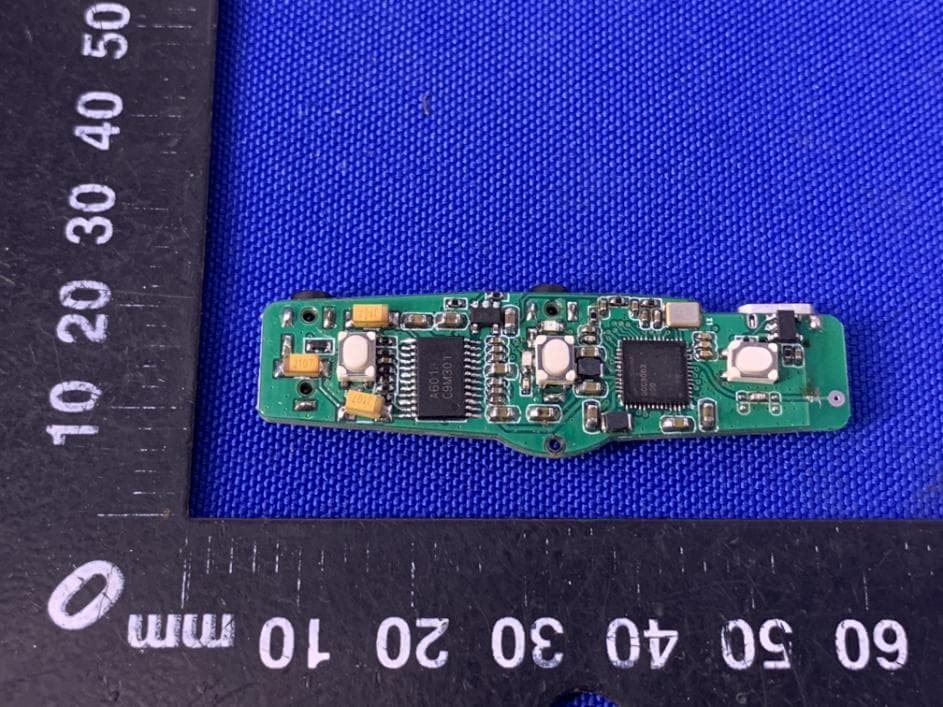
Click to zoom
Application Details
- Equipment Class
- DSS - Part 15 Spread Spectrum Transmitter
- Date of Grant
- Aug 25, 2021
- Application Purpose
- Original Equipment
- Date of Application
- Aug 25, 2021
- Equipment Note
- BT-MOTO HELMET BLUETOOTH HEADSET
- Frequency Range
- 2402.00000000 - 2480.00000000
- Company
- Rugged Radios
- Country
- United States
Documents & Files
Document Text
Text extracted from the exhibit documents filed with the FCC. Open a document above to read the original.
Users Manual
BT-MOTO Operation Manual 0102 03 1.Outlook 2.Functions -- Reorient or relocate the receiving antenna. -- Increase the separation between the equipment and receiver. -- Connect the equipment into an outlet on a circuit different from that to which the receiver is connected. -- Consult the dealer or an experienced radio/TV technician for help This device complies with part 15 of the FCC rules. Operation is subject to the following two conditions (1)this device may not cause harmful interference, and (2) this device must accept any interference received, including interference that may cause undesired operation.This device has been evaluated to meet general RF exposure requirement. The device can be used in portable exposure condition without restriction. BT-MOTO HELMET BLUETOOTH HEADSET User Manual Volume + Volume - AUX IN Charging/Headset Jack Function Button Functions Status Operation Instructions Power On -- Long press function button 2s Power Off -- Short press volume - and function button Pairing -- Long press function button 7s Pick Up Phone call coming Short press function button Hang Up Phone call Short press function button Re-dial Stand-by Double press function button Volume - Phone call/Music Play Short press volume - Volume + Phone call/Music Play Short press volume + Previous Music Play Long press volume - Next Music Play Long press volume + Play/Pause Music Play Short press function button Voice Prompt Power On / Power Off / Link / Low battery Reject Phone call coming Long press function button 1s Speaker+Mic 3.Statement / Warranty 3.1 FCC Statement Changes or modifications not expressly approved by the party responsible for compliance could void the user's authority to operate the equipment.This equipment has been tested and found to comply with the limits for a Class B digital device, pursuant to Part 15 of the FCC Rules. These limits are designed to provide reasonable protection against harmful interference in a residential installation. This equipment generates uses and can radiate radio frequencyenergy and, if not installed and used in accordance with the instructions, may cause harmful interference to radio communications. However, there is no guarantee that interference will not occur in a particular installation. If this equipment does cause harmful interference to radio or television reception, which can be determined by turning the equipment off and on, the user is encouraged to try to correct the interference by one or more of the following measures: In normal use , we offer one year warranty from the date of purchase , any disassemble , modification will void warranty . 3.2 Warranty Production Date Customer Name Purchase DateCustomer Tel Dealer NameCustomer E-mail Item No.Remark
Cover Letter(s)
Rugged Radios 2021-04-26 Equipment Autorisation Division Federal Communications Commission 7435 Oakland Mills Road Columbia, MD 21046 FCC ID: 2AWYHBT-MOTO Product Name: BT-MOTO HELMET BLUETOOTH HEADSET Request for Confidentiality Pursuant to Sections 0.457 and 0.459 of the commissions rules, we hereby request that the following documents be held confidential: Schematics Block diagram Operation description These materials contain trade secrets and proprietary information and are not customarily released to the public. The public disclosure of this information might be harmful to the company and provide unjustified benefits to our competitors. <Signature> Name: Steve Gonzalez Title: Manager Company: Rugged Radios
Cover Letter(s)
Rugged Radios 2021-04-26 Federal Communications Commission Authorization & Evaluation Division 7345 Oakland Mills Road Columbia, Maryland 21046 Authority to Act asAgent On our behalf, I appointShenzhen Tongce Testing Lab. / 1B/F., Building 1, Yibaolai Industrial Park, Qiaotou, Fuyong, Baoan District,Shenzhen, Guangdong, China(Name of Agent company name andaddress) to act as our agent in the preparation of this application for equipment certification. I certify that submitted documents properly describe the device or system for which equipment certification is sought. I also certify that each unit manufactured, imported or marketed, as defined in the Federal Communications Commission’s regulations will have affixed to it a label identical to that submitted for approval with this application. Forinstanceswhereourauthorizedagentsignstheapplicationforcertificationonourbehalf,Iack nowledgethatallresponsibilityforcomplyingwiththetermsandconditionsforcertification,stillres ideswith Rugged Radios / 951 E Grand Ave, Arroyo Grande, California 93420, United States (Applicant Name and address) <Signature> Name: Steve Gonzalez Title: Manager Applicant Company: Rugged Radios
ID Label/Location Info
Label Artwork and Location Model: BT-MOTO Label: Size: L*W=24*10mm BT-MOTO HELMET BLUETOOTH HEADSET Model: BT-MOTO FCC ID: 2AWYHBT-MOTO Location
Internal Photos
Page 1 of 3 Appendix B: Photographs of EUT Product: BT-MOTO HELMET BLUETOOTH HEADSET Model: BT-MOTO Internal Photos ANT Page 2 of 3 Page 3 of 3
RF Exposure Info
RF exposure evaluation §2.1093 Radiofrequency radiation exposure evaluation: Portable Devices. According to§15.247(i) and§1.1307b(1), systems operating under the provisions of this section shall be operated in a manner that ensures that the public is not exposed to radio frequency energy level in excess of the commission’s guidance. The 1-g SAR test exclusion thresholds for 100 MHz to 6 GHz at test separation distances ≤ 50 mm are determined by: [(max. power of channel, including tune-up tolerance, mW) / (min. test separation distance, mm)] · [√f(GHz)] ≤ 3.0 for 1-g SAR, where f(GHz) is the RF channel transmit frequency in GHz Power and distance are rounded to the nearest mW and mm before calculation When the minimum test separation distance is < 5 mm, a distance of 5 mm according is applied to determine SAR test exclusion. The result is rounded to one decimal place for comparison For BDR+EDR: Channel Frequency (GHz) Max. Power (dBm) Tune up Power (dBm) Max. Tune up Power (dBm) Max. Tune up Power (mW) Test distance (mm) Result exclusion thresholds for 1-g SAR CH 00 2.402 7.92 7.0±1 8.0 6.31 5 1.96 3.0 Result: Base on the calculation value, No SAR measurement is required.
RF Exposure Info
RF exposure evaluation §2.1093 Radiofrequency radiation exposure evaluation: Portable Devices. According to§15.247(i) and§1.1307b(1), systems operating under the provisions of this section shall be operated in a manner that ensures that the public is not exposed to radio frequency energy level in excess of the commission’s guidance. The 1-g SAR test exclusion thresholds for 100 MHz to 6 GHz at test separation distances ≤ 50 mm are determined by: [(max. power of channel, including tune-up tolerance, mW) / (min. test separation distance, mm)] · [√f(GHz)] ≤ 3.0 for 1-g SAR, where f(GHz) is the RF channel transmit frequency in GHz Power and distance are rounded to the nearest mW and mm before calculation When the minimum test separation distance is < 5 mm, a distance of 5 mm according is applied to determine SAR test exclusion. The result is rounded to one decimal place for comparison For BDR+EDR: Channel Frequency (GHz) Max. Power (dBm) Tune up Power (dBm) Max. Tune up Power (dBm) Max. Tune up Power (mW) Test distance (mm) Result exclusion thresholds for 1-g SAR CH 00 2.402 7.92 7.0±1 8.0 6.31 5 1.96 3.0 Result: Base on the calculation value, No SAR measurement is required.
Test Setup Photos
Page 1 of 2 Appendix A: Photographs of Test Setup Product: BT-MOTO HELMET BLUETOOTH HEADSET Model: BT-MOTO Radiated Emission Page 2 of 2 Conducted Emission
Test Setup Photos
Page 1 of 2 Appendix A: Photographs of Test Setup Product: BT-MOTO HELMET BLUETOOTH HEADSET Model: BT-MOTO Radiated Emission Page 2 of 2 Conducted Emission
Contact Information
Applicant
Steve Gonzalez
Test Firm
SHENZHEN TONGCE TESTING LABBeryl Zhao
[email protected]+8675527208735
Technical Specifications
| # | Rule Parts | Frequency Range | Power Output |
|---|---|---|---|
| 1 | 15C | 2.40 GHz - 2.48 GHz | 6.19 mW |
Other Applications from Rugged Radios
2AWYH-GMR5
Sep 08, 2025GMRS Radio
Equipment Class
TNF - Licensed Non-Broadcast Transmitter Held to Face2AWYH-GMR5X
Sep 08, 2025GMRS Radio
Equipment Class
CSR - Scanning Receiver2AWYH-GMR04
Aug 29, 2024Mobile Radio
Equipment Class
CSR - Scanning Receiver2AWYH-RUGGEDBT3
Aug 11, 2024HELMET BLUETOOTH HEADSET
Equipment Class
DSS - Part 15 Spread Spectrum Transmitter
2AWYH-GMR2P
Mar 06, 2023GMRS TRANSCEIVER
Equipment Class
CSR - Scanning Receiver