A3LEJMT820IBluetooth Mouse Slide
Samsung Electronics Co Ltd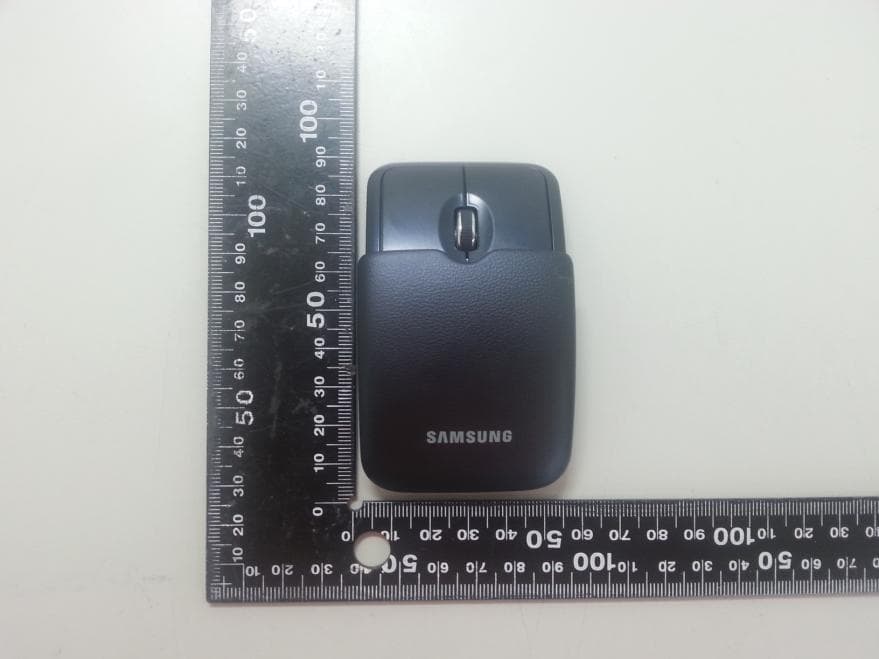
Click to zoom
Application Details
- Equipment Class
- DSS - Part 15 Spread Spectrum Transmitter
- Date of Grant
- Apr 19, 2015
- Application Purpose
- Original Equipment
- Date of Application
- Apr 19, 2015
- Equipment Note
- Bluetooth Mouse Slide
- Frequency Range
- 2402.00000000 - 2480.00000000
- Company
- Samsung Electronics Co Ltd
- Country
- United States
Documents & Files
Document Text
Text extracted from the exhibit documents filed with the FCC. Open a document above to read the original.
Users Manual
1. Turn the mouse over and remove the protective tape from the bottom of the mouse. 2. Loosen and r emove the two screws. 3. From the side of the sliding cover, use a flat- edged tool to pry open the bottom part of the cover. 4. Slide the co ver open. Then, loosen and remove the three screws on the metal connection. 5. Lift the metal connection plate off the two locating pins and remove the top part of the sliding cover. 6. Tur n the mouse back over and from the front of the mouse use a flat-edged tool to pry open the button panel. 7. Loosen and remove the six screws along the border of the mouse. 8. Pry open the cover to gain access to the circuit board. 9. Use wire cutters to cut the wires between the battery and the circuit board. 10. Pr y the battery cover loose from the two connection points and remove the battery. Declaration of Conformity Product details For the following Product : Model(s) : EJ-MT820I Declaration & Applicable standards We hereby declare, that the product above is in compliance with the essential requirements of the R&TTE Directive (1999/5/EC) by application of: EN 301 489-1 V1.9.2 EN 301 489-3 V1.4.1 EN 301 489-17 V2.2.1 EN 55013 : 2001 / A1 : 2003 / A2 : 2006 EN 55020 : 2007 / A11 : 2011 EN 300 328 V1.8.1 EN 302 291-1 V1.1.1 EN 302 291-2 V1.1.1 EN 60950-1 : 2006 + A11 : 2009 + A1 : 2010 + A12 : 2011 and the Directive (2011/65/EU) on the restriction of the use of certain hazardous substances in electrical and electronic equipment by application of EN 50581:2012. The conformity assessment procedure referred to in Article 10 and detailed in Annex[IV] of Directive 1999/5/EC has been followed with the involvement of the following Notified Body(ies): TÜV SÜD BABT, Octagon House, Concorde Way, Fareham, Hampshire, PO15 5RL, UK* Identification mark: 0168 Representative in the EU Samsung Electronics Euro QA Lab. (YEAR TO Blackbushe Business Park BEGIN AFFIXING Saxony Way, Yateley, Hampshire CE MARKING 2015 Yateley, Hampshire, GU46 6GG, UK 2014.XX.XX Stephen Colclough / EU Representative (Place and date of issue) (Name and signature of authorised person) * This is not the address of Samsung Service Centre. For the address or the phone number of Samsung Service Centre, see the warranty card or contact the retailer where you purchased your product. b a c d e f g Copyright © 2015 Samsung Electronics English Bluetooth ® is a registered trademark of Bluetooth SIG, Inc. worldwide. • Please read this manual before using the device to ensure safe and proper use. • Images may differ in appearance from the actual product. Content is subject to change without prior notice. You can access the full user manual for more information. Visit www.samsung.com to view device information, the user manual, and more. • The mouse is compatible with mobile devices and computers running Android 4.1 or higher or Windows 7 or higher. Device layout Scroll wheel Sliding cover Right buttonCharging port Notification lightCONNECT button Left button Charging the battery Before using the mouse for the first time, you must charge the battery. Open the charging port cover and connect the mouse to a computer or the USB power adaptor via the USB cable. • You can charge the device using the charger (sold separately). • The charger should remain close to the electric socket and easily accessible while charging. • The socket-outlet shall be installed near the equipment and shall be easily accessible. Turning the mouse on and off Turn on the mouse by sliding the cover open. Close the cover to turn it off. When you turn on the mouse for the first time, it enters Bluetooth pairing mode. Connecting to another device 1. Press and hold the CONNECT button for more than three seconds. The notification light flashes red, green, and blue and then the mouse enters Bluetooth pairing mode. 2. On your other devic e, activate the Bluetooth feature and tap Samsung Bluetooth Mouse Slide from the list. Safety information Read all safety information before using the device to ensure safe and proper use. To view the full safety information, refer to the Samsung website. Use manufacturer-approved batteries, chargers, accessories, and supplies Do not touch the device with wet hands Do not drop or cause an impact to the charger or the device Do not store your device in very hot or very cold areas. It is recommended to use your device at temperatures from 5°C to 35°C Prevent the multipurpose jack and the small end of the charger from contact with conductive materials, such as liquids, dust, metal powders, and pencil leads Do not allow children or animals to chew or suck the device Do not disassemble, modify, or repair your device Correct disposal This marking on the product, accessories or literature indicates that the product and its electronic accessories (e.g. charger, headset, USB cable) should not be disposed of with other household waste. This product is RoHS compliant. This marking on the battery, manual or packaging indicates that the batteries in this product should not be disposed of with other household waste. Removing the battery • To remove the battery, you must visit an authorised service centre with the provided instructions. • For your safety, you must not attempt to remove the battery. If the battery is not properly removed, it may lead to damage to the battery and device, cause personal injury, and/or result in the device being unsafe. • Samsung does not accept liability for any damage or loss (whether in contract or tort, including negligence) which may arise from failure to precisely follow these warnings and instructions, other than death or personal injury caused by Samsung’s negligence. QUICK START GUIDE EJ-MT820I Printed in Korea A00448 Rev.1.0 E Type 04/2015 FCC ID: A3LEJMT820I FCC Part 15.19 This device complies with part 15 of the FCC Rules. Operation is subject to the following two conditions: (1) This device may not cause harmful interference, and (2) this device must accept any interference received, includi…
Text truncated - open the document above for the full version.
Cover Letter(s)
129, Samsung‐Ro, Yeongtong‐Gu, Suwon‐City Gyeonggi‐Do, 443‐742, Korea April 20, 2015 Federal Communications Commission Authorization and Evaluation Division 7435 Oakland Mills Road, Columbia, MD 21046 LETTER OF AUTHORIZATION To whom it may concern: I, the undersigned, hereby authorize Lab Manager Hyunchae, You (or Logan, Lee) and of SGS Korea Co., Ltd. and hereafter referred to as SGS Korea, to act on our behalf in all manners relating to application for equipment authorization, including signing of all documents relating to these matters. Any and all acts carried out by Lab Manager Hyunchae, You (or Logan. Lee) of SGS Korea Co., Ltd. on our behalf shall have the same effect as acts of our own. I, the undersigned, hereby certify that we are not subject to a denial of federal benefits, that includes FCC benefits, pursuant to Section 5301 of the Anti‐Drug Abuse Act of 1988, 21 U.S.C. 853(a). In authorizing SGS Korea as our agent, we still recognize that we are responsible to: a) comply with the relevant provisions of the certification program; b) make all necessary arrangements for the conduct of the evaluation, including provision for examining documentation and access to all areas, records (including internal audit reports) and personnel for the purposes of evaluation (e.g. testing, inspection, assessment, surveillance, reassessment) and resolution of complaints; c) make claims regarding certification only in respect of the scope for which certification has been granted; d) do not use our product certification in such a manner as to bring the Certification Division into disrepute and not make any statement regarding our product certification which the Certification Division may consider misleading or unauthorized; e) upon suspension or cancellation of certification, discontinue use of all advertising matter that contains any reference thereto and return any certification documents as required by the Certification Division; f) use certification only to indicate the products are certified as being in conformity with specified standards; g) endeavor to ensure that no certificate or report nor any part thereof is used in a misleading manner; h) ensure that any reference to our product certification in communication media such as documents, brochures or advertising, complies with the requirements of the Certification Division; 129, Samsung‐Ro, Yeongtong‐Gu, Suwo n‐City Gyeonggi‐Do, 443‐742, Korea i) keep a record of all complaints made known to the us relating to the product’s compliance with requirements of the relevant standard and to make these records available to the Certification Division when requested; j) take appropriate action with respect to such complaints and any deficiencies found in products or services that affect compliance with the requirements for certification; k) document the actions taken. This authorization is valid until further written notice from the applicant. Sincerely Yours Chan Ho, Youn / General Manager Samsung Electronics North America INC. TEL: +1-973-808-6362 E-mail: [email protected]
Cover Letter(s)
129, Samsun g‐Ro, Yeongtong‐Gu, Suwon‐City Gyeonggi‐Do, 443‐742, Korea April 20, 2015 Federal Communications Commission Authorization and Evaluation Division 7435 Oakland Mills Road, Columbia, MD 21046 REQUEST OF CONFIDENTIALITY for FCC ID: A3LEJMT820I To Whom It May Concern: Pursuant to Sections 0.457 and 0.459 of the Commission’s Rules (CFR 47), and Section 552 (b) (4) of the Freedom of Information Act, Samsung Electronics Co., Ltd. hereby requests confidentiality and treatment of certain information accompanying this application. The materials contain trade secrets and proprietary information not customarily released to the public. The public disclosure of these matters might be harmful to the Applicant and provide unjustified benefits to its competitors. We are also hereby request Short‐Term Confidentiality for 180 days after the grant as outlined in Public Notice DA 04‐1705. This provision will give Samsung Electronics Co., Ltd temporary confidentiality of commercially sensitive information prior to product release. The requested Permanent and Temporary Confidential exhibits are listed as follows: CONFIDENTIAL LIST Permanent 1 Block Diagram 2 Operational Descriptions 3 Schematics Short‐Term 4 External Photos 5 Internal Photos 6 Test‐Setup Photos 7 User Manual The Applicant understands that pursuant to Rule 0.457, disclosure of this application and all accompanying documentations, where applicable, will not be made public before the date of the Grant for this application. Sincerely Yours, Chan Ho, Youn / General Manager Samsung Electronics North America INC. TEL: +1-973-808-6362 E-mail: [email protected]
External Photos
External photos of EUT Top view of EUT Bottom view of EUT Side view of EUT
ID Label/Location Info
Label Information FCC ID: A3LEJMT820I IC: 649E-EJMT820I Bottom side of EUT Slide Label Location Product Label
Internal Photos
Internal photos of EUT Internal view of EUT Top view of PCB Bottom view of PCB Antenna Pattern Antenna
RF Exposure Info
FCC ID : A3LEJMT820I According to KDB 447498 D01 General RF Exposure Guidance v05, section 4.3.1 At 100㎒to 6㎓and fortest separation distances≤50 mm, the SAR test exclusion threshold is determined according to the following [(max. power of channel, including tune-up tolerance,㎽) / (min. test separation distance, mm)] x [√f (GHz) ]≤ 3.0 1. SAR test exclusion threshold Frequency : 2 480㎒ (min. separation distances = 5 mm) SAR test exclusion thresholds(5 mm) = 3 x 5 / (√ 2.480 ) = 9.525 ㎽ Max. tune-up tolerance(㎽) SAR Test Exclusion Thresholds(5 mm) (㎽) 39.525 Calculation value : 3 (㎽) / 5 (mm) x √ 2.480 = 0.945 So, Calculation value≤ 3.0 Remark: -Max. conducted power (㎽) : maximum tolerance power of EUT (4㏈m) -Max. conducted power 2.51 (㎽) is closet 3 (㎽), so 3 (㎽)was calculated. 2. Conclusion : No SAR is required.
Test Report
Report Number:F690501/RF-RTL008596Page:2of47 The results shown in this test report refer only to the sample(s) tested unless otherwise stated. This test report cannot be reproduced, except in full, without prior written permission of the Company. SGS Korea Co., Ltd. (Gunpo Laboratory)4, LS-ro 182beon-gil, Gunpo-si, Gyeonggi-do, Korea, 435-040 http://www.sgsgroup.kr RTT5041-20(2014.01.20)(2)Tel. +82 31 428 5700 / Fax. +82 31 427 2370 A4(210 mmx297 mm) INDEX Table of ContentsPage 1. General Information ---------------------------------------------------------------------------------3 2. Transmitter Radiated Spurious Emissions and Conducted Spurious Emission ------7 3. 20㏈Bandwidth ------------------------------------------------------------------------------------- 23 4. Maximum Peak Output Power -------------------------------------------------------------------27 5. Carrier Frequency Separation --------------------------------------------------------------------29 6. Number of Hopping Frequencies ----------------------------------------------------------------31 7. Time of Occupancy(Dwell Time) -----------------------------------------------------------------34 8. Transmitter AC Power Line Conducted Emission -------------------------------------------42 9. Antenna Requirement ------------------------------------------------------------------------------47 Report Number: F690501/RF-RTL008596 Page: 3 of 47 1. General Information 1. 1. Testing Laboratory SGS Korea Co., Ltd. (Gunpo Laboratory) - Wireless Div. 2FL, 10-2, LS-ro 182beon-gil, Gunpo-si, Gyeonggi-do, Korea, 435-837 All SGS services are rendered in accordance with the applicable SGS conditions of service available on request and accessible at http://www.sgs.com/en/Terms-and-Conditions.aspx. Telephone : +82 31 688 0901 FAX : +82 31 688 0921 1.2. Details of Applicant Applicant : Samsung Electronics Co., Ltd. Address : 129, Samsung-ro, Yeongtong-gu, Suwon-si, Gyeonggi-do, 443-742 Rep. of Korea Contact Person : Ka, Tae-Hwan Phone No. : +82 31 8062 5071 1. 3. Description of EUT Kind of Product Bluetooth Mouse Slide Model Name EJ-MT820I Power Supply DC 3.7 V Frequency Range 2 402 ㎒ ~ 2 480 ㎒ Modulation Technique GFSK Number of Channels 79 channels Antenna Type Internal Type Antenna Gain 3.18 ㏈i H/W Version REV1.0 S/W Version EJ-MT820I_SW01 1.4. Declaration by the manufacturer - Adaptive Frequency Hopping is supported and use at least 20 channels - The modulation type of this Bluetooth device is only GFSK The results shown in this test report refer only to the sample(s) tested unless otherwise stated. This test report cannot be reproduced, except in full, without prior written permission of the Company. SGS Korea Co., Ltd. (Gunpo Laboratory) 4, LS-ro 182beon-gil, Gunpo-si, Gyeonggi-do, Korea, 435-040 http://www.sgsgroup.kr RTT5041-20(2014.01.20)(2) Tel. +82 31 428 5700 / Fax. +82 31 427 2370 A4(210 mmx297 mm) Report Number:F690501/RF-RTL008596Page:4of47 The results shown in this test report refer only to the sample(s) tested unless otherwise stated. This test report cannot be reproduced, except in full, without prior written permission of the Company. SGS Korea Co., Ltd. (Gunpo Laboratory)4, LS-ro 182beon-gil, Gunpo-si, Gyeonggi-do, Korea, 435-040 http://www.sgsgroup.kr RTT5041-20(2014.01.20)(2)Tel. +82 31 428 5700 / Fax. +82 31 427 2370 A4(210 mmx297 mm) 1.5. Information about the FHSS characteristics: 1.5.1. Pseudorandom Frequency Hopping Sequence The channel is represented by a pseudo-random hopping sequence hopping through the 79 RF channels. The hopping sequence is unique for the piconet and is determined by the Bluetooth device address of the master; the phase in the hopping sequence is determined by the Bluetooth clock of the master. The channel is divided into time slots where each slot corresponds to an RF hop frequency. Consecutive hops correspond to different RF hop frequencies. The nominal hop rate is 1 600 hops/s. 1.5.2. Equal Hopping Frequency Use The channels of this system will be used equally over the long-term distribution of the hopsets. 1.5.3. Example of a 79 hopping sequence in data mode: 02, 05, 31, 24, 20, 10, 43, 36, 30, 23, 40, 06, 21, 50, 44, 09, 71, 78, 01, 13, 73, 07, 70, 72, 35, 62, 42, 11, 41, 08, 16, 29, 60, 15, 34, 61, 58, 04, 67, 12, 22, 53, 57, 18, 27, 76, 39, 32, 17, 77, 52, 33, 56, 46, 37, 47, 64, 49, 45, 38, 69, 14, 51, 26, 79, 19, 28, 65, 75, 54, 48, 03, 25, 66, 05, 16, 68, 74, 59, 63, 55 1.5.4. System Receiver Input Bandwidth Each channel bandwidth is 1㎒. The system receivers have input bandwidths that match the hopping channel bandwidths of their corresponding transmitters and shift frequencies in synchronization with the transmitted signals. 1.5.5. Equipment Description 15.247(a)(1) that the rx input bandwidths shift frequencies in synchronization with the transmitted 15.247(g): In accordance with the Bluetooth Industry Standard, the system is designed to comply with all of the regulations in Section 15.247 when the transmitter is presented with a continuous data (or information) system. 15.247(h): In accordance with the Bluetooth Industry Standard, the system does not coordinate it channels selection/ hopping sequence with other frequency hopping systems for the express purpose of avoiding the simultaneous occupancy of individual hopping frequencies by multiple transmitters. Report Number:F690501/RF-RTL008596Page:5of47 The results shown in this test report refer only to the sample(s) tested unless otherwise stated. This test report cannot be reproduced, except in full, without prior written permission of the Company. SGS Korea Co., Ltd. (Gunpo Laboratory)4, LS-ro 182beon-gil, Gunpo-si, Gyeonggi-do, Korea, 435-040 http://www.sgsgroup.kr RTT5041-20(2014.01.20)(2)Tel. +82 31 428 5700 / Fax. +82 31 427 2370 A4(210 mmx297 mm) 1.6. Test Equipment List EquipmentManufacturerModelS/NCal Date Cal Interval Cal Due. Signal GeneratorR&SSMR40100272Jul. 18, 2014AnnualJul. 18, 2015 Signal GeneratorR&SSMBV100A2590…
Text truncated - open the document above for the full version.
Test Setup Photos
Test setup photos of EUT A. Orthogonal planes of EUT - The testing was set in the three orthogonal planes and measured for each position (X, Y, Z). 1. X- axis 2. Y-axis 3. Z-axis B. Photo of Radiated Spurious Emission Test (Below 1㎓) C. Photo of Radiated Spurious Emission Test (Above 1㎓) - DUT was tested in the X-axis D. Photos of AC Power line emission test
Contact Information
Applicant
Jenni Chun(General Manager)
Test Firm
SGS KOREA CO., Ltd.Jackie Jeon
Technical Specifications
| # | Rule Parts | Frequency Range | Power Output |
|---|---|---|---|
| 1 | 15C | 2.40 GHz - 2.48 GHz | 2.00 mW |
Other Applications from Samsung Electronics Co Ltd
A3LSMS741B
Aug 05, 2026Portable Handset
Equipment Class
6VL - 15E 6 GHZ Very Low Power DeviceA3LSMX940
Jul 31, 2026BT,BLE Tablet DTS,UNII a,b,g,n,ac,ax,be and digitizer
Equipment Class
DTS - Digital Transmission SystemA3LSMS741U
Jul 30, 2026Portable Handset
Equipment Class
6CD - 15E 6 GHz Low Power Dual ClientA3LSMX840
Jul 27, 2026BT,BLE Tablet DTS,UNII a,b,g,n,ac,ax and Digitizer
Equipment Class
DSS - Part 15 Spread Spectrum TransmitterA3LSMX848U
Jul 27, 2026WCDMA, LTE, 5G NR Tablet BT,BLE, DTS,UNII a b g n ac ax and Digitizer
Equipment Class
JBP - Part 15 Class B Computing Device Peripheral