A3LSCHI640Dual-Band CDMA Phone
Samsung Electronics Co Ltd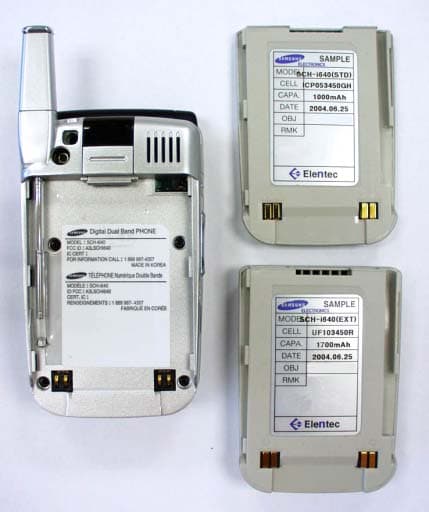
Click to zoom
Application Details
- Equipment Class
- PCE - PCS Licensed Transmitter held to ear
- Date of Grant
- Sep 22, 2004
- Application Purpose
- Original Equipment
- Date of Application
- Sep 22, 2004
- Equipment Note
- Dual-Band CDMA Phone
- Frequency Range
- 1851.25000000 - 1908.75000000
- Company
- Samsung Electronics Co Ltd
- Country
- United States
Documents & Files
Document Text
Text extracted from the exhibit documents filed with the FCC. Open a document above to read the original.
Users Manual
SCH-i640/645 User’s Manual Please read this manual before operating the phone, and keep it for future reference. Contents Safety Precautions .................................................... 3 Introduction to SCH-i640/645 .................................................... 5 Unpacking .................................................... 6 Layout .................................................... 7 How to use Smartphone .................................................... 11 Dialer and Call Progress .................................................... 13 Input Methods .................................................... 15 Other Applications .................................................... 16 Various Settings for Your Phone .......................................... 17 Installing ActiveSync® .................................................... 18 For More Information .................................................... 18 Health and Safty Information ................................................ 19 2 Safety Precautions Compliance with Safety Standards The Samsung Cellular phone meets all standards and recommendations for the protection of the public from exposure to radio frequency (RF) electromagnetic energy established by governmental bodies and other qualified organizations. To reduce the risk of fire, electric shock, serious personal injury, or property damage, please follow these guidelines: Driving Using a wireless phone while driving is illegal in some states and countries. Know the laws and regulations for your area, and pull off the road and park if you need to make a call. If you must use the phone while driving, purchase and install the optional Hands- Free Car Kit. Electronic Devices Your wireless telephone is a radio transmitter and receiver. When the power is on, the phone receives and sends out RF energy. Most modern electronic equipment, such as cars, contains an RF signal shield. RF energy may affect some inadequately shielded electronic equipment. Turn off your phone in health care facilities, and always request pacemakers and hearing aids, to determine if they are shielded adequately from external RF signals. Note if there are any regulations posted in area regarding the operation of wireless phones, and learn where you can use them safely within facility. Aircraft Turn off your phone before boarding any aircraft. The Federal Aviation Administration (FAA) requires that you have prior permission from the crew to use your phone while the plane is on the ground. FCC regulations prohibit using your phone is in the air. Do not use your phone at any time while traveling on board a plane. Blasting Areas Construction crews often use remote-control RF devices to set off explosives. To avoid interfering with blasting operation, turn off your phone when you are in a blasting area or in any area with signs posted as "Turn off two-way radio." 3 Other Dangerous Areas Turn off your phone in any area with a potentially explosive atmosphere. It is rare, but your phone or its accessories could generate sparks, which could lead to explosion or fire. * Fueling areas, such as gas stations * Below deck on boats * Fuel or chemical transfer or storage facilities * Areas where the air contains chemicals or particles such as grain, dust, or metal powders * Any other area where you would normally be advised to turn off your vehicle engine Do not transport or store flammable gas, liquid, or explosives in the compartment of a vehicle containing your phone or accessories. FCC/IC Notice This device compiles with part 15 of the FCC rules. Operation is subject to the following two conditions: (1) This device may not cause harmful interference, and (2) this device must accept any interference received, including interference that may cause undesired operation. 4 Introduction to SCH-i640/645 The following features provide a range of user options that make the phone both fun and easy to use. SCH-i640/645 is based on Microsoft® Windows Mobile® Smartphone 2003 Second Edition. Phone features: You can use advanced phone capabilities. PDA features: Contacts, Calendar, Messaging, Internet Explorer, Windows Media, MSN Messenger, Tasks, Voice Notes, Games, etc. Messaging features: You can receive four kinds of messages - voicemail, text, E-mail, and MMS (645 only). Data capability: ActiveSync® technology to synchronize your phone and PC. Input methods: 3 standard modes - Numeric, T9, multi-press 5 Unpacking z z z z z z z z z z z z z z z 6 Layout The following pictures show the main elements of SCH-i645. (Design can be changed later) [Picture 1] Inside of SCH-i645 7 Earphone jack: Connects the optional 2.5mm ear/microphone. External screen: A secondary screen for phone features. IR port: Uses infrared technology to transmit data to and receive data from other computing platform handhelds, and to perform ActiveSync® operations. Accessory connector: Connects your phone to the cradle, which in turn connects to the back of your computer and through the AC adapter to the wall current. SD slot: Inserts SD card for extended memory, and connects peripherals using SD I/O interface. Volume keys: Press to adjust voice volume during conversation, and adjust audio volume in standby mode. Record button: Press to launch Voice Notes, and press one more time to record the voice memo. Press and hold to activate voice recognition command. Quick List key: Press to launch the Quick List and press and hold to turn phone (radio module) on/off. Camera key (Side): Press and hold to launch the camera application, and press one more time to take a picture or record a video (645 only). 8 How to use Smartphone Home screen The Home screen plays an integral part in the navigational model of Smartphone. It is the first screen displayed every time the device is turned on. The user can easily return. Sample Home Screen Home screen customization The Home screen provides users a customizable starting page for their Smartphone. It can be…
Text truncated - open the document above for the full version.
Attestation Statements
September 17, 2004 Federal Communications Commission Authorization and Evaluation Div. Equipment Authorization Branch 7435 Oakland Mills Road Columbia, MD 21046 In re: Samsung Electronics Co., Ltd. FCC ID.: A3LSCHI640 Request for Confidentiality To Whom It May Concern: In accordance with 0.459 of CFR 47, Samsung Electronics Co., Ltd. requests confidentiality for the Block Diagram, Schematics, Parts list, Tune-up Procedure, Operational and Circuit Description of the attached test report. These documents contain detailed system and equipment descriptions and related information about the product, which Samsung Electronics Co., Ltd. considers to be proprietary, confidential, and a custom design and otherwise, would not release to the general public. Since this design is a basis from which future technological products will evolve, Samsung feels that this information would be of benefit to its competitors, and that the disclosure of the information in these documents would give our competitors an unfair advantage in the market. Sincerely, Wallace Oh Engineering Manager Samsun Samsung Electronics America September 17, 2004 Federal Communications Commission Authorization and Evaluation Div. Equipment Authorization Branch 7435 Oakland Mills Road Columbia, MD 21046 In re: Samsung Electronics Co., Ltd. FCC ID: A3LSCHI640 Request for Short-Term Confidentiality To Whom It May Concern: In accordance with 0.457 and 0.459 of CFR 47, Samsung Electronics Co., Ltd. requests short-term confidentiality for the test setup photos, external photos, internal photos, and user’s manual of the attached test report. These documents contain detailed system and equipment descriptions and related information about the product, which Samsung Electronics Co., Ltd. considers to be proprietary, confidential, and a custom design and otherwise, would not release to the general public. Since this design is a basis from which future technological products will evolve, Samsung feels that this information would be of benefit to its competitors, and that the disclosure of the information in these documents would give our competitors an unfair advantage in the market. Sincerely, Wallace Oh Engineering Manager Samsun Samsung Electronics America
External Photos
© 2004 SAMSUNG ELECTRONICS Co., Ltd. SAMSUNG FCC ID: A3LSCHI640 Dual-Mode Dual-Band CDMA/ PCS Phone © 2004 SAMSUNG ELECTRONICS Co., Ltd. SAMSUNG FCC ID: A3LSCHI640 Dual-Mode Dual-Band CDMA/ PCS Phone © 2004 SAMSUNG ELECTRONICS Co., Ltd. SAMSUNG FCC ID: A3LSCHI640 Dual-Mode Dual-Band CDMA/ PCS Phone © 2004 SAMSUNG ELECTRONICS Co., Ltd. SAMSUNG FCC ID: A3LSCHI640 Dual-Mode Dual-Band CDMA/ PCS Phone © 2004 SAMSUNG ELECTRONICS Co., Ltd. SAMSUNG FCC ID: A3LSCHI640 Dual-Mode Dual-Band CDMA/ PCS Phone
Internal Photos
© 2004 SAMSUNG ELECTRONICS Co., Ltd. SAMSUNG FCC ID: A3LSCHI640 Dual-Mode Dual-Band CDMA/ PCS Phone © 2004 SAMSUNG ELECTRONICS Co., Ltd. SAMSUNG FCC ID: A3LSCHI640 Dual-Mode Dual-Band CDMA/ PCS Phone
RF Exposure Info
1 of 31 SAMSUNG ELECTRONICS Co., Ltd., Regulatory Compliance Team IT R&D Center 416, Maetan-3dong, Yeongtong-gu, Suwon-si, Gyeonggi-do, Korea 442-742 TEST REPORT ON SAR Model Tested: SCH-i640 (Additional Model:SCH-i641~SCH-i644) FCC ID (Requested): A3LSCHI640 Job No: FB-048 Report No: FB-048-S1 Date issued: Sep. 14, 2004 - Abstract – This document reports on SAR Tests carried out in accordance with FCC/OET Bulletin 65, Supplement C(July 2001). Prepared By Date JH NAM – Test Engineer Checked By Date JH CHOI - Manager Authorized By Date JK CHOI – Senior Manager Report Number : FB-048-S1 2 of 31 Contents 1. General Information.............................................................................................3 2. Description of Device...........................................................................................3 3. Description of Test Equipment..............................................................................4 3.1 SAR Measurement Setup.........................................................................................4 3.2 DASY4 E-Field Probe.............................................................................................5 3.3 SAM Phantom.....................................................................................................6 3.4 Brain & Muscle Simulating Mixture Characterization....................................................7 3.5 Device Holder for transmitters.................................................................................8 3.6 Validation Dipole...................................................................................................8 3.7 Equipment Calibration.............................................................................................9 4. SAR Measurement Procedure.............................................................................10 5. Description of test position..............................................................................11 5.1 SAM Phantom Shape............................................................................................11 5.2 Cheek/Touch Position............................................................................................11 5.3 Ear/Tilt 15 Position..............................................................................................13 5.4 Body/Leather Configuration.....................................................................................14 6. Measurement Uncertainty...................................................................................16 7. System Verification............................................................................................18 7.1 Tissue Verification.................................................................................................18 7.2 Test System Validation...........................................................................................18 8. SAR Measurement Results.................................................................................19 8.1 Measurement Results(CELLULAR CDMA Right Head SAR-Touch).................................20 8.2 Measurement Results(CELLULAR CDMA Right Head SAR-Tilt).....................................21 8.3 Measurement Results(CELLULAR CDMA Left Head SAR-Touch)...................................22 8.4 Measurement Results(CELLULAR CDMA Left Head SAR-Tilt).......................................23 8.5 Measurement Results(PCS CDMA Right Head SAR-Touch)..........................................24 8.6 Measurement Results(PCS CDMA Right Head SAR-Tilt)................................................25 8.7 Measurement Results(PCS CDMA Left Head SAR-Touch)..............................................26 8.8 Measurement Results(PCS CDMA Left Head SAR-Tilt)..................................................27 8.9 Measurement Results(CELLULAR CDMA Body SAR with Holster)...................................28 8.10 Measurement Results(PCS CDMA Body SAR with Holster)...........................................29 9. Conclusion.......................................................................................................30 10. Reference.......................................................................................................31 Report Number : FB-048-S1 3 of 31 1. GENERAL INFORMATION Test Sample : Dual-Mode Dual-Band CDMA/ PCS Phone Model Number : SCH-i640 ~ SCH-i644 Serial Number : Identical prototype (S/N : # FB-048-D ) Manufacturer : SAMSUNG ELECTRONICS Co., Ltd. Contact : YB SONG, Assistant Manager Phone : +82-31-279-6925 Fax : +82-31-279-6545 Test Standard : §2.1093; FCC/OET Bulletin 65, Supplement C(July 2001) FCC Classification : Licensed Portable Transmitter Held to Ear (PCE) Test Dates : Sep. 03, 2004 ~ Sep. 07, 2004 Tested for : FCC/TCB Certification 2. DESCRIPTION OF DEVICE Tx Freq. Range : 824.70 – 848.31 MHz (CDMA) 1851.25 – 1908.75 MHz (PCS CDMA) Rx Freq. Range : 869.70 – 893.31 MHz (CDMA) 1931.25 – 1988.75 MHz (PCS CDMA) Max. RF Output Power : 0.294 W ERP CDMA (24.69dBm) 0.714 W EIRP PCS (28.54dBm) Antenna Manufacturer : ACE Model No.: SCH-i640 Antenna Dimensions : Length = 84.5mm [Helical / Whip] Report Number : FB-048-S1 4 of 31 3. DESCRIPTION OF TEST EQUIPMENT 3.1 SAR Measurement Setup Robotic System Measurements are performed using the DASY4 automated dosimetric assessment system. Which is made by Schmid & Partner Engineering AG (SPEAG) in Zurich, Switzerland and consists of high precision robotics system (Stäubli), robot controller, measurement server, Samsung computer, near- field probe, probe alignment sensor, and the SAM twin phantom containing the brain equivalent material. The robot is a six-axis industrial robot performing precise movements to position the probe to the location (points) of maximum electromagnetic field (EMF) (see Fig. 3.1). Figure 3.1 SAR Measurement System Setup System Hardware A cell controller system contains the power supply, robot controller, teach pendant (Joys…
Text truncated - open the document above for the full version.
RF Exposure Info
SAMSUNG FCC ID : A3LSCHI640 -- 835 MHz CDMA Head SAR DUT: SCH-i640; Serial: FB-048-D Program Name: SCH-i640 CDMA Right (Job No.: FB-048) Procedure Name: Cheek/Touch, Ch.0777, Ant.In, Bat.Extended Procedure Notes: Meas.Tissue Temp(celsius)-21.8;Test Date-03/Sep/2004[OET Bulletin 65- Supplement C, July 2001] Communication System: CDMA; Frequency: 848.31 MHz;Duty Cycle: 1:1 Medium parameters used: f = 848.31 MHz; σ = 0.89 mho/m; ε r = 41.1; ρ = 1000 kg/m 3 Phantom section: Right Section DASY4 Configuration: - Probe: ET3DV6 - SN1735; ConvF(7, 7, 7); Calibrated: 2003-11-20 - Sensor-Surface: 4mm (Mechanical And Optical Surface Detection) - Electronics: DAE3 Sn468; Calibrated: 2003-11-21 - Phantom: SAM 835/900 MHz; Type: SAM; Serial: TP-1141 - Measurement SW: DASY4, V4.3 Build 16; Postprocessing SW: SEMCAD, V1.8 Build 123 Cheek/Touch, Ch.0777, Ant.In, Bat.Extended/Area Scan (51x71x1): Measurement grid: dx=20mm, dy=20mm Maximum value of SAR (interpolated) = 0.669 mW/g Cheek/Touch, Ch.0777, Ant.In, Bat.Extended/Zoom Scan (6x6x7)/Cube 0: Measurement grid: dx=8mm, dy=8mm, dz=5mm Reference Value = 12.2 V/m; Power Drift = -0.1 dB Peak SAR (extrapolated) = 1.08 W/kg SAR(1 g) = 0.687 mW/g Maximum value of SAR (measured) = 0.709 mW/g 0 dB = 0.709mW/g SAMSUNG FCC ID : A3LSCHI640 -- 835 MHz CDMA Head SAR DUT: SCH-i640; Serial: FB-048-D Program Name: SCH-i640 CDMA Right (Job No.: FB-048) Procedure Name: Ear/Tilt, Ch.0363, Ant.In, Bat.Extended Procedure Notes: Meas.Tissue Temp(celsius)-21.8;Test Date-03/Sep/2004[OET Bulletin 65- Supplement C, July 2001] Communication System: CDMA; Frequency: 835.89 MHz;Duty Cycle: 1:1 Medium parameters used: f = 835.89 MHz; σ = 0.89 mho/m; ε r = 41.1; ρ = 1000 kg/m 3 Phantom section: Right Section DASY4 Configuration: - Probe: ET3DV6 - SN1735; ConvF(7, 7, 7); Calibrated: 2003-11-20 - Sensor-Surface: 4mm (Mechanical And Optical Surface Detection) - Electronics: DAE3 Sn468; Calibrated: 2003-11-21 - Phantom: SAM 835/900 MHz; Type: SAM; Serial: TP-1141 - Measurement SW: DASY4, V4.3 Build 16; Postprocessing SW: SEMCAD, V1.8 Build 123 Ear/Tilt, Ch.0363, Ant.In, Bat.Extended/Area Scan (51x71x1): Measurement grid: dx=20mm, dy=20mm Maximum value of SAR (interpolated) = 0.156 mW/g Ear/Tilt, Ch.0363, Ant.In, Bat.Extended/Zoom Scan (5x5x7)/Cube 0: Measurement grid: dx=8mm, dy=8mm, dz=5mm Reference Value = 11.2 V/m; Power Drift = 0.0 dB Peak SAR (extrapolated) = 0.194 W/kg SAR(1 g) = 0.154 mW/g Maximum value of SAR (measured) = 0.162 mW/g 0 dB = 0.162mW/g SAMSUNG FCC ID : A3LSCHI640 -- 835 MHz CDMA Head SAR DUT: SCH-i640; Serial: FB-048-D Program Name: SCH-i640 CDMA Left (Job No.: FB-048) Procedure Name: Cheek/Touch, Ch.0363, Ant.In, Bat.Extended Procedure Notes: Meas.Tissue Temp(celsius)-21.8;Test Date-03/Sep/2004[OET Bulletin 65- Supplement C, July 2001] Communication System: CDMA; Frequency: 835.89 MHz;Duty Cycle: 1:1 Medium parameters used: f = 835.89 MHz; σ = 0.89 mho/m; ε r = 41.1; ρ = 1000 kg/m 3 Phantom section: Left Section DASY4 Configuration: - Probe: ET3DV6 - SN1735; ConvF(7, 7, 7); Calibrated: 2003-11-20 - Sensor-Surface: 4mm (Mechanical And Optical Surface Detection) - Electronics: DAE3 Sn468; Calibrated: 2003-11-21 - Phantom: SAM 835/900 MHz; Type: SAM; Serial: TP-1141 - Measurement SW: DASY4, V4.3 Build 16; Postprocessing SW: SEMCAD, V1.8 Build 123 Cheek/Touch, Ch.0363, Ant.In, Bat.Extended/Area Scan (51x71x1): Measurement grid: dx=20mm, dy=20mm Maximum value of SAR (interpolated) = 0.573 mW/g Cheek/Touch, Ch.0363, Ant.In, Bat.Extended/Zoom Scan (5x5x7)/Cube 0: Measurement grid: dx=8mm, dy=8mm, dz=5mm Reference Value = 12.2 V/m; Power Drift = -0.1 dB Peak SAR (extrapolated) = 0.678 W/kg SAR(1 g) = 0.531 mW/g Maximum value of SAR (measured) = 0.546 mW/g 0 dB = 0.546mW/g SAMSUNG FCC ID : A3LSCHI640 -- 835 MHz CDMA Head SAR DUT: SCH-i640; Serial: FB-048-D Program Name: SCH-i640 CDMA Left (Job No.: FB-048) Procedure Name: Ear/Tilt, Ch.0363, Ant.In, Bat.Extended Procedure Notes: Meas.Tissue Temp(celsius)-21.8;Test Date-03/Sep/2004[OET Bulletin 65- Supplement C, July 2001] Communication System: CDMA; Frequency: 835.89 MHz;Duty Cycle: 1:1 Medium parameters used: f = 835.89 MHz; σ = 0.89 mho/m; ε r = 41.1; ρ = 1000 kg/m 3 Phantom section: Left Section DASY4 Configuration: - Probe: ET3DV6 - SN1735; ConvF(7, 7, 7); Calibrated: 2003-11-20 - Sensor-Surface: 4mm (Mechanical And Optical Surface Detection) - Electronics: DAE3 Sn468; Calibrated: 2003-11-21 - Phantom: SAM 835/900 MHz; Type: SAM; Serial: TP-1141 - Measurement SW: DASY4, V4.3 Build 16; Postprocessing SW: SEMCAD, V1.8 Build 123 Ear/Tilt, Ch.0363, Ant.In, Bat.Extended/Area Scan (51x71x1): Measurement grid: dx=20mm, dy=20mm Maximum value of SAR (interpolated) = 0.126 mW/g Ear/Tilt, Ch.0363, Ant.In, Bat.Extended/Zoom Scan (6x6x7)/Cube 0: Measurement grid: dx=8mm, dy=8mm, dz=5mm Reference Value = 10.5 V/m; Power Drift = -0.0 dB Peak SAR (extrapolated) = 0.157 W/kg SAR(1 g) = 0.133 mW/g Maximum value of SAR (measured) = 0.133 mW/g Ear/Tilt, Ch.0363, Ant.In, Bat.Extended/Zoom Scan 2 (5x5x7)/Cube 0: Measurement grid: dx=8mm, dy=8mm, dz=5mm Reference Value = 10.5 V/m; Power Drift = -0.0 dB Peak SAR (extrapolated) = 0.164 W/kg SAR(1 g) = 0.087 mW/g Maximum value of SAR (measured) = 0.096 mW/g 0 dB = 0.096mW/g SAMSUNG FCC ID : A3LSCHI640 -- 1900 MHz PCS CDMA Head SAR DUT: SCH-i640; Serial: FB-048-D Program Name: SCH-i640 PCS Right (Job No.: FB-048) Procedure Name: Cheek/Touch, Ch.0025, Ant.In, Bat.Extended Procedure Notes: Meas.Tissue Temp(celsius)-21.6;Test Date-07/Sep/2004[OET Bulletin 65- Supplement C, July 2001] Communication System: PCS; Frequency: 1851.25 MHz;Duty Cycle: 1:1 Medium parameters used: σ = 1.4; mho/m, ε r = 38.4; ρ = 1000 kg/m 3 Phantom section: Right Section DASY4 Configuration: - Probe: ET3DV6 - SN1617; ConvF(5.11, 5.11, 5.11); Calibrated: 2004-08-27 - Sensor-Surface: 4mm (Mechanical And Optical Surface Detection) - Electronics: DAE3 Sn486; Calibrated: 2004-08-23 - Phantom: SAM 1800/1900 MHz; Type: SAM; Serial: T…
Text truncated - open the document above for the full version.
RF Exposure Info
835MHz Brain Dipole Validaiton DUT: Dipole 835 MHz; Serial: 451 Program Name: 835MHz Dipole Validation Procedure Name: 835MHz @ 250mW Procedure Notes: Meas.Tissue Temp(celsius)-21.6;Test Date-03/Sep/2004 Communication System: CW; Frequency: 835 MHz;Duty Cycle: 1:1 Medium parameters used: f = 835 MHz; σ = 0.89 mho/m; ε r = 41.1; ρ = 1000 kg/m 3 Phantom section: Flat Section DASY4 Configuration: - Probe: ET3DV6 - SN1735; ConvF(7, 7, 7); Calibrated: 2003-11-20 - Sensor-Surface: 4mm (Mechanical And Optical Surface Detection) - Electronics: DAE3 Sn468; Calibrated: 2003-11-21 - Phantom: SAM 835/900 MHz; Type: SAM; Serial: TP-1141 - Measurement SW: DASY4, V4.3 Build 16; Postprocessing SW: SEMCAD, V1.8 Build 123 835MHz @ 250mW/Area Scan (51x51x1): Measurement grid: dx=20mm, dy=20mm Maximum value of SAR (interpolated) = 2.62 mW/g 835MHz @ 250mW/Zoom Scan (5x5x7)/Cube 0: Measurement grid: dx=8mm, dy=8mm, dz=5mm Reference Value = 55.8 V/m; Power Drift = -0.004 dB Peak SAR (extrapolated) = 3.55 W/kg SAR(1 g) = 2.41 mW/g Maximum value of SAR (measured) = 2.61 mW/g 0 dB = 2.61mW/g 835MHz Brain Dipole Validation DUT: Dipole 835 MHz; Serial: 451 Program Name: 835MHz Dipole Validation Procedure Name: 835MHz @ 250mW Procedure Notes: Meas.Tissue Temp(celsius)-21.3;Test Date-06/Sep/2004 Communication System: CW; Frequency: 835 MHz;Duty Cycle: 1:1 Medium parameters used: f = 835 MHz; σ = 0.89 mho/m; ε r = 40.6; ρ = 1000 kg/m 3 Phantom section: Flat Section DASY4 Configuration: - Probe: ET3DV6 - SN1617; ConvF(6.23, 6.23, 6.23); Calibrated: 2004-08-27 - Sensor-Surface: 4mm (Mechanical And Optical Surface Detection) - Electronics: DAE3 Sn486; Calibrated: 2004-08-23 - Phantom: SAM 835/900 MHz; Type: SAM; Serial: TP-1141 - Measurement SW: DASY4, V4.3 Build 16; Postprocessing SW: SEMCAD, V1.8 Build 123 835MHz @ 250mW/Area Scan (51x51x1): Measurement grid: dx=20mm, dy=20mm Maximum value of SAR (interpolated) = 2.74 mW/g 835MHz @ 250mW/Zoom Scan (5x5x7)/Cube 0: Measurement grid: dx=8mm, dy=8mm, dz=5mm Reference Value = 57.5 V/m; Power Drift = 0.002 dB Peak SAR (extrapolated) = 3.72 W/kg SAR(1 g) = 2.5 mW/g Maximum value of SAR (measured) = 2.71 mW/g 0 dB = 2.71mW/g 1900MHz Brain Dipole Validation DUT: Dipole 1900 MHz; Serial: 548 Program Name: 1900MHz Dipole Validation Procedure Name: 1900MHz @ 250mW Procedure Notes: Meas.Tissue Temp(celsius)-21.6;Test Date-07/Sep/2004 Communication System: CW; Frequency: 1900 MHz;Duty Cycle: 1:1 Medium parameters used: σ = 1.4; mho/m, ε r = 38.4; ρ = 1000 kg/m 3 Phantom section: Flat Section DASY4 Configuration: - Probe: ET3DV6 - SN1617; ConvF(5.11, 5.11, 5.11); Calibrated: 2004-08-27 - Sensor-Surface: 4mm (Mechanical And Optical Surface Detection) - Electronics: DAE3 Sn486; Calibrated: 2004-08-23 - Phantom: SAM 1800/1900 MHz; Type: SAM; Serial: TP-1248 - Measurement SW: DASY4, V4.3 Build 16; Postprocessing SW: SEMCAD, V1.8 Build 123 1900MHz @ 250mW/Area Scan (51x51x1): Measurement grid: dx=20mm, dy=20mm Maximum value of SAR (interpolated) = 16.6 mW/g 1900MHz @ 250mW/Zoom Scan (5x5x7)/Cube 0: Measurement grid: dx=8mm, dy=8mm, dz=5mm Reference Value = 96.8 V/m; Power Drift = 0.0 dB Peak SAR (extrapolated) = 17.8 W/kg SAR(1 g) = 10.3 mW/g Maximum value of SAR (measured) = 11.6 mW/g 0 dB = 11.6mW/g
RF Exposure Info
© 2004 SAMSUNG ELECTRONICS Co., Ltd. SAMSUNG FCC ID: A3LSCHI640 Dual-Mode Dual-Band CDMA/ PCS Phone © 2004 SAMSUNG ELECTRONICS Co., Ltd. SAMSUNG FCC ID: A3LSCHI640 Dual-Mode Dual-Band CDMA/ PCS Phone © 2004 SAMSUNG ELECTRONICS Co., Ltd. SAMSUNG FCC ID: A3LSCHI640 Dual-Mode Dual-Band CDMA/ PCS Phone © 2004 SAMSUNG ELECTRONICS Co., Ltd. SAMSUNG FCC ID: A3LSCHI640 Dual-Mode Dual-Band CDMA/ PCS Phone © 2004 SAMSUNG ELECTRONICS Co., Ltd. SAMSUNG FCC ID: A3LSCHI640 Dual-Mode Dual-Band CDMA/ PCS Phone © 2004 SAMSUNG ELECTRONICS Co., Ltd. SAMSUNG FCC ID: A3LSCHI640 Dual-Mode Dual-Band CDMA/ PCS Phone © 2004 SAMSUNG ELECTRONICS Co., Ltd. SAMSUNG FCC ID: A3LSCHI640 Dual-Mode Dual-Band CDMA/ PCS Phone © 2004 SAMSUNG ELECTRONICS Co., Ltd. SAMSUNG FCC ID: A3LSCHI640 Dual-Mode Dual-Band CDMA/ PCS Phone © 2004 SAMSUNG ELECTRONICS Co., Ltd. SAMSUNG FCC ID: A3LSCHI640 Dual-Mode Dual-Band CDMA/ PCS Phone © 2004 SAMSUNG ELECTRONICS Co., Ltd. SAMSUNG FCC ID: A3LSCHI640 Dual-Mode Dual-Band CDMA/ PCS Phone © 2004 SAMSUNG ELECTRONICS Co., Ltd. SAMSUNG FCC ID: A3LSCHI640 Dual-Mode Dual-Band CDMA/ PCS Phone
Test Report
SAMSUNG ELECTRONICS Co., Ltd., Regulatory Compliance Group IT R&D Center 416, Maetan-3Dong, Youngtong-Gu, Suwon-city, Gyeonggi-Do, Korea 442-600 FCC CFR47 PART 22 & 24 SUBPART CERTIFICATION REPORT Model Tested: SCH-i640 Additiond Model: SCH-i641 , SCH-i642 SCH-i643 , SCH-i644 FCC ID (Requested): A3LSCHI640 Report No: FB-048-R1 Job No: FB-048 Date issued: Sep. 17, 2004 - Abstract – All measurement reported herein accordance with FCC Rules, 47CFR Part2, Part22, Part24. Prepared By Date SS LEE – Test Engineer Checked By Date JH CHOI - Engineer Authorized By Date JK CHOI – Senior Manager Report Number : FB-048-R1 TABLE OF CONTENT MEASUREMENT REPORT Page 1. FCC Certification Information 3 1.1 2.1033 General Information 3 2. INTRODUCTION 4 2.1 General 4 3. MEASURING INSTRUMENT CALIBRATION 5 4. TEST EQUIPMENT LIST 6 5. DESCRIPTION OF TESTS 7 5.1 Effective Radiated Power/Equivalent Isotropic Radiated Power 7 5.2 Radiated Spurious & Harmonic Emission 8 5.3 Occupied Bandwidth 10 5.4 Spurious and Harmonic Emissions at Antenna Terminal 10 5.4.1 Occupied Bandwidth Emission Limits 10 5.4.2 Conducted Spurious Emission 11 5.5 Frequency Stability / Temperature Variation 12 6. TEST DATA 13 6.1 Effective Radiated Power(E.R.P.) 13 6.2 Equivalent Isotropic Radiated Power(E.I.R.P.) 14 6.3 Cellular CDMA Radiated Spurious & Harmonic Measurement 15 6.4 PCS CDMA Radiated Spurious & Harmonic Measurement 16 6.5 CDMA Radiated Spurious & Harmonic Conversion Table 17 6.6 PCS Radiated Spurious & Harmonic Conversion Table 18 6.7 Frequency Stability 19 6.7.1 CDMA Frequency Stability Table 19 6.7.2 PCS Frequency Stability Table 20 6.7.3 CDMA Frequency Stability Graph 21 6.7.4 PCS Frequency Stability Graph 23 7.SAMPLE CALCULATION 25 7.1 Emission Designator 8. CONCLUSION 26 9. TEST PLOTS 27 Report Number : FB-048-R1 MEASUREMENT REPORT 1. FCC Certification Information The following information is in accordance with FCC Rules, 47CFR Rart2, Subpart J, Sections 2.1033 – 2.1055. 2.1033 General Information Applicant Name: SAMSUNG ELECRONICS CO., LTD. Address: 416, Maetan-3Dong, Youngtong-Gu, Suwon City Gyeonggi-Do, KOREA 442-600 Attention: FCC ID: Wallace Oh, Engineering Manager (QA Lab) A3LSCHI640 Quantity: Quantity production is planned Emission Designators: 1M25F9W Tx Freq. Range: 824.70-848.31MHz (CDMA) 1851.25-1908.75MHz (PCS CDMA) Rx Freq. Range: 869.70-893.31 MHz (CDMA) 1931.25-1988.75 MHz (PCS CDMA) Max. Power Rating: 0.294 W ERP CDMA( 24.69 dBm) 0.714W EIRP PCS CDMA( 28.54 dBm) FCC Classification(s): Licensed Portable Tx Held to Ear (PCE) Equipment (EUT) Type: Dual-Mode Dual-Band Analog/PCS Phone Modulation(s): CDMA/CDMA PCS Frequency Tolerance: 0.00025% (2.5ppm) FCC Rule Part(s): 24(E), 22(H), 2. Dates of Test: September 03, 09-13, 2004 Place of Test: SAMSUNG Lab, Test Report S/N: FB-048-R1 Report Number : FB-048-R1 2. INTRODUCTION General These measurement test were conducted at SAMSUNG ELECTRONICS CO., LTD(SUWON). The site address is 416,Maetan-3Dong, Youngtong-Gu, Suwon City, Gyeonggi-Do, KOREA 442- 600 The site have 1 Fully-anechoic chamber and measurement facility. Measurement Procedure The radiated and spurious measurements were made Fully-anechoic chamber at a 3-meter test range (see Figure2). The equipment under testing was placed on a wooden turntable 3-meters from the receive antenna. The receive antenna height and turntable rotations were adjusted for the highest reading on the receive spectrum analyzer. The substitution antenna will replace the EUT antenna it the same position and in vertical polarization. The frequency of the signal generator shall be set to the frequencies that were measured on the EUT. The test antenna shall be raised and lowered, if necessary, to ensure that the maximum signal is still being received. The signal generator, output level, shall be adjusted until an equal or a known related level to what was measured from the EUT is obtained in the spectrum analyzer. This level was recorded. For readings above 1 GHz, the above procedure is repeated using horn antennas and the difference between the gain of the horn and an isotropic antenna are taken into consideration. Figure1. Map of the Suwon City area. Fi gure2. Photograph of 3m Fully-Anechoic Chamber Report Number : FB-048-R1 3.MEASURING INSTRUMENT CALIBRATION The measuring equipment, which was utilized in performing the tests documented herein, has been calibrated in accordance with the manufacturer’s recommendations for utilizing calibration equipment, which is traceable to recognized national standards. - End of page - Report Number : FB-048-R1 4. TEST EQUIPMENT LIST Name of Equipment Model Serial No. Due Date E4440A(3Hz~26.5GHz) MY41000236 2004-11-07 Spectrum …
Text truncated - open the document above for the full version.
Contact Information
Applicant
Jenni Chun(General Manager)
Technical Contact
PCTEST Engineering Lab., Inc.Randy Ortanez
[email protected]410-290-6652
6660-B Dobbin Road · Columbia, Maryland · United States
Test Firm
SAMSUNG ELECTRONICS CO., LTD.No Cheon Park
Technical Specifications
| # | Rule Parts | Frequency Range | Power Output | Emission | Tolerance |
|---|---|---|---|---|---|
| 2 | 24E | 1.85 GHz - 1.91 GHz | 714.00 mW | 1M25F9W | 2.5 ppm |
Other Applications from Samsung Electronics Co Ltd
A3LSMS741B
Aug 05, 2026Portable Handset
Equipment Class
6VL - 15E 6 GHZ Very Low Power DeviceA3LSMX940
Jul 31, 2026BT,BLE Tablet DTS,UNII a,b,g,n,ac,ax,be and digitizer
Equipment Class
DTS - Digital Transmission SystemA3LSMS741U
Jul 30, 2026Portable Handset
Equipment Class
6CD - 15E 6 GHz Low Power Dual ClientA3LSMX840
Jul 27, 2026BT,BLE Tablet DTS,UNII a,b,g,n,ac,ax and Digitizer
Equipment Class
DSS - Part 15 Spread Spectrum TransmitterA3LSMX848U
Jul 27, 2026WCDMA, LTE, 5G NR Tablet BT,BLE, DTS,UNII a b g n ac ax and Digitizer
Equipment Class
JBP - Part 15 Class B Computing Device Peripheral