A3LSGHE316Dual-Band GSM Phone
Samsung Electronics Co Ltd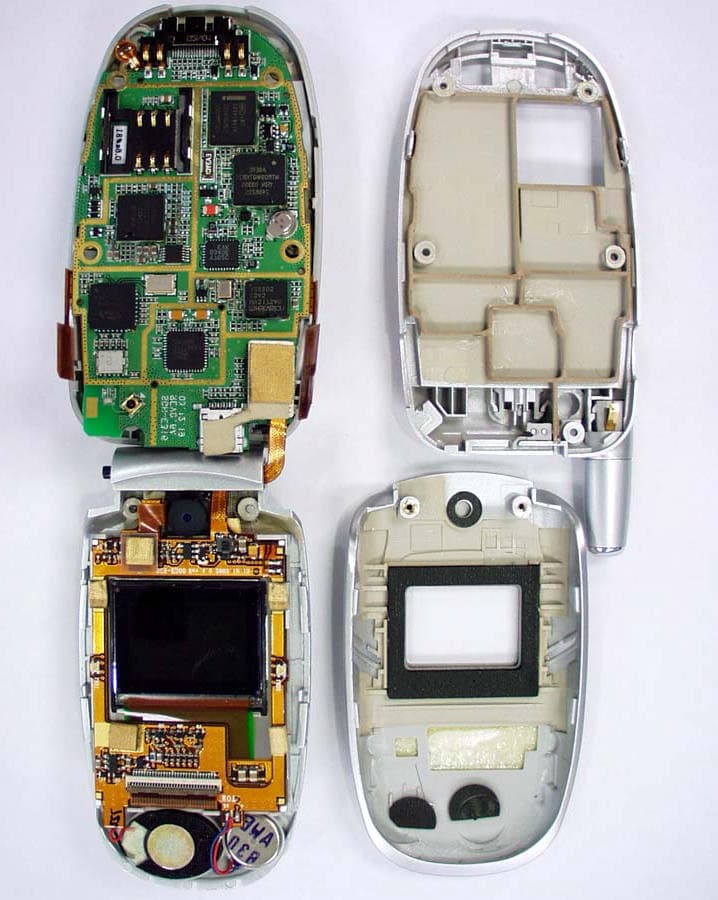
Click to zoom
Application Details
- Equipment Class
- PCE - PCS Licensed Transmitter held to ear
- Date of Grant
- Mar 24, 2004
- Application Purpose
- Original Equipment
- Date of Application
- Mar 24, 2004
- Equipment Note
- Dual-Band GSM Phone
- Frequency Range
- 824.20000000 - 848.80000000
- Company
- Samsung Electronics Co Ltd
- Country
- United States
Documents & Files
Document Text
Text extracted from the exhibit documents filed with the FCC. Open a document above to read the original.
Users Manual
DU A L BAND GPRS Series SGH-e316 Portable Digital Telephone User Manual Please read this manual before operating your phone, and keep it for future reference. Printed in Korea Code No.: GH68-xxxxxA English.12/2003. Rev. 1.0 Intellectual PropertyAll Intellectual Property, as defi ned below, owned by or which is otherwise the property of Samsun g or its respective suppliers relating to the SAMSUNG Phone, including but not limited to, accessories, parts, or software relating thereto (the “Phone System”), is proprietary to Samsung and protected under federal laws, state laws, and international treaty provisions. Intellectual Property includes, but is not limited to, inventions (patentable or unpatentable), patents, trade secrets, copyrights, software, computer programs, and related documentation and other works of authorship. You may not infringe or otherw ise violate the rights secured by the Intellectual Property. Moreover, yo u agree that you will not (and will not attempt to) modify, prepare derivative works of, reverse engineer, decompile, disassemble, or otherwise attempt to create source code from the software. No title to or ownership in the Intellectual Property is transferred to you. All applicable rights of the Intellectual Prop erty shall remain with SAMSUNG and its suppliers. Samsung Telecommunications America (STA), Inc.Headquarters:1130 E. Arapaho RoadRichardson, TX 75081Tel: 972-761-7000Fax: 972-761-7001Customer Care Center:1601 E. Plano ParkwaySuite 150Plano, TX 75047Tel: 888-987-HELP (4357)Fax: 972-761-7501Internet Address: http ://www.samsungusa.com/ wireless ©2003 Samsung Telecommunicati ons America. All rights reserved. No reproduction in wh ole or in part allowed without prior written approval. Samsung is a registered trademark of Samsung Electronics America, Inc. and its related entities. Table of Contents 1 Table of Contents Important Safety Precautions......................... 6Unpacking ...................................................... 8Your Phone ..................................................... 9 Phone Layout .......................................................... 9Display ................................................................. 12Service Light ......................................................... 15Camera ................................................................ 15 Getting Started ............................................. 16 Installing the SIM Card ........................................... 16 Charging the Battery .............................................. 18Switching the Phone On or Off ................................. 20 Call Functions ............................................... 21 Making a Call......................................................... 21Adjusting the Volume ............................................. 23Answering a Call .................................................... 24Viewing Missed Calls............................................... 25Quickly Switching to Silent Mode .............................. 27 Selecting Functions and Options................... 28Phone Book .................................................. 30 Storing a Number with a Name ................................ 30Using Phone Book Entry Options .............................. 32Searching for and Dialing a Number in Phone Book ..... 34Editing a Caller Group............................................. 36Speed-dialing ........................................................ 36Deleting All of the Phone Book Entries....................... 38Checking the Memory Status ................................... 39Using the Service Dialing Numbers ........................... 39 Table of Contents2 Entering Text ................................................ 40 Changing the Text Input Mode ................................. 41Using T9 Mode....................................................... 42Using Alphabet Mode .............................................. 44Using Number Mode ............................................... 45 Using Symbol Mode ................................................ 45 Options During a Call .................................... 46 Putting a Call on Hold ............................................. 46Using the Menu Functions ....................................... 47Switching the Micropho ne Off (Mute) ........................ 48 Muting or Sendin g Key Tones................................... 49 Sending a Sequence of DTMF Tones ......................... 49Searching for a Number in Phone Book ..................... 50 Using the SMS Service ............................................ 50Call Waiting........................................................... 51Making a Multi- party Call......................................... 51 Using the Menus ........................................... 54 Accessing a Menu Function by Scrolling..................... 54 Using Shortcuts ..................................................... 55List of Menu Functions ............................................ 56 Text Messages .............................................. 62 Inbox (Menu 1.1) .................................................... 62 Outbox (Menu 1.2) .................................................. 63 Write New (Menu 1.3) ............................................. 64 Templates (Menu 1.4) ............................................. 67 Settings (Menu 1.5) ................................................ 67 Delete All (Menu 1.6) .............................................. 69 Memory Status (Menu 1.7) ....................................... 69 Voice Mail (Menu 1.8) .............................................. 69 Broadcast (Menu 1.9) .............................................. 70 Table of Contents 3 Picture Messages.......................................... 72 Inbox (Menu 2.1) .................................................... 72 Outbox (Menu 2.2) .................................................. 75 Draft (Me…
Text truncated - open the document above for the full version.
Attestation Statements
February 2, 2004 Federal Communications Commission Authorization and Evaluation Div. Equipment Authorization Branch 7435 Oakland Mills Road Columbia, MD 21046 In re: Samsung Electronics Co., Ltd. FCC ID.: A3LSGHE316 Request for Confidentiality To Whom It May Concern: In accordance with 0.459 of CFR 47, Samsung Electronics Co., Ltd. requests confidentiality for the Block Diagram, Schematics, Parts list, Tune-up Procedure, Operational and Circuit Description of the attached test report. These documents contain detailed system and equipment descriptions and related information about the product, which Samsung Electronics Co., Ltd. considers to be proprietary, confidential, and a custom design and otherwise, would not release to the general public. Since this design is a basis from which future technological products will evolve, Samsung feels that this information would be of benefit to its competitors, and that the disclosure of the information in these documents would give our competitors an unfair advantage in the market. Sincerely, Wallace Oh Engineering Manager Samsun Samsung Electronics America
Internal Photos
© 2004 SAMSUNG ELECTRONICS Co., Ltd. SAMSUNG FCC ID: A3LSGHE316 Dual-Band GSM 850/ GSM PCS Phone © 2004 SAMSUNG ELECTRONICS Co., Ltd. SAMSUNG FCC ID: A3LSGHE316 Dual-Band GSM 850/ GSM PCS Phone
RF Exposure Info
7. SYSTEM VERIFICATION 7.1 Tissue Verification Table 7.1 MEASURED TISSUE PARAMETERS 835MHz Brain 835MHz Muscle 1900MHz Brain 1900MHz Muscle Target Measured Target Measured Target Measured Target Measured Date - Jan. 27,2004 - Jan. 27,2004 - Jan. 26,2004 - Jan. 28,2004 Liquid Temperature(°C) - 21.0 - 21.3 - 21.8 - 21.1 Dielectric Constant: ' 41.5 41.5 55.253.0 40.0 40.1 53.3 51.2 Conductivity: σ 0.90 0.89 0.970.93 1.40 1.42 1.52 1.56 The measured value must be within ±5% of the target value. 7.2 Test System Validation Prior to assessment, the system is verified to the ±10% of the specification at 835MHz and 1900MHz by using the system validation kit(s). (see Appendix F, Graphic Plot Attached) Table 7.2 System Validation Results System Validation Kit Tissue Targeted SAR 1g (mW/g) Measured SAR 1g (mW/g) Deviation (%)Date Liquid Temperature( °C) D-835V2 S/N: 451 835MHz Brain 2.375 2.34 -1.47 Jan. 27,2004 20.6 D-1900V2 S/N: 548 1900MHz Brain 9.925 9.7 -2.27 Jan. 26,2004 21.5 Figure 7.1 Dipole Validation Test Setup PM1 Att1 x Dipole 3D Probe positioner Flat Phantom Field probe Signal Generato AmpLow Pass 3dB Att3 Dir.Coupler Att2 PM2 Cable PM3 s Spacer y z x PC Report Number : FB-004-S1 18 of 33 8. SAR MEASUREMENT RESULTS Procedures Used To Establish Test Signal The handset was placed into simulated call mode (GSM850 & GSM1900) using manufacturers test codes. Such test signals offer a consistent means for testing SAR and are recommended for evaluating SAR. When test modes are not available or inappropriate for testing a handset, the actual transmission is activated through a base station simulator or similar equipment. See data pages for actual procedure used in measurement. Device Test Conditions The handset is battery operated. Each SAR measurement was taken with a fully charged battery. In order to verify that the device was tested at full power, conducted output power measurements were performed before and after each SAR measurement to confirm the output power. If a conducted power deviation of more than 5% occurred, the test was repeated. EUT Handset Reference Points Horizontal Center Line ERP-Ear Reference Point Vertical Center Line Figure 8.1 Handset Reference Points Report Number : FB-004-S1 19 of 33
RF Exposure Info
© 2004 SAMSUNG ELECTRONICS Co., Ltd. SAMSUNG FCC ID: A3LSGHE316 Dual-Band GSM850 / GSM PCS Phone © 2004 SAMSUNG ELECTRONICS Co., Ltd. SAMSUNG FCC ID: A3LSGHE316 Dual-Band GSM850 / GSM PCS Phone © 2004 SAMSUNG ELECTRONICS Co., Ltd. SAMSUNG FCC ID: A3LSGHE316 Dual-Band GSM850 / GSM PCS Phone © 2004 SAMSUNG ELECTRONICS Co., Ltd. SAMSUNG FCC ID: A3LSGHE316 Dual-Band GSM850 / GSM PCS Phone © 2004 SAMSUNG ELECTRONICS Co., Ltd. SAMSUNG FCC ID: A3LSGHE316 Dual-Band GSM850/ GSM PCS Phone © 2004 SAMSUNG ELECTRONICS Co., Ltd. SAMSUNG FCC ID: A3LSGHE316 Dual-Band GSM850/ GSM PCS Phone © 2004 SAMSUNG ELECTRONICS Co., Ltd. SAMSUNG FCC ID: A3LSGHE316 Dual-Band GSM850/ GSM PCS Phone © 2004 SAMSUNG ELECTRONICS Co., Ltd. SAMSUNG FCC ID: A3LSGHE316 Dual-Band GSM850/ GSM PCS Phone © 2004 SAMSUNG ELECTRONICS Co., Ltd. SAMSUNG FCC ID: A3LSGHE316 Dual-Band GSM850 / GSM PCS Phone © 2004 SAMSUNG ELECTRONICS Co., Ltd. SAMSUNG FCC ID: A3LSGHE316 Dual-Band GSM850 / GSM PCS Phone © 2004 SAMSUNG ELECTRONICS Co., Ltd. SAMSUNG FCC ID: A3LSGHE316 Dual-Band GSM850 / GSM PCS Phone © 2004 SAMSUNG ELECTRONICS Co., Ltd. SAMSUNG FCC ID: A3LSGHE316 Dual-Band GSM850 / GSM PCS Phone
Test Report
Report Number : FB-004-R1/2 TABLE OF CONTENT MEASUREMENT REPORT Page 1. FCC Certification Information 4 1.1 2.1033 General Information 4 2. INTRODUCTION 5 2.1 General 5 3. MEASURING INSTRUMENT CALIBRATION 6 4. TEST EQUIPMENT LIST 7 5. DESCRIPTION OF TESTS 8 5.1 Effective Radiated Power/Equivalent Isotropic Radiated Power 8 5.2 Radiated Spurious & Harmonic Emission 9 5.3 Occupied Bandwidth 10 5.4 Spurious and Harmonic Emissions at Antenna Terminal 10 5.4.1 Occupied Bandwidth Emission Limits 10 5.4.2 Conducted Spurious Emission 11 5.5 Frequency Stability / Temperature Variation 12 6. TEST DATA 13 6.1 Effective Radiated Power(E.R.P.) 14 6.2 Equivalent Isotropic Radiated Power(E.I.R.P.) 14 6.3 Cellular CDMA Radiated Spurious & Harmonic Measurement 15 6.4 PCS CDMA Radiated Spurious & Harmonic Measurement 16 6.5 CDMA Radiated Spurious & Harmonic Conversion Table 17 6.6 PCS Radiated Spurious & Harmonic Conversion Table 18 6.7 Frequency Stability 19 6.7.1 CDMA Frequency Stability Table 19 6.7.2 PCS Frequency Stability Table 20 6.7.3 CDMA Frequency Stability Graph 21 6.7.4 PCS Frequency Stability Graph 23 7.SAMPLE CALCULATION 25 8. CONCLUSION 26 9. TEST PLOTS 27 Report Number : FB-004-R1/2 MEASUREMENT REPORT 1. FCC Certification Information The following information is in accordance with FCC Rules, 47CFR Rart2, Subpart J, Sections 2.1033 – 2.1055. 2.1033 General Information Applicant Name: SAMSUNG ELECRONICS CO., LTD. Address: 416, Maetan-3Dong, Youngtong-Gu, Suwon City Gyeonggi-Do, KOREA 442-600 Attention: FCC ID: Wallace Oh, Engineering Manager (QA Lab) A3LSGHE316 Quantity: Quantity production is planned Emission Designators: 300KGX7W Tx Freq. Range: 824.2 - 848.8MHz (GSM 850) 1850.2 -1909.8MHz (GSM 1900) Rx Freq. Range: 869.2 - 893.8 MHz (GSM 850) 1930.2 -1989.8 MHz (GSM 1900 ) Max. Power Rating: 3.475W ERP GSM850(35.41dBm) 1.600W EIRP GSM1900(32.04dBm) FCC Classification(s): Licensed Portable Tx Held to Ear (PCE) Equipment (EUT) Type: Dual-Mode GSM850/GSM1900 Phone Modulation(s): GSM850/PCS GSM Frequency Tolerance: 0.00025% (2.5ppm) FCC Rule Part(s): 24(E), 22(H), 2 Dates of Test: JAN. 19, 29-30, 2004 Place of Test: SAMSUNG Lab, Test Report S/N: FB-004-R1/2 Report Number : FB-004-R1/2 2. INTRODUCTION General These measurement test were conducted at SAMSUNG ELECTRONICS CO., LTD(SUWON). The site address is 416,Maetan-3Dong, Youngtong-Gu, Suwon City, Gyeonggi-Do, KOREA 442- 600. The site have 1 Fully-anechoic chamber and measurement facility. Measurement Procedure The radiated and spurious measurements were made Fully-anechoic chamber at a 3-meter test range (see Figure2). The equipment under testing was placed on a wooden turntable 3-meters from the receive antenna. The receive antenna height and turntable rotations were adjusted for the highest reading on the receive spectrum analyzer. The substitution antenna will replace the EUT antenna it the same position and in vertical polarization. The frequency of the signal generator shall be set to the frequencies that were measured on the EUT. The test antenna shall be raised and lowered, if necessary, to ensure that the maximum signal is still being received. The signal generator, output level, shall be adjusted until an equal or a known related level to what was measured from the EUT is obtained in the spectrum analyzer. This level was recorded. For readings above 1 GHz, the above procedure is repeated using horn antennas and the difference between the gain of the horn and an isotropic antenna are taken into consideration. Figure1. Map of the Suwon City area. Fi gure2. Photograph of 3m Fully-Anechoic Chamber Report Number : FB-004-R1/2 3.MEASURING INSTRUMENT CALIBRATION The measuring equipment, which was utilized in performing the tests documented herein, has been calibrated in accordance with the manufacturer’s recommendations for utilizing calibration equipment, which is traceable to recognized national standards. - End of page - . . Report Number : FB-004-R1/2 3. TEST EQUIPMENT LIST Name of Equipment Model Serial No. Due Date ESI26 836119/010 2004-09-15 E4440A(3Hz~26.5GHz) MY41000236 2004-11-07 Spectrum Analyzer E4440A(3Hz~26.5GHz) MY41000233 2004-11-14 SMIQ03B 83824/021 2005-01-15 Signal Generator SMR20 835197/030 2005-01-15 Power Meter E4419B GB41293846 2004-10-02 8481B 3318A10325 2004-10-06 Power Sensor 8485A 3318A19924 2004-10-04 Amplifier 5S1G4 304866 2004-11-17 Pre-Amplifier 8449B 3008A00691 2005-01-16 8960 GB42230535 2004-11-17 Communication test set 8960 GB42360886 2004-11-10 Antenna Master MA0001 ANT0967 Not Required Controller HD100 100/756 Not Required PL-4S 13005454 2004-08-22 SH-241 92000548 2004-12-04 Environmental Chamber SH-241 92000549 2004-12-04 Horn Antenna HF906 100134 2004-03-31 3121C-DB4 9007-587 2004-03-21 Dipole Antenna 3121C-DB4 9007-588 2004-03-21 Receive Antenna HO040 353255/019 2004-07-14 8494A 3308A31997 2005-01-17 Attenuator 8496A 3308A14426 2005-01-17 4278-311-2 B3679637 2005-01-14 Directional Coupler 4278-111-2 B103DC8722 2005-01-14 WHK1.0/15G-10SS 1 Not Required WHK1.0/15G-10SS 1 Not Required WHK/3.5/18G-10SS 3 Not Required High Pass Filter WHK/3.5/18G-10SS 4 Not Required Shielded Semi-Anechoic Chamber RF0002 ANT0001 Not Required Report Number : FB-004-R1/2 5. DESCRIPTION OF TESTS 5.1 Effective Radiated Power / Equivalent Isotropic Radiated Power Test Set-up for the ERP/EIRP TEST Effective Radiated Power Output and Equivalent Isotropic Radiated Power output Measurements by Substitution Method according to ANSI/TIA/EIA-603-A-2001, Aug. 15, 2001: The EUT was placed on a Non-conducted turntable 3-meters from the receive antenna. The receive antenna height and turntable rotation was adjusted for the highest reading on the receive spectrum analyzer. For GSM signals, a peak detector is used, with RBW=VBW=3MHz, SPAN=10MHz. A half-wave dipole was substituted in place of the EUT. This dipole antenna was driven by a signal generator and the level of the signal generator was adjusted to obtain the same receive spectrum ana…
Text truncated - open the document above for the full version.
Test Setup Photos
© 2004 SAMSUNG ELECTRONICS Co., Ltd. SAMSUNG FCC ID: A3LSGHE316 Dual-Band GSM 850/ GSM PCS Phone © 2004 SAMSUNG ELECTRONICS Co., Ltd. SAMSUNG FCC ID: A3LSGHE316 Dual-Band GSM 850/ GSM PCS Phone © 2004 SAMSUNG ELECTRONICS Co., Ltd. SAMSUNG FCC ID: A3LSGHE316 Dual-Band GSM 850/ GSM PCS Phone © 2004 SAMSUNG ELECTRONICS Co., Ltd. SAMSUNG FCC ID: A3LSGHE316 Dual-Band GSM 850/ GSM PCS Phone © 2004 SAMSUNG ELECTRONICS Co., Ltd. SAMSUNG FCC ID: A3LSGHE316 Dual-Band GSM 850/ GSM PCS Phone © 2004 SAMSUNG ELECTRONICS Co., Ltd. SAMSUNG FCC ID: A3LSGHE316 Dual-Band GSM 850/ GSM PCS Phone
Contact Information
Applicant
Jenni Chun(General Manager)
Technical Contact
PCTEST Engineering Lab., Inc.Randy Ortanez
[email protected]410-290-6652
6660-B Dobbin Road · Columbia, Maryland · United States
Test Firm
SAMSUNG ELECTRONICS CO., LTD.No Cheon Park
Technical Specifications
| # | Rule Parts | Frequency Range | Power Output | Emission | Tolerance |
|---|---|---|---|---|---|
| 2 | 22H | 824.2 MHz - 848.8 MHz | 3.475 W | 300KGXW | 2.5 ppm |
Other Applications from Samsung Electronics Co Ltd
A3LSMS741B
Aug 05, 2026Portable Handset
Equipment Class
6VL - 15E 6 GHZ Very Low Power DeviceA3LSMX940
Jul 31, 2026BT,BLE Tablet DTS,UNII a,b,g,n,ac,ax,be and digitizer
Equipment Class
DTS - Digital Transmission SystemA3LSMS741U
Jul 30, 2026Portable Handset
Equipment Class
6CD - 15E 6 GHz Low Power Dual ClientA3LSMX840
Jul 27, 2026BT,BLE Tablet DTS,UNII a,b,g,n,ac,ax and Digitizer
Equipment Class
DSS - Part 15 Spread Spectrum TransmitterA3LSMX848U
Jul 27, 2026WCDMA, LTE, 5G NR Tablet BT,BLE, DTS,UNII a b g n ac ax and Digitizer
Equipment Class
JBP - Part 15 Class B Computing Device Peripheral