A3LSGHM310Cellular/PCS GSM Phone with Bluetooth
Samsung Electronics Co Ltd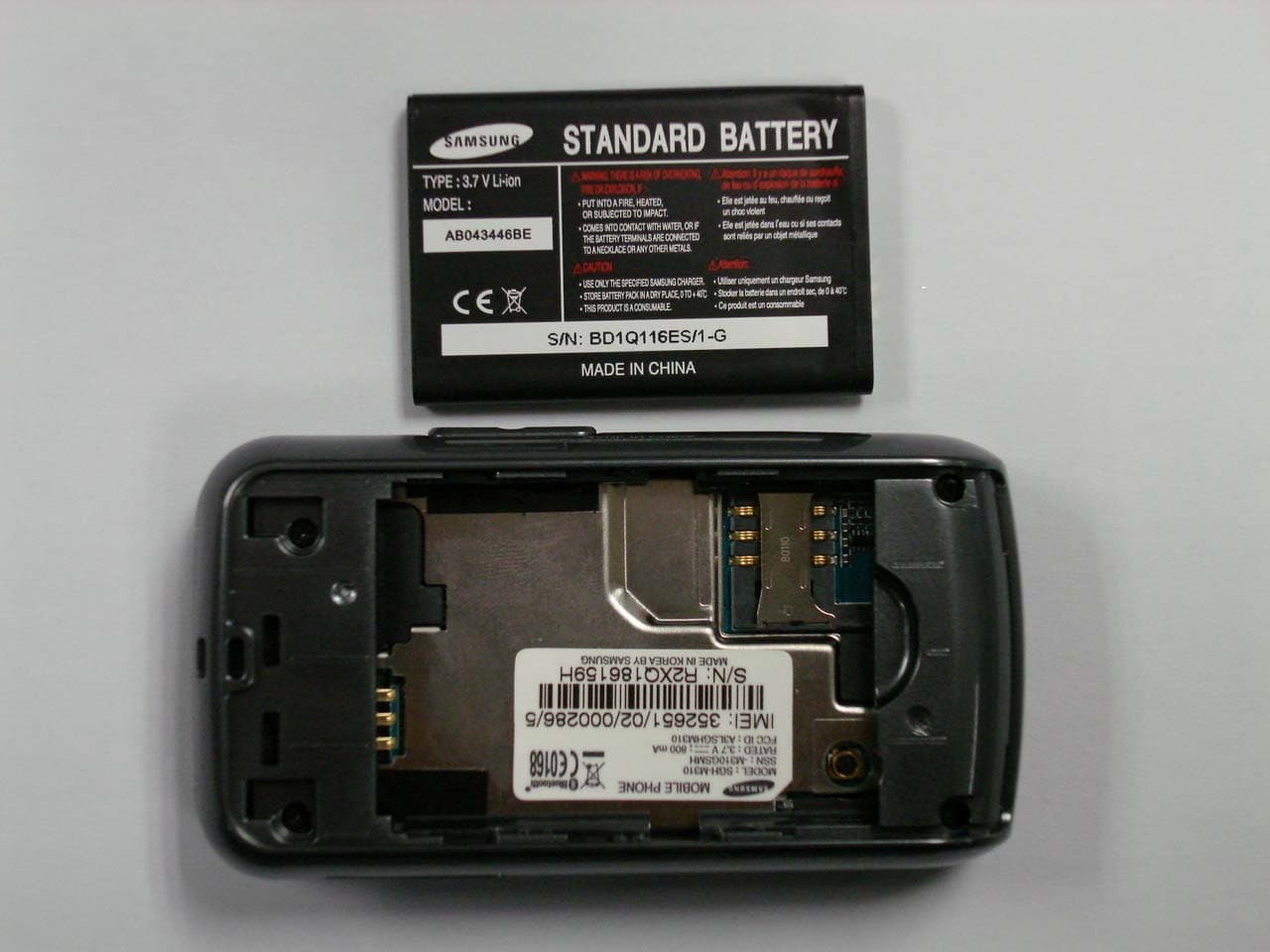
Click to zoom
Application Details
- Equipment Class
- PCE - PCS Licensed Transmitter held to ear
- Date of Grant
- Mar 25, 2008
- Application Purpose
- Original Equipment
- Date of Application
- Mar 25, 2008
- Equipment Note
- Cellular/PCS GSM Phone with Bluetooth
- Frequency Range
- 1850.20000000 - 1909.80000000
- Company
- Samsung Electronics Co Ltd
- Country
- United States
Documents & Files
Document Text
Text extracted from the exhibit documents filed with the FCC. Open a document above to read the original.
Users Manual
Printed in Korea Code No.: GH68- XXXXXA English (EU). 03/2008. Rev.1.0 World Wide Webhttp://www.samsungmobile.com SGH-M310User’s Guide Some of the contents in this guide may differ from your phone depending on the software of the phone or your service provider.Bluetooth QD ID : B0XXXXX Draft 01 2008. 02. 29 SW: M310XXHB2 Installing the SIM card and battery 1. Remove the battery cover and insert the SIM card. 2. Install the battery and reattach the battery cover. Battery cover Battery Charging the battery 1. Plug the supplied travel adapter into the phone and a power outlet. 2. When charging is finished, unplug the travel adapter. Note : Do not remove the battery from the phone without unplugging the travel adapter first. Otherwise, the phone may be damaged. With the triangle facing up Phone layout and key functions Power/End keyTurns the phone on or off when held down. Also, ends a call.Silent mode keyX Silent mode Delete keyDeletes characters from the display or items in an application. Dial key Makes and answers a call. In Idle mode, retrieves the most recent calls. Volume keys In Idle mode, adjust the keypad tone volume. Send an SOS message when pressed 4 times with the phone closed. X SOS mode Alphanumeric keys Web access/ Confirm key In Idle mode, accesses the web browser. In Menu mode, selects the highlighted option or confirms input. Voice mail server key In Idle mode, accesses your voice mail server when held down. 4-way navigation keysIn Idle mode, access the following menus or functions directly:• Up : Camera • Down / Left / Right : your favourite menus In Menu mode, scroll through menu options. Soft keysPerform functions indicated by the text above the key. Display Your phone is in Idle mode when you are not on a call or using a menu. You must be in Idle mode to dial a phone number. Silentmode Press and hold in Idle mode to disable all sounds on the phone. To exit, press and hold this key again. SOS mode With the phone closed, press the Volume keys 4 times to send an SOS message to preset phone numbers. Once the SOS message is sent, the phone will change to SOS mode and will receive calls only from the registered recipients. Upon receiving a call from the SOS message recipients, the phone will automatically answer the call. Press to exit SOS mode. Menu Contacts Text and graphicsSoft key function indicatorsIcons Your phone displays the following status indicators on the top of the screen: Switching on or off the phone 1. Press and hold for more than one second to switch on the phone. 2. Press and hold for more than two seconds to switch off the phone. Changing the display language 1. In Idle mode, press the Menu soft key. 2. Select Settings → Phone settings → Language . 3. Select a language. Making a call 1. In Idle mode, enter an area code and phone number, and press . 2. Press to end the call. Answering a call 1. When the phone rings, press the Accept soft key or to answer a call.Press the Reject soft key or to reject the call. 2. Press to end the call. Adjusting the volume 1. In Idle mode, press the Menu soft key. 2. Select Settings → Sound settings → Incoming call → Call alert volume . 3. Press Left or Right to adjust the volume level. 4. Press the Save soft key. While a call is in progress, press the Volume keys to adjust the earpiece volume. Changing a ringtone for calls 1. In Idle mode, press the Menu soft key. 2. Select Settings → Sound settings → Incoming call → Ringtone . 3. Select a ringtone and press the Save soft key. Redialling recent numbers 1. In Idle mode, press . 2. Press Left or Right to select a call type. 3. Press Up or Down to scroll to the number you want. 4. Press to dial the number. Using the menus In Idle mode, press the Menu soft key to enter the main menu. To exit the menu without changing the menu settings, press this key. Labels at the bottom corners of the display show the current soft key functions. Press the left soft key ( ) or right soft key ( ) to perform the function indicated. Use the 4-way navigation keys as shortcuts to access your favourite menus. Up is fixed as a shortcut to Camera . 1. In Idle mode, press the Menu soft key. 2. Select Settings → Phone settings → Shortcuts . 3. Select a key.4. Select a menu to be assigned to the key. To select or modify a menu or feature:1. In Idle mode, press the Menu soft key. 2. Press the Navigation keys to reach a desired menu and then press the Select soft key or . 3. If the menu contains any submenus, locate the one you want by pressing the Navigation keys. Press the Select soft key or to enter the submenu.If the selected menu contains additional submenus, repeat this step. 4. Press the Navigation keys to find the setting of your choice.5. Press the Select soft key or to confirm your chosen setting. Shortcut numbersYou can quickly access the menu you want by using shortcut numbers. The shortcut number displays in front of the menu name in Menu mode. Menu map 1. Call log 1.1 Recent contacts 1.2 Missed calls1.3 Dialled calls1.4 Received calls1.5 Delete all1.6 Call manager 2. Phonebook 2.1 Contact list2.2 Create contact2.3 Group2.4 Speed dial2.5 My namecard2.6 Own numbers2.7 Management2.8 Service number* 3. Applications 3.1 Alarm3.2 Voice recorder3.3 FM radio3.4 Java world3.5 Memo3.6 World clock 3.7 Calculator3.8 Converter3.9 Timer3.10 Stopwatch3.11 SIM application toolkit * 4. Browser 4.1 Home4.2 Enter URL4.3 Bookmarks4.4 Clear cache4.5 Browser settings 5. Messages 5.1 Create message5.2 My messages5.3 Templates5.4 Delete all5.5 Settings5.6 SOS messages5.7 Memory status 6. My files 6.1 Images6.2 Sounds6.3 Other files6.4 Memory status 7. Calendar8. Camera9. Settings 9.1 Time and date9.2 Phone settings9.3 Display settings9.4 Sound settings9.5 Light settings9.6 Network services9.7 Bluetooth9.8 Security9.9 Connection settings 9.10 Memory status9.11 Reset settings * Available only if supported by your SIM card. Entering text Changing the text input mode• Press and hold to switch between T9 mode and ABC mod…
Text truncated - open the document above for the full version.
Cover Letter(s)
SAMSUNG ELECTRONICS AMERICA, INC. American QA Lab 18600 Broadwick St. Rancho Dominguez, CA 90220 Date: March 18, 2008 Federal Communications Commission Authorization and Evaluation Division 7435 Oakland Mills Road, http Columbia, MD 21046 RE: Request of Confidentiality for FCC ID: A3LSGHM310 To Whom It May Concern: Pursuant to Sections 0.457 and 0.459 of the Commission’s Rules (CFR 47), and Section 552 (b) (4) of the Freedom of Information Act, SAMSUNG ELECTRONICS CO.,LTD. hereby requests confidentiality and treatment of certain information accompanying this application. The materials contain trade secrets and proprietary information not customarily released to the public. The public disclosure of these matters might be harmful to the Applicant and provide unjustified benefits to its competitors. We are also hereby request Short-Term Confidentiality for 180 days after the grant as outlined in Public Notice DA 04-1705. This provision will give SAMSUNG ELECTRONICS CO.,LTD. temporary confidentiality of commercially sensitive information prior to product release. The requested Permanent and Short-Term Confidential exhibits are listed as follows: PERMANENT AND SHORT-TERM CONFIDENTIAL LIST Exhibit Description 1 Block Diagram 2 Operational Description 3 Schematics PERMANENT 4 Parts List & Tune-Up Procedure 5 External Photos 6 Internal Photos 7 Test-Setup Photos SHORT-TERM 8 Users Manual The Applicant understands that pursuant to Rule 0.457, disclosure of this application and all accompanying documentations, where applicable, will not be made public before the date of the Grant for this application. Sincerely, Steve Kim General Manager American QA Lab SAMSUNG Electronics America INC.
Internal Photos
Bluetooth antenna Main antenna * Placement of each antenna in folder close * Placement of each antenna in folder open Bluetooth antenna Main antenna 7.63mm GSM850GSM900 DCS1800PCS1900 * Antenna pattern * Distance between Bluetooth antenna and PCS antenna Bluetooth antenna GSM900 5.76mm PCS1900 • No difference of distance between bluetoothantenna and PCS1900 antenna for each case of folder open and close, because antennas are in the same plastic all together.
RF Exposure Info
Reviewed by: FCC ID: A3LSGHM310 CERTIFICATION REPORT Quality Manager SAR Filename: Test Dates: EUT Type: 0803110296.A3L 03/12/08 850/1900 GSM/GPRS Phone with Bluetooth Page 1 of 27 © 2008 PCTEST Engineering Laboratory, Inc. REV 5.0G 03/13/08 Applicant Name: Date of Testing: Samsung Electronics, Co. Ltd. 03/12/08 18600 Broadwick St. Test Site/Location: Rancho Dominguez, CA 90220 PCTEST Lab, Columbia, MD, USA United States Test Report Serial No.: 0803110296.A3L FCC ID: A3LSGHM310 APPLICANT: SAMSUNG ELECTRONICS, CO. LTD. EUT Type: 850/1900 GSM/GPRS Phone with Bluetooth Application Type: Certification FCC Rule Part(s): §2.1093; FCC/OET Bulletin 65 Supplement C [July 2001] FCC Classification: Licensed Transmitter Held to Ear (PCE) Model(s): SGH-M310, SGH-M318, SGH-M310L, SGH-M310V Tx Frequency: 824.20 - 848.80 MHz (Cellular GSM) 1850.20 - 1909.80 MHz (GSM PCS) Conducted Power: 32.4 dBm Cellular GSM / 29.6 dBm PCS GSM / 0 dBm WLAN Max. SAR Measurement: 0.146 W/kg GSM Head SAR / 0.115 W/kg GPRS Body SAR 0.654 W/kg PCS Head SAR / 0.361 W/kg PCS GPRS Body SAR Test Device Serial No.: Pre-Production [S/N: FF-034-B] This wireless portable device has been shown to be capable of compliance for localized specific absorption rate (SAR) for uncontrolled environment/general population exposure limits specified in ANSI/IEEE Std. C95.1-2005 and has been tested in accordance with the measurement procedures specified in FCC/OET Bulletin 65 Supplement C (2001) and IEEE Std. 1528-2003. I attest to the accuracy of data. All measurements reported herein were performed by me or were made under my supervision and are correct to the best of my knowledge and belief. I assume full responsibility for the completeness of these measurements and vouch for the qualifications of all persons taking them. Grant Conditions: Power output listed is ERP for Part 22 and EIRP for Part 24. SAR compliance for body-worn operating configuration is based on a separation distance of 1.5 cm between the device and the body of the user. End-users must be informed of the body-worn operating requirements for satisfying RF exposure compliance. Belt clips or holsters not specified in this filing may not contain metallic components. PCTEST certifies that no party to this application has been denied the FCC benefits pursuant to Section 5301 of the Anti-Drug Abuse Act of 1988, 21 U.S.C. 862. PCTEST ENGINEERING LABORATORY, INC. 6660-B Dobbin Road, Columbia, MD 21045 USA Tel. 410.290.6652 / Fax 410.290.6554 http://www.pctestlab.com CERTIFICATE OF COMPLIANCE (SAR EVALUATION) Reviewed by: FCC ID: A3LSGHM310 CERTIFICATION REPORT Quality Manager SAR Filename: Test Dates: EUT Type: 0803110296.A3L 03/12/08 850/1900 GSM/GPRS Phone with Bluetooth Page 2 of 27 © 2008 PCTEST Engineering Laboratory, Inc. REV 5.0G 03/13/08 TABLE OF CONTENTS 1 INTRODUCTION ........................................................................................................................ 3 2 TEST SITE LOCATION............................................................................................................... 4 3 SAR MEASUREMENT SETUP ................................................................................................... 5 4 DASY E-FIELD PROBE SYSTEM............................................................................................... 7 5 PROBE CALIBRATION PROCESS............................................................................................. 8 6 PHANTOM AND EQUIVALENT TISSUES .................................................................................. 9 7 DOSIMETRIC ASSESSMENT & PHANTOM SPECS................................................................ 10 8 DEFINITION OF REFERENCE POINTS ................................................................................... 11 9 TEST CONFIGURATION POSITIONS ...................................................................................... 12 10 ANSI/IEEE C95.1-2005 RF EXPOSURE LIMITS...................................................................... 16 11 MEASUREMENT UNCERTAINTIES......................................................................................... 17 12 SYSTEM VERIFICATION ......................................................................................................... 18 13 FCC MULTI-TX AND ANTENNA SAR CONSIDERATIONS....................................................... 19 14 RF CONDUCTED POWER....................................................................................................... 20 15 SAR DATA SUMMARY............................................................................................................. 21 16 EQUIPMENT LIST.................................................................................................................... 24 17 CONCLUSION.......................................................................................................................... 25 18 REFERENCES ......................................................................................................................... 26 Reviewed by: FCC ID: A3LSGHM310 CERTIFICATION REPORT Quality Manager SAR Filename: Test Dates: EUT Type: 0803110296.A3L 03/12/08 850/1900 GSM/GPRS Phone with Bluetooth Page 3 of 27 © 2008 PCTEST Engineering Laboratory, Inc. REV 5.0G 03/13/08 1 INTRODUCTION The FCC has adopted the guidelines for evaluating the environmental effects of radio frequency (RF) radiation in ET Docket 93-62 on Aug. 6, 1996 to protect the public and workers from the potential hazards of RF emissions due to FCC-regulated portable devices.[1] The safety limits used for the environmental evaluation measurements are based on the criteria published by the American National Standards Institute (ANSI) for localized specific absorption rate (SAR) in IEEE/ANSI C95.1-2005 Standard for Safety Levels with Respect to Human Exposure to Radio Frequency Electromagnetic Fields, 3 kHz to 300 GHz[2] and Health Canada RF Exposure Guidelines Safety Code …
Text truncated - open the document above for the full version.
Test Report
SAMSUNG ELECTRONICS Co., Ltd., Regulatory Compliance Group IT R&D Center 416 Maetan3-Dong, Yeongtong-gu, Suwon city, Gyeonggi-Do, Korea 443-742 FCC CFR47 PART 22 & 24 SUBPART CERTIFICATION REPORT Model Tested : SGH-M310 Additional Model : SGH-M318 SGH-M310L SGH-M310V FCC ID(Requested) : A3LSGHM310 Report No : FF-034-R1 Job No : FF-034 Date issued : March 17, 2008 - Abstract - All measurement reported herein accordance with FCC Rules, 47CFR Part2, Part22, Part24. Prepared By JH WOO - Test Engineer Authorized By WW JANG - Technical Manager Report Number : FF-034-R1 TABLE OF CONTENT MEASUREMENT REPORT Page 1. FCC CERTIFICATION INFORMATION .....................................................................2 1.1. §2.1033 General Information .........................................................................2 2. INTRODUCTION .......................................................................................................2 2.1. General..........................................................................................................2 3. MEASURING INSTRUMENT CALIBRATION ...........................................................2 4. TEST EQUIPMENT LIST...........................................................................................2 5. DESCRIPTION OF TESTS ........................................................................................2 5.1. Effective Radiated Power / Equivalent Isotropic Radiated Power ..................2 5.2. Radiated Spurious & Harmonic Emission ......................................................2 5.3. Occupied Bandwidth ......................................................................................2 5.4. Spurious and Harmonic Emission at Antenna Terminal..................................2 5.4.1. Occupied Bandwidth Emission Limits ................................................2 5.4.2. Conducted Spurious Emission ...........................................................2 5.5. Frequency Stability / Temperature Variation ...................................................2 6. TEST DATA ...............................................................................................................2 6.1. Effective Radiated Power (E.R.P.)..................................................................2 6.2. Equivalent Isotropic Radiated Power (E.I.R.P.) ..............................................2 6.3. GSM850 Radiated Spurious & Harmonic measurement ................................2 6.4. GSM1900 Radiated Spurious & Harmonic measurement ..............................2 6.5. GSM850 Radiated Spurious & Harmonic Conversion Table ..........................2 6.6. GSM1900 Radiated Spurious & Harmonic Conversion Table ........................2 6.7. Frequency Stability.........................................................................................2 6.7.1. GSM850 Frequency Stability Table ....................................................2 6.7.2. GSM850 Frequency Stability Graph...................................................2 6.7.3. GSM1900 Frequency Stability Table ..................................................2 6.7.4. GSM1900 Frequency Stability Graph.................................................2 7. CONCLUSION...........................................................................................................2 8. TEST PLOTS.............................................................................................................2 Report Number : FF-034-R1 MEASUREMENT REPORT 1. FCC Certification Information The following information is in accordance with FCC Rules, 47CFR Part2, Subpart J, Sections 2.1033 – 2.1055. 1.1. §2.1033 General Information • Applicant Name : SAMSUNG ELECRONICS CO., LTD. • Address : 416 Maetan3-Dong, Yeongtong-gu, Suwon City Gyeonggi-Do, Korea 443-742 • Attention : SungJoo KIM, Engineering Manager (QA Lab) • FCC ID : A3LSGHM310 • Additional Model : SGH-M318, SGH-M310L, SGH-M310V • Quantity : Quantity production is planned • Emission Designators : 253KGXW(GSM850) 250KGXW(GSM1900) • Tx Freq. Range : 824.2 - 848.8MHz (GSM850) 1850.2MHz - 1909.8MHz (GSM1900) • Rx Freq. Range : 869.2 - 893.8 MHz (GSM850) 1930.2MHz - 1989.8MHz (GSM1900) • Max. Power Rating : 0.611 W ERP GSM850 (27.86dBm) 1.076 W EIRP GSM1900 (30.32dBm) • FCC Classification(s) : Licensed Portable Tx Held to Ear (PCE) • Equipment (EUT) Type : Dual-Band GSM850/1900 Phone with Bluetooth • Frequency Tolerance : ±0.00025% (2.5ppm) • FCC Rule Part(s) : §24(E), §22(H), §2. • Dates of Test : March 03-04, 2008 • Place of Test : SAMSUNG Lab, • Test Report S/N : FF-034-R1 Report Number : FF-034-R1 2. INTRODUCTION 2.1. General These measurement test were conducted at SAMSUNG ELECTRONICS CO., LTD(SUWON). The site address is 416 Maetan3-Dong, Yeongtong-gu, Suwon City, Gyeonggi-Do, Korea 443-742 The site have 1 Fully-anechoic chamber and measurement facility. Measurement Procedure The radiated and spurious measurements were made Fully-anechoic chamber at a 3-meter test range (see Figure2). The equipment under testing was placed on a Non-conducted turntable 3- meters from the receive antenna. The receive antenna height and turntable rotations were adjusted for the highest reading on the receive spectrum analyzer. The substitution antenna will replace the EUT antenna it the same position and in vertical polarization. The frequency of the signal generator shall be set to the frequencies that were measured on the EUT. The test antenna shall be raised and lowered, if necessary, to ensure that the maximum signal is still being received. The signal generator, output level, shall be adjusted until an equal or a known related level to what was measured from the EUT is obtained in the spectrum analyzer. This level was recorded. For readings above 1 GHz, the above procedure is repeated using horn antennas and the difference between the gain of the horn and an isotropic antenna are taken into consideration. Figure1. Map of the Suwon City area. Figur…
Text truncated - open the document above for the full version.
Test Setup Photos
SAMSUNG FCC ID: A3LSGHM310 Dual-Band GSM 850/1900 Phone with Bluetooth
Test Setup Photos
Samsung FCC ID: A3LSGHM310 Model: SGH-M310 SAR Test Setup Photos 850/1900 GSM/GPRS Phone with Bluetooth Page 1 of 6 © 2008 PCTEST Lab. REV 2.1 05/24/2007 1. Right Head SAR 2. Left Head SAR Samsung FCC ID: A3LSGHM310 Model: SGH-M310 SAR Test Setup Photos 850/1900 GSM/GPRS Phone with Bluetooth Page 2 of 6 © 2008 PCTEST Lab. REV 2.1 05/24/2007 3. Right Head SAR, Cheek Touch 4. Right Head SAR, 15 ̊ Tilt Samsung FCC ID: A3LSGHM310 Model: SGH-M310 SAR Test Setup Photos 850/1900 GSM/GPRS Phone with Bluetooth Page 3 of 6 © 2008 PCTEST Lab. REV 2.1 05/24/2007 5. Left Head SAR, Cheek Touch 6. Left Head SAR, 15 ̊ Tilt Samsung FCC ID: A3LSGHM310 Model: SGH-M310 SAR Test Setup Photos 850/1900 GSM/GPRS Phone with Bluetooth Page 4 of 6 © 2008 PCTEST Lab. REV 2.1 05/24/2007 7. Body SAR 8. Body SAR, Front Side with 15mm Space Samsung FCC ID: A3LSGHM310 Model: SGH-M310 SAR Test Setup Photos 850/1900 GSM/GPRS Phone with Bluetooth Page 5 of 6 © 2008 PCTEST Lab. REV 2.1 05/24/2007 9. Body SAR, Back Side with 15mm Space 10. Left Touch/Mouth with 7mm Space Samsung FCC ID: A3LSGHM310 Model: SGH-M310 SAR Test Setup Photos 850/1900 GSM/GPRS Phone with Bluetooth Page 6 of 6 © 2008 PCTEST Lab. REV 2.1 05/24/2007 11. Left Touch/Mouth with 7mm Space
Contact Information
Applicant
Jenni Chun(General Manager)
Technical Contact
PCTEST Engineering Lab., Inc.Randy Ortanez
[email protected]410-290-6652
6660-B Dobbin Road · Columbia, Maryland · United States
Test Firm
PCTEST Engineering Laboratory, Inc.Randy Ortanez
Technical Specifications
| # | Rule Parts | Frequency Range | Power Output | Emission | Tolerance |
|---|---|---|---|---|---|
| 2 | 24E | 1.85 GHz - 1.91 GHz | 1.076 W | 250KGXW | 2.5 ppm |
Other Applications from Samsung Electronics Co Ltd
A3LSMS741B
Aug 05, 2026Portable Handset
Equipment Class
6VL - 15E 6 GHZ Very Low Power DeviceA3LSMX940
Jul 31, 2026BT,BLE Tablet DTS,UNII a,b,g,n,ac,ax,be and digitizer
Equipment Class
DTS - Digital Transmission SystemA3LSMS741U
Jul 30, 2026Portable Handset
Equipment Class
6CD - 15E 6 GHz Low Power Dual ClientA3LSMX840
Jul 27, 2026BT,BLE Tablet DTS,UNII a,b,g,n,ac,ax and Digitizer
Equipment Class
DSS - Part 15 Spread Spectrum TransmitterA3LSMX848U
Jul 27, 2026WCDMA, LTE, 5G NR Tablet BT,BLE, DTS,UNII a b g n ac ax and Digitizer
Equipment Class
JBP - Part 15 Class B Computing Device Peripheral