A3LSGHU900LCellular/PCS GSM/EDGE Phone with Bluetooth
Samsung Electronics Co Ltd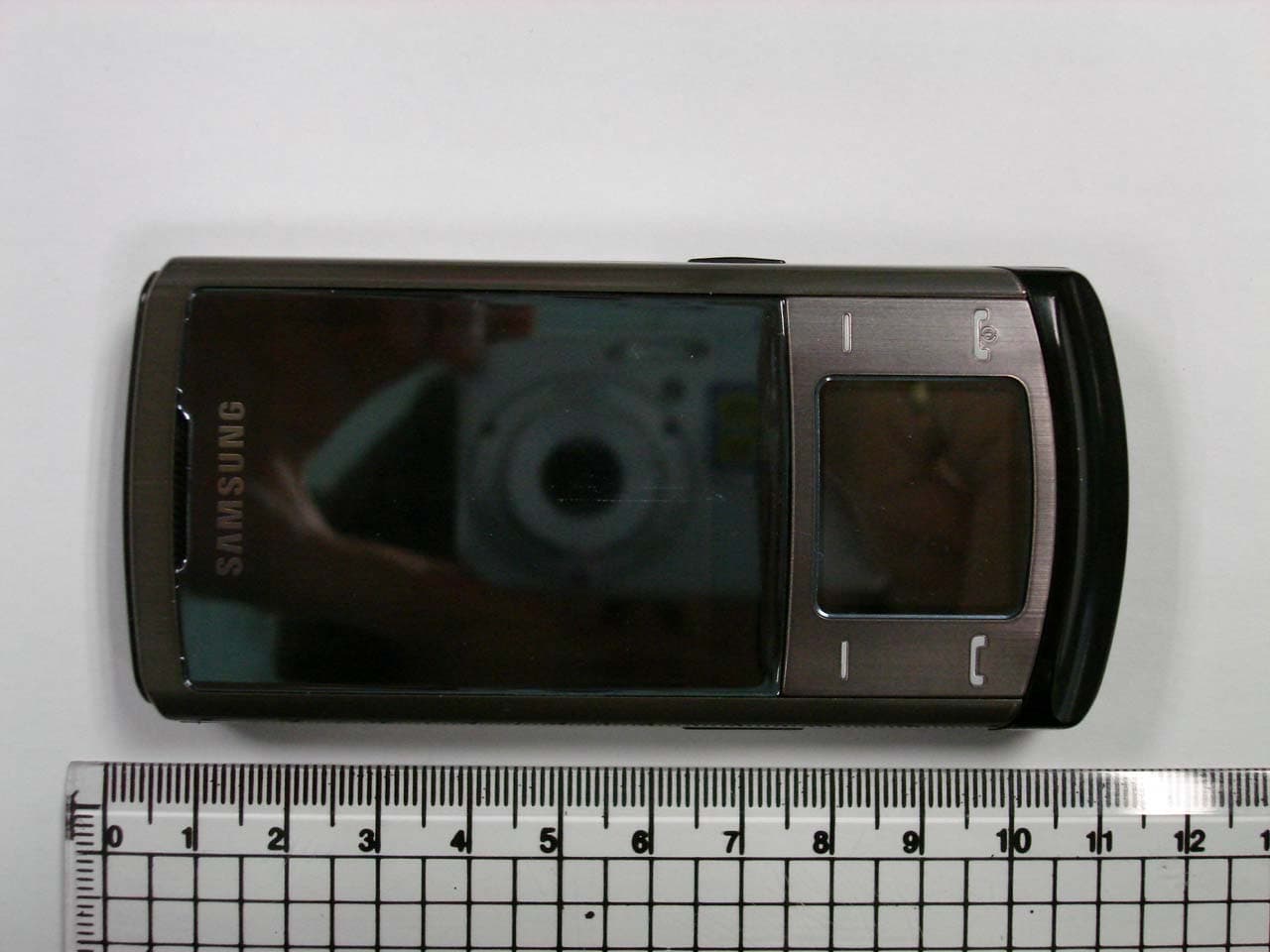
Click to zoom
Application Details
- Equipment Class
- PCE - PCS Licensed Transmitter held to ear
- Date of Grant
- Apr 07, 2008
- Application Purpose
- Original Equipment
- Date of Application
- Apr 07, 2008
- Equipment Note
- Cellular/PCS GSM/EDGE Phone with Bluetooth
- Frequency Range
- 1850.20000000 - 1909.80000000
- Company
- Samsung Electronics Co Ltd
- Country
- United States
Documents & Files
Document Text
Text extracted from the exhibit documents filed with the FCC. Open a document above to read the original.
Users Manual
Some of the contents in this manual may differ from your phone depending on the software of the phone or your service provider.World Wide Webhttp://www.samsungmobile.com Printed in Korea Code No.:GH68-XXXXXA English (LTN). 03/2008. Rev. 1.0 SGH-U900L user manual D r a f t 0 1 20 08 . 0 3. 1 9 S W V e r s io n : U 9 0 0 L U M H B 1 ii using this manual This user manual has been specially designed to guide you through the functions and features of your mobile phone. To get started quickly, refer to “introducing your mobile phone,” “assembling and preparing your mobile phone,” and “using basic functions.” Instructional iconsBefore you start, familiarise yourself with the icons you will see in this manual: War n i n g —situations that could cause injury to yourself or othersCaution —situations that could cause damage to your phone or other equipment Note —notes, usage tips, or additional information X Refer to —pages with related information; for example: X p.12 (represents “see page 12”) using this manual iii Copyright informationRights to all technologies and products that comprise this device are the property of their respective owners:• Bluetooth ® is a registered trademark of the Bluetooth SIG, Inc. worldwide—Bluetooth QD ID: BXXXXXX . • Java™ is a trademark of Sun Microsystems, Inc.• Windows Media Player ® is registered trademark of Microsoft Corporation. → Followed by —the order of options or menus you must select to perform a step; for example: Press <Menu> → Messages → Create new message (represents Menu, followed by Messages, followed by Create new message) [ ] Square brackets —phone keys; for example: [ ] (represents the Power/Menu exit key) <> Angled brackets —softkeys that control different functions at each screen; for example: <OK> (represents the OK softkey) iv contents safety and usage information 2 Safety warnings ................................................ 2Safety precautions ............................................. 4Important usage information ............................. 7 introducing your mobile phone 10 Unpack ............................................................ 10Phone layout ................................................... 11Keys ................................................................ 12Display ............................................................ 13Icons ................................................................ 14 assembling and preparing your mobile phone 16 Install the SIM card and battery ...................... 16Charge the battery ........................................... 18Insert a memory card (optional) ..................... 19 using basic functions 20 Turn your phone on and off ............................ 20Access menus .................................................. 21 contents v Customize your phone ..................................... 21Use basic call functions ................................... 24Send and view messages ................................. 25Add and find contacts ...................................... 27Use basic camera functions ............................. 27Listen to music ................................................ 28Browse the web ............................................... 30 using advanced functions 31 Use advanced call functions ............................ 31Use advanced Phonebook functions ................ 33Use advanced messaging functions ................. 34Use advanced music functions ........................ 36 using tools and applications 39 Use the Bluetooth wireless feature .................. 39Activate and send an SOS message ................. 40Activate the mobile tracker ............................. 41Record and play voice memos ........................ 42 Edit images ..................................................... 43Print images .................................................... 46Use Java-powered games andapplications ..................................................... 46View world clock ............................................ 47Set and use alarms .......................................... 48Use the calculator ........................................... 49Convert or measurements ............................... 49Set a countdown timer .................................... 49Use the stopwatch ........................................... 50Create a text memo ......................................... 50Manage your calendar .................................... 50 troubleshooting aindex d 2 safety and usage information Comply with the following precautions to avoid dangerous or illegal situations and ensure peak performance of your mobile phone. Keep your phone away from small children and petsKeep your phone and all accessories out of the reach of small children or animals. Small parts may cause choking or serious injury if swallowed.Protect your hearing Safety warnings Listening to a headset at high volumes can damage your hearing. Use only the minimum volume setting necessary to hear your conversation or music. safety and usage information 3 Install mobile phones and equipment with cautionEnsure that any mobile phones or related equipment installed in your vehicle are securely mounted. Avoid placing your phone and accessories near or in an air bag deployment area. Improperly installed wireless equipment can cause serious injury when air bags inflate rapidly.Handle and dispose of batteries and chargers with care• Use only Samsung-approved batteries and chargers specifically designed for your phone. Incompatible batteries and chargers can cause serious injuries or damage to your phone. • Never dispose of batteries or phones in a fire. Follow all local regulations when disposing used batteries or phones. • Never place batteries or phones on or in heating devices, such as microwave ovens, stoves, or radiators. Batteries may explode when overheated. • Never crush or puncture the battery. Avoid exposing the battery to high external pressure, which can l…
Text truncated - open the document above for the full version.
Cover Letter(s)
SAMSUNG ELECTRONICS AMERICA, INC. American QA Lab 18600 Broadwick St. Rancho Dominguez, CA 90220 Date: April 1, 2008 Federal Communications Commission Authorization and Evaluation Division 7435 Oakland Mills Road, http Columbia, MD 21046 RE: Request of Confidentiality for FCC ID: A3LSGHU900L To Whom It May Concern: Pursuant to Sections 0.457 and 0.459 of the Commission’s Rules (CFR 47), and Section 552 (b) (4) of the Freedom of Information Act, SAMSUNG ELECTRONICS CO.,LTD. hereby requests confidentiality and treatment of certain information accompanying this application. The materials contain trade secrets and proprietary information not customarily released to the public. The public disclosure of these matters might be harmful to the Applicant and provide unjustified benefits to its competitors. We are also hereby request Short-Term Confidentiality for 180 days after the grant as outlined in Public Notice DA 04-1705. This provision will give SAMSUNG ELECTRONICS CO.,LTD. temporary confidentiality of commercially sensitive information prior to product release. The requested Permanent and Short-Term Confidential exhibits are listed as follows: PERMANENT AND SHORT-TERM CONFIDENTIAL LIST Exhibit Description 1 Block Diagram 2 Operational Description 3 Schematics PERMANENT 4 Parts List & Tune-Up Procedure 5 External Photos 6 Internal Photos 7 Test-Setup Photos SHORT-TERM 8 Users Manual The Applicant understands that pursuant to Rule 0.457, disclosure of this application and all accompanying documentations, where applicable, will not be made public before the date of the Grant for this application. Sincerely, Steve Kim General Manager American QA Lab SAMSUNG Electronics America INC.
Internal Photos
Main antenna * Placement of each antenna in slide up Bluetooth antenna Bluetooth antenna Main antenna 3.32mm * Placement of each antenna in slide down GSM850GSM900 DCS1800PCS1900 * Antenna pattern Bluetooth antenna GSM900 PCS1900 5.38mm * Distance between Bluetooth antenna and PCS antenna • No difference of distance between bluetoothantenna and PCS1900 antenna for each case of slide up and down, because antennas are in the same plastic all together.
RF Exposure Info
of 35 SAMSUNG ELECTRONICS Co., Ltd., Regulatory Compliance Group IT R&D Center 416, Maetan-3dong, Yeongtong-gu, Suwon-si, Gyeonggi-do, Korea 443-742 TEST REPORT ON SAR Model Tested: SGH-U900L FCC ID (Requested): A3LSGHU900L Job No: FF-042 Report No: FF-042-S1 Date issued: Apr.07 , 2008 - Abstract – This document reports on SAR Tests carried out in accordance with FCC/OET Bulletin 65, Supplement C(July 2001). Prepared By EH JUNG - Test Engineer Authorized By JH NAM - Technical Manager Report Number: FF-042-S1 2 of 35 Contents 1. GENERAL INFORMATION............................................................................................................. 3 2. DESCRIPTION OF DEVICE ........................................................................................................... 3 3. DESCRIPTION OF TEST EQUIPMENT ......................................................................................... 4 3.1 SAR Measurement Setup ......................................................................................................4 3.2 E-field Probe .......................................................................................................................... 6 3.3 SAM Phantom ........................................................................................................................ 8 3.4 Brain & Muscle Simulating Mixture Characterization ............................................................. 8 3.5 Device Holder for Transmitters ..............................................................................................9 3.6 Validation Dipole .................................................................................................................... 9 3.7 Equipment Calibration.......................................................................................................... 10 4. SAR MEASUREMENT PROCEDURE ......................................................................................... 11 5. DESCRIPTION OF TEST POSITION ........................................................................................... 12 5.1 SAM Phantom Shape...........................................................................................................12 5.2 Cheek/Touch Position .......................................................................................................... 12 5.3 EAR/Tilt 15° Position ............................................................................................................ 14 5.4 Body Holster/Belt Clip Configurations.................................................................................. 15 6. MEASUREMENT UNCERTAINTY................................................................................................ 17 7. SYSTEM VERIFICATION ............................................................................................................. 20 7.1 Tissue Verification ................................................................................................................ 20 7.2 Test System Validation ......................................................................................................... 20 8. SAR MEASUREMENT RESULTS ................................................................................................ 21 8.1 Measurement Results(GSM850 Right Head SAR - Touch) ................................................. 23 8.2 Measurement Results(GSM850 Right Head SAR - Tilt) ...................................................... 24 8.3 Measurement Results(GSM850 Left Head SAR - Touch).................................................... 25 8.4 Measurement Results(GSM850 Left Head SAR - Tilt)......................................................... 26 8.5 Measurement Results(GPRS850 Body SAR without Holster) ............................................. 27 8.6 Measurement Results(GSM1900 Right Head SAR - Touch) ............................................... 28 8.7 Measurement Results(GSM1900 Right Head SAR - Tilt) .................................................... 29 8.8 Measurement Results(GSM1900 Left Head SAR - Touch).................................................. 30 8.9 Measurement Results(GSM1900 Left Head SAR - Tilt)....................................................... 31 8.10 Measurement Results(GPRS1900 Body SAR without Holster)......................................... 32 9. CONCLUSION .............................................................................................................................. 33 10. REFERENCES ............................................................................................................................ 34 Report Number: FF-042-S1 3 of 35 1. GENERAL INFORMATION Test Sample : Dual-Band GSM/EDGE 850/1900 Phone with Bluetooth Model Number : SGH-U900L Serial Number : Identical prototype (S/N : # FF-042-C) Manufacturer : SAMSUNG ELECTRONICS Co., Ltd. Contact : JW LEE Phone : +82-31-301-6263 Fax : None Test Standard : §2.1093; FCC/OET Bulletin 65, Supplement C(July 2001) FCC Classification : Licensed Portable Transmitter Held to Ear (PCE) Test Dates : Mar.19, 2008 ~ Mar.21, 2008 Tested for : FCC/TCB Certification 2. DESCRIPTION OF DEVICE Tx Freq. Range : 824.2 ~ 848.8 MHz (GSM850) 1850.20 ~ 1909.80 MHz (GSM1900) 2402 ~ 2480 MHz (Bluetooth) Rx Freq. Range : 869.2 ~ 893.8 MHz (GSM850) 1930.20 ~ 1989.80 MHz (GSM1900) 2402 ~ 2480 MHz (Bluetooth) Antenna Manufacturer : YOKOWO Model No.: P5OO88E-02 Antenna Dimensions : 34.6mm×10.2mm GPRS Class 10 Separation distance between GSM and Bluetooth antenna : 0.332 cm Report Number: FF-042-S1 4 of 35 3. DESCRIPTION OF TEST EQUIPMENT 3.1 SAR Measurement Setup Robotic System Measurements are performed using the DASY4 automated dosimetric assessment system. Which is made by Schmid & Partner Engineering AG (SPEAG) in Zurich, Switzerland and consists of high precision robotics system (Stäubli), robot controller, measurement server, Samsung computer, near- field probe, p…
Text truncated - open the document above for the full version.
RF Exposure Info
APPENDIX H Calibration of The Validation Dipole
RF Exposure Info
APPENDIX G Probe Calibration
Test Report
SAMSUNG ELECTRONICS Co., Ltd., Regulatory Compliance Group IT R&D Center 416 Maetan3-Dong, Yeongtong-gu, Suwon city, Gyeonggi-Do, Korea 443-742 FCC CFR47 PART 22 & 24 SUBPART CERTIFICATION REPORT Model Tested : SGH-U900L FCC ID(Requested) : A3LSGHU900L Report No : FF-042-R1 Job No : FF-042 Date issued : March 26, 2008 - Abstract - All measurement reported herein accordance with FCC Rules, 47CFR Part2, Part22, Part24. Prepared By JH WOO - Test Engineer Authorized By WW JANG - Technical Manager Report Number : FF-042-R1 TABLE OF CONTENT MEASUREMENT REPORT Page 1. FCC CERTIFICATION INFORMATION .....................................................................3 1.1. §2.1033 General Information .........................................................................3 2. INTRODUCTION .......................................................................................................3 2.1. General..........................................................................................................3 3. MEASURING INSTRUMENT CALIBRATION ...........................................................3 4. TEST EQUIPMENT LIST...........................................................................................3 5. DESCRIPTION OF TESTS ........................................................................................3 5.1. Effective Radiated Power / Equivalent Isotropic Radiated Power ..................3 5.2. Radiated Spurious & Harmonic Emission ......................................................3 5.3. Occupied Bandwidth ......................................................................................3 5.4. Spurious and Harmonic Emission at Antenna Terminal..................................3 5.4.1. Occupied Bandwidth Emission Limits ................................................3 5.4.2. Conducted Spurious Emission ...........................................................3 5.5. Frequency Stability / Temperature Variation ...................................................3 6. TEST DATA ...............................................................................................................3 6.1. Effective Radiated Power (E.R.P.)..................................................................3 6.2. Equivalent Isotropic Radiated Power (E.I.R.P.) ..............................................3 6.3. GSM850 Radiated Spurious & Harmonic measurement ................................3 6.4. GSM1900 Radiated Spurious & Harmonic measurement ..............................3 6.5. GSM850 Radiated Spurious & Harmonic Conversion Table ..........................3 6.6. GSM1900 Radiated Spurious & Harmonic Conversion Table ........................3 6.7. Frequency Stability.........................................................................................3 6.7.1. GSM850 Frequency Stability Table ....................................................3 6.7.2. GSM850 Frequency Stability Graph...................................................3 6.7.3. GSM1900 Frequency Stability Table ..................................................3 6.7.4. GSM1900 Frequency Stability Graph.................................................3 7. CONCLUSION...........................................................................................................3 8. TEST PLOTS.............................................................................................................3 Report Number : FF-042-R1 MEASUREMENT REPORT 1. FCC Certification Information The following information is in accordance with FCC Rules, 47CFR Part2, Subpart J, Sections 2.1033 – 2.1055. 1.1. §2.1033 General Information • Applicant Name : SAMSUNG ELECRONICS CO., LTD. • Address : 416 Maetan3-Dong, Yeongtong-gu, Suwon City Gyeonggi-Do, Korea 443-742 • Attention : SungJoo KIM, Engineering Manager (QA Lab) • FCC ID : A3LSGHU900L • Quantity : Quantity production is planned • Emission Designators : 253KGXW(GSM850), 246KG7W(GSM850 EDGE) 252KGXW(GSM1900), 247KG7W(GSM1900 EDGE) • Tx Freq. Range : 824.2 - 848.8MHz (GSM850) 1850.2MHz - 1909.8MHz (GSM1900) • Rx Freq. Range : 869.2 - 893.8 MHz (GSM850) 1930.2MHz - 1989.8MHz (GSM1900) • Max. Power Rating : 1.738 W ERP GSM850 (32.40dBm) 1.086 W EIRP GSM1900 (30.36dBm) 0.755 W ERP GSM850 EDGE(28.78dBm) 0.843 W EIRP GSM1900 EDGE(29.26dBm) • FCC Classification(s) : Licensed Portable Tx Held to Ear (PCE) • Equipment (EUT) Type : Dual-Band GSM/EDGE 850/1900 Phone with Bluetooth • Frequency Tolerance : ±0.00025% (2.5ppm) • FCC Rule Part(s) : §24(E), §22(H), §2. • Dates of Test : March 11-12, 2008 • Place of Test : SAMSUNG Lab, • Test Report S/N : FF-042-R1 Report Number : FF-042-R1 2. INTRODUCTION 2.1. General These measurement test were conducted at SAMSUNG ELECTRONICS CO., LTD(SUWON). The site address is 416 Maetan3-Dong, Yeongtong-gu, Suwon City, Gyeonggi-Do, Korea 443-742 The site have 1 Fully-anechoic chamber and measurement facility. Measurement Procedure The radiated and spurious measurements were made Fully-anechoic chamber at a 3-meter test range (see Figure2). The equipment under testing was placed on a Non-conducted turntable 3- meters from the receive antenna. The receive antenna height and turntable rotations were adjusted for the highest reading on the receive spectrum analyzer. The substitution antenna will replace the EUT antenna it the same position and in vertical polarization. The frequency of the signal generator shall be set to the frequencies that were measured on the EUT. The test antenna shall be raised and lowered, if necessary, to ensure that the maximum signal is still being received. The signal generator, output level, shall be adjusted until an equal or a known related level to what was measured from the EUT is obtained in the spectrum analyzer. This level was recorded. For readings above 1 GHz, the above procedure is repeated using horn antennas and the difference between the gain of the horn and an isotropic antenna are taken into consideration. Figure1. Map of th…
Text truncated - open the document above for the full version.
Test Setup Photos
SAMSUNG FCC ID: A3LSGHU900L Dual-Band GSM/EDGE 850/1900 Phone with Bluetooth SAMSUNG FCC ID: A3LSGHU900L Dual-Band GSM/EDGE 850/1900 Phone with Bluetooth
Test Setup Photos
© 2008 SAMSUNG ELECTRONICS Co., Ltd SAMSUNG FCC ID:A3LSGHU900L Dual-Band GSM/EDGE 850/1900 Phone with Bluetooth © 2008 SAMSUNG ELECTRONICS Co., Ltd SAMSUNG FCC ID:A3LSGHU900L Dual-Band GSM/EDGE 850/1900 Phone with Bluetooth © 2008 SAMSUNG ELECTRONICS Co., Ltd SAMSUNG FCC ID:A3LSGHU900L Dual-Band GSM/EDGE 850/1900 Phone with Bluetooth © 2008 SAMSUNG ELECTRONICS Co., Ltd SAMSUNG FCC ID:A3LSGHU900L Dual-Band GSM/EDGE 850/1900 Phone with Bluetooth © 2008 SAMSUNG ELECTRONICS Co., Ltd SAMSUNG FCC ID:A3LSGHU900L Dual-Band GSM/EDGE 850/1900 Phone with Bluetooth © 2008 SAMSUNG ELECTRONICS Co., Ltd SAMSUNG FCC ID:A3LSGHU900L Dual-Band GSM/EDGE 850/1900 Phone with Bluetooth © 2008 SAMSUNG ELECTRONICS Co., Ltd SAMSUNG FCC ID:A3LSGHU900L Dual-Band GSM/EDGE 850/1900 Phone with Bluetooth © 2008 SAMSUNG ELECTRONICS Co., Ltd SAMSUNG FCC ID:A3LSGHU900L Dual-Band GSM/EDGE 850/1900 Phone with Bluetooth © 2008 SAMSUNG ELECTRONICS Co., Ltd SAMSUNG FCC ID:A3LSGHU900L Dual-Band GSM/EDGE 850/1900 Phone with Bluetooth © 2008 SAMSUNG ELECTRONICS Co., Ltd SAMSUNG FCC ID:A3LSGHU900L Dual-Band GSM/EDGE 850/1900 Phone with Bluetooth © 2008 SAMSUNG ELECTRONICS Co., Ltd SAMSUNG FCC ID:A3LSGHU900L Dual-Band GSM/EDGE 850/1900 Phone with Bluetooth © 2008 SAMSUNG ELECTRONICS Co., Ltd SAMSUNG FCC ID:A3LSGHU900L Dual-Band GSM/EDGE 850/1900 Phone with Bluetooth
Contact Information
Applicant
Jenni Chun(General Manager)
Technical Contact
PCTEST Engineering Lab., Inc.Randy Ortanez
[email protected]410-290-6652
6660-B Dobbin Road · Columbia, Maryland · United States
Test Firm
Samsung Electronics Co., Ltd. Global CS CenterPark No cheon
Technical Specifications
| # | Rule Parts | Frequency Range | Power Output | Emission | Tolerance |
|---|---|---|---|---|---|
| 4 | 24E | 1.85 GHz - 1.91 GHz | 843.00 mW | 247KG7W | 2.5 ppm |
Other Applications from Samsung Electronics Co Ltd
A3LSMS741B
Aug 05, 2026Portable Handset
Equipment Class
6VL - 15E 6 GHZ Very Low Power DeviceA3LSMX940
Jul 31, 2026BT,BLE Tablet DTS,UNII a,b,g,n,ac,ax,be and digitizer
Equipment Class
DTS - Digital Transmission SystemA3LSMS741U
Jul 30, 2026Portable Handset
Equipment Class
6CD - 15E 6 GHz Low Power Dual ClientA3LSMX840
Jul 27, 2026BT,BLE Tablet DTS,UNII a,b,g,n,ac,ax and Digitizer
Equipment Class
DSS - Part 15 Spread Spectrum TransmitterA3LSMX848U
Jul 27, 2026WCDMA, LTE, 5G NR Tablet BT,BLE, DTS,UNII a b g n ac ax and Digitizer
Equipment Class
JBP - Part 15 Class B Computing Device Peripheral