A3LSPHI330Tri-Mode Dual-Band Analog/PCS Phone (AMPS/CDMA)
Samsung Electronics Co Ltd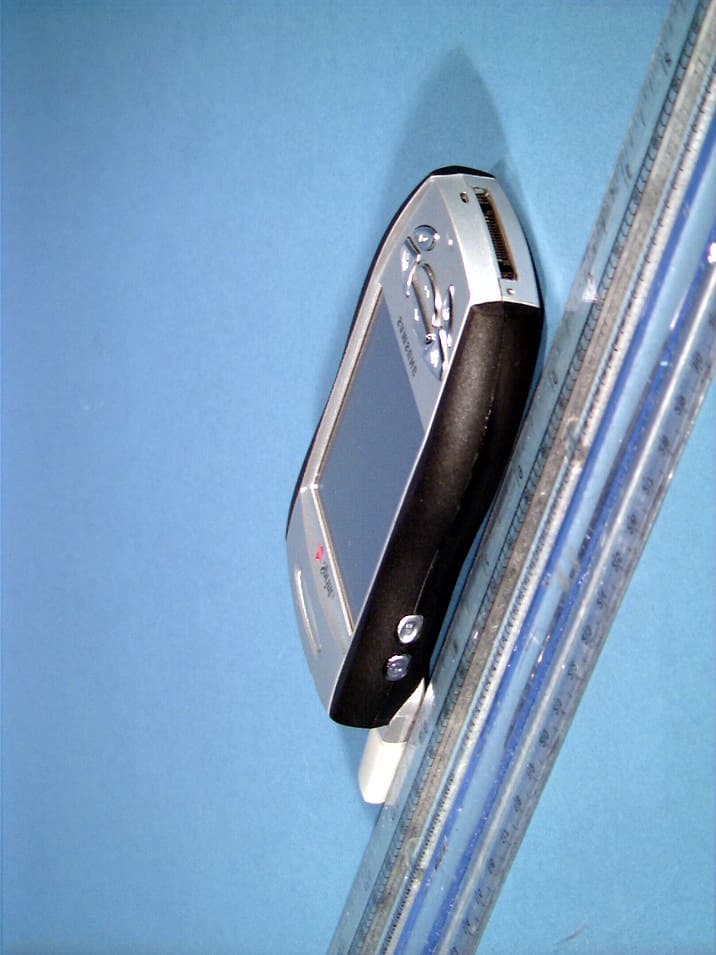
Click to zoom
Application Details
- Equipment Class
- PCE - PCS Licensed Transmitter held to ear
- Date of Grant
- Jun 19, 2002
- Application Purpose
- Original Equipment
- Date of Application
- Jun 19, 2002
- Equipment Note
- Tri-Mode Dual-Band Analog/PCS Phone (AMPS/CDMA)
- Frequency Range
- 1851.25000000 - 1908.75000000
- Company
- Samsung Electronics Co Ltd
- Country
- United States
Documents & Files
Document Text
Text extracted from the exhibit documents filed with the FCC. Open a document above to read the original.
Users Manual
SPH-i330 User's Manual 2 Please read this manual before operating the phone, and keep it for future reference. 3 Contents Safety Precautions..................................................3 Introduction ..........................................................5 Layout...................................................................6 Interface ...............................................................7 Phone Application................................................10 SMS Application.....................................................12 Another Applications..............................................13 Setting Preferences ...............................................14 Communications...................................................15 For more information about RF exposure, please visit the FCC website at www.fcc.gov FCC RF EXPOSURE INFORMATION In August 1996 the Federal Communications Commission (FCC) of the United States with its action in Report and Order FCC 96-326 adopted an updated safety standard for human exposure to radio frequency electromagnetic energy emitted by FCC regulated transmitters. Those guidelines are consistent with the safety standard previously set by both U.S. and international standards bodies. The design of this phone complies with the FCC guidelines and these international standards. Use only the supplied or an approved antenna. Unauthorized antennas, modifications, or attachments could impair call quality, damage the phone, or result in violation of FCC regulations. Do not use the phone with a damaged antenna. If a damaged antenna comes into contact with the skin, a minor burn may result. Please contact your local dealer for replacement antenna. Body-worn Operation This device was tested for typical body-worn operations with the back of the phone kept 1.5 cm. from the body. To maintain compliance with FCC RF exposure requirements, use only belt-clips, holsters or similar accessories that maintain a 1.5 cm. separation distance between the user’s body and the back of the phone, including the antenna, whether extended or retracted. The use of belt-clips, holsters and similar accessories should not contain metallic components in its assembly. The use of accessories that do not satisfy these requirements may not comply with FCC RF exposure requirements, and should be avoided. WARNING! Read this information before using your phone 4 Safety Precautions Compliance with Safety Standards The Samsung Cellular phone meets all standards and recommendations for the protection of the public from exposure to radio frequency(RF) electromagnetic energy established by governmental bodies and other qualified organizations. To reduce the risk of fire, electric shock, serious personal injury, or property damage, please follow these guidelines: Driving Using a wireless phone while driving is illegal in some states and countries. Know the laws and regulations for your area, and pull off the road and park if you need to make a call. If you must use the phone while driving, purchase and install the optional Hands- Free Car Kit. Electronic Devices Your wireless telephone is a radio transmitter and receiver. When the power is on, the phone receives and sends out RF energy. Most modern electronic equipment, such as equipment and cars, contains an RF signal shield. RF energy may affect some inadequately shielded electronic equipment. Turn off tour phone in health care facilities, and always request pacemakers and hearing aids, to determine if they are shielded adequately from external RF signals. Note if there are any regulations posted in area regarding the operation of wireless phones, and learn where you can use them safely within facility. Aircraft Turn off your phone before boarding any aircraft. The Federal Aviation Administration (FAA) requires that you have prior permission from the crew to use your phone while the plane is on the ground. FCC regulations prohibit using your phone is in the air. Do not use your phone at any time while traveling on board a plane. Blasting Areas Construction crews often use remote-control RF devices to set off explosives. To avoid interfering with blasting operation , turn off your phone when you are in a blasting area or in any area with signs posted that read "Turn off two-way radio." 5 Other Dangerous Areas Turn off your phone in any area with a potentially explosive atmosphere. It is rare, but your phone or its accessories could generate sparks, which could explosion or fire. * Fueling areas, such as gas stations * Below deck on boats * Furl or chemical transfer or storage facilities * Areas where the air contain chemicals or particles such as grain, dust, or metal powders * Any other area where you would normally be advised to turn off your vehicle engine Do not transport or store flammable gas, liquid, or explosives in the compartment of a vehicle containing your or accessories. FCC/IC Notice This device compiles with part 15 of the FCC rules. Operation is subject to the following two condition: (1) This device may not cause harmful interference, and (2) this device must accept any interference received, including interference that may cause undesired operation. 6 Introduction to SPH-i330 The following features provide a range of user options that make the phone both fun and easy to use. Phone features : You can use advanced phone capabilities. PDA features : Address, Calculator, Date book, Expense, Memo Pad, To Do List etc. Messaging feature : You can receive three kinds of messages - voicemail, text, numeric pages. Data Capability : HotSync technology to synchronize your phone and PC. Touch Screen Writing Recognition and On-Screen keyboard and PC input method 7 Layout The following picture shows the main elements of SPH-i330. 8 Power button : Press to turn the phone on / off. Contrast adjust button : Press to control the contrast of the display. Scroll button : Displays text and other information that extends beyond the area …
Text truncated - open the document above for the full version.
Attestation Statements
May 10, 2002 Federal Communications Commission Authorization and Evaluation Div. Equipment Authorization Branch 7435 Oakland Mills Road Columbia, MD 21046 In re: Samsung Electronics Co., Ltd. FCC ID.: A3LSPHI330 Request for Confidentiality To Whom It May Concern: In accordance with 0.459 of CFR 47, Samsung Electronics Co., Ltd. requests confidentiality for the Block Diagram, Schematics, Parts list, Tune-up Procedure, Operational and Circuit Description of the attached test report. These documents contain detailed system and equipment descriptions and related information about the product, which Samsung Electronics Co., Ltd. considers to be proprietary, confidential, and a custom design and otherwise, would not release to the general public. Since this design is a basis from which future technological products will evolve, Samsung feels that this information would be of benefit to its competitors, and that the disclosure of the information in these documents would give our competitors an unfair advantage in the market.
Cover Letter(s)
May 29, 2002 Federal Communications Commission Equipment Approval Services 7435 Oakland Mills Road Columbia, MD 21046 SUBJECT: SAMSUNG Electronics Co., Ltd. FCC ID: A3LSPHI330 Part 24/22 Certification Gentlemen: Submitted herewith, on behalf of SAMSUNG Electronics Co., Ltd., is an application for Part 24/22 Certification of the Tri-Mode Dual-Band Analog/PCS Phone. Attached is the applicant’s Letter of Authorization, Confidentiality Request, ESN Affidavit, E911 compliance statement, measurement report test data and plots, RF Exposure measurement report and data, FCC ID label and location, test setup photographs, internal and external photographs, block diagram (confidential), circuit diagrams & description (confidential), operational description (confidential), parts list & tune-up procedure (confidential), and the user's manual. Should you have any questions or comments concerning the above, please contact the undersigned. cc: SAMSUNG Electronics Co., Ltd.
Cover Letter(s)
July 26, 2002 Federal Communications Commission Equipment Approval Services 7435 Oakland Mills Road Columbia, MD 21046 Re: Withdrawal of Confidentiality Request FCC ID: A3LSPHI330 Gentlemen: PCTEST TCB has removed or is removing the check mark from the confidentiality request box for the reference item in compliance with your request. This action insures that all requests and other issues raised by the Commission in regard to their post grant review of this application has been addressed. In regard to the original request for confidentiality of the subject business documents, it is understood that such a request should be addressed through a different venue. Accordingly, we are withdrawing the confidentiality request and the test firm, in this case PCTEST Lab, is considering addressing the confidentiality issues directly as a policy matter with the Commission. Should you have any questions or comments concerning the above, please contact the undersigned.
Cover Letter(s)
August 1, 2002 Federal Communications Commission Equipment Approval Services 7435 Oakland Mills Road Columbia, MD 21046 Attn: Mr. Martin Perrine SUBJECT: Samsung Electronics Co., Ltd. FCC ID: A3LSPHI330 731 Confirmation No.: TC362144 Correspondence Reference No.: 4559 Request for Tech. Info.: 7/03/02 Dear Martin: Transmitted herewith, on behalf of Samsung Electronics Co., Ltd. is an amendment provided in response to the request for technical information dated July 3, 2002. 1. Please find attached the SAR summary data and plots for CDMA 800. 2. Please find attached the Data comparison between Speag probe calibration and PCTEST probe calibration. Please note that this application refers to sample number 6. 3. We would like to confirm that we have marked this application as not confidential. We trust this information is sufficient to resolve FCC questions in this application. If you have any further questions, please do not hesitate to contact us. cc: Samsung Electronics Co., Ltd.
External Photos
© 2002 PCTEST Lab SAMSUNG FCC ID: A3LSPHI330 (Model: SPH-I330) Tri-Mode Dual-Band Analog/PCS Phone (AMPS/CDMA) © 2002 PCTEST Lab SAMSUNG FCC ID: A3LSPHI330 (Model: SPH-I330) Tri-Mode Dual-Band Analog/PCS Phone (AMPS/CDMA) © 2002 PCTEST Lab SAMSUNG FCC ID: A3LSPHI330 (Model: SPH-I330) Tri-Mode Dual-Band Analog/PCS Phone (AMPS/CDMA) © 2002 PCTEST Lab SAMSUNG FCC ID: A3LSPHI330 (Model: SPH-I330) Tri-Mode Dual-Band Analog/PCS Phone (AMPS/CDMA) © 2002 PCTEST Lab SAMSUNG FCC ID: A3LSPHI330 (Model: SPH-I330) Tri-Mode Dual-Band Analog/PCS Phone (AMPS/CDMA) © 2002 PCTEST Lab SAMSUNG FCC ID: A3LSPHI330 (Model: SPH-I330) Tri-Mode Dual-Band Analog/PCS Phone (AMPS/CDMA) © 2002 PCTEST Lab SAMSUNG FCC ID: A3LSPHI330 (Model: SPH-I330) Tri-Mode Dual-Band Analog/PCS Phone (AMPS/CDMA)
ID Label/Location Info
© 2002PCTEST Lab FCC ID SAMPLE LABEL & LOCATION LABELLING REQUIREMENTS PER §§ 2.925 The Label shown shall be permanently affixed at a conspicuous location on the device and be readily visible to the user at the time of purchase. (SEE NEXT PAGE) SAMSUNG ELECTRONICS CO., LTD. MODEL NO: SPH-i330 FCC ID: A3LSPHI330 MADE IN KOREA SAMSUNG ELECTRONICS CO., LTD
Internal Photos
© 2002 PCTEST Lab SAMSUNG FCC ID: A3LSPHI330 (Model: SPH-I330) Tri-Mode Dual-Band Analog/PCS Phone (AMPS/CDMA) © 2002 PCTEST Lab SAMSUNG FCC ID: A3LSPHI330 (Model: SPH-I330) Tri-Mode Dual-Band Analog/PCS Phone (AMPS/CDMA) © 2002 PCTEST Lab SAMSUNG FCC ID: A3LSPHI330 (Model: SPH-I330) Tri-Mode Dual-Band Analog/PCS Phone (AMPS/CDMA) © 2002 PCTEST Lab SAMSUNG FCC ID: A3LSPHI330 (Model: SPH-I330) Tri-Mode Dual-Band Analog/PCS Phone (AMPS/CDMA) © 2002 PCTEST Lab SAMSUNG FCC ID: A3LSPHI330 (Model: SPH-I330) Tri-Mode Dual-Band Analog/PCS Phone (AMPS/CDMA) © 2002 PCTEST Lab SAMSUNG FCC ID: A3LSPHI330 (Model: SPH-I330) Tri-Mode Dual-Band Analog/PCS Phone (AMPS/CDMA) © 2002 PCTEST Lab SAMSUNG FCC ID: A3LSPHI330 (Model: SPH-I330) Tri-Mode Dual-Band Analog/PCS Phone (AMPS/CDMA) © 2002 PCTEST Lab SAMSUNG FCC ID: A3LSPHI330 (Model: SPH-I330) Tri-Mode Dual-Band Analog/PCS Phone (AMPS/CDMA) © 2002 PCTEST Lab SAMSUNG FCC ID: A3LSPHI330 (Model: SPH-I330) Tri-Mode Dual-Band Analog/PCS Phone (AMPS/CDMA)
Operational Description
SPH-i330(Tri-Band Quad-Mode) March 25, 2002 3.Antenna Specification VENDER: SBTELCOMCO. ELECTRICAL DATA Freq. Band AMPS Band Transmit Band: 824~ 849MHz Receive Band: 869~ 894MHz GPS Band: 1575.42MHz PCS Band Transmit Band: 1850~ 1910MHz Receive Band: 1930~ 1990MHz Impedence Normal Value: 50 VSWR(FreeSpace) RetractedLessthan 2.5 : 1 ExtendedLessthan 2.5 : 1 Gain RetractedGreater than-4dBd ExtendedGreater than-3dBd (dBd : dBrelative to a dipole) MaximumLobe Tilt Retracted45 Extended45
Operational Description
PCTEST ENGINEERING LABORATORY, INC. 6660 — B Dobbin Road • Columbia, MD 21045 • USA Telephone 410.290.6652 / Fax 410.290.6654 http://www.pctestlab.com (email: [email protected]) CERTIFICATE OF COMPLIANCE (SAR EVALUATION) PCTEST SAR REPORT FCC CERTIFICATION Reviewed by: Quality Manager SAR Filename: SAR-220325126.A3L Test Dates: March 25-28, 2002 Phone Type: Tri-Mode Dual-Band FCC ID: A3LSPHI330 Page 1 of 35 © 2002 PCTEST Engineering Laboratory, Inc APPLICANT NAME & ADDRESS: DATE & LOCATION OF TESTING: SAMSUNG ELECTRONICS CO., LTD. Dates of Tests: March 25-28, 2002 416 Maetan-3 Dong, Paldal-Ku Test Report S/N: 22/24.220325126.A3L Suwon City Kyungki-Do 441-742, KOREA Test Site: PCTEST Lab, Columbia MD Attn: Wallace Oh, Engineering Manager Samsung Electronics America (QA Lab) FCC ID: A3LSPHI330 APPLICANT: SAMSUNG ELECTRONICS CO., LTD. EUT Type: Tri-Mode Dual-Band Analog/PCS Phone (AMPS/CDMA) Tx Frequency: 824.04 — 848.97 MHz (AMPS) / 824.70 — 848.31 MHz (CDMA) 1851.25 — 1908.75 MHz (PCS CDMA) Rx Frequency: 869.04 — 893.97 MHz (AMPS) / 869.70 — 893.31 MHz (CDMA) 1931.25 — 1988.75 MHz (PCS CDMA) Max. RF Output Power: 0.535 W ERP AMPS (27.283 dBm) / 26.5 dBm Conducted 0.477 W ERP CDMA (26.783 dBm) / 26.0 dBm Conducted 0.452 W EIRP PCS CDMA (26.551 dBm)/ 24.5 dBm Conducted Max. SAR Measurement: 1.400W/kg AMPS Head SAR; 0.989W/kg AMPS Body SAR; 1.090W/kg CDMA Head SAR; 0.788W/kg CDMA Body SAR; 1.370W/kg PCS CDMA Head SAR; 0.714W/kg PCS CDMA Body SAR Trade Name/Model(s): SPH-i330 FCC Classification: Licensed Portable Transmitter Held to Ear (PCE) FCC Rule Part(s): §2.1093; FCC/OET Bulletin 65 Supplement C [July 2001] Application Type: Certification Test Device Serial No.: identical prototype This wireless portable device has been shown to be capable of compliance for localized specific absorption rate (SAR) for uncontrolled environment/general population exposure limits specified in ANSI/IEEE Std. C95.1-1992 and had been tested in accordance with the measurement procedures specified in FCC/OET Bulletin 65 Supplement C (2001) and IEEE Std. 1528-200X (Draft 6.4, July 2001). I attest to the accuracy of data. All measurements reported herein were performed by me or were made under my supervision and are correct to the best of my knowledge and belief. I assume full responsibility for the completeness of these measurements and vouch for the qualifications of all persons taking them. PCTEST certifies that no party to this application has been denied the FCC benefits pursuant to Section 5301 of the Anti-Drug Abuse Act of 1988, 21 U.S.C. 862. 220325126.A3L PCTEST SAR REPORT FCC CERTIFICATION Reviewed by: Quality Manager SAR Filename: SAR-220325126.A3L Test Dates: March 25-28, 2002 Phone Type: Tri-Mode Dual-Band FCC ID: A3LSPHI330 Page 2 of 35 © 2002 PCTEST Engineering Laboratory, Inc 1. INTRODUCTION .................................................................................................. 3 SAR DEFINITION ................................................................................................. 3 2. SAR MEASUREMENT SETUP .................................................................................. 4 Robotic System ....................................................................................................... 4 System Hardware ................................................................................................... 4 System Electronics .................................................................................................. 4 3. DASY3 E-FIELD PROBE SYSTEM ............................................................................ 5 Probe Measurement System.................................................................................... 5 Probe Specifications ............................................................................................... 5 4. Probe Calibration Process....................................................................................... 6 Dosimetric Assessment Procedure .......................................................................... 6 Free Space Assessment ........................................................................................... 6 Temperature Assessment ........................................................................................ 6 5. PHANTOM & EQUIVALENT TISSUES .................................................................... 7 SAM Phantom ........................................................................................................ 7 Brain & Muscle Simulating Mixture Characterization ............................................. 7 Device Holder for Transmitters............................................................................... 7 6. TEST SYSTEM SPECIFICATIONS ............................................................................. 8 Automated Test System Specifications .................................................................... 8 7. DOSIMETRIC ASSESSMENT & PHANTOM SPECS ................................................. 9 Measurement Procedure......................................................................................... 9 Specific Anthropomorphic Mannequin (SAM) Specifications.................................. 9 8. DEFINITION OF REFERENCE POINTS ................................................................. 10 EAR Reference Point............................................................................................. 10 Handset Reference Points ..................................................................................... 10 9. TEST CONFIGURATION POSITIONS .................................................................. 11 Positioning for Cheek/Touch ................................................................................ 11 Positioning for Ear / 15° Tilt .................................................................................. 12 Body Holster /Belt Clip Configurations ..............................…
Text truncated - open the document above for the full version.
RF Exposure Info
© 2002 PCTEST Lab SAMSUNG FCC ID: A3LSPHI330 (Model: SPH-I330) Tri-Mode Dual-Band Analog/PCS Phone (AMPS/CDMA) © 2002 PCTEST Lab SAMSUNG FCC ID: A3LSPHI330 (Model: SPH-I330) Tri-Mode Dual-Band Analog/PCS Phone (AMPS/CDMA) © 2002 PCTEST Lab SAMSUNG FCC ID: A3LSPHI330 (Model: SPH-I330) Tri-Mode Dual-Band Analog/PCS Phone (AMPS/CDMA) © 2002 PCTEST Lab SAMSUNG FCC ID: A3LSPHI330 (Model: SPH-I330) Tri-Mode Dual-Band Analog/PCS Phone (AMPS/CDMA) © 2002 PCTEST Lab SAMSUNG FCC ID: A3LSPHI330 (Model: SPH-I330) Tri-Mode Dual-Band Analog/PCS Phone (AMPS/CDMA) © 2002 PCTEST Lab SAMSUNG FCC ID: A3LSPHI330 (Model: SPH-I330) Tri-Mode Dual-Band Analog/PCS Phone (AMPS/CDMA) © 2002 PCTEST Lab SAMSUNG FCC ID: A3LSPHI330 (Model: SPH-I330) Tri-Mode Dual-Band Analog/PCS Phone (AMPS/CDMA) © 2002 PCTEST Lab SAMSUNG FCC ID: A3LSPHI330 (Model: SPH-I330) Tri-Mode Dual-Band Analog/PCS Phone (AMPS/CDMA) © 2002 PCTEST Lab SAMSUNG FCC ID: A3LSPHI330 (Model: SPH-I330) Tri-Mode Dual-Band Analog/PCS Phone (AMPS/CDMA) © 2002 PCTEST Lab SAMSUNG FCC ID: A3LSPHI330 (Model: SPH-I330) Tri-Mode Dual-Band Analog/PCS Phone (AMPS/CDMA) © 2002 PCTEST Lab SAMSUNG FCC ID: A3LSPHI330 (Model: SPH-I330) Tri-Mode Dual-Band Analog/PCS Phone (AMPS/CDMA) © 2002 PCTEST Lab SAMSUNG FCC ID: A3LSPHI330 (Model: SPH-I330) Tri-Mode Dual-Band Analog/PCS Phone (AMPS/CDMA) © 2002 PCTEST Lab SAMSUNG FCC ID: A3LSPHI330 (Model: SPH-I330) Tri-Mode Dual-Band Analog/PCS Phone (AMPS/CDMA) © 2002 PCTEST Lab SAMSUNG FCC ID: A3LSPHI330 (Model: SPH-I330) Tri-Mode Dual-Band Analog/PCS Phone (AMPS/CDMA) © 2002 PCTEST Lab SAMSUNG FCC ID: A3LSPHI330 (Model: SPH-I330) Tri-Mode Dual-Band Analog/PCS Phone (AMPS/CDMA)
RF Exposure Info
PCTEST ENGINEERING LABORATORY, INC. 6660 — B Dobbin Road • Columbia, MD 21045 • USA Telephone 410.290.6652 / Fax 410.290.6654 http://www.pctestlab.com (email: [email protected]) CERTIFICATE OF COMPLIANCE (SAR EVALUATION) PCTEST SAR REPORT FCC CERTIFICATION Reviewed by: Quality Manager SAR Filename: SAR-220325126.A3L Test Dates: March 25-28, 2002 Phone Type: Tri-Mode Dual-Band FCC ID: A3LSPHI330 Page 1 of 35 © 2002 PCTEST Engineering Laboratory, Inc APPLICANT NAME & ADDRESS: DATE & LOCATION OF TESTING: SAMSUNG ELECTRONICS CO., LTD. Dates of Tests: March 25-28, 2002 416 Maetan-3 Dong, Paldal-Ku Test Report S/N: 22/24.220325126.A3L Suwon City Kyungki-Do 441-742, KOREA Test Site: PCTEST Lab, Columbia MD Attn: Wallace Oh, Engineering Manager Samsung Electronics America (QA Lab) FCC ID: A3LSPHI330 APPLICANT: SAMSUNG ELECTRONICS CO., LTD. EUT Type: Tri-Mode Dual-Band Analog/PCS Phone (AMPS/CDMA) Tx Frequency: 824.04 — 848.97 MHz (AMPS) / 824.70 — 848.31 MHz (CDMA) 1851.25 — 1908.75 MHz (PCS CDMA) Rx Frequency: 869.04 — 893.97 MHz (AMPS) / 869.70 — 893.31 MHz (CDMA) 1931.25 — 1988.75 MHz (PCS CDMA) Max. RF Output Power: 0.535 W ERP AMPS (27.283 dBm) / 26.5 dBm Conducted 0.477 W ERP CDMA (26.783 dBm) / 26.0 dBm Conducted 0.452 W EIRP PCS CDMA (26.551 dBm)/ 24.5 dBm Conducted Max. SAR Measurement: 1.400W/kg AMPS Head SAR; 0.989W/kg AMPS Body SAR; 1.090W/kg CDMA Head SAR; 0.788W/kg CDMA Body SAR; 1.370W/kg PCS CDMA Head SAR; 0.714W/kg PCS CDMA Body SAR Trade Name/Model(s): SPH-i330 FCC Classification: Licensed Portable Transmitter Held to Ear (PCE) FCC Rule Part(s): §2.1093; FCC/OET Bulletin 65 Supplement C [July 2001] Application Type: Certification Test Device Serial No.: identical prototype This wireless portable device has been shown to be capable of compliance for localized specific absorption rate (SAR) for uncontrolled environment/general population exposure limits specified in ANSI/IEEE Std. C95.1-1992 and had been tested in accordance with the measurement procedures specified in FCC/OET Bulletin 65 Supplement C (2001) and IEEE Std. 1528-200X (Draft 6.4, July 2001). I attest to the accuracy of data. All measurements reported herein were performed by me or were made under my supervision and are correct to the best of my knowledge and belief. I assume full responsibility for the completeness of these measurements and vouch for the qualifications of all persons taking them. PCTEST certifies that no party to this application has been denied the FCC benefits pursuant to Section 5301 of the Anti-Drug Abuse Act of 1988, 21 U.S.C. 862. 220325126.A3L PCTEST SAR REPORT FCC CERTIFICATION Reviewed by: Quality Manager SAR Filename: SAR-220325126.A3L Test Dates: March 25-28, 2002 Phone Type: Tri-Mode Dual-Band FCC ID: A3LSPHI330 Page 16 of 35 © 2002 PCTEST Engineering Laboratory, Inc 12. SYSTEM VERIFICATION Tissue Verification Table 12.1 Simulated Tissue Verification [5] Test System Validation Prior to assessment, the system is verified to the ±10% of the specifications at 835MHz and 1900MHz by using the system validation kit(s). (Graphic Plots Attached) Table 12.2 System Validation [5] MEASURED TISSUE PARAMETERS Date(s) 03/18/02 835MHz Brain 835MHz Muscle 1900MHz Brain 1900MHz Muscle Liquid Temperature (°C) 22.6 Target Measured Target Measured Target Measured Target Measured Dielectric Constant: ε 41.50 43.40 55.20 55.50 40.00 40.30 53.30 54.00 Conductivity: σ 0.900 0.870 0.970 0.990 1.400 1.440 1.520 1.560 SYSTEM DIPOLE VALIDATION TARGET & MEASURED System Validation Kit: D-835V2, S/N: 406 835MHz Brain Targeted SAR 1g (mW/g) 2.375 Measured SAR 1g (mW/g) 2.45 Deviation (%) + 3.2 System Validation Kit: D-1900V2, S/N: 502 1900MHz Brain Targeted SAR 1g (mW/g) 9.925 Measured SAR 1g (mW/g) 10.1 Deviation (%) + 1.8 Figure 12.1 Dipole Validation Test Setup PCTEST SAR REPORT FCC CERTIFICATION Reviewed by: Quality Manager SAR Filename: SAR-220325126.A3L Test Dates: March 25-28, 2002 Phone Type: Tri-Mode Dual-Band FCC ID: A3LSPHI330 Page 17 of 35 © 2002 PCTEST Engineering Laboratory, Inc 13. SAR TEST DATA SUMMARY See Measurement Result Data Pages Procedures Used To Establish Test Signal The handset was placed into simulated call mode (AMPS, Cellular CDMA & PCS CDMA modes) using manufacturers test codes. Such test signals offer a consistent means for testing SAR and are recommended for evaluating SAR [4]. When test modes are not available or inappropriate for testing a handset, the actual transmission is activated through a base station simulator or similar equipment. See data pages for actual procedure used in measurement. Device Test Conditions The handset is battery operated. Each SAR measurement was taken with a fully charged battery. In order to verify that the device was tested at full power, conducted output power measurements were performed before and after each SAR measurement to confirm the output power. If a conducted power deviation of more than 5% occurred, the test was repeated. EUT Handset Reference Points Figure 13.1 Handset Reference Points ERP —Ear Reference Point Horizontal Center Line Vertical Center Line PCTEST SAR REPORT FCC CERTIFICATION Reviewed by: Quality Manager SAR Filename: SAR-220325126.A3L Test Dates: March 25-28, 2002 Phone Type: Tri-Mode Dual-Band FCC ID: A3LSPHI330 Page 18 of 35 © 2002 PCTEST Engineering Laboratory, Inc SAR DATA SUMMARY Mixture Type: 835MHz Brain 14.1 MEASUREMENT RESULTS (AMPS Right Head SAR — Touch) FREQUENCY Begin / End POWER ‡ MHz Ch. Modulation (dBm) Battery Device Test Position Antenna Position SAR (W/kg) 824.04 0991 AMPS 26.5 26.5 Standard Cheek / Touch Fixed 0.959 836.49 0383 AMPS 26.5 26.5 Standard Cheek / Touch Fixed 1.120 848.97 0799 AMPS 26.5 26.5 Standard Cheek / Touch Fixed 1.160 ANSI / IEEE C95.1 1992 - SAFETY LIMIT Spatial Peak Uncontrolled Exposure/General Population Brain 1.6 W/kg (mW/g) averaged over 1 gram NOTES: 1. The test data reported are the worst-case SAR value with the antenna-head position set in a typical configuration. Test proced…
Text truncated - open the document above for the full version.
RF Exposure Info
PCTEST SAR REPORT FCC CERTIFICATION Reviewed by: Quality Manager SAR Filename: SAR-220325126.A3L Test Dates: March 25-28, 2002 Phone Type: Tri-Mode Dual-Band FCC ID: A3LSPHI330 Page 22 of 35 © 2002 PCTEST Engineering Laboratory, Inc SAR DATA SUMMARY (Continued) Mixture Type: 835MHz Brain 14.5 MEASUREMENT RESULTS (CELLULAR CDMA Right Head SAR — Touch) FREQUENCY Begin / End POWER ‡ MHz Ch. Modulation (dBm) Battery Device Test Position Antenna Position SAR (W/kg) 824.70 1013 CDMA 26.0 26.0 Standard Cheek / Touch Fixed 0.873 836.49 0363 CDMA 26.0 26.0 Standard Cheek / Touch Fixed 0.912 848.31 0777 CDMA 26.0 26.0 Standard Cheek / Touch Fixed 1.010 ANSI / IEEE C95.1 1992 - SAFETY LIMIT Spatial Peak Uncontrolled Exposure/General Population Brain 1.6 W/kg (mW/g) averaged over 1 gram NOTES: 1. The test data reported are the worst-case SAR value with the antenna-head position set in a typical configuration. Test procedures used are according to FCC/OET Bulletin 65, Supp.C [July 2001]. 2. All modes of operation were investigated, and worst-case results are reported. 3. Battery is fully charged for all readings. ‡ Power Measured ⌧ Conducted ERP EIRP 4. SAR Measurement System ⌧ DASY3 IDX Phantom Configuration Left Head Flat Phantom ⌧ Right Head 5. SAR Configuration ⌧ Head Body Hand 6. Test Signal Call Mode ⌧ Manu. Test Codes Base Station Simulator 7. Tissue parameters and temperatures are listed on the SAR plots. 8. Liquid tissue depth is 15.1 cm. ± 0.1 9. Justification for reduced test configurations: Per FCC P1528 Power Rule (Jan. 31, 2002), SAR measurements were taken on only one channel because the peak SAR value is less than 85% of the maximum SAR value in AMPS mode. Figure 14.5 Right Head SAR Test Setup -- Cheek / Touch Position -- PCTEST SAR REPORT FCC CERTIFICATION Reviewed by: Quality Manager SAR Filename: SAR-220325126.A3L Test Dates: March 25-28, 2002 Phone Type: Tri-Mode Dual-Band FCC ID: A3LSPHI330 Page 23 of 35 © 2002 PCTEST Engineering Laboratory, Inc SAR DATA SUMMARY (Continued) Mixture Type: 835MHz Brain 14.6 MEASUREMENT RESULTS (CELLULAR CDMA Right Head SAR — Tilt) FREQUENCY Begin / End POWER ‡ MHz Ch. Modulation (dBm) Battery Device Test Position Antenna Position SAR (W/kg) 824.70 1013 CDMA 26.0 26.0 Standard Ear / 15 ° Tilt Fixed 0.821 836.49 0363 CDMA 26.0 26.0 Standard Ear / 15 ° Tilt Fixed 0.792 848.31 0777 CDMA 26.0 26.0 Standard Ear / 15 ° Tilt Fixed 0.866 ANSI / IEEE C95.1 1992 - SAFETY LIMIT Spatial Peak Uncontrolled Exposure/General Population Brain 1.6 W/kg (mW/g) averaged over 1 gram NOTES: 1. The test data reported are the worst-case SAR value with the antenna-head position set in a typical configuration. Test procedures used are according to FCC/OET Bulletin 65, Supp.C [July 2001]. 2. All modes of operation were investigated, and worst-case results are reported. 3. Battery is fully charged for all readings. ‡ Power Measured ⌧ Conducted ERP EIRP 4. SAR Measurement System ⌧ DASY3 IDX Phantom Configuration Left Head Flat Phantom ⌧ Right Head 5. SAR Configuration ⌧ Head Body Hand 6. Test Signal Call Mode ⌧ Manu. Test Codes Base Station Simulator 7. Tissue parameters and temperatures are listed on the SAR plots. 8. Liquid tissue depth is 15.1 cm. ± 0.1 9. Justification for reduced test configurations: Per FCC P1528 Power Rule (Jan. 31, 2002), SAR measurements were taken on only one channel because the peak SAR value is less than 85% of the maximum SAR value in AMPS mode. Figure 14.6 Right Head SAR Test Setup -- Ear / 15 ° Tilt Position -- PCTEST SAR REPORT FCC CERTIFICATION Reviewed by: Quality Manager SAR Filename: SAR-220325126.A3L Test Dates: March 25-28, 2002 Phone Type: Tri-Mode Dual-Band FCC ID: A3LSPHI330 Page 24 of 35 © 2002 PCTEST …
Text truncated - open the document above for the full version.
Contact Information
Applicant
Jenni Chun(General Manager)
Technical Contact
PCTEST Engineering Lab., Inc.Randy Ortanez
[email protected]410-290-6652
6660-B Dobbin Road · Columbia, Maryland · United States
Non-Technical Contact
PCTEST Engineering Lab., Inc.Randy Ortanez
[email protected]410-290-6652
Test Firm
PCTEST Engineering Laboratory, Inc.Randy Ortanez
Technical Specifications
| # | Rule Parts | Frequency Range | Power Output | Emission | Tolerance |
|---|---|---|---|---|---|
| 4 | 24E | 1.85 GHz - 1.91 GHz | 452.00 mW | 1M25F9W | 2.5 ppm |
Other Applications from Samsung Electronics Co Ltd
A3LSMS741B
Aug 05, 2026Portable Handset
Equipment Class
6VL - 15E 6 GHZ Very Low Power DeviceA3LSMX940
Jul 31, 2026BT,BLE Tablet DTS,UNII a,b,g,n,ac,ax,be and digitizer
Equipment Class
DTS - Digital Transmission SystemA3LSMS741U
Jul 30, 2026Portable Handset
Equipment Class
6CD - 15E 6 GHz Low Power Dual ClientA3LSMX840
Jul 27, 2026BT,BLE Tablet DTS,UNII a,b,g,n,ac,ax and Digitizer
Equipment Class
DSS - Part 15 Spread Spectrum TransmitterA3LSMX848U
Jul 27, 2026WCDMA, LTE, 5G NR Tablet BT,BLE, DTS,UNII a b g n ac ax and Digitizer
Equipment Class
JBP - Part 15 Class B Computing Device Peripheral