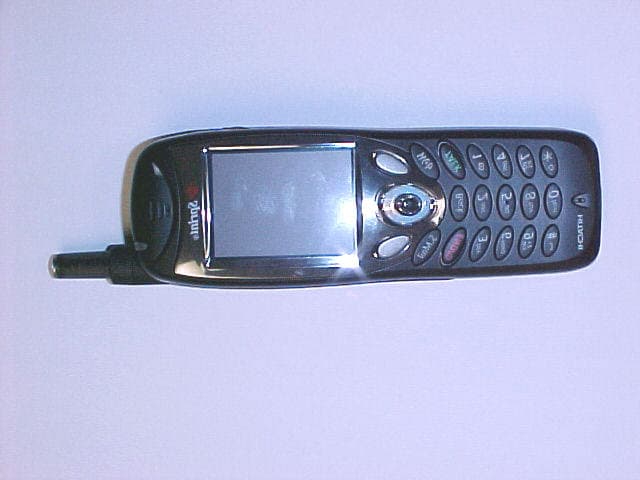
ABLSH-G1000PCS CDMA Phone / PDA Combination
Hitachi Ltd
Click to zoom
Application Details
- Equipment Class
- PCE - PCS Licensed Transmitter held to ear
- Date of Grant
- Apr 02, 2003
- Application Purpose
- Original Equipment
- Date of Application
- Apr 02, 2003
- Equipment Note
- PCS CDMA Phone / PDA Combination
- Frequency Range
- 1851.25000000 - 1908.75000000
- Company
- Hitachi Ltd
- Country
- Japan
Documents & Files
Document Text
Text extracted from the exhibit documents filed with the FCC. Open a document above to read the original.
Users Manual
PCS Service www.sprintpcs.com Copyright © 2003 Sprint Spectrum L.P. All rights reserved. No reproduction in whole or in part without prior written approval. Sprint and the diamond logo are trademarks of Sprint Communications Company L.P. Microsoft, MS, ActiveSync, Outlook, Windows, Windows NT, and the Windows logo are either registered trademarks or trademarks of Microsoft Corporation in the United States and/or other countries. Microsoft products are licensed to OEMs by Microsoft Licensing, Inc., a wholly owned subsidiary of Microsoft Corporation. All other trademarks are property of their respective owners. Printed in Japan. Table of Contents How to Use This Guide . . . . . . . . . . . . . . . . . . . . . . . . . . . . . . . . . . . . . . . . . . .i Getting Advanced Phone and Service Information . . . . . . . . . . . . . .ii Getting Started . . . . . . . . . . . . . . . . . . . . . . . . . . . . . . . . . . . . . . . . . . . . . . . . . .iii Basics of Your PCS Phone . . . . . . . . . . . . . . . . . . . . . . . . . . . . . . . . . . . . . . .1 1. Your New PCS Phone . . . . . . . . . . . . . . . . . . . . . . . . . . . . . . . . . . . . . . . .2 2. Turning Your Device On and Off . . . . . . . . . . . . . . . . . . . . . . . . . . . . . .6 Turning Your Device On and Off . . . . . . . . . . . . . . . . . . . . . . . . . . . . . . . . . . . . . . . . . .6 Turning the Phone On and Off . . . . . . . . . . . . . . . . . . . . . . . . . . . . . . . . . . . . . . . . . . .6 3. Set up Your Device . . . . . . . . . . . . . . . . . . . . . . . . . . . . . . . . . . . . . . . . . . .7 4. Using the Battery and Charger . . . . . . . . . . . . . . . . . . . . . . . . . . . . . . .8 Installing the Battery . . . . . . . . . . . . . . . . . . . . . . . . . . . . . . . . . . . . . . . . . . . . . . . . . . . .8 Charging the Battery . . . . . . . . . . . . . . . . . . . . . . . . . . . . . . . . . . . . . . . . . . . . . . . . . . .10 Removing the Battery . . . . . . . . . . . . . . . . . . . . . . . . . . . . . . . . . . . . . . . . . . . . . . . . . .12 5. Before Making Calls . . . . . . . . . . . . . . . . . . . . . . . . . . . . . . . . . . . . . . . .14 6. Making and Answering Calls . . . . . . . . . . . . . . . . . . . . . . . . . . . . . .15 Making Calls . . . . . . . . . . . . . . . . . . . . . . . . . . . . . . . . . . . . . . . . . . . . . . . . . . . . . . . . . . .15 Answering Calls . . . . . . . . . . . . . . . . . . . . . . . . . . . . . . . . . . . . . . . . . . . . . . . . . . . . . . . .15 Signal Strength . . . . . . . . . . . . . . . . . . . . . . . . . . . . . . . . . . . . . . . . . . . . . . . . . . . . . . . .16 7. Controlling Your Roaming Experience . . . . . . . . . . . . . . . . . . . . .17 Setting Your Device’s Roam Mode . . . . . . . . . . . . . . . . . . . . . . . . . . . . . . . . . . . . . . .17 Call Guard . . . . . . . . . . . . . . . . . . . . . . . . . . . . . . . . . . . . . . . . . . . . . . . . . . . . . . . . . . . . .17 Feature Availability . . . . . . . . . . . . . . . . . . . . . . . . . . . . . . . . . . . . . . . . . . . . . . . . . . . . .18 8. Internal Phone Book . . . . . . . . . . . . . . . . . . . . . . . . . . . . . . . . . . . . . . . .19 Saving Phone Numbers . . . . . . . . . . . . . . . . . . . . . . . . . . . . . . . . . . . . . . . . . . . . . . . .19 Finding Phone Numbers . . . . . . . . . . . . . . . . . . . . . . . . . . . . . . . . . . . . . . . . . . . . . . .21 Making a Call From Your Internal Phone Book . . . . . . . . . . . . . . . . . . . . . . . . . .22 16. Performance and Safety . . . . . . . . . . . . . . . . . . . . . . . . . . . . . . . . . . . .34 Important Information About Your Device and Service . . . . . . . . . . . . . . . . . . .34 Maintaining Safe Use of and Access to Your Device . . . . . . . . . . . . . . . . . . . . . . .35 Caring for the Battery . . . . . . . . . . . . . . . . . . . . . . . . . . . . . . . . . . . . . . . . . . . . . . . . . . .38 Warning . . . . . . . . . . . . . . . . . . . . . . . . . . . . . . . . . . . . . . . . . . . . . . . . . . . . . . . . . . . . . . .39 Caution . . . . . . . . . . . . . . . . . . . . . . . . . . . . . . . . . . . . . . . . . . . . . . . . . . . . . . . . . . . . . . .41 Precautions for Use . . . . . . . . . . . . . . . . . . . . . . . . . . . . . . . . . . . . . . . . . . . . . . . . . . . . .43 Instructions for Daily Use . . . . . . . . . . . . . . . . . . . . . . . . . . . . . . . . . . . . . . . . . . . . . . .43 Acknowledging Special Precautions and the FCC Notice . . . . . . . . . . . . . . . . . .45 17. Terms and Conditions & Warranty Information . . . . . . . . . . . . .48 Terms and Conditions of Services . . . . . . . . . . . . . . . . . . . . . . . . . . . . . . . . . . . . . . .48 Terms of PCS Picture Mail Service . . . . . . . . . . . . . . . . . . . . . . . . . . . . . . . . . . . . . . .65 Customer Limited Warranty . . . . . . . . . . . . . . . . . . . . . . . . . . . . . . . . . . . . . . . . . . . .77 9. Changing Your Device’s Settings . . . . . . . . . . . . . . . . . . . . . . . . . . .23 Adjusting the Ringer, Key Beep . . . . . . . . . . . . . . . . . . . . . . . . . . . . . . . . . . . . . . . . . .23 Adjusting the Phone Volume . . . . . . . . . . . . . . . . . . . . . . . . . . . . . . . . . . . . . . . . . . . .24 Adjusting Receiver Volume During a Conversation . . . . . . . . . . . . . . . . . . . . . . .24 10. Sending and Receiving Messages . . . . . . . . . . . . . . . . . . . . . . . . .25 Setting Up Voicemail . . . . . . . . . . . . . . . . . . . . . . . . . . . . . . . . . . . . . . . . . . . . . . . . . . .25 Retrieving Voicemail Messages . . . . . . . . . . . . . . . . . . . . . . . . . . . . . . . . . . . . . . . . . .25 Accessing Voicemail From Another Phone . . . . . . . . . . . . . . . . . . . . . . . . . . . . . . .25 Displaying Numeric Pages . . . . . . . . . . . . . . . . . . . . . . . . . . . . . . . . . . . . . . . . . . . . . .25 11. PCS Service …
Text truncated - open the document above for the full version.
Cover Letter(s)
American Telecommunications Certification Body Inc. 6731 Whittier Ave, McLean, VA 22101 March 28, 2003 RE: FCC ID: ABLSH-G1000 Attention: Jon Hughes I have a few comments on this Application. 1. Please note that Hitachi not Sprint is the applicant for this device. Consequently, Sprint has no authority to authorize modifications. This means that the non-modification statement in the manual is incorrect. While this only applies to the Part 15 portion, the statement needs to be correct. The easiest way to revise the statement is to change “approved in this document” to “approved by the party responsible for compliance”. XXX 2. The manual states that to use the device in the lap the device must be in the soft case. How does the applicant prevent use of this device outside the soft case in this situation? Does the device shut down, does it stop operating? What is to prevent the user from not using the soft case in the lap position? Please explain. FCC EMAIL CORRESPONDENCE PROVIDED 3. The manual needs to inform the user of the distances required for SAR compliance. This would appear to be 2.3cm for body worn and 1cm for laptop use. Please revise the manual to provide this information. xxx 4. The actual levels of measured the highest SAR is to be in the manual. Please provide the insert sheet or the manual page that informs the user of these highest SAR levels. xxx 5. PCS part 24 devices are to have radiated emissions done using the antenna substitution method. Section 4.1 of the report is not an antenna substitution test method. Please revise the report to properly show the substitution method for radiated spurious emissions as shown is EIA/TIA603 and in the data table for radiated emissions in the report. xxx 6. Dennis Ward mailto:[email protected] The items indicated above must be submitted before processing can continue on the above referenced application. Failure to provide the requested information may result in application termination. Correspondence should be considered part of the permanent submission and may be viewed from the Internet after a Grant of Equipment Authorization is issued. Please do not respond to this correspondence using the email reply button. In order for your response to be processed expeditiously, you must submit your documents through the AmericanTCB.com website. Also, please note that partial responses increase processing time and should not be submitted. Any questions about the content of this correspondence should be directed to the sender.
Cover Letter(s)
Celltech Labs Inc. 1955 Moss Court, Kelowna, B.C. Canada V1Y 9L3 Tel. 250-448-7047 • Fax. 250-448-7046 • e-mail: [email protected] www.celltechlabs.com April 3, 2003 American Telecommunications Certification Body, Inc. 6731 Whittier Avenue, Suite C110 McLean, VA 22101 Attn: Dennis Ward SUBJECT: HITACHI LTD. FCC ID: ABLSH-G1000 Part 24(E) - Certification Application ID: ATCB000342 Response to Questions (03/28/03) Dear Dennis: On behalf of Hitachi Ltd. is our response to your e-mail dated March 28, 2003 requesting additional information for the subject application. 1. Attached is the resubmitted user manual with revised Part 15 non-modification statement (following page 47). 2. The lap-held operating configuration and corresponding user manual statements were verified with Tim Harrington at the FCC prior to the SAR evaluation. Please refer to the attached e-mail correspondence. 3. The body-worn separation distances were not included in the user manual statements based on the fact that the softcase with belt-clip accessory is the only body-worn accessory available and is supplied with the device at time of purchase. The user manual body-worn statement clearly informs the user that this device should only be operated in the body-worn and lap-held configurations with the supplied softcase accessory. 4. Attached is the revised user manual with highest SAR levels listed (page 47). 5. Attached is the resubmitted EMC test report with revised Section 4.1 describing the substitution method used for the radiated spurious emission measurements in accordance with ANSI EIA/TIA-603-A-2001. If you have any questions or comments concerning the above, please contact the undersigned. Sincerely, Jonathan Hughes General Manager Celltech Labs Inc. cc: Hitachi Ltd.
Cover Letter(s)
From: Tim Harrington [mailto:[email protected]] Sent: Thursday, January 23, 2003 2:29 PM To: [email protected] Cc: Martin Perrine; Tim Harrington Subject: RE: spacing From these descriptions and ruminations the proposed approach with cover and instructions seems reasonable. Keep in mind stability consideration below if you have not seen it. From: Tim Harrington To: TCB Council Date: Dec 2002 Subject: Re: Zero Gap SAR measurement for lap held position for GSM-PDA device Per Rich F. and EAB, response to 12/2/ PDA question is below. INQUIRY: "I understand that FCC is requiring zero gap separation on PDA/notebook PC products that have internal radio. The reason behind this requirement is that the users can put the device on his/her laps even though the GSM-PDA may be provided with a belt clip similar to what the cell phone vendors provide. Is FCC imposing this zero gap SAR separation on cell/handset/smart phones vendors as well? For example, will Smart phone manufacturers like Samsung or Nokia or Ericson need to worry about this stuff? If not, then I think that this zero gap requirement will put PDA GSM handheld-platform products in a direct disadvantage relative to the mobile handset counterparts. Reason = their mobile performance and our performance, in term of targeted features, have converged already or will converge very soon. Convergence means that the simple digital assistant, phone, webbrowsing, SMS functions are all now combined into one device, except theirs is a handset and ours has the PDA form factor. If PDA manufacturer has to meet zero gap and they don't due to the form factor difference, what are the grounds for FCC to ensure competitive fairness even though the device's supported features are virtually identical/converging??" RESPONSE: FCC is becoming aware of the potential interactive use of PDAs, smartphones, communicators, palmtops, convergence devices, subnotebooks, PADs, etc. when placed on a user's thigh while seated, in order to free up one hand for other activities or to avoid minor fatigue or discomfort. Belt-clip/holster SAR data may be applicable to a held-on-lap position if such accessories are installed during normal use, and if the device with belt-clip is reasonably stable when placed on the lap. In both direct- contact and belt-clip-spaced lap cases, it is anticipated that one hand may be used to stabilize the device (not necessarily in-between PDA and lap), while the other hand operates the device, unless the other hand is operating another device or pencil. If certain angles are needed to view the screen, in lap-held use it is anticipated that persons' feet may be propped up to achieve such angles. FCC will generally consider PDAs and smartphones on a case-by- case basis until further notice. The spatial peak SAR limit of 1.6 W/kg in 1-gram is applicable to both head and body positions. FCC welcomes industry comments on whether it is reasonable to expect that this is a normal use position for PDAs. Details of other possible effective schemes that manufacturers may have to comply with FCC RF exposure guidelines throughout device normal use are also welcomed. ---Original Message----- From: Tim Harrington [mailto:[email protected]] Sent: Thursday, January 23, 2003 1:43 PM To: [email protected] Subject: RE: spacing Do you mean without knob? I am unclear on final expected body spacing relative to 8mm "compliance distance" mentioned earlier. Does SAR level or pattern change much with 8mm air vs 8mm leather? From: Jonathan Hughes To: Tim Harrington Date: 1/23/03 4:31PM Subject: RE: spacing Tim, the client would ultimately like to go with the cover in the fold-over position requirement if possible. From: Jonathan Hughes To: Tim Harrington Cc: Martin Perrine Date: 1/23/03 4:19PM Subject: RE: spacing Good question, in actual fact on the back of the cover is a swivel stud for the belt-clip to latch on to. This provides a thickness of 10mm. The thickness of the cover with the fold-over is 15mm. Fold-over not necessarily required for compliance based on this. The body-worn manual statements would then make it clear that the leather carry-case is required for lapheld position. From: Tim Harrington [mailto:[email protected]] Sent: Thursday, January 23, 2003 10:39 AM To: [email protected] Cc: Martin Perrine; Tim Harrington Subject: spacing What is cover only thickness then thickness with fold-over? From: Jonathan Hughes To: Tim Harrington CC: Martin Perrine Date: 1/23/03 1:28PM Subject: Phone/PDA Question Dear Tim, Our client is producing a handheld/body-worn/lapheld Phone/PDA device with external stubby antenna. The device will be supplied to the user with a belt-clip, headset, and leather carry-case (pouch with fold-over flip-cover type). For lapheld position it was determined that an 8mm spacing would be required from the back side of the unit to ass SAR. It was also determined that if the device is placed inside the leather carry-case with the front flip-cover of the carry-case folded back behind the device, a separation distance greater than 8mm was maintained between the back of the Phone/PDA and the user's lap. QUESTION: If the quick start, users manual, and RF exposure statements are explicit in providing the appropriate operating instructions to the user, can this device be certified for body-worn SAR in the lapheld configuration based on the device being placed in the supplied carry-case with the flip-cover open and folded back behind the device?
External Photos
© 2003 Celltech Labs Inc.HITACHI LTD. FCC ID: ABLSH-G1000 (Model: SH-G1000) PCS CDMA Phone/PDA Combination with Wireless Capabilities EXTERNAL EUT PHOTOGRAPHS © 2003 Celltech Labs Inc.HITACHI LTD. FCC ID: ABLSH-G1000 (Model: SH-G1000) PCS CDMA Phone/PDA Combination with Wireless Capabilities EXTERNAL EUT PHOTOGRAPHS © 2003 Celltech Labs Inc.HITACHI LTD. FCC ID: ABLSH-G1000 (Model: SH-G1000) PCS CDMA Phone/PDA Combination with Wireless Capabilities EXTERNAL EUT PHOTOGRAPHS © 2003 Celltech Labs Inc.HITACHI LTD. FCC ID: ABLSH-G1000 (Model: SH-G1000) PCS CDMA Phone/PDA Combination with Wireless Capabilities EXTERNAL EUT PHOTOGRAPHS © 2003 Celltech Labs Inc.HITACHI LTD. FCC ID: ABLSH-G1000 (Model: SH-G1000) PCS CDMA Phone/PDA Combination with Wireless Capabilities EXTERNAL EUT PHOTOGRAPHS
ID Label/Location Info
© 2003 Celltech Labs Inc.HITACHI LTD. FCC ID: ABLSH-G1000 (Model: SH-G1000) PCS CDMA Phone/PDA Combination with Wireless Capabilities FCC ID LABEL & LOCATION LABELING REQUIREMENTS PER §2.925 The label shall be permanently affixed at a conspicuous location on the device.
Internal Photos
© 2003 Celltech Labs Inc.HITACHI LTD. FCC ID: ABLSH-G1000 (Model: SH-G1000) PCS CDMA Phone/PDA Combination with Wireless Capabilities INTERNAL EUT PHOTOGRAPHS © 2003 Celltech Labs Inc.HITACHI LTD. FCC ID: ABLSH-G1000 (Model: SH-G1000) PCS CDMA Phone/PDA Combination with Wireless Capabilities INTERNAL EUT PHOTOGRAPHS © 2003 Celltech Labs Inc.HITACHI LTD. FCC ID: ABLSH-G1000 (Model: SH-G1000) PCS CDMA Phone/PDA Combination with Wireless Capabilities INTERNAL EUT PHOTOGRAPHS © 2003 Celltech Labs Inc.HITACHI LTD. FCC ID: ABLSH-G1000 (Model: SH-G1000) PCS CDMA Phone/PDA Combination with Wireless Capabilities INTERNAL EUT PHOTOGRAPHS © 2003 Celltech Labs Inc.HITACHI LTD. FCC ID: ABLSH-G1000 (Model: SH-G1000) PCS CDMA Phone/PDA Combination with Wireless Capabilities INTERNAL EUT PHOTOGRAPHS © 2003 Celltech Labs Inc.HITACHI LTD. FCC ID: ABLSH-G1000 (Model: SH-G1000) PCS CDMA Phone/PDA Combination with Wireless Capabilities INTERNAL EUT PHOTOGRAPHS © 2003 Celltech Labs Inc.HITACHI LTD. FCC ID: ABLSH-G1000 (Model: SH-G1000) PCS CDMA Phone/PDA Combination with Wireless Capabilities INTERNAL EUT PHOTOGRAPHS © 2003 Celltech Labs Inc.HITACHI LTD. FCC ID: ABLSH-G1000 (Model: SH-G1000) PCS CDMA Phone/PDA Combination with Wireless Capabilities INTERNAL EUT PHOTOGRAPHS
RF Exposure Info
Test Report S/N: 031003-350ABL Test Date(s): March 10, 2003 FCC SAR Evaluation © 2003 Celltech Labs Inc.1 of 24 DECLARATION OF COMPLIANCE SAR EVALUATION Test Lab CELLTECH LABS INC. Testing and Engineering Lab 1955 Moss Court Kelowna, B.C. Canada V1Y 9L3 Phone: 250-448-7047 Fax: 250-448-7046 e-mail: [email protected] web site: www.celltechlabs.com Applicant Information HITACHI LTD. 6 Kanda, Surugadai 4 Chome Chiyoda-ku, Tokyo 101 Japan FCC Rule Part(s):47 CFR §2.1093 Test Procedure(s):FCC OET Bulletin 65, Supplement C (01-01); IEEE Std 1528-200X (Draft) FCC ID: ABLSH-G1000 Model(s):SH-G1000 Device Type:PCS CDMA Phone / PDA Combination with Wireless Capabilities FCC Classification:Part 24 Licensed Portable Transmitter held to ear (PCE) Mode(s) of Operation:PCS CDMA Tx Frequency Range:1851.25 - 1908.75 MHz Conducted Power Tested:24.5 dBm (Max.) Antenna Type:Fixed Stubby Battery Type:3.7V Lithium-Ion (Model: SH-G1000BAT) Body-Worn Accessories:Softcase with Belt-Clip, Ear-Microphone Max. SAR Measured:1.44 W/kg (Head) 0.401 W/kg (Body-worn) 1.17 W/kg (Lap held) Celltech Labs Inc. declares under its sole responsibility that this device was found to be in compliance with the Specific Absorption Rate (SAR) RF exposure requirements specified in FCC 47 CFR §2.1093. The device was tested in accordance with the measurement standards and procedures specified in FCC OET Bulletin 65, Supplement C, Edition 01-01 and IEEE Standard 1528-200X (Draft) for the General Population / Uncontrolled Exposure environment. I attest to the accuracy of data. All measurements were performed by me or were made under my supervision and are correct to the best of my knowledge and belief. I assume full responsibility for the completeness of these measurements and vouch for the qualifications of all persons taking them. This test report shall not be reproduced partially, or in full, without the prior written approval of Celltech Labs Inc. The results and statements contained in this report pertain only to the device(s) evaluated. Russell W. Pipe Senior Compliance Technologist Celltech Labs Inc. Test Report S/N: 031003-350ABL Test Date(s): March 10, 2003 FCC SAR Evaluation © 2003 Celltech Labs Inc.2 of 24 TABLE OF CONTENTS 1.0INTRODUCTION..................................................................... 3 2.0DESCRIPTION OF EUT............................................................ 3 3.0SAR MEASUREMENT SYSTEM ............................................... 4 4.0MEASUREMENT SUMMARY..................................................... 5-6 5.0DETAILS OF SAR EVALUATION............................................... 7-8 6.0EVALUATION PROCEDURES...................................................9-10 7.0SYSTEM PERFORMANCE CHECK............................................ 11 8.0EQUIVALENT TISSUES........................................................... 12 9.0SAR LIMITS........................................................................... 12 10.0SYSTEM SPECIFICATIONS...................................................... 13 11.0SAM PHANTOM...................................................................... 14 12.0DEVICE HOLDER.................................................................... 14 13.0PROBE SPECIFICATION......................................................... 14 14.0TEST EQUIPMENT LIST........................................................... 15 15.0MEASUREMENT UNCERTAINTIES............................................ 16 16.0REFERENCES........................................................................ 17 APPENDIX A - SAR MEASUREMENT DATA............................................. 18 APPENDIX B - SYSTEM CHECK DATA.................................................... 19 APPENDIX C -SYSTEM VALIDATION..................................................... 20 APPENDIX D - PROBE CALIBRATION.................................................... 21 APPENDIX E - MEASURED FLUID DIELECTRIC PARAMETERS................ 22 APPENDIX F - SAM PHANTOM CERTIFICATE OF CONFORMITY.............. 23 APPENDIX G - SAR TEST SETUP & EUT PHOTOGRAPHS........................ 24 Test Report S/N: 031003-350ABL Test Date(s): March 10, 2003 FCC SAR Evaluation © 2003 Celltech Labs Inc.HITACHI LTD. FCC ID: ABLSH-G1000 (Model: SH-G1000)3 of 24 PCS CDMA Phone/PDA Combination with Wireless Capabilities 1.0 INTRODUCTION This measurement report shows that the HITACHI LTD. Model: SH-G1000 Single-Mode PCS CDMA Phone / PDA Combination with Wireless Capabilities FCC ID: ABLSH-G1000 complies with FCC 47 CFR §2.1093 (see reference [1]) (General Population / Uncontrolled Exposure environment). The test procedures described in FCC OET Bulletin 65, Supplement C, Edition 01-01 (see reference [2]), and IEEE 1528-200X (see reference [3]) were employed. A description of the product and operating configuration, detailed summary of the test results, methodology and procedures used in the evaluation, equipment used, and the various provisions of the rules are included within this test report. 2.0 DESCRIPTION of Equipment Under Test (EUT) EUT Type Single-Mode PCS CDMA Phone / PDA Combination withWireless Capabilities Equipment Class Licensed Portable Transmitter Held to Ear (PCE) FCC Rule Part(s) 47 CFR §2.1093 Test Procedure(s) FCC OET Bulletin 65, Supplement C (01-01) IEEE 1528-200X (DRAFT) FCC ID ABLSH-G1000 Model No.(s) SH-G1000 Tx Frequency Range 1851.25 - 1908.75 MHz Measured RF Conducted Power 24.5 dBm (Max.) Mode(s) of Operation PCS CDMA Battery Type(s) 3.7V Lithium-ion (Model: SG-G1000BAT) Antenna Type Fixed Stubby (Length: 34 mm) Body-Worn Accessories Tested Softcase with Belt-Clip, Ear-Microphone Test Report S/N: 031003-350ABL Test Date(s): March 10, 2003 FCC SAR Evaluation © 2003 Celltech Labs Inc.HITACHI LTD. FCC ID: ABLSH-G1000 (Model: SH-G1000)4 of 24 PCS CDMA Phone/PDA Combination with Wireless Capabilities 3.0 SAR MEASUREMENT SYSTEM Celltech Labs SAR measurement facility utilizes the Dosimetric Assessment System (DASY™) manufactured by Sc…
Text truncated - open the document above for the full version.
RF Exposure Info
Hitachi Ltd. FCC ID: ABLSH-G1000 SAM Phantom; Flat Section; Position: (270°,90°) Probe: ET3DV6 - SN1590; ConvF(5.30,5.30,5.30); Crest factor: 1.0 1900 MHz Muscle: σ = 1.55 mho/m ε r = 51.7 ρ = 1.00 g/cm 3 Coarse: Dx = 15.0, Dy = 15.0, Dz = 10.0 Cube 5x5x7 SAR (1g): 0.342 mW/g, SAR (10g): 0.182 mW/g Body-Worn SAR with Softcase, Belt-Clip, & Ear-Microphone Accessories 2.3 cm Belt-Clip Separation Distance to Planar Phantom SH-G1000 PCS CDMA Phone/PDA Fixed Stubby Antenna 3.7V Lithium-ion Battery (Model: SH-G1000BAT) Channel 0025 [1851.25 MHz] Conducted Power: 24.5 dBm Ambient Temp. 22.8°C; Fluid Temp. 22.0°C Date Tested: March 10, 2003 SAR Tot [mW/g] 2.29E-26.88E-21.15E-11.61E-12.06E-12.52E-12.98E-1 03/10/03Celltech Labs Inc. Hitachi Ltd. FCC ID: ABLSH-G1000 SAM Phantom; Flat Section; Position: (270°,90°) Probe: ET3DV6 - SN1590; ConvF(5.30,5.30,5.30); Crest factor: 1.0 1900 MHz Muscle: σ = 1.55 mho/m ε r = 51.7 ρ = 1.00 g/cm 3 Coarse: Dx = 15.0, Dy = 15.0, Dz = 10.0 Cube 5x5x7 SAR (1g): 0.401 mW/g, SAR (10g): 0.205 mW/g Body-Worn SAR with Softcase, Belt-Clip, & Ear-Microphone Accessories 2.3 cm Belt-Clip Separation Distance to Planar Phantom SH-G1000 PCS CDMA Phone/PDA Fixed Stubby Antenna 3.7V Lithium-ion Battery (Model: SH-G1000BAT) Channel 0600 [1880.00 MHz] Conducted Power: 24.5 dBm Ambient Temp. 22.8°C; Fluid Temp. 22.0°C Date Tested: March 10, 2003 SAR Tot [mW/g] 2.39E-27.18E-21.20E-11.68E-12.15E-12.63E-13.11E-1 03/10/03Celltech Labs Inc. Hitachi Ltd. FCC ID: ABLSH-G1000 SAM Phantom; Flat Section; Position: (270°,90°) Probe: ET3DV6 - SN1590; ConvF(5.30,5.30,5.30); Crest factor: 1.0 1900 MHz Muscle: σ = 1.55 mho/m ε r = 51.7 ρ = 1.00 g/cm 3 Coarse: Dx = 15.0, Dy = 15.0, Dz = 10.0 Cube 5x5x7 SAR (1g): 0.271 mW/g, SAR (10g): 0.162 mW/g Body-Worn SAR with Softcase, Belt-Clip, & Ear-Microphone Accessories 2.3 cm Belt-Clip Separation Distance to Planar Phantom SH-G1000 PCS CDMA Phone/PDA Fixed Stubby Antenna 3.7V Lithium-ion Battery (Model: SH-G1000BAT) Channel 1175 [1908.75 MHz] Conducted Power: 24.5 dBm Ambient Temp. 22.8°C; Fluid Temp. 22.0°C Date Tested: March 10, 2003 SAR Tot [mW/g] 2.13E-26.39E-21.06E-11.49E-11.92E-12.34E-12.77E-1 03/10/03Celltech Labs Inc. Hitachi Ltd. FCC ID: ABLSH-G1000 SAM Phantom; Flat Section; Position: (270°,90°) Probe: ET3DV6 - SN1590; ConvF(5.30,5.30,5.30); Crest factor: 1.0 1900 MHz Muscle: σ = 1.55 mho/m ε r = 51.7 ρ = 1.00 g/cm 3 Coarse: Dx = 15.0, Dy = 15.0, Dz = 10.0 Cube 5x5x7 SAR (1g): 1.17 mW/g, SAR (10g): 0.662 mW/g Lap Held SAR with Softcase & Ear-Microphone Accessories Front Flip Cover Folded Behind Back Surface 1.0 cm Softcase Separation Distance to Planar Phantom SH-G1000 PCS CDMA Phone/PDA Fixed Stubby Antenna 3.7V Lithium-ion Battery (Model: SH-G1000BAT) Channel 0025 [1851.25 MHz] Conducted Power: 24.5 dBm Ambient Temp. 22.8°C; Fluid Temp. 22.0°C Date Tested: March 10, 2003 SAR Tot [mW/g] 7.69E-22.31E-13.84E-15.38E-16.92E-18.45E-19.99E-1 03/10/03Celltech Labs Inc. Hitachi Ltd. FCC ID: ABLSH-G1000 SAM Phantom; Flat Section Probe: ET3DV6 - SN1590; ConvF(5.30,5.30,5.30); Crest factor: 1.0 1900 MHz Muscle: σ = 1.55 mho/m ε r = 51.7 ρ = 1.00 g/cm 3 Z-Axis Extrapolation at Peak SAR Location Lap Held SAR with Softcase & Ear-Microphone Accessories Front Flip Cover Folded Behind Back Surface 1.0 cm Softcase Separation Distance to Planar Phantom SH-G1000 PCS CDMA Phone/PDA Fixed Stubby Antenna 3.7V Lithium-ion Battery (Model: SH-G1000BAT) Channel 0025 [1851.25 MHz] Conducted Power: 24.5 dBm Ambient Temp. 22.8°C; Fluid Temp. 22.0°C Date Tested: March 10, 2003 03/10/03Celltech Labs Inc. 0.00.51.01.52.02.5 0 10 20 30 40 50 60 70 80 90 100 110 120 130 140 150 SAR tot [mW/g] [mm] Hitachi Ltd. FCC ID: ABLSH-G1000 SAM Phantom; Flat Section; Position: (270°,90°) Probe: ET3DV6 - SN1590; ConvF(5.30,5.30,5.30); Crest factor: 1.0 1900 MHz Muscle: σ = 1.55 mho/m ε r = 51.7 ρ = 1.00 g/cm 3 Coarse: Dx = 15.0, Dy = 15.0, Dz = 10.0 Cube 5x5x7 SAR (1g): 1.07 mW/g, SAR (10g): 0.607 mW/g Lap Held SAR with Softcase & Ear-Microphone Accessories Front Flip Cover Folded Behind Back Surface 1.0 cm Softcase Separation Distance to Planar Phantom SH-G1000 PCS CDMA Phone/PDA Fixed Stubby Antenna 3.7V Lithium-ion Battery (Model: SH-G1000BAT) Channel 0600 [1880.00 MHz] Conducted Power: 24.5 dBm Ambient Temp. 22.8°C; Fluid Temp. 22.0°C Date Tested: March 10, 2003 SAR Tot [mW/g] 7.59E-22.28E-13.79E-15.31E-16.83E-18.34E-19.86E-1 03/10/03Celltech Labs Inc. Hitachi Ltd. FCC ID: ABLSH-G1000 SAM Phantom; Flat Section; Position: (270°,90°) Probe: ET3DV6 - SN1590; ConvF(5.30,5.30,5.30); Crest factor: 1.0 1900 MHz Muscle: σ = 1.55 mho/m ε r = 51.7 ρ = 1.00 g/cm 3 Coarse: Dx = 15.0, Dy = 15.0, Dz = 10.0 Cube 5x5x7 SAR (1g): 0.922 mW/g, SAR (10g): 0.527 mW/g Lap Held SAR with Softcase & Ear-Microphone Accessories Front Flip Cover Folded Behind Back Surface 1.0 cm Softcase Separation Distance to Planar Phantom SH-G1000 PCS CDMA Phone/PDA Fixed Stubby Antenna 3.7V Lithium-ion Battery (Model: SH-G1000BAT) Channel 1175 [1908.75 MHz] Conducted Power: 24.5 dBm Ambient Temp. 22.8°C; Fluid Temp. 22.0°C Date Tested: March 10, 2003 SAR Tot [mW/g] 6.88E-22.06E-13.44E-14.81E-16.19E-17.57E-18.94E-1 03/10/03Celltech Labs Inc.
RF Exposure Info
Hitachi Ltd. FCC ID: ABLSH-G1000 SAM Phantom; Left Head Section; Position: (90°,65°) Probe: ET3DV6 - SN1590; ConvF(5.60,5.60,5.60); Crest factor: 1.0 1900 MHz Brain: σ = 1.42 mho/m ε r = 38.4 ρ = 1.00 g/cm 3 Coarse: Dx = 15.0, Dy = 15.0, Dz = 10.0 Cube 5x5x7 SAR (1g): 1.29 mW/g, SAR (10g): 0.683 mW/g Head SAR - Left Ear - Cheek/Touch Position SH-G1000 PCS CDMA Phone/PDA Fixed Stubby Antenna 3.7V Lithium-ion Battery (Model: SH-G1000BAT) Channel 0025 [1851.25 MHz] Conducted Power: 24.5 dBm Ambient Temp. 22.8°C; Fluid Temp. 22.0°C Date Tested: March 10, 2003 SAR Tot [mW/g] 1.05E-13.14E-15.23E-17.31E-19.41E-11.15E+01.36E+0 03/10/03Celltech Labs Inc. Hitachi Ltd. FCC ID: …
Text truncated - open the document above for the full version.
Contact Information
Applicant
Y Tajimi
Technical Contact
Technical Specifications
| # | Rule Parts | Frequency Range | Power Output | Emission | Tolerance |
|---|---|---|---|---|---|
| 1 | 24E | 1.85 GHz - 1.91 GHz | 341.00 mW | 1M25F9W | 150.0000000000 Hz |
Other Applications from Hitachi Ltd
ABLSP20
Apr 18, 2002PCS Handset
Equipment Class
PCE - PCS Licensed Transmitter held to ear
ABL045
May 25, 1998JBP - Part 15 Class B Computing Device Peripheral
Equipment Class
JBP - Part 15 Class B Computing Device PeripheralABL0086
Jan 27, 1998HID - Part 15 TV Interface Device
Equipment Class
HID - Part 15 TV Interface DeviceABL044
Sep 03, 1997JBP - Part 15 Class B Computing Device Peripheral
Equipment Class
JBP - Part 15 Class B Computing Device PeripheralABL0085
May 04, 1997Videocassette Recorder
Equipment Class
HID - Part 15 TV Interface Device