AK8MDR1ABTWIRELESS STEREO HEADSET
Sony Group Corporation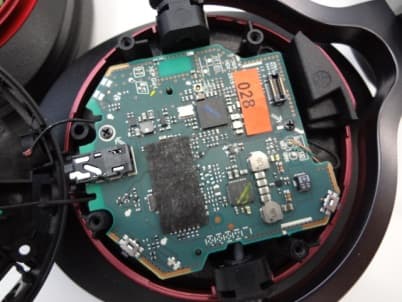
Click to zoom
Application Details
- Equipment Class
- DSS - Part 15 Spread Spectrum Transmitter
- Date of Grant
- Jan 18, 2015
- Application Purpose
- Original Equipment
- Date of Application
- Jan 18, 2015
- Equipment Note
- WIRELESS STEREO HEADSET
- Frequency Range
- 2402.00000000 - 2480.00000000
- Company
- Sony Group Corporation
- Country
- Japan
Documents & Files
Document Text
Text extracted from the exhibit documents filed with the FCC. Open a document above to read the original.
Users Manual
MDR-1ABT 4-567-319-11(1) Quick Start Guide US Guide de prise en main FR Guía de inicio rápido ES Wireless Stereo Headset Casque stéréo sans fil Auriculares estéreo inalámbricos Charging the unit/ Chargement de l’appareil/ Cargar la unidad Connect the unit and the booted computer using the micro-USB cable supplied. When the unit and the computer are connected, charging starts and the indicator (red) lights up. Charging is completed in about 4 hours at most and the indicator (red) goes off automatically. Notes Use the micro-USB cable supplied. You may not be able to charge the unit with other cables. Charging will not be completed properly if the computer enters into hibernation or standby mode while connected to the unit. If this happens, change the settings of the computer and charge the unit again. This unit cannot be turned on, nor can the BLUETOOTH function be used, during charging. An iPhone, iPad, or iPod touch (iOS 5.0 or later) will show an icon that indicates the remaining battery charge of the headset on the screen. For details, refer to the Help Guide. Connectez l’appareil à l’ordinateur allumé à l’aide du câble micro-USB fourni. Lorsque l’appareil et l’ordinateur sont connectés, le chargement commence et le témoin (rouge) s’allume. Le chargement dure environ 4 heures au maximum et le témoin (rouge) s’éteint automatiquement. Remarques Utilisez le câble micro-USB fourni. Il pourra s’avérer impossible de charger l’appareil avec d’autres câbles. Le chargement ne se termine pas correctement si l’ordinateur passe en mode veille ou veille prolongée alors qu’il est branché à l’appareil. Dans une telle situation, modifiez les paramètres de l’ordinateur et rechargez l’appareil. Lors du chargement, cet appareil ne peut pas être mis sous tension et la fonction BLUETOOTH ne peut pas être utilisée. Un iPhone, un iPad ou un iPod touch (iOS 5.0 ou supérieur) affiche une icône indiquant la durée de charge de batterie restante du casque sur l ’écran. Pour plus de détails, consultez le Manuel d’aide. Conecte la unidad y la computadora iniciada usando el cable micro-USB proporcionado. Cuando la unidad y la computadora están conectadas, comienza la carga y el indicador (rojo) se enciende. La carga finaliza en aproximadamente 4 horas como máximo y el indicador (rojo) se apaga automáticamente. Notas Use el cable micro-USB proporcionado. Puede que la unidad no se cargue si utiliza otros cables. La carga no se completará correctamente si la computadora entra en modo de espera o hibernación mientras está conectada a la unidad. Si esto ocurre, cambie la configuración de la computadora y vuelva a cargar la unidad. No es posible encender la unidad ni utilizar la función BLUETOOTH durante la carga. Un iPhone, iPad o iPod touch (iOS 5.0 o posterior) mostrará un icono con la carga de batería restante de los auriculares en la pantalla. Para obtener más información, consulte la Guía de ayuda. A One-touch connection with a smartphone (NFC)/ Connexion une touche avec un smartphone (NFC)/ Conexión one touch con un teléfono inteligente (NFC) NFC Easy Connect Connexion NFC facile Conexión fácil NFC By touching the unit with a smartphone, the unit is turned on automatically and proceeds to pair and connect via BLUETOOTH. Compatible smartphones NFC-compatible smartphones with Android 2.3.3 or later installed (excluding Android 3.x). On the connection with other BLUETOOTH devices, see “ Pairing and connecting with a BLUETOOTH device.” NFC NFC (Near Field Communication) is a technology enabling short-range wireless communication between various devices, such as smartphones and IC tags. Thanks to the NFC function, data communication - for example, BLUETOOTH pairing - can be achieved easily by simply touching NFC compatible devices together (i.e., at the N-Mark symbol or location designated on each device). 1 Set the NFC function of the smartphone to on. For details, refer to the operating instructions supplied with the smartphone. If your smartphone OS is Android 2.3.3 or later, and less than Android 4.1 (excluding Android 3.x): proceed to step 2. If your smartphone OS is Android 4.1 or later: proceed to step 4. 2 Download and install the app “NFC Easy Connect.” “NFC Easy Connect” is a free Android app you can download from Google Play. Download the app by searching for “NFC Easy Connect” or access it by using the two-dimensional code. Fees may be charged for downloading the app. Note The App may not be available in some countries and/ or regions. 3 Start the app “NFC Easy Connect” on the smartphone. One-touch connection is possible only when the app screen is displayed on the smartphone. 4 Touch this unit with the smartphone. Unlock the screen of the smartphone beforehand. Touch the smartphone on the N marked part of this unit. Keep touching the unit with the smartphone until the smartphone reacts. Follow the on-screen instructions to complete the pairing and connection. To disconnect, touch the smartphone again. You can select the sound from other NFC compatible BLUETOOTH devices. For details, refer to the Help Guide. To connect the unit with the paired smartphone, perform step 4. (When you are using the app “NFC Easy Connect,” perform steps 3 and 4.) En mettant l’appareil en contact avec un smartphone, l’appareil est automatiquement mis sous tension, puis procède au pairage et à la connexion via BLUETOOTH. Smartphones compatibles Les smartphones compatibles NFC sur lesquels Android 2.3.3 ou ultérieur est installé (excepté Android 3.x). Pour voir des informations sur la connexion à d’autres périphériques BLUETOOTH, consultez « Pairage et connexion avec un périphérique BLUETOOTH ». NFC NFC (Near Field Communication) est une technologie permettant d’établir une communication sans fil à courte portée entre divers périphériques, tels que des smartphones et des étiquettes électroniques. Grâce à la fonction NFC, il est possible de communiquer des données facilement (par exemple pairage BLUETOOTH) en mettant…
Text truncated - open the document above for the full version.
Users Manual
MDR-1ABT 4-567-320-11(2) MDR-1ABT Wireless Stereo Headset Casque stéréo sans fil Auriculares estéreo inalámbricos Reference Guide US Guide de référence FR Guía de referencia ES 4-567-320-11(2) http://www.sony.net/ ©2015 Sony Corporation Printed in Malaysia English WARNING To reduce the risk of electrical shock, do not open the cabinet. Refer servicing to qualified personnel only. Information FOR UNITED STATES CUSTOMERS. NOT APPLICABLE IN CANADA, INCLUDING IN THE PROVINCE OF QUEBEC. POUR LES CONSOMMATEURS AUX ÉTATS-UNIS. NON APPLICABLE AU CANADA, Y COMPRIS LA PROVINCE DE QUÉBEC. CAUTION: Risk of Fire and Burns. Do Not Open, Crush, Heat Above 140°F or Incinerate. This device complies with Part 15 of the FCC Rules. Operation is subject to the following two conditions: (1) this device may not cause harmful interference, and (2) this device must accept any interference received, including interference that may cause undesired operation. You are cautioned that any changes or modifications not expressly approved in this manual could void your authority to operate this equipment. This equipment must not be co-located or operated in conjunction with any other antenna or transmitter. Note This equipment has been tested and found to comply with the limits for a Class B digital device, pursuant to Part 15 of the FCC Rules. These limits are designed to provide reasonable protection against harmful interference in a residential installation. This equipment generates, uses and can radiate radio frequency energy and, if not installed and used in accordance with the instructions, may cause harmful interference to radio communications. However, there is no guarantee that interference will not occur in a particular installation. If this equipment does cause harmful interference to radio or television reception, which can be determined by turning the equipment off and on, the user is encouraged to try to correct the interference by one or more of the following measures: Reorient or relocate the receiving antenna. Increase the separation between the equipment and receiver. Connect the equipment into an outlet on a circuit different from that to which the receiver is connected. Consult the dealer or an experienced radio/TV technician for help. This device complies with Industry Canada licence-exempt RSS standard(s). Operation is subject to the following two conditions: (1) this device may not cause interference, and (2) this device must accept any interference, including interference that may cause undesired operation of the device. This equipment complies with FCC/IC radiation exposure limits set forth for an uncontrolled environment and meets the FCC radio frequency (RF) Exposure Guidelines and RSS-102 of the IC radio frequency (RF) Exposure rules. This equipment has very low levels of RF energy that are deemed to comply without testing of specific absorption rate (SAR). The LDAC TM name and logo is a trademark of Sony Corporation. The BLUETOOTH word mark and logos are owned by the Bluetooth SIG, Inc. and any use of such marks by Sony Corporation is under license. The N Mark is a trademark or registered trademark of NFC Forum, Inc. in the United States and in other countries. Microsoft, Windows and Windows Vista are registered trademarks or trademarks of Microsoft Corporation in the United States and/or other countries. Mac and Mac OS are trademarks of Apple Inc., registered in the U.S. and other countries. iPhone is a trademark of Apple Inc., registered in the U.S. and ther countries. The aptX® mark and the aptX logo are trade marks of CSR plc or one of its group companies and may be registered in one or more jurisdictions. Other trademarks and trade names are those of their respective owners. Precautions On BLUETOOTH communication BLUETOOTH wireless technology operates within a range of about 10 m (30 feet). Maximum communication range may vary depending on obstacles (human body, metal, wall, etc.) or electromagnetic environment. The antenna is built into the unit as illustrated in the dotted line. The sensitivity of the BLUETOOTH communication will improve by turning the direction of the built-in antenna to the connected BLUETOOTH device. When obstacles are between the antenna of the connected device and the built-in antenna of this unit, noise or audio dropout may occur, or communications may be disabled. BLUETOOTH communications may be disabled, or noise or audio dropout may occur under the following conditions. There is a human body between the unit and the BLUETOOTH device. This situation may be improved by placing the BLUETOOTH device facing the antenna of the unit. There is an obstacle, such as metal or wall, between the unit and the BLUETOOTH device. A device using 2.4 GHz frequency, such as a Wi-Fi device, cordless telephone, or microwave oven, is in use near this unit. Because BLUETOOTH devices and Wi-Fi (IEEE802.11b/g/n) use the same frequency (2.4 GHz), microwave interference may occur resulting in noise or audio dropout or communications being disabled if this unit is used near a Wi-Fi device. In such a case, perform the following. Use this unit at least 10 m (30 feet) away from the Wi-Fi device. If this unit is used within 10 m (30 feet) of a Wi-Fi device, turn off the Wi-Fi device. Install this unit and the BLUETOOTH device as near to each other as possible. Microwaves emitting from a BLUETOOTH device may affect the operation of electronic medical devices. Turn off this unit and other BLUETOOTH devices in the following locations, as it may cause an accident: where inflammable gas is present, in a hospital, or a petrol station near automatic doors or a fire alarm Do not use the unit on an airplane. Radio waves may affect instruments, causing an accident due to malfunction. This unit supports security capabilities that comply with the BLUETOOTH standard to provide a secure connection when the BLUETOOTH wireless technology is used, but security may not be enough depending on…
Text truncated - open the document above for the full version.
External Photos
MDR-1ABT Photos for Application External: * These are photos of Black Color model. MDR-1ABT has the Silver Color model besides the Black Color model.
ID Label/Location Info
Pringing Position of Nameplate (L) Printing Position of Nameplate (R)
Internal Photos
Internal: Main mount Chip Antenna Bluetooth Chip Position:
RF Exposure Info
UL Japan, Inc. Shonan EMC Lab. 1-22-3 Megumigaoka, Hiratsuka-shi, Kanagawa-ken, 259-1220 JAPAN Telephone: +81 463 50 6400 Facsimile: +81 463 50 6401 2015/1/13 UL Japan, Inc. 1-22-3 Megumigaoka, Hiratsuka-shi, Kanagawa-ken, 259-1220 JAPAN FCC ID: AK8MDR1ABT To whom it may concern, We, UL Japan, Inc., hereby declare that Wireless Stereo Headset, model : MDR-1ABT (FCC ID: AK8MDR1ABT) of Sony Corporation is exempt from RF exposure SAR evaluation as its output power meets the exclusion limits stated in FCC Part 2 §2.1093. KDB 447498D01(v05r02) has the following exclusion for portable devices: The 1g and 10g SAR test exclusion thresholds for 100 MHz to 6 GHz at test separation distances < 50 mm are determined by: [(measured maximum average output power(mW))/(Minimum separation distance(mm))]•[ √ f (GHz)] < 3.0 for 1g SAR and <7.5 for 10g extremity SAR where • f(GHz) is the RF channel transmit frequency in GHz • Power and distance are rounded to the nearest mW and mm before calculation • The result is rounded to one decimal place for comparison The test exclusions are a pplicable only when the minimum test separation distance is < 50 mm and for transmission frequencies between 100 MHz and 6 GHz. When the minimum test separation distance is < 5 mm, a distance of 5 mm is applied to determine SAR test exclusion. This device f = 2.48 GHz, distance = 5mm (minimum separation distance: 5 mm was used in the calculation) and the measured maximum average output power was 1 mW So for this device: 1 mW [measured maximum avera ge output power] / 5 mm [minimum separation distance] * ( √ 2.48) = 0.3 *This is less than 3.0, so no SAR is required. Even takin g into account the tolerance, this device can be satisfied with the limits. Thank you for your attention to this matter. Toyokazu Imamura Leader Consumer Technology Division UL Japan, Inc.
Test Report
Test report No. : 10602930S-C Page : 1 of 44 Issued date : January 13, 2015 Revised date : January 19, 2015 FCC ID : AK8MDR1ABT UL Japan, Inc. Shonan EMC Lab. 1-22-3 Megumigaoka, Hiratsuka-shi, Kanagawa-ken, 259-1220 JAPAN Telephone: +81 463 50 6400 Facsimile: +81 463 50 6401 RADIO TEST REPORT Test Report No.: 10602930S-C Applicant : Sony Corporation Type of Equipment : Wireless Stereo Headset Model No. : MDR-1ABT FCC ID : AK8MDR1ABT Test regulation : FCC Part15 Subpart C: 2014 Test result : Complied 1. This test report shall not be reproduced in full or partial, without the written approval of UL Japan, Inc. 2. The results in this report apply only to the sample tested. 3. This sample tested is in compliance with the limits of the above regulation. 4. The test results in this test report are traceable to the national or international standards. 5. This test report must not be used by the customer to claim product certification, approval, or endorsement by any agency of the Federal Government. 6. The opinions and the interpretations to the result of the description in this report are outside scopes where UL Japan has been accredited. Date of test: December 10 to 11, 2014 Tested by: Shinichi Takano Engineer Consumer Technology Division Approved by : Toyokazu Imamura Leader Consumer Technology Division RTL02610 The testing in which "Non-accreditation" is displayed is outside the accreditation scopes in UL Japan. There is no testing item of "Non-accreditation". 13-EM-F0429 Test report No. : 10602930S-C Page : 2 of 44 Issued date : January 13, 2015 Revised date : January 19, 2015 FCC ID : AK8MDR1ABT UL Japan, Inc. Shonan EMC Lab. 1-22-3 Megumigaoka, Hiratsuka-shi, Kanagawa-ken, 259-1220 JAPAN Telephone: +81 463 50 6400 Facsimile: +81 463 50 6401 REVISION HISTORY Original Test Report No.: 10602930S-C Revision Test report No. Date Page revisedContents - (Original) 10602930S-C January 13, 2015 - - 1 10602930S-C January 19, 2015 4 Addition of Clock frequency Test report No. : 10602930S-C Page : 3 of 44 Issued date : January 13, 2015 FCC ID : AK8MDR1ABT UL Japan, Inc. Shonan EMC Lab. 1-22-3 Megumigaoka, Hiratsuka-shi, Kanagawa-ken, 259-1220 JAPAN Telephone: +81 463 50 6400 Facsimile: +81 463 50 6401 Contents Page SECTION 1: Customer information ..................................................................................... 4 SECTION 2: Equipment under test (E.U.T.) ........................................................................ 4 SECTION 3: Test specification, procedures & results ........................................................ 5 SECTION 4: Operation of E.U.T. during testing ................................................................. 8 SECTION 5: Carrier frequency separation ........................................................................ 10 SECTION 6: 20dB bandwidth & Occupied bandwidth (99%) ......................................... 10 SECTION 7: Number of hopping frequency ...................................................................... 10 SECTION 8: Dwell time ....................................................................................................... 10 SECTION 9: Maximum peak output power ....................................................................... 10 SECTION 10: Spurious emissions (Antenna port conducted) .......................................... 10 SECTION 11: Radiated emission ......................................................................................... 11 Contents of APPENDIXES ...................................................................................................... 13 APPENDIX 1: Data of radio tests ........................................................................................ 14 APPENDIX 2: Test instruments .......................................................................................... 42 APPENDIX 3: Photographs of test setup ............................................................................ 43 Test report No. : 10602930S-C Page : 4 of 44 Issued date : January 13, 2015 Revised date : January 19, 2015 FCC ID : AK8MDR1ABT UL Japan, Inc. Shonan EMC Lab. 1-22-3 Megumigaoka, Hiratsuka-shi, Kanagawa-ken, 259-1220 JAPAN Telephone: +81 463 50 6400 Facsimile: +81 463 50 6401 SECTION 1: Customer information Company name : Sony Corporation Brand name : SONY Address : 2-10-1 Osaki, Shinagawa-ku, Tokyo 141-8610 Japan Telephone Number : +81-50-3750-7634 Contact Person : Shigeru Higai SECTION 2: Equipment under test (E.U.T.) 2.1 Identification of E.U.T. Type of Equipment : Wireless Stereo Headset Model Number : MDR-1ABT Serial Number : Refer to Clause 4.2 Rating : DC3.7V Country of Mass-production : China Condition of EUT : Engineering prototype (Not for Sale: This sample is equivalent to mass-produced items.) Receipt Date of Sample : December 3, 2014 Modification of EUT : No modification by the test lab. 2.2 Product description Model: MDR-1ABT (referred to as the EUT in this report) is a Wireless Stereo Headset. Clock frequencies: DSP:122.88MHz, Bluetooth:80MHz, Codec:49.152MHz, MCU1:8MHz, MCU2:48MHz, MCU3:16MHz, Crystal Resonator: 26MHz Bluetooth specification: Equipment type :Transceiver Frequency of operation :2402-2480MHz Bandwidth / Channel spacing :1MHz / 1MHz Type of modulation :FHSS (GFSK, π/4-DQPSK, 8DPSK) Antenna type :Chip Antenna Antenna connector type :None Antenna gain :1.6 dBi ITU code :F1D, G1D Operation temperature range :0 to +40 deg.C FCC 15.31 (e) The EUT is a battery-operated device and test was performed with the full-charged battery. Therefore, the EUT complies with the requirement. FCC 15.203 The equipment and its antenna comply with the requirement since the antenna is built in the equipment and it cannot be replaced by end users. Test report No. : 10602930S-C Page : 5 of 44 Issued date : January 13, 2015 FCC ID : AK8MDR1ABT UL Japan, Inc. Shonan EMC Lab. 1-22-3 Megumigaoka, Hiratsuka-shi, Kanagawa-ken, 259-1220 JAPAN Telephone: +81 463 50 6400 Facsimil…
Text truncated - open the document above for the full version.
Test Setup Photos
UL Japan, Inc. Shonan EMC Lab. 1-22-3 Megumigaoka, Hiratsuka-shi, Kanagawa-ken, 259-1220 JAPAN Telephone : +81 463 50 6400 Facsimile : +81 463 50 6401 APPENDIX 3: Photographs of test setup Radiated emission (Front) (Rear, below 1GHz) (Rear, above 1GHz) Test report No. : 10602930S-C 43 of 44 UL Japan, Inc. Shonan EMC Lab. 1-22-3 Megumigaoka, Hiratsuka-shi, Kanagawa-ken, 259-1220 JAPAN Telephone : +81 463 50 6400 Facsimile : +81 463 50 6401 Pre-check of the worst position X-axis Y-axis Z-axis END OF REPORT Test report No. : 10602930S-C 44 of 44
Contact Information
Applicant
Kazuyuki Hori(Chief EMC/RF Compliance Specialist)
Technical Contact
UL Japan, Inc.Toyokazu Imamura
[email protected]81-463-50-6400
1-22-3 Megumigaoka, Hiratsuka-shi · Kanagawa-ken · Japan
Test Firm
UL Japan, Inc. Shonan EMC EMC Lab.Tetsuya Hashimoto
Technical Specifications
| # | Rule Parts | Frequency Range | Power Output |
|---|---|---|---|
| 1 | 15C | 2.40 GHz - 2.48 GHz | 1.30 mW |
Other Applications from Sony Group Corporation
AK8WW81782
Aug 21, 2026Radio Equipment
Equipment Class
DSS - Part 15 Spread Spectrum TransmitterAK8CFIZCP2
Aug 03, 2026Wireless Controller
Equipment Class
DSS - Part 15 Spread Spectrum TransmitterAK8OEV321MUH
Apr 14, 2026LCD Monitor
Equipment Class
JAD - Part 15 Class A Digital DeviceAK8OEV431MUH
Apr 14, 2026LCD Monitor
Equipment Class
JAD - Part 15 Class A Digital DeviceAK8OEV271MUH
Apr 14, 2026LCD Monitor
Equipment Class
JAD - Part 15 Class A Digital Device