C3K1546Accessory Wireless Controller
Microsoft Corporation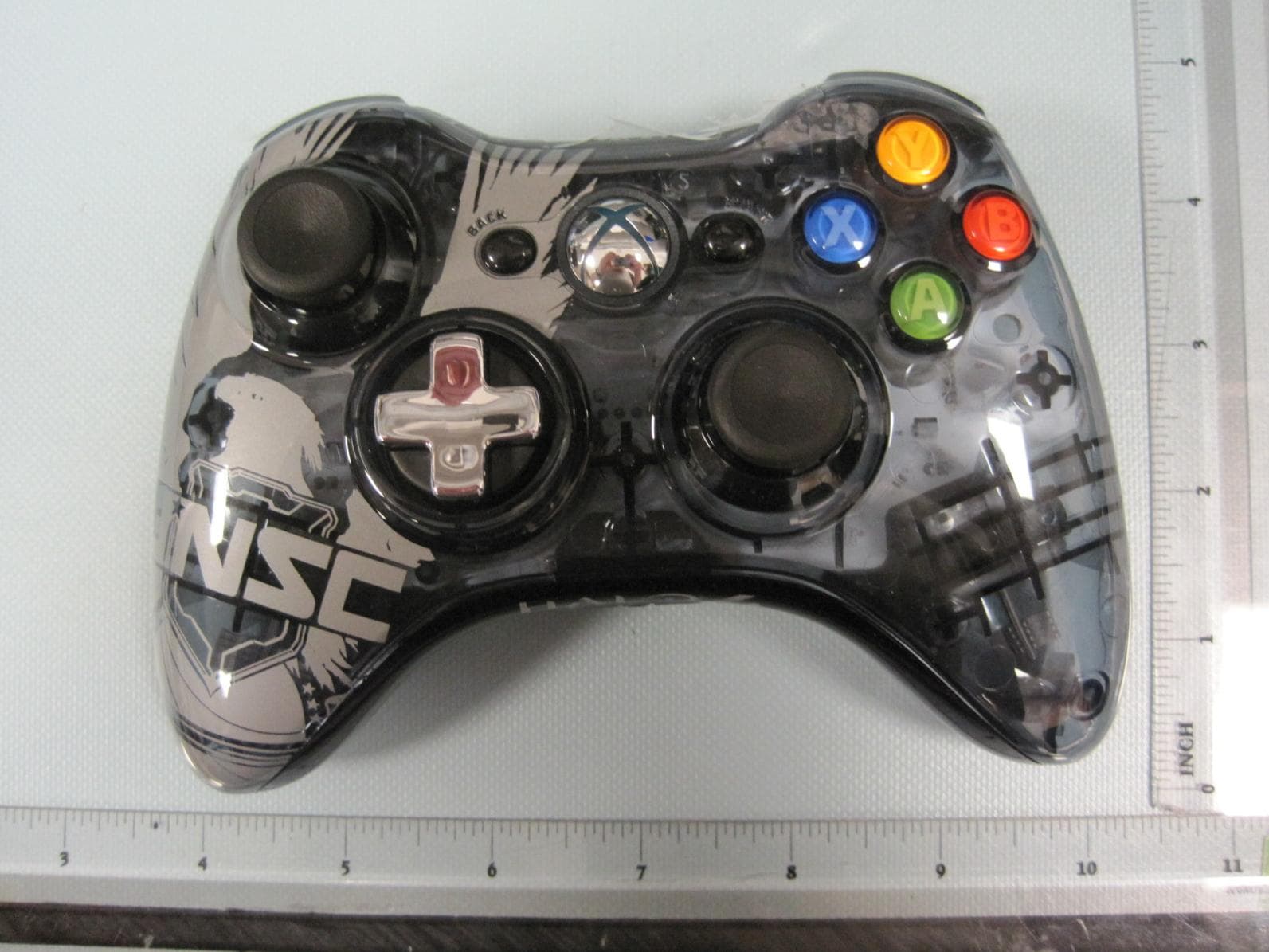
Click to zoom
Application Details
- Equipment Class
- DSS - Part 15 Spread Spectrum Transmitter
- Date of Grant
- Jun 05, 2012
- Application Purpose
- Original Equipment
- Date of Application
- May 22, 2012
- Equipment Note
- Accessory Wireless Controller
- Frequency Range
- 2402.00000000 - 2482.00000000
- Company
- Microsoft Corporation
- Country
- United States
Documents & Files
Document Text
Text extracted from the exhibit documents filed with the FCC. Open a document above to read the original.
Users Manual
USING YOUR CONTROLLER Xbox Guide Button The Xbox Guide button in the center of your controller puts the Xbox 360 ® experience at your fi ngertips. Press and hold the Xbox Guide button to turn your console on. Once on, the Xbox Guide button gives you immediate access to the Xbox Guide. To turn off your console, press and hold the Xbox Guide button and confi rm your selection. Directional Pad Your Controller has a transforming directional pad. To use the directional pad for sweeping motion control, twist the pad in either direction to transform to a disc. To use the pad for four–point directional control, twist the pad to transform into a plus. ! WARNING Before using this product, read this manual and the Xbox 360 console instructions for important safety and health information. Keep all manuals for future reference. For replacement manuals, visit www.xbox.com/support. The limited warranty covering this product is contained in the Xbox 360 console instructions and is available online at www.xbox.com/support. ! Disposable Battery Safety Improper use of batteries may result in battery fl uid leakage, overheating, or explosion. Risk of explosion if batteries are replaced by an incorrect type. Use and replace only with correct size and type of batteries. Released battery fl uid is corrosive and may be toxic. It can cause skin and eye burns, and is harmful if swallowed. To reduce the risk of injury: • Keep batteries out of reach of children. • Do not heat, open, puncture, mutilate, or dispose of batteries in fi re. • Use only alkaline (not rechargeable) batteries, type AA (LR6). • Do not mix new and old batteries or batteries of different types. • Do not allow metal objects to touch the battery terminals on the device; they can become hot and cause burns. • Remove the batteries if they are worn out or before storing your controller for an extended period of time. Do not leave batteries in the AA battery pack when it is not installed in the controller. • If a battery leaks, remove all batteries, taking care to keep the leaked fl uid from touching your skin or clothes. If fl uid from the battery comes into contact with skin or clothes, fl ush skin with water immediately. Before inserting new batteries, thoroughly clean the battery compartment with a damp paper towel, or follow the battery manufacturer’s recommendations for cleanup. • Dispose of batteries in accordance with local and national disposal regulations (if any). Insert batteries according to the instructions in this manual. IMPORTANT hEALTh WARNINGS ABOUT PLAYING VIDEO GAMES Photosensitive Seizures A very small percentage of people may experience a seizure when exposed to certain visual images, including fl ashing lights or patterns that may appear in video games. Even people who have no history of seizures or epilepsy may have an undiagnosed condition that can cause these “photosensitive epileptic seizures” while watching video games. These seizures may have a variety of symptoms, including lightheadedness, altered vision, eye or face twitching, jerking or shaking of arms or legs, disorientation, confusion, or momentary loss of awareness. Seizures may also cause loss of consciousness or convulsions that can lead to injury from falling down or striking nearby objects. Immediately stop playing and consult a doctor if you experience any of these symptoms. Parents should watch for or ask their children about the above symptoms—children and teenagers are more likely than adults to experience these seizures. The risk of photosensitive epileptic seizures may be reduced by taking the following precautions: • Sit farther from the TV screen. • Use a smaller TV screen. • Play in a well-lit room. • Do not play when you are drowsy or fatigued. If you or any of your relatives have a history of seizures or epilepsy, consult a doctor before playing. Musculoskeletal Disorders Use of game controllers, keyboards, mice, or other electronic input devices may be linked to serious injuries or disorders. When playing video games, as with many activities, you may experience occasional discomfort in your hands, arms, shoulders, neck, or other parts of your body. However, if you experience symptoms such as persistent or recurring discomfort, pain, throbbing, aching, tingling, numbness, burning sensation, or stiffness, DO NOT IGNORE THESE WARNING SIGNS. PROMPTLY SEE A QUALIFIED HEALTH PROFESSIONAL, even if symptoms occur when you are not playing a video game. Symptoms such as these can be associated with painful and sometimes permanently disabling injuries or disorders of the nerves, muscles, tendons, blood vessels, and other parts of the body. These musculoskeletal disorders (MSDs) include carpal tunnel syndrome, tendonitis, tenosynovitis, vibration syndromes, and other conditions. While researchers are not yet able to answer many questions about MSDs, there is general agreement that many factors may be linked to their occurrence, including medical and physical conditions, stress and how one copes with it, overall health, and how a person positions and uses their body during work and other activities (including playing a video game). Some studies suggest that the amount of time a person performs an activity may also be a factor. Some guidelines that may help you work and play more comfortably and possibly reduce your risk of experiencing an MSD can be found in the Healthy Gaming Guide at www.xbox.com. These guidelines address topics such as: • Positioning yourself to use comfortable, not awkward, postures. • Keeping your hands, fi ngers, and other body parts relaxed. • Taking breaks. • Developing a healthy lifestyle. If you have questions about how your own lifestyle, activities, or medical or physical condition may be related to MSDs, see a qualifi ed health professional. NOTE To avoid pinching your fi ngers when inserting, push only on the fl at surface of the battery pack. ! Remove Controller Batteries Aboard Aircraft Before boarding any aircraft or packing t…
Text truncated - open the document above for the full version.
Cover Letter(s)
CONFIDENTIALITY STATEMENT The information contained in this facsimile message is legally privileged and confidential information intended only for the use of the addressee listed on this cover sheet. If the reader of this message is not the intended recipient, you are hereby notified that any dissemination, distribution or copy of this facsimile is strictly prohibited. If you have received this facsimile in error, please immediately notify us by telephone at the number listed on this cover sheet and return the original message to us at the above address via the United States Postal Service. We will reimburse any costs you incur in notifying us and returning the message to us. Thank you. Microsoft Corporation is an equal opportunity employer May 17 rd , 2012 Federal Communications Commission Authorization and Evaluation Division 7435 Oakland Mills Road Columbia , Maryland 21046 Subject: Confidentiality request regarding application for certification of FCC ID: C3K1546 TO WHOM IT MAY CONCERN Pursuant to Sections 0.457 and 0.459 of the Commission’s Rules, the Applicant hereby requests confidential treatment of information accompanying this Application as outlined below: Block Diagram Schematics Operational Description The above materials contain trade secrets and proprietary information not customarily released to the public. The public disclosure of these matters might be harmful to the Applicant and provide unjustified benefits to its competitors. The Applicant understands that pursuant to Rule 0.457, disclosure of this Application and all accompanying documentation will not be made before the date of the Grant for this application. Sincerely, Anindita Mitra Compliance Engineer Microsoft Corporation
Cover Letter(s)
CONFIDENTIALITY STATEMENT The information contained in this facsimile message is legally privileged and confidential information intended only for the use of the addressee listed on this cover sheet. If the reader of this message is not the intended recipient, you are hereby notified that any dissemination, distribution or copy of this facsimile is strictly prohibited. If you have received this facsimile in error, please immediately notify us by telephone at the number listed on this cover sheet and return the original message to us at the above address via the United States Postal Service. We will reimburse any costs you incur in notifying us and returning the message to us. Thank you. Microsoft Corporation is an equal opportunity employer. May 17, 2012 Federal Communications Commission Authorization and Evaluation Division 7435 Oakland Mills Road Columbia , Maryland 21046 Subject: Short-term confidentiality request regarding application for certification of FCC ID: C3K1546 TO WHOM IT MAY CONCERN Pursuant to DA 04-1705 of the Commission’s public notice, we request short- term confidential treatment for the following information until November 30, 2012 in order to ensure sensitive business information remains confidential until the actual marketing of the device: • External Photos • Test Setup Photos • User’s Manual • Internal Photos Sincerely, Anindita Mitra Compliance Engineer Microsoft Corporation
External Photos
Model 1546 External Photos Standard Non-metallic Enclosure Metallic Artwork Enclosure
ID Label/Location Info
Model 1546 Label Content
ID Label/Location Info
1546 Label Location Note: Location indicated above is inside battery compartment. It is not on the removable battery cover.
Internal Photos
Model 1546 Internal Photos
Test Report
FCC CFR47 PART 15 SUBPART C INDUSTRY CANADA RSS-210 ISSUE 8 CERTIFICATION TEST REPORT FOR Accessory Wireless Controller MODEL NUMBER: 1546 FCC ID: C3K1546 IC: 3048A-1546 REPORT NUMBER: 12U14344-1, Revision D ISSUE DATE: June 1, 2012 Prepared for MICROSOFT CORPORATION ONE MICROSOFT WAY REDMOND, WA 98052, U.S.A. Prepared by COMPLIANCE CERTIFICATION SERVICES (UL CCS) 47173 BENICIA STREET FREMONT, CA 94538, U.S.A. TEL: (510) 771-1000 FAX: (510) 661-0888 REPORT NO: 12U14344-1D DATE: June 1, 2012 FCC ID: C3K1546 IC: 3048A-1546 Page 2 of 70 COMPLIANCE CERTIFICATION SERVICES (UL CCS) FORM NO: CCSUP4701D 47173 BENICIA STREET, FREMONT, CA 94538, USA TEL: (510) 771-1000 FAX: (510) 661-0888 This report shall not be reproduced except in full, without the written approval of UL CCS. Revision History Rev. Issue Date Revisions Revised By -- 05/10/12 Initial Issue T.LEE A 05/29/12 Added Duty Cycle T. LEE B 05/29/12 Updated report to maintain product confidentiality A. Zaffar C 06/01/12 Corrected Duty Cycle T. LEE D 06/01/12 Corrected Harmonic with Duty Cycle T. LEE REPORT NO: 12U14344-1D DATE: June 1, 2012 FCC ID: C3K1546 IC: 3048A-1546 Page 3 of 70 COMPLIANCE CERTIFICATION SERVICES (UL CCS) FORM NO: CCSUP4701D 47173 BENICIA STREET, FREMONT, CA 94538, USA TEL: (510) 771-1000 FAX: (510) 661-0888 This report shall not be reproduced except in full, without the written approval of UL CCS. TABLE OF CONTENTS 1. ATTESTATION OF TEST RESULTS .................................................................................... 4 2. TEST METHODOLOGY ........................................................................................................ 5 3. FACILITIES AND ACCREDITATION .................................................................................... 5 4. CALIBRATION AND UNCERTAINTY .................................................................................. 5 4.1. MEASURING INSTRUMENT CALIBRATION ................................................................ 5 4.2. SAMPLE CALCULATION ............................................................................................... 5 4.3. MEASUREMENT UNCERTAINTY ................................................................................. 5 5. EQUIPMENT UNDER TEST ................................................................................................. 6 5.1. DESCRIPTION OF EUT ................................................................................................. 6 5.2. MAXIMUM OUTPUT POWER ........................................................................................ 6 5.3. DESCRIPTION OF AVAILABLE ANTENNAS ................................................................ 6 5.4. SOFTWARE AND FIRMWARE ...................................................................................... 6 5.5. WORST-CASE CONFIGURATION AND MODE ............................................................ 7 5.6. DESCRIPTION OF TEST SETUP .................................................................................. 8 6. TEST AND MEASUREMENT EQUIPMENT ....................................................................... 10 7. ANTENNA PORT TEST RESULTS .................................................................................... 11 7.1.1. 20 dB AND 99% BANDWIDTH ............................................................................. 11 7.1.2. HOPPING FREQUENCY SEPARATION .............................................................. 18 7.1.3. NUMBER OF HOPPING CHANNELS ................................................................... 20 7.1.4. AVERAGE TIME OF OCCUPANCY ..................................................................... 24 7.1.5. OUTPUT POWER ................................................................................................. 27 7.1.6. AVERAGE POWER .............................................................................................. 31 7.1.7. CONDUCTED SPURIOUS EMISSIONS ............................................................... 32 7.1.8. DUTY CYCLE ........................................................................................................ 41 8. RADIATED TEST RESULTS .............................................................................................. 42 LIMITS AND PROCEDURE .................................................................................................... 42 8.1. Standard Non-metallic Enclosure ................................................................................. 43 8.1.1. TRANSMITTER ABOVE 1 GHz ............................................................................ 43 8.1.2. WORST-CASE BELOW 1 GHz ............................................................................. 50 8.2. Metallic Artwork Enclosure ........................................................................................... 53 8.2.1. TRANSMITTER ABOVE 1 GHz ............................................................................ 53 8.2.2. WORST-CASE BELOW 1 GHz ............................................................................. 60 9. MAXIMUM PERMISSIBLE EXPOSURE ............................................................................. 63 10. SETUP PHOTOS ............................................................................................................. 66 REPORT NO: 12U14344-1D DATE: June 1, 2012 FCC ID: C3K1546 IC: 3048A-1546 Page 4 of 70 COMPLIANCE CERTIFICATION SERVICES (UL CCS) FORM NO: CCSUP4701D 47173 BENICIA STREET, FREMONT, CA 94538, USA TEL: (510) 771-1000 FAX: (510) 661-0888 This report shall not be reproduced except in full, without the written approval of UL CCS. 1. ATTESTATION OF TEST RESULTS COMPANY NAME: MICROSOFT CORPORATION ONE MICROSOFT WAY REDMOND, WA 98052 U.S.A. EUT DESCRIPTION: Accessory Wireless Controller MODEL: 1546 SERIAL NUMBER: Standard Non-metallic Enclosure: EV2 103(Conducted) & EV2 229(Radiated) Metallic Artwork Enclosure: EV2B(Radiated) DATE TESTED: April 18 – May 10, 2012 …
Text truncated - open the document above for the full version.
Test Setup Photos
FCC CFR47 PART 15 SUBPART C INDUSTRY CANADA RSS-210 ISSUE 8 CERTIFICATION TEST REPORT FOR Accessory Wireless Controller MODEL NUMBER: 1546 FCC ID: C3K1546 IC: 3048A-1546 REPORT NUMBER: 12U14344-1, Revision D ISSUE DATE: June 1, 2012 Prepared for MICROSOFT CORPORATION ONE MICROSOFT WAY REDMOND, WA 98052, U.S.A. Prepared by COMPLIANCE CERTIFICATION SERVICES (UL CCS) 47173 BENICIA STREET FREMONT, CA 94538, U.S.A. TEL: (510) 771-1000 FAX: (510) 661-0888 REPORT NO: 12U14344-1D DATE: June 1, 2012 FCC ID: C3K1546 IC: 3048A-1546 Page 2 of 70 COMPLIANCE CERTIFICATION SERVICES (UL CCS) FORM NO: CCSUP4701D 47173 BENICIA STREET, FREMONT, CA 94538, USA TEL: (510) 771-1000 FAX: (510) 661-0888 This report shall not be reproduced except in full, without the written approval of UL CCS. Revision History Rev. Issue Date Revisions Revised By -- 05/10/12 Initial Issue T.LEE A 05/29/12 Added Duty Cycle T. LEE B 05/29/12 Updated report to maintain product confidentiality A. Zaffar C 06/01/12 Corrected Duty Cycle T. LEE D 06/01/12 Corrected Harmonic with Duty Cycle T. LEE REPORT NO: 12U14344-1D DATE: June 1, 2012 FCC ID: C3K1546 IC: 3048A-1546 Page 3 of 70 COMPLIANCE CERTIFICATION SERVICES (UL CCS) FORM NO: CCSUP4701D 47173 BENICIA STREET, FREMONT, CA 94538, USA TEL: (510) 771-1000 FAX: (510) 661-0888 This report shall not be reproduced except in full, without the written approval of UL CCS. TABLE OF CONTENTS 1. ATTESTATION OF TEST RESULTS .................................................................................... 4 2. TEST METHODOLOGY ........................................................................................................ 5 3. FACILITIES AND ACCREDITATION .................................................................................... 5 4. CALIBRATION AND UNCERTAINTY .................................................................................. 5 4.1. MEASURING INSTRUMENT CALIBRATION ................................................................ 5 4.2. SAMPLE CALCULATION ............................................................................................... 5 4.3. MEASUREMENT UNCERTAINTY ................................................................................. 5 5. EQUIPMENT UNDER TEST ................................................................................................. 6 5.1. DESCRIPTION OF EUT ................................................................................................. 6 5.2. MAXIMUM OUTPUT POWER ........................................................................................ 6 5.3. DESCRIPTION OF AVAILABLE ANTENNAS ................................................................ 6 5.4. SOFTWARE AND FIRMWARE ...................................................................................... 6 5.5. WORST-CASE CONFIGURATION AND MODE ............................................................ 7 5.6. DESCRIPTION OF TEST SETUP .................................................................................. 8 6. TEST AND MEASUREMENT EQUIPMENT ....................................................................... 10 7. ANTENNA PORT TEST RESULTS .................................................................................... 11 7.1.1. 20 dB AND 99% BANDWIDTH ............................................................................. 11 7.1.2. HOPPING FREQUENCY SEPARATION .............................................................. 18 7.1.3. NUMBER OF HOPPING CHANNELS ................................................................... 20 7.1.4. AVERAGE TIME OF OCCUPANCY ..................................................................... 24 7.1.5. OUTPUT POWER ................................................................................................. 27 7.1.6. AVERAGE POWER .............................................................................................. 31 7.1.7. CONDUCTED SPURIOUS EMISSIONS ............................................................... 32 7.1.8. DUTY CYCLE ........................................................................................................ 41 8. RADIATED TEST RESULTS .............................................................................................. 42 LIMITS AND PROCEDURE .................................................................................................... 42 8.1. Standard Non-metallic Enclosure ................................................................................. 43 8.1.1. TRANSMITTER ABOVE 1 GHz ............................................................................ 43 8.1.2. WORST-CASE BELOW 1 GHz ............................................................................. 50 8.2. Metallic Artwork Enclosure ........................................................................................... 53 8.2.1. TRANSMITTER ABOVE 1 GHz ............................................................................ 53 8.2.2. WORST-CASE BELOW 1 GHz ............................................................................. 60 9. MAXIMUM PERMISSIBLE EXPOSURE ............................................................................. 63 10. SETUP PHOTOS ............................................................................................................. 66 REPORT NO: 12U14344-1D DATE: June 1, 2012 FCC ID: C3K1546 IC: 3048A-1546 Page 4 of 70 COMPLIANCE CERTIFICATION SERVICES (UL CCS) FORM NO: CCSUP4701D 47173 BENICIA STREET, FREMONT, CA 94538, USA TEL: (510) 771-1000 FAX: (510) 661-0888 This report shall not be reproduced except in full, without the written approval of UL CCS. 1. ATTESTATION OF TEST RESULTS COMPANY NAME: MICROSOFT CORPORATION ONE MICROSOFT WAY REDMOND, WA 98052 U.S.A. EUT DESCRIPTION: Accessory Wireless Controller MODEL: 1546 SERIAL NUMBER: Standard Non-metallic Enclosure: EV2 103(Conducted) & EV2 229(Radiated) Metallic Artwork Enclosure: EV2B(Radiated) DATE TESTED: April 18 – May 10, 2012 …
Text truncated - open the document above for the full version.
Contact Information
Applicant
Hasnain Syed(SR. DIR EMC/SI&RF COMPLIANCE)
Technical Contact
Microsoft CorporationAnindita Mitra
[email protected]425-421-3619
One Microsoft Way · Redmond · United States
Non-Technical Contact
Microsoft CorporationAnindita Mitra
Test Firm
Compliance Certification Services (UL CCS)Barbara Judge
Technical Specifications
| # | Rule Parts | Frequency Range | Power Output |
|---|---|---|---|
| 1 | 15C | 2.40 GHz - 2.48 GHz | 2.40 mW |
Other Applications from Microsoft Corporation
C3K2147
Aug 28, 2026Wireless input device
Equipment Class
DTS - Digital Transmission SystemC3K2148
Aug 12, 2026Portable Computing Device
Equipment Class
DXX - Part 15 Low Power Communication Device TransmitterC3K2149
Aug 12, 2026Portable Computing Device
Equipment Class
DXX - Part 15 Low Power Communication Device TransmitterC3K2152
Aug 11, 2026Wireless Accessory
Equipment Class
DTS - Digital Transmission SystemC3K2150
Aug 06, 2026Portable Computing Device
Equipment Class
DXX - Part 15 Low Power Communication Device Transmitter