C3K1703Portable Computing Device
Microsoft Corporation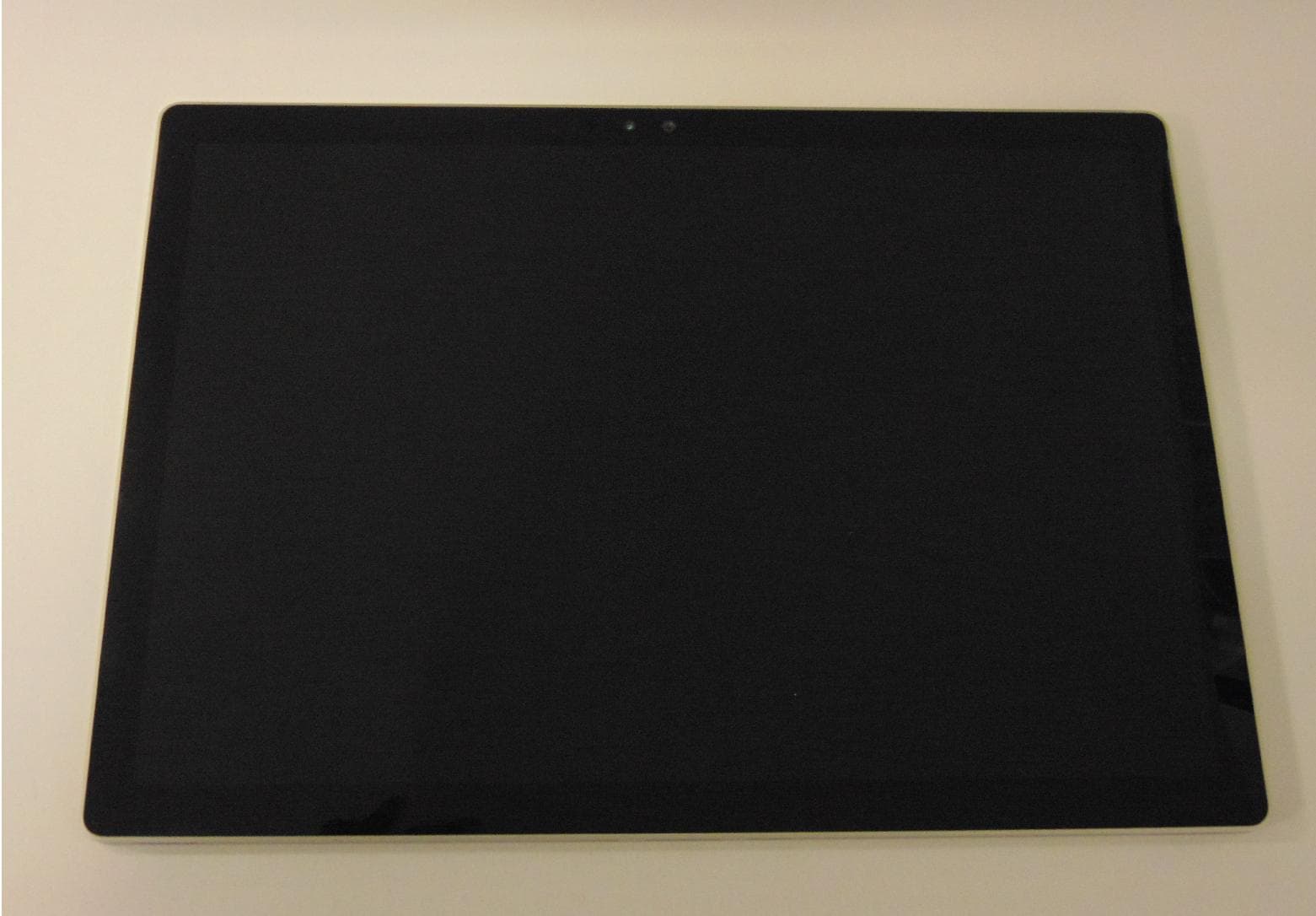
Click to zoom
Application Details
- Equipment Class
- NII - Unlicensed National Information Infrastructure TX
- Date of Grant
- Oct 05, 2015
- Application Purpose
- Original Equipment
- Date of Application
- Sep 30, 2015
- Equipment Note
- Portable Computing Device
- Frequency Range
- 5745.00000000 - 5825.00000000
- Company
- Microsoft Corporation
- Country
- United States
Documents & Files
Document Text
Text extracted from the exhibit documents filed with the FCC. Open a document above to read the original.
Users Manual
Model 1703 User Guide (draft content)
Users Manual
2. English 11. Français 21. Español 2 Surface CLEANING & USAGE INSTRUCTIONS Always handle your device with care to maintain its appearance. To clean, wipe the outer surface with a soft, lint-free cloth. This symbol identifies safety and health messages in this Device Guide WARNING: Read Safety & Health Info Read this guide for important safety and health information and the terms of the Limited Warranty that apply to the Microsoft ® device that you have purchased. Keep all printed guides for future reference. Failure to follow instructions and properly set up, use, and care for this product can increase the risk of serious injury or death, or damage to the device or devices. For an online version of this guide go to: www.surface.com/support Warning: Do Not Attempt Repairs Do not attempt to take apart, open, service, or modify the product, accessories, or power supply. Doing so could present the risk of electric shock or other hazard. Any evidence of any attempt to open and/or modify this device, including any peeling, puncturing, or removal of any of the labels, will void the Limited Warranty. Warning: AC Adapter Safety Failure to take the following precautions can result in serious injury or death from electric shock or fire or in damage to the device. To select an appropriate power source for your device: • Use only the power supply unit and AC power cord that came with your device or that you received from an authorized Microsoft retailer. • Do not use non-standard power sources, such as generators or inverters, even if the voltage and frequency appear acceptable. Only use AC power provided by a standard wall outlet. • Do not overload your wall outlet, extension cord, power strip, or other electrical receptacle. Confirm that they are rated to handle the total current (in amps [A]) drawn by the device (indicated on the power supply unit) and any other devices that are on the same circuit. • On devices where the AC prongs may be folded for storage, before plugging the AC adapter into a power outlet, make sure its prongs are fully extended. • On devices where the AC prongs are removable and where the power supply uses a universal adapter, before plugging the AC adapter into a power outlet, make sure the prong assembly is of the proper configuration for the power outlet and fully seated into the adapter. Caution: Cable and cord safety Arrange all cables and cords so that people and pets are not likely to trip over or accidentally pull on them as they move around or walk through the area. Do not allow children to play with cables and cords. To avoid damaging the power cords and power supply: • Protect the power cords from being walked on. • Protect cords from being pinched or sharply bent, particularly where they connect to the power outlet, the power supply unit, and the device. • Do not jerk, knot, sharply bend, or otherwise abuse the power cords. • Do not expose the power cords to sources of heat. • Keep children and pets away from the power cords. Do not allow them to bite or chew on them. • When disconnecting the power cords, pull on the plug—do not pull on the cord. • If a power cord or power supply becomes damaged in any way, stop using it immediately. • Unplug your device during lightning storms or when unused for long periods of time. • For devices with an AC power cord that connects to the power supply, always connect the power cord according to the following instructions: 1 Plug the AC power cord into the power supply until it seats fully. 2 Plug the other end of the AC power cord into the wall outlet. 3 Warning: Battery Safety Information This device contains a built-in battery, improper use of which may result in explosion. Do not heat, open, puncture, mutilate, or dispose of the product in fire. Do not leave the device in direct sunlight for an extended period of time, which could cause melting or battery damage. The battery in this device is not user replaceable and should only be replaced by Microsoft or a Microsoft Authorized Service Provider. See www.surface.com/support for additional details. • Do not disassemble or open, crush, bend or deform, puncture or shred • Do not modify or remanufacture, attempt to insert foreign objects into the battery, immerse or expose to water or other liquids, expose to fire, explosion or other hazard. • Only use the battery with a charging system that has been qualified with the system per CTIA Certification Requirements for Battery System Compliance to IEEE 1725. Use of an unqualified battery or charger may present a risk of fire, explosion, leakage, or other hazard. • Promptly dispose of used batteries in accordance with local regulations • Avoid dropping the device or battery. If the device or battery is dropped, especially on a hard surface, and the user suspects damage, take it to a service center for inspection. • Improper battery use may result in a fire, explosion or other hazard. • This device shall only be connected to CTIA certified adapters, products that bear the USB-IF logo or products that have completed the USB-IF compliance program. Warning: Use Near Water To reduce the risk of fire or shock, do not use this device near water and do not expose it to rain or moisture. Do not attempt to dry device with a hair dryer or a microwave oven. Warning: Hearing Safety Set the volume loud enough to hear clearly in quiet surroundings, and no louder. Do not increase the volume after you start listening. Your ears can adapt over time so that high volume sounds normal, but the high volume may still damage your hearing. • Do not increase the volume to block out outside noise. The combination of outside noise and sound from your headphones can damage your hearing. Sealed or noise-canceling headphones can reduce outside noise so that you don’t have to turn up the volume. If you can’t understand someone nearby speaking normally, turn down the volume. Sound that drowns out normal speech can damage your hearing. Even with sealed or noise-cancel…
Text truncated - open the document above for the full version.
Cover Letter(s)
Microsoft Corporation is an equal opportunity employer. September 16, 2015 Federal Communications Commission Equipment Authorization branch 7435 Oakland Mills Road Columbia, MD 21046 To whom it may concern: I, the undersigned, hereby authorize UL Verification Services Inc. to act on our behalf in all manners relating to application for equipment authorization, including signing of all documents relating to these matters. Any and all acts carried out by UL Verification Services Inc. on our behalf shall have the same effect as acts of our own. I, the undersigned, hereby certify that we are not subject to a denial of federal benefits, that includes FCC benefits, pursuant to Section 5301 of the Anti-Drug Abuse Act of 1988, 21 U.S.C. 853(a). In authorizing UL Verification Services Inc. as our representative, we still recognize that we are responsible to: a) comply with the relevant provisions of the certification program; b) make all necessary arrangements for the conduct of the evaluation, including provision for examining documentation and access to all areas, records (including internal audit reports) and personnel for the purposes of evaluation (e.g. testing, inspection, assessment, surveillance, reassessment) and resolution of complaints; c) make claims regarding certification only in respect of the scope for which certification has been granted; d) do not use our product certification in such a manner as to bring the Certification Division into disrepute and not make any statement regarding our product certification which the Certification Division may consider misleading or unauthorized; e) upon suspension or cancellation of certification, discontinue use of all advertising matter that contains any reference thereto and return any certification documents as required by the Certification Division; f) use certification only to indicate the products are certified as being in conformity with specified standards; Microsoft Corporation is an equal opportunity employer. g) endeavor to ensure that no certificate or report nor any part thereof is used in a misleading manner; h) ensure that any reference to our product certification in communication media such as documents, brochures or advertising, complies with the requirements of the Certification Division; i) keep a record of all complaints made known to the us relating to the product’s compliance with requirements of the relevant standard and to make these records available to the when requested; j) take appropriate action with respect to such complaints and any deficiencies found in products or services that affect compliance with the requirements for certification; k) document the actions taken. This authorization is valid until further written notice from the applicant. Sincerely Yours, Sahithi Kandula Compliance Engineer Microsoft Corporation
Cover Letter(s)
Microsoft Corporation is an equal opportunity employer September 16, 2015 Federal Communications Commission Authorization and Evaluation Division 7435 Oakland Mills Road Columbia, Maryland 21046 Subject: Confidentiality request regarding application for certification of FCC ID: C3K1703 TO WHOM IT MAY CONCERN Pursuant to Sections 0.457 and 0.459 of the Commission’s Rules, the Applicant hereby requests confidential treatment of information accompanying this Application as outlined below: Block Diagram Schematics Operational Description The above materials contain trade secrets and proprietary information not customarily released to the public. The public disclosure of these matters might be harmful to the Applicant and provide unjustified benefits to its competitors. The Applicant understands that pursuant to Rule 0.457, disclosure of this Application and all accompanying documentation will not be made before the date of the Grant for this application. Sincerely, Sahithi Kandula Compliance Engineer, Microsoft Corporation.
Cover Letter(s)
Microsoft Corporation is an equal opportunity employer September 16, 2015 Federal Communications Commission Authorization and Evaluation Division 7435 Oakland Mills Road Columbia, Maryland 21046 Subject: Short-term confidentiality request regarding application for Certification of FCC ID: C3K1703 TO WHOM IT MAY CONCERN Pursuant to CFR 47, Sections 0.457 and 0.459, we request short-term confidential treatment for the following information until March 31, 2016 in order to ensure sensitive business information remains confidential until the actual marketing of the device: • External Photos • Test Setup Photos • User’s Manual • Internal Photos Sincerely, Sahithi Kandula Compliance Engineer, Microsoft Corporation.
Cover Letter(s)
Microsoft Corporation is an equal opportunity employer. September 17, 2015 Federal Communications Commission Authorization and Evaluation Division 7435 Oakland Mills Road Columbia, Maryland 21046 Agency authorization letter for Microsoft employees To whom it may concern, We, the undersigned, Microsoft® Corporation hereby authorize the following, to act on our behalf, as our agent, in all matters relating to all processes required according to FCC Part 15C for Microsoft® Corporation products (Grantee Code:C3K): Michael Boucher Pam Galvan Albert Huang Bill Huang Joy Alegria Hasnain Syed Tim Calland Kitty Tam Sahithi Kandula Jennifer Liu Anindita Mitra Chaitrali Limaye David Johnson If you have any questions regarding the authorization, please don’t hesitate to contact me. Sincerely, Stephen M. Stegner Compliance Engineer Microsoft Corporation
External Photos
Microsoft Corporation is an equal opportunity employer. Model 1703 – External Photos Antenna locations Microsoft Corporation is an equal opportunity employer. Left side view Right side view Microsoft Corporation is an equal opportunity employer. Top view Bottom view
ID Label/Location Info
Model 1703 Label Content Microsoft Corporation Model: 1703 FCC ID: C3K1703 IC: 3048A-1703
RF Exposure Info
Test Report#: S‐TR32‐FCC‐TP‐1 Issued: 09/16/2015 Page 1 of 8 Microsoft EMC Laboratory Plot 1 Date/Time: 6/29/2015 5:48:44 PM Test Laboratory: Microsoft EMC DUT: 1703; Type: Portable Computing Device; Serial: 126552157 Communication System: UID 0, 802.11 2.4 GHz (0); Frequency: 2462 MHz Medium parameters used: f = 2462 MHz; σ = 1.984 S/m; ε r = 52.732; ρ = 1000 kg/m 3 Phantom section: Flat Section Measurement Standard: DASY5 (IEEE/IEC/ANSI C63.19-2007) DASY Configuration: Probe: EX3DV4 - SN3939; ConvF(6.9, 6.9, 6.9); Calibrated: 7/17/2014; Sensor-Surface: 2mm (Mechanical Surface Detection), z = 1.0, 31.0 Electronics: DAE4 Sn1383; Calibrated: 7/11/2014 Phantom: ELI v5.0 - Front; Type: QDOVA002AA; Serial: TP:1218 DASY52 52.8.7(1137); SEMCAD X 14.6.10(7164) Flat-Section MSL 2 2/06/29/15 g mode Chain A Top 0mm 10 dBm Tune up 2462 MHz Full Area Scan/Area Scan (51x301x1): Interpolated grid: dx=1.200 mm, dy=1.200 mm Reference Value = 2.642 V/m; Power Drift = -0.04 dB Fast SAR: SAR(1 g) = 0.920 W/kg; SAR(10 g) = 0.304 W/kg Maximum value of SAR (interpolated) = 2.09 W/kg Flat-Section MSL 2 2/06/29/15 g mode Chain A Top 0mm 10 dBm Tune up 2462 MHz Full Area Scan/Zoom Scan (7x7x7)/Cube 0: Measurement grid: dx=5mm, dy=5mm, dz=5mm Reference Value = 2.642 V/m; Power Drift = -0.04 dB Peak SAR (extrapolated) = 3.01 W/kg SAR(1 g) = 0.978 W/kg; SAR(10 g) = 0.309 W/kg Maximum value of SAR (measured) = 1.71 W/kg Test Report#: S‐TR32‐FCC‐TP‐1 Issued: 09/16/2015 Page 2 of 8 Microsoft EMC Laboratory Plot 2 Date/Time: 8/31/2015 11:47:00 AM Test Laboratory: Microsoft EMC DUT: 1703; Type: Portable Computing Device; Serial: 126552157 Communication System: UID 0, CW (0); Frequency: 5230 MHz Medium parameters used: f = 5230 MHz; σ = 5.541 S/m; ε r = 46.78; ρ = 1000 kg/m 3 Phantom section: Flat Section Measurement Standard: DASY5 (IEEE/IEC/ANSI C63.19-2007) DASY Configuration: Probe: EX3DV4 - SN3999; ConvF(5, 5, 5); Calibrated: 5/27/2015; Sensor-Surface: 2mm (Mechanical Surface Detection), z = 1.0, 23.0 Electronics: DAE4 Sn1445; Calibrated: 5/22/2015 Phantom: ELI v5.0 - Front; Type: QDOVA002AA; Serial: TP:xxxx DASY52 52.8.7(1137); SEMCAD X 14.6.10(7164) Flat-Section MSL/08/31/2015 HT40 mode Chain A Top 0 mm 9 dBm Tune up 5230 MHz/Area Scan (61x61x1): Interpolated grid: dx=1.000 mm, dy=1.000 mm Reference Value = 15.758 V/m; Power Drift = -0.28 dB Fast SAR: SAR(1 g) = 0.501 W/kg; SAR(10 g) = 0.146 W/kg Maximum value of SAR (interpolated) = 1.19 W/kg Flat-Section MSL/08/31/2015 HT40 mode Chain A Top 0 mm 9 dBm Tune up 5230 MHz/Zoom Scan (7x7x12)/Cube 0: Measurement grid: dx=4mm, dy=4mm, dz=2mm Reference Value = 15.758 V/m; Power Drift = -0.28 dB Peak SAR (extrapolated) = 5.02 W/kg SAR(1 g) = 0.801 W/kg; SAR(10 g) = 0.206 W/kg Maximum value of SAR (measured) = 2.05 W/kg Test Report#: S‐TR32‐FCC‐TP‐1 Issued: 09/16/2015 Page 3 of 8 Microsoft EMC Laboratory Plot 3 Date/Time: 7/1/2015 7:54:41 PM Test Laboratory: Microsoft EMC DUT: 1703; Type: Portable Computing Device; Serial: 118452157 Communication System: UID 0, 802.11 5GHz (0); Frequency: 5590 MHz Medium parameters used: f = 5590 MHz; σ = 5.924 S/m; ε r = 46.279; ρ = 1000 kg/m 3 Phantom section: Flat Section Measurement Standard: DASY5 (IEEE/IEC/ANSI C63.19-2007) DASY Configuration: Probe: EX3DV4 - SN3940; ConvF(3.77, 3.77, 3.77); Calibrated: 7/17/2014; Sensor-Surface: 2mm (Mechanical Surface Detection (Locations From Previous Scan Used)), Sensor- Surface: 2mm (Mechanical Surface Detection), z = 1.0, 23.0 Electronics: DAE4 Sn1384; Calibrated: 7/11/2014 Phantom: ELI v5.0 - Front; Type: QDOVA002AA; Serial: TP:1217 DASY52 52.8.7(1137); SEMCAD X 14.6.10(7164) Flat-Section MSL_Chain B/Chain B_802.11nHT40_Top 0mm_5590 MHz_Repeat/Area Scan (51x101x1): Interpolated grid: dx=1.000 mm, dy=1.000 mm Reference Value = 21.005 V/m; Power Drift = 0.18 dB Fast SAR: SAR(1 g) = 0.654 W/kg; SAR(10 g) = 0.141 W/kg Maximum value of SAR (interpolated) = 2.40 W/kg Flat-Section MSL_Chain B/Chain B_802.11nHT40_Top 0mm_5590 MHz_Repeat/Zoom Scan (7x7x12)/Cube 0: Measurement grid: dx=4mm, dy=4mm, dz=2mm Reference Value = 21.005 V/m; Power Drift = 0.18 dB Peak SAR (extrapolated) = 6.29 W/kg SAR(1 g) = 0.905 W/kg; SAR(10 g) = 0.158 W/kg Maximum value of SAR (measured) = 2.20 W/kg Test Report#: S‐TR32‐FCC‐TP‐1 Issued: 09/16/2015 Page 4 of 8 Microsoft EMC Laboratory Plot 4 Date/Time: 7/2/2015 1:59:54 PM Test Laboratory: Microsoft EMC DUT: 1703; Type: Portable Computing Device; Serial: 118452157 Communication System: UID 0, 802.11 5GHz (0); Frequency: 5680 MHz Medium parameters used: f = 5680 MHz; σ = 6.047 S/m; ε r = 46.127; ρ = 1000 kg/m 3 Phantom section: Flat Section Measurement Standard: DASY5 (IEEE/IEC/ANSI C63.19-2007) DASY Configuration: Probe: EX3DV4 - SN3940; ConvF(3.77, 3.77, 3.77); Calibrated: 7/17/2014; Sensor-Surface: 2mm (Mechanical Surface Detection (Locations From Previous Scan Used)), Sensor- Surface: 2mm (Mechanical Surface Detection), z = 1.0, 23.0 Electronics: DAE4 Sn1384; Calibrated: 7/11/2014 Phantom: ELI v5.0 - Front; Type: QDOVA002AA; Serial: TP:1217 DASY52 52.8.7(1137); SEMCAD X 14.6.10(7164) Flat-Section MSL_Chain B/Chain B_802.11a_Top 0mm_5680 MHz/Area Scan (51x101x1): Interpolated grid: dx=1.000 mm, dy=1.000 mm Reference Value = 18.753 V/m; Power Drift = 0.13 dB Fast SAR: SAR(1 g) = 0.789 W/kg; SAR(10 g) = 0.179 W/kg Maximum value of SAR (interpolated) = 2.72 W/kg Flat-Section MSL_Chain B/Chain B_802.11a_Top 0mm_5680 MHz/Zoom Scan (7x7x12)/Cube 0: Measurement grid: dx=4mm, dy=4mm, dz=2mm Reference Value = 18.753 V/m; Power Drift = 0.13 dB Peak SAR (extrapolated) = 7.93 W/kg SAR(1 g) = 1.02 W/kg; SAR(10 g) = 0.176 W/kg Maximum value of SAR (measured) = 2.44 W/kg Test Report#: S‐TR32‐FCC‐TP‐1 Issued: 09/16/2015 Page 5 of 8 Microsoft EMC Laboratory Plot 5 Date/Time: 8/14/2015 11:16:07 AM Test Laboratory: Microsoft EMC System Check 2.4GHz SN 917 08-14-2015 DUT: Dipole 2450 MHz D2450V2; Type: D2450V2; Serial: D2450V2 - SN:917 Communication Sy…
Text truncated - open the document above for the full version.
RF Exposure Info
Report V3.0 SAR TEST REPORT for MODEL NO. 1703 Test Report No. S-TR32-FCC-TR-2 Issue Date: 9-29-2015 FCC CFR 47 PART 2.1093 IEEE 1528-2013 Prepared by Microsoft EMC Laboratory 17760 NE 67th Ct, Redmond WA, 98052, U.S.A. 425-421-9799 [email protected] TESTING CERT #3472.01 Report#: S-TR32-FCC-TR-2 Issued: 9/29/2015 Page 2 of 52 Microsoft EMC Laboratory 1 Record of Revisions Revision Date Section Page(s)Summaryof Changes Author/Revised By: 1.0 09/17/2015 All All First Version Z. Gray 2.0 09/29/2015 8.5, 11.2 17, 28Added justification for not testing channels 12 and 13. Z. Gray Report#: S-TR32-FCC-TR-2 Issued: 9/29/2015 Page 3 of 52 Microsoft EMC Laboratory Test Report Attestation Microsoft Corporation Model: 1703 Applicable Standards Specification Test Result FCC CFR 47 PART 2.1093 IEEE 1528-2013 Pass Microsoft EMC Laboratory attests that the product model identified in this report has been tested to and meets the requirements identified in the above standards. The test results in this report solely pertains to the specific sample tested, under the conditions and operating modes as provided by the customer. This report shall not be used to claim product certification, approval, or endorsement by A2LA or any agency of any Government. Reproduction, duplication or publication of extracts from this test report is prohibited and requires prior written approval of Microsoft EMC Laboratory. This test report replaces the previously issued report #S-TR32-FCC-TR-1 issued by Microsoft EMC Labs on 9/17/2015. Written By: Zack Gray Reviewed/ Issued By: Sajay Jose SAR Test Lead EMC/RF Compliance Lab Manager Report#: S-TR32-FCC-TR-2 Issued: 9/29/2015 Page 4 of 52 Microsoft EMC Laboratory Table of Contents 1 Record of Revisions ............................................................................................................... 2 2 Deviations from Standard ...................................................................................................... 7 3 Facilities and Accreditation .................................................................................................... 7 3.1 TEST FACILITY .............................................................................................................. 7 3.2 ACCREDITATIONS ........................................................................................................ 7 3.3 Test Equipment .............................................................................................................. 7 4 Product Description ............................................................................................................... 8 4.1 TEST CONFIGURATIONS ............................................................................................. 8 4.2 ENVIRONMENTAL CONDITIONS ................................................................................. 8 4.3 EQUIPMENT MODIFICATIONS ..................................................................................... 8 4.4 EQUIPMENT UNDER TEST .......................................................................................... 9 Accessory Test Equipment ...................................................................................... 9 4.5 Supported Air Interfaces and Transmission Configurations ......................................... 10 Supported Air Interfaces ........................................................................................ 10 Transmission Configurations ................................................................................. 10 5 Highest Reported SAR Values ............................................................................................ 11 5.1 SAR Limits .................................................................................................................... 11 6 Test Equipment List ............................................................................................................. 12 7 Test Methodology ................................................................................................................ 14 8 Conducted RF Average Output Power Measurements ....................................................... 15 8.1 Bluetooth Conducted Output Power Measurements .................................................... 15 8.2 Bluetooth LE Conducted Output Power Measurements ............................................... 15 8.3 WLAN Power Measurement Requirements .................................................................. 16 8.4 Initial Test Configuration for OFDM Configurations ...................................................... 16 8.5 WLAN 2.4 GHz Conducted Output Power Measurements ........................................... 17 8.6 WLAN 5 GHz Conducted Output Power Measurements .............................................. 18 5.2 GHz Conducted Measurements (U-NII-1) ....................................................... 18 5.3 GHz Conducted Measurements (U-NII-2A) ..................................................... 19 5.6 GHz Conducted Measurements (U-NII-2C) .................................................... 20 5.8 GHz Conducted Measurements (U-NII-3) ....................................................... 21 5.8 GHz Conducted Measurements (U-NII-3) Continued ...................................... 22 9 Test Configurations .............................................................................................................. 23 Report#: S-TR32-FCC-TR-2 Issued: 9/29/2015 Page 5 of 52 Microsoft EMC Laboratory 9.1 Evaluation of Required Test Configurations ................................................................. 24 9.2 Test Positions ............................................................................................................... 2 5 Test Positions without Keyboard ........................................................................... 25 Additional Test Positions with Keyboard Attached .............................................…
Text truncated - open the document above for the full version.
Test Report
Rev 2.0 RADIO TEST REPORT For MODEL NO. 1703 FCC ID: C3K1703 IC ID: 3048A-1703 Test Report No. R-TR190-FCCIC-DFS-2 Issue Date: September 29, 2015 FCC CFR47 Part 15 Subpart E Industry Canada RSS-247 Issue 1 Prepared by Microsoft EMC Laboratory 17760 NE 67th Ct, Redmond WA, 98052, U.S.A. 425-421-9799 [email protected] TESTING CERT #3472.01 Report#: R-TR190-FCCIC-DFS-2 Issued: September 29, 2015 Page 2 of 19 Microsoft EMC Laboratory 1 Record of Revisions Revision Date Section Page(s)Summaryof Changes Author/Revised By: 1.0 09/15/2015 All All First Version Daniel Salinas 2.0 09/29/2015 4, 6, 8.3, 8.4 7, 8, 16, 17 Include test sample serial number; Include FCC ID of Router; Remove 80 MHz data Daniel Salinas Report#: R-TR190-FCCIC-DFS-2 Issued: September 29, 2015 Page 3 of 19 Microsoft EMC Laboratory Table of Contents 1 Record of Revisions ............................................................................................................... 2 2 Deviations from Standards .................................................................................................... 6 3 Facilities and Accreditations .................................................................................................. 6 3.1 Test Facility .................................................................................................................... 6 3.2 Accreditations ................................................................................................................. 6 3.3 Test Equipment .............................................................................................................. 6 4 Product Description ............................................................................................................... 7 4.1 Test Configurations ........................................................................................................ 7 4.2 Environmental Conditions ............................................................................................... 7 4.3 Equipment Modifications ................................................................................................ 7 4.4 Dates of Testing ............................................................................................................. 7 5 Test Results Summary .......................................................................................................... 8 6 Test Equipment List ............................................................................................................... 8 7 Test Method ........................................................................................................................... 9 7.1 Antenna port conducted measurements ......................................................................... 9 7.2 Test Setup Diagrams ...................................................................................................... 9 8 Test Results ......................................................................................................................... 10 8.1 In-service monitoring .................................................................................................... 10 Test Requirement: ................................................................................................. 10 Test Method: ......................................................................................................... 10 Limits: .................................................................................................................... 10 Test Results: ......................................................................................................... 10 8.2 Channel Availability Check Time .................................................................................. 11 Test Requirement: ................................................................................................. 11 Test Method: ......................................................................................................... 11 Limits: .................................................................................................................... 11 Test Results: ......................................................................................................... 11 8.3 Channel Move Time ..................................................................................................... 12 Test Requirement: ................................................................................................. 12 Test Method: ......................................................................................................... 12 Limits: .................................................................................................................... 12 Test Results: ......................................................................................................... 12 Test Data ............................................................................................................... 13 Report#: R-TR190-FCCIC-DFS-2 Issued: September 29, 2015 Page 4 of 19 Microsoft EMC Laboratory 8.4 Channel Closing Transmission Time ............................................................................ 17 Test Requirement: ................................................................................................. 17 Test Method: ......................................................................................................... 17 Limits: .................................................................................................................... 17 Test Results: ......................................................................................................... 17 Test Data ............................................................................................................... 17 8.5 Non-Occupancy Period ........................................................................................…
Text truncated - open the document above for the full version.
Test Report
Rev 2.0 RADIO TEST REPORT For MODEL NO. 1703 FCC ID: C3K1703 IC ID: 3048A-1703 Test Report No. R-TR190-FCCIC-UNII-1 Issue Date: 14 September 2015 FCC CFR…
Text truncated - open the document above for the full version.
Contact Information
Applicant
Hasnain Syed(SR. DIR EMC/SI&RF COMPLIANCE)
Test Firm
Microsoft EMC LaboratoryJames Wooten
[email protected]4257068002
Technical Specifications
| # | Rule Parts | Frequency Range | Power Output |
|---|---|---|---|
| 4 | 15E | 5.75 GHz - 5.83 GHz | 11.70 mW |
Other Applications from Microsoft Corporation
C3K2147
Aug 28, 2026Wireless input device
Equipment Class
DTS - Digital Transmission SystemC3K2148
Aug 12, 2026Portable Computing Device
Equipment Class
DXX - Part 15 Low Power Communication Device TransmitterC3K2149
Aug 12, 2026Portable Computing Device
Equipment Class
DXX - Part 15 Low Power Communication Device TransmitterC3K2152
Aug 11, 2026Wireless Accessory
Equipment Class
DTS - Digital Transmission SystemC3K2150
Aug 06, 2026Portable Computing Device
Equipment Class
DXX - Part 15 Low Power Communication Device Transmitter