C3KMS9Wireless Optical Mouse
Microsoft Corporation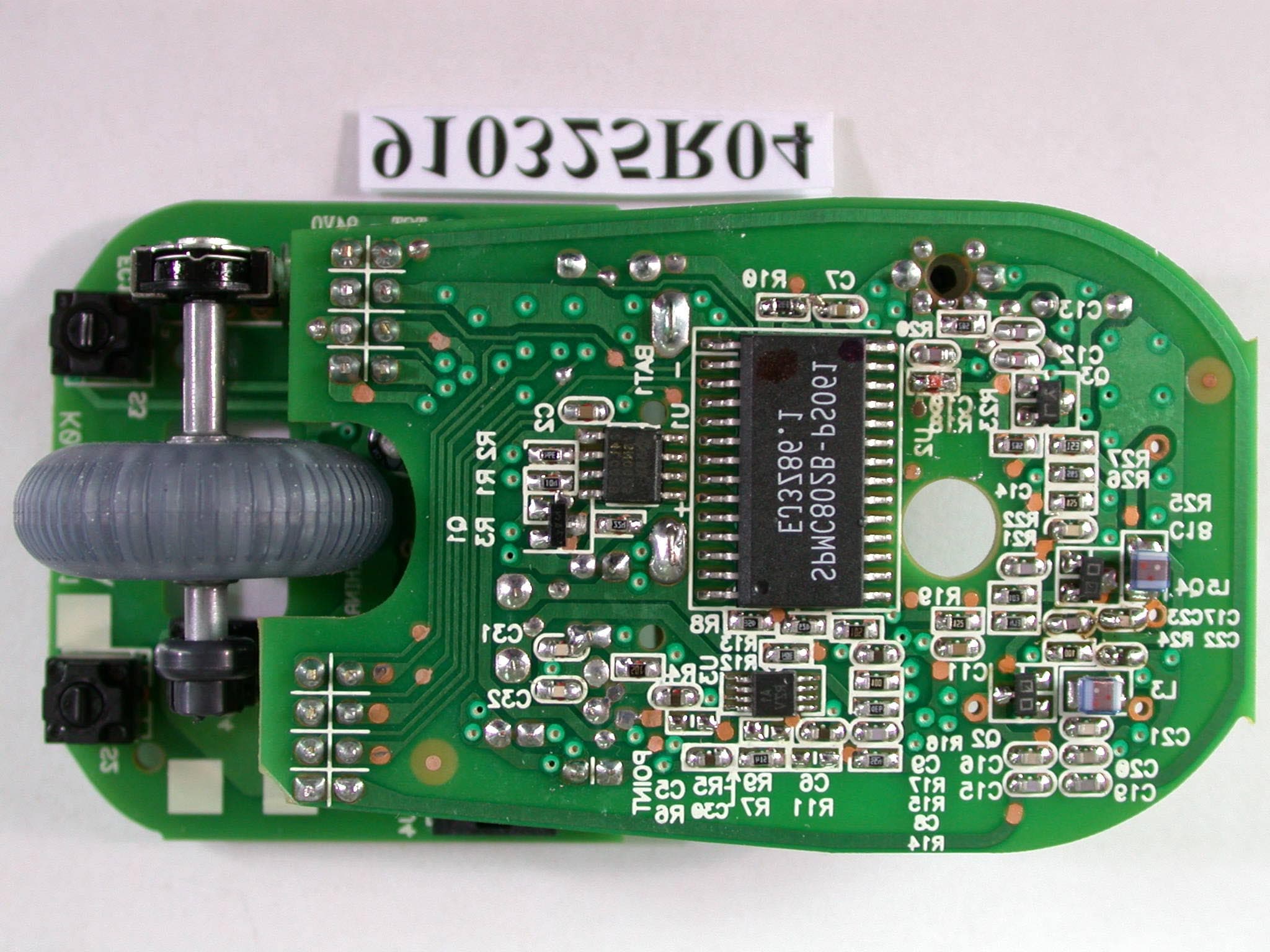
Click to zoom
Application Details
- Equipment Class
- DXX - Part 15 Low Power Communication Device Transmitter
- Date of Grant
- May 02, 2002
- Application Purpose
- Original Equipment
- Date of Application
- May 02, 2002
- Equipment Note
- Wireless Optical Mouse
- Frequency Range
- 27.14500000 - 27.14500000
- Company
- Microsoft Corporation
- Country
- United States
Documents & Files
Document Text
Text extracted from the exhibit documents filed with the FCC. Open a document above to read the original.
Users Manual
Getting Started W W W W W ir ir ir ir ir eless P eless P eless P eless P eless P ointing De ointing De ointing De ointing De ointing De vices vices vices vices vices M www.microsoft.com/mouse M 3/02 Part No. xx-xxxxx X08-75976_Cvr_Ret_Wireless_Pointing_Devices.p65 3/6/2002, 9:50 AM 1 Health WarningUse of a keyboard or pointing device may be linked to serious injuries or disorders.When using a computer, as with many activities, you may experience occasional discomfort in your hands,arms, shoulders, neck, or other parts of your body. However, if you experience symptoms such as persis-tent or recurring discomfort, pain, throbbing, aching, tingling, numbness, burning sensation, or stiffness,DO NOT IGNORE THESE WARNING SIGNS. PROMPTLY SEE A QUALIFIED HEALTH PROFESSIONAL , even if symptoms occur when you are not working at your computer. Symptoms such as these can be associatedwith painful and sometimes permanently disabling injuries or disorders of the nerves, muscles, tendons,or other parts of the body. These musculoskeletal disorders (MSDs) include carpal tunnel syndrome,tendonitis, tenosynovitis, and other conditions.While researchers are not yet able to answer many questions about MSDs, there is general agreementthat many factors may be linked to their occurrence, including: medical and physical conditions, stressand how one copes with it, overall health, and how a person positions and uses his or her body duringwork and other activities (including use of a keyboard or pointing device). Some studies suggest that theamount of time a person uses a keyboard may also be a factor. Some guidelines that may help you workmore comfortably with your computer and possibly reduce your risk of experiencing an MSD can be f ound in the “Healthy Computing Guide” topic of the User’s Guide, provided with the software program on yourCD-ROM. If you do not have the CD-ROM for this product, you can access the “Healthy Computing Guide”from http://www.microsoft.com/hardware/, or (in the United States only) call 1-800-360-7561 to requesta CD-ROM at no charge. If you have questions about how your own lifestyle, activities, or medical orphysical condition may be related to MSDs, see a qualified health professional.Information in this document, including URL and other Internet Web site refer ences, is subject to change without notice. Unless otherwise noted, the example companies, organizations, products, domain names, e-mail ad-dresses, logos, people, places and events depicted herein are fictitious, and no association with any real company,organization, product, domain name, e-mail address, logo, person, place or event is intended or should be inferred.Complying with all applicable copyright laws is the responsibility of the user. Without limiting the rights undercopyright, no part of this document may be reproduced, stored in or introduced into a retrieval system, or transmit-ted in any form or by any means (electronic, mechanical, photocopying, recording, or otherwise), or for any pur-pose, without the express written permission of Microsoft Corporation.Microsoft may have patents, patent applications, trademarks, copyrights, or other intellectual property rightscovering subject matter in this document. Except as expressly provided in any written license agreement fromMicrosoft, the furnishing of this document does not give you any license to these patents, trademarks, copyrights,or other intellectual property.Microsoft Corporation grants the purchaser of this product the right to reproduce one (1) copy of the enclosed“Getting Started” printed guide for each Hardware Device you purchased in the package.©1999–2002 Microsoft Corporation. All rights reserved.Microsoft, IntelliMouse, Natural, and Windows are either registered trademarks or trademarks of MicrosoftCorporation in the United States and/or other countries.The names of actual companies and products mentioned herein may be the trademarks of their respective owners. X08-75976_Cvr_Ret_Wireless_Pointing_Devices.p65 3/6/2002, 9:50 AM 2 1 Welcome! Setting up your Microsoft ® pointing device takes a few simple steps, and then you can enjoy the freedom and convenience of wireless technology. Install IntelliPoint Software IntelliPoint software enables the unique features of your pointing device and provides battery status information. If you do not already have a pointing device, you can connect the receiver before installation so you can use your pointing device during IntelliPoint Setup. About Your Rights and Obligations The software with this product is licensed, not sold. You must either agree to the license contract in the software Setup screens or promptly return the entire product for a refund, excluding the return costs. After you install the software, you may consult the license and the Limited Warranty for the product at any time by looking in the “Legal Information” section of the software User’s Guide. You may also print a copy for your records. To install IntelliPoint software (Windows ® ) 1Insert the Microsoft IntelliPoint compact disc into the computer’s CD-ROM drive. If Setup does not start automatically, do the following: •Click the Start button, and then click Run. •Type [drive]:setup For example, if your CD-ROM drive is drive E, type e:setup 2Follow the Setup Wizard instructions on your screen. Depending on your operating system version, you may be asked to restart your computer before Setup can begin. 3After installation is complete, restart your computer if prompted to do so. The Quick Start Guide will automatically open to help you learn about the pointing device features. 1 X08-75976_Mnl_Ret_Wireless_Pointing_Devices.p653/6/2002, 9:49 AM1 2 To install IntelliPoint software (Macintosh) If your pointing device has a Universal Serial Bus (USB) connector, it can be used with a Macintosh computer. •Insert the Microsoft IntelliPoint compact disc into the computer’s CD-ROM drive, double-click the IntelliPoint Installer icon, and then follow the on-s…
Text truncated - open the document above for the full version.
Internal Photos
Page 5 Page 6
Internal Photos
Page 7 Page 8
Operational Description
FCC ID: C3KMS9 ADT No.910325R04 Operational Description The transmitter of the EUT (Wireless Optical Mouse) is powered by 3V Battery. The receiver is powered by host computer. Both transmitter and receiver use Integral antenna. The output power of this device is very low. Under normal use condition, the transmitter and the receiver are quite close, so high EIRP power is neither necessary nor allowed because of interference.
Test Report
FCC ID: C3KMS9 Report No.: RF910325R04 1 Issued: April 8, 2002 FCC TEST REPORT REPORT NO.: RF910325R04 MODEL NO.: Wireless Optical Mouse Wireless Optical Mouse Blue Wireless Optical Mouse 1.0A RECEIVED: March 25, 2002 TESTED: April 2, 2002 APPLICANT:MICROSOFT CORPORATION ADDRESS: ONE MICROSOFT WAY REDMON, WA 98052-6399, U.S.A ISSUED BY:Advance Data Technology Corporation LAB LOCATION:47 14th Lin, Chia Pau Tsuen, Linkou Hsiang, Taipei, Taiwan, R.O.C. This test report consists of 14 pages in total. It may be duplicated completely for legal use with the approval of the applicant. It should not be reproduced except in full, without the written approval of our laboratory. The client should not use it to claim product endorsement by NVLAP or any U.S. government agencies. The test results in the report only apply to the tested sample. Lab Code: 200102-0 0528 ILAC MRA FCC ID: C3KMS9 Report No.: RF910325R04 2 Issued: April 8, 2002 Table of Contents 1CERTIFICATION..............................................................................................3 2SUMMARY OF TEST RESULTS .....................................................................4 3GENERAL INFORMATION..............................................................................5 3.1GENERAL DESCRIPTION OF EUT ................................................................5 3.2DESCRIPTION OF TEST MODES ..................................................................6 3.3GENERAL DESCRIPTION OF APPLIED STANDARDS .................................6 3.4DESCRIPTION OF SUPPORT UNITS ............................................................6 4TEST PROCEDURE AND RESULT ................................................................7 4.1CONDUCTED EMISSION MEASUREMENT...................................................7 4.2RADIATED EMISSION MEASUREMENT........................................................7 4.2.1 LIMITS OF RADIATED EMISSION MEASUREMENT .....................................7 4.2.2 TEST INSTRUMENT .......................................................................................8 4.2.3 TEST PROCEDURE........................................................................................9 4.2.4 TEST SETUP.................................................................................................10 4.2.5 EUT OPERATING CONDITION.....................................................................10 4.2.6 TEST RESULT............................................................................................... 11 5PHOTOGRAPHS OF THE TEST CONFIGURATION ....................................13 6INFORMATION ON THE TESTING LABORATORIES ..................................14 FCC ID: C3KMS9 Report No.: RF910325R04 3 Issued: April 8, 2002 1 CERTIFICATION PRODUCT : Wireless Optical Mouse BRAND NAME : Microsoft MODEL NO : Wireless Optical Mouse Wireless Optical Mouse Blue Wireless Optical Mouse 1.0A APPLICANT : MICROSOFT CORPORATION STANDARDS : 47 CFR Part 15, Subpart C(15.227) ANSI C63.4-1992, Canada RSS 210 We, Advance Data Technology Corporation, hereby certify that one sample of the designation has been tested in our facility on April 2, 2002. The test record, data evaluation and Equipment Under Test (EUT) configurations represented herein are true and accurate accounts of the measurements of the sample's EMC characteristics under the conditions herein specified. FCC ID: C3KMS9 Report No.: RF910325R04 4 Issued: April 8, 2002 2 SUMMARY OF TEST RESULTS The EUT has been tested according to the following specifications: APPLIED STANDARD: 47 CFR Part 15, Subpart C STANDARD PARAGRAPH TEST TYPERESULTREMARK 15.207Conducted Emission TestN/A Power supply is 3VDC from battery 15.227Radiated Emission TestPASS Minimum passing margin is –-14.0dBuV at 54.30MHz NOTE: The receiver part to communicate with the EUT has been verified to comply with FCC Part 15, Subpart B, Class B (DoC). The test report can be provided upon request. FCC ID: C3KMS9 Report No.: RF910325R04 5 Issued: April 8, 2002 3 GENERAL INFORMATION 3.1 GENERAL DESCRIPTION OF EUT PRODUCTWireless Optical Mouse MODEL NO. Wireless Optical Mouse Wireless Optical Mouse Blue Wireless Optical Mouse 1.0A POWER SUPPLY3VDC from battery MODULATION TYPE FSK CARRIER FREQUENCY OF EACH CHANNEL 27.145MHz BANDWIDTH OF EACH CHANNEL 3.2KHz ± 550Hz NUMBER OF CHANNEL1 ANTENNA TYPEIntegral antenna DATA CABLENA I/O PORTSNA ASSOCIATED DEVICESNA NOTE: 1. The EUT is the transmitter part of a Wireless Optical Mouse. 2. Three models mentioned above are identical except for their model number due to marketing requirement. 3. EUT information: ManufacturerComponent typePart no.Revision no. KYEMouseX08-72982 KYEReceiverX08-7294 SunplusTX-MCU SPMC802B-PS061 EJ3Z86.1 K033B06300 AgilentTX-SeneorSDNS-2030K030C00100 MotorolaRX-MCUMC68HC705JB8K033B06400 SamsungRX-Converter3361DK130B145A Y.C. CABLEX01-03696-01 (Blue) JI HAW Cable X01-03696-02 (Grey) A TX PCB LayoutK023B151TB RX OPT MC3361 PCB LayoutK023B152TCTA C H I E N RXMOD OPT MC68 PCB LayoutK023B153TB TX PCB AssemblyK000B18204 RX OPT MC3361 PCB AssemblyK010B11503 KYE RX MCU PCB AssemblyK000B18702 4. For more detailed features description of the EUT, please refer to the manufacturer's specifications or the User's Manual. FCC ID: C3KMS9 Report No.: RF910325R04 6 Issued: April 8, 2002 3.2 DESCRIPTION OF TEST MODES One channel was provided in this EUT. ChannelFrequencyChannelFrequency 127.145MHz 3.3 GENERAL DESCRIPTION OF APPLIED STANDARDS The EUT is the transmitter part of a Wireless Optical Mouse. According to the specifications of the manufacturer, it must comply with the requirements of the following standards: FCC CFR 47 Part 15, Subpart C (15.227) ANSI C63.4-1992, Canada RSS 210 All tests have been performed and recorded as per the above standards. 3.4 DESCRIPTION OF SUPPORT UNITS The EUT has been tested as an independent unit together with other necessary accessories or support units. The following support units or accessories were used to form a represen…
Text truncated - open the document above for the full version.
Test Setup Photos
FCC ID: C3KMS9 Report No.: RF910325R04 13 Issued: April 8, 2002 5 PHOTOGRAPHS OF THE TEST CONFIGURATION RADIATED EMISSION TEST
Contact Information
Applicant
Hasnain Syed(SR. DIR EMC/SI&RF COMPLIANCE)
Technical Contact
Advance Data Technology CorporationAlan Lane
[email protected]+886-3-327-0910
13-1, Lane 19, WenShan 3 rd ., St., · Taoyuan · Taiwan
Non-Technical Contact
Advance Data Technology CorporationAlan Lane
[email protected]+886-3-327-0910
Test Firm
Bureau Veritas CPS (H.K.) Ltd. Taoyuan BranchRichard Chen
Technical Specifications
| # | Rule Parts | Frequency Range | Power Output |
|---|---|---|---|
| 1 | 15C | 27.145 MHz - 27.145 MHz | - |
Other Applications from Microsoft Corporation
C3K2147
Aug 28, 2026Wireless input device
Equipment Class
DTS - Digital Transmission SystemC3K2148
Aug 12, 2026Portable Computing Device
Equipment Class
DXX - Part 15 Low Power Communication Device TransmitterC3K2149
Aug 12, 2026Portable Computing Device
Equipment Class
DXX - Part 15 Low Power Communication Device TransmitterC3K2152
Aug 11, 2026Wireless Accessory
Equipment Class
DTS - Digital Transmission SystemC3K2150
Aug 06, 2026Portable Computing Device
Equipment Class
DXX - Part 15 Low Power Communication Device Transmitter