EW780-5214-12900 MHz Cordless Telephone System
VTech Telecommunications Ltd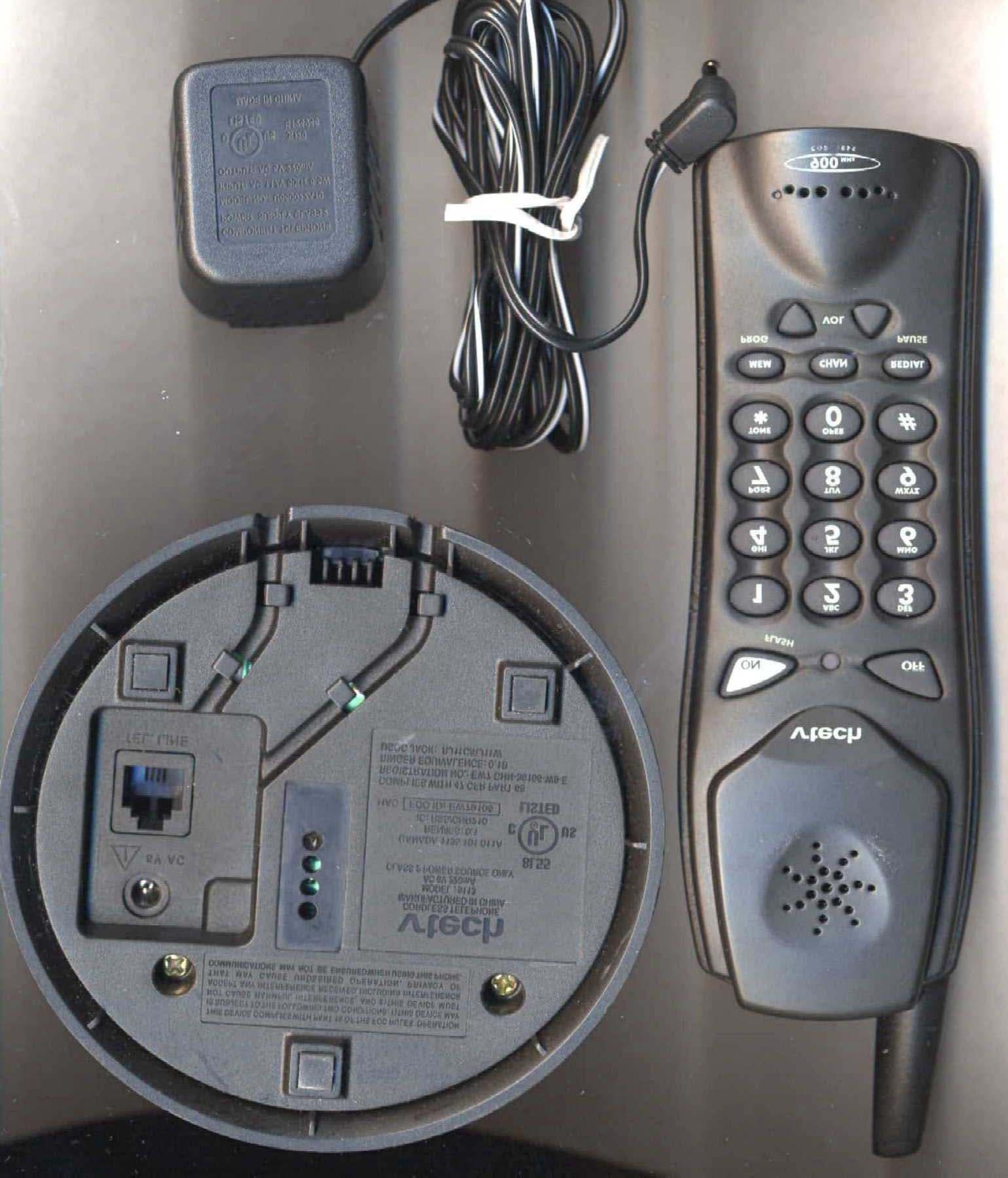
Click to zoom
Application Details
- Equipment Class
- DXX - Part 15 Low Power Communication Device Transmitter
- Date of Grant
- Sep 11, 2003
- Application Purpose
- Original Equipment
- Date of Application
- Sep 11, 2003
- Equipment Note
- 900 MHz Cordless Telephone System
- Frequency Range
- 923.40000000 - 927.75000000
- Company
- VTech Telecommunications Ltd
- Country
- Hong Kong
Documents & Files
Document Text
Text extracted from the exhibit documents filed with the FCC. Open a document above to read the original.
Users Manual
Parts Check List: 1.Handset 2.Base Unit 3.Telephone line cord 4.Battery Pack 5.AC Adapter When using your telephone equipment, basic safety precautions should always be followed to reduce the risk of fire, electric shock and injury, including the following: 1. Read and understand all instructions. 2. Follow all warnings and instructions marked on the product. 3. Unplug this product from the wall outlet before cleaning. Do not use liquid cleaners or aerosol cleaners. Use a damp cloth for cleaning. 4. Do not use this product near water (for example, near a bath tub, kitchen sink, or swimming pool). 5. Do not place this product on an unstable cart, stand, or table. The product may fall, causing serious damage to the product. 6 . Slots and openings in the cabinet and the back or bottom are provided for ventilation. To protect it from overheating, these openings must not be blocked by placing the product on the bed, sofa, rug, or other similar surface. This product should never be placed near or over a radiator or heat register. This product should not be placed in a built-in- installation where proper ventilation is not provided. 7. This product should be operated only from the type of power source indicated on the marking label. If you are not sure of the type of power supply to your home, consult your dealer or local power company. 8 . Do not allow anything to rest on the power cord. Do not locate this product where the cord will be abused by persons walking on it. 9. Never push objects of any kind into this product through cabinet slots, as they may touch dangerous voltage points or short out parts that could result in a risk of fire or electric shock. Never spill liquid of any kind on the product. 10.To reduce the risk of electric shock, do not disassemble this product. If service or repair work is required, contact VTech Customer Service at 1-800-595-9511. Opening or removing cabinet parts other than specified access doors may expose you to dangerous voltages or other risks. Incorrect reassembling can cause electric shock when the appliance is subsequently used. 11.Do not overload wall outlets and extension cords as this can result in the risk of fire or electric shock. 12.Unplug this product from the wall outlet: a) When the power supply cord or plug is damaged or frayed. b) If liquid has been spilled into the product. c) If the product has been exposed to rain or water. d) If the product does not operate normally by following the operating instructions. Adjust only those controls that are covered by the operating instructions, because improper adjustment of other controls may result in damage and will often require extensive work to restore the product to normal operation. e) If the product has been dropped and the cabinet has been damaged. f) If the product exhibits a distinct change in performance. 13.Avoid using a telephone (other than a cordless type) during an electrical storm. There may be a remote risk of electric shock from lightning. 14. Do not use the telephone to report a gas leak in the vicinity of the leak. SAVE THESE INSTRUCTIONS 1. Slide the battery cover off by gently pressing on the recessed area with a downward motion. 2. Unplug and remove the old battery pack. Don't put the old battery pack in a trash compactor or a fire - it could burst. 3. With the red and black wires at the bottom of the pack, angle the top of the battery into the compartment, under the two “claws”. Next, press the lower end of the battery pack down, so it is held in place by the lower claw. Now, plug the connector into the socket, located below the battery. Slip the battery wires into the wire guide, located below and to the left of the socket. 4. Replace the battery cover by sliding it into place. INTRODUCTION To purchase replacement battery packs, call VTECH Communications at 1-800-595-9511. In Canada, call VTECH Electronics at 1-800-267- 7377. IMPORTANT SAFETY INSTRUCTIONS INSTALLING/REPLACING THE BATTERY PACK 5. The new battery pack must be charged before using your telephone. Place the handset in the cradle of the base unit to allow it to charge for 16 hours. Maximum battery life between charges is more than 4.5 hours of continuous talk time or 6 days of standby. CAUTION:To reduce the risk of fire or injury, read and follow these instructions: 1. Use only VTECH battery pack supplied, or equivalent.. 2. Do not open or mutilate the battery. Released electrolyte is corrosive and may cause damage to the eyes or skin. It may be toxic if swallowed. 3. Exercise care in handling batteries in order not to short the battery with conducting materials such as rings, bracelets, and keys. The battery or conductor may overheat and cause burns. 4. Do not dispose of the battery in a fire. The cell may explode. The RBRC™ Seal The RBRC ® Seal on the nickel-cadmium battery indicates that VTech Communications, Inc. is voluntarily participating in an industry program to collect and recycle these batteries at the end of their useful lives, when taken out of service within the United States and Canada. The RBRC ® program provides a convenient alternative to placing used nickel- cadmium batteries into the trash or municipal waste, which may be illegal in your area. VTech’s participation with RBRC ® makes it easy for you to drop off the spent battery at local retailers participating in the RBRC ® program or at authorized VTech product service centers. Please call 1-800-8-BATTERY™ for information on Ni-Cd battery recycling and disposal bans / restrictions in your area. VTech’s involvement in this program is part of its commitment to protecting our environment and conserving natural resources. RBRC ® is a registered trademark of Rechargeable Battery Recycling Corporation. HANDSETBASE UNIT TELEPHONE CORDBATTERY PACKAC ADAPTER 1 2 3 Setting Up Your VT9113 1.Choose an area near an electrical outlet and a telephone wall jack. 2.Plug the AC power adapter into an electrical outlet and the DC connector to the power jack on t…
Text truncated - open the document above for the full version.
Cover Letter(s)
September 3, 2003 Federal Communications Commission Authorization and Evaluation Division Confidentiality Request regarding application for certification of FCC ID: EW780-5214-12 Pursuant to Sections 0.457 and 0.459 of the Commission’s Rules, we hereby request confidential treatment of information accompanying this application as outlined below: (1) Theory of Operation (2) Wireless System Description (3) Schematics (4) Manual Test Mode (5) Block Diagrams The above materials contain trade secrets and proprietary information not customarily released to the public. The public disclosure of these materials may be harmful to the applicant and provide unjustified benefits to its competitors. The applicant understands that pursuant to Section 0.457 of the Rules, disclosure of this application and all accompanying documentation will not be made before the date of the Grant for this application. Sincerely, Joseph Poon Regulatory Compliance Manager
Cover Letter(s)
Response to TCB Findings 1. Please confirm the base has complied with the requirements of 15.31(e) and fresh batteries have been used for the handset testing. Response: For the base the voltage was varied +/- 15% (102 to 138 Vac) with no impact on output power. And for the handset a fully charged 3.6 V battery pack was used and the power was varied from +15% to battery cutoff, which was at approximately 3.0 V, with no impact on output power. 2. Please specify the detector function used during the radiated emissions testing below 1GHz, including fundamentals. Response: Detector function used below 1 GHz was PEAK.
ID Label/Location Info
9113 MK5a ENGRAVE (C) ENGRAVE (D) ENGRAVE (E) ENGRAVE (B) ENGRAVE (A) TEL. LINE 6V AC CANADA 1135 101 611A USE ONLY VTECH BATTERY 80-5074-02-00 CAUTION: Danger of explosion if battery is incorrectly replaced THIS DEVICE COMPLIES WITH PART 15 OF THE FCC RULES. OPERATION IS SUBJECT TO THE FOLLOWING TWO CONDITIONS: 1)THIS DEVICE MAY NOT CAUSE HARMFUL INTERFERENCE; AND 2)THIS DEVICE MUST ACCEPT ANY INTERFERENCE RECEIVED, INCLUDING INTERFERENCE THAT MAY CAUSE UNDESIRED OPERATION. PRIVACY OF COMMUNICATIONS MAY NOT BE ENSURED WHEN USING THIS PHONE. COMPLIES WITH 47 CFR PART 68 REGISTRATION NO.: EW7 CHN-36166-W9-E RINGER EQUIVALENCE: 0.1B USOC JACK: RJ11C HAC CANADA 1135 101 611A REN/IES: 0.1 IC: RSS/CNR210 CORDLESS TELEPHONE MANUFACTURED IN CHINA MODEL : 9113 AC 6V 220mA CLASS 2 POWER SOURCE ONLY FCC ID: EW780-5214-12 FCC ID: EW780-5214-12
Test Report
Nemko Test Report: 3L0300RUS1 Applicant: VTECH Engineering Canada 200-7671 Alderbrdge Way Richmond, B.C. V6X 1Z9 Canada Equipment Under Test: VTECH 9113 900 MHz Cordless Phone (E.U.T.) In Accordance With: FCC Part 15, Subpart C, 15.249 For 900 MHz Cordless Telephones Tested By: Nemko Dallas Inc. 802 N. Kealy Dallas, Texas 75057 Authorized By: David Light, Lab Resource Manager Date: 8/27/03 Nemko Dallas FCC PART 15, SUBPART C FOR 900 MHz CORDLESS TELEPHONES PROJECT NO.: 3L0300RUS1 EQUIPMENT: VTECH 9113 900 MHz Cordless Phone Page 2 of 17 Table Of Contents Section 1. Summary of Test Results General Summary of Test Data Section 2. General Equipment Specification Specifications Modifications Theory of Operation System Diagram Section 3. Powerline Conducted Emissions Test Results Graphs Photographs Section 4. Radiated Emissions Test Results Base Data Table Base Photographs Section 5. Test Equipment List Annex A. Test Diagrams Conducted Emissions Radiated Prescan Test Site for Radiated Emissions Nemko Dallas FCC PART 15, SUBPART C FOR 900 MHz CORDLESS TELEPHONES PROJECT NO.: 3L0300RUS1 EQUIPMENT: VTECH 9113 900 MHz Cordless Phone Page 3 of 17 Section 1. Summary Of Test Results Manufacturer: VTECH Engineering Canada Model No.: VTECH 9113 Serial No.: 07/03 General: All measurements are traceable to national standards. These tests were conducted on a sample of the equipment for the purpose of demonstrating compliance with FCC Part 15.249. All tests were conducted using measurement procedure ANSI C63.4-1992. Radiated Emissions were made on an open area test site. New Submission Production Unit Class II Permissive Change Pre-Production Unit Equipment Code THIS TEST REPORT RELATES ONLY TO THE ITEM(S) TESTED. THE FOLLOWING DEVIATIONS FROM, ADDITIONS TO, OR EXCLUSIONS FROM THE TEST SPECIFICATIONS HAVE BEEN MADE. NONE See “ Summary of Test Data”. Nemko Dallas Inc. authorizes the above named company to reproduce this report provided it is reproduced in its entirety and for use by the company’s employees only. Any use which a third party makes of this report, or any reliance on or decisions to be made based on it, are the responsibility of such third parties. Nemko Dallas Inc. accepts no responsibility for damages, if any, suffered by any third party as a result of decisions made or actions based on this report. This report applies only to the items tested. Nemko Dallas FCC PART 15, SUBPART C FOR 900 MHz CORDLESS TELEPHONES PROJECT NO.: 3L0300RUS1 EQUIPMENT: VTECH 9113 900 MHz Cordless Phone Page 4 of 17 Summary Of Test Data Base: NAME OF TEST PARA. NO. RESULT Conducted Emissions 15.207 Pass Radiated Emissions 15.249 Pass Handset: NAME OF TEST PARA. NO. RESULT Conducted Emissions 15.207 NA Radiated Emissions 15.249 Pass Footnotes For N/A’s: Note – The handset is battery powered. Test Conditions: Indoor Temperature: 23°C Humidity: 41% Outdoor Temperature: 28°C Humidity: 50% Nemko Dallas FCC PART 15, SUBPART C FOR 900 MHz CORDLESS TELEPHONES PROJECT NO.: 3L0300RUS1 EQUIPMENT: VTECH 9113 900 MHz Cordless Phone Page 5 of 17 Section 2A. General Equipment Specification Base: Frequency Range: 902.4 – 907.05 MHz Base Operating Frequency(ies) of Sample: Same as above Tunable Bands: 902.4 – 907.05 MHz Base Number of Channels: 30 Channel Spacing: 150 kHz Crystal Frequencies: Base: RF 8MHz, MCU 6MHz User Frequency Adjustment: Integral Antenna Yes No Note: If antenna is not integral to transmitter explain method of attachment and type of unique connector: Nemko Dallas FCC PART 15, SUBPART C FOR 900 MHz CORDLESS TELEPHONES PROJECT NO.: 3L0300RUS1 EQUIPMENT: VTECH 9113 900 MHz Cordless Phone Page 6 of 17 Section 2B. General Equipment Specification Handset Frequency Range: 923.4 – 927.75 MHz Handset Operating Frequency(ies) of Sample: Same as above Tunable Bands: 923.4 – 927.75 MHz Handset Number of Channels: 30 Channel Spacing: 150 kHz Crystal Frequencies: Handset: RF 8MHz, MCU 4MHz User Frequency Adjustment: Integral Antenna Yes No Note: If antenna is not integral to transmitter explain method of attachment and type of unique connector: Nemko Dallas FCC PART 15, SUBPART C FOR 900 MHz CORDLESS TELEPHONES PROJECT NO.: 3L0300RUS1 EQUIPMENT: VTECH 9113 900 MHz Cordless Phone Page 7 of 17 Modifications Made During Testing There were no modifications done during this assessment. Theory of Operation The EUT is used to place a call on the PSTN, and gives the user mobility being a cordless telephone. System Diagram Client Name:VTECHWork Order #: 3L0300R Model Number: 9113 900 MHZ cordless phoneDate:8/26/2003 Test Configuration: Test mode Handset Base Transformer PSTN Nemko Dallas FCC PART 15, SUBPART C FOR 900 MHz CORDLESS TELEPHONES PROJECT NO.: 3L0300RUS1 EQUIPMENT: VTECH 9113 900 MHz Cordless Phone Page 8 of 17 Section 3. Powerline Conducted Emissions NAME OF TEST: Powerline Conducted Emissions PARA. NO.: 15.207 TESTED BY: Ed McGrath DATE:7/22/03 Minimum Standard: Frequency range Limits dB (μV) MHz Quasi-peak Average 0.15 to 0.50 66 Decreasing linearly with logarithm of frequency to 56 56 Decreasing linearly with logarithm of frequency to 46 0.50 to 5 56 46 5 to 30 60 50 NOTE – Care should be taken to comply with leakage current requirements. Test Results: Complies. See attached data. Measurement Data: See attached graph(s). Method of Measurement: (Procedure ANSI C63.4-1992) Measurements were made using a spectrum analyzer with 10 kHz RBW, Peak Detector. Any emissions that are close to the limit are measured using a test receiver with 10 kHz bandwidth, CISPR Quasi-Peak Detector. Nemko Dallas FCC PART 15, SUBPART C FOR 900 MHz CORDLESS TELEPHONES PROJECT NO.: 3L0300RUS1 EQUIPMENT: VTECH 9113 900 MHz Cordless Phone Page 9 of 17 Test Data – Powerline Conducted Emissions Conducted Emissions Powerline Voltage Measurement CompleteXJob # : 3L0300ETest # : CEPV-01 PreliminaryPage1of1 Client Name :VTECH Engineering EUT Name :VTECH 9113 900MHz Cordless Phone EUT Model # :VTECH 9113 900MHz Cordless Phone EUT Part # :Sample 1 EUT Seria…
Text truncated - open the document above for the full version.
Test Setup Photos
Nemko Dallas FCC PART 15, SUBPART C FOR 900 MHz CORDLESS TELEPHONES PROJECT NO.: 3L0300RUS1 EQUIPMENT: VTECH 9113 900 MHz Cordless Phone Page 10 of 17 Conducted Photographs (Worst Case Configuration)
Test Setup Photos
Nemko Dallas FCC PART 15, SUBPART C FOR 900 MHz CORDLESS TELEPHONES PROJECT NO.: 3L0300RUS1 EQUIPMENT: VTECH 9113 900 MHz Cordless Phone Page 14 of 17 Radiated Photographs (Worst Case Configuration)
Contact Information
Applicant
Michael Tsui(Approbation Supervisor)
Test Firm
Nemko Canada Inc.Stuart Beck
Technical Specifications
| # | Rule Parts | Frequency Range | Power Output |
|---|---|---|---|
| 2 | 15C | 923.4 MHz - 927.75 MHz | - |
Other Applications from VTech Telecommunications Ltd

EW780-2531-01
Sep 12, 2024Video Baby Monitor
Equipment Class
DSS - Part 15 Spread Spectrum Transmitter
EW780-2531-00
Sep 12, 2024Video Baby Monitor
Equipment Class
DXX - Part 15 Low Power Communication Device Transmitter
EW780-2792-00A
Sep 09, 2024Video Baby Monitor
Equipment Class
DSS - Part 15 Spread Spectrum Transmitter
EW780-H0HQ-13
Aug 20, 2024SIP cordless hotel phone
Equipment Class
PUB - Part 15 Unlicensed PCS Base Station
EW780-2365-00A
Aug 19, 2024Video Baby Monitor
Equipment Class
DSS - Part 15 Spread Spectrum Transmitter