IHDT56DP1Portable Cellular/ PCS Transceiver (AMPS/CDMA)
Motorola Mobility LLC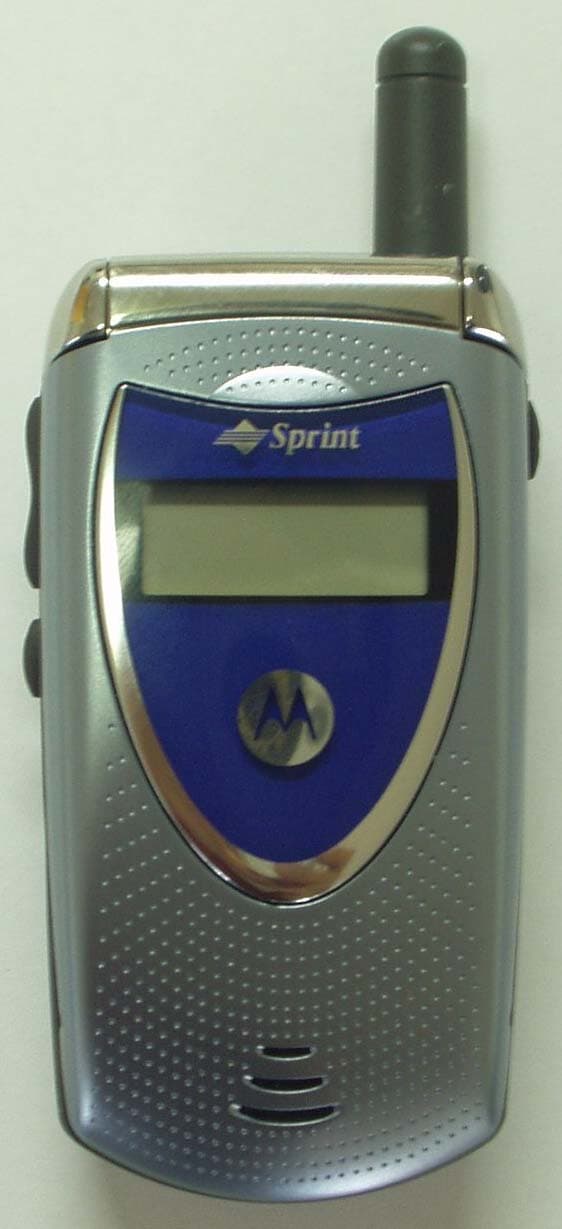
Click to zoom
Application Details
- Equipment Class
- PCE - PCS Licensed Transmitter held to ear
- Date of Grant
- Nov 09, 2003
- Application Purpose
- Original Equipment
- Date of Application
- Nov 09, 2003
- Equipment Note
- Portable Cellular/ PCS Transceiver (AMPS/CDMA)
- Frequency Range
- 1851.25000000 - 1908.75000000
- Company
- Motorola Mobility LLC
- Country
- United States
Documents & Files
Document Text
Text extracted from the exhibit documents filed with the FCC. Open a document above to read the original.
Users Manual
APPLICANT: MOTOROLA, INC. FCC ID: IHDT56DP1 EXHIBIT 8 INSTRUCTION MANUAL A preliminary draft copy of the Users Manual follows: User’s GuideVision-enabled PCS PhoneModel [xx] Manufacturer’s Logo SPRINT-motorola8/27 2003.8.27 2:16 PM Page b Table of Contents Welcome to Sprint . . . . . . . . . . . . . . . . . . . . . . . . . . . . . . . . . . . . . . . . . . . .iIntroduction . . . . . . . . . . . . . . . . . . . . . . . . . . . . . . . . . . . . . . . . . . . . . . . . .iiiSection 1: Getting Started . . . . . . . . . . . . . . . . . . . . . . . . . . . . . . . . . . . .1 1A. Setting Up Service . . . . . . . . . . . . . . . . . . . . . . . . . . . . . . . . . . . . . . . . . . . . . . . . . . . . . 3 Getting Started With PCS Service . . . . . . . . . . . . . . . . . . . . . . . . . . . . . . . . . . . . . .4Setting Up Your Voicemail . . . . . . . . . . . . . . . . . . . . . . . . . . . . . . . . . . . . . . . . . . . .5Getting Help . . . . . . . . . . . . . . . . . . . . . . . . . . . . . . . . . . . . . . . . . . . . . . . . . . . . . . . .5 Section 2: Understanding Your PCS Phone . . . . . . . . . . . . . . . . . . .7 2A. Your PCS Phone: The Basics . . . . . . . . . . . . . . . . . . . . . . . . . . . . . . . . . . . . . . . . . .9 Front View of Phone . . . . . . . . . . . . . . . . . . . . . . . . . . . . . . . . . . . . . . . . . . . . . . . .10 Functions . . . . . . . . . . . . . . . . . . . . . . . . . . . . . . . . . . . . . . . . . . . . . . . . . . . . . . . . .11 Viewing the Display Screen . . . . . . . . . . . . . . . . . . . . . . . . . . . . . . . . . . . . . . . . .12Features of Your PCS Phone . . . . . . . . . . . . . . . . . . . . . . . . . . . . . . . . . . . . . . . . .13Turning Your Phone ON and OFF . . . . . . . . . . . . . . . . . . . . . . . . . . . . . . . . . . . .14Using Your Phone’s Battery . . . . . . . . . . . . . . . . . . . . . . . . . . . . . . . . . . . . . . . . . .14Replacing the Convertible Covers . . . . . . . . . . . . . . . . . . . . . . . . . . . . . . . . . . .17Displaying Your Phone Number . . . . . . . . . . . . . . . . . . . . . . . . . . . . . . . . . . . . .18Making and Answering Calls . . . . . . . . . . . . . . . . . . . . . . . . . . . . . . . . . . . . . . . . .18 Making Calls . . . . . . . . . . . . . . . . . . . . . . . . . . . . . . . . . . . . . . . . . . . . . . . . . . . . . .18Answering Calls . . . . . . . . . . . . . . . . . . . . . . . . . . . . . . . . . . . . . . . . . . . . . . . . . . .19External Display (Sub LCD) . . . . . . . . . . . . . . . . . . . . . . . . . . . . . . . . . . . . . . . .20Smart Key . . . . . . . . . . . . . . . . . . . . . . . . . . . . . . . . . . . . . . . . . . . . . . . . . . . . . . . .21Changing the Zoom Setting . . . . . . . . . . . . . . . . . . . . . . . . . . . . . . . . . . . . . . . .21Volume Keys . . . . . . . . . . . . . . . . . . . . . . . . . . . . . . . . . . . . . . . . . . . . . . . . . . . . . .21Redialing a Number . . . . . . . . . . . . . . . . . . . . . . . . . . . . . . . . . . . . . . . . . . . . . . .21Using Automatic Redial . . . . . . . . . . . . . . . . . . . . . . . . . . . . . . . . . . . . . . . . . . . .22Caller ID . . . . . . . . . . . . . . . . . . . . . . . . . . . . . . . . . . . . . . . . . . . . . . . . . . . . . . . . . .22Returning an Unanswered Call . . . . . . . . . . . . . . . . . . . . . . . . . . . . . . . . . . . . .22Dialing an Emergency Number . . . . . . . . . . . . . . . . . . . . . . . . . . . . . . . . . . . . .22Entering Numbers in the Notepad . . . . . . . . . . . . . . . . . . . . . . . . . . . . . . . . . .23Terminating an Incoming Call . . . . . . . . . . . . . . . . . . . . . . . . . . . . . . . . . . . . . .23Dialing With Speed Dial . . . . . . . . . . . . . . . . . . . . . . . . . . . . . . . . . . . . . . . . . . . .23Dialing With 1-Touch Dial . . . . . . . . . . . . . . . . . . . . . . . . . . . . . . . . . . . . . . . . . .23Dialing a Number In a Text Message . . . . . . . . . . . . . . . . . . . . . . . . . . . . . . . . .23Additional Dialing Features . . . . . . . . . . . . . . . . . . . . . . . . . . . . . . . . . . . . . . . .24 Using Features While On a Call . . . . . . . . . . . . . . . . . . . . . . . . . . . . . . . . . . . . . . .25 SPRINT-motorola8/27 2003.8.27 2:16 PM Page d Version . . . . . . . . . . . . . . . . . . . . . . . . . . . . . . . . . . . . . . . . . . . . . . . . . . . . . . . . . . .50 2C. Setting Your Phone’s Security . . . . . . . . . . . . . . . . . . . . . . . . . . . . . . . . . . . . . . . .51 Setting Your Phone’s Security . . . . . . . . . . . . . . . . . . . . . . . . . . . . . . . . . . . . . . . .52 Lock Phone . . . . . . . . . . . . . . . . . . . . . . . . . . . . . . . . . . . . . . . . . . . . . . . . . . . . . . .52Change Lock Code . . . . . . . . . . . . . . . . . . . . . . . . . . . . . . . . . . . . . . . . . . . . . . . .52Phonebook Lock . . . . . . . . . . . . . . . . . . . . . . . . . . . . . . . . . . . . . . . . . . . . . . . . . .53Erase Phonebook . . . . . . . . . . . . . . . . . . . . . . . . . . . . . . . . . . . . . . . . . . . . . . . . .53Restrict Calls . . . . . . . . . . . . . . . . . . . . . . . . . . . . . . . . . . . . . . . . . . . . . . . . . . . . . .53Limit Use . . . . . . . . . . . . . . . . . . . . . . . . . . . . . . . . . . . . . . . . . . . . . . . . . . . . . . . . .54Master Reset . . . . . . . . . . . . . . . . . . . . . . . . . . . . . . . . . . . . . . . . . . . . . . . . . . . . . .56Master Clear . . . . . . . . . . . . . . . . . . . . . . . . . . . . . . . . . . . . . . . . . . . . . . . . . . . . . .56 2D. Controlling Your Roaming Experience . . . . . . . . . . . . . . . . . . . . . . . . . . . . . . .57 Understanding Roaming . . . . . . . . . . . . . . . . . . . . . . . . . . . . . . . . . . . . . . . . . . . .58Setting Your Phone’s Roam Mode . . . . . . . . . . . . . . . . . . . . . . . . . . . . . . . . . . . .60Controlling Roaming Charges Using Call Guard . . . . . .…
Text truncated - open the document above for the full version.
Users Manual
Consumer Information on Wireless Phones (The following information comes from a consumer information Web site jointly sponsored by the U.S.Food and Drug Administration(FDA) and the Federal Communications Commission (FCC),entitled“Cell Phone Facts:Consumer Information on Wireless Phones.”Theinformation reproduced herein is dated April 3,2002.For furtherupdates,please visit the Web site: http://www .fda.gov/cellphones/ .) 1. What is radiofrequency energy (RF)?Radiofrequency (RF) energy is another name for radio waves.It is oneform of electromagnetic energy that makes up the electromagneticspectrum.Some of the other forms of energy in the electromagneticspectrum are gamma rays,x-rays and light.Electromagnetic energy(or electromagnetic radiation) consists of waves of electric andmagnetic energy moving together (radiating) through space.The areawhere these waves are found is called an electromagnetic field.Radio waves are created due to the movement of electrical charges inantennas.As they are created,these waves radiate away from theantenna.All electromagnetic waves travel at the speed of light.Themajor differences between the different types of waves are thedistances covered by one cycle of the wave and the number of wavesthat pass a certain point during a set time period.The wavelength isthe distance covered by one cycle of a wave.The frequency is thenumber of waves passing a given point in one second.For anyelectromagnetic wave,the wavelength multiplied by the frequencyequals the speed of light.The frequency of an RF signal is usuallyexpressed in units called hertz (Hz).One Hz equals one wave persecond.One kilohertz (kHz) equals one thousand waves per second,one megahertz (MHz) equals one million waves per second,and onegigahertz (GHz) equals one billion waves per second.RF energy includes waves with frequencies ranging from about 3000waves per second (3 kHz) to 300 billion waves per second (300 GHz).Microwaves are a subset of radio waves that have frequencies rangingfrom around 300 million waves per second (300 MHz) to three billionwaves per second (3 GHz). Specific Absorption Rates (SAR) for Wireless Phones The SAR is a value that corresponds to the relative amount of RFenergy absorbed in the head of a user of a wireless handset.The SAR value of a phone is the result of an extensive testing,measuring and calculation process.It does not represent how muchRF the phone emits.All phone models are tested at their highest valuein strict laboratory settings.But when in operation,the SAR of aphone can be substantially less than the level reported to the FCC.This is because of a variety of factors including its proximity to a basestation antenna,phone design and other factors.What is important toremember is that each phone meets strict federal guidelines.Variations in SARs do not represent a variation in safety.All phones must meet the federal standard,which incorporates asubstantial margin of safety.As stated above,variations in SAR valuesbetween different model phones do not mean variations in safety.SAR values at or below the federal standard of 1.6 W/kg areconsidered safe for use by the public.The highest reported SAR values are:Head:1.56 W/kg; Body-worn:0.48 W/kg FCC Radiofrequency Emission This phone meets the FCC Radiofrequency Emission Guidelines.FCCID number : FCC ID: IHDT56DP1. More information on the phone's SAR can be found from the following FCC Web site:http://www .fcc.gov/oet/fccid . Section 4: Safety Guidelines and Warranty Information4A: Safety 135 Section 4: Safety Guidelines and Warranty Information4A: Safety 134 SPRINT-motorola8/27 2003.8.27 2:17 PM Page 134
Users Manual
Date: February 5, 2004 Subject: Request for additional information regarding FCC ID: IHDT56DP1 (Cellular/PCS transceiver) Reference: Correspondence Reference Number: 10581 Confirmation Number: TC686107 Date of Original Email: 1/09/2004 Prepared by: Andrew Bachler, Principal Staff Engineer Motorola Personal Communications Sector Libertyville, Illinois Questions and responses follow: Regarding your answer to question 2 the 1.5 cm gap body worn SAR data mentioned could not be found. Please locate. Update user manual statement and grant comment accordingly. Response: The body worn SAR data (1.5 cm gap) follows: Body Worn Back of Phone with 15mm Separation from Phantom f (MHz) Description Conducted Output Power (dBm) Measured (W/kg) Drift (dB) Extrapolated (W/kg) Simulate Temp (°C) Channel 991 26.90 Channel 384 26.91 0.44 -0.07 0.45 19.4 Analog 800MHz Channel 799 26.90 Channel 1013 24.97 Channel 384 25.02 0.393 -0.11 0.40 18.9 Digital 800MHz Channel 777 24.95 Channel 25 24.14 Channel 600 24.22 0.43 -0.07 0.44 19.3 Digital 1900MHz Channel 1175 24.19 SAR measurement results for the portable cellular telephone FCC ID IHDT56DP1 at highest possible output power. Measured against the body with 15mm separation. Sprint has agreed to use the FCC approved standard Motorola body worn statement with a specified distance of 1.5 cm. Please refer to the following user manual excerpt. As of this date, the product has not shipped, and the final version of the users manual is not available. 1 Safety and General Information IMPORTANT INFORMATION ON SAFE AND EFFICIENT OPERATION. READ THIS INFORMATION BEFORE USING YOUR PHONE. The information provided in this document supersedes the general safety information in user’s guides published prior to December 1, 2002. Exposure To Radio Frequency (RF) Energy Your phone contains a transmitter and a receiver. When it is ON, it receives and transmits RF energy. When you communicate with your phone, the system handling your call controls the power level at which your phone transmits. Your Motorola phone is designed to comply with local regulatory requirements in your country concerning exposure of human beings to RF energy. Operational Precautions To assure optimal phone performance and make sure human exposure to RF energy is within the guidelines set forth in the relevant standards, always adhere to the following procedures. External Antenna Care Use only the supplied or Motorola-approved replacement antenna. Unauthorized antennas, modifications, or attachments could damage the phone. Do NOT hold the external antenna when the phone is IN USE. Holding the external antenna affects call quality and may cause the phone to operate at a higher power level than needed. In addition, use of unauthorized antennas may result in non-compliance with the local regulatory requirements in your country. 2 Phone Operation When placing or receiving a phone call, hold your phone as you would a wireline telephone. Body-Worn Operation To maintain compliance with RF energy exposure guidelines, if you wear a phone on your body when transmitting, always place the phone in a Motorola-supplied or approved clip, holder, holster, case, or body harness for this phone, if available. Use of accessories not approved by Motorola may exceed RF energy exposure guidelines. If you do not use one of the body-worn accessories approved or supplied by Motorola, and are not using the phone held in the normal use position, ensure the phone and its antenna are at least 7/16 inch (1.5 centimeters) from your body when transmitting. Data Operation When using any data feature of the phone, with or without an accessory cable, position the phone and its antenna at least 7/16 inch (1.5 centimeters) from your body. Approved Accessories Use of accessories not approved by Motorola, including but not limited to batteries and antennas, may cause your phone to exceed RF energy exposure guidelines. For a list of approved Motorola accessories, visit our website at www.Motorola.com. RF Energy Interference/Compatibility Note: Nearly every electronic device is susceptible to RF energy interference from external sources if inadequately shielded, designed, or otherwise configured for RF energy compatibility. In some circumstances your phone may cause interference. Facilities Turn off your phone in any facility where posted notices instruct you to do so. These facilities may include hospitals or health care facilities that may be using equipment that is sensitive to external RF energy. 3 Aircraft When instructed to do so, turn off your phone when on board an aircraft. Any use of a phone must be in accordance with applicable regulations per airline crew instructions. Medical Devices Pacemakers Pacemaker manufacturers recommend that a minimum separation of 6 inches (15 centimeters) be maintained between a handheld wireless phone and a pacemaker. Persons with pacemakers should: •ALWAYS keep the phone more than 6 inches (15 centimeters) from your pacemaker when the phone is turned ON. •NOT carry the phone in the breast pocket. •Use the ear opposite the pacemaker to minimize the potential for interference. •Turn OFF the phone immediately if you have any reason to suspect that interference is taking place. Hearing Aids Some digital wireless phones may interfere with some hearing aids. In the event of such interference, you may want to consult your hearing aid manufacturer to discuss alternatives. Other Medical Devices If you use any other personal medical device, consult the manufacturer of your device to determine if it is adequately shielded from RF energy. Your physician may be able to assist you in obtaining this information. Use While Driving Check the laws and regulations on the use of phones in the area where you drive. Always obey them. 4 When using your phone while driving, please: •Give full attention to driving and to the road. •Use handsfree operation, if available. •Pull off the road and park before making or answering a call if d…
Text truncated - open the document above for the full version.
Attestation Statements
APPLICANT MOTOROLA INC. FCC ID: IHDT56DP1 ATTESTATION STATEMENTS Transceiver type IHDT56DP1 has been tested in accordance with the requirements contained in the appropriate Commission regulations. To the best of my knowledge, these tests were performed using measurement procedures consistent with industry or Commission standards and demonstrate that this equipment complies with the appropriate standards. Each unit manufactured imported or marketed, will conform to the sample tested within the variations that can be expected due to quantity production and testing on a statistical basis. I further certify that the necessary measurements were made at Motorola, located at 600 North U.S. Highway 45, Libertyville, IL NAME: James Miller TITLE: ENGINEERING MANAGER PERSONAL COMMUNICATIONS SECTOR I hereby certify that the above application was prepared under my direction and that to the best of my knowledge and belief, the facts set forth in this application and accompanying technical data are true and correct. The technical data supplied with this application was taken under my supervision and is hereby duly certified. I also certify that this transmit equipment (FCC ID: IHDT56DP1) is in compliance with all applicable parts of the FCC Rules. NAME: Thomas Lee TITLE: Senior Electrical Engineer Date: 10/06/2003 EXHIBIT 2 1 APPLICANT MOTOROLA INC. FCC ID: IHDT56DP1 911 Call Processing Method Compliance Statement Method Used Pursuant to 47 CFR Sec. 22.921, this Motorola CDMA phone at the time of commercial distribution will use a call completion method for 911 calls that is approved or endorsed by the FCC. At this time Motorola intends that this phone will incorporate either the Automatic A/B Intelligent Retry method or the Automatic A/B-Intelligent Retry, Version 2 method for providing 911 emergency calling support. EXHIBIT 2 2 APPLICANT MOTOROLA INC. FCC ID: IHDT56DP1 INFORMATION REGARDING ELECTRONIC SERIAL NUMBER PROTECTION This cellular transceiver uses a microprocessor to control its call processing operation. This microprocessor accesses a programmable memory area, which is used to store an encrypted data block that contains the Electronic Serial Number (ESN). A proprietary scheme is used to create this data block whereby it is encrypted using methods similar to known public key cryptography methods. It is emphasized that the method used is similar to but different from these known methods and the actual method used is kept proprietary to provide the essential security for the ESN. Also, the transceiver will not operate unless the microprocessor is able to decrypt this data block correctly. Access is controlled to both the method of encryption and to the production/repair equipment that has the ability to program the encrypted data block. EXHIBIT 2 3
Attestation Statements
Date: November 7, 2003 Subject: Request for additional information regarding FCC ID: IHDT56DP1 (Cellular/PCS transceiver) Reference: Application Received: 9/22/2003 Correspondence Reference Number: 231105A.IHD Confirmation Number: TC3239 Date of Original Email: 11/05/2003 Prepared by: Andrew Bachler, Principal Staff Engineer Motorola Personal Communications Sector Libertyville, Illinois Questions and responses follow: 1. Both the AMPS and PCS conducted output power levels are listed as being higher in the EMC report than the measured values in the SAR report, by 0.89 dB and 0.98 dB, respectively. Please address. Response: The values in the SAR report are correct, but the values in the EMC report are in error. Please refer to the revised EMC report submitted on November 7, 2003. 2. The 900 MHz validation plots taken on 9/4/03 do not list the actual SAR values. Please resubmit with the values included. 3. The z-axis plot for the 1800 MHz validation test does not list the actual SAR value. Please resubmit with the value included. 4. Please submit the SAR plots, worst case, for the following configurations: AMPS right head touch AMPS right head tilt CDMA left head tilt AMPS body belt clip rotated 90 degrees AMPS body leather pouch 5. Please correct the typo on p.8 of the SAR report: conversion factors for 835 MHz and 1900 MHz are reversed. 6. Please submit photos of the body-worn accessories showing the separation distance that they provide from the body. Response: For questions 2-6, refer to the supplemental SAR report submitted on November 7, 2003. 1 2 7. Page 9 of the EMC report states that Burst AVG mode was used to measure CDMA power output. Should this be MAP mode? 8. Please submit the modulation characteristics plots for AMPS, per Section 2.1047. 9. What settings (RBW, VBW, detector function) were used to measure spurious conducted emissions? 10. Please submit the occupied bandwidth plots for CDMA and PCS. The plots submitted do not indicate the actual occupied bandwidth values. 11. Please submit the upper bandedge plot (1910 MHz) for PCS. The plot submitted is for 1895 MHz. 12. FYI: in the future, please use RBW = 100 kHz for spurious radiated and conducted emissions for Part 22 operation. Response: For questions 7-12, please refer to the revised EMC report submitted on November 7, 2003. 13. Please correct p.134 of the user's manual to include the actual measured SAR values in the info to user. Response: Please refer to the supplemental users manual (Exhibit 8A) submitted on November 7, 2003.
Attestation Statements
Date: November 10, 2003 Subject: Request for additional information regarding FCC ID: IHDT56DP1 (Cellular/PCS transceiver) Reference: Application Received: 9/22/2003 Correspondence Reference Number: 231110A.IHD Confirmation Number: TC3239 Date of Original Email: 11/05/2003 Prepared by: Andrew Bachler, Principal Staff Engineer Motorola Personal Communications Sector Libertyville, Illinois Question and response follow: 1. The highest listed conducted output power in the revised EMC report for PCS operation is 0.61 dB greater than the highest measured conducted output power for PCS operation listed in the SAR report. FCC policy requires that the highest such level always be that measured in the SAR report, although a 0.5 dB tolerance on this measurement has been allowed. The amount in this case, 0.61 dB, exceeds that tolerance. Please address. Response: Exhibit 6A reports an erroneous value. Please refer to the following corrected list: CDMA 1900 Frequency (MHz) Power (dBm) 1851.25 24.07 1880.00 24.38 1908.75 24.32 1
Attestation Statements
Date: January 5, 2004 Subject: Request for additional information regarding FCC ID: IHDT56DP1 (Cellular/PCS transceiver) Reference: Correspondence Reference Number: 10442 Confirmation Number: TC686107 Date of Original Email: 12/09/2003 Prepared by: Andrew Bachler, Principal Staff Engineer Motorola Personal Communications Sector Libertyville, Illinois Questions and responses follow: 1) Please clarify maximum conducted power. One EMC report contains values higher than the second EMC and the SAR report. Please clarify. Please remove any unnecessary reports. Response: In the email dated 11/05/03 from the TCB to Motorola, it was pointed out that there were discrepancies in the reported conducted output power levels. Motorola's response, dated 11/07/03, indicated that the conducted power levels listed in the original EMC report were incorrect, while those listed in the SAR report are correct. The replacement report submitted at that time contains the corrected values. Please disregard the values in the original EMC report. 2) The body worn accessory statement in the user manual does not specifically define the authorized accessory. Also, Sprint is not the entity approving the accessory. Please update accordingly. Response: This PCS product is marketed only through Sprint. Motorola concurs that the specific wording in the Sprint user manuals is not identical to the standard Motorola wording, agreed upon during the February 2003 meeting with the FCC at the OET labs. In particular, Sprint user manuals instruct the end-user to either use a Sprint approved body worn accessory or maintain a separation distance of 1.5 cm. The standard wording in Motorola manuals indicate to either use an approved Motorola accessory or maintain a separation distance of 2.5 cm. In either case, Motorola tests the body worn accessory and generates an SAR report which is submitted to the FCC. The product (including the body worn device) is marketed only after the FCC has reviewed the entire submission and issued a grant of equipment authorization. In the specific case of this Sprint product, the equipment was additionally tested at a separation distance of 1.5 cm.
Cover Letter(s)
APPLICANT: MOTOROLA FCC ID: IHDT56DP1 September 17, 2003 CONFIDENTIALITY REQUEST CONTAINED WITHIN Federal Communications Commission Authorization and Evaluation Division 7435 Oakland Mills Road Columbia, Maryland 21046 Re: Application for Cellular/PCS Transceiver Certification Gentlemen: Application: Motorola, Inc., Personal Communications Sector, 600 N. U.S. Highway 45, Libertyville, Illinois 60048-1286 herein submits: Application for Equipment Authorization for Certification of a Cellular Transceiver, FCC ID: IHDT56DP1. Confidentiality: Pursuant to Section 0.459 of the Commission's rules (CFR 47), Motorola requests confidentiality for portions of the material contained in this application and that the identified material be withheld from public inspection following the grant of this authorization. This material contains Motorola's trade secrets and confidential information that Motorola does not customarily release to the public and which is otherwise not generally available to the public. Confidentiality is requested for the following exhibits: • Exhibit 4 Block Diagrams • Exhibit 5 Schematics • Exhibit 12 Operational Description Description: This equipment has the capability to operate in the conventional Analog Cellular standard in the 800 MHz cellular band, and the Digital CDMA standard in both the 800 MHz and the 1900 MHz PCS bands. Contact Information: Please contact me by telephone at (847) 523-6167, or by e-mail ( [email protected]), if there are questions or additional information needed concerning this filing. Regards, Andrew J. Bachler FCC Liaison Cellular Subscriber Sector 600 N. U.S. Highway 45 Libertyville, IL 60048-5343 Exhibit 13
External Photos
APPLICANT : MOT O ROLA FCC ID: IHDT56DP1 Front V i ew Rear V i ew Rear V i e w (Battery removed to s h ow ID Label) Exhibit 3
ID Label/Location Info
APPLICANT: MOTOROLA INC. FCC ID: IHDT56DP1 EXHIBIT 1 FCC IDENTIFICATION (NAMEPLATE) INFORMATION The FCC label shown is representative of the label that will appear on the radio when in production. It will be placed on the outside of the equipment as shown in Exhibit 3. Other information may also be included on this label. FCC ID: IHDT56DP1
Internal Photos
APPLICANT: MOTOROLA FCC ID: IHDT56DP1 Front View Rear View Exhibit 9 1 APPLICANT: MOTOROLA FCC ID: IHDT56DP1 Front View Rear View without Shields Exhibit 9 2 APPLICANT: MOTOROLA FCC ID: IHDT56DP1 Front Housing Internal View Rear Housing Internal View Exhibit 9 3
Parts List/Tune Up Info
Applicant: Motorola, Inc. FCC ID: IHDT56DP1 Transceiver Adjustments/Tune-Up Procedure There are no user accessible adjustments or tuning in this portable cellular transceiver. All necessary adjustments and tuning are performed during manufacture of the product. Any adjustments or tuning after service or repair are done as part of that process as special equipment is required to perform such adjustments. Parts List Part lists information follows: Exhibit 10 Applicant: Motorola, Inc. FCC ID: IHDT56DP1 Reference SymbolPart NumberDescription U302RFR6000RF RECEIVER U403RFT6100TX-BASEBAND RF CONVERTER U301RFL6000RF LNA U101PM6000POWER MANAGEMENT UNIT FIL305UX1880L406USPCS DUPLEXER FIL302SF25-0881M5UB01CDMA RX RF SAW FIL301SF25-1960M5UB01PCS RX RF SAW FIL304B9000GPS RX RF SAW FIL401B7759PCS TX FULLBAND SAW FIL402B7748CDMA TX RF SAW U402 CX77105 CDMA PAM U401CX77107PCS PAM U304MQK300B1G75R6VCO U303KT21P-DCV28A-19.200M-TVC-TCXO U202ISP1102USB TRANSCEIVER Y101SM14JSLEEP XTAL(32.768KHz) U106NCP345SNT1OVER VOLTAGE PROTECTION F101FCC20162ADTPFUSE D124AVLC5S02050P / 50pFVARISTOR U205CSPEMI201AESD FILTER U206CSPEMI204ESD FILTER S101,S102,S103,S104,S105CSPESD304ESD FILTER U406,U407UMC5NTRANSISTOR(NPN,PNP) Q102KTA1001TRANSISTOR Q101,Q104Si2305DSPOWER FET U103PSR05TVS DIODE(ESD) D104KDR730ESCHOTTKY DIODE D118KDS160SWITCHING DIODE D1011N5819HWSCHOTTKY DIODE U110MS-156(02)RF SWITCH CONN A301Pb-S-1/2H(0.15t),Ni3+Au0.2CONTACT-PLATE ANT J102 54722-0307 FPCB CONN(30PIN) J1043987522K03BATT CONN E301,E302,E303,E304,E310,E40 1,E402,E403,E404 HB-1M1005-601JT / 600BEAD(600 OHM) R120 RLC32 R150 FTP / 0.15Ω LOW RESISTOR TH101,TH401ECTH 100505 103F 3435FTTHERMISTOR CT401 278M1002106MR / 10uF(10V)TANTAL CAPACITOR CT101TLM1C226TSSR / 22uF(16V)TANTAL CAPACITOR CT204TPM0J106PSSR / 10uF(6.3V)TANTAL CAPACITOR CT405TPM1A475PSSR / 4.7uF(10V)TANTAL CAPACITOR C357GJ221BF50J106ZD01L / 10uFCAPACITOR C457GRP1555C1HR50CZ01E / 0.5pFCAPACITOR C433,C313GRP1555C1H1R5CZ01E / 1.5pCAPACITOR C320,C334,C335,C423,C424GRP1555C1H6R0DZ01E / 6pFCAPACITOR C321,C322,C416GRP1555C1H100JZ01E /10pFCAPACITOR C323,C425GRP1555C1H120JZ01E / 12pFCAPACITOR C269,C270GRP1555C1H270JZ01E / 27pFCAPACITOR C106,C107GRP1555C1H300JZ01E / 30pFCAPACITOR C309GRP1555C1H330JZ01E / 33pFCAPACITOR Exhibit 10 Applicant: Motorola, Inc. FCC ID: IHDT56DP1 C306,C341,C342,C343,C344,C34 6,C348,C350,C351,C352,C359,C 360,C438,C439,C440,C441,C443 ,C444,C447,C448,C449,C451 GRP1555C1H470JZ01E / 47pFCAPACITOR C324GRP1555C1H820JZ01E / 82pFCAPACITOR C130,C310,C311,C315,C316,C31 7,C319,C338,C412 GRP1555C1H101JD01E / 100pFCAPACITOR C435,C436GRP1556C1E201JD01E / 200pFCAPACITOR C340,C356GRP155R71H102KA01E / 1000pFCAPACITOR C430GRP155R71H222KA01E / 2.2nFCAPACITOR C113,C426GRP155R71E472KA01E / 4700pFCAPACITOR C442GRP155R71E562KA01E / 5600pFCAPACITOR C140,C227,C232,C354,C355,C40 7,C411,C417,C418,C427,C432 GRP155R71C103KA01E / 0.01uFCAPACITOR C103,C114,C117,C120,C124,C12 5,C127,C128,C228,C305,C314,C 318,C333,C336,C339,C345,C347 ,C349,C353,C361,C408,C420,C4 34,C437,C445,C446,C450 GRP155F51C104ZA01E / 0.1uFCAPACITOR C358GRP155F51A474ZD02E / 0.47uFCAPACITOR C170,C171GRP155F50J105ZD02E / 1uFCAPACITOR C431GRM188R71C683KA01D / 0.068uFCAPACITOR C428GRM188R71C823KC01D / 0.082uFCAPACITOR C122GRM188R61C105KA12D / 1uFCAPACITOR C119,C121 GRM219F51C105ZA01L / 1uFCAPACITOR C111,C112,C406,C410,C415,C41 9 GRM21BF51C225ZA01L / 2.2uFCAPACITOR C115,C116,C118GRM21BF51A475ZA01L / 4.7uFCAPACITOR …
Text truncated - open the document above for the full version.
Contact Information
Applicant
Jeff Narducci(Director Product Compliance)
Test Firm
Motorola Inc.Albert Patapack
Technical Specifications
| # | Rule Parts | Frequency Range | Power Output | Emission | Tolerance |
|---|---|---|---|---|---|
| 4 | 24E | 1.85 GHz - 1.91 GHz | 292.00 mW | 1M25F9W | 150 Hz |
Other Applications from Motorola Mobility LLC
IHDT56AW9
May 12, 2026Smart Watch
Equipment Class
NII - Unlicensed National Information Infrastructure TXIHDT56AW5
Apr 08, 2026Mobile Cellular Phone
Equipment Class
DTS - Digital Transmission SystemIHDT56AW6
Mar 18, 2026Smart Watch
Equipment Class
JBP - Part 15 Class B Computing Device PeripheralIHDT56AX4
Mar 17, 2026Mobile Cellular Phone
Equipment Class
PCE - PCS Licensed Transmitter held to earIHDT56AW3
Mar 03, 2026Mobile Cellular Phone
Equipment Class
6XD - 15E 6 GHz Low Power Indoor Client