IHDT56FQ1Portable Dual-Band CDMA Transceiver with Bluetooth
Motorola Mobility LLC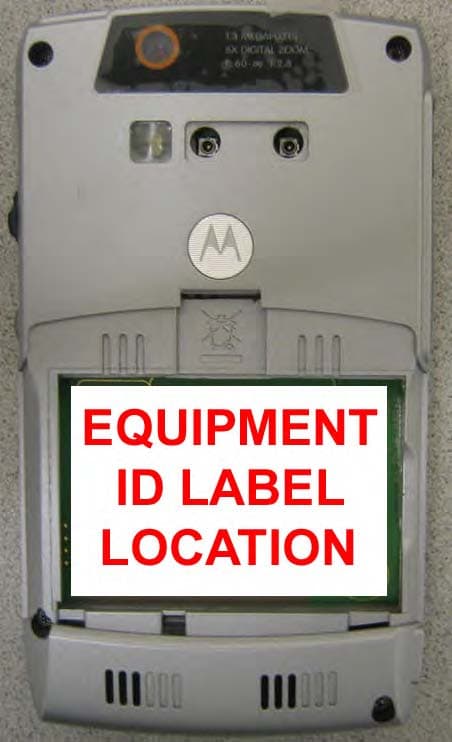
Click to zoom
Application Details
- Equipment Class
- PCE - PCS Licensed Transmitter held to ear
- Date of Grant
- Apr 18, 2006
- Application Purpose
- Original Equipment
- Date of Application
- Apr 18, 2006
- Equipment Note
- Portable Dual-Band CDMA Transceiver with Bluetooth
- Frequency Range
- 1851.25000000 - 1908.75000000
- Company
- Motorola Mobility LLC
- Country
- United States
Documents & Files
Document Text
Text extracted from the exhibit documents filed with the FCC. Open a document above to read the original.
Users Manual
APPLICANT: MOTOROLA, INC. FCC ID: IHDT56FQ1 EXHIBIT 8 INSTRUCTION MANUAL A preliminary draft copy of the Users Manual follows: 105 × 148mm PMS 032 BLACK CDMA 1 HELLOMOTOIntroducing your new Motorola Q CDMA wireless phone! You can check and write e-mail , use the QWERTY Keyboard for texting capabilities, and use it with Bluetooth Enabled headsets. Here’s a quick anatomy lesson. Left Soft Key Navigate menus. Center KeySelects menuitems. Make & answer calls. Camera Key Thumb Wheel Home Key Turn on & off,hang up, exit menus. Right Soft Key Undo/Back Key Microphone ALT Key Enter Key Space Key Caps Key Back Key Power/End Key Call/Answer Key Navigation Key Message/DisplayOff Ke y Speakerphone/VoiceRecognition Key 2If you need help while using your phone press Start > Help and QuickStart ( 1 ) to open the in-device help. Also see Additional Information on page 77. CameraFlash Camera Lens Headset Jack Battery Door Release Charge and connect phone accessories Infrared Port Memory Card Port Speakers Mini USB Port 3 Motorola, Inc.Consumer Advocacy Office1307 East Algonquin RoadSchaumburg, IL 60196www.hellomoto.comCertain mobile phone features are dependent on the capabilities and settings of your service provider’s network. Additionally, certain features may not be activated by your service provider, and/or the provider’s network settings may limit the feature’s functionality. Always contact your service provider about feature availability and functionality. All features, functionality, and other product specifications, as well as the information contained in this user’s guide are based upon the latest available information and are believed to be accurate at the time of printing. Motorola reserves the right to change or modify any information or specifications without notice or obligation.MOTOROLA and the Stylized M Logo are registered in the US Patent & Trademark Office. The Bluetooth trademarks are owned by their proprietor and used by Motorola, Inc. under licen se. Microsoft, Windows, ActiveSync, Windows Me dia, Outlook, Pocket Outlook, Excel, and Word and MSN are registered trademarks of Microsoft Corporation; and Windows XP, Windows Mobile and Microsoft.net are trademarks of Microsoft Corporation. All other product or service names are the property of their respective owners.© Motorola, Inc., 2006. Caution: Changes or modifications made in the radio phone, not expressly approved by Motorola, will void the user’s authority to operate the equipment. Software Copyright Notice The Motorola products described in this manual may include copyrighted Motorola and third-party software stored in semiconductor memories or other media. Laws in the United States and other countries preserve for Motorola and third-party software providers certain exclusive rights for copyrighted software, such as the exclusiv e rights to distribute or 4reproduce the copyrighted software. Accordingly, any copyrighted software contained in the Motorola products may not be modified, reverse-engineered, distributed, or reproduced in any manner to the extent allowed by law. Furthermore, the purchase of the Motorola products shall not be deemed to grant either directly or by im plication, estoppel, or otherwise, any license under the copyrights, patents, or patent applications of Motorola or any third-party software provider, except for the normal, non-exclusive, royalty-free license to use that arises by operation of law in the sale of a product.Manual Number: 6809500A11-O contents 5 contentsstart menu . . . . . . . . . . . 7use and care . . . . . . . . . . 8essentials . . . . . . . . . . . . 9 about this guide . . . . . . 9battery . . . . . . . . . . . . 10turn it on & off . . . . . . 13make a call . . . . . . . . . 13answer a call. . . . . . . . 13open a program . . . . . 13your phone number . . 14change between uppercase, lowercase, and caps lock. . . . . . . . . . . 14entering text and numbers . . . . . . . . . . . 14undo/back key. . . . . . . 15thumb wheel . . . . . . . 15 infrared port . . . . . . . . 15memory card . . . . . . . 15lock & unlock phone . . 16lock & unlock keypad . 17 main attractions . . . . . . 18 synchronize. . . . . . . . . 18e-mail & messages. . . 21take & send a photo . . 31record & play video clip 33download and copy media files . . . . . . . . . 36Bluetooth® wireless. . 37 basics. . . . . . . . . . . . . . . 40 display . . . . . . . . . . . . 40thumb wheel . . . . . . . 42menus . . . . . . . . . . . . 43text entry . . . . . . . . . . 45 iTAP® mode . . . . . . . . 46numeric mode . . . . . . 47symbol mode . . . . . . . 47volume . . . . . . . . . . . . 47handsfree speaker . . . 48voice commands . . . . 48flight mode . . . . . . . . . 50media player . . . . . . . . 50audio enhancement . . 51web browser . . . . . . . 51file manager . . . . . . . . 52task manager . . . . . . . 52 customize . . . . . . . . . . . 54 profiles . . . . . . . . . . . . 54time & date. . . . . . . . . 55home screen . . . . . . . 55backlight . . . . . . . . . . . 57 6 contents brightness . . . . . . . . . . 57answer options . . . . . . 57 calls. . . . . . . . . . . . . . . . . 59 turn off a call alert . . . . 59recent calls . . . . . . . . . 59redial . . . . . . . . . . . . . . 60view missed call . . . . . 60caller ID . . . . . . . . . . . . 61emergency calls . . . . . 61international calls. . . . . 62speed dial . . . . . . . . . . 62voicemail . . . . . . . . . . . 62 other features . . . . . . . . 64 advanced calling . . . . . 64contacts. . . . . . . . . . . . 65personalizing . . . . . . . . 68call times & costs . . . . 70handsfree . . . . . . . . . . 71network connections. . 72calendar . . . . . . . . . . . . 72security . . . . . . . . . . . . 74 phone information . . . . 74fun & games . . . . . . . . 75 additional information . 77service & repair . . . . . . . 78SAR Data . . . . . . . . . . . . 79Microsoft License . . . . . 81Safety Information . . . . 91Warranty. . . . . . . . . . . . . 97Hearing Aid Compatibility . . . . . . . .…
Text truncated - open the document above for the full version.
Attestation Statements
APPLICANT: MOTOROLA, INC. FCC ID: IHDT56FQ1 SPECIFICATION COMPLIANCE STATEMENT Transceiver type FCC ID: IHDT56FQ1 has been tested in accordance with the requirements contained in the appropriate Commission regulations. To the best of my knowledge, these tests were performed using measurement procedures consistent with industry or Commission standards and demonstrate that this equipment complies with the appropriate standards. Each unit manufactured imported or marketed, will conform to the sample tested within the variations that can be expected due to quantity production and testing on a statistical basis. I further certify that the necessary measurements were made at: Motorola, 600 North US Hwy 45, Libertyville, IL 60048. NAME: Ansheng Wang TITLE: Engineering Manager Mobile Devices Date: April 11, 2006 EXHIBIT 2 APPLICANT: MOTOROLA, INC. FCC ID: IHDT56FQ1 STATEMENT OF CERTIFICATION I hereby certify that the above application was prepared under my direction and That to the best of my knowledge and belief, the facts set forth in this application And accompanying technical data are true and correct. The technical data supplied with this application was taken under my supervision And is hereby duly certified. I also certify that this transmits equipment (FCC ID: IHDT56FQ1) is in compliance with all applicable parts of the FCC Rules. NAME: Ansheng Wang TITLE: Lead Engineer Mobile Device Date: April 11, 2006 EXHIBIT 2 APPLICANT MOTOROLA INC. FCC ID: IHDT56FQ1 ATTESTATION STATEMENT This device contains an embedded Bluetooth device that Motorola confirms compliance with the following Part 15 regulations. 15.247(a)(1) • the hopping sequence must be pseudorandom • all Channels are used equally on average • the receiver input bandwidth is approximately equal to the transmit bandwidth • the receiver hops in sequence with the transmitted signal 15.247(g) the system is designed to comply with all of the regulations in Section 15.247 when the transmitter is presented with a continuous data (or information) 15.247(h) the system does not coordinate its channel selection/hopping sequence with other frequency hopping systems for the express purpose of avoiding the simultaneous occupancy of individual hopping frequencies by multiple transmitters NAME: Ansheng Wang TITLE: ENGINEERING MANAGER Mobile Device Business Motorola, Inc. Date: April 11, 2006 EXHIBIT 2A
Cover Letter(s)
APPLICANT: MOTOROLA FCC ID: IHDT56FQ1 April 11, 2006 CONFIDENTIALITY REQUEST CONTAINED WITHIN Federal Communications Commission Authorization and Evaluation Division 7435 Oakland Mills Road Columbia, Maryland 21046 Re: Application for Cellular/PCS Transceiver Certification Gentlemen: Application: Motorola, Inc., Mobile Devices, 600 N. U.S. Highway 45, Libertyville, Illinois 60048-1286 herein submits: Application for Equipment Authorization for Certification of a Cellular Transceiver, FCC ID: IHDT56FQ1. Confidentiality: Pursuant to Section 0.459 of the Commission's rules (CFR 47), Motorola requests confidentiality for portions of the material contained in this application and that the identified material be withheld from public inspection following the grant of this authorization. This material contains Motorola's trade secrets and confidential information that Motorola does not customarily release to the public and which is otherwise not generally available to the public. Confidentiality is requested for the following exhibits: • Exhibit 4 Block Diagrams • Exhibit 5 Schematics • Exhibit 10 Parts List • Exhibit 12 Operational Description Description: This equipment has the capability to operate in the Digital CDMA standard in both the 800 MHz and the 1900 MHz PCS bands. The unit also contains a 2.4 GHz Bluetooth transmitter (Part 15.247). Contact Information: Please contact me by telephone at (847) 523-6167, or by e-mail ( [email protected]), if there are questions or additional information needed concerning this filing. Regards, Andrew J. Bachler FCC Liaison Mobile Devices 600 N. U.S. Highway 45 Libertyville, IL 60048-5343 Exhibit 13
Cover Letter(s)
Courtenay Geraghty From: Gregory Czumak [[email protected]] Sent: Monday, October 24, 2005 11:50 AM To: PCTEST - Courtenay Subject: EV-DO request for guidance Page 1 of 1 11/8/2005 From: Generic Office of Engineering Technology [mailto:[email protected]] Sent: Friday, October 21, 2005 8:51 AM To: [email protected] Subject: Response to Inquiry to FCC (Tracking Number 178238) Inquiry: I am currently reviewing a phone with EV-DO capability (CDMA 1xEV-DO 800MHz), and so I am contacting the FCC to seek guidance on the review. I would like to point out that it is unlikely that any SAR would be applicable to EV-DO operation- as a data only service (unlike full-fledged cdma2000, there is no voice option here), it is used for emails, browsing the internet, etc., which would require that the phone he held in the hands for normal operation (thus, a mobile configuration, not portable). If used with a laptop pc, it is connected by cable, so, again, it is unlikely that someone would be wearing the phone on their belt during normal EV-DO operation. Please let me know what, if anything, we should be checking during our review- as always, grant time is critical to the applicant, so if you could respond at your earliest convenience, it would be much appreciated. Response: We understand that the device in question is a cellular band handset (assuming CDMA 2000 1x) with EV-DO capability (assuming Rev. 0; i.e. 153.6 kbps maximum uplink). Also assume that the maximum average output for EV-DO is less than or equal to any of the CDMA 2000 modes. SAR for head and body exposure should be tested according to applicable CDMA 2000 Radio configurations (RC 1-4 etc.) and Service Options provided previously. Body-worn SAR should be repeated in EV-DO (Rev. 0 only) using the CDMA 2000 body-worn channel configuration that resulted in the highest SAR among the various Radio Configurations in this frequency band (that is, just a single SAR test for EV-! DO, as a sanity check). If this EV-DO SAR is greater than the highest body-worn SAR in CDMA 2000, perform body-worn SAR for the other 2 channels (among the required H, M, L channels). Note: EV-DO operates independently of CDMA 2000 with different modulation, channel and protocol structures. It is not an integral part (seamless) of the CDMA 2000 structure, but overlays the 1x structure. EV-DO Rev A allows 307 kbps and higher order modulations; therefore, may need additional considerations. The above procedures applies to single band CDMA 2000 1x handsets with built-in EV-DO (Rev. 0) using the same transmit path hardware. Please contact us if the device in question operates in other configurations or EV-DO does not apply to body-worn conditions. The above should be considered interim procedures while it remains to be determined if CDMA 2000 or EV-DO should be considered the dominant body-worn operating condition (i.e. test SAR in EV-DO mode and check CDMA 2000 at highest SAR configuration etc.) Do not reply to this message. Please select the Reply to an Inquiry Response link from the OET Inquiry S ystem to add any additional information pertaining to this inquiry.
Cover Letter(s)
Courtenay Geraghty From: Gregory Czumak [[email protected]] Sent: Thursday, October 20, 2005 3:25 PM To: PCTEST - Courtenay Subject: FW: CDMA 2000 application Follow Up Flag: Follow up Flag Status: Red Attachments: CDMA-2000 SAR Config.doc Page 1 of 2 11/7/2005 From: Kwok Chan [mailto:[email protected]] Sent: Thursday, May 19, 2005 11:37 AM To: Gregory Czumak Cc: PCTEST - Al Cirwithian; PCTEST - Randy Ortanez Subject: RE: CDMA 2000 application Greg: According to information available to us, the attached describes the basic criteria for reviewing typical CDMA- 2000 client devices. This should be considered as a draft while we are continuing to review & identify other test and product specific issues. Please let us know if this is insufficient or if more coordination is necessary, and continue to inform us on subsequent CDMA-2000 filings. Kwok Chan -----Original Message----- From: Gregory Czumak [mailto:[email protected]] Sent: Thursday, May 19, 2005 9:10 AM To: Kwok Chan Cc: PCTEST - Al Cirwithian; PCTEST - Randy Ortanez; PCTest - Andrea Zaworski; PCTEST - Keats Ortiz; PCTEST - Steve Liu; PCTEST - Yukio Tanuma Subject: CDMA 2000 application Hi Kwok, I hope all is well with you and your family (your kids must be getting big... I know mine are!). Based on the info provided last week at the Workshop, I am contacting you to let you know that I am currently reviewing an application for a WLL PCS CDMA phone that has CDMA 2000 capabilities. As with most WLL phones that we see, it is designed to replace the phone on your desk (i.e., it sits on the desk, and looks like a regular corded phone- no RF in the handset, just a whip antenna sticking out of the back of the base portion). The lab performed body SAR measurements with a separation distance of 2.5 cm. Is there anything specific for which I should look, given its CDMA 2000 capabilities? Please let me know at your earliest convenience (of course, we are under pressure to finish the review ASAP). I appreciate your time and effort- thank you. Take care. Greg Sincerely, Gregory Czumak Quality Manager Senior Certification Engineer PCTEST Engineering Laboratory, Inc. 6660-B Dobbin Road Columbia, MD 21045 410-290-6652 410-290-6654 (Fax) [email protected] This communication and its attachments contain information from PCTEST Engineering Laboratory, Inc., and is intended for the exclusive use of the recipient (s) named above. It may contain information that is confidential and/or legally privileged. Any unauthorized use that may compromise that confidentiality via distribution or disclosure is prohibited. Please notify the sender immediately if you receive this communication in error, and delete it from your computer system. Usage of PCTEST email addresses for non-business related activities is strictly prohibited. No warranty is made that the e-mail or attachment(s) are free from computer virus or other defect. Thank you. Page 2 of 2 11/7/2005
External Photos
Rear View with Battery Cover Removed Showing ID Label Rear ViewFront View APPLICANT: MOTOROLA INC. FCC ID: IHDT56FQ1 EXHIBIT 3
ID Label/Location Info
APPLICANT: MOTOROLA INC. FCC ID: IHDT56FQ1 FCC IDENTIFICATION (NAMEPLATE) INFORMATION FCC ID: IHDT56FQ1 The FCC label shown is representative of the label that will appear on the radio when in production. It will be placed on the outside of the equipment as shown in Exhibit 3. Other information may also be included on this label. EXHIBIT 1
Internal Photos
FrontView RearView RearViewwithoutshields FCC ID: IHDT56FQ1 EXHIBIT 9 1 0F 3 APPLICANT: MOTOROLA, INC. Keypad Board Daughter Board without shields Front View without shields FCC ID: IHDT56FQ1 EXHIBIT 9 2 0F 3 APPLICANT: MOTOROLA, INC. Inside View of Rear Housing FCC ID: IHDT56FQ1 EXHIBIT 9 3 0F 3 Inside View of Front Housing APPLICANT: MOTOROLA, INC.
RF Exposure Info
APPLICANT: MOTOROLA, INC. FCC ID: IHDT56FQ1 E E x x h h i i b b i i t t 1 1 1 1 P P a a g g e e 1 1 Exhibit 11: SAR Test Report IHDT56FQ1 Date of test: Date of Report: 11/01/2005 through 11/07/2005 11/16/2005 Laboratory: Motorola Mobile Devices Business Product Safety & Compliance Laboratory 600 N. US Highway 45 Room: MW113 Libertyville, Illinois 60048 Test Responsible: Paul Ma RF Engineer Accreditation: This laboratory is accredited to ISO/IEC 17025-1999 to perform the following tests: Tests : Procedures: Electromagnetic Specific Absorption Rate ANSI/IEEE C95.1-1992, 1999 (SAR) IEEE C95.3-1991 IEEE 1528, IEC 62209-1 FCC OET Bulletin 65 (including Supplements A, B, C) Australian Communications Authority Radio Communications (Electromagnetic Radiation – Human Exposure) Standard 1999 CENELEC EN 50361 (2001) Simulated Tissue Preparation APP-0247 RF Power Measurement DOI-0876, 0900, 0902, 0904, 0915 On the following products or types of products: Wireless Communications Devices (Examples): Two Way Radios; Portable Phones (including Cellular, Licensed Non-Broadcast and PCS); Low Frequency Readers; and Pagers A2LA certificate #1651-01 Statement of Compliance: Motorola declares under its sole responsibility that portable cellular telephone FCC ID IHDT56FQ1 to which this declaration relates, is in conformity with the appropriate General Population/Uncontrolled RF exposure standards, recommendations and guidelines (FCC 47 CFR §2.1093). It also declares that the product was tested in accordance with the appropriate measurement standards, guidelines and recommended practices. Any deviations from these standards, guidelines and recommended practices are noted below: (none) ©Motorola, Inc. 2005 This test report shall not be reproduced except in full, without written approval of the laboratory. The results and statements contained herein relate only to the items tested. The names of individuals involved may be mentioned only in connection with the statements or results from this report. Motorola encourages all feedback, both positive and negative, on this test report. APPLICANT: MOTOROLA, INC. FCC ID: IHDT56FQ1 E E x x h h i i b b i i t t 1 1 1 1 P P a a g g e e 2 2 Table of Contents 1. INTRODUCTION ...................................................................................................................................................3 2. DESCRIPTION OF THE DEVICE UNDER TEST.............................................................................................3 2.1 Antenna description ..............................................................................................................................................3 2.2 Device description..................................................................................................................................................3 3. TEST EQUIPMENT USED....................................................................................................................................3 3.1 Dosimetric System .................................................................................................................................................3 3.2 Additional Equipment...........................................................................................................................................4 4. ELECTRICAL PARAMETERS OF THE TISSUE SIMULATING LIQUID ..................................................4 5. SYSTEM ACCURACY VERIFICATION............................................................................................................5 6. TEST RESULTS......................................................................................................................................................6 6.1 Head Adjacent Test Results..................................................................................................................................7 6.2 Body Worn Test Results .......................................................................................................................................9 APPENDIX 1: SAR DISTRIBUTION COMPARISON FOR SYSTEM ACCURACY VERIFICATION .....12 APPENDIX 2: SAR DISTRIBUTION PLOTS FOR PHANTOM HEAD ADJACENT USE ..........................13 APPENDIX 3: SAR DISTRIBUTION PLOTS FOR BODY WORN CONFIGURATION ..............................14 APPENDIX 4: PROBE CALIBRATION CERTIFICATE ..................................................................................15 APPENDIX 5: MEASUREMENT UNCERTAINTY BUDGET..........................................................................16 APPENDIX 6: DIPOLE CHARACTERIZATION CERTIFICATE ..................................................................19 APPLICANT: MOTOROLA, INC. FCC ID: IHDT56FQ1 E E x x h h i i b b i i t t 1 1 1 1 P P a a g g e e 3 3 1 Introduction The Motorola Mobile Devices Business Product Safety Laboratory has performed measurements of the maximum potential exposure to the user of portable cellular phone (FCC ID IHDT56FQ1). The Specific Absorption Rate (SAR) of this product was measured. The portable cellular phone was tested in accordance with FCC OET Bulletin 65 Supplement C 01-01. 2 Description of the Device Under Test 2.1 Antenna description Type Internal Antenna Location – CDMA 800 Band Bottom ; Rear Side Location – PCS 1900 Band Upper Left Corner ; Rear Side Length 48 mm Dimensions – CDMA 800 Band Width 17 mm Length 17 mm Dimensions – PCS 1900 Band Width 15 mm Configuration PIFA 2.2 Device description FCC ID Number IHDT56FQ1 Serial number 5281C085 Mode(s) of Operation 800 CDMA 1900 CDMA BlueTooth Modulation Mode(s) CDMA CDMA BlueTooth Maximum Output Power Setting 26.00dBm 25.00dBm 4.00dBm Duty Cycle 1:1 1:1 1:1 Transmitting Frequency Rang(s) 824-849MHz 1851-1909MHz 2400 - 2483.5MHz Production Unit or Identical Prototype (47 CFR §2..908) Identical Prototype Device Category Portable RF Exposure Limits General Population / Uncontrolled 3 Test Equipment Used 3.1 Dosimetric System The Motorola…
Text truncated - open the document above for the full version.
RF Exposure Info
APPLICANT: MOTOROLA, INC. FCC ID: IHDT56FQ1 Exhibit 11 December 13, 2005 Supplement to SAR Test Report for Motorola portable cellular phone (FCC ID IHDT56FQ1) Prepared by: Paul Ma Motorola Personal Communications Sector Product Safety Laboratory Libertyville, Illinois Steven Hauswirth Motorola Personal Communications Sector Product Safety Laboratory Libertyville, Illinois APPLICANT: MOTOROLA, INC. FCC ID: IHDT56FQ1 Summary of FCC request for additional information There was a request for additional information regarding Motorola’s SAR Test Report for Motorola portable cellular phone (FCC ID IHDT56FQ1). The requested information is addressed below in the same numbering sequence received. 3a . What is the CDMA MS Protocol Revision number. RESPONSE: Protocol revision 6 (complaint to IS-2000 Rev 0). 3b . Please address the applicability of test codes to simulate the required test conditions, as defined in 3GPP2, TIA, and other standards. RESPONSE: All phones are tested using a base station simulator, not in test mode as stated in section 6 Test Results in the SAR report. Future reports will have this section edited to properly reflect the configuration of the phone during testing. 3c. Please identify the CDMA Radio Configurations, Service Options, multiplex options voice/data, code channel combinations and options available to the EUT. RESPONSE: To test voice calls on the DUT, the test equipment was configured to use “all up bits” for RC1 / SO2 on J-STD-008 for CDMA 1900MHz and TSB-74 for CDMA 800MHz on the Agilent E8285A CDMA Mobile Station test set. 3d. Please identify the CDMA Radio Configurations, Service Options, multiplex options, voice/data, code channel combinations and options used for the SAR tests. RESPONSE: Please see answer to inquiry #3e below. 3e.Because of the different RC's, SO's, data rates, channel combinations and modulations, the filing should include justification for the selection of applicable configurations used to establish and maintain maximum output in order to demonstrate SAR compliance for other configurations that were not tested. Please provide the justification for the specific combination(s) used during the SAR tests. RESPONSE: Motorola IS2000 CDMA cellular phones does not use different data rates or concurrent channels (supplemental channels) while in the voice mode, thus testing voice modes using RC1 is applicable. Motorola IS2000 CDMA products do use supplemental channels and different data rates for data mode. The output power of the DUT is controlled by a power control loop within the DUT. This power control loop measures the total RF power supplied into the antenna match network for emission. This output power measurement will include the power from different data rates and concurrent channels. The measured power level is controlled and limited to the maximum output power setting for the phone. Motorola performs SAR tests of IS2000 CDMA phones at this maximum power level using RC1 / SO2, thus the output power under this test setup is equivalent to the maximum output power for any data rate and/or concurrent channel capability of the DUT. The Motorola IS2000 CDMA cellular phones were measured in voice calls only. Exhibit 11 APPLICANT: MOTOROLA, INC. FCC ID: IHDT56FQ1 Exhibit 11 Summary of FCC request for additional information. 4. Does the EUT employ EV-DO? If so, Body-worn SAR should be repeated in EV-DO (Rev. 0 only) using the CDMA 2000 body-worn channel configuration that resulted in the highest SAR among the various Radio Configurations in this frequency band (that is, just a single SAR test for EV-! DO, as a sanity check). If this EV-DO SAR is greater than the highest body-worn SAR in CDMA 2000, perform body-worn SAR for the other 2 channels (among the required H, M, L channels). Response: See below. EV-DO Data for Body Worn SAR Table Body Worn Back of phone 25 mm away from phantom (EDGE Class 6) f (MHz) Description Conducted Output Power (dBm) Measured (W/kg) Drift (dB) Extrapolated (W/kg) Simulate Temp (°C) Channel 1013 26.13 Channel 384 26.11 1.39 -0.03 1.4 20.9 Digital 800MHz Channel 777 25.84 Channel 25 25.10 0.75 -0.06 0.76 20.0 Channel 600 25.09 0.86 -0.19 0.9 20.6 Digital 1900MHz Channel 1175 25.12 1.06 -0.24 1.12 20.0 Changes to Dosimetric System Table from Section 3.1 of Original Report Description Serial Number Cal Due Date DASY4 DAE3 437 3/24/2006 DASY4 DAE4 661 8/26/2006 DASY4 DAE3 440 2/21/2006 E-Field Probe ET3DV6R 1397 4/22/2006 E-Field Probe ET3DV6R 1506 5/26/2006 Dipole Validation Kit, D900V2 80 S.A.M. Phantom used for 800MHz TP-1153 Dipole Validation Kit, D900V2 91 S.A.M. Phantom used for 800MHz TP-1005 Dipole Validation Kit, D1800V2 251TR S.A.M. Phantom used for 1900MHz TP-1159 Dipole Validation Kit, D1800V2 259TR APPLICANT: MOTOROLA, INC. FCC ID: IHDT56FQ1 Exhibit 11 Changes to Electrical Parameters Table from Section 4 of Original Report Dielectric Parameters f (MHz) Tissue type Limits / Measured ε r σ (S/m) Temp (°C) Measured, 11/1/2005 42.4 0.92 20.2 Head Recommended Limits 41.5 ±5% 0.90 ±5% 18-25 Measured, 11/4/2005 53.9 0.98 19.6 Measured, 12/9/2005 54.3 0.98 20.9 835 Body Recommended Limits 55.2 ±5% 0.97 ±5% 18-25 Measured, 11/3/2005 39.2 1.45 19.5 Head Recommended Limits 40.0 ±5% 1.40 ±5% 18-25 Measured, 11/7/2005 51.1 1.59 20.5 Measured, 12/12/2005 50.9 1.59 20.0 1880 Body Recommended Limits 53.3 ±5% 1.52 ±5% 18-25 Changes to System Accuracy Verification Table From Section 5 of Original Report f Dielectric Parameters (MHz) Description SAR (W/kg), 1gram ε r σ (S/m) Ambient Temp (°C) Tissue Temp (°C) Measured, 11/01/2005 11.2 41.6 0.98 22.0 20.7 Measured, 11/04/2005 11.0 40.7 0.97 22.0 20.0 Measured, 12/09/2005 11.0 41.3 0.97 23.0 21.0 900 Recommended Limits 11.3 41.5 ±5% 0.97 ±5% 18-25 18-25 Measured, 11/03/2005 37.8 39.6 1.37 23.0 19.7 Measured, 11/07/2005 38.2 39.0 1.37 21.0 19.8 Measured, 12/12/2005 36.4 40.2 1.34 22.0 20.2 1800 Recommended Limits 38.1 40.0 ±5% 1.4 ±5% 18-25 18-25 APPLICANT: MOTOROLA, INC. FCC ID: IHD…
Text truncated - open the document above for the full version.
Test Report
APPLICANT: MOTOROLA INC FCC ID: IHDT56FQ1 MOBILE DEVICES BUSINESS PRODUCT SAFETY AND COMPLIANCE EMC LABORATORY EMC TEST REPORT Test Report Number – 17234-2 Report Date – November 21, 2005 The test results contained herein relate only to the model(s) identified. It is the manufacturer’s responsibility to assure that additional production units of this model are manufactured with identical electrical and mechanical characteristics. As the responsible EMC Engineer, I hereby declare that the equipment tested as specified in this report conforms to the requirements indicated . Signature Name: _Michael E. Hill Title: Senior Staff Electrical Engineer Date: November 21, 2005 This report must not be reproduced, except in full, without written approval from this laboratory. THIS REPORT MUST NOT BE USED TO CLAIM PRODUCT ENDORSEMENT BY A2LA OR ANY AGENCY OF THE U.S. GOVERNMENT. A2LA Certificate Number: 1846-01 EXHIBIT 6 APPLICANT: MOTOROLA INC FCC ID: IHDT56FQ1 Table of Contents Description Page Test Report Details 4 Applicable Standards …
Text truncated - open the document above for the full version.
Contact Information
Applicant
Jeff Narducci(Director Product Compliance)
Technical Contact
PCTEST Engineering Laboratory, Inc.Randy Ortanez
[email protected]410-290-6652
6660-B Dobbin Road · Columbia, Maryland · United States
Test Firm
Motorola Inc.Albert Patapack
Technical Specifications
| # | Rule Parts | Frequency Range | Power Output | Emission | Tolerance |
|---|---|---|---|---|---|
| 2 | 24E | 1.85 GHz - 1.91 GHz | 369.00 mW | 1M26F9W | 150 Hz |
Other Applications from Motorola Mobility LLC
IHDT56AW9
May 12, 2026Smart Watch
Equipment Class
NII - Unlicensed National Information Infrastructure TXIHDT56AW5
Apr 08, 2026Mobile Cellular Phone
Equipment Class
DTS - Digital Transmission SystemIHDT56AW6
Mar 18, 2026Smart Watch
Equipment Class
JBP - Part 15 Class B Computing Device PeripheralIHDT56AX4
Mar 17, 2026Mobile Cellular Phone
Equipment Class
PCE - PCS Licensed Transmitter held to earIHDT56AW3
Mar 03, 2026Mobile Cellular Phone
Equipment Class
6XD - 15E 6 GHz Low Power Indoor Client