IHDT56HD1Portable Cellular/ PCS CDMA Transceiver with BT
Motorola Mobility LLC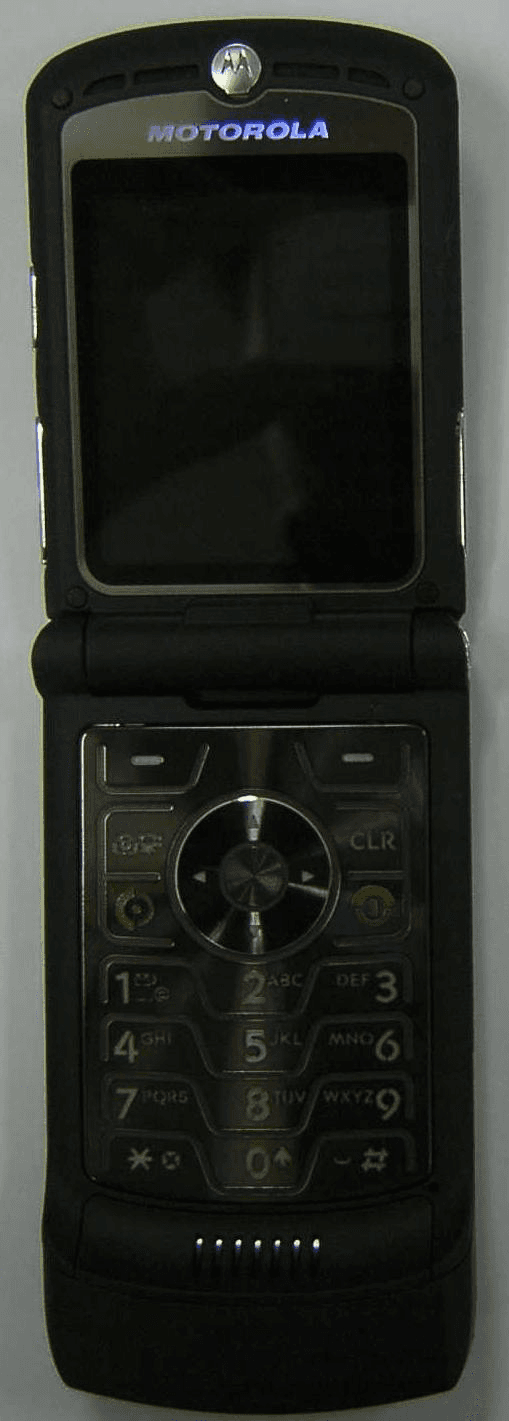
Click to zoom
Application Details
- Equipment Class
- JBP - Part 15 Class B Computing Device Peripheral
- Date of Grant
- Mar 28, 2007
- Application Purpose
- Original Equipment
- Date of Application
- Mar 28, 2007
- Equipment Note
- Portable Cellular/ PCS CDMA Transceiver with BT
- Company
- Motorola Mobility LLC
- Country
- United States
Documents & Files
Document Text
Text extracted from the exhibit documents filed with the FCC. Open a document above to read the original.
Users Manual
APPLICANT: MOTOROLA, INC. FCC ID: IHDT56HD1 USER’S MANUAL • A preliminary draft copy of the User’s Manual follows this cover page. • The text on the following three pages will be added for FCC requirements. EXHIBIT 8 FCC NoticeFCC Notice To UsersFCC NoticeMotorola has not approved any changes or modifications to this device by the user. Any changes or modifications could void the user’s authority to operate the equipment. See 47 CFR Sec. 15.21.This device complies with part 15 of the FCC Rules. Operation is subject to the following two conditions: (1) This device may not cause harmful interference, and (2) this device must accept any interference received, including interference that may cause undesired operation. See 47 CFR Sec. 15.19(3).If your mobile device or accessory has a USB connector, or is otherwise considered a computer peripheral device whereby it can be connected to a computer for purposes of transferring data, then it is considered a Class B device and the following statement applies:This equipment has been tested and found to comply with the limits for a Class B digital device, pursuant to part 15 of the FCC Rules. These limits are designed to provide reasonable protection against harmful interference in a residential installation. This equipment generates, uses and can radiate radio frequency energy and, if not installed and used in accordance with the instructions, may cause harmful interference to radio communications. However, there is no guarantee that interference will not occur in a particular installation. If this equipment does cause harmful interference to radio or television reception, which can be determined by turning the equipment off and on, the user is encouraged to try to correct the interference by one or more of the following measures: • Reorient or relocate the receiving antenna. • Increase the separation between the equipment and the receiver. • Connect the equipment to an outlet on a circuit different from that to which the receiver is connected. • Consult the dealer or an experienced radio/TV technician for help. SAR DataSpecific Absorption Rate DataSAR DataThis model wireless phone meets the government’s requirements for exposure to radio waves.Your wireless phone is a radio transmitter and receiver. It is designed and manufactured not to exceed limits for exposure to radio frequency (RF) energy set by the Federal Communications Commission (FCC) of the U.S. Government and by the Canadian regulatory authorities. These limits are part of comprehensive guidelines and establish permitted levels of RF energy for the general population. The guidelines are based on standards that were developed by independent scientific organizations through periodic and thorough evaluation of scientific studies. The standards include a substantial safety margin designed to assure the safety of all persons, regardless of age or health.The exposure standard for wireless mobile phones employs a unit of measurement known as the Specific Absorption Rate, or SAR. The SAR limit set by the FCC and by the Canadian regulatory authorities is 1.6 W/kg. 1 Tests for SAR are conducted using standard operating positions accepted by the FCC and by Industry Canada with the phone transmitting at its highest certified power level in all tested frequency bands. Although the SAR is determined at the highest certified power level, the actual SAR level of the phone while operating can be well below the maximum value. This is because the phone is designed to operate at multiple power levels so as to use only the power required to reach the network. In general, the closer you are to a wireless base station, the lower the power output.Before a phone model is available for sale to the public in the U.S. and Canada, it must be tested and certified to the FCC and Industry Canada that it does not exceed the limit established by each government for safe exposure. The tests are performed in positions and locations (e.g., at the ear and worn on the body) reported to the FCC and available for review by Industry Canada. The highest SAR value for this model phone when tested for use at the ear is 1 . 3 8 W/kg, and when worn on the body, as described in this user guide, is 1 . 59 W/kg. (Body-worn measurements differ among phone models, depending upon available accessories and regulatory requirements). 2 While there may be differences between the SAR levels of various phones and at various positions, they all meet the governmental requirements for safe exposure. Please note that improvements to this product model could cause differences in the SAR value for later products; in all cases, products are designed to be within the guidelines. SAR Data Additional information on Specific Absorption Rates (SAR) can be found on the Cellular Telecommunications & Internet Association (CTIA) Web site:http://www.phonefacts.netor the Canadian Wireless Telecommunications Association (CWTA) Web site:http://www.cwta.ca1. In the United States and Canada, the SAR limit for mobile phones used by the public is 1.6 watts/kg (W/kg) averaged over one gram of tissue. The standard incorporates a substantial margin of safety to give additional protection for the public and to account for any variations in measurements. 2. The SAR information includes the Motorola testing protocol, assessment procedure, and measurement uncertainty range for this product. Welcom to the world of Motorola digital wireless communication! We are pleased that you have chosen the Motorola V3a wireless phone. Personal Communications Sector 600 North U.S Highway 45 Libertyville, Illinois 60048 1-800-331-6456(United States) 1-888-390-6456(TTY/TDD United States) 10800-461-4575(Canada) www.motorola.com MOTOROLA, the Stylized M Logo and all other trademarks indicated as such herein are trademarks of Motorola, INC. Reg. U.S Pat. & Tm. Off. TrueSync, Sidekick, Starfish and the Stylized Starfish Logo are registered tradmarks of Starfish Software, Inc., a wholly owned ind…
Text truncated - open the document above for the full version.
Attestation Statements
APPLICANT: MOTOROLA, INC. FCC ID: IHDT56HD1 SPECIFICATION COMPLIANCE STATEMENT Transceiver type: FCC ID: IHDT56HD1 has been tested in accordance with the requirements contained in the appropriate Commission regulations. To the best of my knowledge, these tests were performed using measurement procedures consistent with industry or Commission standards and demonstrate that this equipment complies with the appropriate standards. Each unit manufactured imported or marketed, will conform to the sample tested within the variations that can be expected due to quantity production and testing on a statistical basis. I further certify that the necessary measurements were made at Motorola, located at Motorola, 600 N. U.S. Highway 45, Libertyville, IL 60048. NAME: Frank.Hyochang Kim TITLE: Engineering Manager Motorola Mobile Device Business Date: Feb, 30, 2007 EXHIBIT 2 APPLICANT: MOTOROLA, INC. FCC ID: IHDT56HD1 STATEMENT OF CERTIFICATION I hereby certify that the above application was prepared under my direction and that to the best of my knowledge and belief, the facts set forth in this application and accompanying technical data are true and correct. The technical data supplied with this application was taken under my supervision and is hereby duly certified. I also certify that this transmit equipment (FCC ID: IHDT56HD1) is in compliance with all applicable parts of the FCC Rules. NAME: Frank.Hyochang Kim TITLE: Engineering Manager Motorola Mobile Device Business Date: Feb, 30, 2007 EXHIBIT 2 APPLICANT: MOTOROLA, INC. FCC ID: IHDT56HD1 ATTESTATION STATEMENT This device contains an embedded Bluetooth device that Motorola confirms compliance with the following Part 15 regulations. 15.247(a)(1) • the hopping sequence must be pseudorandom • all Channels are used equally on average • the receiver input bandwidth is approximately equal to the transmit bandwidth • the receiver hops in sequence with the transmitted signal 15.247(g) the system is designed to comply with all of the regulations in Section 15.247 when the transmitter is presented with a continuous data (or information) 15.247(h) the system does not coordinate its channel selection/hopping sequence with other frequency hopping systems for the express purpose of avoiding the simultaneous occupancy of individual hopping frequencies by multiple transmitters NAME: Frank Hyochang Kim TITLE: Engineering Manager Mobile Device Business Motorola, Inc. Date: February 30, 2007 EXHIBIT 2
Cover Letter(s)
APPLICANT: MOTOROLA, INC. FCC ID: IHDT56HD1 February 28, 2007 CONFIDENTIALITY REQUEST CONTAINED WITHIN Federal Communications Commission Authorization and Evaluation Division 7435 Oakland Mills Road Columbia, Maryland 21046 Re: Application for Cellular/PCS Transceiver Certification Gentlemen: Application: Motorola, Inc., Mobile Devices, 600 N. U.S. Highway 45, Libertyville, Illinois 60048-1286 herein submits: Application for Equipment Authorization for Certification of a Cellular Transceiver, FCC ID: IHDT56HD1. Motorola is also the manufacturer of this equipment. Confidentiality: Pursuant to Section 0.459 of the Commission's rules (CFR 47), Motorola requests confidentiality for portions of the material contained in this application and that the identified material be withheld from public inspection following the grant of this authorization. This material contains Motorola's trade secrets and confidential information that Motorola does not customarily release to the public and which is otherwise not generally available to the public. Confidentiality is requested for the following exhibits: • Exhibit 4 Block Diagrams • Exhibit 5 Schematics • Exhibit 10 Parts List • Exhibit 12 Operational Description Description: This equipment is a CDMA portable transceiver which operates in the 850 and 1900 MHz PCS band. The unit also employs CDMA 1X and contains a 2.4 GHz Bluetooth transmitter (Part 15.247). The unit may be connected to a computer via a USB connection ( Part 15, Class B, Computing Device Peripheral). We have tested for HAC and T-Coil. Contact Information: Please contact me by telephone at (847) 523-6167, or by e-mail ( [email protected]), if there are questions or additional information needed concerning this filing. Regards, Andrew J. Bachler FCC Liaison Mobile Devices 600 N. U.S. Highway 45 Libertyville, IL 60048-5343 Exhibit 13
External Photos
APPLICANT : MOTOROLA, INC. FCC ID : IHDT56HD1 Front view flip opened Rear view flip opened without battery cover EXHIBIT 3 EQUIPMENT ID LABEL LOCATION APPLICANT : MOTOROLA, INC. FCC ID : IHDT56HD1 Front View Rear View EXHIBIT 3
ID Label/Location Info
APPLICANT: MOTOROLA INC. FCC ID: IHDT56HD1 FCC IDENTIFICATION (NAMEPLATE) INFORMATION FCC ID: IHDT56HD1 The FCC label shown is representative of the label that will appear on the radio when in production. It will be placed on the outside of the equipment as shown in Exhibit 3, and is readily visible at the time of purchase. Other information may also be included on this label. EXHIBIT 1
Internal Photos
APPLICANT : MOTOROLA, INC. FCC ID : IHDT56HD1 Front View Rear View EXHIBIT 9 APPLICANT : MOTOROLA, INC. FCC ID : IHDT56HD1 Main Board(shield on) Main Board(Shiend on) EXHIBIT 9 APPLICANT : MOTOROLA, INC. FCC ID : IHDT56HD1 Main Board(Keypad installed) EXHIBIT 9 APPLICANT : MOTOROLA, INC. FCC ID : IHDT56HD1 Housing internal views EXHIBIT 9 APPLICANT : MOTOROLA, INC. FCC ID : IHDT56HD1 Housing internal views EXHIBIT 9
Test Report
APPLICANT: MOTOROLA INC FCC ID: IHDT56HD1 Test Report Number: 19959-1 Supplement 1 of 10 EXHIBIT 6A3 MOBILE DEVICES BUSINESS PRODUCT SAFETY AND COMPLIANCE EMC LABORATORY EMC TEST REPORT Test Report Number – 19959-1 Supplement Report Date – February 6, 2007 The test results contained herein relate only to the model(s) identified. It is the manufacturer’s responsibility to assure that additional production units of this model are manufactured with identical electrical and mechanical characteristics. As the responsible EMC Engineer, I hereby declare that the equipment tested as specified in this report conforms to the requirements indicated. Signature: Name: Albert J. Patapack Title: EMC Engineer Date: February 6, 2007 This report must not be reproduced, except in full, without written approval from this laboratory. THIS REPORT MUST NOT BE USED TO CLAIM PRODUCT ENDORSEMENT BY A2LA OR ANY AGENCY OF THE U.S. GOVERNMENT. A2LA Certificate Number: 2518-02 APPLICANT: MOTOROLA INC FCC ID: IHDT56HD1 Test Report Number: 19959-1 Supplement 2 of 10 EXHIBIT 6A3 Table of Contents Description Page Test Report Details 3 Applicable Standards 3 Summary of Testing 4 General and Special Conditions 4 Equipment and Cable Configuration 5 Measurement Procedures and Data 6 APPLICANT: MOTOROLA INC FCC ID: IHDT56HD1 Test Report Number: 19959-1 Supplement 3 of 10 EXHIBIT 6A3 Test Report Details Tests Performed By: Motorola Mobile Devices business (MDb) Product Safety and Compliance Group 600 North US Hwy 45 Libertyville, IL 60048 PH (847) 523-6167 Fax (847) 523-4538 Motorola MDb FRN: 0004321311 FCC Registration Number: 316588 Industry Canada Number: IC3908-1 Tests Requested By: Motorola Inc. Mobile Devices business 600 North US Hwy 45 Libertyville, IL 60048 Signaling Capability: CDMA 800, CDMA 1900, Bluetooth FCC ID : IHDT56HD1 Serial Numbers: 808B1B7D, 800DD4AB, 80CA291B Testing Complete Date: January 29, 2007 Applicable Standards All tests and measurements indicated in this document were performed in accordance with the Code of Federal Regulations Title 47 : X Part 15 Subpart B – Unintentional Radiators Applicable Standards: ANSI 63.4 2003 APPLICANT: MOTOROLA INC FCC ID: IHDT56HD1 Test Report Number: 19959-1 Supplement 4 of 10 EXHIBIT 6A3 Summary of Testing Test Test Name # Pass/Fail _________ 1 Field Strength of Spurious Emissions Pass from Unintentional Radiators 2 AC Line Conducted Emissions Pass Test Test Name Margin with respect # to the Limit_________ 1 Field Strength of Spurious Emissions see results from Unintentional Radiators 2 AC Line Conducted Emissions see results The margin with respect to the limit is the minimum margin for all modes and bands. General and Special Conditions The EUT was tested using a fully charged battery. All testing was done in an indoor controlled environment with an average temperature of 22º C and relative humidity of 50%. APPLICANT: MOTOROLA INC FCC ID: IHDT56HD1 Test Report Number: 19959-1 Supplement 5 of 10 EXHIBIT 6A3 Equipment List Manufacturer Equipment Type Model No. Serial Number Calibration Due Date Rohde Schwarz Receiver ESI26 100001 3/08/07 Rohde Schwarz Receiver ESI40 100226 6/05/07 A.H. Systems Inc. DRG Horn Antenna SAS 200/571 365 5/12/07 ETS Log-Periodic Antenna 3148 1188 6/05/07 ETS Biconical Antenna 3110B 3370 3/03/07 Attenuator Weinschel AS-6 7075 6/29/07 Attenuator Weinschel AS-6 7074 6/29/07 ETS LISN 3810/2NM 00062907 5/10/07 ETS LISN 3810/2NM 00062912 5/10/07 Dell Laptop Computer M20 NA NA Iomega Zip Drive Z250S P9HM1992CK NA Olympus Camera D-600L 4020727 NA All equipment is on a one-year calibration cycle. The Dell M20 Laptop Computer, the Iomega Z250S Zip Drive and the Olympus D-600L Camera are labeled as DoC. APPLICANT: MOTOROLA INC FCC ID: IHDT56HD1 Test Report Number: 19959-1 Supplement 6 of 10 EXHIBIT 6A3 Measurement Procedures and Data FIELD STRENGTH OF EMISSIONS FROM UNINTENTIONAL RADIATORS Measurement Procedure The equipment under test is placed inside the semi-anechoic chamber on a wooden table on the turntable center. For each radiated emission, the antenna mast is raised and lowered from 1 to 4 meters and the turntable is rotated 360 degrees to obtain a maximum peak reading on the spectrum analyzer. The final radiated emissions are then measured using an EMI receiver employing a CISPR quasi-peak detector function below 1000 MHz and an average detector function above 1000 MHz. This is repeated for both horizontal and vertical polarizations of the receive antenna. The field strength of each radiated emission is calculated by correcting the EMI receiver level for cable loss, amplifier gain, and antenna correction factors. Field Strength (dBuV/m) = EMI Receiver Level (dBuV) + Cable Loss (dB) - Amplifier Gain (dB) + Antenna Correction Factor (1/m) Test Setup The EUT and the host equipment were setup according to the procedures in ANSI C63.4- 2003. The EUT was connected to a laptop computer using a USB data cable. The USB data cable is 1 m in length. The parallel and the serial ports of the computer were populated. The EUT was communicating with the laptop computer continuously. APPLICANT: MOTOROLA INC FCC ID: IHDT56HD1 Test Report Number: 19959-1 Supplement 7 of 10 EXHIBIT 6A3 Measurement Results Operating Mode – Rx Mode, Data Transfer Mode. Notes: Worst Case emissions reported. 30 MHz – 1000 MHz Frequency MHz Level dBμV/m Measured dBμV Transd dB Cables dB Limit dBμV/m Margin dB Height cm Angle deg Pol. 35.00 35.32 15.19 12.3 7.8 40 4.7 100 153 VERT 96.12 31.67 12.01 10.5 9.2 43.5 11.8 210 209 VERT 138.96 30.60 8.06 12.6 9.9 43.5 12.9 100 345 VERT 181.84 29.00 4.83 13.7 10.5 43.5 14.5 193 207 HORI 191.40 34.03 8.02 15.5 10.5 43.5 9.5 100 194 VERT 196.36 37.02 11.25 15.2 10.6 43.5 6.5 184 233 HORI 261.80 36.12 11.90 12.9 11.3 46 9.9 150 338 HORI 319.00 38.96 12.12 14.9 11.9 46 7 100 263 HORI 366.44 37.61 9.97 15.4 12.3 46 8.4 181 232 VERT Above 1 GHz Frequency MHz Level dBμV/m Measured dBμV Transd dB Gain dB Limit dBμV/m Margin dB Height cm Angle deg …
Text truncated - open the document above for the full version.
Test Setup Photos
EMC TEST SETUP PHOTOS EMC Report #19959-1, AC Line - Part 15 APPLICANT: MOTOROLA, INC. FCC ID: IHDT56HD1 Page 1 of 17 EXHIBIT 7 EMC Report #19959-1, Part 15, PC Peripheral APPLICANT: MOTOROLA, INC. FCC ID: IHDT56HD1 Page 2 of 17 EXHIBIT 7 EMC Report #19959-1, Antenna - Substitution APPLICANT: MOTOROLA, INC. FCC ID: IHDT56HD1 Page 3 of 17 EXHIBIT 7 EMC Report #19959-1, Tx Radiated APPLICANT: MOTOROLA, INC. FCC ID: IHDT56HD1 Page 4 of 17 EXHIBIT 7 APPLICANT: MOTOROLA, INC. FCC ID: IHDT56HD1 P P a a g g e e 2 2 0 0 E E x x h h i i b b i i t t 6 6 B B - - 1 1 Appendix 5 Pictures of Test Setup >> EXTRACTED FROM FCC EXHIBIT 6B1<<<< FROM HAC Test Report for Near Field Emissions APPLICANT: MOTOROLA, INC. FCC ID: IHDT56HD1 Page 5 of 17 EXHIBIT 7 APPLICANT: MOTOROLA, INC. FCC ID: IHDT56HD1 P P a a g g e e 2 2 1 1 E E x x h h i i b b i i t t 6 6 B B - - 1 1 Figure A5-1. Phone Closed Figure A5-2. Phone Open - Orientation of Wireless Device and Measurement Plane APPLICANT: MOTOROLA, INC. FCC ID: IHDT56HD1 Page 6 of 17 EXHIBIT 7 APPLICANT: MOTOROLA, INC. FCC ID: IHDT56HD1 P P a a g g e e 2 2 2 2 E E x x h h i i b b i i t t 6 6 B B - - 1 1 Figure A5-3. Views from the front Figure A5-4. Views from the side APPLICANT: MOTOROLA, INC. FCC ID: IHDT56HD1 Page 7 of 17 EXHIBIT 7 APPLICANT: MOTOROLA, INC. FCC ID: IHDT56HD1 P P a a g g e e 2 2 5 5 E E x x h h i i b b i i t t 6 6 B B - - 2 2 Appendix 4 Pictures of Test Setup >> EXTRACTED FROM FCC EXHIBIT 6B2, HAC Test Report for T-coil<<< APPLICANT: MOTOROLA, INC. FCC ID: IHDT56HD1 Page 8 of 17 EXHIBIT 7 APPLICANT: MOTOROLA, INC. FCC ID: IHDT56HD1 P P a a g g e e 2 2 6 6 E E x x h h i i b b i i t t 6 6 B B - - 2 2 Figure A4-1. Phone Closed Figure A4-2. Phone Open – 5cm x 5cm grid for Near Field Measurements APPLICANT: MOTOROLA, INC. FCC ID: IHDT56HD1 Page 9 of 17 EXHIBIT 7 APPLICANT: MOTOROLA, INC. FCC ID: IHDT56HD1 P P a a g g e e 2 2 7 7 E E x x h h i i b b i i t t 6 6 B B - - 2 2 Figure A4-3. Views from the front Figure A4-4. Views from the side APPLICANT: MOTOROLA, INC. FCC ID: IHDT56HD1 Page 10 of 17 EXHIBIT 7 MOTOROLA, INC. Portable Cellular Phone SAR Test Report Number: 19953-1F E E x x h h i i b b i i t t 1 1 1 1 P P a a g g e e 2 2 1 1 Appendix 6 Photographs of the device under test >> PHOTOS WERE EXTRACTED FROM FCC EXHIBIT 11, SAR REPORT<<< APPLICANT: MOTOROLA, INC. FCC ID: IHDT56HD1 Page 11 of 17 EXHIBIT 7 MOTOROLA, INC. Portable Cellular Phone SAR Test Report Number: 19953-1F E E x x h h i i b b i i t t 1 1 1 1 P P a a g g e e 2 2 2 2 Figure 1. Front of Phone Figure 2. Phone Open APPLICANT: MOTOROLA, INC. FCC ID: IHDT56HD1 Page 12 of 17 EXHIBIT 7 MOTOROLA, INC. Portable Cellular Phone SAR Test Report Number: 19953-1F E E x x h h i i b b i i t t 1 1 1 1 P P a a g g e e 2 2 3 3 Figure 3. Back of Phone Figure 4. Phone Against the Flat Phantom APPLICANT: MOTOROLA, INC. FCC ID: IHDT56HD1 Page 13 of 17 EXHIBIT 7 MOTOROLA, INC. Portable Cellular Phone SAR Test Report Number: 19953-1F E E x x h h i i b b i i t t 1 1 1 1 P P a a g g e e 2 2 4 4 Figure 5. Phone Against the Head Phantom (Cheek Touch) Figure 6. Phone Against the Head Phantom (15°Tilt) APPLICANT: MOTOROLA, INC. FCC ID: IHDT56HD1 Page 14 of 17 EXHIBIT 7 MOTOROLA, INC. Portable Cellular Phone SAR Test Report Number: 19953-1F E E x x h h i i b b i i t t 1 1 1 1 P P a a g g e e 2 2 5 5 Figure 7. Front of Phone with Case VLV32 Figure 8. Phone Open with Case VLV32 APPLICANT: MOTOROLA, INC. FCC ID: IHDT56HD1 Page 15 of 17 EXHIBIT 7 MOTOROLA, INC. Portable Cellular Phone SAR Test Report Number: 19953-1F E E x x h h i i b b i i t t 1 1 1 1 P P a a g g e e 2 2 6 6 Figure 9. Back of Phone with Case VLV32 Figure 10. Back View: Case CHYN4647A APPLICANT: MOTOROLA, INC. FCC ID: IHDT56HD1 Page 16 of 17 EXHIBIT 7 MOTOROLA, INC. Portable Cellular Phone SAR Test Report Number: 19953-1F E E x x h h i i b b i i t t 1 1 1 1 P P a a g g e e 2 2 7 7 Figure 11. Side View: Case CHYN4647A APPLICANT: MOTOROLA, INC. FCC ID: IHDT56HD1 Page 17 of 17 EXHIBIT 7
Contact Information
Applicant
Jeff Narducci(Director Product Compliance)
Technical Contact
PCTEST Engineering Laboratory, Inc.Randy Ortanez
[email protected]410-290-6652
6660-B Dobbin Road · Columbia, Maryland · United States
Test Firm
Motorola Inc.Albert Patapack
Technical Specifications
| # | Rule Parts | Frequency Range | Power Output |
|---|---|---|---|
| 1 | 15B | - | - |
Other Applications from Motorola Mobility LLC
IHDT56AW9
May 12, 2026Smart Watch
Equipment Class
NII - Unlicensed National Information Infrastructure TXIHDT56AW5
Apr 08, 2026Mobile Cellular Phone
Equipment Class
DTS - Digital Transmission SystemIHDT56AW6
Mar 18, 2026Smart Watch
Equipment Class
JBP - Part 15 Class B Computing Device PeripheralIHDT56AX4
Mar 17, 2026Mobile Cellular Phone
Equipment Class
PCE - PCS Licensed Transmitter held to earIHDT56AW3
Mar 03, 2026Mobile Cellular Phone
Equipment Class
6XD - 15E 6 GHz Low Power Indoor Client