IHDT56HX1Portable Cellular/ PCS GSM/ EDGE Transceiver w/ BT
Motorola Mobility LLC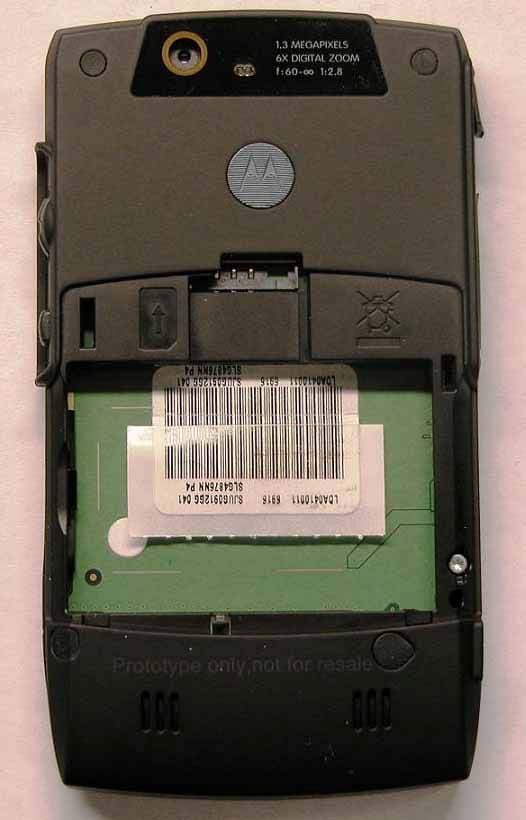
Click to zoom
Application Details
- Equipment Class
- PCE - PCS Licensed Transmitter held to ear
- Date of Grant
- Mar 20, 2007
- Application Purpose
- Original Equipment
- Date of Application
- Mar 20, 2007
- Equipment Note
- Portable Cellular/ PCS GSM/ EDGE Transceiver w/ BT
- Frequency Range
- 1850.20000000 - 1909.80000000
- Company
- Motorola Mobility LLC
- Country
- United States
Documents & Files
Document Text
Text extracted from the exhibit documents filed with the FCC. Open a document above to read the original.
Users Manual
INSTRUCTION MANUAL A preliminary draft of the User’s Manual follows this page. The text on the following two pages will be added to the user manual. APPLICANT: MOTOROLA,INC. FCC ID: IHDT56HX1 EXHIBIT 8 SAR DataSpecific Absorption Rate DataSAR DataThis model wireless phone meets the government’s requirements for exposure to radio waves.Your wireless phone is a radio transmitter and receiver. It is designed and manufactured not to exceed limits for exposure to radio frequency (RF) energy set by the Federal Communications Commission (FCC) of the U.S. Government and by the Canadian regulatory authorities. These limits are part of comprehensive guidelines and establish permitted levels of RF energy for the general population. The guidelines are based on standards that were developed by independent scientific organizations through periodic and thorough evaluation of scientific studies. The standards include a substantial safety margin designed to assure the safety of all persons, regardless of age or health.The exposure standard for wireless mobile phones employs a unit of measurement known as the Specific Absorption Rate, or SAR. The SAR limit set by the FCC and by the Canadian regulatory authorities is 1.6 W/kg. 1 Tests for SAR are conducted using standard operating positions accepted by the FCC and by Industry Canada with the phone transmitting at its highest certified power level in all tested frequency bands. Although the SAR is determined at the highest certified power level, the actual SAR level of the phone while operating can be well below the maximum value. This is because the phone is designed to operate at multiple power levels so as to use only the power required to reach the network. In general, the closer you are to a wireless base station, the lower the power output.Before a phone model is available for sale to the public in the U.S. and Canada, it must be tested and certified to the FCC and Industry Canada that it does not exceed the limit established by each government for safe exposure. The tests are performed in positions and locations (e.g., at the ear and worn on the body) reported to the FCC and available for review by Industry Canada. The highest SAR value for this model phone when tested for use at the ear is 1. 32 W/kg, and when worn on the body, as described in this user guide, is 0. 77 W/kg. The SAR value for this product in its data transmission mode (body-worn use) is 0. 6 7 W/kg. (Body-worn measurements differ among phone models, depending upon available accessories and regulatory requirements). 2 While there may be differences between the SAR levels of various phones and at various positions, they all meet the governmental requirements for safe exposure. Please note that improvements to this product model could cause differences in the SAR value for later products; in all cases, products are designed to be within the guidelines. SAR Data Additional information on Specific Absorption Rates (SAR) can be found on the Cellular Telecommunications & Internet Association (CTIA) Web site:http://www.phonefacts.netor the Canadian Wireless Telecommunications Association (CWTA) Web site:http://www.cwta.ca1. In the United States and Canada, the SAR limit for mobile phones used by the public is 1.6 watts/kg (W/kg) averaged over one gram of tissue. The standard incorporates a substantial margin of safety to give additional protection for the public and to account for any variations in measurements. 2. The SAR information includes the Motorola testing protocol, assessment procedure, and measurement uncertainty range for this product. 1 HELLOMOTOThanks for purchasing the MOTO Q™ gsm wireless phone! It's a phone with a distinct edge—personalization, music, videos, and e-mail—all in a streamlined, intelligent, must-have device.My Phone, My Way – It's your phone—make it that way. Customize your home screen with personal pictures, change wallpapers, and use your favorite song as your ringtone. Anytime Entertainment – Can't live without your favorite movies or music? Transfer video and music files from your computer to your phone and instantly a media library is available anytime. Freedom from Wires – Your life just got a little less wired. With Bluetooth™ wireless 2.0 technology, streaming video and wireless stereo sound is now a reality. Working Remotely – Tired of being connected to your desk or computer? With Windows Mobile, now you can keep on top of work e-mail and edit Microsoft Office® documents from wherever you are in the world. Help & QuickStart Tour – On-phone help is available anytime. Just press Start > 1 Help and Quickstart . 2Here’s a quick anatomy lesson. Left Soft Key Navigate menus. Center Select KeySelects menuitems. Camera Key Thumb Wheel Home Key Right Soft Key Undo/Back Key Microphone ALT Key Enter Key Space Key Caps Key Back Key Power/End Key Call/Answer Key Navigation Key Message/Display Off Key Speakerphone/VoiceRecognition Key Make & answer calls. Turn on & off,hang up, exitmenus. 3 To avoid damaging your phone, carry it in an approved holster or case rather than a pocket, purse, or bag. Camera Lens Battery Door Release Speakers Camera Flash 2.5mm Headset Jack Memory Card Port Mini USB Port Charge and connect phone accessories \ 4From the home screen, press Start to open the main menu. To change your home screen shortcuts and main menu appearance, see page 36.If you need help while using your phone press Start > 1 Help and QuickStart to open the in-device help. Also see the Motorola Q Support Web site at http://www.motorola.com/support/Q-gsm . The Phone Company11:36 PMPartner Meeting - Discuss project schedule10:30 AM Room 100Profile: Normal 11/10/2007 Contacts C #QJ0 a More Menu g m c G Start V K A I Messaging Contacts ActiveSync Call History Internet Explorer Ta s k s Windows Media Calendar Home Screen Menu Screen Press and release the Power Key O to turn on your phone. 1 Press the Start key (left soft key) to open the main menu. 2 Press the Navigation Ke…
Text truncated - open the document above for the full version.
Attestation Statements
APPLICANT: MOTOROLA INC. FCC ID: IHDT56HX1 SPECIFICATION COMPLIANCE STATEMENT Transceiver type (IHDT56HX1) has been tested in accordance with the requirements contained in the appropriate Commission regulations. To the best of my knowledge, these tests were performed using measurement procedures consistent with industry or Commission standards and demonstrate that this equipment complies with the appropriate standards. Each unit manufactured imported or marketed, will conform to the sample tested within the variations that can be expected due to quantity production and testing on a statistical basis. I further certify that the necessary measurements were made at Motorola, 600 N. U.S. Highway 45, Libertyville, IL 60048. NAME: Tom Daniel TITLE: Engineering Manager Motorola Mobile Devices Business Date: 02/23/2007 Page 1 of 3 EXHIBIT 2 APPLICANT: MOTOROLA INC. FCC ID: IHDT56HX1 STATEMENT OF CERTIFICATION I hereby certify that the above application was prepared under my direction and that to the best of my knowledge and belief, the facts set forth in this application and accompanying technical data are true and correct. The technical data supplied with this application was taken under my supervision and is hereby duly certified. I also certify that this transmit equipment (IHDT56HX1) is in compliance with all applicable parts of the FCC Rules. NAME: Tom Daniel TITLE: Engineering Manager Motorola Mobile Devices Business Date: 02/23/2007 Page 2 of 3 EXHIBIT 2 APPLICANT: MOTOROLA INC. FCC ID: IHDT56HX1 ATTESTATION STATEMENT This device contains an embedded Bluetooth device that Motorola confirms compliance with the following Part 15 regulations. 15.247(a)(1) • the hopping sequence must be pseudorandom • all Channels are used equally on average • the receiver input bandwidth is approximately equal to the transmit bandwidth • the receiver hops in sequence with the transmitted signal 15.247(g) the system is designed to comply with all of the regulations in Section 15.247 when the transmitter is presented with a continuous data (or information) 15.247(h) the system does not coordinate its channel selection/hopping sequence with other frequency hopping systems for the express purpose of avoiding the simultaneous occupancy of individual hopping frequencies by multiple transmitters NAME: Tom Daniel TITLE: Engineering Manager Motorola Mobile Devices Business Date: 02/23/2007 Page 3 of 3 EXHIBIT 2
Cover Letter(s)
APPLICANT: MOTOROLA FCC ID: IHDT56HX1 February 23, 2007 SHORT TERM CONFIDENTIALITY REQUEST 45 DAYS Federal Communications Commission Authorization and Evaluation Division 7435 Oakland Mills Road Columbia, Maryland 21046 Re: Cellular/PCS Transceiver FCC ID IHDT56HX1 Gentlemen: Introduction: Pursuant to Section 0.459 of the Commission's rules (CFR 47) and Section 552(b)(4) of the Freedom of Information Act, Motorola requests confidentiality for portions of the material contained in this application; and that the identified material be withheld from public inspection following the grant of this authorization. This material contains Motorola's trade secrets and confidential information that Motorola does not customarily release to the public and which is otherwise not generally available to the public. Standard Confidentiality Request: Confidentiality is requested for the following exhibits: • Exhibit 4 Block Diagrams • Exhibit 5 Schematics • Exhibit 10 Parts List / Tune up Information • Exhibit 12 Operational Description Short Term Confidentiality Request: Furthermore, due to sensitive business information, Motorola requests the following exhibits be withheld from public viewing for 45 days: • Exhibit 3 External Photographs • Exhibit 7 and 7A Photographs of the device under test • Exhibit 8 User’s Manual • Exhibit 9 Internal Photographs Contact Information: Please contact me by telephone at (847) 523-6167, or by e-mail ( [email protected]), if there are questions or additional information needed concerning this filing. Regards, Andrew J. Bachler FCC Liaison Mobile Devices 600 N. U.S. Highway 45 Libertyville, IL 60048-5343 Exhibit 13A
Cover Letter(s)
Applicant: Motorola, Inc. Date: March 20, 2007 Subject: Request for additional information regarding FCC ID: IHDT56HX1 Reference: Correspondence Reference Number: IHD7090 Confirmation Number: 702090090-92 Date of Original Email: March 09, 2007 Questions and responses follow: 1. The Bluetooth 20 dBc bandwidth plot was not measured correctly. The markers should be set at the widest possible 20 dBc points of the emission (they were not). Please remeasure and submit new data. Response: Please refer to the following: 20dB Bandwidth CFR 47 Part 15.247 Measurement Procedure The RF output port of the Equipment-Under-Test is directly coupled to the input of the EMC analyzer through a specialized RF connector and a 10dB passive attenuator. A fully charged battery was used for the supply voltage. The Bluetooth frequency hopping function of the EUT was enabled. The spectrum analyzer used the following settings: 1. Span = approx. 2 to 3 times the 20dB bandwidth, centered on a hopping frequency 2. RBW ≥ 1% of the 20dB span 3. VBW ≥ RBW 4. Sweep = auto 5. Detector function = peak 6. Trace = max hold The trace was allowed to stabilize. The EUT was transmitting at its maximum data rate. The marker-to-peak function was used to set the marker to the peak of the emission. The marker-delta function was used to measure 20dB down one side of the emission. The marker-delta function and marker was moved to the other side of the emission until it was even with the reference marker. The marker-delta reading at this point was the 20dB bandwidth of the emission. 1 Measurement Results 2. The Environmental Chamber in the Part 22/24 EMC Test Report is listed as being past its cal due date. Please address. Response: The calibration date was a typo. Please refer to the following corrected information: Thermotron Environmental Chamber S-4 31580 1/31/08 Prepared by: Andrew Bachler, Principal Staff Engineer Motorola Mobile Device Business Libertyville, Illinois 2
Cover Letter(s)
PCTEST Engineering Laboratory, Inc. 6660 Dobbin Road Suite A-E Columbia, Maryland 21045-4844 Tel.: 410-290-6652 / Fax: 410-290-6654 June 18, 2007 Federal Communications Commission Equipment Approval Services 7435 Oakland Mills Road Columbia, MD 21046 Attn: Mr. Tim Harrington SUBJECT: Motorola Inc. FCC ID: IHDT56HX1 Correspondence Reference No.: 39724 Request for Tech. Info.: 06/18/2007 Dear Tim: Transmitted herewith, on behalf of Motorola Inc is an amendment provided in response to the request for technical information dated June 18, 2007. 1. While certain Body-SAR measurements were performed with a 1.5 cm spacing, others (i.e., GPRS, and EDGE modes) were performed with a 2.5 cm spacing, as can be seen on p. 13/49 of the SAR Report. Absent the data to demonstrate RF exposure compliance at 1.5 cm spacing for all modes of operation, the grant comment specified 2.5 cm, since compliant data at 2.5 cm was included in the report for the referenced modes of operation. We trust this information is sufficient to resolve FCC questions in this application. If you have any further questions, please do not hesitate to contact us. cc: Motorola Inc.
External Photos
APPLICANT: MOTOROLA, INC. FCC ID: IHDT56HX1 Front View Rear View EQUIPMENT ID LABEL LOCATION Rear View without Back Cover Page 1 of 1 EXHIBIT 3
ID Label/Location Info
APPLICANT: MOTOROLA INC. FCC ID: IHDT56HX1 FCC IDENTIFICATION (NAMEPLATE) INFORMATION FCC ID: IHDT56HX1 The FCC label shown is representative of the label that will appear on the radio when in production. It will be placed on the outside of the equipment as shown in Exhibit 3, and is readily visible at the time of purchase. Other information may also be included on this label. EXHIBIT 1
Internal Photos
APPLICANT: MOTOROLA, INC. FCC ID: IHDT56HX1 No Back Housing Back Housing Page 1 of 9 EXHIBIT 3 APPLICANT: MOTOROLA, INC. FCC ID: IHDT56HX1 Main PCB (Side 1) Page 2 of 9 EXHIBIT 3 APPLICANT: MOTOROLA, INC. FCC ID: IHDT56HX1 Main PCB (Side 2) Page 3 of 9 EXHIBIT 3 APPLICANT: MOTOROLA, INC. FCC ID: IHDT56HX1 Key Pad PCB (Side 1) Key Pad PCB (Side 2) Page 4 of 9 EXHIBIT 3 APPLICANT: MOTOROLA, INC. FCC ID: IHDT56HX1 Daughter Board (Side 1) Daughter Board (Side 2) Page 5 of 9 EXHIBIT 3 APPLICANT: MOTOROLA, INC. FCC ID: IHDT56HX1 Main PCB without Shields (Side 1) Page 6 of 9 EXHIBIT 3 APPLICANT: MOTOROLA, INC. FCC ID: IHDT56HX1 Main PCB without Shields (Side 2) Page 7 of 9 EXHIBIT 3 APPLICANT: MOTOROLA, INC. FCC ID: IHDT56HX1 Key Pad PCB without Shields Page 8 of 9 EXHIBIT 3 APPLICANT: MOTOROLA, INC. FCC ID: IHDT56HX1 Main Antenna – Quad Band GSM (850/900/1800/1900 MHz) Bluetooth Antenna Location Page 9 of 9 EXHIBIT 3
RF Exposure Info
0 0 Portable Cellular Phone SAR Test Report Test Report #: 20026-2F Date of Report: Feb-23-2007 Date of Test: Feb-14-2007 to Feb-22-2007 FCC ID #: IHDT56HX1 Generic Name: MQ4-4411K11 Laboratory: Motorola Mobile Devices Business Product Safety & Compliance Laboratory 600 N. US Highway 45 Libertyville, Illinois 60048 Report Author: Thomas Nipple RF Engineer Accreditation: This laboratory is accredited to ISO/IEC 17025-1999 to perform the following tests: Tests : Procedures: Electromagnetic Specific Absorption Rate IEC 62209-1 RSS-102 IEEE 1528 - 2003 FCC OET Bulletin 65 (including Supplement C) Australian Communications Authority Radio Communications (Electromagnetic Radiation – Human Exposure) Standard 2003 CENELEC EN 50360 (2001) CENELEC EN 50361 (2001) ARIB Std. T-56 (2002) On the following products or types of products: Wireless Communications Devices (Examples): Two Way Radios; Portable Phones (including Cellular, Licensed Non-Broadcast and PCS); Low Frequency Readers; and Pagers A2LA certificate #2518-02 Statement of Compliance: Motorola declares under its sole responsibility that the portable cellular telephone model to which this declaration relates, is in conformity with the appropriate General Population/Uncontrolled RF exposure standards, recommendations and guidelines (FCC 47 CFR §2.1093) as well as with CENELEC en50360:2001 and ANSI / IEEE C95.1. It also declares that the product was tested in accordance with CENELEC en50361:2001, IEEE 1528, as well as other appropriate measurement standards, guidelines and recommended practices. Any deviations from these standards, guidelines and recommended practices are noted below: (none) ©Motorola, Inc. 2007 This test report shall not be reproduced except in full, without written approval of the laboratory. The results and statements contained herein relate only to the items tested. The names of individuals involved may be mentioned only in connection with the statements or results from this report. Motorola encourages all feedback, both positive and negative, on this test report. MOTOROLA, INC. Portable Cellular Phone SAR Test Report Number: 20026-2 E E x x h h i i b b i i t t 1 1 1 1 P P a a g g e e 1 1 Table of Contents 1. Introduction 2 2. Description of the Device Under Test 2 2.1 Antenna description 2 2.2 Device description 2 3. Test Equipment Used 3 3.1 Dosimetric System 3 3.2 Additional Equipment 3 4. Electrical parameters of the tissue simulating liquid 4 5. System Accuracy Verification 5 6. Test Results 6 6.1 Head Adjacent Test Results 6 6.2 Body Worn Test Results 10 References 14 Appendix 1: SAR distribution comparison for system accuracy verification 15 Appendix 2: SAR distribution plots for Phantom Head Adjacent Use 16 Appendix 3: SAR distribution plots for Body Worn Configuration 17 Appendix 4: Probe Calibration Certificate 18 Appendix 5: Measurement Uncertainty Budget 19 Appendix 6: Photographs of the device under test 21 Appendix 7: Dipole Characterization Certificate 27 MOTOROLA, INC. Portable Cellular Phone SAR Test Report Number: 20026-2 E E x x h h i i b b i i t t 1 1 1 1 P P a a g g e e 2 2 1. Introduction The Motorola Mobile Devices Business Product Safety Laboratory has performed measurements of the maximum potential exposure to the user of the portable cellular phone covered by this test report. The Specific Absorption Rate (SAR) of this product was measured. The portable cellular phone was tested in accordance with [1], [4] and [5]. The SAR values measured for the portable cellular phone are below the maximum recommended levels of 1.6 W/kg in a 1 g average set in [3] and 2.0 W/kg in a 10 g average set in [2]. For ICNIRP (10 g), the final SAR reading for this phone is 1.25 W/kg for head adjacent use and 0.73 W/kg for body worn use. For ANSI / IEEE C95.1 (1 g), the final SAR reading for this phone is 1.32 W/kg for head adjacent use and 0.77 W/kg for body worn use. These measurements were performed using a DASY4™ v4.7 system manufactured by Schmid & Partner Engineering AG (SPEAG), of Zurich Switzerland. 2. Description of the Device Under Test 2.1 Antenna description Type Internal Location Bottom of Transceiver Width 32.28 mm Dimensions Length 71.31 mm Configuration FJA 2.2 Device description Serial Number LDAA380052 Mode(s) of Operation GSM 850 GSM 900 GSM 1800 GSM 1900 Bluetooth Modulation Mode(s) GMSK GMSK GMSK GMSK GFSK Maximum Output Power Setting 33.00 dBm 32.50 dBm 30.00 dBm 30.00 dBm 4.0 dBm Duty Cycle 1:8 1:8 1:8 1:8 1:1 Transmitting Frequency Range(s) 824.2 - 848.8 MHz 880.2 - 914.8 MHz 1710.2 - 1784.8 MHz 1850.2 - 1909.8 MHz 2400.0 - 2483.5 MHz Production Unit or Identical Prototype (47 CFR §2..908) Identical Prototype Device Category Portable RF Exposure Limits General Population / Uncontrolled Serial Number LDAA380052 Mode(s) of Operation GPRS 850 GPRS 900 GPRS 1800 GPRS 1900 EDGE 850 EDGE 900 EDGE 1800 EDGE 1900 Modulation Mode(s) GMSK GMSK GMSK GMSK 8PSK 8PSK 8PSK 8PSK Maximum Output Power Setting 33.00 dBm 30.00 dBm 32.50 dBm 29.50 dBm 30.00 dBm 27.00 dBm 30.00 dBm 27.00 dBm 28.00 dBm 25.00 dBm 28.00 dBm 25.00 dBm 27.00 dBm 24.00 dBm 27.00 dBm 24.00 dBm Duty Cycle 1:8 2:8 1:8 2:8 1:8 2:8 1:8 2:8 1:8 2:8 1:8 2:8 1:8 2:8 1:8 2:8 Transmitting Frequency Range(s) 824.2 - 848.8 MHz 880.2 - 914.8 MHz 1710.2 - 1784.8 MHz 1850.2 - 1909.8 MHz 824.2 - 848.8 MHz 880.2 - 914.8 MHz 1710.2 - 1784.8 MHz 1850.2 - 1909.8 MHz Production Unit or Identical Prototype (47 CFR §2..908) Identical Prototype Device Category Portable RF Exposure Limits General Population / Uncontrolled MOTOROLA, INC. Portable Cellular Phone SAR Test Report Number: 20026-2 E E x x h h i i b b i i t t 1 1 1 1 P P a a g g e e 3 3 3. Test Equipment Used 3.1 Dosimetric System The Motorola Mobile Devices Business Product Safety & Compliance Laboratory utilizes a Dosimetric Assessment System (DASY4™ v4.7) manufactured by Schmid & Partner Engineering AG (SPEAG™), of Zurich Switzerland. All the SAR measurements are taken within a shielded enclosure. The o…
Text truncated - open the document above for the full version.
Test Report
APPLICANT: MOTOROLA INC FCC ID: IHDT56HX1 EXHIBIT 6 MOBILE DEVICES BUSINESS PRODUCT SAFETY AND COMPLIANCE EMC LABORATORY EMC TEST REPORT Test Report Number – 20041-2 Report Date – February 23, 2007 The test results contained herein relate only to the model(s) identified. It is the manufacturer’s responsibility to assure that additional production units of this model are manufactured with identical electrical and mechanical characteristics. As the responsible EMC Engineer, I hereby declare that the equipment tested as specified in this report conforms to the requirements indicated. Signature: Name: Thanigaiselvan Palaniswami Title: EMC Engineer Date: February 23, 2007 This report must not be reproduced, except in full, without written approval from this laboratory. THIS REPORT MUST NOT BE USED TO CLAIM PRODUCT ENDORSEMENT BY A2LA OR ANY AGENCY OF THE U.S. GOVERNMENT. A2LA Certificate Number: 2518-02 APPLICANT: MOTOROLA INC FCC ID: IHDT56HX1 Test Report Number: 20041-2 EXHIBIT 6 2 Table of Contents Description Page Test Report Details 3 Applicable Standards 3 Summary of Testing 4 General and Special Conditions 4 Equipment and Cable Configuration 5 Measurement Procedures and Data 6 RF Power Output 6 Measurement results 6 Radiated Power 7 Measurement results 7 Occupied Bandwidth 8 Measurement results 9 Spurious Emissions at Antenna Terminals 17 Measurement results 18 Field Strength of Spurious Emissions 22 Measurement results 23 Frequency Stability 26 Measurement results 27 Field Strength of Spurious Emissions -Unintentional Radiators 31 Measurement results 32 AC Line Conducted Emissions 33 Measurement results 34 APPLICANT: MOTOROLA INC FCC ID: IHDT56HX1 Test Report Number: 20041-2 EXHIBIT 6 3 Test Report Details Tests Performed By: Motorola Mobile Devices business (MDb) Product Safety and Compliance Group 600 North US Hwy 45 Libertyville, IL 60048 PH (847) 523-6167 Fax (847) 523-4538 Motorola MDb FRN: 0004321311 FCC Registration Number: 316588 Industry Canada Number: IC3908-1 Tests Requested By: Motorola Inc. Mobile Devices Business 600 North US Hwy 45 Libertyville, IL 60048 Product Type: Cellular Phone Signaling Capability: GSM 850, GSM 1900, Bluetooth FCC ID : IHDT56HX1 Serial Numbers: LDAA380094, LDAA350010, LDAA380009 Testing Complete Date: February 20, 2007 Applicable Standards All tests and measurements indicated in this document were performed in accordance with the Code of Federal Regulations Title 47 Part 2, Sub-part J as well as the following parts: X Part 15 Subpart B – Unintentional Radiators X Part 22 Subpart H - Public Mobile Services X Part 24 Subpart E – Personal Communications Services APPLICANT: MOTOROLA INC FCC ID: IHDT56HX1 Test Report Number: 20041-2 EXHIBIT 6 4 Summary of Testing Test Test Name # Pass/Fail 1 RF Power Output NA 2 ERP (Effective Radiated Power) Pass 3 EIRP (Effective Isotropic Radiated Power) Pass 4 Occupied Bandwidth Pass 5 Spurious Emissions at Antenna Terminal Pass 6 Field Strength of Spurious Emissions Pass 7 Frequency Stability Pass 8 Field Strength of Spurious Emissions Pass from Unintentional Radiators 9 AC Line Conducted Emissions Pass Test Test Name Margin with respect # to the Limit_________ 1 RF Power Output NA 2 ERP (Effective Radiated Power) See results 3 EIRP (Effective Isotropic Radiated Power) See results 3 Occupied Bandwidth See Plots 4 Spurious Emissions at Antenna Terminal See results 5 Field Strength of Spurious Emissions See results 6 Frequency Stability See results 7 Field Strength of Spurious Emissions Below noise floor from Unintentional Radiators 8 AC Line Conducted Emissions See Plots The margin with respect to the limit is the minimum margin for all modes and bands. General and Special Conditions The EUT was tested using a fully charged battery when applicable. Where a battery could not be used due to the need for a controlled variation of input voltage, an external power supply was utilized. All testing was done in an indoor controlled environment with an average temperature of 22º C and relative humidity of 50%. APPLICANT: MOTOROLA INC FCC ID: IHDT56HX1 Test Report Number: 20041-2 EXHIBIT 6 5 Equipment and Cable Configurations The EUT was tested in a stand-alone configuration that is representative of typical use. Manufacturer Equipment Type Model No. Serial Number Calibration Due Date Rohde Schwarz Receiver ESI26 100001 3/08/07 Rohde Schwarz Receiver ESI40 100226 6/05/07 Hewlett Packard EMC Analyzer E7405 US40240219 6/01/07 Hewlett Packard Signal Generator 83712A 3429A00286 6/06/07 A.H. Systems DRG Horn Antenna SAS 200/571 365 5/12/07 ETS. Horn Antenna 3115 6222 3/03/07 ETS Log-Periodic Antenna 3148 1188 6/05/07 ETS Biconical Antenna 3110B 3370 3/03/07 Weinschel Attenuator AS-6 7075 6/29/07 Weinschel Attenuator AS-6 7074 6/29/07 Thermotron Environmental Chamber S-4 31580 1/31/07 Agilent Power Meter E4416A GB41293263 12/27/08 Agilent Power Sensor E9323A MY44420342 12/28/07 ETS LISN 3810/2NM 00062907 5/10/07 ETS LISN 3810/2NM 00062912 5/10/07 APPLICANT: MOTOROLA INC FCC ID: IHDT56HX1 Test Report Number: 20041-2 EXHIBIT 6 6 Measurement Procedures and Data RF POWER OUTPUT Measurement Procedure The RF output port of the equipment under test is directly coupled to the input of an Agilent power meter through a 20dB passive attenuator, adaptor (if needed), and specialized RF connector. The peak power output is measured for all channels. Measurement Results GSM 850 Frequency (MHz) Power (dBm) 824.2 33.02 836.6 32.98 848.8 32.98 GSM 1900 Frequency (MHz) Power (dBm) 1850.20 30.02 1880.00 30.01 1909.80 30.05 GSM 850 Edge Frequency (MHz) Power (dBm) 824.2 28.01 836.6 28.07 848.8 28.00 GSM 1900 Edge Frequency (MHz) Power (dBm) 1850.20 27.00 1880.00 26.93 1909.80 26.97 APPLICANT: MOTOROLA INC FCC ID: IHDT56HX1 Test Report Number: 20041-2 EXHIBIT 6 7 RADIATED POWER (EIRP AND ERP) Measurement Procedure The phone was tested in a 16’ anechoic chamber with a 2-axis position system that permits taking complete spherical scans of the EUT’s radiat…
Text truncated - open the document above for the full version.
Test Setup Photos
EMC TEST SETUP PHOTOS For Motorola EMC Test Report 20041-2 dated Feb. 23, 2007 AC Line - Part 15 APPLICANT: MOTOROLA, INC. FCC ID: IHDT56HX1 Page 1 of 10 EXHIBIT 7 Part 15, PC Peripheral APPLICANT: MOTOROLA, INC. FCC ID: IHDT56HX1 Page 2 of 10 EXHIBIT 7 Antenna - Substitution APPLICANT: MOTOROLA, INC. FCC ID: IHDT56HX1 Page 3 of 10 EXHIBIT 7 Tx Radiated APPLICANT: MOTOROLA, INC. FCC ID: IHDT56HX1 Page 4 of 10 EXHIBIT 7 MOTOROLA, INC. Portable Cellular Phone SAR Test Report Number: 20026-2 E E x x h h i i b b i i t t 1 1 1 1 P P a a g g e e 2 2 1 1 Appendix 6 Photographs of the device under test >>> Extracted from FCC Exhibit 11 <<< APPLICANT: MOTOROLA, INC. FCC ID: IHDT56HX1 Page 5 of 10 EXHIBIT 7 MOTOROLA, INC. Portable Cellular Phone SAR Test Report Number: 20026-2 E E x x h h i i b b i i t t 1 1 1 1 P P a a g g e e 2 2 2 2 Figure 1 – Front and Back of Transceiver Figure 2 – Transceiver with Fitted Pouch FLFRA01B APPLICANT: MOTOROLA, INC. FCC ID: IHDT56HX1 Page 6 of 10 EXHIBIT 7 MOTOROLA, INC. Portable Cellular Phone SAR Test Report Number: 20026-2 E E x x h h i i b b i i t t 1 1 1 1 P P a a g g e e 2 2 3 3 Figure 3 – Transceiver with Plastic Clip SYN1446A Figure 4 – Transceiver with Leather Pouch SYN1985A APPLICANT: MOTOROLA, INC. FCC ID: IHDT56HX1 Page 7 of 10 EXHIBIT 7 MOTOROLA, INC. Portable Cellular Phone SAR Test Report Number: 20026-2 E E x x h h i i b b i i t t 1 1 1 1 P P a a g g e e 2 2 4 4 Figure 5 – Transceiver against head, Cheek Touch position Figure 6 – Transceiver against head, Cheek Touch position APPLICANT: MOTOROLA, INC. FCC ID: IHDT56HX1 Page 8 of 10 EXHIBIT 7 MOTOROLA, INC. Portable Cellular Phone SAR Test Report Number: 20026-2 E E x x h h i i b b i i t t 1 1 1 1 P P a a g g e e 2 2 5 5 Figure 7 – Transceiver against head, 15º Tilt position Figure 8 – Transceiver against head, 15º Tilt position APPLICANT: MOTOROLA, INC. FCC ID: IHDT56HX1 Page 9 of 10 EXHIBIT 7 MOTOROLA, INC. Portable Cellular Phone SAR Test Report Number: 20026-2 E E x x h h i i b b i i t t 1 1 1 1 P P a a g g e e 2 2 6 6 Figure 9 – Transceiver against body, Back of Phone 15mm from Phantom position Figure 10 – Transceiver against body with Accessory APPLICANT: MOTOROLA, INC. FCC ID: IHDT56HX1 Page 10 of 10 EXHIBIT 7
Contact Information
Applicant
Jeff Narducci(Director Product Compliance)
Technical Contact
PCTEST Engineering Laboratory, Inc.Randy Ortanez
[email protected]410-290-6652
6660-B Dobbin Road · Columbia, Maryland · United States
Test Firm
Motorola Inc.Albert Patapack
Technical Specifications
| # | Rule Parts | Frequency Range | Power Output | Emission | Tolerance |
|---|---|---|---|---|---|
| 4 | 24E | 1.85 GHz - 1.91 GHz | 908.00 mW | 239KG7W | 0.1 ppm |
Other Applications from Motorola Mobility LLC
IHDT56AW9
May 12, 2026Smart Watch
Equipment Class
NII - Unlicensed National Information Infrastructure TXIHDT56AW5
Apr 08, 2026Mobile Cellular Phone
Equipment Class
DTS - Digital Transmission SystemIHDT56AW6
Mar 18, 2026Smart Watch
Equipment Class
JBP - Part 15 Class B Computing Device PeripheralIHDT56AX4
Mar 17, 2026Mobile Cellular Phone
Equipment Class
PCE - PCS Licensed Transmitter held to earIHDT56AW3
Mar 03, 2026Mobile Cellular Phone
Equipment Class
6XD - 15E 6 GHz Low Power Indoor Client