IHDT6ZC1PCS Deskset
Motorola Mobility LLC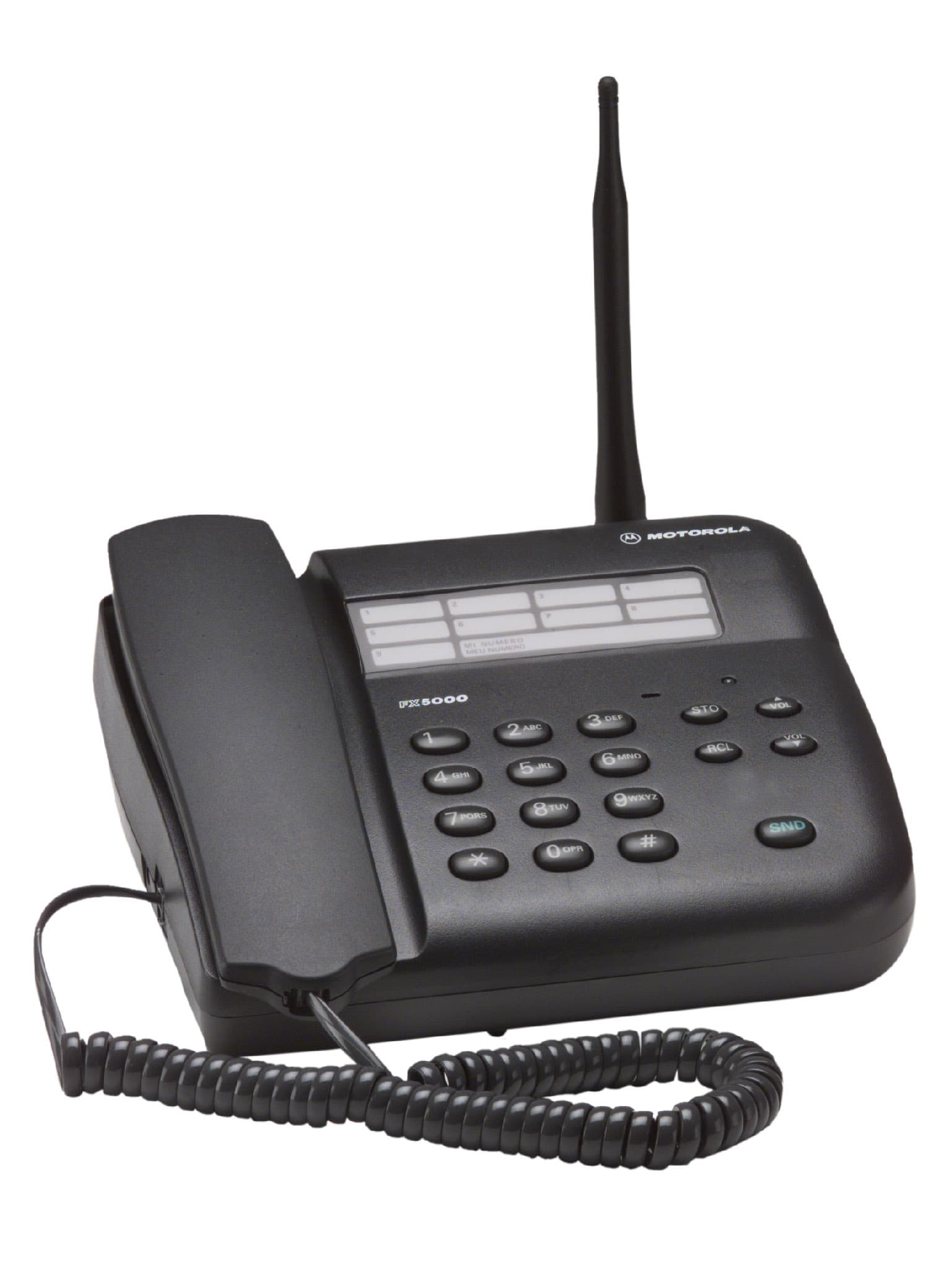
Click to zoom
Application Details
- Equipment Class
- TNB - Licensed Non-Broadcast Station Transmitter
- Date of Grant
- May 08, 2000
- Application Purpose
- Original Equipment
- Date of Application
- Mar 06, 2000
- Equipment Note
- PCS Deskset
- Frequency Range
- 1851.25000000 - 1908.75000000
- Company
- Motorola Mobility LLC
- Country
- United States
Documents & Files
Document Text
Text extracted from the exhibit documents filed with the FCC. Open a document above to read the original.
Users Manual
APPLICANT: MOTOROLA, INC.FCC ID: IHDT6ZC1 EXHIBIT 8 INSTRUCTION MANUAL A preliminary draft copy of the Users Manual follows: FX5000 Digital Fixed Wireless Telephone Cover to be Designed FX5000.book Page 1 Monday, February 14, 2000 1:24 PM Welcome Thank you for selecting Motorola — a world leader in communications technology . All Motorola wireless phones are designed and manufactured to meet Motorola’s exacting specifications and world class quality standards. The FX5000 Digital fixed wireless phone is no exception. This personal phone withstands our rigorous durability tests including temperature, humidity, and a drop test. • For any information about your wireless service, please call your service provider (Carrier). Carrier’s NameCarrier’s Phone Number • You will need to have the following information when you inquire about your phone or service. ESN NumberMSN NumberModel NumberWireless Phone NumberWarranty Expiration DateDate of Purchase Product Quality is yours with Motorola! FX5000.book Page 2 Monday, February 14, 2000 1:24 PM iii General Safety Information Wireless Operation Safety Information IMPORTANT! Read This Information Before Using Your Wireless Telephone. Exposure to Radio Frequency Signals Your fixed wireless telephone is a radio transmitter and receiver. When it is ON, it receives and also sends out radio frequency (RF) signals.European and International Agencies have set standards and recommendations for the protection of public exposure to RF electromagnetic energy. • International Commission on Non-Ionizing Radiation Protection (ICNIRP) 1996• Verband Deutscher Electringenieure (VDE) DIN-0848• Directives of the European Community, Directorate General V in Matters of Radio Frequency Electromagnetic Energy• National Radiological Protection Board of the United Kingdom, GS 11, 1998• American National Standards Institute (ANSI) IEEE. C95.1-1992• National Council on Radiation Protection and Measurements (NCRP). Report 86• Department of Health and Welfare Canada. Safety Code 6 These standards are based on extensive scientific review. For example, over 120 scientists, engineers, and physicians from universities, government health agencies, and industry reviewed the available body of research to develop the updated ANSI Standard.The design of your phone complies with these standards when used normally. During operation the user must be at least 20 centimeters away from the antenna. FX5000.book Page iii Monday, February 14, 2000 1:24 PM iv General Safety Information Antenna Care Use only the supplied or approved replacement antenna. Unauthorized antennas, modifications, or attachments could damage the phone and may violate FCC regulations. Electronic Devices Most modern electronic equipment is shielded from RF signals. However, certain electronic equipment may not be shielded against the RF signals from your fixed wireless phone. Pacemakers — The Health Industry Manufacturers Association recommends that a minimum separation of six inches (fifteen centimeters) be maintained between a fixed wireless phone and a pacemaker to avoid potential interference with the pacemaker. These recommendations are consistent with the independent research by and recommendations of Wireless Technology Research.Persons with pacemakers: • Should always keep the phone more than six inches (fifteen centimeters) from their pacemaker when the phone is turned ON. • If you have any reason to suspect that interference is taking place, turn your phone OFF immediately. Hearing Aids — Some digital wireless phones may interfere with some hearing aids. In the event of such interference, you may want to consult your hearing aid manufacturer to discuss alternatives. Other Medical Devices — If you use any other personal medical device, consult the manufacturer of your device to determine if they are adequately shielded from external RF energy. Your physician may be able to assist you in obtaining this information. Blasting Areas Do not use your fixed wireless phone in an area where blasting operations are being performed. v General Safety Information Potentially Explosive Atmospheres Do not operate your phone when in any area with a potentially explosive atmosphere and obey all signs and instructions. Sparks in such areas could cause an explosion or fire resulting in bodily injury or even death.Areas with a potentially explosive atmosphere are often, but not always, clearly marked. They include: fueling areas such as gasoline stations, below deck on boats, fuel or chemical transfer or storage facilities, vehicles using liquefied petroleum gas (such as propane or butane), areas where the air contains chemicals or particles, such as grain, dust, or metal powders. Using External Antennas Your FX5000 Digital telephone is equipped with an antenna which screws onto the transceiver. This antenna is intended for internal use, and will provide adequate operation under normal circumstances. If you elect to install an external antenna (not supplied by Motorola), you must take precautions to provide adequate lightning protection for the external antenna. Motorola assumes no liability if you elect to install an external antenna. Please Save These Instructions FX5000.book Pages iv - v Monday, February 14, 2000 1:24 PM vi General Safety Information Notes... FX5000.book Page vi Monday, February 14, 2000 1:24 PM 1 Introduction About Your New FX5000 Digital Telephone The FX5000 Digital fixed wireless phone is a convenient and efficient solution for providing residential telephone service in geographical areas where normal landline telephone service is either inadequate or not available.The FX5000 Digital telephone consists of a base (containing a keypad and an internal wireless radio transceiver), a handset, and a power supply. After your Wireless Service Provider registers your phone for wireless service, simply plug the cord into any wall outlet and you are ready to place and receive calls. Since your FX5000 Digital telephone opera…
Text truncated - open the document above for the full version.
Attestation Statements
APPLICANT: MOTOROLA, INCFCC ID: IHDT6ZC1 EXHIBIT 2A SPECIFICATION COMPLIANCE STATEMENT Engineer-in-Charge Equipment Authorization Branch Federal Communications Commission We hereby certify that this transmit and receive equipment (FCC ID: IHDT6ZC1) for single mode, single band Fixed PCS Unit use is capable of compliance with TIA/EIA-95-B Mobile Station-Base Station Compatibility Standard for Dual-Mode Spread Spectrum Systems, December 1998. (Signed – Júlio Nakane) Júlio Nakane Engineering Section Manager Cellular Subscriber Equipment (Signed – Valdir Reis) Valdir Reis Engineering Manager Cellular Subscriber Equipment APPLICANT: MOTOROLA, INCFCC ID: IHDT6ZC1 EXHIBIT 2B STATEMENT OF CERTIFICATION The technical data supplied with this application, having been taken under my supervision is hereby duly certified. The following is a statement of my qualifications: Engineering Diploma (MSEE) 1983 Industrial Engineering College (FEI) – Brazil 20 years experience in Electronic and Telecommunications Industry 3 years Cellular Design experience SIGNATURE: (signed) Júlio Nakane NAME: Júlio Nakane DATE: 28/12/99 POSITION: Engineering Manager I hereby certify that the above application was prepared under my direction and that to the best of my knowledge and belief, the facts set forth in the application and accompanying technical data are true and correct: SIGNATURE: (signed) Valdir Reis NAME: Valdir Reis DATE: 28/12/99 POSITION: Engineering Section Manager
Cover Letter(s)
APPLICANT: MOTOROLAFCC ID: IHDT6ZC1 Exhibit 13 March 8, 2000 CONFIDENTIALITY REQUEST CONTAINED WITHIN Federal Communications Commission Authorization and Evaluation Division 7435 Oakland Mills Road Columbia, Maryland 21046 Re: Application for Cellular/PCS Transceiver Certification Gentlemen: Application: Motorola, Inc., Personal Communications Sector, 600 N. U.S. Highway 45, Libertyville, Illinois 60048-1286 herein submits: Application for Equipment Authorization (FCC Form 731-October 1992 with integrated Fee Processing Form, Fee Codes EFT and EBC), application fee in the amount of $610, and Exhibits; for Certification of a Cellular Transceiver, FCC ID: IHDT5ZC1. Motorola is also the manufacturer of this equipment. Confidentiality: Pursuant to Section 0.459 of the Commission's rules (CFR 47), Motorola requests confidentiality for portions of the material contained in this application and that the identified material be withheld from public inspection following the grant of this authorization. This material contains Motorola's trade secrets and confidential information that Motorola does not customarily release to the public and which is otherwise not generally available to the public. Confidentiality is requested for the following exhibits: • Exhibit 4 Block Diagrams • Exhibit 5 Schematics • Exhibit 12 Operational Description Description: This equipment is a fixed wireless deskset which operates using the digital CDMA standard in the PCS band. Technical details for this technology are detailed in Exhibit 12. Contact Information: Please contact me by telephone at (847) 523-6167, by facsimile at (847) 523-2350, or by e-mail ([email protected]), if there are questions or additional information needed concerning this filing. Regards, Andrew J. Bachler FCC Liaison Cellular Subscriber Sector 600 N. U.S. Highway 45 Libertyville, IL 60048-5343
External Photos
APPLICANT: MOTOROLA, INC. FCC ID: IHDT6ZC1 EXHIBIT 3 Front-Top View Bottom View Showing Equipment ID
ID Label/Location Info
APPLICANT: MOTOROLA, INCFCC ID: IHDT6ZC1 EXHIBIT 1 FCC IDENTIFICATION (NAMEPLATE) INFORMATION The FCC label shown is representative of the label that will appear on the radio when in production. It will be placed on this Fixed PCS Unit as shown in Exhibit 3. Other information may also be included on this label. FCC ID: IHDT6ZC1
Internal Photos
APPLICANT: MOTOROLA, INC. FCC ID: IHDT6ZC1 EXHIBIT 9 Transceiver Board Front View (Shields Removed) Transceiver Board Rear View (Shields Removed)
Parts List/Tune Up Info
APPLICANT: MOTOROLA, INCFCC ID: IHDT6ZC1 EXHIBIT 10 TRANSCEIVER ADJUSTMENTS/TUNE-UP PROCEDURE There are no user accessible adjustments or tuning in this Fixed PCS Unit transceiver. All necessary adjustments and tuning are performed during manufacture of the product. Any Adjustments or tuning after service or repair are done as part of that process as special equipment is required to perform such adjustments.
RF Exposure Info
March 16, 2000 SAR Test Report for Motorola Desktop Phone FCC ID IHDT6ZC1. Prepared by: Paul Moller, Principal Staff Engineer Motorola Personal Communications Sector Product Safety Laboratory Libertyville, Illinois The Motorola Personal Communications Sector Product Safety & Compliance Laboratory has evaluated the Desktop Phone FCC ID IHDT6ZC1 for the need to conduct SAR evaluation. The appropriate standards are Federal Communications Commission section 47 CFR § 2.1091, the ANSI/IEEE C95.1 1992 and the NCRP Report Number 86. All of these standards have the same exclusionary requirements. Due to the design and installation of this product, it qualifies for the exclusion called out in Federal Communications Commission section 47 CFR § 2.1091 titled “Radiofrequency radiation exposure evaluation: mobile devices.” Based on the installation of the transceiver and the antenna, the transmitters radiating structure is more than 20 centimeters from the user. Thus, the Desktop Phone FCC ID IHDT6ZC1 is a “mobile device” as defined in section § 2.1091 paragraph (b). Since the transceivers transmit frequency is above 1.5GHz and its ERP with the supplied antenna is below 3 Watts, the Desktop Phone FCC ID IHDT6ZC1 is “categorically excluded from routine environmental evaluation” per paragraph (c), and thus SAR evaluation is not required. Thus, the Desktop Phone FCC ID IHDT6ZC1 does not require SAR evaluation.
RF Exposure Info
APPLICANT: MOTOROLA, INC.FCC ID: IHDT6ZC1 Exhibit 8A Wireless Operation Safety Information IMPORTANT: Read this information before using your wireless telephone. Exposure to Radio Frequency Signals Your wireless mobile telephone is a low power radio transmitter and receiver. When it is ON, it receives and also sends out radio frequency (RF) signals. International agencies have set standards and recommendations for the protection of public exposure to RF electromagnetic energy. • International Commission on Non-Ionizing Radiation Protection (ICNIRP)1996 • Verband Deutscher Elektrotechniker (VDE) DIN-0848 • United States Federal Communications Commission, Radio Frequency Exposure Guidelines (1996) • National Radiological Protection Board of the United Kingdom, GS 11, 1988 • American National Standards Institute (ANSI) IEEE. C95. 1-1992 • National Council on Radiation Protection and Measurements (NCRP). Report 86 • Ministry of Health (Canada), Safety Code 6 These standards are based on extensive scientific review. For example, over 120 scientists, engineers, and physicians from universities, government health agencies, and industry reviewed the available body of research to develop the updated ANSI standard. The design of your phone complies with these standards when used as described under "Telephone Operation." Antenna Care Use only the supplied or an approved replacement antenna. Unauthorized antennas, modifications, or attachments could damage the phone and may violate local agency regulations. Telephone Operation Do not operate your telephone when a person is within 8 inches (20 centimeters) of the antenna. A person or object within 8 inches (20 centimeters) of the antenna could impair call quality and may cause the phone to operate at a higher power level than necessary and expose that person to RF energy in excess of that established by the FCC RF Exposure Guidelines. Electronic Devices Most modern electronic equipment is shielded from RF signals. However, certain equipment may not be shielded against the RF signals from your wireless phone. Pacemakers The Health Industry Manufacturers Association recommends that a minimum separation of 6 inches (15 centimeters) be maintained between a wireless phone's antenna and a pacemaker to avoid potential interference with the pacemaker. These recommendations are consistent with the independent research by and recommendations of Wireless Technology Research. Persons with pacemakers: • should ALWAYS keep the phone more than 6 inches (15 centimeters) from their pacemaker when the phone is turned ON • should turn the phone OFF immediately if you have any reason to suspect that interference is taking place Other Medical Devices If you use any other personal medical device, consult the manufacturer of your device to determine if it is adequately shielded from external RF energy. Your physician may be able to assist you in obtaining this information. APPLICANT: MOTOROLA, INC.FCC ID: IHDT6ZC1 Exhibit 8A Blasting Areas To avoid interfering with blasting operations, turn your phone OFF when in a "blasting area" or in areas posted: "Turn off two-way radio." Obey all signs and instructions. Potentially Explosive Atmospheres Turn your phone OFF, do not remove your battery when you are in any area with a potentially explosive atmosphere, and obey all signs and instructions. Sparks from your battery in such areas could cause an explosion or fire resulting in bodily injury or even death. Areas with a potentially explosive atmosphere are often but not always clearly marked. They include: fueling areas such as gasoline stations; below deck on boats; fuel or chemical transfer or storage facilities; areas where fuel odors are present (for example, if a gas/propane leak occurs in a car or home); areas where the air contains chemicals or particles, such as grain, dust, or metal powders; and any other area where you normally would be advised to turn off your vehicle engine. Using External Antennas Your FX5000 Digital telephone is equipped with an antenna which screws onto the transceiver. This antenna is intended for internal use, and will provide adequate operation under normal circumstances. If you elect to install an external antenna (not supplied by Motorola), you must take precautions to provide adequate lightning protection for the external antenna. Motorola assumes no liability if you elect to install an external antenna. External Antenna Installation IMPORTANT: To comply with the FCC RF exposure limits and satisfy the categorical exclusion requirements for mobile transmitters, the following requirements must be met: 1. A minimum separation distance of 20 cm must be maintained between the antenna and all persons. 2. The transmitter effective radiated power must be less than 1.5 Watts ERP (2.46 Watts or 33.9 dBm EIRP). This requires that the combination of antenna gain and feed line loss does not exceed 10 dBi.
Test Report
APPLICANT: MOTOROLA, INCFCC ID: IHDT6ZC1 EXHIBIT 6 SUBMITTED MEASURED DATA INDEX EXHIBITMEASUREMENT 6A RF Power Output 6B Occupied Bandwidth, Digital Mode – Graph 6C Conducted Spurious and Harmonic Emissions, Digital Mode – Graph 6D Radiated Spurious and Harmonic Emissions, Digital Mode – Graph 6E Frequency Change vs. Temperature, Digital Mode 6F Frequency Change vs. Supply Voltage, Digital Mode - Graph APPLICANT: MOTOROLA, INCFCC ID: IHDT6ZC1 EXHIBIT 6A RF POWER OUTPUT DATA The input supply to the transmitter was set at 3.6 Volts. The RF power output was measured with the indicated voltage and current applied into the final RF amplifying device(s). DIGITAL MODE In Digital Mode the values measured for RF Output of the radio board, DC Current and RF Input Power are all average values which reflect a 100% transmit duty cycle in CDMA operation. Measured RF output: 0.326W Measured DC voltage: 3.6V Measured DC current: 580mA. Measured RF input: 2.98Mw EFFECTIVE RADIATED POWER Since the unit is intended for use with a provided antenna (and “non standard” RF connector), EIRP is measured. The dipole antenna substitution method was used. The result indicated is the maximum EIRP found over the channels and radio orientations tested. Maximum Effective Isotropic Radiated Power: Digital Mode 23.8 dBm (0.239 W) APPLICANT: MOTOROLA, INC. TRANSCEIVER TYPE: IHDT6ZC1 EXHIBIT 6B BANDWIDTH MEASUREMENT DATA FOR TRANSMITTER TYPES F9W DEVIATION OF THE CARRIER WITH OQPSK MODULATION HORIZONTAL SCALE = 1MHz / DIVISION VERTICAL SCALE = 10 dB / DIVISION (ATTENUATION) RESOLUTION BANDWIDTH = 30 kHz VIDEO BANDWIDTH = 100 Hz POWER LEVEL = 0.316W (Average Power in transmitter) MEASURED DATA: 1. Modulate the transmitter with OQPSK modulation, using pseudo random data. Obtain image on spectrum analyzer. COMMENTS: Modulation products in a bandwidth of 30 kHz ,centered +/- 1.25 MHz from the channel center frequency should be at least 45 dB and should be at least 42 dB below the mean output power level. APLICANT: MOTOROLA, INCFCC ID: IHDT6ZC1 EXHIBIT 6C 0 -20 -40 -60 -80 -100 - 100 0 100 200 23456789 10 25 5 -15 -35 -55 -75 Spurious Level ( dBc ) Spurious Level ( dBm ) Frequency from Carrier (MHz) Harmonic of Carrier DIGITAL CONDUCTED SPURIOUS AND HARMONIC EMISSIONS - GRAPH Spec Limit: 43+10log(carrier power)=-13.00dBm Data taken at L.S. Compliance Inc Measurement facility ID: 3140/SIT Oct 6, 13, 14 1999 Digital Transmitter Conduct Spurious Emissions Carrier Power: 0.34W to 0.0001 mW Carrier Frequency: 1851.25 to 1908.75 MHz in 50 kHz steps Each reported emission reflects the highest absolute level found all power levels, channels, power amplifier configuration tested All emissions not reported are more than 30 dB bellow the FCC specification No signals greater than - 80 dBm where found in the 1930 to 1990 MHz band spectrum was searched from 30 kHz to the 10th Harmonic of the transmitter - 200 APLICANT: MOTOROLA, INCFCC ID: IHDT6ZC1 EXHIBIT 6D 0 -20 -40 -60 -80 -100 - 100 0 100 200 23456789 10 25 5 -15 -35 -55 -75 Spurious Level ( dBc ) Spurious Level ( dBm ) Frequency from Carrier (MHz) Harmonic of Carrier DIGITAL RADIATED SPURIOUS AND HARMONIC EMISSIONS - GRAPH Spec Limit: 43+10log(carrier power)=-13.00dBm (82.2dBuV) Data taken at L.S. Compliance Inc Measurement facility ID: 3140/SIT Oct 6, 13, 14 1999 Digital Transmitter Conduct Spurious Emissions Carrier Power: 0.34W to 0.0001 mW Carrier Frequency: 1851.25 to 1908.75 MHz in 50 kHz steps Each reported emission reflects the highest absolute level found all power levels, channels, power amplifier configuration tested All emissions not reported are more than 20 dB bellow the FCC specification No signals greater than - 80 dBm where found in the 1930 to 1990 MHz band spectrum was searched from 30 kHz to the 10th Harmonic of the transmitter - 200 APPLICANT: MOTOROLA, INC. TRANSCEIVER TYPE: IHDT6ZC1 EXHIBIT 6E Frequency Change vs. Temperature (Digital Mode)-Graph REFERENCE OSCILLATOR FREQUENCY STABILITY VS TEMPERATURE - DIGITAL MODE -1 -0.5 0 0.5 1 -40 -30 -20 -10 0 10 20 30 40 50 60 70 TEMPERATURE (Deg C) FREQUENCY CHANGE (ppm) W.R. T. INPU T S IGNAL FREQUENCY - - - - - SPEC LIMIT: +/- 300 Hz --------- Frequency Change LOG PAGE: 116052 0 ppm = 16.8 MHz. Date 5/6/1999 Signature: APPLICANT: MOTOROLA, INCFCC ID: IHDT6ZC1 MOTOROLA CONFIDENTIAL PROPRIETARY EXHIBIT 6F REFERENCE OSCILATOR FREQUENCY STABILITY - DIGITAL MODE -1 -0.5 0 0.5 1 859095100105110115 PERCENTAGE OF NOMINAL SUPPLY VOLTAGE (%) Frequency Change (ppm) W.R.T. Input Signal Frequency 7.5 V 8.6 V
Contact Information
Applicant
Jeff Narducci(Director Product Compliance)
Technical Specifications
| # | Rule Parts | Frequency Range | Power Output | Emission | Tolerance |
|---|---|---|---|---|---|
| 1 | 24E | 1.85 GHz - 1.91 GHz | 240.00 mW | 1M25F9W | 150.0000000000 Hz |
Other Applications from Motorola Mobility LLC
IHDT56AW9
May 12, 2026Smart Watch
Equipment Class
NII - Unlicensed National Information Infrastructure TXIHDT56AW5
Apr 08, 2026Mobile Cellular Phone
Equipment Class
DTS - Digital Transmission SystemIHDT56AW6
Mar 18, 2026Smart Watch
Equipment Class
JBP - Part 15 Class B Computing Device PeripheralIHDT56AX4
Mar 17, 2026Mobile Cellular Phone
Equipment Class
PCE - PCS Licensed Transmitter held to earIHDT56AW3
Mar 03, 2026Mobile Cellular Phone
Equipment Class
6XD - 15E 6 GHz Low Power Indoor Client