KOBGTE06ARemote Control Transmitter
Lear Corporation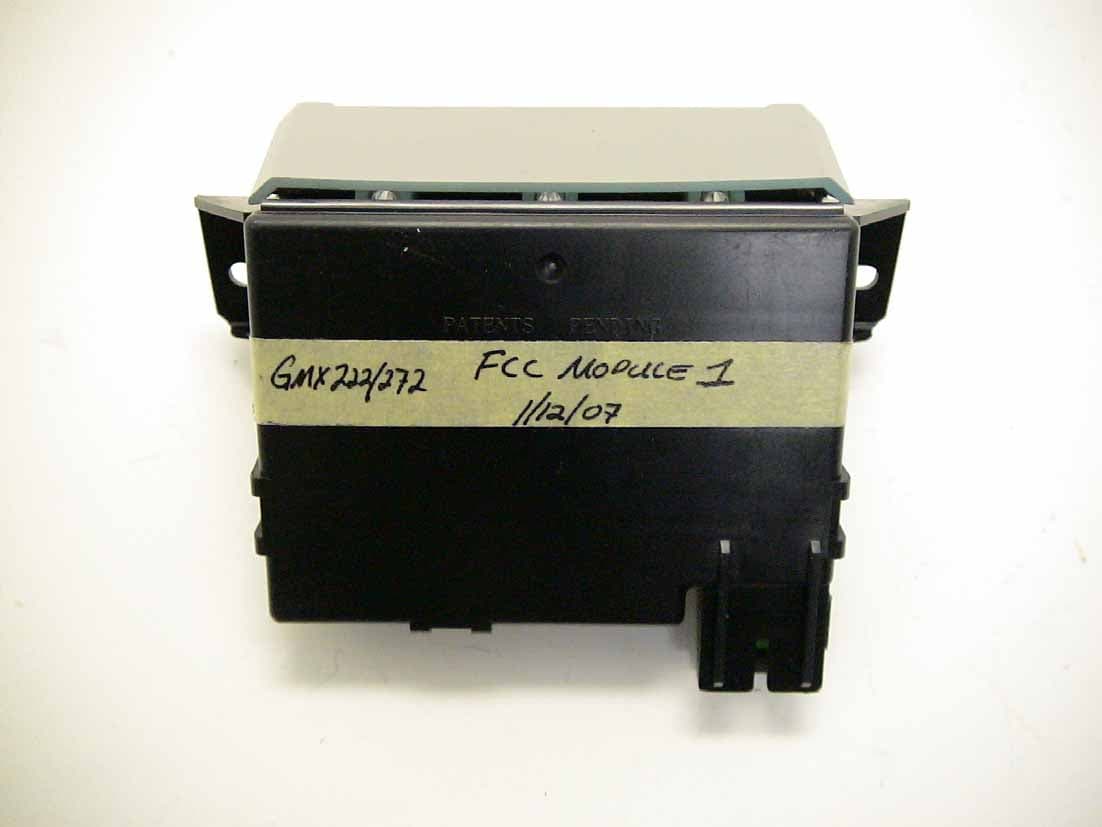
Click to zoom
Application Details
- Equipment Class
- DSC - Part 15 Security/Remote Control Transmitter
- Date of Grant
- Mar 12, 2007
- Application Purpose
- Original Equipment
- Date of Application
- Mar 11, 2007
- Equipment Note
- Remote Control Transmitter
- Frequency Range
- 390.00000000 - 390.00000000
- Company
- Lear Corporation
- Country
- United States
Documents & Files
Document Text
Text extracted from the exhibit documents filed with the FCC. Open a document above to read the original.
Users Manual
Lear UGDO Lear UGDO Owner’s Guide Version 3.2 Page 1 3/27/2006 Lear Car2U Transmitter The Lear Universal Garage Door Opener (LEAR Car2U ™) is a universal transmitter and can replace up to three different remote control transmitter units used to operate the following types of devices: xGarage Door Opener xSecurity Devices xHome Lighting Systems Additional Lear Car2U ™ information can be found on the internet at www.learcar2U.com or by calling 1-866-57Car2U. Types of Garage Door Openers (Fixed Code and Rolling Code) Lear UGDO™ has the capability of programming rolling code and fixed code garage door openers: xRolling code garage door openers are used for garage doors produced after 1996 and are code protected. Rolling code means the coded signal is changed every time your remote control garage door opener is used. xFixed code garage door openers are used for garage doors produced prior to 1996. Fixed code uses the same coded signal every time, which is manually programmed by setting DIP switches for a unique personal code. If you do not know if your garage door opener is a rolling code or fixed code device, open your garage door opener’s remote control battery cover. If a panel of DIP switches is present as shown in the typical remote device shown below, your garage door opener is a fixed code device. If not, your garage door opener is a rolling code device. Lear UGDO Lear UGDO Owner’s Guide Version 3.2 Page 2 3/27/2006 Programming the Lear UGDO™ Transmitter Depending on your garage door opener manufacturer, Lear UGDO™ provides two easy ways to program your garage door opener. 1. Rolling Code Garage Door Openers: If your garage door opener is a rolling code device and do not have a row of dip switches use the “Programming Rolling Code Garage Door Opener” procedure on page 4. 2. Fixed Code Garage Door Opener: If your garage door opener is a fixed code device and has a row of dip switches use the “Programming Fixed Code Garage Door Opener” procedure on page 6. CAUTION xDo not use the Lear UGDO™ Transmitter with any garage door opener that does not have a “stop and reverse” feature. This includes any garage door opener model manufactured before April 1, 1982. xRead the instructions completely before attempting to program the LEAR UGDO™ transmitter. Because of the steps involved, it may be helpful to have another person assist you in programming the transmitter. xBe sure to keep the original remote control transmitter for use in other vehicles as well as for future Lear UGDO™ programming. You only need it for fixed code device programming. It is also recommended that upon the sale or lease termination of the vehicle, the programmed Lear UGDO™ buttons should be erased for security reasons. Refer to “Erasing Lear UGDO™ Buttons” or for assistance, contact Lear UGDO™ at 1- 866-57Car2U. xMake sure that people and objects are clear of the garage door opener or security device you are programming. When programming a garage door, it is advised to park outside the garage. PROGRAMING CONSIDERATIONS: Read the instructions completely before attempting to program Car2U. The following items may assist you in programming the system: oA ladder oA screwdriver oA writing pad and a pencil or pen It may be helpful but is not required to have an additional person available when programming Car2U. Retain the original transmitter for use in other vehicles as well as for future programming procedures (i.e. new Car2U-equipped vehicle purchase). Upon the sale of the vehicle, it is recommended that the programmed Car2U buttons should be erased for security reasons (refer to “Erase Car2U Settings”). Repeat the programming steps for each garage door opener you wish to program up to a maximum of three. Lear UGDO Lear UGDO Owner’s Guide Version 3.2 Page 3 3/27/2006 CAUTION Programming the Rolling Code Garage Door Opener involves time-sensitive actions. Read the ENTIRE procedure prior to beginning so you will know which actions are time-sensitive. If you do not follow the time-sensitive actions, the device will time out and you will have to repeat the procedure. Make sure that your key is ON and engine OFF while programming the transmitter. Use the following steps to program up to three different devices. Lear UGDO Lear UGDO Owner’s Guide Version 3.2 Page 4 3/27/2006 Programming Rolling Code Garage Door Opener or Device 1. Firmly PRESS the outer two Lear UGDO™ buttons for one — two seconds and immediately release them. 2. Go to the garage. Locate the garage door motor head and Press and Release its “learn” button. You may need a ladder to reach the unit and you may need to remove the unit’s cover to locate the “learn” button. After pressing the “learn” Button you have 10 to 30 seconds to complete Step 3 depending on your garage control unit If you cannot locate the “learn” button, refer to the Owner’s Guide of your garage door opener or call 1-866- 57Car2U. 3. Return to your vehicle, Press and HOLD the Car2U Button you would like to use to control the garage door. Immediately (within 1 second) release the button once the garage door begins to move. You may need to hold the button from 5 to 20 seconds during which time the selected button indicator light will blink slowly. Press ANY one of the three Lear UGDO™ buttons to assign the rolling code to the garage door opener. “Learn” Button shown on typical Rolling Code Garage Door Opener Lear UGDO Lear UGDO Owner’s Guide Version 3.2 Page 5 3/27/2006 4. The indicator light will blink rapidly until programming is complete Press and release the button again. The garage door should move confirming that programming is successful and complete. 5. To program another rolling code device such as an additional garage door opener, a security device, or home lighting, repeat steps 1 – 4 substituting a different function button in Step 3 than what you used for the garage door opener. For example, you could assign the left-most button to the garage door, the center button to a security d…
Text truncated - open the document above for the full version.
Block Diagram
21557 Telegraph Road. Southfield, Michigan 48033 (248) 447-5000 Date: January 12, 2007 RE: Lear Universal Transmitter Model # UHR 222_272 FCC ID: KOBGTE06A IC: 3521A-GTE06A Block Circuit Diagram Transmit Functions The circuit is actuated when one of the three switches is depressed. The switch operation powers the module and the 20MHz crystal oscillator clock circuit of the microcontroller turns on. The microcontroller generates data internally based on the timing of the clock oscillator. The microcontroller also configures the frequency synthesizer/PLL IC for proper RF data frequency operation. The frequency synthesizer/PLL IC shares the same 20MHz clock source as the microcontroller. The data is outputted from the microcontroller to the RF amplifier, switching power on and off to the amplifier generating an AM transmission signal. The RF amplifier radiates out through a PCB trace monopole antenna.
Cover Letter(s)
Re: Certification for Lear Receiver Model(s): UHR 222_272 FCC ID: KOBGTE06A IC: 3521A-GTE06A POWER OF ATTORNEY A letter granting Valdis V. Liepa the Power of Attorney is on file and can be provided when so requested. Re: Certification for Lear Receiver Model(s): UHR 222_272 FCC ID: KOBGTE06A IC: 3521A-GTE06A REQUEST FOR CONFIDENTIALITY Pursuant to 47 CRF 0.459, Lear requests that a part of the subject application be held confidential. This comprises Exhibits (5) Schematics (10) Parts List (12) Description of Operation (Part of Exhibit only) Lear has spent substantial effort in developing this product and it is one of the first of its kind in industry. Having the subject information easily available to "competition" would negate the advantage they have achieved by developing this product. Not protecting the details of the design will result in financial hardship. If there are any questions regarding this request, please contact me at the above address or call 734-483-4211, fax 734-647-2106 or e-mail [email protected]. Sincerely, Valdis V. Liepa Research Scientist University of Michigan March 3, 2007 Re: Certification for Lear Receiver Model(s): UHR 222_272 FCC ID: KOBGTE06A IC: 3521A-GTE06A STATEMENT OF MODIFICATIONS There were no modifications made to the DUT by this test laboratory. (Also see Section 3.1 of the attached Test Report). _____________________ Valdis V. Liepa Research Scientist Re: Certification for Lear Receiver Model(s): UHR 222_272 FCC ID: KOBGTE06A IC: 3521A-GTE06A GENERAL PRODUCT INFORMATION The device, for which certification is pursued, has been designed by: Lear Corporation 5200 Auto Club Drive Dearborn, MI 48126 Tom Tang Tel: (313) 593-9934 Fax: (313) 240-3062 It will be manufactured by: Lear Corporation 5100 West Waters Avenue Tampa, FL 33634 Tom Tang Tel: (313) 593-9934 Fax: (313) 240-3062 Canadian Contact: Tom Odell 1908 Colonel Sam Drive Oshawa, ON. L1H 8P7 Tel: (905) 644-7103
Cover Letter(s)
March 3, 2007 Federal Communications Commission Equipment Approval Services P.O. Box 358315 Pittsburgh, PA 15251-5315 Re: Certification for Lear Receiver Model(s): UHR 222_272 FCC ID: KOBGTE06A IC: 3521A-GTE06A Please find enclosed application materials for certification of Lear UHR 222_272 Receiver. We tested it and found it to comply with FCC Part 15. If there are any questions regarding the application or testing performed, please contact me at the above address or call 734-483-4211, fax 734-647-2106, or e-mail [email protected]. Sincerely, Valdis V. Liepa Research Scientist March 3, 2007 Certification and Engineering Bureau Industry Canada 3701 Carling Avenue, Bldg. 94 Ottawa, Ontario K2H 8S2 Re: Certification for Lear Receiver Model(s): UHR 222_272 FCC ID: KOBGTE06A IC: 3521A-GTE06A Please find enclosed application materials for certification of Lear UHR 222_272 Receiver. We tested the device and found it to comply with RSS-GEN/102/210. The product is identified by: IC: 3521A-GTE06A If there are any questions, suggestions, etc., regarding the application or testing performed, please contact me at the above address or call 734-483-4211, fax 734-647- 2106; e-mail: [email protected]. Sincerely, Valdis V. Liepa Research Scientist
ID Label/Location Info
Bottom of DUT
Operational Description
Re: Certification for Lear Receiver Model(s): UHR 222_272 FCC ID: KOBGTE06A IC: 3521A-GTE06A DESCRIPTION OF OPERATION The Lear Universal Transmitter is a multi-frequency (8 frequencies total: 288MHz, 300MHz, 303MHz, 310MHz, 315MHz, 318MHz, 372MHz, and 390MHz) transmitter that is designed to emulate existing transmitters within a pre-defined list of manufacturers and model numbers in the market place. This transmitter has pre-programmed protocols in memory that are selectable by the user based upon the manufacturer and model number of the transmitter they are trying to emulate. The device is NOT a learning transmitter and is not capable of measuring another transmitters RF frequency or data and re- transmitting what was learned. There is no RF detector on board with which to perform such function. More details of the device operation are provided in the confidential portion of this exhibit.
Test Report
University of Michigan Radiation Laboratory FCC Part 15, IC RSS-210/Gen - Test Report No. 415031-355 Page 1 of 22 The University of Michigan Radiation Laboratory 3228 EECS Building Ann Arbor, MI 48109-2122 Tel: (734) 764-0500 Measured Radio Frequency Emissions From Lear Corporation Transmitter Model(s): UHR 222_272 Report No. 415031-355 March 3, 2007 Copyright © 2007 For: Lear Corporation 5200 Auto Club Dr. Dearborn, MI 48126-9982 Contact: Tom Tang Tel: 313-593 - 9934 Fax: 313-593-9526 PO: Verbal Tests supervised by: Measurements made by: Report approved by: _____________________ Valdis V. Liepa Valdis V. Liepa Joseph D. Brunett Research Scientist Summary Tests for compliance with FCC Regulations Part 15, Subpart C and Industry Canada RSS-210/Gen were performed on Lear Corporation model UHR 222_272. This device is subject to the Rules and Regulations as a Transmitter. In testing completed on March 2, 2007 the device tested in the worst case met the allowed specifications for radiated emissions by 1.8 dB (see p. 7-9). Besides harmonics, there were no other significant spurious emissions found; emissions from digital circuitry were negligible. Line conducted emission tests do not apply since the device is powered from a 12 VDC system. University of Michigan Radiation Laboratory FCC Part 15, IC RSS-210/Gen - Test Report No. 415031-355 Page 2 of 22 1. Introduction Lear Corporation model UHR 222_272was tested for compliance with FCC Regulations, Part 15, adopted under Docket 87-389, April 18, 1989 as subsequently amended, and with Industry Canada RSS-210, Issue 6, September 2005. The tests were performed at the University of Michigan Radiation Laboratory Willow Run Test Range following the procedures described in ANSI C63.4-2003 "Methods of Measurement of Radio-Noise Emissions from Low-Voltage Electrical and Electronic Equipment in the Range of 9 kHz to 40 GHz". The Site description and attenuation characteristics of the Open Site facility are on file with FCC Laboratory, Columbia, Maryland (FCC Reg. No: 91050) and with Industry Canada, Ottawa, ON (File Ref. No: IC 2057A-1). 2. Test Procedure and Equipment Used The pertinent test equipment commonly used in our facility for measurements is listed in Table 2.1 below. The middle column identifies the specific equipment used in these tests. Table 2.1 Test Equipment. Test Instrument Eqpt. Used Manufacturer/Model Spectrum Analyzer (0.1-1500 MHz) Hewlett-Packard, 182T/8558B Spectrum Analyzer (9kHz-22GHz) X Hewlett-Packard 8593A SN: 3107A01358 Spectrum Analyzer (9kHz-26GHz) X Hewlett-Packard 8593E, SN: 3412A01131 Spectrum Analyzer (9kHz-26GHz) Hewlett-Packard 8563E, SN: 3310A01174 Spectrum Analyzer (9kHz-40GHz) Hewlett-Packard 8564E, SN: 3745A01031 Power Meter Hewlett-Packard, 432A Power Meter Anritsu, ML4803A/MP Harmonic Mixer (26-40 GHz) Hewlett-Packard 11970A, SN: 3003A08327 Harmonic Mixer (40-60 GHz) Hewlett-Packard 11970U, SN: 2332A00500 Harmonic Mixer (75-110 GHz) Hewlett-Packard 11970W, SN: 2521A00179 Harmonic Mixer (140-220 GHz) Pacific Millimeter Prod., GMA, SN: 26 S-Band Std. Gain Horn S/A, Model SGH-2.6 C-Band Std. Gain Horn University of Michigan, NRL design XN-Band Std. Gain Horn University of Michigan, NRL design X-Band Std. Gain Horn S/A, Model 12-8.2 X-band horn (8.2- 12.4 GHz) Narda 640 X-band horn (8.2- 12.4 GHz) Scientific Atlanta , 12-8.2, SN: 730 K-band horn (18-26.5 GHz) FXR, Inc., K638KF Ka-band horn (26.5-40 GHz) FXR, Inc., U638A U-band horn (40-60 GHz) Custom Microwave, HO19 W-band horn(75-110 GHz) Custom Microwave, HO10 G-band horn (140-220 GHz) Custom Microwave, HO5R Bicone Antenna (30-250 MHz) X University of Michigan, RLBC-1 Bicone Antenna (200-1000 MHz) X University of Michigan, RLBC-2 Dipole Antenna Set (30-1000 MHz) X University of Michigan, RLDP-1,-2,-3 Dipole Antenna Set (30-1000 MHz) EMCO 2131C, SN: 992 Active Rod Antenna (30 Hz-50 MHz) EMCO 3301B, SN: 3223 Active Loop Antenna (30 Hz-50 MHz) EMCO 6502, SN:2855 Ridge-horn Antenna (300-5000 MHz) X University of Michigan Amplifier (5-1000 MHz) X Avantak, A11-1, A25-1S Amplifier (5-4500 MHz) X Avantak Amplifier (4.5-13 GHz) Avantek, AFT-12665 Amplifier (6-16 GHz) Trek Amplifier (16-26 GHz) Avantek LISN Box University of Michigan Signal Generator Hewlett-Packard 8657B University of Michigan Radiation Laboratory FCC Part 15, IC RSS-210/Gen - Test Report No. 415031-355 Page 3 of 22 3. Configuration and Identification of Device Under Test The DUT is a multi-frequency (8 frequencies total: 288MHz, 300MHz, 303MHz, 310MHz, 315MHz, 318MHz, 372MHz, and 390MHz) transmitter, 4 x 3 x 2 inches in size, designed to emulate existing garage door openers. The antenna is mounted off the PCB. The DUT was designed and manufactured by Lear Corporation, 5200 Auto Club Dr., Dearborn, MI 48126-9982. It is identified as: Lear Corporation Transmitter Model: UHR 222_272 FCC ID: KOBGTE06A IC: 3521A-GTE06A 3.1 Modes of Operation This transmitter has pre-programmed protocols selected by the user based upon garage door receiver information. There are three buttons on the device so that the user may program a separate protocol to each button. There exist 2 protocols wherein both 315 MHz and 390 MHz are used sequentially during a single button press in normal operating mode; all other protocols transmit on only a single frequency in this mode. In programming mode the device may transmit on up to 4 frequencies in a sequential manner during a single button press. The details of these modes are outlined in the included documentation. The output power of the DUT is internally adjusted according to the RF frequency and data transmitted. Duty factors are calculated in software for all fixed code transmissions. For rolling code transmissions, the duty factor is computed for the worst case maximum on time. Since the DUT is capable of transmitting a large number of different protocols over 8 different frequencies, the following test procedure has been followed. The lowest, middle, and highest frequencies have b…
Text truncated - open the document above for the full version.
Contact Information
Applicant
Kristof von Czarnowski(RF Engineer)
Technical Contact
Universuity Of MichiganValdis Liepa
[email protected]734 483 4211
1301 Beal Ave · Ann Arbor, Michigan · United States
Test Firm
University of MichiganValdis Liepa
Technical Specifications
| # | Rule Parts | Frequency Range | Power Output |
|---|---|---|---|
| 8 | 15.231 | 390 MHz - 390 MHz | - |
Other Applications from Lear Corporation
KOBJXF23B
Jul 20, 2026RKE Transmitter with UWB
Equipment Class
DSC - Part 15 Security/Remote Control Transmitter
KOBJXF23A
Sep 26, 2023RKE Transmitter with UWB
Equipment Class
DSC - Part 15 Security/Remote Control Transmitter
KOBHT13BTPM
Oct 15, 2012Security/Remote Control Transmitter
Equipment Class
DSC - Part 15 Security/Remote Control TransmitterKOBATA12A
Jun 20, 2012Remote keyless entry / Remote start
Equipment Class
DSC - Part 15 Security/Remote Control Transmitter
KOBGTE12A
Apr 20, 2012Car2U System TX
Equipment Class
DSC - Part 15 Security/Remote Control Transmitter