NKRDBPCBluetooth VoIP Cardphone
Wistron NeWeb Corporation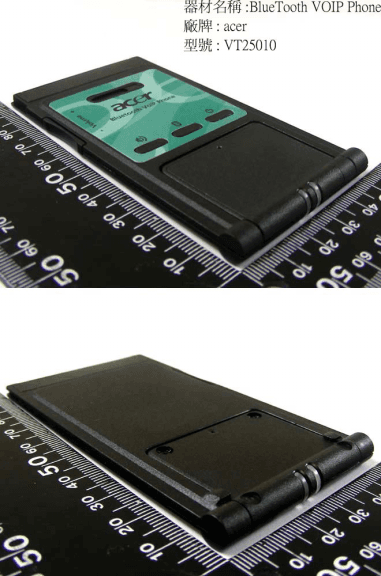
Click to zoom
Application Details
- Equipment Class
- DSS - Part 15 Spread Spectrum Transmitter
- Date of Grant
- Mar 09, 2006
- Application Purpose
- Original Equipment
- Date of Application
- Mar 08, 2006
- Equipment Note
- Bluetooth VoIP Cardphone
- Frequency Range
- 2402.00000000 - 2480.00000000
- Company
- Wistron NeWeb Corporation
- Country
- Taiwan
Documents & Files
Document Text
Text extracted from the exhibit documents filed with the FCC. Open a document above to read the original.
Users Manual
-1- Acer Bluetooth VoIP Phone Quick Guide Notices © Acer Incorporated, 2005. All Rights Reserved. Changes may be made periodically to the information in this publication without obligation to notify any person of such revision or changes. Such changes may be incorporated in new editions of this manual or supplementary documents and publications. This company makes no representations or warranties, either expressed or implied, with respect to the contents hereof and specifically disclaims the implied warranties of merchantability or fitness for a particular purpose. No part of this publication may be reproduced, stored in a retrieval system, or transmitted, in any form or by any means, electronic, mechanical, photocopy, recording, or otherwise, without the prior written permission of Acer Incorporated. Acer and the Acer logo are registered trademarks of Acer Incorporated. Other company's product names or trademarks are used herein for identification purposes only and belong to their respective companies. Safety Handle this product with care. Do not expose this product to liquids, heat, magnetic fields, dust and vibration. Do not use this product while on an airplane, while driving, near medical equipment, or in any potentially explosive area. This product is not a toy; keep it away from children. Do not attempt to disassemble this product. This product does not contain any customer serviceable or replaceable parts. Only authorized Acer service centers or partners should service the product. Bluetooth The Acer Bluetooth VoIP Phone is a Bluetooth device. It is an RF (radiofrequency) radio transmitter and receiver and communicates with Bluetooth-enabled devices. FCC This device complies with Part 15 of the FCC Rules. Operation is subject to the following two conditions: (1) this device may not cause harmful interference, and (2) this device must accept any interference received, including interference that may cause undesired operation. Lithium battery Danger of explosion if battery is incorrectly replaced. Only authorized Acer service centers or partners should remove or replace the battery. -2- Federal Communication Commission Interference Statement This equipment has been tested and found to comply with the limits for a Class B digital device, pursuant to Part 15 of the FCC Rules. These limits are designed to provide reasonable protection against harmful interference in a residential installation. This equipment generates, uses and can radiate radio frequency energy and, if not installed and used in accordance with the instructions, may cause harmful interference to radio communications. However, there is no guarantee that interference will not occur in a particular installation. If this equipment does cause harmful interference to radio or television reception, which can be determined by turning the equipment off and on, the user is encouraged to try to correct the interference by one of the following measures: - Reorient or relocate the receiving antenna. - Increase the separation between the equipment and receiver. - Connect the equipment into an outlet on a circuit different from that to which the receiver is connected. - Consult the dealer or an experienced radio/TV technician for help. This device complies with Part 15 of the FCC Rules. Operation is subject to the following two conditions: (1) This device may not cause harmful interference, and (2) This device must accept any interference received, including interference that may cause undesired operation. Information to User To assure continued compliance, (example - use only shielded interface cables when connecting to computer or peripheral devices) any changes or modifications not expressly approved by the party responsible for compliance could void the user’s authority to operate this equipment. IMPORTANT NOTE: FCC Radiation Exposure Statement: This equipment complies with FCC radiation exposure limits set forth for an uncontrolled environment. This transmitter must not be co-located or operating in conjunction with any other antenna or transmitter. The Acer Bluetooth VoIP Phone is a Bluetooth VoIP (Voice over IP) handset the size of a PC Card. 1 PC Card (PCMCIA) interface 2 Speaker 3 Power button 4 Bluetooth connection/pairing indicator (blue) 5 Charge/ Power indicator (amber) 6 Microphone 7 Phonepad 8 Bluetooth connection/pairing button 9 Speakerphone button 10 Volume up/down button Installing the software Install the software to enable Acer Bluetooth VoIP Phone functions for charging and for linking it to your notebook computer. 1. Insert the installation CD in the CD or DVD drive. 2. Locate the setup.exe file, and double-click on it. 3. Follow the onscreen instructions to complete the installation. The application icon appears on the desktop; double-click to launch it. The message box appears to indicate the phone usage status.. -2- Inserting and charging the Acer Bluetooth VoIP Phone The first time you insert the Acer Bluetooth VoIP Phone, the system detects the device. 1. Click No, not this time, and click Next>. 2. Click Install the software automatically (Recommended), and click Next>. 3. Click Finish to complete the hardware installation. When the Acer Bluetooth VoIP Phone is inserted into a PC Card slot in your Acer notebook PC, the charge/power indicator lights up in amber. It goes off when fully charged and flashes when it needs to be recharged. Note: The notebook computer has to be on to charge the phone. It takes about four hours for a full charge. Pairing with your notebook Before you can use Acer Bluetooth VoIP Phone, you need to pair it with your notebook. You will only need to do this once. 1. Press the Bluetooth communication button on your Acer notebook PC to turn on Bluetooth connectivity. 2. Double-click the Bluetooth icon on the taskbar. My Bluetooth Places window appears. -3- Note: If you cannot see the tasks pane in My Bluetooth Places, click Tools, Folder Options...; then click Show common tasks in fol…
Text truncated - open the document above for the full version.
Cover Letter(s)
Rev 2 C:\tmp\06LR004 VT25010\FCC\AP FORM.doc 02/08/02 American Telecommunications Certification Body, Inc. 6731 Whittier Avenue McLean, VA 22101 Ph: (703) 847-4700 FAX: (703) 847-6888 Certification Application Package AmericanTCB CERTIFICATION APPLICATION Rev 2 C:\tmp\06LR004 VT25010\FCC\AP FORM.doc 02/08/02 Wistron NeWeb Corporation No. 10-1, Li-hsin Road I, Science-based Industrial Park Hsinchu 300, Taiwan, R. O. C. This TESTING AND CERTIFICATION AGREEMENT ("Agreement") is made effective as of the latter date of execution below, by and between American Telecommunication Certification Body (ATCB) and Wistron NeWeb Corporation (Applicant), collectively referred to as "the Parties". Equipment Description Equipment Description: Bluetooth VoIP Phone Model Number: VT25010 FCC Rule Part(s): 15C In consideration of the mutual covenants in this Agreement, ATCB or its subcontractors will perform certification inspection services to determine if Applicant's device(s) identified above under Equipment Description (hereinafter "Devices") are in compliance with the laws, regulations and technical standards (hereinafter "Certification Regulations") of the national authorities specified by Applicant in Schedule A. 1. General 1.1 This Agreement is for the purpose of testing and certification and applies to all tests, audits, and certifications for the Devices, and will be performed in accordance with the Certification Regulations of the national authorities specified in Schedule A. 1.2 ATCB retains full discretion to determine if the Devices are compliant with the Certification Regulations of the Countries. In the event that certification is not issued for the aforementioned Devices, ATCB agrees to advise Applicant in writing of the reasons thereof. 1.3 This Agreement may not be assigned to or acquired by any other person, firm, or corporation without ATCB's written authorization. 2. Scope of Performance 2.1 The scope of performance between the Parties shall be agreed to by contract, purchase order or other mutually agreed-upon schedule or order. 2.2 Except as provided in Section 2.3 hereof, testing of all Devices shall take place at ATCB facilities. 2.3 In lieu of section 2.2 above, ATCB may agree to accept test data from any ISO/IEC Guide 25 accredited laboratory or FCC-Listed Laboratory and evaluate the Devices on the basis of this data. ATCB may also choose to accept test data from ISO Guide 25 accredited laboratories owned by Applicant, provided the requirements of 2.3.1. are met. 2.3.1 Employees of Applicant shall not participate in any tests, evaluations, or assessments described in sections 2.2 or 2.3 above without the presence and supervision of an ATCB engineer or technician. 2.4 If requested for sample purposes (as required by the FCC), client shall supply ATCB, at no charge, with at least one test sample of each Device, including the necessary peripherals, connecting cables, accessories or other hardware or software (hereinafter collectively referred to as "support equipment") required for testing, evaluation, and assessment. 2.5 Applicant shall supply ATCB, at no charge, with all technical documentation and materials required for the testing, evaluation, and assessment of such Devices and support equipment. 2.5.1 Technical documentation and materials include, but are not limited to, any relevant operating instructions, schematics, block diagrams, photographs, prior tests and certificates concerning the safety of the Devices, its components or support equipment. 2.6 Applicant recognizes that Device samples, including support equipment, may be damaged or completely destroyed when subjected to ATCB's testing and evaluation process. Applicant shall hold ATCB harmless for any such damage or destruction to its equipment. 2.7 If necessary ATCB shall test, evaluate, or assess Applicant's equipment within 30 business days of ATCB's receipt of such Devices, support equipment and technical documentation, and to work diligently until certification is granted or denied, or Applicant decides to abandon testing, evaluation, and assessment on such Devices. AmericanTCB CERTIFICATION APPLICATION Rev 2 C:\tmp\06LR004 VT25010\FCC\AP FORM.doc 02/08/02 2.8 Upon completion of testing, evaluation, or assessment, ATCB shall advise Applicant via an abbreviated report whether the results are favorable, and what, if any, conditions, limitations or qualifications to the requested Certification exist. 2.9 Applicant agrees that a full report is available to Applicant only by special request, and for the separate charge specified. 2.10 Where testing, evaluation, and assessment results in certification, ATCB shall certify Applicant's equipment as compliant with the laws, regulations and/or standards of the Countries within 30 business days from the date testing, evaluation, and assessment is completed. 2.10.1 Section 2.11 may be dependent upon a timely response by the United States Federal Communications Commission (FCC) or its foreign equivalent. 2.10.2 In the event of product certification, Applicant may request that ATCB return or destroy Applicant's Device sample(s), equipment support, and technical documentation. Applicant shall bear all costs associated with the return or destruction of such equipment test sample(s) and support equipment. 2.11 Where testing, evaluation, and assessment does not result in certification, ATCB shall provide cost-free storage for each Device sample, support equipment, and technical documentation for a period not to exceed 30 days, provided Applicant agrees to re-testing within this period when notified of the Device's failure. 2.12 If Applicant does not collect or accept receipt of the Device sample(s), support equipment and technical documentation, despite ATCB having sent notice pursuant to subsection 2.12.1, ATCB reserves the right to dispose of them at Applicant's expense. 2.13 Applicant shall retain all documents forwarded to it by ATCB as required by the Certification Regulations of…
Text truncated - open the document above for the full version.
External Photos
International Standards Laboratory Report Number: ISL-06LR004P HC LAB:NVLAP:200234-0;VCCI: R-341,C-354;BSMI:SL2-IN-E-0037;SL2-R1-E-0037;CNLA:1178; IC:IC4067 LT LAB: NVLAP:200234-0;VCCI: R-1435,C-1440;NEMKO:ELA 113B;CNLA:0997; IC:IC4164-1 -1- EUT-1. International Standards Laboratory Report Number: ISL-06LR004P HC LAB:NVLAP:200234-0;VCCI: R-341,C-354;BSMI:SL2-IN-E-0037;SL2-R1-E-0037;CNLA:1178; IC:IC4067 LT LAB: NVLAP:200234-0;VCCI: R-1435,C-1440;NEMKO:ELA 113B;CNLA:0997; IC:IC4164-1 -2- EUT-2.
ID Label/Location Info
Label Location Warning statement Label
Internal Photos
International Standards Laboratory Report Number: ISL-06LR004P HC LAB:NVLAP:200234-0;VCCI: R-341,C-354;BSMI:SL2-IN-E-0037;SL2-R1-E-0037;CNLA:1178; IC:IC4067 LT LAB: NVLAP:200234-0;VCCI: R-1435,C-1440;NEMKO:ELA 113B;CNLA:0997; IC:IC4164-1 -3- EUT-3. International Standards Laboratory Report Number: ISL-06LR004P HC LAB:NVLAP:200234-0;VCCI: R-341,C-354;BSMI:SL2-IN-E-0037;SL2-R1-E-0037;CNLA:1178; IC:IC4067 LT LAB: NVLAP:200234-0;VCCI: R-1435,C-1440;NEMKO:ELA 113B;CNLA:0997; IC:IC4164-1 -4- EUT-4.
RF Exposure Info
FCC ID: NKRDBPC No SAR Evaluation Required if power is below the following threshold: Tunable Range F(GHz) Low F(GHz) High Center of Tunable Band (GHz) 60/f SAR Limitation mW 2.4 022.4802.44124.62 Maximum measured transmitter power: Pout Conducted (mW) Maximum Antenna Gain dBi Pout EIRP (mW ) 2.71 1.13 3.44 Threshold for no SAR evaluation is 24.62 mW Maximum TX Power is 2.71mW Conducted and 3.44mW EIRP Conclusion: No SAR evaluation required since maximum Transmitter Pout (both conducted and EIRP) is below FCC threshold
RF Exposure Info
Antenna Report Prepared by Steven Chang 2006/02/21 Coordinates system -x -Y +z -Y -x +z VSWR 2.9 GHz 1 U/1 U11 U CH1 1 U/ REF 1 U START 2GHz ST O P 3 GHz 100 MHz/ SWR LIN FI L 1 k 1kFI L 1 k 1kCP L CAIOFS M 1 2 3 1: 1.493 U 2.4 GHz 2: 1.307 U 2.45 GHz 3: 1.341 U 2.5 GHz 〈 1 U Date: 21.FEB.06 08:52:11 +Z-X Plane Pattern -X +Z +Z-Y Plane Pattern +Z -Y XY Plane pattern -Y -X
Test Report
Report Number: ISL-06LR004FC Issue Date: 2006/03/08 HC LAB:NVLAP:200234-0;VCCI: R-341,C-354;BSMI:SL2-IN-E-0037;SL2-R1-E-0037;CNLA:1178; IC:IC4067 LT LAB: NVLAP:200234-0;VCCI: R-1435,C-1440;NEMKO:ELA 113B;CNLA:0997; IC:IC4164-1 ISL-T10-R2-3 Test Report for FCC Part 15 Subpart B & C of Product Name Bluetooth VoIP Phone Model VT25010 (Brand: acer) Applied by: Wistron Neweb Corporation No. 10-1, Li-hsin Road 1, Science-based Industrial Park,Hsinchu 300, Taiwan, R. O. C. Test Performed by: International Standards Laboratory No. 120, Lane 180, San Ho Tsuen, Hsin Ho Rd. Lung-Tan Hsiang, Tao Yuan County 325 Taiwan, R.O.C. Tel:(03)407-1718 Fax:(03)407-1738 FCC ID: NKRDBPC International Standards Laboratory Report Number: 06LR004FC HC LAB:NVLAP:200234-0;VCCI: R-341,C-354;BSMI:SL2-IN-E-0037;SL2-R1-E-0037;CNLA:1178; IC:IC4067 LT LAB: NVLAP:200234-0;VCCI: R-1435,C-1440;NEMKO:ELA 113B;CNLA:0997; IC:IC4164-1 -i- Contents of Report 1. General........................................................................................................ 1 1.1 Certification of Accuracy of Test Data ........................................................................ 1 2. Test Results Summary............................................................................ 2 3. Description of Equipment Under Test (EUT)................................... 3 4. TEST RESULTS (Bluetooth)......................................................... 4 4.1 Powerline Conducted Emissions .................................................................................. 4 4.1.1 EUT Configuration................................................................................................................. 4 4.1.2 Test Procedure.......................................................................................................................... 4 4.1.3 EMI Receiver/Spectrum Analyzer Configuration (for the frequencies tested).4 4.1.4 Test Data:.................................................................................................................................... 5 4.2 FHSS Maximum Peak Output Power ........................................................................... 7 4.2.1 Test Procedure.......................................................................................................................... 7 4.2.2 Test Setup................................................................................................................................... 7 4.2.3 Test Data..................................................................................................................................... 7 4.3 Radiated Emission Measurement ................................................................................. 9 4.3.1 EUT Configuration................................................................................................................. 9 4.3.2 Test Procedure.......................................................................................................................... 9 4.3.3 EMI Receiver/Spectrum Analyzer Configuration (for the frequencies tested).9 4.3.4 Test Data (30MHz – 1GHz):............................................................................................. 10 4.3.5 Test Data ( 1GHz – 25 GHz) ............................................................................................ 12 4.4 Band Edge Measurement............................................................................................ 15 4.4.1 Test Procedure (Conducted).............................................................................................. 15 4.4.2 Test Setup (Conducted)....................................................................................................... 15 4.4.3 Test Data:.................................................................................................................................. 15 4.4.4 Test Procedure (Radiated).................................................................................................. 17 4.4.5 Test Setup (Radiated)........................................................................................................... 17 4.4.6 Test Data................................................................................................................................... 18 4.5 Bandwidth & Hopping Channel Separation ............................................................... 21 4.5.1 Standard Applicable...................................................................................................................... 21 4.5.2 Test Procedure .............................................................................................................................. 21 4.5.3 Test Setup................................................................................................................................. 21 4.5.4 Test Data................................................................................................................................... 22 4.6 Number of Hopping Frequency Used......................................................................... 26 4.6.1 Test Procedure .............................................................................................................................. 26 4.6.2 Test Setup................................................................................................................................. 26 4.6.3 Test Data................................................................................................................................... 26 4.7 Dwell Time .................................................................................................................28 4.7.1 Test Procedure .............................................................................................................................. 28 4.7.2 Test Setup.......................................................................................................…
Text truncated - open the document above for the full version.
Test Setup Photos
The Front View of Highest Conducted Set-up For EUT The Back View of Highest Conducted Set-up For EUT The Front View of Highest Radiated Set-up For EUT The Back View of Highest Radiated Set-up For EUT
Contact Information
Applicant
William Su(Senior Director / System Engineering dept.)
Technical Contact
International Standards LaboratoryDaphne Liu
[email protected]+886 2 2646 2550
No. 65, Ku Dai Keng St. · Hsinchu · Taiwan
Non-Technical Contact
International Standards LaboratoryJerry Chiou
[email protected]+886 3 407 1718
Test Firm
International Standards LaboratoryDavid Wu
Technical Specifications
| # | Rule Parts | Frequency Range | Power Output |
|---|---|---|---|
| 1 | 15C | 2.40 GHz - 2.48 GHz | 2.70 mW |
Other Applications from Wistron NeWeb Corporation
NKR-ATTCGW453
Aug 25, 2026Enterprise product
Equipment Class
NII - Unlicensed National Information Infrastructure TXNKR-LS06B
Aug 24, 2026Touchscreen
Equipment Class
NII - Unlicensed National Information Infrastructure TXNKR-DWSZW
Aug 10, 2026Door/Window Sensor
Equipment Class
DXX - Part 15 Low Power Communication Device TransmitterNKR-TELE2
Jun 26, 2026TELE2
Equipment Class
NII - Unlicensed National Information Infrastructure TXNKR-VMC-SA525MAX
Jun 05, 2026NAD (Network Access Device)
Equipment Class
CXX - Communications Rcvr for use w/ licensed Tx and CBs