PX2001Low Power Transmitter
Abbott Neuromodulation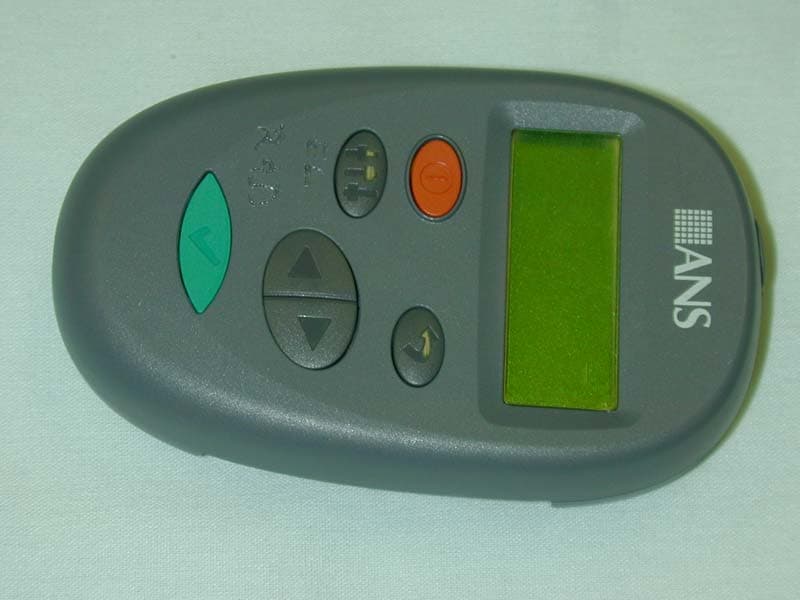
Click to zoom
Application Details
- Equipment Class
- DCD - Part 15 Low Power Transmitter Below 1705 kHz
- Date of Grant
- Mar 12, 2002
- Application Purpose
- Original Equipment
- Date of Application
- Mar 12, 2002
- Equipment Note
- Low Power Transmitter
- Frequency Range
- 0.08750000 - 0.08750000
- Company
- Abbott Neuromodulation
- Country
- United States
Documents & Files
Document Text
Text extracted from the exhibit documents filed with the FCC. Open a document above to read the original.
Users Manual
Genesis Programmer User’s Guide USER’S GUIDE Neurostimulation has been shown to benefit patients with certain types of chronic intractable pain conditions. It uses a method of pain control that replaces areas of chronic pain with a more pleasant tingling or massaging sensation called paresthesia. This manual will help you understand how to use and care for your Genesis Implantable Pulse Generator (IPG) and Programmer. Thoroughly review this manual before using your system and ask anyone involved in your care to also read it. If you have questions beyond those addressed in this manual, or if an unusual situation arises, consult your physician. Your physician is familiar with your medical history and can give you more detailed information. For assistance or questions about the system not covered in this manual call: 1 (800) 727-7846 or (972) 309-8000 © October 2001 by Advanced Neuromodulation Systems, Inc. All Rights Reserved. Genesis TM is a trademark and MultiStim ® , PC-Stim ® and Patient Controlled Stimulation ® are registered trademarks of Advanced Neuromodulation Systems, Inc. CAUTION: Federal law (USA) restricts this device to sale by or on the order of a physician. 37-0426-01A.qxd 2/13/02 10:08 AM Page ii Genesis Programmer User’s Guide1 CONTENTSPage Indications for Use, Contraindication, Warnings, Precautions and Adverse Effects . . . . . . . . . . . . . . . . . . . . . . . . . . . . .2 Genesis (IPG) Neurostimulation System Clinical Summary . . . . . . . . . . .6 System Registration . . . . . . . . . . . . . . . . . . . . . . . . . . . . . . . . . . . . . . . .10 Service Information . . . . . . . . . . . . . . . . . . . . . . . . . . . . . . . . . . . . . . . .10 Patient Accessories and Ordering Information . . . . . . . . . . . . . . . . . . .10 System Description . . . . . . . . . . . . . . . . . . . . . . . . . . . . . . . . . . . . . . . . .11 Definitions . . . . . . . . . . . . . . . . . . . . . . . . . . . . . . . . . . . . . . . . . . . . . . .12 The Genesis Programmer . . . . . . . . . . . . . . . . . . . . . . . . . . . . . . . . . . . .13 The Operational Display Screen . . . . . . . . . . . . . . . . . . . . . . . . . . . . . . .15 Starting Your Genesis System . . . . . . . . . . . . . . . . . . . . . . . . . . . . . . . . .18 To Begin Stimulation . . . . . . . . . . . . . . . . . . . . . . . . . . . . . . . . . . . . . . .20 Introduction to Program Selection* (Optional Features) . . . . . . . . . . .21 Using the Balance Control . . . . . . . . . . . . . . . . . . . . . . . . . . . . . . . . . . .23 Fine-Tuning Your System . . . . . . . . . . . . . . . . . . . . . . . . . . . . . . . . . . . .25 Partially Authorized Programmers . . . . . . . . . . . . . . . . . . . . . . . . . . . . .27 Programmer Battery Information . . . . . . . . . . . . . . . . . . . . . . . . . . . . .27 Battery Removal and Installation . . . . . . . . . . . . . . . . . . . . . . . . . . . . . .28 To End Stimulation . . . . . . . . . . . . . . . . . . . . . . . . . . . . . . . . . . . . . . . . .29 Using Your Magnet . . . . . . . . . . . . . . . . . . . . . . . . . . . . . . . . . . . . . . . .30 Genesis System End of Life . . . . . . . . . . . . . . . . . . . . . . . . . . . . . . . . . .31 Caring For Your Programmer . . . . . . . . . . . . . . . . . . . . . . . . . . . . . . . . .32 Troubleshooting . . . . . . . . . . . . . . . . . . . . . . . . . . . . . . . . . . . . . . . . . . .33 Changes in the Stimulation Sensation . . . . . . . . . . . . . . . . . . . . . . . . . .34 Troubleshooting Guidelines . . . . . . . . . . . . . . . . . . . . . . . . . . . . . . . . . .36 Limited Warranty . . . . . . . . . . . . . . . . . . . . . . . . . . . . . . . . . . . . . . . . . .39 Customer Service Information . . . . . . . . . . . . . . . . . . . . . . . . . . . . . . . . .42 Notes . . . . . . . . . . . . . . . . . . . . . . . . . . . . . . . . . . . . . . . . . . . . . . . . . . . .43 Index . . . . . . . . . . . . . . . . . . . . . . . . . . . . . . . . . . . . . . . . . . . . . . . . . . . .44 37-0426-01A.qxd 2/13/02 10:08 AM Page 1 2Genesis Programmer User’s Guide INDICATIONS FOR USE, CONTRAINDICATIONS, WARNINGS, PRECAUTIONS AND ADVERSE EFFECTS INDICATIONSFOR USE The Genesis (IPG) Neurostimulation System is indicated as an aid in the management of chronic intractable pain of the trunk and/or limbs including unilateral or bilateral pain associated with any of the following: failed back surgery syndrome, and intractable low back and leg pain. CONTRAINDICATIONS The system is contraindicated for patients with demand type cardiac pacemakers. If you are unable to operate the system or fail to receive effective pain relief during trial stimulation you cannot be implanted with a SCS. WARNINGS This section lists the potential hazards associated with spinal cord stimulation that you must be aware of to avoid serious outcomes that may cause injury or death. You should not use Spinal Cord Stimulation (SCS) if you are a poor surgical risk, have multiple illnesses or active general infections. Diathermy Therapy – You cannot have any short-wave diathermy, microwave diathermy or therapeutic ultrasound diathermy (all now referred to as diathermy) on your body if you have any part of a spinal cord stimulator implanted. Energy from diathermy can be transferred through the implanted system and can cause tissue damage at the location of the implanted electrodes, resulting in severe injury or death. Diathermy is further prohibited because it may also damage the neurostimulation system components resulting in loss of therapy, requiring additional surgery for system implantation and replacement. Injury or damage can occur during diathermy treatment whether the neurostimulation system is turned "On” or “Off." You are advised to inform their health care professional that you cannot be exposed to diathermy treatment. Operation of Machines, Equipment, and Vehicles — Do not drive, operate heavy machinery or power tools with the stimu…
Text truncated - open the document above for the full version.
Block Diagram
RF Tr a n s m i t t e r RF Re c e i v e r P r ogr a m m i n g W a nd T r ans / R ec v Po w e r An t S i gn al Li n e Di r e c t i o n Co n t r o l Po we r a n d S i gn a l Li ne P r ot e c t i on Po w e r C o ndi t i oni ng R e ce i v e A m p l i f i e r S uppl y T r an sm i t & S i gn a l C o nd i t i o ni n g S u pp l y R e c e i v er S i gnal C o nd i t i o n i ng Re c e i v e Bl a n k i n g P r ogr am m e r I/O O LC D D i s p l a y Ke y P a d
External Photos
FCC ID: PX2001 External photos
ID Label/Location Info
FIGURE 3 (37-0277-03) 2x R.25 .29 2x R.05 1.23 DETAIL 3 – PANTONE BLACK (37-0277-03) • Vertical target distance ⊕: 1.25 +/-.01 inches • Horizontal target distance ⊕: 2.25 +/-.01 inches
Internal Photos
FCC ID: PX2001 Internal photos
Operational Description
THE GENESIS IPG SYSTEM The Genesis TM System is a multi-programmable implantable neurostimulation system designed to deliver low-intensity, electrical impulses to nerve structures. The system consists of a hand-held battery powered patient programmer which communicates to a self-powered implantable pulse generator (IPG). The IPG delivers electrical impulses through an implanted lead(s) to the selected nerve fibers in order to provide therapeutic stimulation. The patient programmer enables the patient to adjust current stimulation parameters and select new programs for customized therapy. The Genesis Programmer and IPG communicate by modulating a 116Khz +/-5% signal for data sent to the IPG and modulating a 40Khz signal for data sent back to the patient programmer. The data is modulated using a standard 2400 Baud RS232 protocol. All of the RF circuitry for the patient programmer is included in the paddle-like device which attaches to the patient programmer called the ‘wand’. The wand must be placed within several inches of the implanted IPG to communicate with it. For the transmitter section of the wand circuitry, timer circuitry generates a signal which is approximately 116Khz that drives the carrier signal through an airwound inducter that acts as an antenna. The carrier is switched on and off by a signal from the patient programmer such that it meets the RS232 2400 baud timing requirements. For the receiver section of the wand circuitry, when the wand is in receive mode, the airwound inductor becomes part of a 40Khz LC resonant tank circuit and the received carrier is sent through a two stage 40Khz bandpass circuit where it is then lowpass filtered to recover a 2400 baud logic level signal.
Test Report
Nemko Test Report: 1L0548RUS1 Applicant: Advanced Neuromodulation Systems, Inc, 6501 Windcrest Drive, Suite 100 Plano, Texas 75024 Equipment Under Test: Genesis System (E.U.T.) In Accordance With: FCC Part 15, Subpart C, Paragraph 15.209 General Limits For Low Power Transmitters Tested By: Nemko Dallas Inc. 802 North Kealy Dallas, TX 75057 Authorized By: Tom Tidwell, Wireless Group Manager Date: 01/04/2002 Total Number of Pages: 15 Nemko Dallas FCC PART 15, SUBPART C PARAGRAPH 15.209 PROJECT NO.:1L0548RUS1 EQUIPMENT:Genesis System Page 2 of 15 Table of Contents SECTION 1. SUMMARY OF TEST RESULTS.................................................................................................3 SECTION 2. GENERAL EQUIPMENT SPECIFICATION..............................................................................5 SECTION 3. POWERLINE CONDUCTED EMISSIONS.................................................................................7 SECTION 4. RADIATED EMISSIONS..............................................................................................................8 SECTION 5. TEST EQUIPMENT LIST..........................................................................................................13 ANNEX A - TEST DIAGRAMS..........................................................................................................................14 Nemko Dallas FCC PART 15, SUBPART C PARAGRAPH 15.209 PROJECT NO.:1L0548RUS1 EQUIPMENT:Genesis System Page 3 of 15 Section 1. Summary Of Test Results Manufacturer: Advanced Neuromodulation Systems, Inc, Model No.: Genesis System Serial No.: None General: All measurements are traceable to national standards. These tests were conducted on a sample of the equipment for the purpose of demonstrating compliance with FCC Part 15, Subpart C for low power devices. All tests were conducted using measurement procedure ANSI C63.4-1992. Radiated Emissions were made on an open area test site. New Submission Production Unit Class II Permissive Change Pre-Production Unit THIS TEST REPORT RELATES ONLY TO THE ITEM(S) TESTED. THE FOLLOWING DEVIATIONS FROM, ADDITIONS TO, OR EXCLUSIONS FROM THE TEST SPECIFICATIONS HAVE BEEN MADE. See “ Summary of Test Data”. NVLAP LAB CODE: 100496-0 Nemko Dallas Inc. authorizes the above named company to reproduce this report provided it is reproduced in its entirety and for use by the company’s employees only. Any use which a third party makes of this report, or any reliance on or decisions to be made based on it, are the responsibility of such third parties. Nemko Dallas Inc. accepts no responsibility for damages, if any, suffered by any third party as a result of decisions made or actions based on this report. This report applies only to the items tested. Nemko Dallas FCC PART 15, SUBPART C PARAGRAPH 15.209 PROJECT NO.:1L0548RUS1 EQUIPMENT:Genesis System Page 4 of 15 Summary Of Test Data NAME OF TEST PARA. NO. RESULT Powerline Conducted Emissions 15.207 N/A Radiated Emissions 15.209 Complies Footnotes For N/A’s: The device is battery powered. (Qty 3, AAA) Nemko Dallas FCC PART 15, SUBPART C PARAGRAPH 15.209 PROJECT NO.:1L0548RUS1 EQUIPMENT:Genesis System Page 5 of 15 Section 2. General Equipment Specification Frequency Range: 87.5 kHz +/- 2.5 kHz Operating Frequency(ies) of Sample: 87.3 kHz Crystal Frequencies: 3.6 MHz Integral Antenna Yes No Note: If antenna is not integral to transmitter explain method of attachment and type of unique connector: Nemko Dallas FCC PART 15, SUBPART C PARAGRAPH 15.209 PROJECT NO.:1L0548RUS1 EQUIPMENT:Genesis System Page 6 of 15 Description of Modification for Class II Permissive Change Not Applicable Modifications Made During Testing Not Applicable Theory of Operation The Genesis TM System is a multi-programmable implantable neurostimulation system designed to deliver low- intensity, electrical impulses to nerve structures. The system consists of a hand-held battery powered patient programmer which communicates to a self-powered implantable pulse generator (IPG). The IPG delivers electrical impulses through an implanted lead(s) to the selected nerve fibers in order to provide therapeutic stimulation. The patient programmer enables the patient to adjust current stimulation parameters and select new programs for customized therapy. The Genesis Programmer and IPG communicate by modulating a 87.5 kHz +/-2.5 kHz signal for data sent to the IPG and modulating a 40Khz signal for data sent back to the patient programmer. The data is modulated using a standard 2400 Baud RS232 protocol. All of the RF circuitry for the patient programmer is included in the paddle- like device which attaches to the patient programmer called the ‘wand’. The wand must be placed within several inches of the implanted IPG to communicate with it. For the transmitter section of the wand circuitry, timer circuitry generates a signal which is approximately 87.5 kHz that drives the carrier signal through an airwound inducter that acts as an antenna. The carrier is switched on and off by a signal from the patient programmer such that it meets the RS232 2400 baud timing requirements. For the receiver section of the wand circuitry, when the wand is in receive mode, the airwound inductor becomes part of a 40Khz LC resonant tank circuit and the received carrier is sent through a two stage 40Khz bandpass circuit where it is then lowpass filtered to recover a 2400 baud logic level signal. System Diagram Nemko Dallas FCC PART 15, SUBPART C PARAGRAPH 15.209 PROJECT NO.:1L0548RUS1 EQUIPMENT:Genesis System Page 7 of 15 Section 3. Powerline Conducted Emissions NAME OF TEST: Powerline Conducted Emissions PARA. NO.: 15.207 TESTED BY: DATE: Minimum Standard: Frequency Maximum Powerline Conducted RF Voltage (MHz) (μV) (dBμV) 0.45 - 30.0 250 48 Test Results: Complies / Does not comply. See attached graph(s). Measurement Data: See attached graph(s). Method of Measurement: (Procedure ANSI C63.4-1992) Measurements were made using a spectrum analyzer w…
Text truncated - open the document above for the full version.
Test Setup Photos
FCC ID: PX2001 Test setup photos
Contact Information
Applicant
Manasi Khare(Director, Regulatory Affairs)
Test Firm
Nemko Dallas, Inc.Michael Cantwell
Technical Specifications
| # | Rule Parts | Frequency Range | Power Output |
|---|---|---|---|
| 1 | 15C | 0.0875 MHz - 0.0875 MHz | - |
Other Applications from Abbott Neuromodulation
PX2-ORMET1
Jul 21, 2024Abbott ORN Exit Tool
Equipment Class
DCD - Part 15 Low Power Transmitter Below 1705 kHz
PX2-GMCHG1
Feb 01, 202316000
Equipment Class
DTS - Digital Transmission System