QDJ-0212BAC01PCS 1900 Mobile Handset
Chi Mei Communication Systems, Inc.Application Details
- Equipment Class
- PCE - PCS Licensed Transmitter held to ear
- Date of Grant
- Feb 02, 2003
- Application Purpose
- Original Equipment
- Date of Application
- Feb 02, 2003
- Equipment Note
- PCS 1900 Mobile Handset
- Frequency Range
- 1850.20000000 - 1909.80000000
- Country
- Taiwan
Documents & Files
Document Text
Text extracted from the exhibit documents filed with the FCC. Open a document above to read the original.
Users Manual
GSM/GPRS Phone User Guide Copyright Statement Copyright 2002 by CMCS. All rights reserved. No part of this publication may be reproduced, trans- mitted, transcribed, stored in a retrieval system or translated into any language or computer language, in any form or by any means, electronic, mechanical, magnetic, optical, chemical, manual or other- wise, without the prior written permission of CMCS. Disclaimer CMCS makes no representations or warranties, either expressed or implied, with respect to the con- tents hereof and specifically disclaims any warranties, merchantability or fitness for any particular pur- pose. Further, CMCS reserves the right to revise this publication and to make changes from time to time in the contents hereof without obligation of CMCS to notify any person of such revision or changes. ALL INFORMATION IS PROVIDED BY CMCS ON AN "AS IS" BASIS ONLY. CMCS PRO- VIDES NO REPRESENTATIONS AND WARRANTIES, EXPRESS OR IMPLIED, INCLUD- ING THE IMPLIED WARRANTIES OF FITNESS FOR A PARTICULAR PURPOSE, MERCHANTABILITY AND NONINFRINGEMENT. Important Safety Precautions When using this product, the safety precautions below must be taken against possible legal issues and damages. SAFETY IN AIRCRAFT The interference would be caused by this product to an aircraft's navigation system and its network. In most countries, using this product on board an airplane is against the law. SAFETY FOR ENVIRONMENTS Do not use this product in gas stations. Also the use of this product is prohibited in fuel storehouse, chemical plants and locations containing explosives. SAFETY ON THE ROAD Vehicle drivers in motion are not permitted to use telephony services with the handheld device, except in the case of emergency. In some countries, using hand- free devices as an alternative is allowed. SAFETY ABOUT RADIATION This product should be operated in the suggested normal condition only to ensure the radiative performance and safety of the interference. SAFETY FOR MEDICAL EQUIPMENT This product may cause malfunctions of medical equipment. In most hospital or medical centers, use of this product is forbidden. Attention Tips When Using ï Avoid using the product near metal structures (for example, large metal furniture or steel frames of a building). The transmission and reception of signal can be effected by these objects. ï Avoid using the product near strong electromagnetic sources, such as microwave ovens, sound speakers, TV and radio. ï Avoid using the product right after dramatic change of temperature. There are no user serviceable parts inside this product. If this product appears to be broken, call a qualified service personnel or send this product to your original dealer. Do not attempt to disassemble or repair this product as it may result in electric shock or unrecoverable damage to the product itself. Keep this product out of reach of small children. Store this product in its protective case in a cool dry place. Do not throw the battery into fire or other heat source. Dispose of used batteries according to your local regulations. FCC Compliance Statement This device complies with Part 15 of the FCC Rules. Operation is subject to the following two condi- tions: (1) this device may not cause harmful interference, and (2) this device must accept any interfer- ence received, including interference that may cause undesired operation. FCC ID: QDJ-0212BAC01 Statement according to FCC part 15.21 Modifications not expressly approved by this company could void the user's authority to operate the equipment. Statement according to FCC part 15.105 NOTE: This equipment has been tested and found to comply with the limits for a Class B digital device, pursuant to Part 15 of the FCC Rules. These limits are designed to provide reasonable protec- tion against harmful interference in a residential installation. This equipment generates, uses and can radiate radio frequency energy and, if not installed and used in accordance with the instructions, may cause harmful interference to radio communications. However, there is no guarantee that interference will not occur in a particular installation. If this equipment does cause harmful interference to radio or television reception, which can be determined by turning the equipment off and on, the user is encouraged to try to correct the interference by one or more of the following measures: ï Reorient or relocate the receiving antenna. ï Increase the separation between the equipment and receiver. ï Connect the equipment into an outlet on a circuit different from that to which the receiver is con- nected. ï Consult the dealer or an experienced radio/TV technician for help. RF exposure Tests for SAR are conducted using standard operating positions specified by the FCC with the phone transmitting at its highest certified power level in all tested frequency bands. Although the SAR is determined at the highest certified power level, the actual SAR level of the phone while operation can be well below the maximum value. This is because the phone is designed to operate at multiple power levels so as to use only the power required to reach the network. In general, the closer you are to a wireless base station antenna, the lower the power output. Before a phone model is available for sale to the public, it must be tested and certified to the FCC that it does not exceed the limit established by the government-adopted requirement for safe exposure. The tests are performed in positions and locations (e.g., at the ear and worn on the body) as required by the FCC for each model. (Body-worn measurements may differ among phone models, depending upon available accessories and FCC requirements). While there may be differences between the SAR levels of various phones and at various positions, they all meet the government requirement for safe exposure. For body worn operation, to maintain compliance with FCC RF exposure guidelines, use only acces- sories that contain no metallic components. Use o…
Text truncated - open the document above for the full version.
Users Manual
The Main Menu Message 38 ï Insert sound: Insert sound effect into the message. ï Insert melody: Insert a ring tone melody into the message. 4. If the message is sent, copy will be stored in your Outbox. You can also send a message from message templates. Please refer to "Sending a message from templates"on page 41 for details. Viewing sent messages The draft and sent messages are automatically stored in the Outbox. To open the Outbox and check these messages: 1. In standby mode, press Menu, Select. 2. Scroll to Outbox and press Select. A list of draft and sent messages will appear on the screen. The icon that appears in front of a message indicates the status of the message. 3. Scroll to a message and press Select. The message will be opened. 4. Press Options and you can also choose to perform the following operations to selected message. ï Erase: Erase current message. ï Send: Send this message to other recipients. ï Edit: Edit current message. You can send the message after you finish edit- ing. ï Use number: Capture the numbers in the message. The numbers captured will appear on the screen. Scroll to a number and press Select. You can call the number directly or save it in Phone Book. Receiving messages When a new message is received, New message and the iconwill appear on the screen. Press Detail. The list of received messages will appear on the screen. IconStatus of message Unsent message Sent message The Main Menu Message 39 Viewing received messages The messages you received are stored in the Inbox. To open Inbox and view received messages: 1. In standby mode, press Menu, Select. 2. Press Select. A list of received messages will appear on the screen. The icon that appears in front of a message indicates the status of the message. 3. Scroll to a message you want to read and press Select. The contents of the message will be opened to the screen. 4. You can press Options to perform the following operations: ï Erase: Erase current message. ï Reply: Reply to current message. ï Send: Send this message to other recipients. ï Edit: Edit current message. You can send the message after you finish edit- ing. ï Use number: Capture the numbers in the message. The numbers captured will appear on the screen. Scroll to a number and press Select. You can call the number directly or save it in Phone Book. ï Callback: Make a call to the sender of current message. IconStatus of message Unread message Read message Unread e-mail message Read e-mail message Unread Fax message Read Fax message Unread paging message Read paging message Unread message in any other format Read message in any other format The Main Menu Message 40 ï Open Chatroom: Open a new chatroom session with the sender of current message. You can also add other members to the chatroom. Chatroom The Chatroom function allows you to chat on-line with multiple members via text messages. In a chat session, you can invite up to 4 members to your chat- room and talk to each other simultaneously. If someone else invites you to join his/her chatroom, you will be notified by a chat message. Press OK to join the chat. Opening a new chat session 1. In standby mode, press Menu, Select. 2. Scroll to Chatroom and press Select. 3. Enter the number of chat member, or pick a member from your Phone Book by pressing Names. Repeat this step if you want to invite multiple members to your chatroom. 4. Press OK. Enter your nickname and press OK. In a chat session, chat membersí message will appear on the screen following their nicknames. You can enter your message and send it by pressing Options, Select. Options during a chat session Press Options during a chat session. Scroll to an option and press Select to select it. ï Send: Send the message you entered. ï Insert template: Insert message templates into your chat message. You can also customize your own message templates. See "Customizing message template"on page 41 for details. ï Insert Smiley: Insert smiley symbols into your chat message. ï Nickname: Change your nickname during a chat session. Enter your new nickname and press OK. ï Chat numbers: Invite new members to your chatroom. Enter the number of chat member, or pick a member from your Phone Book by pressing Names. ï View History: View the history of current chat session. The Main Menu Message 41 Customizing templates Templates are frequently used phrases stored in phone memory. When writing a message, you can insert them into your message directly. You can also cus- tomize your own templates. Customizing message template 1. In standby mode, press Menu, Select. 2. Scroll to Template and press Select. 3. Scroll to an empty template and press Select. 4. Scroll to Edit and press Select. 5. Write the contents of the template. 6.When done, press Options. 7. Scroll to Save and press Select. Erasing customized message template 1. In standby mode, press Menu, Select. 2. Scroll to Template and press Select. 3. Scroll to a customized template and press Select. 4. Scroll to Erase template and press Select. Sending a message from templates 1. In standby mode, press Menu, Select. 2. Scroll to Template and press Select. 3. Scroll to the template you want to send and press Select. 4. Press Select. 5. Enter the recipient's number or pick one from Phone Book by pressing Names. 6. Press Send and the message will be sent. Erasing all messages This function allows you to erase all messages in Inbox and Outbox. 1. In standby mode, press Menu, Select. 2. Scroll to Erase all and press Select. 3. Press Erase. The Main Menu Message 42 Message settings Configuring message setting profiles The message settings can be configured in different profiles. Usually you use the profile of your operator pre-programmed on the SIM card. If your SIM card does not contain such profile, you need to set up a profile in your phone. Using the profile on your SIM card 1. In standby mode, press Menu, Select. 2. Scroll to Profile and press Select. 3. Press Select. Configuring a new profile 1. In s…
Text truncated - open the document above for the full version.
Cover Letter(s)
Request: 1) Magnitude of the radiated spurious emission Answer: Please find attached the revised test report with the magnitude of the radiated spurious emission. 2) Conducted power was measured on the same device as used for SAR testing Answer: Please find attached the SAR_declaration and the ITS_T_HU_Response. 3) Updated user manual. Page 6 contains the incorrect FCC ID. Answer: Please find attached the revised User Manual. 4) Justification for probe calibration for body liquid. Answer (Aprel): A copy of the body calibration certificate is attached. 5) New head SAR plots. Current plots show the hot spot cutoff. Hot spot must be completely scanned. Answer (Aprel): When the scan parameters were extended to cover a larger area the conservative SAR and location of the cube did not change. Additional plots for the conservative SAR device position and frequency showing the SAR location, and distribution shall be generated and provided at a latter date. Please find attached the ITS_T_HU_Response 6) SAR should be measured with and without such a memory chip. Answer (Aprel): APREL laboratories were never provided a copy of the user manual. Revision of the user manual is out side of the scope for the project. It is the responsibility of either the organization that put together the submission package, or the TCB to identify that a peripheral attached to the DUI has not been assessed and as such additional measurements need to be made. The device, which APREL received, has no provisions for an additional memory card (unless this would be located within the SIM card assembly). A request was made to ITS for ALL accessories, and peripherals to be provided to APREL for inclusion into the test plan. “ITS DID NOT” provide APREL with the above mentioned memory chip (or DUI), and as such this was not included in the assessment. 7) Justification that the probe calibration is suitable for GSM signals. Answer (Aprel): DCP data is provided within the SAR report. Section 5.1 “ALIDX-500 Measurement System” of both SAR reports provides the details of how the system handles pulse modulation devices. 8) Update Form 731 Answer: Please find attached the revised Form 731 FYI Normally RHS tilt SAR data is required. Answer (Aprel): If the lab follows the requirements of IEEE P-1528, it is not always necessary to assess a DUI fully if it can be justified that the conservative SAR has proven to be found through the executed test process. This was the case with the CMCS Bach device. Due to the time restriction involved with the assessment of this device executing tests, which were deemed unnecessary would have delayed the project completion time. Unnecessary assessment of a DUI can lead to delays and additional costs to a project.
RF Exposure Info
Certification Report on Specific Absorption Rate (SAR) Experimental Analysis Chi Mei Communications Systems Inc. Tri-Mode Cellular Phone Bach Test Date: December 2002 51 Spectrum Way Nepean ON K2R 1E6 Tel: (613) 820-2730 Fax: (613) 820-4161 email: [email protected] This report shall not be reproduced, except in full, without the express written permission of APREL Laboratories ITSD-CMS GSM 1900 Handset GPRS-3968A CMCS-Bach Page 2 of 69 Project # ITSD-CMS GSM 1900 Handset GPRS-3968A 51 Spectrum WayTel. (613) 820-2730 Nepean, Ontario, K2R 1E6 Fax (613) 820 4161 e-mail: [email protected]© APREL 2002 This report shall not be reproduced, except in full, without the express written approval of APREL Laboratories. FCC ID:QDJ-0212BAC01 Applicant:Chi Mei Communications Systems Inc Equipment:Tri-Mode Cellular Telephone Model:Bach Standard:FCC 96 –326, Guidelines for Evaluating the Environmental Effects of Radio-Frequency Radiation ENGINEERING SUMMARY This report contains the results of the engineering evaluation performed on the CMCS Bach GPRS Tri-Mode Cellular Telephone (Handset), operating in PCS mode. The measurements were carried out in accordance with FCC 96-326. Scientific and technical procedures as presented in IEEE P-1528 were also used for the assessment of the device tested. The Device Under Investigation (DUI) was evaluated for its maximum power level of 29.7dBm using a secondary handset as supplied by the manufacturer with an SMA connector permanently attached so as to make conducted power measurements. The manufacturer has supplied APREL laboratories with a letter of attestation, stating that both models have been manufactured using the same production process. A copy of this letter is contained as an appendix. The CMCS Cellular Telephone can operate with GPRS but for the purpose of this analysis only one Tx slot was used with a 1/8 duty cycle. The end user shall not be able to change the duty cycle. The CMCS Bach GPRS Tri-Mode Cellular Telephone is a Handheld unit with an external antenna. The CMCS Bach GPRS Tri-Mode Cellular Telephone was tested at low (ch#512), middle(ch#661) and high(ch#810) channels for body-worn exposure and direct contact SAR. For body exposure, the maximum 1g SAR was found to be 0.37 W/kg for the peak RF output power on the high channel (ch#810, 1909.8 MHz) with zero separation. For direct contact exposure, the maximum 10g SAR was found to be 0.17 W/kg for the peak RF output power on the high channel (ch#810, 1909.8 MHz) with zero separation. The CMCS Bach GPRS Tri-Mode Cellular Telephone will not be supplied with either a belt-clip or holster for use with the headset (body-worn application). Based on the test results and on how the device will be marketed and used, it is certified that the product meets the requirements as set forth in the above specifications, for the RF exposure environment. The results presented in this report relate only to the sample evaluated. Page 3 of 69 Project # ITSD-CMS GSM 1900 Handset GPRS-3968A 51 Spectrum WayTel. (613) 820-2730 Nepean, Ontario, K2R 1E6 Fax (613) 820 4161 e-mail: [email protected]© APREL 2002 This report shall not be reproduced, except in full, without the express written approval of APREL Laboratories. 1. INTRODUCTION Tests were conducted to determine the Specific Absorption Rate (SAR) for a sample CMCS Bach GPRS Tri-Mode Cellular Telephone (Handset). These tests were conducted at APREL Laboratories facility located at 51 Spectrum Way, Nepean, Ontario, Canada. A view of the SAR measurement setup is contained within this report. 2. APPLICABLE DOCUMENTS The following documents are applicable to the work performed: 1) FCC 96-326, Guidelines for Evaluating the Environmental Effects of Radio- Frequency Radiation 2) ANSI/IEEE C95.1-1999, IEEE Standard for Safety Levels with Respect to Human Exposure to Radio Frequency Electromagnetic Fields, 3 kHz to 300 GHz. 3) ANSI/IEEE C95.3-1992, IEEE Recommended Practice for the Measurement of Potentially Hazardous Electromagnetic Fields – RF and Microwave. 4) OET Bulletin 65 (Edition 97-01) Supplement C (Edition 01-01), “Evaluating Compliance with FCC Guidelines for Human Exposure to Radio Frequency Electromagnetic Fields”. 5)IEEE P-1528 Draft “Recommended Practice for Determining the Peak Spatial Average Specific Absorption Rate (SAR) in the Human Body Due to Wireless Communication Devices: Experimental Techniques.” Page 4 of 69 Project # ITSD-CMS GSM 1900 Handset GPRS-3968A 51 Spectrum WayTel. (613) 820-2730 Nepean, Ontario, K2R 1E6 Fax (613) 820 4161 e-mail: [email protected]© APREL 2002 This report shall not be reproduced, except in full, without the express written approval of APREL Laboratories. 3. DEVICE UNDER INVESTIGATION ÿ CMCS Bach Tri Mode GPRS Cellular Telephone, received on December 15 th 2002. The CMCS Bach GPRS Tri-Mode Cellular Telephone shall be called DUI (Device Under Investigation) in the following test report. Table 1: Measured Transmitted Power Frequency MHzChannel #L/M/HConducted Power 1850.2512Low29.7 1880661Mid29.7 1909.8810High29.7 DUI: CMCS Bach Tri Mode GPRS Cellular Telephone Page 5 of 69 Project # ITSD-CMS GSM 1900 Handset GPRS-3968A 51 Spectrum WayTel. (613) 820-2730 Nepean, Ontario, K2R 1E6 Fax (613) 820 4161 e-mail: [email protected]© APREL 2002 This report shall not be reproduced, except in full, without the express written approval of APREL Laboratories. 4. TEST EQUIPMENT • APREL Triangular Dosimetric Probe Model E-010, s/n 163 • ALIDX-500 Dosimetric SAR Measurement System • APREL flat Phantom F1, Part # P-V-G8 (overall shell thickness 2mm) • APREL 1.9 GHz Dipole • APREL RF Amplifier • Hewlett Packard Signal Generator • Gigatronics Power Meter • Gigatronics Power Sensor • Hewlett Packard Dual Directional Coupler • R&S CMD55 Radio Communications Testset Table 2: Instrumentation InstrumentCalibration DueAsset Number/Serial Number E-010 ProbeMay 2003163 ALIDX-500March 2003N/A APREL Flat PhantomN/AAPL-001 APREL UniPhantomN/AAPL-085 APREL 2450MHz DipoleCBTN/A A…
Text truncated - open the document above for the full version.
RF Exposure Info
Certification Report on Specific Absorption Rate (SAR) Experimental Analysis Chi Mei Communications Systems Inc. Tri-Mode Cellular Phone Bach Test Date: December 2002 51 Spectrum Way Nepean ON K2R 1E6 Tel: (613) 820-2730 Fax: (613) 820-4161 email: [email protected] This report shall not be reproduced, except in full, without the express written permission of APREL Laboratories ITSD-CMS GSM 1900 Handset GPRS-3968B CMCS-Bach Page 2 of 69 Project # ITSD-CMS GSM 1900 Handset GPRS-3968B 51 Spectrum WayTel. (613) 820-2730 Nepean, Ontario, K2R 1E6 Fax (613) 820 4161 e-mail: [email protected]© APREL 2002 This report shall not be reproduced, except in full, without the express written approval of APREL Laboratories. FCC ID:QDJ-0212BAC01 Applicant:Chi Mei Communications Systems Inc Equipment:Tri-Mode Cellular Telephone Model:Bach Standard:FCC 96 –326, Guidelines for Evaluating the Environmental Effects of Radio-Frequency Radiation ENGINEERING SUMMARY This report contains the results of the engineering evaluation performed on the CMCS Bach GPRS Tri-Mode Cellular Telephone (Handset), operating in PCS mode. The measurements were carried out in accordance with FCC 96-326. Scientific and technical procedures as presented in IEEE P-1528 were also used for the assessment of the device tested. The Device Under Investigation (DUI) was evaluated for its maximum power level of 29.7dBm using a secondary handset as supplied by the manufacturer with an SMA connector permanently attached so as to make conducted power measurements. The manufacturer has supplied APREL laboratories with a letter of attestation, stating that both models have been manufactured using the same production process. A copy of this letter is contained as an appendix. The CMCS Cellular Telephone can operate with GPRS but for the purpose of this analysis only one Tx slot was used with a 1/8 duty cycle. The end user shall not be able to change the duty cycle. The CMCS Bach GPRS Tri-Mode Cellular Telephone is a Handheld unit with an external antenna. The CMCS Bach GPRS Tri-Mode Cellular Telephone a Handheld unit with an external antenna. The CMCS Bach GPRS Tri-Mode Cellular Telephone was tested at low(ch#512), middle(ch#661) and high(ch#810) channels for the right and left sides of the head in both the touch and tilt positions. For head exposure, the maximum 1g SAR was found to be 0.24 W/kg for the peak RF output power on the low channel (ch#512, 1850.2 MHz) for the left head side at the touch position. Test data and graphs are presented in this report. Based on the test results and on how the device will be marketed and used, it is certified that the product meets the requirements as set forth in the above specifications, for the RF exposure environment. The results presented in this report relate only to the sample evaluated. Page 3 of 69 Project # ITSD-CMS GSM 1900 Handset GPRS-3968B 51 Spectrum WayTel. (613) 820-2730 Nepean, Ontario, K2R 1E6 Fax (613) 820 4161 e-mail: [email protected]© APREL 2002 This report shall not be reproduced, except in full, without the express written approval of APREL Laboratories. 1. INTRODUCTION Tests were conducted to determine the Specific Absorption Rate (SAR) for a sample CMCS Bach GPRS Tri-Mode Cellular Telephone (Handset). These tests were conducted at APREL Laboratories facility located at 51 Spectrum Way, Nepean, Ontario, Canada. A view of the SAR measurement setup can be seen in Appendix A Figure 1. This report describes the results obtained. 2. APPLICABLE DOCUMENTS The following documents are applicable to the work performed: 1) FCC 96-326, Guidelines for Evaluating the Environmental Effects of Radio- Frequency Radiation 2) ANSI/IEEE C95.1-1999, IEEE Standard for Safety Levels with Respect to Human Exposure to Radio Frequency Electromagnetic Fields, 3 kHz to 300 GHz. 3) ANSI/IEEE C95.3-1992, IEEE Recommended Practice for the Measurement of Potentially Hazardous Electromagnetic Fields – RF and Microwave. 4) OET Bulletin 65 (Edition 97-01) Supplement C (Edition 01-01), “Evaluating Compliance with FCC Guidelines for Human Exposure to Radio Frequency Electromagnetic Fields”. 5)IEEE P-1528 Draft “Recommended Practice for Determining the Peak Spatial Average Specific Absorption Rate (SAR) in the Human Body Due to Wireless Communication Devices: Experimental Techniques.” Page 4 of 69 Project # ITSD-CMS GSM 1900 Handset GPRS-3968B 51 Spectrum WayTel. (613) 820-2730 Nepean, Ontario, K2R 1E6 Fax (613) 820 4161 e-mail: [email protected]© APREL 2002 This report shall not be reproduced, except in full, without the express written approval of APREL Laboratories. 3. DEVICE UNDER INVESTIGATION ÿ CMCS Bach Tri Mode GPRS Cellular Telephone, received on December 15 th 2002. The CMCS Bach GPRS Tri-Mode Cellular Telephone shall be called DUI (Device Under Investigation) in the following test report. Table 1: Measured Transmitted Power FrequencyChannel #L/M/HConducted Power 1850.2512Low29.7 dB 1880661Mid29.7 dB 1909.8810High29.7 dB DUI: CMCS Bach Tri Mode GPRS Cellular Telephone Page 5 of 69 Project # ITSD-CMS GSM 1900 Handset GPRS-3968B 51 Spectrum WayTel. (613) 820-2730 Nepean, Ontario, K2R 1E6 Fax (613) 820 4161 e-mail: [email protected]© APREL 2002 This report shall not be reproduced, except in full, without the express written approval of APREL Laboratories. 4. TEST EQUIPMENT • APREL Triangular Dosimetric Probe Model E-010, s/n 163 • ALIDX-500 Dosimetric SAR Measurement System • APREL flat Phantom F1, Part # P-V-G8 (overall shell thickness 2mm) • APREL 1.9 GHz Dipole • APREL RF Amplifier • Hewlett Packard Signal Generator • Gigatronics Power Meter • Gigatronics Power Sensor • Hewlett Packard Dual Directional Coupler • R&S CMD55 Radio Communications Testset Table 2: Instrumentation InstrumentCalibration DueAsset Number/Serial Number E-010 ProbeMay 2003163 ALIDX-500March 2003N/A APREL Flat PhantomN/AAPL-001 APREL UniPhantomN/AAPL-085 APREL 2450MHz DipoleCBTN/A APREL RF AmplifierCBT301467 HP-Signal GeneratorSeptember 2003301468 Gigatro…
Text truncated - open the document above for the full version.
RF Exposure Info
51 Spectrum Way Tel (613) 820-2730 Email: [email protected] Nepean, Ontario Fax (613) 820-4161 HTTP://www.aprel.com Canada K2R 1E6 31 st September 2003 Reference to: FCC ID: QDJ-0212BAC01 Product: Tri-Mode Cellular Telephone Model: Bach Client: Chi Mei Communications Systems Inc Address: C/O ITS Taiwan Ltd Project #: ITSD-CMS GSM 1900 Handset GPRS-3968B Miss Hu, In reference to the telephone conversation held today and the above project, conducted between yourself and APREL (Stuart Nicol) I am writing to provide you with the additional information, which was requested in support of the above grant. I must make you aware that had APREL received a copy of the original correspondence, which was received by the CAB/TCB from the FCC, the outstanding issues would have been resolved in a more expedient manor. Attached, as an appendix is an update to the pages numbered 20, 22, and 24, which show the graphic plots, associated with the area scan, executed on the above named device. The following text is the question received by APREL concerning power measurement methodology, and the answer provided. FCC: 1) Please confirm that conducted power was measured on the same device as used for SAR testing. Page 13 of the SAR report might be understood to mean that the device used for SAR testing was not measured for power. Please clarify. Power of the device tested must be provided. [Andreas] I am wondering about the Note on page 13 of the SAR report . Please explain why? Thank you. “The note on page 13 describes the way in which APREL assessed the device for power. The unit tested for SAR was not assessed for conducted power, hence the request for an attestation in respect to the method employed to assess the DUT power. APREL notified ITS of the FCC power measurement requirement prior to commencement of the project. The result of this requirement being the attached attestation, and an additional DUI with an SMA attached being received for conducted power measurements.” “I have attached a copy of the attestation, which was provided to APREL.” 51 Spectrum Way Tel (613) 820-2730 Email: [email protected] Nepean, Ontario Fax (613) 820-4161 HTTP://www.aprel.com Canada K2R 1E6 APREL find it unusual that the answer provided above is not acceptable to the FCC, in respect to the method used to assess power drift. As APREL were not involved during the EMC assessment for the device it is difficult for us to understand why the method employed would not be acceptable. APREL understand that if the manufacturer of the device under test provides written attestation that samples used during the assessment process have been taken from a specific production run, and all are within manufacturing tolerances, it is acceptable to modify a unit so as to make power measurements on a device, so as to assess power drift. This was the method in which APREL used for this project at the request of ITS. During the measurement process the power measured by the base station emulator was also gauged to see if any drift could be measured. Taking ambient conditions into account, it was assessed that the device tested followed the same characteristics of the sample used during the SAR analysis. If you require that APREL carry out a series of ERP assessmen…
Text truncated - open the document above for the full version.
Contact Information
Applicant
James Wen(Manager)
Test Firm
Eurofins Product Service GmbHRobert Kschiwan-Kaspar
Technical Specifications
| # | Rule Parts | Frequency Range | Power Output | Emission | Tolerance |
|---|---|---|---|---|---|
| 1 | 24E | 1.85 GHz - 1.91 GHz | 344.00 mW | 242KGXW | 180.0000000000 Hz |
Other Applications from Chi Mei Communication Systems, Inc.

QDJ-GOXW
Mar 11, 2012Tablet PC
Equipment Class
DSS - Part 15 Spread Spectrum TransmitterQDJ-VPHN1044G
May 15, 2011Smart Phone
Equipment Class
DSS - Part 15 Spread Spectrum Transmitter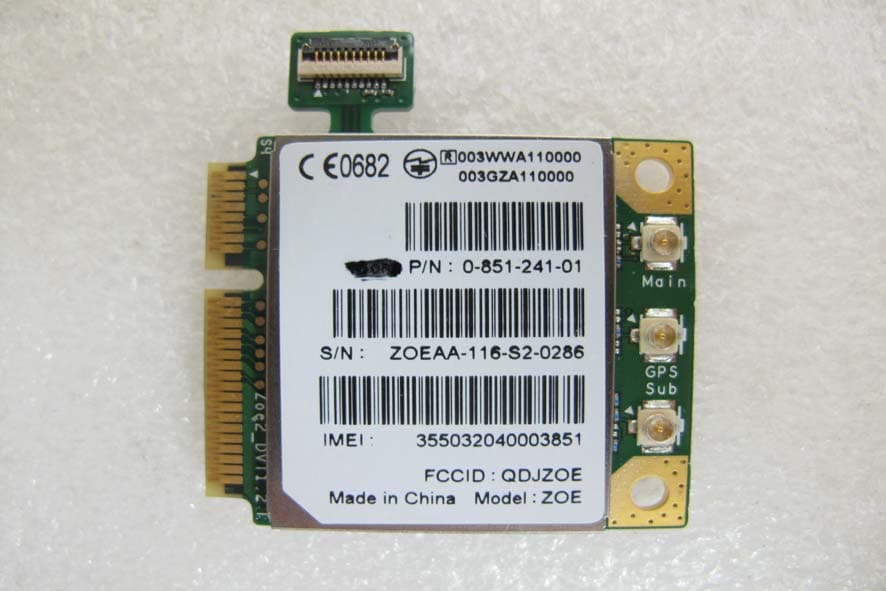
QDJZOE
Feb 21, 20113G Data Module
Equipment Class
PCB - PCS Licensed Transmitter
QDJ-F902
Feb 25, 2010SMART PHONE
Equipment Class
DSS - Part 15 Spread Spectrum Transmitter
QDJ-0602DBS01
Jun 13, 2006Smart Phone
Equipment Class
DTS - Digital Transmission System