QTDI38Bluetooth Headset iCliq i38
Emerging Technologies Limited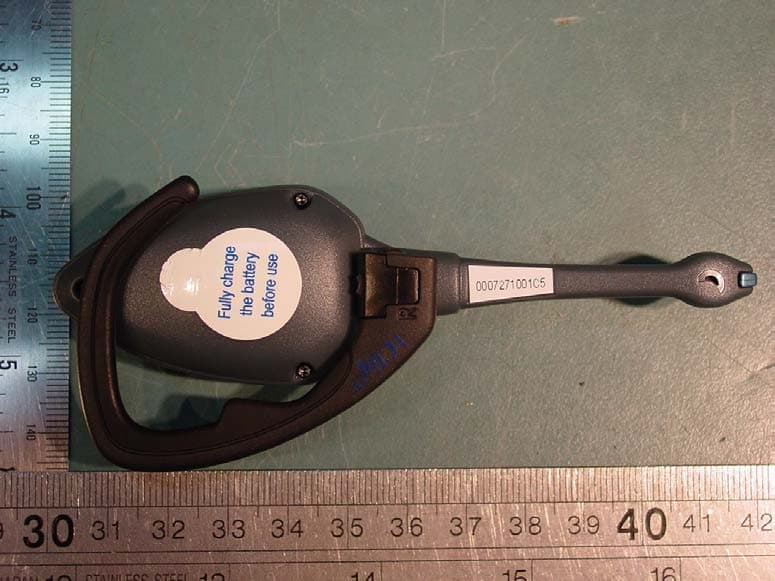
Click to zoom
Application Details
- Equipment Class
- DTS - Digital Transmission System
- Date of Grant
- Feb 04, 2003
- Application Purpose
- Original Equipment
- Date of Application
- Feb 04, 2003
- Equipment Note
- Bluetooth Headset iCliq i38
- Frequency Range
- 2402.00000000 - 2480.00000000
- Country
- Hong Kong
Documents & Files
Document Text
Text extracted from the exhibit documents filed with the FCC. Open a document above to read the original.
Users Manual
1 iCliq™ Bluetooth™ Headset – Model i38 Quick Reference Guide Turning on your iCliq™ Press and hold the power button for 2 seconds Turning off your iCliq™ Press and hold the power button for 2 seconds Pairing your iCliq™ with the phone Press and hold both the headset and power buttons simultaneously for 2 seconds until the status indicator light flashes green and red. Perform a device discovery from the phone. Enter the passkey 0000 to pair your iCliq™ with the phone. Answering a call Press and release the headset button Making a call using voice dialing* Press and release the headset button Ending a call from your iCliq™ Press and release the headset button Rejecting a call from your iCliq™ Press and release the power button Transferring a call to your iCliq™ Press and release the headset button Activating the microphone mute Press and release the power button Deactivating the microphone mute Press and release the power button * Your phone must support this feature. Remarks: This quick reference guide is served as a handy and quick reminder of some key operations. Users are advised to read and understand all instructions provided in the user guide before using the headset for the first time. iCliq™ Bluetooth™ Headset – Model i38 Audio and Visual Indicators Headset State Light Indication Audio Indication Charging in process Steady red light No audio indication Charging complete Steady green light No audio indication Standby mode Green light flashes every 2 seconds No audio indication Talk mode Double green light flashes every second No audio indication Low battery Red light flashes every 2 seconds in standby mode Double red light flashes every second during a call A battery low tone is repeated every 60 seconds Pairing mode Green and red light flashes alternately No audio indication Incoming call Double green light flashes every second Ring tone End a call Steady orange light stays for 2 seconds Hang up tone Making a call by using voice dial* Double green light flashes every second after the confirmation tone Series of tones followed by a confirmation tone Ring volume adjustment (standby mode) No light indication Louder/softer double tone Microphone mute during a call Double orange light flashes every second Single high tone repeated every second Power off Red light off Series of 3 high tones * Your phone must support this feature. 2 Important Safety Instructions........... Introduction................................ Getting Started............................. Setting Up Your iCliq™ .................. Using Your iCliq™......................... Troubleshooting ........................... Specifications............................... Additional Information .................. iCliq™ i38 Bluetooth™ Headset User Guide December 2002 This manual is published by Emerging Technologies Limited (ETL), without any warranty. Improvements and changes to this manual necessitated by typographical errors, inaccuracies of current information, or improvements to programs and/or equipment, may be made by ETL at any time and without notice. Such changes will, however, be incorporated into new editions of this manual. © 2002 Emerging Technologies Limited. All Rights Reserved. iCliq is a trademark of Emerging Technologies Limited. Bluetooth is a trademark owned by its proprietor and used by Emerging Technologies Limited under license. Important Safety Instructions Before using your iCliq™ Bluetooth headset, please read “Guidelines for safe and efficient use” and “Limited warranty” to reduce the risk of fire, electrical shock, damage to the unit and injury to persons. Always handle your iCliq™ with care! Introduction Congratulations on your purchase of the iCliq™ i38 Bluetooth headset. iCliq™ is a cordless portable hands free headset based on Bluetooth wireless technology. It features simple push button operation and is comfortable to wear. iCliq™ combines mobility, technology and fashion in a miniature Bluetooth headset. It gives you a new level of convenience in the world of mobility. What is Bluetooth wireless technology? The Bluetooth wireless technology is set to revolutionize the personal connectivity market by providing freedom from wired connections. It is a specification for a small-form factor, low-cost radio solution providing links between mobile computers, mobile phones and other portable handheld devices, and connectivity to the Internet. Visit www.bluetooth.com for more information about Bluetooth wireless technology. 3 How can I use my iCliq™ Bluetooth headset? You can connect your iCliq™ to your mobile phone or any device with Bluetooth wireless technology that supports the headset profile – to free your hands for more important tasks when you are in the office or on the move. This user guide focuses on how to use the iCliq™ with your mobile phone. Once your iCliq™ is connected to your mobile phone, you can use it to answer/make/end calls without touching your phone. The phone can be tucked away in your pocket or in your bag. With iCliq™, you can always be in touch. Getting Started Overview iCliq™ can be used in conjunction with any device that is compatible with Bluetooth wireless technology and supports the headset profile. To be able to use the iCliq™ together with a mobile phone, you need to have a phone with built-in Bluetooth capability, or a phone with a Bluetooth adapter connected to it. Checking the package contents Your iCliq™ comes from the factory with the ear hook attached to the headset and the charging connector attached to the charger. Illustration 1 iCliq™ Bluetooth headset Charging connector User guide Headset iCliq™ gives you a new level of convenience in the world of mobility. Model i38 Hands free, lightweight wearable addition to every mobile wardrobe. User Guide 4 Identifying the keys and controls Front Back Headset button Volume up/down buttons Power button Ear hook Status indicator light Microphone Speaker Illustration 2 Charging connection (hidden) Lanyard port (hidde…
Text truncated - open the document above for the full version.
Block Diagram
TÜV Rheinland Product Safety GmbH Am Grauen Stein D - 51105 Köln Appendix 4 Prüfbericht - Nr.: Test Report No. 14002427 001 Seite 4 von 8 Page 4 of 8 2.2 Block Diagram 2.2.1 Block Diagram of i38 Bluetooth Headset Bluetooth Radio Ericsson PBA31305 Bluetooth BaseBand Ericsson PBM99080/22 Battery AE562030P (3.5V-4.2V) 2.6V Regulator XC6204B Voltage Detector XC61CN3502 Voltage Detecto r 13MHz Xtal Voice Codec MSM7732 MIC C0-27 SPK LT301 LEDs Buttons Battery Charger LTC1732EMS-4.2 2.6V Regulator XC6204B 6Vdc
External Photos
TÜV Rheinland Product Safety GmbH Am Grauen Stein D - 51105 Köln Appendix 3 Prüfbericht - Nr.: Test Report No. 14002427 001 Seite 1 von 7 Page 1 of 7 ETL - Bluetooth Headset i38 Front side of external view: TÜV Rheinland Product Safety GmbH Am Grauen Stein D - 51105 Köln Appendix 3 Prüfbericht - Nr.: Test Report No. 14002427 001 Seite 2 von 7 Page 2 of 7 Rear side of external view: TÜV Rheinland Product Safety GmbH Am Grauen Stein D - 51105 Köln Appendix 3 Prüfbericht - Nr.: Test Report No. 14002427 001 Seite 3 von 7 Page 3 of 7 Side view of external view:
ID Label/Location Info
TÜV Rheinland Product Safety GmbH Am Grauen Stein D - 51105 Köln Appendix 4 Prüfbericht - Nr.: Test Report No. 14002427 001 Seite 1 von 8 Page 1 of 8 1.1 FCCID Label Artwork The yellow oval indicates the location of the FCCID label. Remark: The label inside the photo is not the FCCID label.
Internal Photos
TÜV Rheinland Product Safety GmbH Am Grauen Stein D - 51105 Köln Appendix 3 Prüfbericht - Nr.: Test Report No. 14002427 001 Seite 4 von 7 Page 4 of 7 Front side of internal view: The yellow oval indicates the location of the antenna. TÜV Rheinland Product Safety GmbH Am Grauen Stein D - 51105 Köln Appendix 3 Prüfbericht - Nr.: Test Report No. 14002427 001 Seite 5 von 7 Page 5 of 7 Front side of internal view (Zoom): TÜV Rheinland Product Safety GmbH Am Grauen Stein D - 51105 Köln Appendix 3 Prüfbericht - Nr.: Test Report No. 14002427 001 Seite 6 von 7 Page 6 of 7 Rear side of internal view: TÜV Rheinland Product Safety GmbH Am Grauen Stein D - 51105 Köln Appendix 3 Prüfbericht - Nr.: Test Report No. 14002427 001 Seite 7 von 7 Page 7 of 7 Side view of internal view:
Operational Description
TÜV Rheinland Product Safety GmbH Am Grauen Stein D - 51105 Köln Appendix 4 Prüfbericht - Nr.: Test Report No. 14002427 001 Seite 2 von 8 Page 2 of 8 2.1 Description of Circuit Function 2.1.1 General Description Bluetooth operates in the unlicensed ISM band at 2.4 GHz. A frequency hop transceiver is applied to combat interference and fading. A shaped, binary FM modulation is applied to minimize transceiver complexity. The symbol rate is 1 Ms/s. A slotted channel is applied with a nominal slot length of 625 μs. For full duplex transmission, a Time-Division Duplex (TDD) scheme is used. On the channel, information is exchanged through packets. Each packet is transmitted on a different hop frequency. A packet nominally covers a single slot, but can be extended to cover up to five slots. The Bluetooth protocol uses a combination of circuit and packet switching. Slots can be reserved for synchronous packets. Bluetooth can support an asynchronous data channel, up to three simultaneous synchronous voice channels, or a channel which simultaneously supports asynchronous data and synchronous voice. Each voice channel supports a 64 kb/s synchronous (voice) channel in each direction. The asynchronous channel can support maximal 723.2 kb/s asymmetric (and still up to 57.6 kb/s in the return direction), or 433.9 kb/s symmetric. The Bluetooth system consists of a radio unit, a link control unit, and a support unit for link management and host terminal interface functions. 2.1.2 Specific Information about the RF module The Bluetooth Radio PBA 313 05 from Ericsson Microelectronics is a short- range microwave frequency radio transceiver for Bluetooth communication links. Provided in a compact LGA package. No external shield is required. The Bluetooth Radio offers a combination of compact size, low power consumption, and cost effective assembly. The PBA 313 05 forms a complete radio with only the addition of an antenna, a 13 MHz reference frequency crystal, and a digital control functionality. PBA 313 05 is built around an RFCMOS ASIC. Antenna filter, RX and TX baluns are all integrated into the circuit. 2.1.3 Modulation technique The transmitter utilises an IQ modulation architecture where the carrier wave is generated by the local oscillator. The receiver has a near-zero IF heterodyne architecture with IF around 3 MHz. The receiver consists of a LNA followed by I and Q mixers. The I and Q IF (Intermediate frequency) signals of these mixers are fed to an image rejecting selectivity filter (a bandpass filter). The filter is followed by two limiters (I and Q) fixing the amplitude of the received signal to the required level for the demodulator. The limiters generate an RSSI signal, which is converted to a digital word and is available through the serial interface. The demodulator is an IQ TÜV Rheinland Product Safety GmbH Am Grauen Stein D - 51105 Köln Appendix 4 Prüfbericht - Nr.: Test Report No. 14002427 001 Seite 3 von 8 Page 3 of 8 quadrature demodulator. A post detection filter and a slicer, which will output the received data to the baseband processor, follow the demodulator. The local oscillator is an integrated VCO (Synthesizer). The VCO frequency is controlled by means of a phase locked loop. A loop filter is to generate the tuning voltage for the VCO. The same VCO is used when receiving and transmitting. The transmitter utilises IQ modulation. The bit stream from the baseband radio is digitally processed to generate gaussian shaped I & Q output. A DAC and reconstruction filter is used to generate the IF input to the mixer. This RF input to the mixer comes from the phase locked VCO via phase shifters and buffering. The mixer output is fed to the Power Amplifier, which will deliver the output power at the antenna. There are a number of other circuit blocks such as the crystal oscillator, low power oscillator, power on reset circuit, control logic and the serial interface. Baluns: Rx balun: Transformation from unbalanced (single-ended) to balanced (differential) transmission. Tx balun: Transformation from balanced to unbalanced transmission. The baluns are integrated in the substrate. Antenna switch: Directs the power either from the antenna filter to the receive ports or from the external PA output ports to the antenna filter. Antenna filter: Front end bandpass filter fully integrated in the ceramic substrate. Power Supply: There is only one supply connection Vdd=2.6Vdc (min=2.5V, max=2.75V), powered by an external regulator.
Schematics
TÜV Rheinland Product Safety GmbH Am Grauen Stein D - 51105 Köln Appendix 4 Prüfbericht - Nr.: Test Report No. 14002427 001 Seite 7 von 8 Page 7 of 8 2.3.3 Top part TÜV Rheinland Product Safety GmbH Am Grauen Stein D - 51105 Köln Appendix 4 Prüfbericht - Nr.: Test Report No. 14002427 001 Seite 8 von 8 Page 8 of 8 2.3.4 Bottom part
Test Report
TÜV Rheinland Product Safety GmbH Am Grauen Stein D - 51105 Köln Appendix 1 Prüfbericht - Nr.: Test Report No. 14002427 001 Seite 1 von 59 Page 1 of 59 20dB bandwidth – 2402MHz TÜV Rheinland Product Safety GmbH Am Grauen Stein D - 51105 Köln Appendix 1 Prüfbericht - Nr.: Test Report No. 14002427 001 Seite 2 von 59 Page 2 of 59 20dB bandwidth – 2441MHz TÜV Rheinland Product Safety GmbH Am Grauen Stein D - 51105 Köln Appendix 1 Prüfbericht - Nr.: Test Report No. 14002427 001 Seite 3 von 59 Page 3 of 59 20dB bandwidth – 2480MHz TÜV Rheinland Product Safety GmbH Am Grauen Stein D - 51105 Köln Appendix 1 Prüfbericht - Nr.: Test Report No. 14002427 001 Seite 4 von 59 Page 4 of 59 Peak power output – 2402MHz TÜV Rheinland Product Safety GmbH Am Grauen Stein D - 51105 Köln Appendix 1 Prüfbericht - Nr.: Test Report No. 14002427 001 Seite 5 von 59 Page 5 of 59 Peak power output – 2441MHz TÜV Rheinland Product Safety GmbH Am Grauen Stein D - 51105 Köln Appendix 1 Prüfbericht - Nr.: Test Report No. 14002427 001 Seite 6 von 59 Page 6 of 59 Peak power output – 2480MHz TÜV Rheinland Product Safety GmbH Am Grauen Stein D - 51105 Köln Appendix 1 Prüfbericht - Nr.: Test Report No. 14002427 001 Seite 7 von 59 Page 7 of 59 Spurious emission, conducted – 2402MHz (30MHz – 10GHz) TÜV Rheinland Product Safety GmbH Am Grauen Stein D - 51105 Köln Appendix 1 Prüfbericht - Nr.: Test Report No. 14002427 001 Seite 8 von 59 Page 8 of 59 Spurious emission, conducted – 2402MHz (10GHz – 20GHz) TÜV Rheinland Product Safety GmbH Am Grauen Stein D - 51105 Köln Appendix 1 Prüfbericht - Nr.: Test Report No. 14002427 001 Seite 9 von 59 Page 9 of 59 Spurious emission, conducted – 2402MHz (20GHz – 25GHz) TÜV Rheinland Product Safety GmbH Am Grauen Stein D - 51105 Köln Appendix 1 Prüfbericht - Nr.: Test Report No. 14002427 001 Seite 10 von 59 Page 10 of 59 Spurious emission, conducted – 2441MHz (30MHz – 10GHz) TÜV Rheinland Product Safety GmbH Am Grauen Stein D - 51105 Köln Appendix 1 Prüfbericht - Nr.: Test Report No. 14002427 001 Seite 11 von 59 Page 11 of 59 Spurious emission, conducted – 2441MHz (10GHz – 20GHz) TÜV Rheinland Product Safety GmbH Am Grauen Stein D - 51105 Köln Appendix 1 Prüfbericht - Nr.: Test Report No. 14002427 001 Seite 12 von 59 Page 12 of 59 Spurious emission, conducted – 2441MHz (20GHz – 25GHz) TÜV Rheinland Product Safety GmbH Am Grauen Stein D - 51105 Köln Appendix 1 Prüfbericht - Nr.: Test Report No. 14002427 001 Seite 13 von 59 Page 13 of 59 Spurious emission, conducted – 2480MHz (30MHz – 10GHz) TÜV Rheinland Product Safety GmbH Am Grauen Stein D - 51105 Köln Appendix 1 Prüfbericht - Nr.: Test Report No. 14002427 001 Seite 14 von 59 Page 14 of 59 Spurious emission, conducted – 2480MHz (10GHz – 20GHz) TÜV Rheinland Product Safety GmbH Am Grauen Stein D - 51105 Köln Appendix 1 Prüfbericht - Nr.: Test Report No. 14002427 001 Seite 15 von 59 Page 15 of 59 Spurious emission, conducted – 2480MHz (20GHz – 25GHz) TÜV Rheinland Product Safety GmbH Am Grauen Stein D - 51105 Köln Appendix 1 Prüfbericht - Nr.: Test Report No. 14002427 001 Seite 16 von 59 Page 16 of 59 Spurious emissions, conducted – 2402MHz Band-edge compliance TÜV Rheinland Product Safety GmbH Am Grauen Stein D - 51105 Köln Appendix 1 Prüfbericht - Nr.: Test Report No. 14002427 001 Seite 17 von 59 Page 17 of 59 Spurious emissions, conducted – 2441MHz Band-edge compliance TÜV Rheinland Product Safety GmbH Am Grauen Stein D - 51105 Köln Appendix 1 Prüfbericht - Nr.: Test Report No. 14002427 001 Seite 18 von 59 Page 18 of 59 Spurious emissions, conducted – 2480MHz Band-edge compliance TÜV Rheinland Product Safety GmbH Am Grauen Stein D - 51105 Köln Appendix 1 Prüfbericht - Nr.: Test Report No. 14002427 001 Seite 19 von 59 Page 19 of 59 Dwell time Channel occupancy DH5 packet TÜV Rheinland Product Safety GmbH Am Grauen Stein D - 51105 Köln Appendix 1 Prüfbericht - Nr.: Test Report No. 14002427 001 Seite 20 von 59 Page 20 of 59 Dwell time Burst duration DH5 packet TÜV Rheinland Product Safety GmbH Am Grauen Stein D - 51105 Köln Appendix 1 Prüfbericht - Nr.: Test Report No. 14002427 001 Seite 21 von 59 Page 21 of 59 Channel separation TÜV Rheinland Product Safety GmbH Am Grauen Stein D - 51105 Köln Appendix 1 Prüfbericht - Nr.: Test Report No. 14002427 001 Seite 22 von 59 Page 22 of 59 Disturbance voltage in AC mains TÜV Rheinland Product Safety GmbH Am Grauen Stein D - 51105 Köln Appendix 1 Prüfbericht - Nr.: Test Report No. 14002427 001 Seite 23 von 59 Page 23 of 59 TÜV Rheinland Product Safety GmbH Am Grauen Stein D - 51105 Köln Appendix 1 Prüfbericht - Nr.: Test Report No. 14002427 001 Seite 24 von 59 Page 24 of 59 Spurious Radiated Emissions (2402MHz: 30MHz – 25GHz) TÜV Rheinland Product Safety GmbH Am Grauen Stein D - 51105 Köln Appendix 1 Prüfbericht - Nr.: Test Report No. 14002427 001 Seite 25 von 59 Page 25 of 59 TÜV Rheinland Product Safety GmbH Am Grauen Stein D - 51105 Köln Appendix 1 Prüfbericht - Nr.: Test Report No. 14002427 001 Seite 26 von 59 Page 26 of 59 TÜV Rheinland Product Safety GmbH Am Grauen Stein D - 51105 Köln Appendix 1 Prüfbericht - Nr.: Test Report No. 14002427 001 Seite 27 von 59 Page 27 of 59 TÜV Rheinland Product Safety GmbH Am Grauen Stein D - 51105 Köln Appendix 1 Prüfbericht - Nr.: Test Report No. 14002427 001 Seite 28 von 59 Page 28 of 59 TÜV Rheinland Product Safety GmbH Am Grauen Stein D - 51105 Köln Appendix 1 Prüfbericht - Nr.: Test Report No. 14002427 001 Seite 29 von 59 Page 29 of 59 TÜV Rheinland Product Safety GmbH Am Grauen Stein D - 51105 Köln Appendix 1 Prüfbericht - Nr.: Test Report No. 14002427 001 Seite 30 von 59 Page 30 of 59 TÜV Rheinland Product Safety GmbH Am Grauen Stein D - 51105 Köln Appendix 1 Prüfbericht - Nr.: Test Report No. 14002427 001 Seite 31 von 59 Page 31 of 59
Test Setup Photos
TÜV Rheinland Product Safety GmbH Am Grauen Stein D - 51105 Köln Appendix 2 Prüfbericht - Nr.: Test Report No. 14002427 001 Seite 1 von 2 Page 1 of 2 1.1 Test set-up (Spurious Radiated Emissions) TÜV Rheinland Product Safety GmbH Am Grauen Stein D - 51105 Köln Appendix 2 Prüfbericht - Nr.: Test Report No. 14002427 001 Seite 2 von 2 Page 2 of 2
Contact Information
Applicant
Maria Liao(Vice President)
Technical Contact
T�V Rheinland Hong Kong Ltd.Stephan Wald
[email protected]+852 2779 3181
Room 405, Tech Centre · Hong Kong · Hong Kong
Non-Technical Contact
Emerging Technologies LimitedLiao Maria
[email protected]+852 2357 7540
Test Firm
Hong Kong Productivity CouncilIr Angel Wong Yuen-yee
Technical Specifications
| # | Rule Parts | Frequency Range | Power Output |
|---|---|---|---|
| 1 | 15C | 2.40 GHz - 2.48 GHz | 600.00 µW |