Y56QSLMA825Bluetooth Speaker
SHENZHEN QI SHENGLONG INDUSTRIALIST CO.,LTD.Application Details
- Equipment Class
- DSS - Part 15 Spread Spectrum Transmitter
- Date of Grant
- Feb 20, 2013
- Application Purpose
- Original Equipment
- Date of Application
- Feb 20, 2013
- Equipment Note
- Bluetooth Speaker
- Frequency Range
- 2402.00000000 - 2480.00000000
- Country
- China
Documents & Files
Document Text
Text extracted from the exhibit documents filed with the FCC. Open a document above to read the original.
Users Manual
Bluetooth Speaker Instruction Guide MODEL NO.: MA-825 Know your speaker 1、Pause / Play 2、Bluetooth indicator light 3、On / Off Button 4、USB DC 5V Using Bluetooth Speaker - To turn ON, slide the [POWER ON/OFF] switch to the ON position, the LED flashes BLUE 6 times quickly then once every few seconds. - To turn OFF, slide the [POWER ON/OFF] switch to the OFF position, the LED illuminates and the speaker will power OFF. The Reasons why you love it - Compatible with the Iphone, Ipad or any cell phone has Bluetooth, enjoy your loved song anytime, anywhere. - Can control the play mode through the speaker, makes everything convenient. - Wireless Bluetooth connection, effective range can reach to 10M, enjoys music boundless. - Automatically snooze mode, smart energy conversation. - USB charge support, easy for operation. Product Specifications - Dimension & Weight Dimension: Weight: - Standard Battery: Built in rechargeable 450mAh Lithium battery - Charge condition: Charge time: 3-4 hours Power input: DC 5V/500mA. Speaker Specifications - Diameter: φ40 mm - Impedance: 4Ω - Power output: 3W - Dbspl: 80±3dB 1W/M Wireless function - Frequency: 2.402-2.480 GHz - Receiving sensitivity: -82dBm - Transmission distance: within 10 meters - Data transmission rate: 3 Mbps Package & accessories - Bluetooth Speaker - USB cable - Instruction manual Operating Environment 1. Due to the used enclosure material, the GSM mobile phone shall only be connected to a USB Interface of version 2.0 or higher. The connection to so called power USB is prohibited. 2. Do not use the mobile phone in the environment at too high or too low temperature, never expose the mobile phone under strong sunshine or too wet environment. The suitable temperature for the phone and accessories is 0°C-40°C. FCC STATEMENT 1. This device complies with Part 15 of the FCC Rules. Operation is subject to the following two conditions: (1) This device may not cause harmful interference. (2) This device must accept any interference received, including interference that may cause undesired operation. 2. Changes or modifications not expressly approved by the party responsible for compliance could void the user's authority to operate the equipment. NOTE: This equipment has been tested and found to comply with the limits for a Class B digital device, pursuant to Part 15 of the FCC Rules. These limits are designed to provide reasonable protection against harmful interference in a residential installation. This equipment generates uses and can radiate radio frequency energy and, if not installed and used in accordance with the instructions, may cause harmful interference to radio communications. However, there is no guarantee that interference will not occur in a particular installation. If this equipment does cause harmful interference to radio or television reception, which can be determined by turning the equipment off and on, the user is encouraged to try to correct the interference by one or more of the following measures: Reorient or relocate the receiving antenna. Increase the separation between the equipment and receiver. Connect the equipment into an outlet on a circuit different from that to which the receiver is connected. Consult the dealer or an experienced radio/TV technician for help. Changes or modifications made to this equipment not expressly approved by SHENZHEN QI SHENGLONG INDUSTRIALIST CO.,LTD. may void the FCC authorization to operate this equipment. FCC Radiation Exposure Statement This equipment complies with FCC radiation exposure limits set forth for an uncontrolled environment.
External Photos
External Photos 1. EUT front view with accessory 2. EUT rear view 3. EUT left side view 4. EUT right side view 5. EUT top view 6. EUT bottom view
ID Label/Location Info
FCC ID: Y56QSLMA825 Label Label Location FCC ID Location
Internal Photos
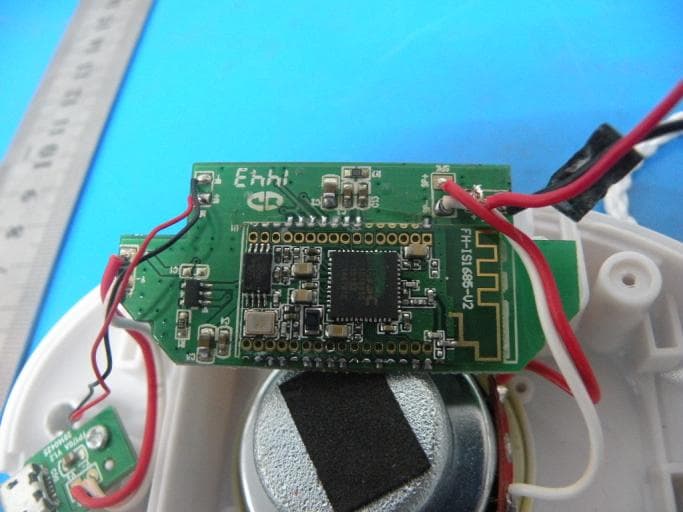
Internal Photos 1. EUT uncover view 2. Mainboard front view 3. Mainboard rear view 4. BT chip view 5. BT antenna view
Test Report
SZ12110064W02 Page 2 of 79 DIRECTORY 1. GENERAL INFORMATION .................................................................................................... 3 1.1. EUT Description ....................................................................................................................... 3 1.2. Test Standards and Results ........................................................................................................ 4 1.3. Facilities and Accreditations ..................................................................................................... 5 2. 47 CFR PART 15C REQUIREMENTS .................................................................................... 6 2.1. Antenna requirement ................................................................................................................. 6 2.2. Number of Hopping Frequency ................................................................................................ 6 2.3. Peak Output Power.................................................................................................................. 12 2.4. 20dB Bandwidth ..................................................................................................................... 14 2.5. Carried Frequency Separation ................................................................................................. 21 2.6. Time of Occupancy (Dwell time) ........................................................................................... 24 2.7. Conducted Spurious Emissions ............................................................................................... 31 2.8. Band Edge ............................................................................................................................... 38 2.9. Conducted Emission ............................................................................................................... 55 2.10. Radiated Emission................................................................................................................... 58 Change History Issue Date Reason for change 1.0 January 31, 2013 First edition SZ12110064W02 Page 3 of 79 1. General Information 1.1. EUT Description EUT Type ............................. : Bluetooth Stereo Speaker Serial No. .............................. : (n.a, marked #1 by test site) Hardware Version ................. : BM85-Rev1.0 Software Version .................. : Applicant .............................. : Manufacturer ........................ : MA825REV1.0 SHENZHEN QI SHENGLONG INDUSTRIALIST CO.,LTD. 5F.,Blk 6A, Jing Nan Industry,Bai Ge long,Buji,Shenzhen,China DONGGUAN FEIHAO INDUSTRIALIST CO.,LTD No.8,Fengyi Road,Dakan Village,Huangjiang,DongGuan,China Frequency Range .................. : The frequency range used is 2402MHz - 2480MHz (79 channels, at intervals of 1MHz); The frequency block is 2400MHz to 2483.5MHz. Modulation Type .................. : Bluetooth: FHSS (GFSK(1Mbps), ∏/4-DQPSK(EDR 2Mbps), 8-DPSK(EDR 3Mbps)) Antenna Type ........................ : PCB Antenna Antenna Gain ........................ : 0dBi Note 1: The EUT is a Bluetooth Stereo Speaker, it contains Bluetooth Module operating at 2.4GHz ISM band; the frequencies allocated for the Bluetooth Module is F(MHz)=2402+1*n (0<=n<=78). The lowest, middle, highest channel numbers of the Bluetooth Module used and tested in this report are separately 0 (2402MHz), 39 (2441MHz) and 78 (2480MHz). Note 2: For a more detailed description, please refer to Specification or User’s Manual supplied by the applicant and/or manufacturer. Note 3: a. When power on, the EUT will scan the whole frequency until a Connection command from the other BT devices. b. When receiving the signal from the other BT devices, The EUT transmit aresponse signal. c. The other devices receive the response signal and recognize it, then send a connection command to establish the connection. d. After the connection establish successfully, the data transmission is beginning. At the same time, the both devices will shift frequencies in synchronization per a same pseudo randomly ordered list of hopping frequencies, the hopping rate is1600 times per second. This device conforms to the criteria in FCC Public Notice DA 00-705. e. The bandwidth of the receiver, which is set to a fixed width by the software. Note 4: Bluetooth signal has 9 packages DH1, DH3, DH5, 3DH1, 3DH3, 3DH5, 5DH1, 5DH3, 5DH5, DH5 package is largest, we are testing DH5 in the document. SZ12110064W02 Page 4 of 79 1.2. Test Standards and Results The objective of the report is to perform testing according to 47 CFR Part 15 Subpart C (Bluetooth, 2.4GHz ISM band radiators) for the EUT FCC ID Certification: No. Identity Document Title 1 47 CFR Part 15 (10-1-09 Edition) Radio Frequency Devices Test detailed items/section required by FCC rules and results are as below: No. Section in CFR 47Description Result 1 15.203 Antenna Requirement PASS 2 15.247(a) Number of Hopping Frequency PASS 3 15.247(b) Peak Output Power PASS 4 15.247(a) 20dB Bandwidth PASS 5 15.247(a) Carrier Frequency Separation PASS 6 15.247(a) Time of Occupancy (Dwell time) PASS 7 15.247(d) Conducted Spurious Emission PASS 8 15.247(d) Band Edge PASS 9 15.207 Conducted Emission PASS 10 15.209 15.247(d) Radiated Emission PASS 11 15.247(i), 1.1307&2.1093 RF exposure evaluation PA S S NOTE: The tests were performed according to the method of measurements prescribed in DA-00-705. SZ12110064W02 Page 5 of 79 1.3. Facilities and Accreditations 1.3.1. Facilities Shenzhen Morlab Communications Technology Co., Ltd. Morlab Laboratory is a testing organization accredited by China National Accreditation Service for Conformity Assessment (CNAS) according to ISO/IEC 17025. The accreditation certificate number is L3572. All measurement facilities used to collect the measurement data are located at FL.1, Building A, FeiYang Science Park, Block 67, BaoAn District, Shenzhen, 518101 P. R. China. The test site…
Text truncated - open the document above for the full version.
Test Setup Photos
Test Setup Photos 1. Conducted emission main’s port front view 2. Conducted emission main’s port side view 3. Radiated emission (9KHz-30MHz) 4. Radiated emission (30MHz-1GHz) 5. Radiated emission (above 1GHz) 6. Conducted emission antenna’s port
Contact Information
Applicant
Derong Huang(Manager)
Test Firm
Shenzhen Morlab Communications Technology Co., LtdIvy zhu
Technical Specifications
| # | Rule Parts | Frequency Range | Power Output |
|---|---|---|---|
| 1 | 15C | 2.40 GHz - 2.48 GHz | 2.74 mW |
Other Applications from SHENZHEN QI SHENGLONG INDUSTRIALIST CO.,LTD.
Y56QSLMA878B
Jul 17, 2015Bluetooth Shower Speaker
Equipment Class
DSS - Part 15 Spread Spectrum Transmitter
Y56QSLHD276
Jan 10, 2015Portable Bluetooth Headset
Equipment Class
DSS - Part 15 Spread Spectrum TransmitterY56QSLDC932C
Nov 15, 2014Portable Bluetooth Stereo Speaker
Equipment Class
DSS - Part 15 Spread Spectrum Transmitter
Y56QSLMA0129
Sep 02, 2014Hands-Free Bluetooth Hat
Equipment Class
DSS - Part 15 Spread Spectrum Transmitter
Y56QSLMA960B
Aug 10, 2014Bluetooth Speaker
Equipment Class
DSS - Part 15 Spread Spectrum Transmitter