2ADYY-B1Wireless Earphone
TECNO MOBILE LIMITED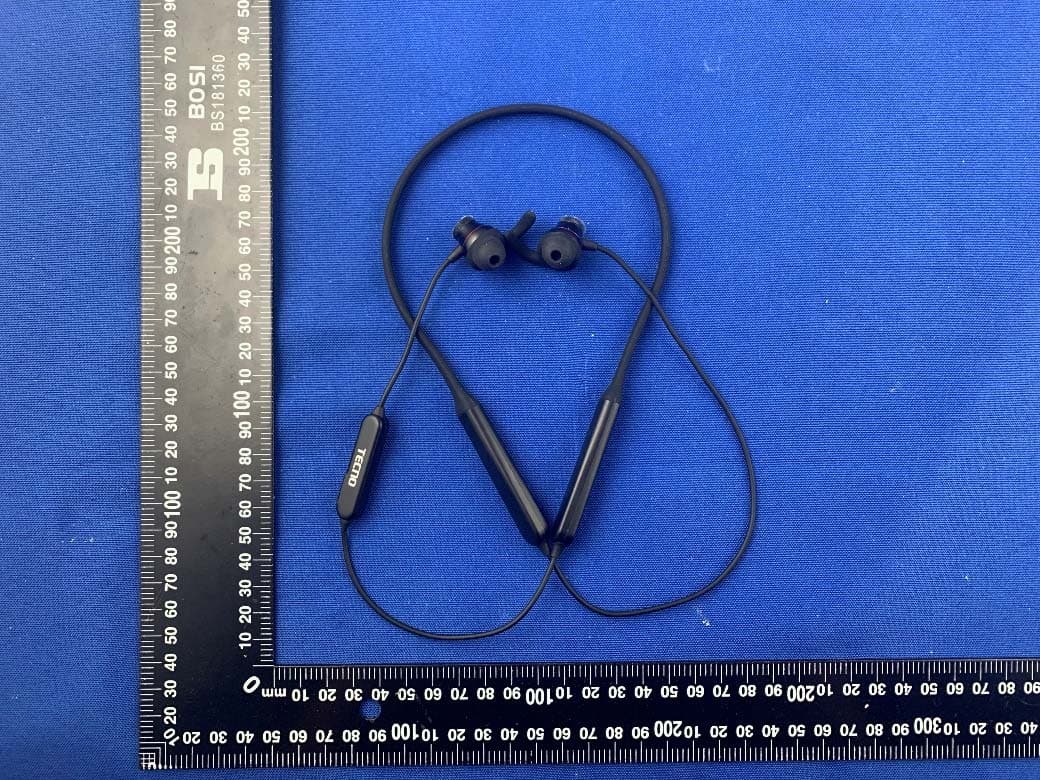
Click to zoom
Application Details
- Equipment Class
- DSS - Part 15 Spread Spectrum Transmitter
- Date of Grant
- Nov 17, 2020
- Application Purpose
- Original Equipment
- Date of Application
- Nov 17, 2020
- Equipment Note
- Wireless Earphone
- Frequency Range
- 2402.00000000 - 2480.00000000
- Company
- TECNO MOBILE LIMITED
- Country
- Hong Kong
Documents & Files
Document Text
Text extracted from the exhibit documents filed with the FCC. Open a document above to read the original.
Users Manual
USER MANUAL BRILLIANT SOUND MAGNET HOW TO WEAR Please wear the earphones as shown in the diagram: 1. Attach the ear hooks onto the earphones. 2. Wear the earphones and the hooks on your ears and adjust for the best fit. PACKAGE CONTENT 1 × Bravo-B1 Wireless Earphone 1 × USB Charging Cable 4 × Earbuds 4 × Ear Hooks 1 × User Manual CUSTOMER SERVICE WARRANTY CERTIFICATE Date of purchase Name Address Tel. No dd/mm/yy Store name S/N PRODUCT OVERVIEW ①②③④ ⑤ WELCOME Thank you for choosing our products. The Bravo-B1 wireless earphone has a fashionable design, powerful functions, and high compatibility, providing you with hands-free convenience in making calls and listening to music. ① ② ③ ④ ⑤ Volume + / Next Track Multifunction LED Indicator / Microphone Volume - / Previous Track Micro USB Charging Port HOW TO USE 1. Charging 1) Connect the charging port with any USB charging adapter or active computer USB port. 2) Charging will start automatically with LED indicate red. 3) The earphones are fully charged when LED indicate blue. Note: Make sure the battery is fully charged before putting the earphones away for storage. Charge the earphones at least once every 3 months when not using for a long time. 2. Pairing 1) Make sure the earphones and your BT device are next to each other (within 10 meters). 2) The first time you use the earphone, press the multifunction button until the LED indicator flashes red and blue alternately. Now the earphones are in pairing mode. 3) Activate BT function on your phone and search for the nearby wireless connection: Find “TECNO-Bravo-B1” in the search results. Tap on the name to connect. Once connected, blue LED will flash. 4) If you have paired your device with the earphones before, remove “TECNO-Bravo-B1” from the BT device list and pair again. Note 1. The wireless earphones can remember previous paired devices. 2. If the earphone cannot pair with your BT device. Press and hold the multifunction button (when the earphone is off) for 10 seconds until the LED indicator flashes purple twice to clear the pairing history. Then restart the earphone to pair again. OPERATION AND FUNCTIONS Power On Power Off Pairing Answer / Hang up a Call Reject the Incoming Call Restore to Factory Settings Long press the multifunction button for 1-2 seconds Long press the multifunction button for 3 seconds Long press the multifunction button for 4-5 seconds to enter pairing mode Play / PausePress the multifunction button once Volume + / -Short press the volume + / - button Next Track / Previous Track Long press the volume + / - button Press the multifunction button once Long press the multifunction button for 1-2 seconds and then release Phone Mute 1. In the calling state, press the volume plus key and volume minus key together to turn on the phone mute 2. Press the multifuncion button and volume plus key together to turn off phone mute When the earphones off, press and hold the multifunction button for 10 seconds until the LED flashes purple twice WIRELESS TECHNOLOGY With the wireless technology, you can connect earphone to its compatible communication devices without using cables. The wireless connection allows you to use a cell phone without holding it against the earphone, but the maximum distance between them cannot exceed 10 meters (Distance between open areas can be increased). The wireless connection may be interfered by obstacles (such as walls) or other electronic devices. In some areas, use of the wireless technology may be subject to some constraints. Please consult your local authority or service provider for details. Voice Dialing Long press the multifunction button for 1 second in the connected state (BT device support is required) Back to Connection 1. Automatically connect with the last connected device after starting up 2. The device that has been paired with the earphone and is not connected for the last time enters the BT setting of the device and connects to the earphone again Multi-point Connection After pairing with two BT devices, connect with the BT device that has been successfully connected for the last time, and then enter the BT setting menu of another BT device. Click this wireless earphone to connect (multiple devices can be connected back after multi-point connection) WARRANTY TERMS & CONDITIONS 365 DAYS WARRANTY Please keep well your receipt, this warranty covers only original TECNO products. It is not applicable to normal wear and tear, or any effects or damage caused by misuse of the product.Warranty is for primary product only. Additional or free of cost products are not covered under warranty. TECNO MOBILE LIMITED TM and ©2019 TECNO Corporation. All rights reserved. Other product and company names mentioned herein may be trademarks or trade names of their respective owners. Specifications are subject to change without notice. Model names and the availability of particular products may vary by region. This equipment complies with FCC RF radiation exposure limits set forth for an uncontrolled environment. This device complies with Part 15 of the FCC Rules. Operation is subject to the following two conditions: (1) This device may not cause harmful interference. (2) This device must accept any interference received, including interference that may cause undesired operation. NOTE: This equipment has been tested and found to comply with the limits for a Class B digital device, pursuant to part 15 of the FCC Rules. These limits are designed to provide reasonable protection against harmful interference in a residential installation. This equipment generates uses and can radiate radio frequency energy and, if not installed and used in accordance with the instructions, may cause harmful interference to radio communications. However, there is no guarantee that interference will not occur in a particular installation. If this equipment does cause harmful interference to radio or television reception, which can be determined by turning the equipment off and on, th…
Text truncated - open the document above for the full version.
Cover Letter(s)
TECNO MOBILE LIMITED Date: 11 Nov,2020 To: Federal Communications Commission, Authorization & Evaluation Division, 7435 Oakland Mills Road, Columbia, MD 21046 To Whom It May Concern: The TECNO MOBILE LIMITED, the undersigned, hereby authorizes Mr. Wu Xuewen from Shenzhen BALUN Technology Co., Ltd., to act on the behalf of the TECNO MOBILE LIMITED solely in matters relating to the application for an FCC equipment authorization for FCC ID: 2ADYY-B1 including the signing of documents in connection with this Application. Necessary acts carried out by Shenzhen BALUN Technology Co., Ltd. in connection with the Application shall have the same effect as acts of the TECNO MOBILE LIMITED. The TECNO MOBILE LIMITED also hereby certify that no party to this application is subject to a denial of benefits, including FCC benefits, pursuant to Section 5301 of the Anti-Drug Abuse Act of 1988, 21 U.S.C. Section 862. Yours Sincerely, (signature) Print name: Yiting.Luo Title: Mangaer TECNO MOBILE LIMITED
Cover Letter(s)
TECNO MOBILE LIMITED Date: 11 Nov,2020 To: Federal Communications Commission, Authorization & Evaluation Division, 7435 Oakland Mills Road, Columbia, MD 21046 RE: TECNO MOBILE LIMITED FCC ID: 2ADYY-B1 FCC Certification Confidentiality Request Gentlemen: This letter is to comply with 47 CFR 0.457 and 0.459 pertaining to confidentiality material. TECNO MOBILE LIMITED requests that the following documents regarding this submission for FCC ID : 2ADYY-B1 be kept Long-Term confidential: Exhibit Type File Name Block Diagram Block Diagram.pdf Schematics Schematics.pdf Operational Description Operational Description.pdf And below exhibit kept short-term confidential (180 days): Exhibit Type File Name External Photos External Photo.pdf Internal Photos Internal Photo.pdf Test Setup Photos Test Setup Photos.pdf Users Manuals Users Manual.pdf Those documents contain detailed system and equipment description and related information about the product which TECNO MOBILE LIMITED considers to be confidential proprietary, a custom design and, otherwise, not releasable to the general public. Since this design is a basis form which future technological products will evolve, TECNO MOBILE LIMITED considers this information would be of benefit to its competitors, and that the disclosure of the information in these documents would give competitors an unfair advantage in the market. Thank you for your attention to this matter. Yours Sincerely, (signature) Print name: Yiting.Luo Title: Mangaer TECNO MOBILE LIMITED
External Photos
Annex No.: BL-SZ20A0330-AW 1 / 4 EUT EXTERNAL PHOTOS FRONT VIEW OF EUT REAR VIEW OF EUT Annex No.: BL-SZ20A0330-AW 2 / 4 LEFT SIDE VIEW OF EUT RIGHT SIDE OF EUT c Annex No.: BL-SZ20A0330-AW 3 / 4 TOP VIEW OF EUT c BOTTOM VIEW OF EUT Annex No.: BL-SZ20A0330-AW 4 / 4 Accessory-USB Cable
ID Label/Location Info
Label Label location
Internal Photos
Annex No.: BL-SZ20A0330-AI 1 / 3 EUT INTERNAL PHOTOS EUT UNCOVER VIEW MAIN BOARD TOP VIEW Ceramic Antenna RF Chip Annex No.: BL-SZ20A0330-AI 2 / 3 MAIN BOARD REAR VIEW Battery Photo (FRONT) c Annex No.: BL-SZ20A0330-AI 3 / 3 Battery Photo (REAR) c
RF Exposure Info
RF Exposure Evaluation for FCC ID: 2ADYY-B1 Refer user manual this device is a Wireless Earphone, and this device was designed used in portable devices that the minimum distance between human’s body is 5mm. Based on the 47CFR 2.1093, this device belongs to portable device. The definition of the category as following: Portable Derives: CFR Title 47 §2.1093(b) (b) For purposes of this section, a portable device is defined as a transmitting device designed to be used so that the radiating structure(s) of the device is/are within 20 centimeters of the body of the user. FCC KDB 447498 D01 General RF Exposure Guidance v06 Limit Unless specifically required by the published RF exposure KDB procedures, standalone 1- g head or body and 10-g extremity SAR evaluation for general population exposure conditions, by measurement or numerical simulation, is not required when the corresponding SAR Test Exclusion Threshold condition, listed below, is satisfied. These test exclusion conditions are based on source-based time-averaged maximum conducted output power of the RF channel requiring evaluation, adjusted for tune-up tolerance, and the minimum test separation distance required for the exposure conditions. The minimum test separation distance is determined by the smallest distance from the antenna and radiating structures or outer surface of the device, according to the host form factor, exposure conditions and platform requirements, to any part of the body or extremity of a user or bystander. The 1-g and 10-g SAR test exclusion thresholds for 100 MHz to 6 GHz at test separation distances ≤ 50 mm are determined by: [(max. power of channel, including tune-up tolerance, mW) / (min. test separation distance, mm)] · [√f(GHz) ] ≤ 3.0 for 1-g SAR and ≤ 7.5 for 10-g extremity SAR Where • f (GHz) is the RF channel transmit frequency in GHz • Power and distance are rounded to the nearest mW and mm before calculation • The result is rounded to one decimal place for comparison The test exclusions are applicable only when the minimum test separation distance is ≤ 50 mm and for transmission frequencies between 100 MHz and 6 GHz. When the minimum test separation distance is < 5 mm, a distance of 5 mm is applied to determine SAR test exclusion. Test data BLUETOOTH Mode GFSK ∏/4-DQPSK 8-DPSK GFSK (BLE 1Mbps) GFSK (BLE 2Mbps) AV Power (dBm) 7.65 8.00 7.92 5.88 2.96 Note: This report listed the worst case av power value, please refer to RF test report for more details. Turn-up power Mode Power Range (dBm) Bluetooth 2.00-8.00 RF Exposure Evaluation Result Mode Tune-up limit power(dBm) Distance (mm) Calculation Frequency(MHz) Calculation Results Verdict Bluetooth 8.00 5 2441 1.97 Compliance --END OF REPORT--
Test Report
Report No.: BL-SZ20A0330-601 2 / 73 Revision History Version Issue Date Revisions Content Rev. 01 Nov. 12, 2020 Initial Issue TABLE OF CONTENTS 1 ADMINISTRATIVE DATA (GENERAL INFORMATION) .......................................................................... 5 1.1 Identification of the Testing Laboratory ....................................................................................... 5 1.2 Identification of the Responsible Testing Location ...................................................................... 5 1.3 Laboratory Condition ................................................................................................................... 5 1.4 Announce .................................................................................................................................... 6 2 PRODUCT INFORMATION ...................................................................................................................... 7 2.1 Applicant Information ................................................................................................................... 7 2.2 Manufacturer Information ............................................................................................................ 7 2.3 Factory Information ..................................................................................................................... 7 2.4 General Description for Equipment under Test (EUT) ................................................................ 7 2.5 Technical Information .................................................................................................................. 8 2.6 Additional Instructions ................................................................................................................. 9 3 SUMMARY OF TEST RESULTS ............................................................................................................ 10 3.1 Test Standards .......................................................................................................................... 10 3.2 Verdict ....................................................................................................................................... 10 4 GENERAL TEST CONFIGURATIONS ................................................................................................... 11 4.1 Test Environments .................................................................................................................... 11 4.2 Test Equipment List ................................................................................................................... 11 4.3 Measurement Uncertainty ......................................................................................................... 12 4.4 Description of Test Setup .......................................................................................................... 13 4.4.1 For Antenna Port Test ............................................................................................................... 13 4.4.2 For AC Power Supply Port Test ................................................................................................ 13 4.4.3 For Radiated Test (Below 30 MHz) ........................................................................................... 14 4.4.4 For Radiated Test (30 MHz-1 GHz) .......................................................................................... 14 4.4.5 For Radiated Test (Above 1 GHz) ............................................................................................. 15 4.5 Measurement Results Explanation Example ............................................................................. 16 4.5.1 For conducted test items: .......................................................................................................... 16 Report No.: BL-SZ20A0330-601 3 / 73 5 TEST ITEMS ........................................................................................................................................... 17 5.1 Antenna Requirements .............................................................................................................. 17 5.1.1 Relevant Standards ................................................................................................................... 17 5.1.2 Antenna Anti-Replacement Construction .................................................................................. 17 5.1.3 Antenna Gain ............................................................................................................................ 17 5.2 Frequency Hopping Systems .................................................................................................... 18 5.2.1 Relevant Standards ................................................................................................................... 18 5.2.2 Description of the systems ........................................................................................................ 18 5.3 Number of Hopping Frequencies .............................................................................................. 20 5.3.1 Limit ........................................................................................................................................... 20 5.3.2 Test Setup ................................................................................................................................. 20 5.3.3 Test Procedure .......................................................................................................................... 20 5.3.4 Test Result ................................................................................................................................ 20 5.4 Output Power ............................................................................................................................ 21 5.4.1 Test Limit .........................................................…
Text truncated - open the document above for the full version.
Test Setup Photos
Annex No.: BL-SZ20A0330-AR TEST SETUP PHOTOS 1 Radiated Test Photo Below 30 MHz 30 MHz-1 GHz Annex No.: BL-SZ20A0330-AR Close-Up Above 1GHz Annex No.: BL-SZ20A0330-AR Close-Up 2 Conducted Emissions Test Photo 1 Annex No.: BL-SZ20A0330-AR Test Photo 2 3 Conducted Test Photo Conducted Test-BT Annex No.: BL-SZ20A0330-AR Conducted Test-BLE
Contact Information
Applicant
Yiting Luo
Test Firm
Shenzhen BALUN Technology Co., Ltd.Hanson Lin
[email protected]86-755-66833830
Technical Specifications
| # | Rule Parts | Frequency Range | Power Output |
|---|---|---|---|
| 1 | 15C | 2.40 GHz - 2.48 GHz | 14.69 mW |
Other Applications from TECNO MOBILE LIMITED
2ADYY-KO2
Sep 16, 2026Mobile Phone
Equipment Class
DSS - Part 15 Spread Spectrum Transmitter2ADYY-T1002W
Jun 10, 2026Tablet
Equipment Class
DTS - Digital Transmission System2ADYY-KN4N
Jun 08, 2026Mobile Phone
Equipment Class
PCE - PCS Licensed Transmitter held to ear2ADYY-CN6
Jun 05, 2026Mobile Phone
Equipment Class
DTS - Digital Transmission System2ADYY-T1103
May 25, 2026Tablet
Equipment Class
NII - Unlicensed National Information Infrastructure TX