2AHXM-V2Bluetooth Speaker
PHIMAX INTERNATIONAL LIMITED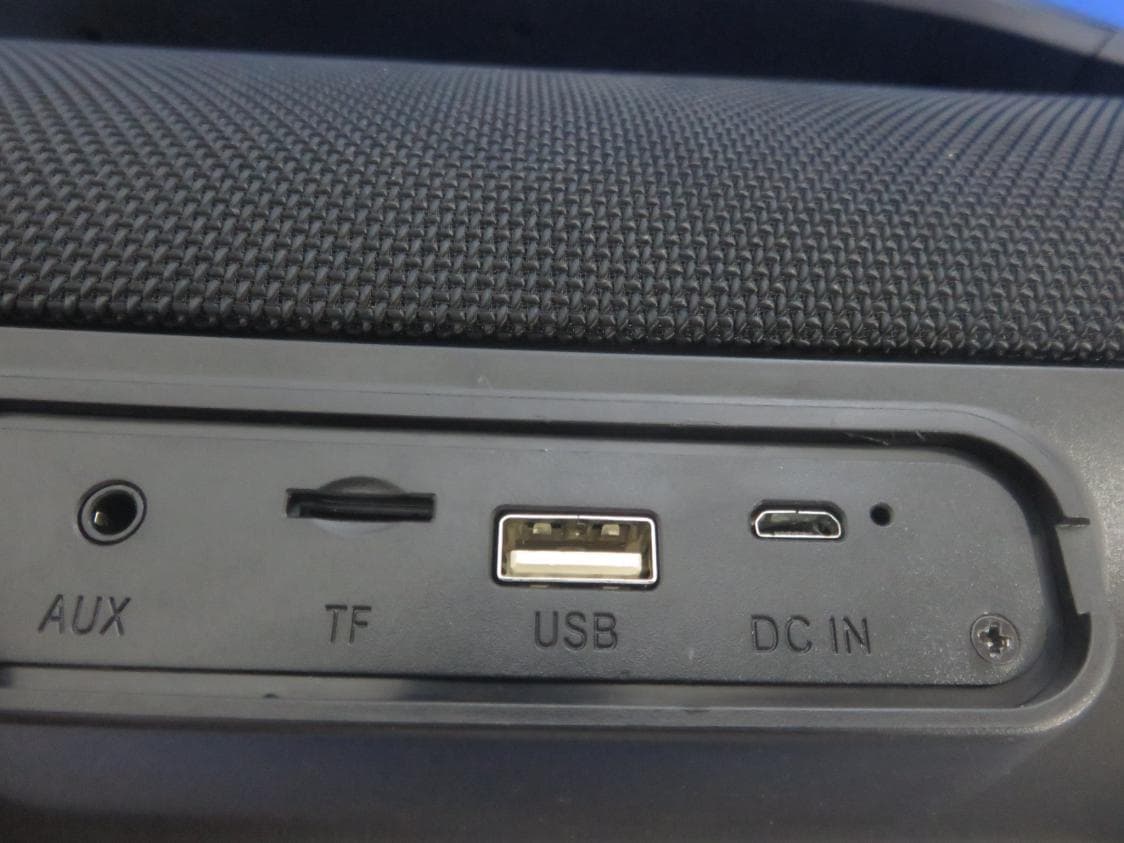
Click to zoom
Application Details
- Equipment Class
- DSS - Part 15 Spread Spectrum Transmitter
- Date of Grant
- Jul 14, 2020
- Application Purpose
- Original Equipment
- Date of Application
- Jul 14, 2020
- Equipment Note
- Bluetooth Speaker
- Frequency Range
- 2402.00000000 - 2480.00000000
- Company
- PHIMAX INTERNATIONAL LIMITED
- Country
- China
Documents & Files
Document Text
Text extracted from the exhibit documents filed with the FCC. Open a document above to read the original.
Users Manual
Please read the instructions carefully before using the speaker Please Keep this manual for future access problems Open the box a. a bluetooth speaker b. USB Cable c. a user manual d. a 3.5mm audio cable bluetooth speakeruser manual user manual external audio cable Built-in Bluetooth Built Efficacy USB Play/SD(MP3,WMA) 3.5MM line output jack handfree function FUNCTIONS Technical parameters Please make sure the following accessories are safe USB Cable With DSP Power Output: RMS 10W*2 Speaker full range unit: 2"x10Wx2 S/N: ≥70dB THD<0.2% Frequency response: 90Hz-20KHz Separation: ≥45dB Bluetooth:5.0+EDR Battery:2*1800MAH/7.4V Size:322*153*209mm OPERATION 一 Button operation; MODE: Mode Shift Button, AUX-USB-BLUETOOTH BLUETOOTH: Bluetooth button, short press for bluetooth mode AUX: AUX button, short press for AUX mode USB: USB button, short press to read music USB mode. 二LED DESCRIPTION 1 White is always bright in AUX mode, 2In USB and Play mode, red is.twinkle slowly 3Blue LED Bluetooth indicator light When changing to bluetooth mode A: Blue light bright is showing the bluetooth paused status B: when searching, fast twinkle blue light is showing bluetooth into the search status; After a successful connection, blue is always bright C: In bluetooth play status, blue light always bright "-": In USB mode, short press for item; In AUX mode invalid; In bluetooth mode , short press for item, long press to volume down. “>||”: In USB mode is play/pause; In AUX mode invalid; In bluetooth mode , short press for play/pause,long press to reselect the pairing connection status, waiting for other bluetooth devices to connect. “+”: In USB mode, short press for last item; In AUX mode invalid; In bluetooth mode , short press for last item, long press to volume up. 4Charge batteny A: When charge battery not finished red always bright B: When full charge battery green always bright White (always bright) Green Redunder chargingCharge Greenfinished PreviousPreviousPrevious Product Operation Introduction 4. Bluetooth/AUX playback selector 5. Next track/[+] Volume 6. Play/pause 2. Previous track/ [-] Volume 3. On/off 1. Hand Free AVOIDING WATER The product should not be subjected to water or water splashing, should not be placed in some objects such as vases filled with liquid Keep the product away from vases, buckets, wash bowls. If the liquid poured into the product, HIGH TEMPERATURE OR HUMIDITY Do not use the product which be placed in high temperature environment (such as an ignition source, oven or similar environment) Do not use the product which be placed in very humid or steam filled environment When you move the product from a cold environment to a hot environment, if the product interior already with moisture, will not work. At this time, turn on the power to wait for about an hour,it can work normally after all moisture evaporation. FCC STATEMENT : Attention : Our company retained the power that change the design and specifications for improve the product. Please kindly understand that we will not notice in further. This device complies with Part 15 of the FCC Rules. Operation is subject to the following two conditions: (1) This device may not cause harmful interference, and (2) This device must accept any interference received, including interference that may cause undesired operation. Warning: Changes or modifications not exp ressly approved by the party responsible for compliance could void the user's authority to operate the equip ment. NOTE: This equipment has been te sted and found to comply with t he limits for a Class B digital device, pursuant to Par t 15 of the FCC Rules. These limits are designed to provide reasonable protection against harmful inter ference in a residential installation. This equipment generates uses and can radiate radio frequency energy and, if not installed and used in accordance with the in structions, may cause harmful interference to radio communications. However, there is no guarantee that interference will not occur in a particular installation. If this equipment does cause harmful interference to radio or television reception, which can be determined by turning the equipment off and on, the user is encouraged to try to correct the interference by one or more of the following measures: Reorient or relocate the receiving antenna. Increase the separation bet ween the equipment and receiver. Connect the equipment into an outlet on a circuit different from that to which the receiver is connected. Consult the dealer or an experienced radio/TV technician for help. FCC Radiation Exposure Statement: This equipment complies with FCC radiation exposure limits set forth for an uncontrolled environment. This equipment should be installed and operated with minimum distance 20cm between the radiator & your body. Model: V2
External Photos
FCC ID: 2AHXM-V2
ID Label/Location Info
Label Location On EUT Label Product Name: Bluetooth Speaker Model No.: V2 FCC ID: 2AHXM-V2 This device complies with Part 15 of the FCC Rules. Operation is subject to the following two conditions: (1) This device may not cause harmful interference, and (2) This device must accept any interference received, including interference that may cause undesired operation.
Internal Photos
FCC ID: 2AHXM-V2 ANT
Operational Description
version01 PHIMAX INTERNATIONAL LIMITED Declaration concerning Antenna Specification It is hereby declared that the product Model No.: V2 FCCID:2AHXM-V2 fulfills the requirement in FCC test relating to the antenna type. The device specified above confirms to the FCC recommendations for internal antenna type(s) described below: BDR+EDR: Model No. of antenna: N/A Type of antenna:PCB Antenna Gain of the antenna: 2 dBi Frequency range:2402MHz~2480MHz The mounting of the antenna is fixed to the radio module and no other antenna should be used. Company name: PHIMAX INTERNATIONAL LIMITED Address: Room 1303, No.95 XinYan Building YanLing Road TianHe Distirctt, Guangzhou, China City:Guangzhou ZIP / Postal code: N/A Country:China Place:ChinaDate: 2020-07-14 Signature:
RF Exposure Info
RF EXPOSURE EVALUATION FCC ID: 2AHXM-V2 According to FCC 1.1310: The criteria listed in the following table shall be used to evaluate the environment impact of human exposure to radio frequency(RF) Radiation as specified in §1.1307(b): Routine SAR evaluation refers to that specifically required by §2.1093, using measurements or computer simulation. When routine SAR evaluation is not required, portable transmitters withoutput power greater than the applicable low threshold require SAR evaluation to qualify for TCB approval. Channel (MHz) Maximum output power (dBm) Tune up tolerance (dBm) Max Tune Up Power (dBm) Distance (mm) Calculation results Limit Operating Mode 2402-2.269 -2.269±1-1.26950.2313 BDR+EDR 2441-0.448 -0.448±10.55250.3553 24800.683 0.683±11.68350.4643 2402-2.822 -2.822±1-1.82250.2043 2441-1.168 -1.168±1-0.16850.3013 2480-0.210 -0.210±10.79050.3783 Test Results:PASS.
Test Report
Report No.: 18220WC00055501FCC ID: 2AHXM-V2Page 1 of 62 Code:AB-RF-05-a FCC TEST REPORT Client Name: PHIMAX INTERNATIONAL LIMITED Address: Room 1303, No.95 XinYan Building, YanLing Road TianHe Distirct, Guangzhou, China Product Name: Bluetooth Speaker Date: Jul. 10, 2020 Shenzhen Anbotek Compliance Laboratory Limited Report No.: 18220WC00055501FCC ID: 2AHXM-V2Page 2 of 62 Code:AB-RF-05-a Contents 1. General Information ............................................................................................................................................... 5 1.1. Client Information ....................................................................................................................................... 5 1.2. Description of Device (EUT) ..................................................................................................................... 5 1.3. Auxiliary Equipment Used During Test ................................................................................................... 6 1.4. Description of Test Modes ........................................................................................................................ 6 1.5. List of channels ........................................................................................................................................... 7 1.6. Description Of Test Setup ......................................................................................................................... 8 1.7. Test Equipment List .................................................................................................................................... 9 1.8. Measurement Uncertainty ....................................................................................................................... 10 1.9. Description of Test Facility ...................................................................................................................... 10 2. Summary of Test Results ................................................................................................................................... 11 3. Conducted Emission Test ................................................................................................................................... 12 3.1. Test Standard and Limit .......................................................................................................................... 12 3.2. Test Setup .................................................................................................................................................. 12 3.3. Test Procedure .......................................................................................................................................... 12 3.4. Test Data .................................................................................................................................................... 12 4. Radiation Spurious Emission and Band Edge ................................................................................................ 17 4.1. Test Standard and Limit .......................................................................................................................... 17 4.2. Test Setup .................................................................................................................................................. 17 4.3. Test Procedure .......................................................................................................................................... 18 4.4. Test Data .................................................................................................................................................... 19 5. Maximum Peak Output Power Test .................................................................................................................. 27 5.1. Test Standard and Limit .......................................................................................................................... 27 5.2. Test Setup .................................................................................................................................................. 27 5.3. Test Procedure .......................................................................................................................................... 27 5.4. Test Data .................................................................................................................................................... 27 6. 20DB Occupy Bandwidth Test ........................................................................................................................... 31 6.1. Test Standard ............................................................................................................................................ 31 6.2. Test Setup .................................................................................................................................................. 31 6.3. Test Procedure .......................................................................................................................................... 31 6.4. Test Data .................................................................................................................................................... 31 7. Carrier Frequency Separation Test ................................................................................................................... 35 7.1. Test Standard and Limit .......................................................................................................................... 35 7.2. Test Setup .................................................................................................................................................. 35 7.3. Test Procedure .......................................................................................................................................... 35 7.4. T…
Text truncated - open the document above for the full version.
Test Setup Photos
FCC ID: 2AHXM-V2 Photo of Conducted Emission Measurement Photo of Radiation Emission Test
Contact Information
Applicant
Phibe Yang
Test Firm
Shenzhen Anbotek Compliance Laboratory LimitedJeff Zhu
Technical Specifications
| # | Rule Parts | Frequency Range | Power Output |
|---|---|---|---|
| 1 | 15C | 2.40 GHz - 2.48 GHz | 1.20 mW |
Other Applications from PHIMAX INTERNATIONAL LIMITED
2AHXM-FUNK5
Jan 14, 2024Bluetooth speaker
Equipment Class
DTS - Digital Transmission System