A3LSPHA760Tri-Mode Dual-Band Analog/ PCS Phone (AMPS/CDMA)
Samsung Electronics Co Ltd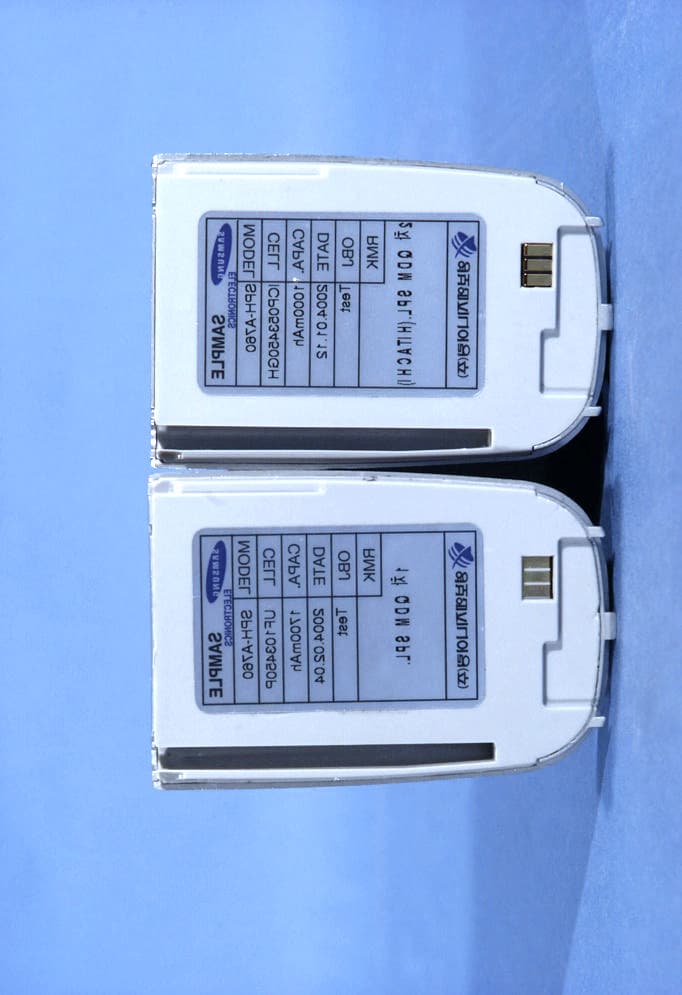
Click to zoom
Application Details
- Equipment Class
- PCE - PCS Licensed Transmitter held to ear
- Date of Grant
- Mar 02, 2004
- Application Purpose
- Original Equipment
- Date of Application
- Mar 02, 2004
- Equipment Note
- Tri-Mode Dual-Band Analog/ PCS Phone (AMPS/CDMA)
- Frequency Range
- 1851.25000000 - 1908.75000000
- Company
- Samsung Electronics Co Ltd
- Country
- United States
Documents & Files
Document Text
Text extracted from the exhibit documents filed with the FCC. Open a document above to read the original.
Users Manual
PCS Service www.sprintpcs.com Copyright © 2004 Sprint Spectrum L.P. All rights reserved. No reproduction in whole or in part allowed without prior written approval. Sprint, the diamond logo and all other trademarks listed herein are registered trade marks of Sprint Communications Company, L.P., used under license. Printed in South Korea WJ10.06_LMAA760_010804F5 FCC RF EXPOSURE INFORMATION In August 1996 the Federal Communications Commission (FCC) of the United States with its action in Report and Order FCC 96-326 adopted an updated safety standard for human exposure to radio frequency electromagnetic energy emitted by FCC regulated transmitters. Those guidelines are consistent with the safety standards previously set by both U.S. and international standards bodies. The design of this phone complies with the FCC guidelines and these international standards. Use only the supplied antenna or one that is approved. Unauthorized antennas, modifications, or attachments could impair call quality, damage the phone, or result in a violation of FCC regulations. Do not use the phone with a damaged antenna. If a damaged antenna comes into contact with the skin, a minor burn may result. Please contact your local dealer for a replacement antenna. Body-worn Operation SAR compliance for body-worn operating configurations is limited to the specific belt-clip/holster supplied or approved by Samsung, if available. End-users must be informed of the body-worn operating requirements for satisfying RF exposure compliance. The use of accessories that do not satisfy these requirements may not comply with FCC RF exposure compliance and should be avoided. For more information about RF exposure, please visit the FCC Web site at www.fcc.gov. Vehicle Mounted External Antenna (optional, if available.) A minimum separation distance of 7.9 inches (20cm) must be maintained between a person and the vehicle mounted external antenna to satisfy FCC RF exposure requirements. For more information about RF exposure, please visit the FCC web site at www 1 Table of Contents How to Use This Guide ......................................................... i Getting Advanced Phone and Service Information ........... ii Getting Started...................................................................... 1 Basics of Your PCS Phone ................................................ 15 Your New PCS Phone ........................................................................... 16 Your Phone’s Features ....................................................................................... 17 Viewing the Display Screen ............................................................................... 19 Turning Your Phone On and Off ......................................................... 22 Turning Your Phone ON................................................................................... 22 Turning Your Phone OFF ................................................................................. 22 Setting the Language ........................................................................................... 22 Using the Battery and Charger ............................................................ 23 Installing and Removing the Battery ................................................................ 23 Charging the Battery ........................................................................................... 24 Making and Answering Calls ............................................................... 25 Making Calls ......................................................................................................... 25 Answering Calls ................................................................................................... 25 Signal Strength ..................................................................................................... 25 Controlling Your Roaming Experience ............................................... 26 Setting Your Phone’s Roam Mode ................................................................... 26 Call Guard............................................................................................................. 27 Internal Phone Book ............................................................................. 28 Saving Phone Numbers ...................................................................................... 28 Finding Phone Numbers .................................................................................... 29 Making a Call From Your Internal Phone Book ............................................ 29 Changing Your Phone’s Settings ........................................................ 30 Airplane Mode ..................................................................................................... 30 Changing the Greeting........................................................................................ 30 Adjusting the Ringer and Key Beep Volume .................................................. 31 Adjusting Volume During a Conversation ...................................................... 31 TTY Use With PCS Service From Sprint ....................................................... 31 2 Receiving Voicemail Messages ...........................................................33 Setting Up Voicemail ......................................................................................... 33 Retrieving Voicemail Messages......................................................................... 33 Accessing Voicemail From Another Phone ................................................... 33 PCS Service Features ...........................................................................34 Call Waiting ......................................................................................................... 34 Call Forwarding................................................................................................... 34 Three-Way Calling .........…
Text truncated - open the document above for the full version.
Attestation Statements
February 4, 2004 Federal Communications Commission Authorization and Evaluation Div. Equipment Authorization Branch 7435 Oakland Mills Road Columbia, MD 21046 To whom it may concern: We, the undersigned, hereby authorize PCTEST Engineering Laboratory Inc., to act as agent on behalf of all matters relating to applications for equipment authorization, including the signing of all documents relating to these matters. Any and all acts carried out by PCTEST Engineering Laboratory, Inc. on our behalf shall have the same effect as acts of our own. We also hereby certify that no party to this application is subject to a denial of benefits, including FCC benefits, pursuant to Section 5301 of the Anti-Drug Abuse Act of 1988,21 U.S.C.862. Sincerely, Wallace Oh Engineering Manager Samsun Electronics America February 4, 2004 Federal Communications Commission Equipment Approval Services 7435 Oakland Mills Road Columbia, MD 21046 SUBJECT: FCC E911 REQUIREMENTS PER §22.921 Gentlemen: Samsung Electronics Co., Ltd. hereby certifies that the analog cellular telephone (FCC ID: A3LSPHA760), using the Automatic A/B Roaming — Intelligent Retry method, meets the E911 requirements specified in Section 22.921 of the FCC Rules. This procedure recognizes when a “9-1-1” call is made and, at such time, will override any programming in the mobile unit that determines the handling of a non-911 call and permit the call to be handled by other analog carriers. Should you have any questions or comments concerning the above, please contact the undersigned.
Attestation Statements
February 4, 2004 Federal Communications Commission Authorization and Evaluation Div. Equipment Authorization Branch 7435 Oakland Mills Road Columbia, MD 21046 In re: Samsung Electronics Co., Ltd. FCC ID.: A3LSPHA760 Request for Confidentiality To Whom It May Concern: In accordance with 0.459 of CFR 47, Samsung Electronics Co., Ltd. requests confidentiality for the Block Diagram, Schematics, Parts list, Tune-up Procedure, Operational and Circuit Description of the attached test report. These documents contain detailed system and equipment descriptions and related information about the product, which Samsung Electronics Co., Ltd. considers to be proprietary, confidential, and a custom design and otherwise, would not release to the general public. Since this design is a basis from which future technological products will evolve, Samsung feels that this information would be of benefit to its competitors, and that the disclosure of the information in these documents would give our competitors an unfair advantage in the market. Sincerely, Wallace Oh Engineering Manager Samsun Samsung Electronics America
Cover Letter(s)
February 26, 2004 Federal Communications Commission Equipment Approval Services 7435 Oakland Mills Road Columbia, MD 21046 SUBJECT: SAMSUNG Electronics Co., Ltd. FCC ID: A3LSPHA760 Part 22/24 Certification Gentlemen: Submitted herewith, on behalf of SAMSUNG Electronics Co., Ltd., is an application for Part 22/24 Certification of the Tri-Mode Dual-Band Analog/PCS CDMA Phone (AMPS/CDMA). Attached is the applicant’s Letter of Authorization, Confidentiality Request, measurement report test data and plots, RF Exposure measurement report and data, FCC ID label and location, test setup photographs, internal and external photographs, block diagram (confidential), circuit diagrams & description (confidential), operational description (confidential), parts list & tune-up procedure (confidential), and the user's manual. Should you have any questions or comments concerning the above, please contact the undersigned. cc: SAMSUNG Electronics Co., Ltd.
External Photos
SAMSUNG FCC ID: A3LSPHA760 EUT Photographs © 2004 PCTEST Lab. Tri-Mode Dual-Band Analog/PCS Phone Model: SPH-A760 SAMSUNG FCC ID: A3LSPHA760 EUT Photographs © 2004 PCTEST Lab. Tri-Mode Dual-Band Analog/PCS Phone Model: SPH-A760 SAMSUNG FCC ID: A3LSPHA760 EUT Photographs © 2004 PCTEST Lab. Tri-Mode Dual-Band Analog/PCS Phone Model: SPH-A760 SAMSUNG FCC ID: A3LSPHA760 EUT Photographs © 2004 PCTEST Lab. Tri-Mode Dual-Band Analog/PCS Phone Model: SPH-A760 SAMSUNG FCC ID: A3LSPHA760 EUT Photographs © 2004 PCTEST Lab. Tri-Mode Dual-Band Analog/PCS Phone Model: SPH-A760 SAMSUNG FCC ID: A3LSPHA760 EUT Photographs © 2004 PCTEST Lab. Tri-Mode Dual-Band Analog/PCS Phone Model: SPH-A760 SAMSUNG FCC ID: A3LSPHA760 EUT Photographs © 2004 PCTEST Lab. Tri-Mode Dual-Band Analog/PCS Phone Model: SPH-A760 SAMSUNG FCC ID: A3LSPHA760 EUT Photographs © 2004 PCTEST Lab. Tri-Mode Dual-Band Analog/PCS Phone Model: SPH-A760 SAMSUNG FCC ID: A3LSPHA760 EUT Photographs © 2004 PCTEST Lab. Tri-Mode Dual-Band Analog/PCS Phone Model: SPH-A760
ID Label/Location Info
© 2004 PCTEST Lab FCC ID SAMPLE LABEL & LOCATION LABELLING REQUIREMENTS The Label shown shall be permanently affixed at a conspicuous location on the device and be readily visible to the user at the time of purchase. (SEE NEXT PAGE) SAMSUNG ELECTRONICS CO., LTD. MODEL NO: SPH-A760 FCC ID: A3LSPHA760 MADE IN KOREA SAMSUNG ELECTRONICS CO., LTD
Internal Photos
SAMSUNG FCC ID: A3LSPHA760 EUT Photographs © 2004 PCTEST Lab. Tri-Mode Dual-Band Analog/PCS Phone Model: SPH-A760 SAMSUNG FCC ID: A3LSPHA760 EUT Photographs © 2004 PCTEST Lab. Tri-Mode Dual-Band Analog/PCS Phone Model: SPH-A760 SAMSUNG FCC ID: A3LSPHA760 EUT Photographs © 2004 PCTEST Lab. Tri-Mode Dual-Band Analog/PCS Phone Model: SPH-A760 SAMSUNG FCC ID: A3LSPHA760 EUT Photographs © 2004 PCTEST Lab. Tri-Mode Dual-Band Analog/PCS Phone Model: SPH-A760 SAMSUNG FCC ID: A3LSPHA760 EUT Photographs © 2004 PCTEST Lab. Tri-Mode Dual-Band Analog/PCS Phone Model: SPH-A760 SAMSUNG FCC ID: A3LSPHA760 EUT Photographs © 2004 PCTEST Lab. Tri-Mode Dual-Band Analog/PCS Phone Model: SPH-A760 SAMSUNG FCC ID: A3LSPHA760 EUT Photographs © 2004 PCTEST Lab. Tri-Mode Dual-Band Analog/PCS Phone Model: SPH-A760 SAMSUNG FCC ID: A3LSPHA760 EUT Photographs © 2004 PCTEST Lab. Tri-Mode Dual-Band Analog/PCS Phone Model: SPH-A760 SAMSUNG FCC ID: A3LSPHA760 EUT Photographs © 2004 PCTEST Lab. Tri-Mode Dual-Band Analog/PCS Phone Model: SPH-A760
RF Exposure Info
PCTEST ENGINEERING LABORATORY, INC. DUT: Dipole 835 MHz; Type: D835V2; Serial: 406 Communication System: CW; Frequency: 835 MHz;Duty Cycle: 1:1 Medium: 835 Brain ( σ = 0.91 mho/m, ε r = 40.82, ρ = 1000 kg/m 3 ) Phantom section: Flat Section; Space: 1.5 cm Test Date: 01-16-2004; Ambient Temp: 22.7°C; Tissue Temp: 20.6°C Probe: ES3DV2 - SN3022; ConvF(6.1, 6.1, 6.1); Calibrated: 9/23/2003 Sensor-Surface: 3mm (Mechanical Surface Detection) Electronics: DAE3 Sn445; Phantom: SAM 12b; Type: SAM 4.0; Serial: TP:1197 Measurement SW: DASY4, V4.1 Build 47; Postprocessing SW: SEMCAD, V1.8 Build 93 835 MHz Dipole Validation Area Scan (61x121x1): Measurement grid: dx=15mm, dy=15mm Zoom Scan (7x7x7)/Cube 0: Measurement grid: dx=5mm, dy=5mm, dz=5mm Input Power = 24.0 dBm (250 mW) SAR(1 g) = 2.41 mW/g; SAR(10 g) = 1.57 mW/g Target SAR(1g) = 2.375 mW/g; Deviation = +1.47 % 0 dB = 2.82mW/g PCTEST ENGINEERING LABORATORY, INC. DUT: Dipole 1900 MHz; Type: D1900V2; Serial: 502 Communication System: CW; Frequency: 1900 MHz;Duty Cycle: 1:1 Medium: 1900 Brain ( σ = 1.38 mho/m, ε r = 40.43, ρ = 1000 kg/m 3 ) Phantom section: Flat Section; Space: 1.0 cm Test Date: 01-16-2004; Ambient Temp: 22.4°C; Tissue Temp: 20.1°C Probe: ES3DV2 - SN3022; ConvF(5, 5, 5); Calibrated: 9/23/2003 Sensor-Surface: 3mm (Mechanical Surface Detection) Electronics: DAE3 Sn445; Phantom: SAM 12b; Type: SAM 4.0; Serial: TP:1197 Measurement SW: DASY4, V4.2 Build 12; Postprocessing SW: SEMCAD, V1.8 Build 93 1900 MHz Dipole Validation Area Scan (41x51x1): Measurement grid: dx=15mm, dy=15mm Zoom Scan (7x7x7)/Cube 0: Measurement grid: dx=5mm, dy=5mm, dz=5mm Input Power = 20.0 dBm (100 mW) SAR(1 g) = 3.76 mW/g; SAR(10 g) = 1.88 mW/g Target SAR(1g) = 3.97 mW/g; Deviation = -5.28 % 0 dB = 4.93mW/g
RF Exposure Info
ES3DV2-SN:3022 Page 1 of 2 December 3, 2003 Additional Conversion Factors for Dosimetric E-Field Probe Type: Serial Number: Place of Assessment: Date of Assessment: Probe Calibration Date: Schmid & Partner Engineering AG hereby certifies that conversion factor(s) of this probe have been evaluated on the date indicated above. The assessment was performed using the FDTD numerical code SEMCAD of Schmid & Partner Engineering AG. Since the evaluation is coupled with measured conversion factors, it has to be recalculated yearly, i.e., following the re-calibration schedule of the probe. The uncertainty of the numerical assessment is based on the extrapolation from measured value at 900 MHz or at 1800 MHz. Assessed by: ES3DV2 3022 Zurich December 3, 2003 September 23, 2003 ES3DV2-SN:3022 Page 2 of 2 December 3, 2003 Dosimetric E-Field Probe ES3DV2 SN:3022 Conversion factor (± standard deviation) 1950 MHz ConvF 4.7 ± 9.5% e r = 40.0 ± 5% s = 1.40 ± 5% mho/m (head tissue) 1950 MHz ConvF 4. 3 ± 9.5% e r = 53.3 ± 5% s = 1.52 ± 5% mho/m (body tissue) ES3DV2-SN:3022Page 1 of 2November 28, 2003 Additional Conversion Factors for Dosimetric E-Field Probe Type: Serial Number: Place of Assessment: Date of Assessment: Probe Calibration Date: Schmid & Partner Engineering AG hereby certifies that conversion factor(s) of this probe have been evaluated on the date indicated above. The assessment was performed using the FDTD numerical code SEMCAD of Schmid & Partner Engineering AG. Since the evaluation is coupled with measured conversion factors, it has to be recalculated yearly, i.e., following the re-calibration schedule of the probe. The uncertainty of the numerical assessment is based on the extrapolation from measured value at 900 MHz or at 1800 MHz. Assessed by: ES3DV2 3022 Zurich November 28, 2003 September 23, 2003 ES3DV2-SN:3022Page 2 of 2November 28, 2003 Dosimetric E-Field Probe ES3DV2 SN:3022 Conversion factor (± standard deviation) 1600 MHzConvF5.2 ± 8% e r =40.3 ± 5% s =1.29 ± 5% mho/m (head tissue) 1600 MHzConvF4.9 ± 8% e r =53.8 ± 5% s =1.40 ± 5% mho/m (body tissue) ES3DV2-SN:3022Page 1 of 2December 9, 2003 Additional Conversion Factors for Dosimetric E-Field Probe Type: Serial Number: Place of Assessment: Date of Assessment: Probe Calibration Date: Schmid & Partner Engineering AG hereby certifies that conversion factor(s) of this probe have been evaluated on the date indicated above. The assessment was performed using the FDTD numerical code SEMCAD of Schmid & Partner Engineering AG. Since the evaluation is coupled with measured conversion factors, it has to be recalculated yearly, i.e., following the re-calibration schedule of the probe. The uncertainty of the numerical assessment is based on the extrapolation from measured value at 900 MHz or at 1800 MHz. Assessed by: ES3DV2 3022 Zurich December 9, 2003 September 23, 2003 ES3DV2-SN:3022Page 2 of 2December 9, 2003 Dosimetric E-Field Probe ES3DV2 SN:3022 Conversion factor (± standard deviation) 2140 MHzConvF4.5 ± 8% e r =39.8 ± 5% s =1.49 ± 5% mho/m (brain tissue)
RF Exposure Info
SAMSUNG FCC ID: A3LSPHA760 EUT Photographs © 2004 PCTEST Lab. Tri-Mode Dual-Band Analog/PCS Phone Model: SPH-A760 SAMSUNG FCC ID: A3LSPHA760 EUT Photographs © 2004 PCTEST Lab. Tri-Mode Dual-Band Analog/PCS Phone Model: SPH-A760 SAMSUNG FCC ID: A3LSPHA760 EUT Photographs © 2004 PCTEST Lab. Tri-Mode Dual-Band Analog/PCS Phone Model: SPH-A760 SAMSUNG FCC ID: A3LSPHA760 EUT Photographs © 2004 PCTEST Lab. Tri-Mode Dual-Band Analog/PCS Phone Model: SPH-A760 SAMSUNG FCC ID: A3LSPHA760 EUT Photographs © 2004 PCTEST Lab. Tri-Mode Dual-Band Analog/PCS Phone Model: SPH-A760 SAMSUNG FCC ID: A3LSPHA760 EUT Photographs © 2004 PCTEST Lab. Tri-Mode Dual-Band Analog/PCS Phone Model: SPH-A760 SAMSUNG FCC ID: A3LSPHA760 EUT Photographs © 2004 PCTEST Lab. Tri-Mode Dual-Band Analog/PCS Phone Model: SPH-A760 SAMSUNG FCC ID: A3LSPHA760 EUT Photographs © 2004 PCTEST Lab. Tri-Mode Dual-Band Analog/PCS Phone Model: SPH-A760 SAMSUNG FCC ID: A3LSPHA760 EUT Photographs © 2004 PCTEST Lab. Tri-Mode Dual-Band Analog/PCS Phone Model: SPH-A760 SAMSUNG FCC ID: A3LSPHA760 EUT Photographs © 2004 PCTEST Lab. Tri-Mode Dual-Band Analog/PCS Phone Model: SPH-A760 SAMSUNG FCC ID: A3LSPHA760 EUT Photographs © 2004 PCTEST Lab. Tri-Mode Dual-Band Analog/PCS Phone Model: SPH-A760 SAMSUNG FCC ID: A3LSPHA760 EUT Photographs © 2004 PCTEST Lab. Tri-Mode Dual-Band Analog/PCS Phone Model: SPH-A760 SAMSUNG FCC ID: A3LSPHA760 EUT Photographs © 2004 PCTEST Lab. Tri-Mode Dual-Band Analog/PCS Phone Model: SPH-A760 SAMSUNG FCC ID: A3LSPHA760 EUT Photographs © 2004 PCTEST Lab. Tri-Mode Dual-Band Analog/PCS Phone Model: SPH-A760 SAMSUNG FCC ID: A3LSPHA760 EUT Photographs © 2004 PCTEST Lab. Tri-Mode Dual-Band Analog/PCS Phone Model: SPH-A760
RF Exposure Info
PCTEST ENGINEERING LABORATORY, INC. 6660 – B Dobbin Road • Columbia, MD 21045 • USA Telephone 410.290.6652 / Fax 410.290.6654 http://www.pctestlab.com (email: [email protected]) CERTIFICATE OF COMPLIANCE (SAR EVALUATION) PCTEST SAR REPORT FCC CERTIFICATION Reviewed by: Quality Manager SAR Filename: SAR-240116022-R1.A3L Test Dates: Jan. 16-21 & Feb. 20, 2004 Phone Type: Tri-Mode Dual-Band Phone FCC ID: A3LSPHA760 Page 1 of 36 © 2004 PCTEST Engineering Laboratory, Inc APPLICANT NAME & ADDRESS: DATE & LOCATION OF TESTING: SAMSUNG ELECTRONICS CO., LTD. Dates of Tests: Jan. 16-21 & Feb. 20, 2004 3351 Michelson Drive, Suite 290 Test Report S/N: SAR.240116022-R1.A3L Irvine, CA 92612 Test Site: PCTEST Lab, Columbia MD FCC ID: A3LSPHA760 APPLICANT: SAMSUNG ELECTRONICS CO., LTD. EUT Type: Tri-Mode Dual-Band Analog/PCS Phone (AMPS/CDMA) Tx Frequency: 824.04 – 848.97 MHz (AMPS) / 824.70 – 848.31 MHz (CDMA) 1851.25 – 1908.75 MHz (PCS CDMA) Rx Frequency: 869.04 – 893.97 MHz (AMPS) / 869.70 – 893.31 MHz (CDMA) 1931.25 – 1988.75 MHz (PCS CDMA) Max. RF Output Power: 0.322 W ERP AMPS (25.079 dBm) / 26.0 dBm Conducted 0.322 W ERP CDMA (25.073 dBm) / 25.0 dBm Conducted 0.321 W EIRP PCS CDMA (25.051 dBm) / 25.0 dBm Conducted Max. SAR Measurement: 1.370 W/kg AMPS Head SAR; 1.104 W/kg AMPS Body SAR; 1.120 W/kg CDMA Head SAR; 1.020 W/kg CDMA Body SAR; 0.823 W/kg PCS CDMA Head SAR; 0.746 W/kg PCS CDMA Body SAR 0.132 W/kg PCS CDMA Face Trade Name/Model(s): SPH-A760 FCC Classification: Licensed Portable Transmitter Held to Ear (PCE) FCC Rule Part(s): §2.1093; FCC/OET Bulletin 65 Supplement C [July 2001] Application Type: Certification Test Device Serial No.: identical prototype [S/N: #2] This wireless portable device has been shown to be capable of compliance for localized specific absorption rate (SAR) for uncontrolled environment/general population exposure limits specified in ANSI/IEEE Std. C95.1-1992 and had been tested in accordance with the measurement procedures specified in FCC/OET Bulletin 65 Supplement C (2001) and IEEE Std. P1528 D1.2 (April 2003). I attest to the accuracy of data. All measurements reported herein were performed by me or were made under my supervision and are correct to the best of my knowledge and belief. I assume full responsibility for the completeness of these measurements and vouch for the qualifications of all persons taking them. Grant Conditions: Power output listed is ERP for Part 22 and EIRP for Part 24. SAR compliance for body-worn operating configuration is limited to the specific belt-clip tested for this filing. Push-to- Talk PTT operating configuration is based on a separation distance of 2.5 cm from the front of the unit and the face of the user. End-users must be informed of the body-worn operating requirements for satisfying RF exposure compliance. PCTEST certifies that no party to this application has been denied the FCC benefits pursuant to Section 5301 of the Anti-Drug Abuse Act of 1988, 21 U.S.C. 862. PCTEST SAR REPORT FCC CERTIFICATION Reviewed by: Quality Manager SAR Filename: SAR-240116022-R1.A3L Test Dates: Jan. 16-21 & Feb. 20, 2004 Phone Type: Tri-Mode Dual-Band Phone FCC ID: A3LSPHA760 Page 2 of 36 © 2004 PCTEST Engineering Laboratory, Inc TABLE OF CONTENTS 1. INTRODUCTION / SAR DEFINITION.................................................................................3 2. SAR MEASUREMENT SETUP..............................................................................................4 3. DASY4 E-FIELD PROBE SYSTEM........................................................................................5 4. PROBE CALIBRATION PROCESS.......................................................................................6 5. PHANTOM & EQUIVALENT TISSUES.................................................................................7 6. TEST SYSTEM SPECIFICATIONS.........................................................................................8 7. DOSIMETRIC ASSESSMENT & PHANTOM SPECS................................................................9 8. DEFINITION OF REFERENCE POINTS..............................................................................10 9. TEST CONFIGURATION POSITIONS...............................................................................11 10. ANSI/IEEE C95.1 - 1992 RF EXPOSURE LIMITS.................................................................14 11. MEASUREMENT UNCERTAINTIES...................................................................................15 12. SYSTEM VERIFICATION..................................................................................................16 13. SAR TEST DATA SUMMARY.......................................................................................17-33 15. SAR TEST EQUIPMENT..........................................................................................34 16. CONCLUSION...............................................................................................................35 17. REFERENCES..................................................................................................................36 PCTEST SAR REPORT FCC CERTIFICATION Reviewed by: Quality Manager SAR Filename: SAR-240116022-R1.A3L Test Dates: Jan. 16-21 & Feb. 20, 2004 Phone Type: Tri-Mode Dual-Band Phone FCC ID: A3LSPHA760 Page 3 of 36 © 2004 PCTEST Engineering Laboratory, Inc 1. INTRODUCTION / SAR DEFINITION The FCC has adopted the guidelines for evaluating the environmental effects of radiofrequency radiation in ET Docket 93-62 on Aug. 6, 1996 to protect the public and workers from the potential hazards of RF emissions due to FCC-regulated portable devices.[1] The safety limits used for the environmental evaluation measurements are based on the criteria published by the American National Standards Institute (ANSI) for localized specific absorption rate (SAR) in IEEE/ANSI C95.1-1992 Standard for Safety Levels with Respect to Human Exposure to Radio Frequency Electromagnetic Fields,…
Text truncated - open the document above for the full version.
RF Exposure Info
PCTEST ENGINEERING LABORATORY, INC. DUT: SPH-A760; Type: SAMSUNG Tri Mode Phone; Serial: #2; Conducted Power: 26.0 dBm Communication System: AMPS; Frequency: 836.49 MHz;Duty Cycle: 1:1 Medium: 835 Brain ( σ = 0.91 mho/m, ε r = 40.82, ρ = 1000 kg/m 3 ) Phantom section: Right Section Test Date: 01-16-2004; Ambient Temp: 22.7°C; Tissue Temp: 20.6°C Probe: ES3DV2 - SN3022; ConvF(6.1, 6.1, 6.1); Calibrated: 9/23/2003 Sensor-Surface: 3mm (Mechanical Surface Detection) Electronics: DAE3 Sn445; Phantom: SAM 12b; Type: SAM 4.0; Serial: TP:1197 Measurement SW: DASY4, V4.2 Build 12; Postprocessing SW: SEMCAD, V1.8 Build 93 Touch, Ch.0383, Ant.Out, Standard Battery Area Scan (51x141x1): Measurement grid: dx=15mm, dy=15mm Zoom Scan (5x5x7)/Cube 0: Measurement grid: dx=8mm, dy=8mm, dz=5mm Peak SAR (extrapolated) = 1.93 W/kg SAR(1 g) = 1.37 mW/g; SAR(10 g) = 0.923 mW/g Reference Value = 12.9 V/m 0 dB = 1.57mW/g PCTEST ENGINEERING LABORATORY, INC. DUT: SPH-A760; Type: SAMSUNG Tri Mode Phone; Serial: #2; Conducted Power: 26.0 dBm Communication System: AMPS; Frequency: 836.49 MHz;Duty Cycle: 1:1 Medium: 835 Brain ( σ = 0.91 mho/m, ε r = 40.82, ρ = 1000 kg/m 3 ) Phantom section: Right Section Test Date: 01-20-2004; Ambient Temp: 23.5°C; Tissue Temp: 20.9°C Probe: ES3DV2 - SN3022; ConvF(6.1, 6.1, 6.1); Calibrated: 9/23/2003 Sensor-Surface: 3mm (Mechanical Surface Detection) Electronics: DAE3 Sn445; Phantom: SAM 12b; Type: SAM 4.0; Serial: TP:1197 Measurement SW: DASY4, V4.2 Build 12; Postprocessing SW: SEMCAD, V1.8 Build 93 Tilt, Ch.0383, Ant.Out, Standard Battery Area Scan (51x141x1): Measurement grid: dx=15mm, dy=15mm Zoom Scan (5x5x7)/Cube 0: Measurement grid: dx=8mm, dy=8mm, dz=5mm Peak SAR (extrapolated) = 0.385 W/kg SAR(1 g) = 0.297 mW/g; SAR(10 g) = 0.222 mW/g Reference Value = 13.1 V/m 0 dB = 0.328mW/g PCTEST ENGINEERING LABORATORY, INC. DUT: SPH-A760; Type: SAMSUNG Tri Mode Phone; Serial: #2; Conducted Power: 26.0 dBm Communication System: AMPS; Frequency: 824.04 MHz;Duty Cycle: 1:1 Medium: 835 Brain ( σ = 0.91 mho/m, ε r = 40.82, ρ = 1000 kg/m 3 ) Phantom section: Left Section Test Date: 01-20-2004; Ambient Temp: 23.5°C; Tissue Temp: 20.9°C Probe: ES3DV2 - SN3022; ConvF(6.1, 6.1, 6.1); Calibrated: 9/23/2003 Sensor-Surface: 3mm (Mechanical Surface Detection) Electronics: DAE3 Sn445; Phantom: SAM 12b; Type: SAM 4.0; Serial: TP:1197 Measurement SW: DASY4, V4.2 Build 12; Postprocessing SW: SEMCAD, V1.8 Build 93 Touch, Ch.0991, Ant.Out, Standard Battery Area Scan (51x141x1): Measurement grid: dx=15mm, dy=15mm Zoom Scan (5x5x7)/Cube 0: Measurement grid: dx=8mm, dy=8mm, dz=5mm Peak SAR (extrapolated) = 1.73 W/kg SAR(1 g) = 1.28 mW/g; SAR(10 g) = 0.866 mW/g Reference Value = 12.3 V/m 0 dB = 1.44mW/g PCTEST ENGINEERING LABORATORY, INC. DUT: SPH-A760; Type: SAMSUNG Tri Mode Phone; Serial: #2; Conducted Power: 26.0 dBm Communication System: AMPS; Frequency: 836.49 MHz;Duty Cycle: 1:1 Medium: 835 Brain ( σ = 0.91 mho/m, ε r = 40.82, ρ = 1000 kg/m 3 ) Phantom section: Left Section Test Date: 01-20-2004; Ambient Temp: 23.5°C; Tissue Temp: 20.9°C Probe: ES3DV2 - SN3022; ConvF(6.1, 6.1, 6.1); Calibrated: 9/23/2003 Sensor-Surface: 3mm (Mechanical Surface Detection) Electronics: DAE3 Sn445; Phantom: SAM 12b; Type: SAM 4.0; Serial: TP:1197 Measurement SW: DASY4, V4.2 Build 12; Postprocessing SW: SEMCAD, V1.8 Build 93 Tilt, Ch.0383, Ant.Out, Standard Battery Area Scan (51x141x1): Measurement grid: dx=15mm, dy=15mm Zoom Scan (5x5x7)/Cube 0: Measurement grid: dx=8mm, dy=8mm, dz=5mm Peak SAR (extrapolated) = 0.373 W/kg SAR(1 g) = 0.288 mW/g; SAR(10 g) = 0.212 mW/g Reference Value = 10.9 V/m 0 dB = 0.320mW/g PCTEST ENGINEERING LABORATORY, INC. DUT: SPH-A760; Type: SAMSUNG Tri Mode Phone; Serial: #2; Conducted Power: 25.0 dBm Communication System: Cellular CDMA; Frequency: 836.49 MHz;Duty Cycle: 1:1 Medium: 835 Brain ( σ = 0.91 mho/m, ε r = 40.82, ρ = 1000 kg/m 3 ) Phantom section: Right Section Test Date: 01-20-2004; Ambient Temp: 23.5°C; Tissue Temp: 20.9°C Probe: ES3DV2 - SN3022; ConvF(6.1, 6.1, 6.1); Calibrated: 9/23/2003 Sensor-Surface: 3mm (Mechanical Surface Detection) Electronics: DAE3 Sn445; Phantom: SAM 12b; Type: SAM 4.0; Serial: TP:1197 Measurement SW: DASY4, V4.2 Build 12; Postprocessing SW: SEMCAD, V1.8 Build 93 Touch, Ch.0383, Ant.Out, Standard Battery Area Scan (51x141x1): Measurement grid: dx=15mm, dy=15mm Zoom Scan (5x5x7)/Cube 0: Measurement grid: dx=8mm, dy=8mm, dz=5mm Peak SAR (extrapolated) = 1.59 W/kg SAR(1 g) = 1.12 mW/g; SAR(10 g) = 0.751 mW/g Reference Value = 12.3 V/m 0 dB = 1.3mW/g PCTEST ENGINEERING LABORATORY, INC. DUT: SPH-A760; Type: SAMSUNG Tri Mode Phone; Serial: #2; Conducted Power: 25.0 dBm Communication System: Cellular CDMA; Frequency: 836.49 MHz;Duty Cycle: 1:1 Medium: 835 Brain ( σ = 0.91 mho/m, ε r = 40.82, ρ = 1000 kg/m 3 ) Phantom section: Right Section Test Date: 01-20-2004; Ambient Temp: 23.5°C; Tissue Temp: 20.9°C Probe: ES3DV2 - SN3022; ConvF(6.1, 6.1, 6.1); Calibrated: 9/23/2003 Sensor-Surface: 3mm (Mechanical Surface Detection) Electronics: DAE3 Sn445; Phantom: SAM 12b; Type: SAM 4.0; Serial: TP:1197 Measurement SW: DASY4, V4.2 Build 12; Postprocessing SW: SEMCAD, V1.8 Build 93 Tilt, Ch.0383, Ant.Out, Standard Battery Area Scan (51x141x1): Measurement grid: dx=15mm, dy=15mm Zoom Scan (5x5x7)/Cube 0: Measurement grid: dx=8mm, dy=8mm, dz=5mm Peak SAR (extrapolated) = 0.297 W/kg SAR(1 g) = 0.228 mW/g; SAR(10 g) = 0.172 mW/g Reference Value = 11.4 V/m …
Text truncated - open the document above for the full version.
Contact Information
Applicant
Jenni Chun(General Manager)
Technical Contact
PCTEST Engineering Lab., Inc.Randy Ortanez
[email protected]410-290-6652
6660-B Dobbin Road · Columbia, Maryland · United States
Test Firm
PCTEST Engineering Laboratory, Inc.Randy Ortanez
Technical Specifications
| # | Rule Parts | Frequency Range | Power Output | Emission | Tolerance |
|---|---|---|---|---|---|
| 4 | 24E | 1.85 GHz - 1.91 GHz | 321.00 mW | 1M25F9W | 2.5 ppm |
Other Applications from Samsung Electronics Co Ltd
A3LSMS741B
Aug 05, 2026Portable Handset
Equipment Class
6VL - 15E 6 GHZ Very Low Power DeviceA3LSMX940
Jul 31, 2026BT,BLE Tablet DTS,UNII a,b,g,n,ac,ax,be and digitizer
Equipment Class
DTS - Digital Transmission SystemA3LSMS741U
Jul 30, 2026Portable Handset
Equipment Class
6CD - 15E 6 GHz Low Power Dual ClientA3LSMX840
Jul 27, 2026BT,BLE Tablet DTS,UNII a,b,g,n,ac,ax and Digitizer
Equipment Class
DSS - Part 15 Spread Spectrum TransmitterA3LSMX848U
Jul 27, 2026WCDMA, LTE, 5G NR Tablet BT,BLE, DTS,UNII a b g n ac ax and Digitizer
Equipment Class
JBP - Part 15 Class B Computing Device Peripheral