ACJ9TAK-SHH141.9 GHz Wireless Handheld Microphone
Panasonic Corporation of North America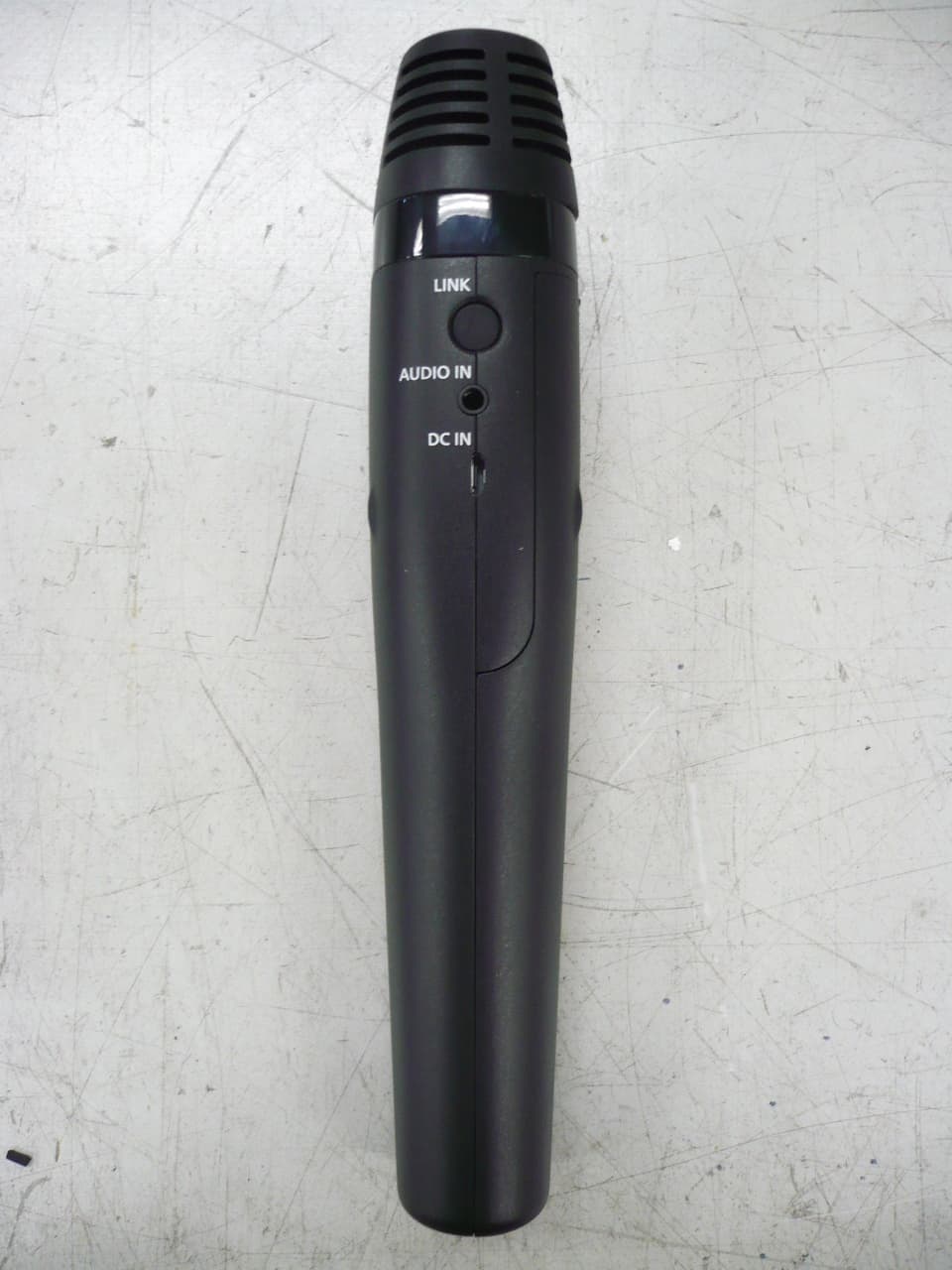
Click to zoom
Application Details
- Equipment Class
- PUF - Part 15 Unlicensed PCS portable Tx held to face
- Date of Grant
- Dec 17, 2014
- Application Purpose
- Original Equipment
- Date of Application
- Dec 17, 2014
- Equipment Note
- 1.9 GHz Wireless Handheld Microphone
- Frequency Range
- 1921.53600000 - 1928.44800000
- Country
- United States
Documents & Files
Document Text
Text extracted from the exhibit documents filed with the FCC. Open a document above to read the original.
Users Manual
1 Rev.1.0 1.9GHz Wireless Handheld Microphone K-SHH14 2 Rev.1.0 FCC CAUTION Changes or modifications not expressly approved by the party responsible for compliance could void the user’s authority to operate the equipment. This device complies with part 15 of the FCC Rules. Operation is subject to the following two conditions: (1) This device may not cause harmful interference, and (2) this device must accept any interference received, including interference that may cause undesired operation. Radio Frequency (RF) Exposure Warning The available scientific evidence does not show that any health problems are associated with using low power wireless devices. There is no proof, however, that these low power wireless devices are absolutely safe. Low power Wireless devices emit low levels of radio frequency energy (RF) in the microwave range while being used. Whereas high levels of RF can produce health effects (by heating tissue), exposure of low-level RF that does not produce heating effects causes no known adverse health effects. Many studies of low-level RF exposures have not found any biological effects. Some studies have suggested that some biological effects might occur, but such findings have not been confirmed by additional research. 1.9GHz Wireless Handheld Microphone, model K-SHH14 has been tested and found to comply with FCC radiation exposure limits set forth for an uncontrolled environment and meets the FCC radio frequency (RF) Exposure Guidelines. Notice FCC ID can be found on the battery compartment of the units. 3 Rev.1.0 WARNING: 1) To prevent fire or electric shock hazard, do not expose this apparatus to rain or moisture. 2) The apparatus should not be exposed to dripping or splashing and no objects filled with liquids, such as vases, should be placed on the apparatus. 3) Batteries shall not be exposed to excessive heat such as sunshine, fire or the like The model number and serial number of this product may be found on the surface of the unit. You should note the model number and serial number of this unit in the space provided and retain this book as a permanent record of your purchase to aid identification in the event of theft. Model No. Serial No. A lithium ion/polymer battery that is recyclable powers the product you have purchased. Please call 1-800-8-BATTERY for information on how to recycle this battery. MEDICAL: Consult the manufacturer of any personal medical devices, such as pacemakers, to determine if they are adequately shielded from external RF (radio frequency) energy. The unit operates in the frequency range of 1.92 GHz to 1.93 GHz. Do not use the unit in health care facilities if any regulations posted in the area instruct you not to do so. Hospitals or health care facilities may be using equipment that could be sensitive to external RF (radio frequency) energy. 4 Rev.1.0 Important Safety Instructions 1) Read these instructions. 2) Keep these instructions. 3) Heed all warnings. 4) Follow all instructions. 5) Do not use this apparatus near water. 6) Clean only with dry cloth. 7) Do not block any ventilation openings. Install in accordance with the manufacturer's instructions. 8) Do not install near any heat sources such as radiators, heat registers, stoves, or other apparatus (including amplifiers) that produce heat. 9) Only use attachments/accessories specified by the manufacturer. 5 Rev.1.0 Precautions Turn off the power supply when inside an aircraft. The product might interfere with operational safety of the aircraft. Do not attempt to disassemble or shortcircuit rechargeable batteries. An exploding battery or leaking battery fluid may result in fire, injury and burns. Avoid placing the product in unstable conditions. Failure to do so may cause injury. Stop operation immediately when something is wrong with the product. When smoke goes up from the product or the smell of smoke comes from the product, continued use will result in fire. Immediately remove the battery and the battery charger, and contact your dealer. Do not swing the product around on its strap. The strap might come off, resulting in personal injury or damage to the product. 6 Rev.1.0 [Precautions for use] • Operating temperature: 5 °C - 35 °C {41 °F - 95 °F} When calculating the battery life, note that temperatures below 10 °C {50 °F} shorten the battery duration. • Do not disassemble the product or touch internal parts. • Battery power is slightly consumed even when the power of this product is OFF. If the battery is left unused, that may result in liquid leakage. To prevent this, remove the battery from the product when unused for a long time. • Exercise care when using the product in high places. If it falls down, it may cause personal injury or suffer damage. • Do not use or leave the battery in places where it will be exposed to high temperatures, such as in strong direct sunlight, in a sun-heated car, by the fire, or in front of a stove. • Do not touch the battery poles or contacts inside the battery cover with dirty hands. Otherwise poor contact or noise may result. If dirty, wipe off with a dry soft cloth. The contacts inside the battery cover tend to get dirty. Clean them regularly (about once a month) with ethyl alcohol. Do not use solvents, such as benzine or thinner, or a metal polish. Otherwise the contacts may become deformed or discolored, or the brass plating may come off. • Do not use a deteriorated or short-circuited battery. A battery in this condition may leak fluid, overheat and cause damage. • The product is not made to drip-proof specification. Do not use the product with the wet hands in a place where it is directly exposed to water. • Do not swing the product around on the neck strap. To prevent strangling, the closure of the strap provided for hanging the product around the neck is designed to give way under pressure. If swung around on the neck strap, the closure will open and the product will fly away, resulting in personal injury or damage to the product. • The …
Text truncated - open the document above for the full version.
Cover Letter(s)
EXHIBIT A STATEMENT OF SECURITY CODE This product has no security codes.
Cover Letter(s)
Panasonic Corporation of North America Two Riverfront Plaza, 9 th Floor, Newark, NJ 07102-5490 Tel/Fax: 201-348-7758 / [email protected] Richard Mullen, Group Manager Product Safety and Compliance Department Agency Authorization Letter December 11, 2014 PSSD-14-F053 Federal Communications Commission Authorization and Evaluation Division 7435 Oakland Mills Road Columbia MD 21046-1609 Re: Original Certification for 1.9GHz DECT Wireless Handheld Microphone under FCC ID: ACJ9TAK-SHH14 Trade Name: Audio Enhancement Model Number: K-SHH14 To whom it may concern; The undersigned, Panasonic Corporation of North America, hereby authorizes Nemko AS to act on our behalf in all matters relating to all processes required in RF equipment authorization for the subject FCC ID. Any and all acts carried out by UL on our behalf, shall have the same effects as acts of our own. I acknowledge that all responsibilities for complying with the terms and conditions for certification, still reside with Panasonic Corporation of North America. This authorization shall expire six months from issued grant date. We certify that neither the applicant nor any party to this application, as defined in 47 CFR Ch. 1.2002(b), is subject to a denial to Federal benefits, that include FCC benefits, pursuant to section 5301 of the Anti-Drug Abuse Act of 1988, 21 U.S.C. 862. This appointment also includes the authority to complete FCC Form 731 on our behalf and sign the application as an authorized agent. Type Filing: Original Certification for 1.9GHz DECT Wireless Handheld Microphone FCC Classification: Isochronous UPCS Portable Transmitter Held to Face (PUF) FCC ID: 1 ACJ9TAK-SHH14 FCC Rule Part: FCC Part 15, Subpart D Frequency Range: 1921.536 ~ 1928.448 Responsible Panasonic Corporation of North America Applicant & Grantee: Two Riverfront Plaza, 9 th Floor, Newark, NJ 07102-5490 Responsible Manufacturer: Panasonic System Networks Co., Ltd. Sincerely yours, Richard Mullen Group Manager Panasonic Corporation of North America Cc: Panasonic System Networks Co., Ltd. Security Systems Business Division Attn: Yukio Kaneko / [email protected] 1 This product may be marketed with associated 1.9GHz DECT transmitters under FCC ID’s: ACJ9TAK-SAP14, ACJ9TAK-SRC14 and ACJ9TAK-STD14. Panasonic Corporation of North America Two Riverfront Plaza, 9 th Floor, Newark, NJ 07102-5490 Tel/Fax: 201-348-7758 / [email protected] Richard Mullen, Group Manager Product Safety and Compliance Department Request for Confidentiality December 11, 2014 PSSD-14-F053 Federal Communications Commission Authorization and Evaluation Division 7435 Oakland Mills Road Columbia MD 21046-1609 Re: Original Certification for 1.9GHz DECT Wireless Handheld Microphone under FCC ID: ACJ9TAK-SHH14 Trade Name: Audio Enhancement Model Number: K-STD14 To Whom It May Concern, In accordance with provisions of Sections 0.457 and 0.459 of the Commission’s Rules and Section 552(b)(4) of the Freedom of Information Act, we request permanent confidentiality for the below indicated exhibits. This transmitter is not user adjustable and is not provided with user tune-up procedure or parts list. These exhibits contain proprietary, confidential and/or trade secret materials, which would not be routinely made available for public inspection. • Schematic Diagram • Block Diagram • Theory of Operation In accordance with FCC Public DA 04-1705, we request forty-five day short-term confidentiality, starting from the issuance of equipment authorization date, for the below indicated exhibits. These exhibits contain pre-market information, which could give our competitors unfair advantage should this information be released before this product is actually introduced into the common marketplace. • External Photographs • Internal Photographs • Test Setup Photographs • User Manual The above materials contain trade secrets and proprietary information not customarily released to the general public. Since this design is a basis from which future technological products will evolve, the public disclosure of these materials can be harmful to the Applicant by providing unfair advantage and benefits to its competitors. Thank you for your attention to this matter. Sincerely, Richard Mullen Group Manager Panasonic Corporation of North America
External Photos
EXTERNAL PHOTOGRAPHS K-SHH14 Rear View
ID Label/Location Info
EXHIBIT B MARKINGS 1.9 GHz Wireless Handheld Microphone: Nameplate including FCC ID: The marking will be shown on the battery compartment of the unit. NOTE: The portable unit is sold without the battery installed. FCC 15 statement: Below statement is shown on the user manual of the unit. This device complies with part 15 of the FCC Rules. Operation is subject to the following two conditions: (1) This device may not cause harmful interference, and (2) this device must accept any interference received, including interference that may cause undesired operation.
Internal Photos
INTERNAL PHOTOGRAPHS Internal View Main Board Back Side RF Portion
RF Exposure Info
SAR_Report_Nemko_60320_6140460_FCC_DECT_K-SHH14_CalData Page 1 of 20 The Testcenter facility ‘Dosimetric Test Lab’ within IMST GmbH is accredited by the German National ‘Deutsche Akkreditierungsstelle GmbH (DAkkS)’ for testing according to the scope as listed in the accreditation certificate: D-PL-12139-01-00. Appendix for the SAR Test Report Dosimetric Assessment of the Portable Device K-SHH14 from Panasonic (FCC ID: ACJ9TAK-SHH14) (IC: 216A-KSHH14) According to the FCC Requirements Calibration Data December 01, 2014 IMST GmbH Carl-Friedrich-Gauß-Str. 2 - 4 47475 Kamp-Lintfort Germany Customer Panasonic System Networks Co., Ltd. 1 - 62, 4 - chome Minoshima, Hakata, Fukuoka 812-8531 Japan The Testcenter facility ‘Dosimetric Test Lab’ within IMST GmbH is accredited by the German National ‘Deutsche Akkreditierungsstelle GmbH (DAkkS)’ for testing according to the scope as listed in the accreditation certificate: D-PL-12139-01-01. Cal_D1900V2_SN5d051_Sep2013_V2 Page 1 of 7 Calibration Certificate Certificate No: Cal_D1900V2_SN5d051_Sep2013_V2 Object: D1900V2 SN: 5d051 Date of Calibration: September 25, 2013 Next Calibration: September 2015 Object Condition: In Tolerance Calibration Equipment used: Test Equipment Serial Number Last calibration Calibrated by Next calibration Powermeter E4416A GB41050414 Nov 12 Rohde&Schwarz (262487-D-K-15012- 01-00-2012-11) Nov 14 Power Sensor E9301H US40010212 Nov 12 Rohde&Schwarz (262492-D-K-15012- 01-00-2012-11) Nov 14 Powermeter E4417A GB41050441 Nov 12 Rohde&Schwarz (262488-D-K-15012- 01-00-2012-11) Nov 14 Power Sensor E9301A MY41495584 Nov 12 Rohde&Schwarz (262489-D-K-15012- 01-00-2012-11) Nov 14 Network Analyzer E5071C MY46103220 Jul 13 Rohde&Schwarz (11-300285997) Jul 15 Reference Probe EX3DV4 SN 3536 Sep 12 SPEAG (EX3-3536_Sep12) Sep 13 DAE3 SN 335 Feb 13 SPEAG (DAE3-335_Feb13) Feb 14 Cal_D1900V2_SN5d051_Sep2013_V2 Page 2 of 7 Calibration is performed according the following standards: IEEE 1528-2003 "IEEE Recommended Practice for Determining the Peak Spatial - Averaged Specific Absorption Rate (SAR) in the Human Head from Wireless Communication Devices: Measurement Technique", December 2003 IEC 62209-1 "Procedure to measure the Specific Absorption Rate (SAR) for hand - held devices used in close proximity to the ear (frequency range of 300 MHz to 3GHz)", February 2005 IEC 62209-2 "Evaluation of Human Exposure to Radio Frequency Fields from Handheld and Body-Mounted Wireless Communication Devices in the Frequency Range of 30 MHz to 6 GHz: Human models, Instrumentation, and Procedures ", Part 2: “Procedure to determine the Specific Absorption Rate (SAR) for including accessories and multiple transmitters” Edition 1.0, 2010-01 Additional Documentation: DASY 4/5 System Handbook prepared by: reviewed by: Alexander Rahn André van den Bosch test engineer quality assurance engineer 08 Cal_D1900V2_SN5d051_Sep2013_V2 Page 3 of 7 Measurement Conditions DASY Version: Dasy 4; V4.7 Phantom: SAM Phantom 1059 Distance Dipole Center – TSL: 10mm With spacer Area Scan resolution dx, dy = 10mm Zoom Scan resolution dx, dy, dz = 5mm Frequency: 1900 MHz ± 1MHz Head TSL Parameters Temperature Permittivity Conductivity Nominal Head TSL Parameters 22.0 40.00 1.40 Measured Head TSL Parameters 21.8 41.4 ± 6% 1.43 S/m ± 6% SAR Result with Head TSL Averaged over 1g SAR measured 250 mW input power 9.80 mW/g SAR normalized normalized to 1W 39.20 mW/g SAR for nominal Head TSL parameters normalized to 1W 39.01 mW/g ± 16.5 % (k=2) Averaged over 10g SAR measured 250 mW input power 4.93 mW/g SAR normalized normalized to 1W 19.72 mW/g SAR for nominal Head TSL parameters normalized to 1W 19.66 mW/g ± 16.5 % (k=2) Cal_D1900V2_SN5d051_Sep2013_V2 Page 4 of 7 Body TSL Parameters Temperature Permittivity Conductivity Nominal Body TSL Parameters 22.0 53.30 1.52 Measured Body TSL Parameters 21.7 55.00 ± 6% 1.51 S/m ± 6% SAR Result with Body TSL Averaged over 1g SAR measured 250 mW input power 9.53 mW/g SAR normalized normalized to 1W 38.12 mW/g SAR for nominal Body TSL parameters normalized to 1W 38.54 mW/g ± 16.5 % (k=2) Averaged over 10g SAR measured 250 mW input power 4.85 mW/g SAR normalized normalized to 1W 19.40 mW/g SAR for nominal Body TSL parameters normalized to 1W 19.54 mW/g ± 16.5 % (k=2) General Antenna Parameters Antenna Parameters with Head TSL Impedance, transformed to feed point 47.6 Ω + 0.21 jΩ Return Loss -32.05 dB Antenna Parameter with Body TSL Impedance, transformed to feed point 52.4 Ω – 0.83 jΩ Return Loss -32.06 dB After long term use with 100W radiated power, only a slight warming of the dipole near the feed point can be measured. The dipole is made of standard semigrid coaxial cable. The center conductor of the feeding line is directly connected to the second arm of the dipole. The antenna is therefore short-circuited for DC signals. Additional EUT Data Manufactured by: SPEAG Manufactured on: May, 2004 Cal_D1900V2_SN5d051_Sep2013_V2 Page 5 of 7 SAR Result with Head TSL Test Laboratory: IMST GmbH, DASY Blue (I); File Name: 250913_b_3536.da4 DUT: Dipole 1900 MHz SN: 5d051; Type: D1900V2; Serial: D1900V2 - SN5d051 Program Name: System Performance Check at 1900 MHz Communication System: CW; Frequency: 1900 MHz;Duty Cycle: 1:1 Medium parameters used: f = 1900 MHz; σ = 1.43 mho/m; ε r = 41.4; ρ = 1000 kg/m 3 Phantom section: Flat Section DASY4 Configuration: - Probe: EX3DV4 - SN3536; ConvF(8.41, 8.41, 8.41); Calibrated: 24.09.2012 - Sensor-Surface: 4mm (Mechanical Surface Detection) - Electronics: DAE3 Sn335; Calibrated: 18.02.2013 - Phantom: SAM Glycol 1176; Type: Speag; Serial: 1176 - Measurement SW: DASY4, V4.7 Build 80; Postprocessing SW: SEMCAD, V1.8 Build 186 d=10mm, Pin=250mW/Area Scan (7x7x1): Measurement grid: dx=10mm, dy=10mm Maximum value of SAR (measured) = 10.8 mW/g d=10mm, Pin=250mW/Zoom Scan (7x7x7)/Cube 0: Measurement grid: dx=5mm, dy=5mm, dz=5mm Reference Value = 87.1 V/m; Power Drift = -0.014 dB Peak SAR (extrapolated) = 19.2 W/kg SAR(1 g) = 9.8 mW/g; SAR(1…
Text truncated - open the document above for the full version.
RF Exposure Info
SAR_Report_Nemko_60320_6140460_FCC_DECT_K-SHH14_Conf Page 1 of 25 The Testcenter facility ‘Dosimetric Test Lab’ within IMST GmbH is accredited by the German National ‘Deutsche Akkreditierungsstelle GmbH (DAkkS)’ for testing according to the scope as listed in the accreditation certificate: D-PL-12139-01-00. SAR Test Report Dosimetric Assessment of the Portable Device K-SHH14 from Panasonic (FCC ID: ACJ9TAK-SHH14) (IC: 216A-KSHH14) According to the FCC Requirements December 01, 2014 IMST GmbH Carl-Friedrich-Gauß-Str. 2 - 4 47475 Kamp-Lintfort Germany Customer Panasonic System Networks Co., Ltd. 1 - 62, 4 - chome Minoshima, Hakata, Fukuoka 812-8531 Japan The test results only relate to the items tested. This report shall not be reproduced except in full without the written approval of the testing laboratory. SAR_Report_Nemko_60320_6140460_FCC_DECT_K-SHH14_Conf Page 2 of 25 SAR_Report_FCC_DECT_WiFI_Head_Body_1.0/10.12.2013/AR Executive Summary The K-SHH14 is a new cordless handheld microphone (Portable Device) from Panasonic operating in the 1920 MHz - 1930 MHz frequency range. The device has an integrated antenna and works in US DECT standard. The objective of the measurements done by IMST was the dosimetric assessment of one device in a worst case setup below the flat part of the SAM phantom. Since there was a special test software available, SAR tests were conducted with a specific channel and maximum output power during the measurement. The examinations have been carried out with the dosimetric assessment system „DASY4“. The measurements were made according to the 47 CFR § 2.1093 [47CFR] for evaluating compliance of mobile and portable devices with FCC limits for human exposure (general population) to radiofrequency emissions. Additional information and guidelines given by the following FCC documents were used: SAR Measurement Requirements for 100 MHz to 6 GHz [KDB 865664 D01 v01r03] Mobile and Portable Devices RF Exposure Procedures and Equipment Authorization Policies [KDB 447498 D01 v05r02] All measurements have been performed in accordance to the recommendations given by the System Manufacturer SPEAG AG, Switzerland. SAR_Report_Nemko_60320_6140460_FCC_DECT_K-SHH14_Conf Page 3 of 25 SAR_Report_FCC_DECT_WiFI_Head_Body_1.0/10.12.2013/AR Compliance Statement The cordless Panasonic K-SHH14 handheld microphone (FCC ID: ACJ9TAK-SHH14, IC: 216A-KSHH14) is in compliance with the following standards for uncontrolled exposure: 47 CFR § 2.1093 [47CFR], ANSI / IEEE C95.1-1999 [IEEE C95.1-1999] Since the intended use position for the handheld microphone is in front of mouth, SAR assessment was conducted with the device positioned in direct contact below the flat part of the SAM phantom using head tissue simulating liquid. The maximum results of SAR for K-SHH14 are as follows: Worst Case SAR Results Band Frequency [MHz] CH Phantom Configuration Figure No. Highest Reported SAR 1g [W/kg] SAR Limit [W/kg] Plot No. US DECT 1924.992 2 Flat Part 11 - 13 0.001 1.6 PASS2 - 4 Prepared by: ........................................... Alexander Rahn Test Engineer Reviewed by: ........................................... ........................................... Johannes Borkes Dr. Matthias Geissler Quality Management Quality Assurance IMST GmbH Carl-Friedrich-Gauß-Straße 2 - 4 D-47475 Kamp-Lintfort Tel. +49- 2842-981 325 Fax +49- 2842-981 399 email: [email protected] SAR_Report_Nemko_60320_6140460_FCC_DECT_K-SHH14_Conf Page 4 of 25 SAR_Report_FCC_DECT_WiFI_Head_Body_1.0/10.12.2013/AR Table of Contents SUBJECT OF INVESTIGATION ...................................................................................................................5 1 FCC EXPOSURE CRITERIA ................................................................................................................5 1.1 DISTINCTION BETWEEN EXPOSED POPULATION, DURATION OF EXPOSURE AND FREQUENCIES ...........6 1.2 DISTINCTION BETWEEN MAXIMUM PERMISSIBLE EXPOSURE AND SAR LIMITS ....................................6 2 THE FCC MEASUREMENT PROCEDURE .........................................................................................7 2.1 GENERAL REQUIREMENTS ..............................................................................................................7 2.2 BODY-WORN CONFIGURATIONS ......................................................................................................7 2.3 PHANTOM REQUIREMENTS ..............................................................................................................7 2.4 TEST TO BE PERFORMED ................................................................................................................8 2.4.1 MEASUREMENT VARIABILITY .......................................................................................................8 3 THE MEASUREMENT SYSTEM ..........................................................................................................9 3.1 PHANTOMS ...................................................................................................................................10 3.2 E-FIELD-PROBES ..........................................................................................................................11 3.3 MEASUREMENT PROCEDURE .........................................................................................................12 3.4 UNCERTAINTY ASSESSMENT .........................................................................................................13 4 OUTPUT POWER VALUES AND TUNE-UP INFORMATION ..........................................................14 5 SAR RESULTS ...................................................................................................................................14 6 APPENDIX ..........................................................................................................................................15 6.1 ADMINISTRATIVE DATA .......................................…
Text truncated - open the document above for the full version.
RF Exposure Info
SAR_Report_Nemko_60320_6140460_FCC_DECT_K-SHH14_Plots Page 1 of 6 The Testcenter facility ‘Dosimetric Test Lab’ within IMST GmbH is accredited by the German National ‘Deutsche Akkreditierungsstelle GmbH (DAkkS)’ for testing according to the scope as listed in the accreditation certificate: D-PL-12139-01-00. Appendix for the SAR Test Report Dosimetric Assessment of the Portable Device K-SHH14 from Panasonic (FCC ID: ACJ9TAK-SHH14) (IC: 216A-KSHH14) According to the FCC Requirements SAR Distribution Plots December 01, 2014 IMST GmbH Carl-Friedrich-Gauß-Str. 2 - 4 47475 Kamp-Lintfort Germany Customer Panasonic System Networks Co., Ltd. 1 - 62, 4 - chome Minoshima, Hakata, Fukuoka 812-8531 Japan The test results only relate to the items tested. This report shall not be reproduced except in full without the written approval of the testing laboratory. SAR_Report_Nemko_60320_6140460_FCC_DECT_K-SHH14_Plots Page 2 of 6 SAR_Report_FCC_DECT_WiFI_Head_Body_1.0/10.12.2013/AR 1 SAR Distribution Plots Test Laboratory: Imst GmbH, DASY Yellow (II); File Name: SHH14_yphm_1_front.da4 DUT: Panasonic; Type: K-SHH14; Program Name: US DECT Communication System: DECT US; Frequency: 1924.99 MHz;Duty Cycle: 1:24 Medium parameters used: f = 1924.99 MHz; σ = 1.43 mho/m; ε r = 40.8; ρ = 1000 kg/m 3 Phantom section: Flat Section DASY4 Configuration: - Probe: ET3DV6R - SN1579; ConvF(5, 5, 5); Calibrated: 28.01.2014 - Sensor-Surface: 4mm (Mechanical Surface Detection) - Electronics: DAE4 Sn631; Calibrated: 23.07.2014 - Phantom: SAM Glycol 1340; Type: QD 000 P40 CB; Serial: TP-1340 - Measurement SW: DASY4, V4.7 Build 80; Postprocessing SW: SEMCAD, V1.8 Build 186 Flat Part/Area Scan (7x17x1): Measurement grid: dx=15mm, dy=15mm Maximum value of SAR (measured) = 0.001 mW/g Flat Part/Zoom Scan (7x7x7)/Cube 0: Measurement grid: dx=5mm, dy=5mm, dz=5mm Reference Value = 0.484 V/m; Power Drift = 0.108 dB Peak SAR (extrapolated) = 0.001 W/kg SAR(1 g) = 0.00035 mW/g; SAR(10 g) = 0.000174 mW/g Maximum value of SAR (measured) = 0.000 mW/g Fig. 1: SAR distribution for DECT US, channel 2, test position 1, front of the K-SHH14 towards the flat part of SAM phantom, 0 mm distance (November 24, 2014) SAR_Report_Nemko_60320_6140460_FCC_DECT_K-SHH14_Plots Page 3 of 6 SAR_Report_FCC_DECT_WiFI_Head_Body_1.0/10.12.2013/AR Test Laboratory: Imst GmbH, DASY Yellow (II); File Name: SHH14_yphm_2_back.da4 DUT: Panasonic; Type: K-SHH14; Program Name: US DECT Communication System: DECT US; Frequency: 1924.99 MHz;Duty Cycle: 1:24 Medium parameters used: f = 1924.99 MHz; σ = 1.43 mho/m; ε r = 40.8; ρ = 1000 kg/m 3 Phantom section: Flat Section DASY4 Configuration: - Probe: ET3DV6R - SN1579; ConvF(5, 5, 5); Calibrated: 28.01.2014 - Sensor-Surface: 4mm (Mechanical Surface Detection) - Electronics: DAE4 Sn631; Calibrated: 23.07.2014 - Phantom: SAM Glycol 1340; Type: QD 000 P40 CB; Serial: TP-1340 - Measurement SW: DASY4, V4.7 Build 80; Postprocessing SW: SEMCAD, V1.8 Build 186 Flat Part/Area Scan (7x17x1): Measurement grid: dx=15mm, dy=15mm Maximum value of SAR (measured) = 0.001 mW/g Flat Part/Zoom Scan 3 (7x7x7)/Cube 0: Measurement grid: dx=5mm, dy=5mm, dz=5mm Reference Value = 0.482 V/m; Power Drift = -0.159 dB Peak SAR (extrapolated) = 0.003 W/kg SAR(1 g) = 0.000913 mW/g; SAR(10 g) = 0.000443 mW/g Fig. 2: SAR distribution for DECT US, channel 2, test position 2, back of the K-SHH14 towards the flat part of SAM phantom, 0 mm distance (November 24, 2014) SAR_Report_Nemko_60320_6140460_FCC_DECT_K-SHH14_Plots Page 4 of 6 SAR_Report_FCC_DECT_WiFI_Head_Body_1.0/10.12.2013/AR Test Laboratory: Imst GmbH, DASY Yellow (II); File Name: SHH14_yphm_3_left.da4 DUT: Panasonic; Type: K-SHH14; Program Name: US DECT Communication System: DECT US; Frequency: 1924.99 MHz;Duty Cycle: 1:24 Medium parameters used: f = 1924.99 MHz; σ = 1.43 mho/m; ε r = 40.8; ρ = 1000 kg/m 3 Phantom section: Flat Section DASY4 Configuration: - Probe: ET3DV6R - SN1579; ConvF(5, 5, 5); Calibrated: 28.01.2014 - Sensor-Surface: 4mm (Mechanical Surface Detection) - Electronics: DAE4 Sn631; Calibrated: 23.07.2014 - Phantom: SAM Glycol 1340; Type: QD 000 P40 CB; Serial: TP-1340 - Measurement SW: DASY4, V4.7 Build 80; Postprocessing SW: SEMCAD, V1.8 Build 186 Flat Part/Area Scan (7x17x1): Measurement grid: dx=15mm, dy=15mm Maximum value of SAR (measured) = 0.001 mW/g Flat Part/Zoom Scan (7x7x7)/Cube 0: Measurement grid: dx=5mm, dy=5mm, dz=5mm Reference Value = 0.248 V/m; Power Drift = 0.168 dB Peak SAR (extrapolated) = 0.003 W/kg SAR(1 g) = 0.00132 mW/g; SAR(10 g) = 0.0007 mW/g Maximum value of SAR (measured) = 0.002 mW/g Fig. 3: SAR distribution for DECT US, channel , test position 3, left side of the K-SHH14 towards the flat part of SAM phantom, 0 mm distance (November 24, 2014) SAR_Report_Nemko_60320_6140460_FCC_DECT_K-SHH14_Plots Page 5 of 6 SAR_Report_FCC_DECT_WiFI_Head_Body_1.0/10.12.2013/AR Test Laboratory: Imst GmbH, DASY Yellow (II); File Name: SHH14_yphm_4_right.da4 DUT: Panasonic; Type: K-SHH14; Program Name: US DECT Communication System: DECT US; Frequency: 1924.99 MHz;Duty Cycle: 1:24 Medium parameters used: f = 1924.99 MHz; σ = 1.43 mho/m; ε r = 40.8; ρ = 1000 kg/m 3 Phantom section: Flat Section DASY4 Configuration: - Probe: ET3DV6R - SN1579; ConvF(5, 5, 5); Calibrated: 28.01.2014 - Sensor-Surface: 4mm (Mechanical Surface Detection) - Electronics: DAE4 Sn631; Calibrated: 23.07.2014 - Phantom: SAM Glycol 1340; Type: QD 000 P40 CB; Serial: TP-1340 - Measurement SW: DASY4, V4.7 Build 80; Postprocessing SW: SEMCAD, V1.8 Build 186 Flat Part/Area Scan (7x17x1): Measurement grid: dx=15mm, dy=15mm Maximum value of SAR (measured) = 0.001 mW/g Flat Part/Zoom Scan (7x7x7)/Cube 0: Measurement grid: dx=5mm, dy=5mm, dz=5mm Reference Value = 0.165 V/m; Power Drift = 0.142 dB Peak SAR (extrapolated) = 0.002 W/kg SAR(1 g) = 0.00105 mW/g; SAR(10 g) = 0.000536 mW/g Fig. 4: SAR distribution for DECT US, channel 2, test position 4, right side of the K-SHH14 towards the flat part of SAM phantom, 0 mm dista…
Text truncated - open the document above for the full version.
Test Report
Report No. 270814-1 Template version: B Nemko Norway Nemko AS, Instituttveien 6, P.O. Box 96 Kjeller, 2007 Kjeller, Norway TEL +47 22 96 03 30 FAX +47 22 96 05 50 EMAIL [email protected] ENTERPRISE NUMBER NO974404532 nemko.com/no Test Report Product UPCS Transceiver in Wireless Handheld Microphone Name and address of the applicant Panasonic Corporation of North America Name and address of the manufacturer Panasonic System Networks Co., Ltd. 1-62, 4-chome, Minoshima, Hakata-ku Fukuoka 812-8531, Japan Model K-SHH14 Rating 3.7V DC (Secondary Battery) Trademark Panasonic Serial number / Additional information DECT 6.0 Tested according to FCC Part 15, subpart D Isochronous UPCS Device, 1920 – 1930 MHz Industry Canada RSS 213, Issue 2 2 GHz License-exempt Personal Communications Service Devices (LE-PCS) Order number 270814 Tested in period 2014.11.04 to 2014.11.21 Issue date 2014.12.02 Name and address of the testing laboratory I…
Text truncated - open the document above for the full version.
Contact Information
Applicant
Ben Botros(Manager - Regulatory & Compliance)
Test Firm
Nemko ASFrode Sveinsen
Technical Specifications
| # | Rule Parts | Frequency Range | Power Output |
|---|---|---|---|
| 1 | 15D | 1.92 GHz - 1.93 GHz | 6.90 mW |
Other Applications from Panasonic Corporation of North America
ACJ-EAH-A1000
Aug 19, 2026Digital Wireless Stereo Headphones
Equipment Class
DSS - Part 15 Spread Spectrum TransmitterACJ9TGFZVNF3G1
Jun 16, 2026Contactless Smart Card Reader
Equipment Class
DXX - Part 15 Low Power Communication Device Transmitter
ACJ932AM2301
Jan 29, 2025Car AV Control Unit for CDC
Equipment Class
DTS - Digital Transmission SystemACJ96NKX-TGEA60B
Aug 13, 2024DECT Handset
Equipment Class
PUE - Part 15 Unlicensed PCS portable Tx held to earACJ96NKX-TGE630B
Aug 12, 2024DECT Base Unit
Equipment Class
PUB - Part 15 Unlicensed PCS Base Station