AMWUT896GMRS/FRS Transmitter
Uniden America Corporation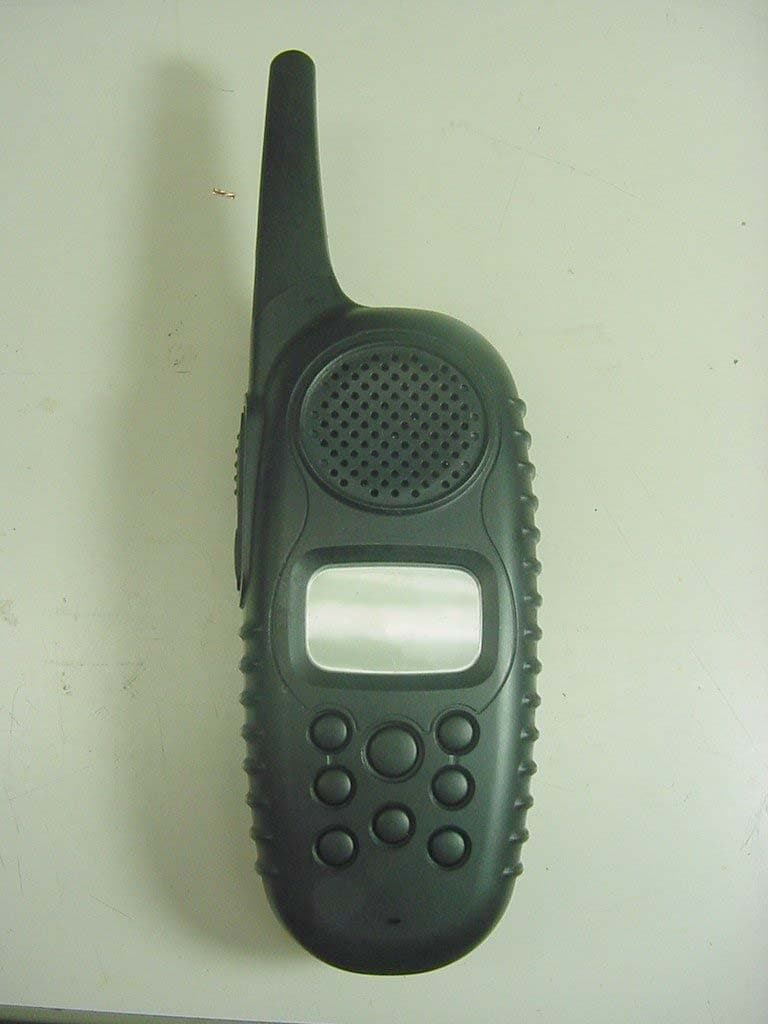
Click to zoom
Application Details
- Equipment Class
- FRF - Part 95 Family Radio Face Held Transmitter
- Date of Grant
- Jun 23, 2003
- Application Purpose
- Original Equipment
- Date of Application
- Jun 23, 2003
- Equipment Note
- GMRS/FRS Transmitter
- Frequency Range
- 462.56250000 - 467.71500000
- Company
- Uniden America Corporation
- Country
- United States
Documents & Files
Document Text
Text extracted from the exhibit documents filed with the FCC. Open a document above to read the original.
Users Manual
Choosing a Channel Your radio has 22 channels and 38 CTCSS codes you can use to talk to others. In order to speak to someone, each of you must be set to the same channel and CTCSS code. To choose a channel: With the radio in "Normal" operating mode press the chan/scan+or –key to increase or decrease the channel number displayed. Note:FRS Channels 8-14 have an expectancy range of up to 2 miles. GMRS channels 1-7, 15-22 have an expectancy range of up to 5 miles. Choosing a CTCSS Code Each of the channels 1-22 may have any one of the codes, OFF or 1-38 selected. Code "OFF" indicates no CTCSS code selected and your radio can receive a signal regardless of the code settings of the transmitting radio. 1) Enter the Menu. The CTCSS code on the LCD display will flash. 2) Press the chan/scan+or –key to increase or decrease the code number displayed. You can also select “OFF” at this stage. 3) Exit the Menu to return to “Normal” mode. Talking on Your Radio To talk to others using the radio: 1) Press and hold the PTTbutton and speak in a clear, normal voice about 2-3 inches away from the microphone. While you are transmitting, the icon will appear on the display. To avoid cutting off the first part of your transmission, pause slightly after pressing the PTTbutton before you start talking. 2) When you are finished speaking, release the PTT button. You can now receive incoming calls. While receiving, the icon will appear on the display. Note:When you press the boostkey, boostand TXappear on the display. The radio will transmit Maximum Power when a GMRS channel is selected. When one minute past after the boost transmission is established, the transmission stops automatically, and you will hear a boost time out error tone. Voice Operated Transmission Your GMRS750 radio is equipped with a user selectable Voice Operated Transmitter (VOX) that can be used for automatic voice transmissions. GMRS750 * Range may vary depending on environmental and/or topographical conditions. • 15 GMRS / 7 FRS Channels • 38 CTCSS Codes • Up to 7 Mile Range* • Internal VOX Circuitry • 5 Selectable Call Tone Alerts • Backlit LCD Display • Optional Headset Accessories • Headset Jack 1 Antenna 2 PTT (Push-To-Talk) Button 3 Boost Key 4 Select/ (power) Key 5 Vol (volume) Up Key 6 Vol (volume) Down Key 7 WX/Alert Key 8 Call Key 9 Headset Jack 10 Speaker 11 Channel/Scan + (Up) Key 12 Channel/Scan – (Down) Key 13 Mon (monitor) Key 14 Scan Indicator 15 Channel Indicator 16 VOX Indicator 17 Volume Setting Indicator 18 Weather Indicator 19 Weather Alert Indicator 20 GMRS/FRS Indicator 21 Battery Level Meter 22 Keypad Lock Indicator 23 rx (receive) Indicator 24 tx (transmit) Indicator 25 Boost Indicator 26 Call Indicator 27 CTCSS Indicator Congratulations on your purchase of the Uniden GMRS750 (General Mobile Radio Service) radio. This product is a lightweight, palm-sized radio. Use it at sporting events to stay in contact with family and friends, hiking, skiing, outdoors, or in a neighborhood watch for vital communication. This compact, state-of-the-art device is equipped with many features. OPTIONAL ACCESSORIES Your package contains the GMRS750 radio, this reference guide, including a product registration card. You may operate the unit using 4 AA alkaline batteries (included). The following optional acces- sories may be purchased from your participating Uniden dealer or call1-800-554-3988 or visit us on the web at www.uniden.com.Use only Uniden accessories. • Headset - #HS2467 FCC GMRS LICENSE The GMRS750 radio operates on the General Mobile Radio Service (GMRS) frequencies which require a Federal Communication Commission license to operate. For licensing information and application forms, visit the FCC online at: www.fcc.gov/wtb/uls or call the FCC hotline at 1-800-418-3676. If you have any questions you can contact the FCC direct at 1-888-225-5322. INSTALL THE BATTERIES Your GMRS750 radio uses 4 AA alkaline batteries. If alkaline batteries are used, we recommend using high quality alkaline batteries. To install the 4 AA alkaline batteries: 1) Make sure your radio is OFF. 2) Open the battery compartment door by pressing the ratch on the bottom of the radio. Then, remove the battery holder. 3) Pull up the tab on the battery holder to slide the battery compartment cover. 4) Install the 4 AA alkaline batteries (included) into the battery compartment. Be certain to follow the + and – symbols in the compartment. Installing the batteries incorrectly will prevent the unit from operating. 5) Replace the battery compartment cover. 6) Insert the battery holder into the radio until it clicks. Then, replace the battery compartment door. USING THE RADIO In order to get the most out of your new radio, read this reference guide completely before attempting to operate the unit. Turning the Radio On and Adjusting the Volume 1) Press and hold the select/key to turn the unit ON, and increase the speaker volume by pressing the vol +key. To decrease the volume, press the vol –key. 2) Press and hold the select/key again to turn the unit OFF. Adjusting the Sound (Key Beeps) Your radio emits a beep each time one of the buttons or keys (except for the PTTbutton and call key) are pressed. To turn this sound OFF, press and hold callwhile turning ON the radio. Repeat this step to turn the sound ON. Navigating through the Menu To access the advanced features of the GMRS750, your radio has a Menu function. • Battery Level Meter • Channel Monitor • Channel Scan • Keypad Lock • 7 Emergency / Weather Channels • Emergency / Weather Alert BATTERY LEVEL AND LOW BATTERY ALERT This unit has a battery level meter on the display to indicate the status of the batteries. When the batteries in the unit are low, the battery level meter icon will flash. Replace the alkaline batteries immediately. 1) To enter the Menu, press the select/key. 2) Additional presses of the select/key will advance you through the Menu until exiting to "Normal" operating mode. 3) Other methods of exitin…
Text truncated - open the document above for the full version.
RF Exposure Info
PCTEST ENGINEERING LABORATORY, INC. 6660 — B Dobbin Road • Columbia, MD 21045 • USA Telephone 410.290.6652 / Fax 410.290.6654 http://www.pctestlab.com (email: [email protected]) CERTIFICATE OF COMPLIANCE (SAR EVALUATION) PCTEST SAR REPORT FCC MEASUREMENT REPORT Reviewed by: Quality Manager SAR Filename: SAR-230602256.AMW Test Dates: June 5-6, 2003 Phone Type: GMRS/ FRS 22 Channel Portable Radio FCC ID: AMWUT896 Page 1 of 26 © 2003 PCTEST Engineering Laboratory, Inc APPLICANT NAME & ADDRESS: DATE & LOCATION OF TESTING: UNIDEN ENGINEERING SERVICES Dates of Tests: June 5-6, 2003 216 John Street Test Report S/N: SAR.230602256.AMW P.O. Box 580 Test Site: PCTEST Lab, Columbia, MD USA Lake City, SC 29560-0580 Attn: Mr. Jim Haynes, Vice President ~ Engineering & Regulatory Affairs FCC ID: AMWUT896 APPLICANT: UNIDEN ENGINEERING SERVICES EUT Type: GMRS/ FRS 22 Channel Portable Radio Tx Frequency: 462.55 — 462.72 (GMRS)/ 462.56 — 467.71 (FRS) Rx Frequency: 462.55 — 462.72 (GMRS)/ 462.56 — 467.71 (FRS) Max. RF Output Power: 0.87W ERP (GMRS) 0.06W ERP (FRS) Max. SAR Measurement: 0.312W/kg GMRS & FRS Face SAR; 0.910W/kg GMRS & FRS Body SAR Trade Name/Model(s): GMRS750 FCC Classification: Part 95 Family Radio Face Held Transmitter (FRF) FCC Rule Part(s): §2.1093; FCC/OET Bulletin 65 Supplement C [July 2001] Application Type: Certification Test Device Serial No.: identical prototype [ S/N:] This wireless portable device has been shown to be capable of compliance for localized specific absorption rate (SAR) for uncontrolled environment/general population exposure limits specified in ANSI/IEEE Std. C95.1-1992 and had been tested in accordance with the measurement procedures specified in FCC/OET Bulletin 65 Supplement C (2001) and IEEE Std. 1528-200X (Draft 6.5, January 15, 2002). I attest to the accuracy of data. All measurements reported herein were performed by me or were made under my supervision and are correct to the best of my knowledge and belief. I assume full responsibility for the completeness of these measurements and vouch for the qualifications of all persons taking them. Grant Conditions: The output power listed is ERP. This device is authorized to operate in the following radio services: FRS (Part 95B) or GMRS (Part 95A). There must be an informational insert inside the box (product package) or the User’s Manual must include information that clearly informs the consumer (buyer/owner) when the radio is transmitting on GMRS frequencies, that operation on GMRS frequencies require an FCC license and such operation is subject to additional rules specified in 47 C.F.R. Part 95. This transmitter has been tested for SAR compliance in Push-to-Talk and body-worn configurations. Body-worn SAR compliance is limited to the specific belt-clip tested in this filing. This device must operate at duty factor not exceeding 50%. PCTEST certifies that no party to this application has been denied the FCC benefits pursuant to Section 5301 of the Anti-Drug Abuse Act of 1988, 21 U.S.C. 862. 230505222.BEJ PCTEST SAR REPORT FCC MEASUREMENT REPORT Reviewed by: Quality Manager SAR Filename: SAR-230602256.AMW Test Dates: June 5-6, 2003 Phone Type: GMRS/ FRS 22 Channel Portable Radio FCC ID: AMWUT896 Page 2 of 26 © 2003 PCTEST Engineering Laboratory, Inc TABLE OF CONTENTS TABLE OF CONTENTS ..................................................................................................................... 2 1. INTRODUCTION / SAR DEFINITION ....................................................................................... 3 2. SAR MEASUREMENT SETUP..................................................................................................... 4 3. DASY4 E-FIELD PROBE SYSTEM............................................................................................... 5 4. Probe Calibration Process.......................................................................................................... 6 5. PHANTOM & EQUIVALENT TISSUES....................................................................................... 7 6. TEST SYSTEM SPECIFICATIONS................................................................................................ 8 7. DOSIMETRIC ASSESSMENT & PHANTOM SPECS .................................................................... 9 8. DEFINITION OF REFERENCE POINTS .................................................................................... 10 9. TEST CONFIGURATION POSITIONS ..................................................................................... 11 10. ANSI/IEEE C95.1 - 1992 RF EXPOSURE LIMITS...................................................................... 14 11. MEASUREMENT UNCERTAINTIES.......................................................................................... 15 12. SYSTEM VERIFICATION.......................................................................................................... 16 13. SAR TEST DATA SUMMARY ................................................................................................... 17 15. SAR TEST EQUIPMENT ........................................................................................................... 20 16. CONCLUSION........................................................................................................................ 21 17. REFERENCES ........................................................................................................................... 22 SAR TEST DATA .........................................................................................................23 SAR TEST SETUP PHOTOGRAPHS .................................................................................24 DIPOLE VALIDATION .................................................................................................25 PROBE CALIBRATION ............................................................................................... 26 PCTEST SAR REPORT FCC MEASUREMENT REPORT Reviewed by:…
Text truncated - open the document above for the full version.
RF Exposure Info
UNIDEN FCC ID: AMWUT896 EUT Photographs © 2003 PCTEST Lab. GMRS/FRS 22 Channel Portable Radio Model: GMRS750 UNIDEN FCC ID: AMWUT896 EUT Photographs © 2003 PCTEST Lab. GMRS/FRS 22 Channel Portable Radio Model: GMRS750 UNIDEN FCC ID: AMWUT896 EUT Photographs © 2003 PCTEST Lab. GMRS/FRS 22 Channel Portable Radio Model: GMRS750 UNIDEN FCC ID: AMWUT896 EUT Photographs © 2003 PCTEST Lab. GMRS/FRS 22 Channel Portable Radio Model: GMRS750 UNIDEN FCC ID: AMWUT896 EUT Photographs © 2003 PCTEST Lab. GMRS/FRS 22 Channel Portable Radio Model: GMRS750 UNIDEN FCC ID: AMWUT896 EUT Photographs © 2003 PCTEST Lab. GMRS/FRS 22 Channel Portable Radio Model: GMRS750
Contact Information
Applicant
Paul Roby
Technical Contact
PCTEST Engineering Lab., Inc.Randy Ortanez
[email protected]410-290-6652
6660-B Dobbin Road · Columbia, Maryland · United States
Test Firm
Uniden CorporationKeizo Fujiwara
81-3-5543-2875
Technical Specifications
| # | Rule Parts | Frequency Range | Power Output | Emission | Tolerance |
|---|---|---|---|---|---|
| 2 | 95B | 462.5625 MHz - 467.715 MHz | 60.00 mW | 11K0F3E | 2.5 ppm |
Other Applications from Uniden America Corporation
AMWUA2405
Apr 15, 2026RADAR DETECTOR
Equipment Class
JBP - Part 15 Class B Computing Device PeripheralAMWUA2406
Apr 15, 2026RADAR DETECTOR
Equipment Class
JBP - Part 15 Class B Computing Device PeripheralAMWUA2402
Jul 23, 2024RADAR DETECTOR
Equipment Class
CRD - Part 15 Radar Detector
AMWUA2404
Feb 17, 2024Wi-Fi Bluetooth Combo Module
Equipment Class
DTS - Digital Transmission System
AMWUA2301
Feb 15, 2023RADAR DETECTOR
Equipment Class
CRD - Part 15 Radar Detector