APYHRO00038GSM Cellular Phone W/ Bluetooth
Sharp Corporation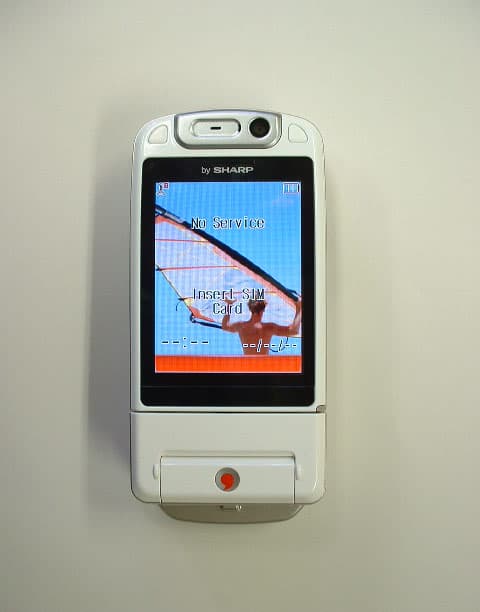
Click to zoom
Application Details
- Equipment Class
- PCE - PCS Licensed Transmitter held to ear
- Date of Grant
- Oct 12, 2004
- Application Purpose
- Original Equipment
- Date of Application
- Oct 12, 2004
- Equipment Note
- GSM Cellular Phone W/ Bluetooth
- Frequency Range
- 1850.20000000 - 1909.80000000
- Company
- Sharp Corporation
- Country
- Japan
Documents & Files
Document Text
Text extracted from the exhibit documents filed with the FCC. Open a document above to read the original.
Users Manual
1 Introduction Congratulations on your new 3G/UMTS 902SH phone. Useful Functions and Services Your phone offers you the following features: •Video calls. You can talk while viewing each other on respective screens. •A built-in digital camera for taking pictures and video clips. •A message function for reading and creating SMS messages. •MMS (Multimedia Messaging Services) for personalising your phone in various ways. •A WAP browser for accessing information on the mobile Internet. •Java™ applications. You can also download various applications from Vodafone via the mobile Internet. •A voice recorder function for recording and playing back voice clips. •A Bluetooth ® wireless technology interface for establishing contact and transmitting data with certain devices. You can transmit pictures, sounds, and video clips to OBEX-enabled phones. •An infrared interface for data communication. You can transmit pictures, sounds, and video clips to OBEX-enabled phones. 2 Introduction •A data synchronisation function for synchronising the Contacts List and schedule entries with Microsoft Outlook or Outlook Express on a PC. •A schedule alarm for creating and sending schedule entries with alarm settings. •Video output. You can connect your phone to other devices, such as TVs or videos set to output, and display Java™ data, images, or video clips. •Barcode scanner. With the built-in digital camera, you can read texts and barcodes, and create QR codes. •Playback of the downloaded sound and video clip files. •SD memory card slot that expands connectivity with a PC using the memory card. 3 Introduction About This User Guide This user guide is carefully designed to help you learn about your phone’s features and operations quickly and effectively. NOTICE •We strongly recommend that you keep separate permanent written records of all important data. Data may be lost or altered in virtually any electronic memory product under certain circumstances. Therefore, we assume no responsibility for data lost or otherwise rendered unusable, whether as a result of improper use, repairs, defects, battery replacement, use after the specified battery life has expired or any other cause. •We assume no responsibility, directly or indirectly, for financial losses or claims from third parties resulting from the use of this product and any of its functions, such as stolen credit card numbers, the loss or alteration of stored data, etc. •All company and/or product names are trademarks and/or registered trademarks of their respective holders. •Screen layout may differ from that illustrated in this user guide. The information described in this user guide is subject to change without notice. 4 Introduction •All the functions described in this user guide may not be supported by all networks. •We assume no responsibility for downloaded contents, information, etc. from the network. •Occasionally, a few black or bright pixels may appear on the screen. Please note that this will not have any impact on any of the features or on performance. Copyright According to copyright laws, the reproduction, alteration and use of material which is protected by copyright (music, pictures, etc.) is only permitted for personal or private use. If the user is not in possession of more extensive copyright or has not received the explicit permission from the copyright owner to reproduce, alter or use a copy which has been made or modified in this way, this is considered to be a violation of the copyright laws and gives the copyright owner the right to claim for damages. For this reason, avoid the illegal use of material which is protected by copyright. Windows is a registered trademark of Microsoft Corporation in the United States and/or other countries. 5 Introduction Powered by JBlend™ Copyright 1997-2004 Aplix Corporation. All rights reserved. JBlend and all JBlend-based trademarks and logos are trademarks or registered trademarks of Aplix Corporation in Japan and other countries. Powered by Mascot Capsule ® /Micro3D Edition™ Mascot Capsule ® is a registered trademark of HI Corporation ©2002-2004 HI Corporation. All Rights Reserved. Licensed by Inter Digital Technology Corporation under one or more of the following United States Patents and/or their domestic or foreign counterparts and other patents pending, including U.S. Patents: 4,675,863: 4,779,262: 4,785,450 & 4,811,420. 6 Introduction T9 Text Input is licensed under one or more of the following: U.S. Pat. Nos. 5,818,437, 5,953,541, 5,187,480, 5,945,928, and 6,011,554; Australian Pat. No. 727539; Canadian Pat. No. 1,331,057; United Kingdom Pat. No. 2238414B; Hong Kong Standard Pat. No. HK0940329; Republic of Singapore Pat. No. 51383; Euro. Pat. No. 0 842 463 (96927260.8) DE/DK, FI, FR, IT, NL,PT.ES,SE,GB; Republic of Korea Pat. Nos. KR201211B1 and KR226206B1; and additional patents are pending worldwide. Bluetooth is a trademark of the Bluetooth SIG, Inc. The Bluetooth word mark and logos are owned by the Bluetooth SIG, Inc. and any use of such marks by Sharp is under license. Other trademarks and trade names are those of their respective owners. CP8 PATENT 7 Introduction This product is licensed under the MPEG-4 Visual Patent Portfolio License for the personal and non-commercial use of a consumer to (i) encode video in compliance with the MPEG-4 Video Standard (“MPEG-4 Video”) and/or (ii) decode MPEG-4 Video that was encoded by a consumer engaged in a personal and non-commercial activity and/or was obtained from a licensed video provider. No license is granted or implied for any other use. Additional information may be obtained from MPEG LA. See http://www.mpegla.com. This product is licensed under the MPEG-4 Systems Patent Portfolio License for encoding in compliance with the MPEG-4 Systems Standard, except that an additional license and payment of royalties are necessary for encoding in connection with (i) data stored or replicated in physical media which is paid for on a title by title basis and/…
Text truncated - open the document above for the full version.
Cover Letter(s)
Model Description Model Name : 902SH Type of Emission : GXW Brand Name : Vodafone by Sharp Type of Equipment : WCDMA&GSM(900/1800/1900) cellular Phone Specification Items Frequency Band WCDMA : Tx 1922.6 to 1977.4MHz Rx 2112.6 to 2167.4MHz 900MHz : Tx 880.2 to 914.8MHz Rx 925.2 to 959.8MHz 1800MHz : Tx 1710.2 to 1784.8MHz Rx 1805.2 to 1879.8MHz 1900MHz : Tx 1850.2 to 1909.8MHz Rx 1930.2 to 1989.8MHz (WCDMA&900/1800MHz Band do not operate in USA) Tx Power WCDMA 23dBm 1dB 900MHz(*) 33dBm 2dB 1800MHz(*) 30dBm 2dB 1900MHz(*) 30dBm 2dB Type of Modulation WCDMA : GIA, GIB, GIC, GID, GIE, GIF, GIX, GIW GSM : GXW Transmission Technology WCDMA : DS-CDMA(FDD) GSM : FDMA/TDMA(8slot) Voice Codec WCDMA : AMR GSM : EFR/FR/HR GPRS GSM : Class8 (TX: 1slot/RX:4slot Total:5slot) Antenna Integrated Antenna SIM Plug-in 1.8/3.0V SIM card slot Display Main LCD 262,144color COG-ASV,240(W) 320(H) with Backlight Sub LCD Monochrome FSTN,12(W) 72(H) with Backlight Status LED Using 7-colour LED module (Green, Red, Blue, Yellow, Purple, Light Blue, White) Camera CCD 2Mpixcel (Auto Focus) Resoluion CMOS 110,000 pixcel WAP Browser OPEN WEB Battery/Talktime Capacity 870mAh Battery Type Rechargable Lithium Ion Battery Standby time T.B.D MAIN SPECIFICATION Ta l k t i m e T. B . D Dimensions Target size 51(W) 189(H) 27(T) Target weight 149g Key Layout Soft key1, Soft key2, Navigation key, Center key, Custom key, 0-9mumeric key, Send/End key, *,# and 5 side key Video output NTSC, PAL Bluetooth Ver 1.1 IrDA Ver 1.2 External connection Ir-Remote-control SD SD AUDIO Ver 1.0 Head set & Video out jack Stereo Headset, Video cable MCPC connector USB, PC-Link cable SIM card terminal SD card terminal External I/F Integrated charger circuit Stereo Headset & Handsfree Microphone Unit AC Charger Input AC 100 to 240V , Output DC 5.2V Video Cable Accessory Battery DC3.7V/ 870mAh
Cover Letter(s)
1 Mike Kuo From: Petruska, Steve [[email protected]] Sent: October082004Friday 12:26 PM To: Mike Kuo Subject: RE: Sharp Corporation , FCC ID: APYHRO00038 , Assessment NO.: A N04T4221/AN04T4222, Notice#1 APYHRO00038 Revised files.zip Hi Mike, Please review the attached revised files for this application which I believe will adequately address the below questions. Please note that the Part 24 test report was modified due to incorrect local oscillation. (13 files contained in the Zip file, about 5.5MB) If there are any further questions or comments, please don't hesitate to contact me. Best regards, Steve Petruska Sharp Electronics Corp. 201-529-9689 -----Original Message----- From: Mike Kuo [mailto:[email protected]] Sent: Monday, September 27, 2004 8:15 PM To: '[email protected]' Subject: FW: Sharp Corporation , FCC ID: APYHRO00038 , Assessment NO.: A N04T4221/AN04T4222, Notice#1 -----Original Message----- From: Compliance Certification Services [mailto:[email protected]] Sent: Monday, September 27, 2004 4:54 PM To: Mike Kuo Subject: Sharp Corporation , FCC ID: APYHRO00038 , Assessment NO.: AN04T4221/AN04T4222, Notice#1 Question #1: Based upon theory of operation, this device is capable of 800/900/1900 GSM, 1800/DCT, WCDMA RX . Such description does not agree with product specification sheet file named " Model description ". In the model description file, the device is claimed to have only WCDMA&GSM(900/1800/1900) cellular Phone. Please explain and confirm the device capabilities. Question #2: XN-1BT90 battery was used during FCC Part 24 tests but SHBW01 was used during SAR evaluation. Please explain the justification in selecting the type of battery for difference tests. Please provide justification or additional test data to verify that the test data presented in EMC and SAR test report are the worst case. Question #3: Is this device capable of transmitting with flip cover closed. Based upon SAR evaluation report, only body worn operation was investigated with flip cover closed. Is this device designed to be used with head operation when the flip cover is covered on the keyboard section ? If such 2 operation is desirable for end user, please provide additional SAR evaluation with flip cover closed for head operation. Question #4: Page 3 section 2.2 of Bluetooth test report indicates the occupied bandwidth is 79 MHz. Such statement is misleading. Please justify such wide bandwidth for Bluetooth device. FYI: 99% Bandwidth is not required to demonstrate FCC compliance per section 15.247 requirement. However, 99% bandwidth measurement is not correct based upon IC requirement. Best Regards Mike Kuo The items indicated above must be submitted before processing can continue on the above referenced application. Failure to provide the requested information within 30 days of the original e-mail date may result in application dismissal and forfeiture of the filing fee. Also, please note that partial responses increase processing time and should not be submitted. Any questions about the content of this correspondence should be directed to the e-mail address listed below the name of the sender.
External Photos
JQA Application No. : KL80040247RRegulation : CFR 47 FCC Rules Part 2 Model No.: 902SHIssue Date : October 8, 2004 FCC ID: APYHRO00038 Page 18 of 25 EUT PHOTOGRAPHS Reversible LCD display
ID Label/Location Info
FCC ID Location & FCC ID Spec Label
RF Exposure Info
IssueDate:October8,2004 Page 1 of 25 TEST REPORTEMCSAR - JQA APPLICATION No.: KL80040247R Name of Product: GSM-WCDMA Mobile-Phone / Bluetooth Enable Model/Type No.: 902SH FCC ID: APYHRO00038 : Sharp Corporation, Communication Systems GroupApplicant : 2-13-1, Iida, Hachihonmatsu, Higashi-Hiroshima City, Hiroshima,Address 739-0192, Japan : Sharp Corporation, Communication Systems GroupManufacturer : 2-13-1, Iida, Hachihonmatsu, Higashi-Hiroshima City, Hiroshima,Address 739-0192, Japan August 27, 2004Receive date of EUT: PassedFinal Judgement: are obtained in use of equipment that is traceable to National TEST RESULTS IN THIS REPORT Institute of Advanced Industrial Science and Technology (AIST) under METI Japan, National Institute of Information and Communications Technology (NICT) under MPHPT Japan, and Laboratory for EMF and Microwave Electronics at the Swiss Federal Institute of Technology (ETH) in Zürich, Switzerland. only responds to the test sample. This test report shall not be reproduced THE TEST RESULTS except in full. Authorized by: Takashi Yamanaka, Director JQA KITA-KANSAI Testing Center Page 2 of 25 DIRECTORY Page A) Documentation Directory2 Test Regulation / General Information3 - 5 SAR Measurement Set-up6 Test Configuration Positions7 - 10 Measurement Process11 Measurement Uncertainties12 Test Conditions13 EUT Tune-up Procedure14 EUT Modification / Responsible Party / Deviation from Standard15 Test results16 Summary17 EUT Photographs18 B) Test data Test System Validation19 - 20 Tissue Simulant Verification21 SAR Measurement Data22 - 24 Appendix25 JQA Application No. : KL80040247RRegulation : CFR 47 FCC Rules Part 2 Model No.: 902SHIssue Date : October 8, 2004 FCC ID: APYHRO00038 JQA Application No. : KL80040247RRegulation : CFR 47 FCC Rules Part 2 Model No.: 902SHIssue Date : October 8, 2004 FCC ID: APYHRO00038 Page 3 of 25 TEST REGULATION FCC Rules and Regulations Parts 2 Subpart J (October 1, 2003) - Mobile Devices (§2.1091)- Occupational/Controlled Exposure{{ - Portable Devices (§2.1093)- General Population/Uncontrolled Exposurezz Test procedure: The SAR measurement procedures were specified in FCC/OET Bulletin 65 Supplement C (July, 2001) and IEEE Std 1528 -2003 TM TheexposurelimitswerespecifiedinANSI/IEEEC95.1-1999. GENERAL INFORMATION Description of the Equipment Under Test (EUT): 1) Name: GSM-WCDMA Mobile-Phone / Bluetooth Enable 2) Model/Type No.: 902SH 3) Product Type: Pre-production (S/N: 350257/00/009108/4) 4) EUT Authorization: - Verification- Certification- D.o.C.{z { 5) Transmitting Frequency: 1850.20 MHz - 1909.80 MHz (PCS1900) 2402.00 MHz - 2480.00 MHz (Bluetooth) 6) Receiving Frequency: 1930.20 MHz - 1989.80 MHz (PCS1900) 2402.00 MHz - 2480.00 MHz (Bluetooth) 7) Max. RF Output Power: 29.98 dBm 8) Power Rating: 4.0VDC Note : This device contains GSM 900 MHz, DCS 1800 MHz and WCDMA functions not operational in U.S. territories. This report is only appliance for PCS 1900 MHz band. Definitions for symbols used in this test report: - Black box indicates that the listed condition, standard or equipment is applicablez for this Report. - Blank box indicates that the listed condition, standard or equipment is not applicable{ for this Report. JQA Application No. : KL80040247RRegulation : CFR 47 FCC Rules Part 2 Model No.: 902SHIssue Date : October 8, 2004 FCC ID: APYHRO00038 Page 4 of 25 Description of the Antenna: Type: L type antenna Dimensions: Maximum width 44.61 mm Maximum length 15.60 mm Location: Inside the back cover [Bluetooth Antenna] Type: L type antenna Dimensions: Maximum width 5.50 mm Maximum length 24.60 mm Location: Inside the back cover Battery Option: Lithium-ion Battery Pack XN-1BT90 (870mAh) Probe Specification: Construction: Symmetricaldesign with triangular core Built-in optical fiber for surface detection system Built-in shielding against static changes Calibration: In air form 10 MHz to 2.5 GHz In head tissue simulating liquid (HSL) and muscle tissue simulating liquid 900 MHz (accuracy ± 11.3%; k=2) 1800 MHz (accuracy ± 11.7%; k=2) 2450 MHz (accuracy ± 9.7%; k=2) Frequency: 10MHzto3GHz(dosimetry); Linearity: ±0.2 dB (30 MHz to 3 GHz) Directivity: ± 0.2 dB in HSL (rotation around probe axis) ± 0.4 dB in HSL (rotation normal probe axis) Dynamic Range: 5 μW/g to >100mW/g;Linearity:±0.2dB Surface Detection : ± 0.2 mm repeatability in air and clear liquids over diffuse reflecting surfaces Dimensions: Overall length 330 mm Tip length16 mm Body diameter 12 mm Tip diameter 6.8 mm Distance from probe tip to dipole centers 2.7 mm JQA Application No. : KL80040247RRegulation : CFR 47 FCC Rules Part 2 Model No.: 902SHIssue Date : October 8, 2004 FCC ID: APYHRO00038 Page 5 of 25 Twin SAM Phantom: The shell corresponds to the specifications of the Specific Anthropomorphic Mannequin (SAM) phantom defined in IEEE 1528-200X, CENELEC 50361 and IEC 62209. It enables the dosimetric evaluation of left and right head phone usage as well as body mounted usage at the flat phantom region. A cover prevents evaporation of the liquid. Reference markings on the phantom allow the complete setup of all predefined phantom positions and measurement grids by manually teaching three points with the robot. Shell Thickness: 2 ± 0.2 mm Filling Volume: Volume Approx. 25 liters Dimensions: 810 × 1000 × 500 mm (H × L × W) Mounting Device for Transmitters: The Mounting Device enables the rotation of the mounted transmitter in spherical coordinates, whereby the rotation point is the ear opening. The devices can be easily and accurately positioned according to IEC, IEEE, CENELEC, FCC or other specifications. The device holder can be locked at different phantom locations (left head, right head, flat phantom). Typical Composition of Ingredients for Liquid Tissue: IngredientsFrequency (MHz) (% by weight)83519002450 HeadBodyHeadBodyHeadBody Water41.4552.4054.9040.4062.7073.20 Salt (NaCl)1.451.400.180.500.500.04 Sugar56.0045.000.0058.000.000.00 HEC1.001.000.001.000.000.00 Bactericide 0.100.100.…
Text truncated - open the document above for the full version.
RF Exposure Info
APPENDIX Exhibit 1 System Validation Plots Date/Time: 09/01/04 11:29:02 Test Laboratory: JAPAN QUALITY ASSURANCE ORGANIZATION File Name: Validation_HSL1800_040901.da4 System Validation DUT: Dipole 1800 MHz; Type: D1800V2; Serial: 2d038 Program: Validation Communication System: CW; Frequency: 1800 MHz;Duty Cycle: 1:1 Medium: HSL1800 (σ = 1.344 mho/m, ε r = 40.79, ρ = 1000 kg/m 3 ) Phantom section: Flat Section Measurement Standard: DASY4 (High Precision Assessment) DASY4 Configuration: zProbe: ET3DV6 - SN1678; ConvF(5.15, 5.15, 5.15); Calibrated: 2004/02/15 zSensor-Surface: 4mm (Mechanical And Optical Surface Detection) zElectronics: DAE3 Sn508; Calibrated: 2004/02/06 zPhantom: SAM 1194; Type: QD 000 P40 CA; Serial: 1194 zMeasurement SW: DASY4, V4.1 Build 47; Postprocessing SW: SEMCAD, V1.6 Build 115 Antenna Input Power 250 mW/Area Scan (5x5x1): Measurement grid: dx=20mm, dy=20mm Reference Value = 92.8 V/m Power Drift = -0.005 dB Maximum value of SAR = 10.3 mW/g Antenna Input Power 250 mW/Zoom Scan (5x5x7)/Cube 0: Measurement grid: dx=8mm, dy=8mm, dz=5mm Peak SAR (extrapolated) = 16 W/kg SAR(1 g) = 9.4 mW/g; SAR(10 g) = 5.02 mW/g Reference Value = 92.8 V/m Power Drift = -0.005 dB Maximum value of SAR = 10.4 mW/g 0 dB = 10.4mW/g Date/Time: 09/02/04 10:52:06 Test Laboratory: JAPAN QUALITY ASSURANCE ORGANIZATION File Name: Validation_M1800_040902.da4 System Validation DUT: Dipole 1800 MHz; Type: D1800V2; Serial: 2d038 Program: Validation Communication System: CW; Frequency: 1800 MHz;Duty Cycle: 1:1 Medium: M1800 (σ = 1.482 mho/m, ε r = 53.85, ρ = 1000 kg/m 3 ) Phantom section: Flat Section Measurement Standard: DASY4 (High Precision Assessment) DASY4 Configuration: zProbe: ET3DV6 - SN1678; ConvF(4.65, 4.65, 4.65); Calibrated: 2004/02/15 zSensor-Surface: 4mm (Mechanical And Optical Surface Detection) zElectronics: DAE3 Sn508; Calibrated: 2004/02/06 zPhantom: SAM 1194; Type: QD 000 P40 CA; Serial: 1194 zMeasurement SW: DASY4, V4.1 Build 47; Postprocessing SW: SEMCAD, V1.6 Build 115 Antenna Input Power 250 mW/Area Scan (5x5x1): Measurement grid: dx=20mm, dy=20mm Reference Value = 90.4 V/m Power Drift = -0.01 dB Maximum value of SAR = 10.5 mW/g Antenna Input Power 250 mW/Zoom Scan (5x5x7)/Cube 0: Measurement grid: dx=8mm, dy=8mm, dz=5mm Peak SAR (extrapolated) = 16 W/kg SAR(1 g) = 9.46 mW/g; SAR(10 g) = 4.98 mW/g Reference Value = 90.4 V/m Power Drift = -0.01 dB Maximum value of SAR = 10.5 mW/g 0 dB = 10.5mW/g Date/Time: 10/06/04 11:05:48 Test Laboratory: JAPAN QUALITY ASSURANCE ORGANIZATION File Name: Validation_HSL1800_041006.da4 System Validation DUT: Dipole 1800 MHz; Type: D1800V2; Serial: 2d038 Program: Validation Communication System: CW; Frequency: 1800 MHz;Duty Cycle: 1:1 Medium: HSL1800 (σ = 1.342 mho/m, ε r = 40.8, ρ = 1000 kg/m 3 ) Phantom section: Flat Section Measurement Standard: DASY4 (High Precision Assessment) DASY4 Configuration: zProbe: ET3DV6 - SN1678; ConvF(5.15, 5.15, 5.15); Calibrated: 2004/02/15 zSensor-Surface: 4mm (Mechanical And Optical Surface Detection) zElectronics: DAE3 Sn508; Calibrated: 2004/02/06 zPhantom: SAM 1194; Type: QD 000 P40 CA; Serial: 1194 zMeasurement SW: DASY4, V4.1 Build 47; Postprocessing SW: SEMCAD, V1.6 Build 115 Antenna Input Power 250 mW/Area Scan (5x5x1): Measurement grid: dx=20mm, dy=20mm Reference Value = 92.5 V/m Power Drift = -0.03 dB Maximum value of SAR = 10.3 mW/g Antenna Input Power 250 mW/Zoom Scan (5x5x7)/Cube 0: Measurement grid: dx=8mm, dy=8mm, dz=5mm Peak SAR (extrapolated) = 16 W/kg SAR(1 g) = 9.23 mW/g; SAR(10 g) = 4.87 mW/g Reference Value = 92.5 V/m Power Drift = -0.03 dB Maximum value of SAR = 10.3 mW/g 0 dB = 10.3mW/g
RF Exposure Info
APPENDIX Exhibit 2 SAR Test Plots Date/Time: 09/01/04 12:16:54 Test Laboratory: JAPAN QUALITY ASSURANCE ORGANIZATION File Name: Left_low_touch.da4 Cheek/Touch 0512ch (1850.20MHz) DUT: GSM-WCDMA Mobile-Phone / Bluetooth Enable; Type: 902SH; Serial: (IMEI) 350257/00/009108/4 Program: Left Head Communication System: GSM 1900; Frequency: 1850.2 MHz;Duty Cycle: 1:8.5 Medium: HSL1900 (σ = 1.458 mho/m, ε r = 40.4, ρ = 1000 kg/m 3 ) Phantom section: Left Section Measurement Standard: DASY4 (High Precision Assessment) DASY4 Configuration: zProbe: ET3DV6 - SN1678; ConvF(5.15, 5.15, 5.15); Calibrated: 2004/02/15 zSensor-Surface: 4mm (Mechanical And Optical Surface Detection) zElectronics: DAE3 Sn508; Calibrated: 2004/02/06 zPhantom: SAM 1194; Type: QD 000 P40 CA; Serial: 1194 zMeasurement SW: DASY4, V4.1 Build 47; Postprocessing SW: SEMCAD, V1.6 Build 115 Cheek/Touch Position/Area Scan (16x8x1): Measurement grid: dx=10mm, dy=10mm Reference Value = 5.2 V/m Power Drift = -0.02 dB Maximum value of SAR = 0.362 mW/g Cheek/Touch Position/Zoom Scan (5x5x7)/Cube 0: Measurement grid: dx=8mm, dy=8mm, dz=5mm Peak SAR (extrapolated) = 0.602 W/kg SAR(1 g) = 0.317 mW/g; SAR(10 g) = 0.152 mW/g Reference Value = 5.2 V/m Power Drift = -0.02 dB Maximum value of SAR = 0.407 mW/g 0 dB = 0.407mW/g Date/Time: 09/01/04 13:34:12 Test Laboratory: JAPAN QUALITY ASSURANCE ORGANIZATION File Name: Left_middle_touch.da4 Cheek/Touch 0661ch (1880.00MHz) DUT: GSM-WCDMA Mobile-Phone / Bluetooth Enable; Type: 902SH; Serial: (IMEI) 350257/00/009108/4 Program: Left Head Communication System: GSM 1900; Frequency: 1880 MHz;Duty Cycle: 1:8.5 Medium: HSL1900 (σ = 1.458 mho/m, ε r = 40.4, ρ = 1000 kg/m 3 ) Phantom section: Left Section Measurement Standard: DASY4 (High Precision Assessment) DASY4 Configuration: zProbe: ET3DV6 - SN1678; ConvF(5.15, 5.15, 5.15); Calibrated: 2004/02/15 zSensor-Surface: 4mm (Mechanical And Optical Surface Detection) zElectronics: DAE3 Sn508; Calibrated: 2004/02/06 zPhantom: SAM 1194; Type: QD 000 P40 CA; Serial: 1194 zMeasurement SW: DASY4, V4.1 Build 47; Postprocessing SW: SEMCAD, V1.6 Build 115 Cheek/Touch Position/Area Scan (16x8x1): Measurement grid: dx=10mm, dy=10mm Reference Value = 5.18 V/m Power Drift = -0.06 dB Maximum value of SAR = 0.369 mW/g Cheek/Touch Position/Zoom Scan (5x5x7)/Cube 0: Measurement grid: dx=8mm, dy=8mm, dz=5mm Peak SAR (extrapolated) = 0.622 W/kg SAR(1 g) = 0.321 mW/g; SAR(10 g) = 0.15 mW/g Reference Value = 5.18 V/m Power Drift = -0.06 dB Maximum value of SAR = 0.419 mW/g 0 dB = 0.419mW/g Date/Time: 09/01/04 13:04:04 Test Laboratory: JAPAN QUALITY ASSURANCE ORGANIZATION File Name: Left_high_touch.da4 Cheek/Touch 0810ch (1909.80MHz) DUT: GSM-WCDMA Mobile-Phone / Bluetooth Enable; Type: 902SH; Serial: (IMEI) 350257/00/009108/4 Program: Left Head Communication System: GSM 1900; Frequency: 1909.8 MHz;Duty Cycle: 1:8.5 Medium: HSL1900 (σ = 1.458 mho/m, ε r = 40.4, ρ = 1000 kg/m 3 ) Phantom section: Left Section Measurement Standard: DASY4 (High Precision Assessment) DASY4 Configuration: zProbe: ET3DV6 - SN1678; ConvF(5.15, 5.15, 5.15); Calibrated: 2004/02/15 zSensor-Surface: 4mm (Mechanical And Optical Surface Detection) zElectronics: DAE3 Sn508; Calibrated: 2004/02/06 zPhantom: SAM 1194; Type: QD 000 P40 CA; Serial: 1194 zMeasurement SW: DASY4, V4.1 Build 47; Postprocessing SW: SEMCAD, V1.6 Build 115 Cheek/Touch Position/Area Scan (16x8x1): Measurement grid: dx=10mm, dy=10mm Reference Value = 4.66 V/m Power Drift = -0.02 dB Maximum value of SAR = 0.306 mW/g Cheek/Touch Position/Zoom Scan (5x5x7)/Cube 0: Measurement grid: dx=8mm, dy=8mm, dz=5mm Peak SAR (extrapolated) = 0.505 W/kg SAR(1 g) = 0.258 mW/g; SAR(10 g) = 0.119 mW/g Reference Value = 4.66 V/m Power Drift = -0.02 dB Maximum value of SAR = 0.34 mW/g 0 dB = 0.34mW/g Date/Time: 09/01/04 14:39:38 Test Laboratory: JAPAN QUALITY ASSURANCE ORGANIZATION File Name: Left_low_tilt.da4 Ear/Tilt 0512ch (1850.20MHz) DUT: GSM-WCDMA Mobile-Phone / Bluetooth Enable; Type: 902SH; Serial: (IMEI) 350257/00/009108/4 Program: Left Head Communication System: GSM 1900; Frequency: 1850.2 MHz;Duty Cycle: 1:8.5 Medium: HSL1900 (σ = 1.458 mho/m, ε r = 40.4, ρ = 1000 kg/m 3 ) Phantom section: Left Section Measurement Standard: DASY4 (High Precision Assessment) DASY4 Configuration: zProbe: ET3DV6 - SN1678; ConvF(5.15, 5.15, 5.15); Calibrated: 2004/02/15 zSensor-Surface: 4mm (Mechanical And Optical Surface Detection) zElectronics: DAE3 Sn508; Calibrated: 2004/02/06 zPhantom: SAM 1194; Type: QD 000 P40 CA; Serial: 1194 zMeasurement SW: DASY4, V4.1 Build 47; Postprocessing SW: SEMCAD, V1.6 Build 115 Ear/Tilt Position/Area Scan (16x8x1): Measurement grid: dx=10mm, dy=10mm Reference Value = 8.74 V/m Power Drift = 0.001 dB Maximum value of SAR = 0.115 mW/g Ear/Tilt Position/Zoom Scan (5x5x7)/Cube 0: Measurement grid: dx=8mm, dy=8mm, dz=5mm Peak SAR (extrapolated) = 0.171 W/kg SAR(1 g) = 0.109 mW/g; SAR(10 g) = 0.0667 mW/g Reference Value = 8.74 V/m Power Drift = 0.001 dB Maximum value of SAR = 0.115 mW/g 0 dB = 0.115mW/g Date/Time: 09/01/04 14:09:40 Test Laboratory: JAPAN QUALITY ASSURANCE ORGANIZATION File Name: Left_middle_tilt.da4 Ear/Tilt 0661ch (1880.00MHz) DUT: GSM-WCDMA Mobile-Phone / Bluetooth Enable; Type: 902SH; Serial: (IMEI) 350257/00/009108/4 Program: Left Head Communication System: GSM 1900; Frequency: 1880 MHz;Duty Cycle: 1:8.5 Medium: HSL1900 (σ = 1.458 mho/m, ε r = 40.4, ρ = 1000 kg/m 3 ) Phantom section: Left Section Measurement Standard: DASY4 (High Precision Assessment) DASY4 Configuration: zProbe: ET3DV6 - SN1678; ConvF(5.15, 5.15, 5.15); Calibrated: 2004/02/15 zSensor-Surface: 4mm (Mechanical And Optical Surface Detection) zElectronics: DAE3 Sn508; Calibrated: 2004/02/06 zPhantom: SAM 1194; Type: QD 000 P40 CA; Serial: 1194 zMeasurement SW: DASY4, V4.1 Build 47; Postprocessing SW: SEMCAD, V1.6 Build 115 Ear/Tilt Position/Area Scan (16x8x1): Measurement grid: dx=10mm, dy=10mm Reference Value = 8.87 V/m Power Drift = -0.07 dB Maximum value o…
Text truncated - open the document above for the full version.
RF Exposure Info
APPENDIX Exhibit 3 Dosimetric E-Field Probe - ET3DV6, S/N: 1678 Calibration Data
RF Exposure Info
APPENDIX Exhibit 4 System Validation Dipole - D1800V2, S/N: 2d038 Calibration Data
Test Report
IssueDate:October8,2004 Page 1 of 36 TEST REPORTEMCEMISSION - JQA APPLICATION No.: KL80040246R Name of Product: GSM-WCDMA Mobile-Phone/Bluetooth Enable Model/Type No.: 902SH FCC ID: APYHRO00038 Applicant: Sharp Corporation, Communication Systems Group Address: 2-13-1, Iida Hachihonmatsu, Higashihiroshima-city, : Hiroshima 739-0192, JAPAN Manufacturer: Sharp Corporation, Communication Systems Group Address: 2-13-1, Iida Hachihonmatsu, Higashihiroshima-city, : Hiroshima 739-0192, JAPAN August 27, 2004Receive date of EUT: passedFinal Judgement: are obtained in use of equipment that is traceable to National TEST RESULTS IN THIS REPORT Institute of Advanced Industrial Science and Technology (AIST) under METI Japan and National Institute of Information and Communications Technology(NICT) under MPHPT Japan. only responds to the test sample. This test report shall not be reproduced THE TEST RESULTS except in full. Authorized by: Takashi Yamanaka, Director JQA KITA-KANSAI Testing Center Page 2 of 36 DIRECTORY Page A) Documentation Directory2 Test Regulation / General Information3 - 4 Test Conditions5-18 Configuration of EUT / Operation mode of the EUT19 - 20 EUT Modification / Responsible Party / Deviation from Standard21 Test results / Measurement Uncertainty22 - 24 Summary25 26Test System-Arrangement (Drawings) 27Test-setup (Photographs) at worst case B) Test data - PCS1900 - Transmitter Power(TP)28 Antenna Conducted Spurious Emission29 - 30 Transmitter Power(EIRP)31 Unwanted Radiation32 - 33 Occupied Bandwidth34 Band-Edge Emission35 Frequency Stability36 JQA Application No.: KL80040246RRegulation: CFR 47 FCC Rules Part 24 Model No.: 902SHIssue Date: October 8, 2004 FCC ID: APYHRO00038 JQA Application No.: KL80040246RRegulation: CFR 47 FCC Rules Part 24 Model No.: 902SHIssue Date: October 8, 2004 FCC ID: APYHRO00038 Page 3 of 36 TEST REGULATION FCC Rules and Regulations Part 24 (October 1, 2003) 1900 MHz systems (Part 24) - Narrowband PCS{ - Broadband PCSz Test procedure: The tests were performed according to FCC Rules and Regulations Part 2 (October 1, 2003), and ANSI C63.4 (2001). GENERAL INFORMATION Test facility: 1) Test Facility located at Kita-Kansai: 1st Open Site (3 m Site) Test Facility located at Kameoka: 1st Open Site (3, 10 and 30 m, on common plane) :2ndOpenSite(3and10m,oncommonplane) FCC filing No. : 31040/SIT 1300F2 2) KITA-KANSAI TESTING CENTER is recognizedunder the National Voluntary Laboratory Accreditation Program for satisfactory compliance established in Title 15, Part 285 Code of Federal Regulations. NVLAP Lab Code: 200191-0 Definitions for symbols used in this test report: - Black box indicates that the listed condition, standard or equipment is applicablez for this Report. - Blank box indicates that the listed condition, standard or equipment is not applicable{ for this Report. JQA Application No.: KL80040246RRegulation: CFR 47 FCC Rules Part 24 Model No.: 902SHIssue Date: October 8, 2004 FCC I…
Text truncated - open the document above for the full version.
Contact Information
Applicant
Taihei Ohtsuka(Deputy Division Manager, ESG & Q promotion unit)
Test Firm
Japan Quality Assurance Org.Katsumi Nishii
Technical Specifications
| # | Rule Parts | Frequency Range | Power Output | Emission | Tolerance |
|---|---|---|---|---|---|
| 1 | 24E | 1.85 GHz - 1.91 GHz | 667.00 mW | 250KGXW | 2.5000000000 ppm |
Other Applications from Sharp Corporation
APYHRO00343
Aug 17, 2026Smartphone
Equipment Class
DTS - Digital Transmission SystemAPYHRO00342
Jul 29, 2026Smart phone
Equipment Class
DXX - Part 15 Low Power Communication Device TransmitterAPYHRO00341
May 28, 2026Smart phone
Equipment Class
DTS - Digital Transmission SystemAPYHRO00340
Dec 01, 2025BT remote control
Equipment Class
DTS - Digital Transmission SystemAPYHRO00339
Sep 17, 2025Smart phone
Equipment Class
NII - Unlicensed National Information Infrastructure TX