APYHRO00050Cellular Transceiver With Bluetooth
Sharp Corporation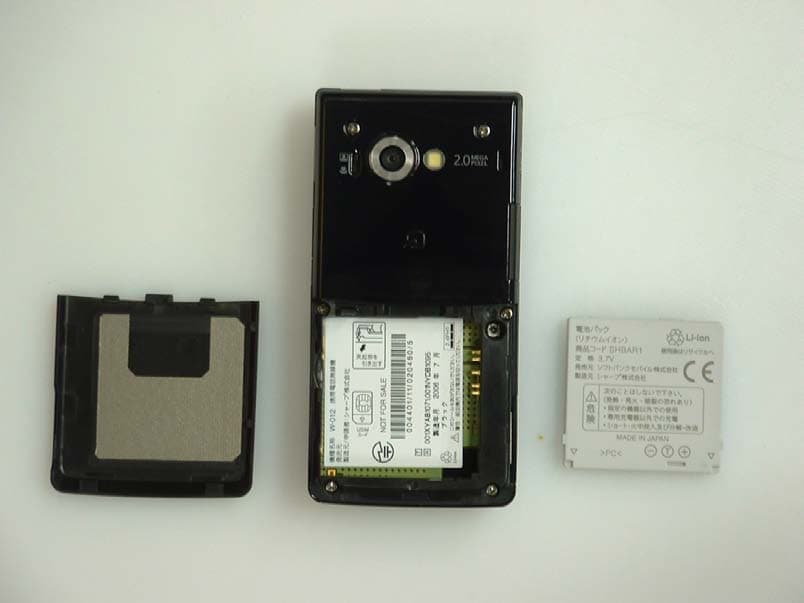
Click to zoom
Application Details
- Equipment Class
- PCE - PCS Licensed Transmitter held to ear
- Date of Grant
- Sep 12, 2006
- Application Purpose
- Original Equipment
- Date of Application
- Sep 12, 2006
- Equipment Note
- Cellular Transceiver With Bluetooth
- Frequency Range
- 1850.20000000 - 1909.80000000
- Company
- Sharp Corporation
- Country
- Japan
Documents & Files
Document Text
Text extracted from the exhibit documents filed with the FCC. Open a document above to read the original.
Users Manual
19-1 Abridged English Manual For more information about handset operations and functions, please go to the SOFTBANK MOBILE Corp. Website (http://www.softbank.jp) for the full manual* or dial 157 from a SoftBank handset for Customer Service. *Please note that the full manual may not be available in English at time of purchase. In this case, call Customer Service or check SoftBank Website again at a later date. J410_insatsu.book 1ページ 2006年8月29日 火曜日 午後5時28分 19-2 Abridged English Manual 19 Accessories ■ Lithium-ion Battery (Type 1) (SHBAR1) ■ AC Charger (SHCAA1) ■ Utility Software (CD-ROM) ★ * ■ Video Cable (SHPU01) ■ microSD™ Memory Card (64 MB) ★ ■ SD™ Memory Card Adapter ★ ■ miniSD™ Memory Card Adapter ★ * Utility Software updates/upgrades may become available on the SoftBank Website (http://www.softbank.jp) without prior notification. Please check for the newest versions of Utility Software and download as required. ★ Complimentary sample not available for purchase Note X Supplied Utility Software is designed exclusively for 810SH/811SH. Tip X . For accessory-related information, please contact SoftBank Customer Centre, General Information (see P.19-48 ). . In this manual, microSD™ Memory Card is referred to as "Memory Card". J410_insatsu.book 2ページ 2006年8月29日 火曜日 午後5時28分 19-3 Abridged English Manual 19 . Read safety precautions before using handset. . Observe precautions to avoid injury to self or others, or damage to property. . SoftBank is not liable for any damages resulting from use of this product. ■ Symbols Make sure you thoroughly understand these symbols before reading on. Symbols and their meanings are described below: Safety Precautions Before Using Handset 0 DANGER Great risk of death or serious injury from improper use 0 WARNING Risk of death or serious injury from improper use 0 CAUTION Risk of injury or damage to property from improper use 12345 Prohibited Actions 67 Compulsory Actions 0 Attention Required 0 DANGER Handset, Battery & Charger 6 Use specified battery, Charger and Desktop Holder only. Using non-specified equipment may cause malfunctions, electric shock or fire due to battery leakage, overheating or bursting. 1 Do not short-circuit Charger terminals. Keep metal objects away from Charger terminals. Keep handset away from jewellery. Battery may leak, overheat, burst or ignite causing injury. Use a case to carry battery. Battery 1 Prevent injury from battery leakage, breakage or fire. Do not:« Heat or dispose of battery in fire « Open/modify/disassemble battery « Damage or solder battery « Use a damaged or deformed battery « Use non-specified charger « Force battery into handset « Charge battery near fire or sources of heat; or expose it to extreme heat « Use battery for other equipment 6 If battery fluid contacts eyes, do not rub them. Rinse with clean water and consult a doctor immediately. Eyes may be severely damaged. J410_insatsu.book 3ページ 2006年8月29日 火曜日 午後5時28分 19-4 Abridged English Manual 19 0 WARNING Handset, Battery & Charger 1 Do not insert foreign objects into the handset, Charger or Desktop Holder. Do not insert metal or flammable objects into handset, Charger or Desktop Holder; may cause fire or electric shock. Keep out of children's reach. 3 Keep handset out of rain or extreme humidity. Fire or electric shock may result. 1 Keep handset away from liquid-filled containers. Keep the handset, Charger and Desktop Holder away from chemicals or liquids; fire or electric shock may result. 1 Keep battery, handset, Charger or Desktop Holder away from microwave ovens. Battery, handset, Charger or Desktop Holder may leak, burst, overheat or ignite, leading to accidents or injury. 2 Do not disassemble or modify handset or related hardware.« Do not open handset, Charger or Desktop Holder; may cause electric shock or injury. Contact SoftBank Customer Centre, Customer Assistance for repairs. « Do not modify handset, Charger or Desktop Holder; fire or electric shock may result. 1 Do not use Mobile Light near people's faces. Eyesight may be temporarily affected leading to accidents.CAUTION:Use of controls, adjustments or performance of procedure other than those specified herein may result in hazardous radiation exposure. As the emission level from Mobile Light LED used in this product is harmful to the eyes, do not attempt to disassemble the cabinet. Servicing is limited to qualified servicing station only. 7 If water or foreign matter is inside handset: Discontinue handset use to prevent fire/electric shock. Turn off handset, remove battery and unplug Charger, then contact SoftBank Customer Centre, Customer Assistance. 1 Avoid sources of fire. Prevent fire or explosion. Do not use handset in the presence of gas or fine particles (coal, dust, metal, etc.). 1 Do not subject handset to strong shocks or impacts. Strong shocks or impacts to handset, Charger or Desktop Holder may cause malfunction or injury. Should handset be damaged, remove battery then contact SoftBank Customer Centre, Customer Assistance. Discontinue handset use; fire or electric shock may occur. 7 If an abnormality occurs: If a handset emits an unusual sound, smoke or odour, discontinue use; may cause fire or electric shock. Turn off handset, remove battery and unplug Charger; contact SoftBank Customer Centre, Customer Assistance. J410_insatsu.book 4ページ 2006年8月29日 火曜日 午後5時28分 19-5 Abridged English Manual 19 Handset 1 Keep Memory Card and Memory Card Adapters out of children's reach. If swallowed, consult a doctor immediately. 1 Take measures to prevent accidents.« For safety, never use handset while driving. Pull over beforehand. Mobile phone use while driving is prohibited by the revised Road Traffic Law (effective 1 November 2004). « Do not use Headphones while driving or riding a bicycle. Accidents may result. « Moderate volume outside, especially at level/road crossings to avoid accidents. 1 Do not swing handset by handstrap. May result in injury or breakage. 6 Turn handset power off before boardi…
Text truncated - open the document above for the full version.
Users Manual
19-28 Abridged English Manual 19 Save names with phone numbers, mail addresses, etc. to Phone Book. 1 Not supported on USIM Card. 2 Image may not appear while an S! Application is active, etc. , Save up to 750 entries in handset Phone Book; USIM Card Phone Book entry limit varies according to card specifications. Depending on the USIM Card in use, some items may not be supported, and character entry limits or number of Categories may be lower. Also, the number of phone numbers or mail addresses per entry may be lower. Saving to Phone Book Phone Book Entry Items Item Description Last Name: Enter up to 32 characters. (Select Name: when saving to USIM Card.) First Name:Reading: Enter up to 64 characters Add Phone Number: Enter up to three numbers on handset/two on USIM Card (32 digits each) Add Email Address: Enter up to three addresses on handset/one on USIM Card (128 single-byte alphanumerics each) Category: Sort entries into 16 Categories (11 on some USIM Cards). Category names can be changed. Set ringtone/ringvideo, Mobile Light and Vibration by Category (handset only). Address: 1 Enter postal code (20 characters), country name (32 characters), state/province (64 characters), city name (64 characters) and street name/number (64 characters) Homepage: 1 Save URLs. Enter up to 1,024 bytes. Item Description Note: 1 Add personal details. Enter up to 256 characters. Birthday: 1 Enter birth date Picture: 1, 2 Set an image to appear for incoming calls/mail Tone/Video for Voice Call: 1 Set ringtone/ringvideo, Mobile Light or Vibration by caller/sender Tone/Video for Video Call: 1 Tone/Video for New Message: 1 Light for Voice Call: 1 Light for Video Call: 1 Light for New Message: 1 Vibration for Incoming Call: 1 Vibration for New Message: 1 Secret: 1 Restrict access to Phone Book entries by saving them as Secret Mode entries Note X Back-up Important Information When battery is exhausted/removed for long periods, Phone Book entries may be lost; handset damage may also affect handset information recovery. SoftBank is not liable for damages from lost/altered data. J410_insatsu.book 28 ページ 2006年8月29日 火曜日 午後5時28分 19-29 Abridged English Manual 19 Enter a name, reading, phone number and mail address. 1 Press % , select Phone and press % 2 Select Add New Entry and press % 3 Select Last Name: and press % 4 Enter last name and press % 5 Select First Name: and press % 6 Enter first name and press % Characters entered for names appear under Reading: . 7 Select Add Phone Number: and press % 8 Enter a phone number and press % 9 Select an icon and press % 1 11 1 0 00 0 Select Add Email Address: and press % 1 11 1 1 11 1 Enter a mail address and press % 1 11 1 2 22 2 Press % 1 11 1 3 33 3 Select an icon and press % 1 11 1 4 44 4 Press A ß 1 Press b and select an entry 2 Press B ø 3 Select Edit and press % 4 Select an item and press % 5 Edit contents and press % After numbers/mail addresses, select an icon and press % . 6 Press A ß Creating Phone Book Entries Tip X Correcting Reading Select Reading: and press % . Make corrections and press % . Note X To save an entry, enter at least one of the following: a) last name; b) first name; c) phone number; or d) mail address. Tip X Setting Default Storage Media Press % S Select Phone S Press % S Select Ph.Book Settings S Press % S Select Save New Entry S Press % S Select Phone , USIM Memory or Ask Each Time S Press % . For Ask Each Time , select storage media for each new entry. Editing Phone Book Entries J410_insatsu.book 29 ページ 2006年8月29日 火曜日 午後5時28分 19-30 Abridged English Manual 19 1 Select a record (see P.19-23 "Calling from Received Calls") 2 Press B ø , select Save Number and press % 3 New Entry 1 Select As New Entry and press % 2 Perform Steps 3 - 13 on P.19-29 Add to Existing Entry 1 Select a Phone Book entry and press % 2 Press A ß 1 Press % , select Phone and press % 2 Select Ph.Book Settings and press % 3 Select Sort Entries and press % 4 Select By Reading , By Category or By a-ka-sa- ta-na and press % 1 Set search method to By Reading 2 In Standby, press b 3 Enter reading 4 Select a name and press % 5 Press ! Back up Phone Book via server; refresh SAB or Phone Book to reflect changes; add to/update SAB online via PC; restore lost/altered Phone Book entriesvia SAB. SAB requires a separate contract. For details, contact SoftBank Customer Centre, General Information (see P.19-48 ) or access the SOFTBANK MOBILE Corp. Website via PC: http://www.softbank.jp Saving from Received Calls Dialling from Phone Book Changing Search Method By Reading Shows entries that start with specified Reading By Category Opens entries in the specified Category By a-ka-sa-ta-na Shows entries with Readings that start with katakana in the specified row Tip X Switching Between Handset & USIM CardPress b S Press B ø S Select Ph.Book Settings S Press % S Select Select Phone Book S P ress % S Select Phone , USIM Memory or Both S Press % . For Both , entries in both storage media appear. Search by Reading Tip X Multiple NumbersUse e to select other numbers. S! Address Book (SAB) J410_insatsu.book 30 ページ 2006年8月29日 火曜日 午後5時28分 19-31 Abridged English Manual 19 Select from two different shooting modes. Use Photo Camera for still images and Video Camera for video. ■ Photo Camera ■ Video Camera * MPEG-4 (.3gp) only for W 240 × H 176 dots. Camera Shake Handset movement may blur images; hold handset firmly or place it on a stable surface and use Self-timer. 1 Press % , select Camera and press % 2 Frame image on Display . In Video Camera mode, press A ( # ) to switch to Photo Camera. 3 Press % 4 Press % to save 5 Press " to exit Mobile Camera Before Using Camera Image Size W 1200 × H 1600 dots W 960 × H 1280 dots W 480 × H 640 dots W 240 × H 320 dots W 120 × H 160 dots File Format JPEG (.jpg) Save Location Handset or Memory Card Image Size W 176 × H 144 dots W 128 × H 96 dots W 480 × H 640 dots W 240 × H 320 dots W 240 × H 176 dots* File Format MPEG-4 or H.263 (.3gp) MPEG-4 (.3gp) MPEG-4 (.ASF) Save …
Text truncated - open the document above for the full version.
External Photos
JAPAN QUALITY ASSURANCE ORGANIZATION Attachment 6 – EUT Photographs JAPAN QUALITY ASSURANCE ORGANIZATION JAPAN QUALITY ASSURANCE ORGANIZATION JAPAN QUALITY ASSURANCE ORGANIZATION
RF Exposure Info
JAPAN QUALITY ASSURANCE ORGANIZATION Page 1 of 22 Technical document No. 23163-0601 JQA File No. : KL80060198 Issued Date : August 15, 2006 TEST REPORT (SAR EVALUATION) APPLICANT : Sharp Corporation, Communication Systems Group ADDRESS : 2-13-1, Iida, Hachihonmatsu, Higashi-Hiroshima City, Hiroshima, 739-0192, Japan PRODUCTS : WCDMA & Tri-band GSM Dual mode Mobile Phone / Bluetooth Enable MODEL NO. : 810SH SERIAL NO. : 004401/11/020460/5 FCC ID : APYHRO00050 TEST STANDARD : FCC/OET Bulletin 65 Supplement C (Edition 01-01) TESTING LOCATION : Japan Quality Assurance Organization KITA-KANSAI Testing Center 1-7-7, Ishimaru, Minoh-shi, Osaka 562-0027, Japan TEST RESULTS : Passed DATE OF TEST : July 31, 2006 - August 1, 2006 This report must not used by the client to claim product endorsement by NVLAP or Yuichi Fukumoto NIST or any agency of the U.S. Government. Manager Japan Quality Assurance Organization KITA-KANSAI Testing Center Testing Dept. EMC Division NVLAP Lab Code 200191-0 1-7-7, Ishimaru, Minoh-shi, Osaka 562-0027, Japan ● The measurement values stated in Test Report was made with traceable to National Institute of Advanced Industrial Science and Technology (AIST) of Japan, National Institute of Information and Communications Technology (NICT) of Japan , and Laboratory for EMF and Microwave Electronics at the Swiss Federal Institute of Technology (ETH) in Zürich, Switzerland. ● The applicable standard, testing condition and testing method which were used for the tests are based on the request of the applicant. ● The test results presented in this report relate only to the offered test sample. ● The contents of this test report cannot be used for the purposes, such as advertisement for consumers. ● This test report shall not be reproduced except in full without the written approval of JQA. JAPAN QUALITY ASSURANCE ORGANIZATION JQA File No. : KL80060198 Issue Date : August 15, 2006 Model No. : 810SH FCC ID : APYHRO00050 Standard : FCC/OET Bulletin 65 Supplement C (Edition 01-01) Page 2 of 22 Technical document No. 23163-0601 TABLE OF CONTENTS Page Documentation ................................................................................................................................................. 3 1 Test Regulation.....................................................................................................................................3 2 Test Location.........................................................................................................................................3 3 Recognition of Test Laboratory............................................................................................................3 4 Description of the Equipment Under Test..........................................................................................4 5 Measurement System Diagram............................................................................................................5 6 System Components..............................................................................................................................6 7 Measurement Process...........................................................................................................................8 8 Measurement Uncertainties.................................................................................................................9 9 Equipment Under Test Modification.................................................................................................10 10 Responsible Party................................................................................................................................10 11 Deviation from Standard....................................................................................................................10 12 Test Results.........................................................................................................................................11 13 Summary..............................................................................................................................................12 14 Test Arrangement...............................................................................................................................13 15 Equipment Under Test Tune-Up Procedures....................................................................................15 Appendix A: Test Data ................................................................................................................................... 16 A.1 System Validation...............................................................................................................................16 A.2 Tissue Verification..............................................................................................................................17 A.3 SAR Measurement Data.....................................................................................................................18 Appendix B: Test Instruments....................................................................................................................... 21 Appendix C: Attachments .............................................................................................................................. 22 DEFINITIONS FOR ABBREVIATION AND SYMBOLS USED IN THIS TEST REPORT “EUT” means Equipment Under the Test. “N/A” means that Not Applicable. “N/T” means that Not Tested. - indicates that the listed condition, standard or equipment is applicable for this report. - indicates that the listed condition, standard or equipment is not applicable for this report. JAPAN QUALITY ASSURANCE ORGANIZATION JQA File No. : KL80060198 Issue Date : August 15, 2006 Model No. : 810SH FCC ID : APYHRO00050 Standard : FCC/OET Bulletin 65 Supplement C (Edition 01-01) Page 3 of 22 Technical document No. 23163-0601 Documentation 1 Test Regulation Applied Standard : FCC/OET Bulletin 65 Supplem…
Text truncated - open the document above for the full version.
RF Exposure Info
Attachment 2 – SAR Test Plots JAPAN QUALITY ASSURANCE ORGANIZATION Date/Time: 2006/07/31 14:08:21Date/Time: 2006/07/31 14:13:58 Test Laboratory: JAPAN QUALITY ASSURANCE ORGANIZATION Cheek/Touch 661ch (1880.00MHz) DUT: WCDMA & Tri-band GSM Dual mode Mobile Phone / Bluetooth Enable; Type: 810SH; Serial: 004401/11/020460/5 Communication System: GSM 1900; Frequency: 1880 MHz;Duty Cycle: 1:8.3 Medium: HSL1900 Medium parameters used: f = 1880 MHz; σ = 1.43 mho/m; ε r = 38.6; ρ = 1000 kg/m 3 Phantom section: Left Section Measurement Standard: DASY4 (High Precision Assessment) DASY4 Configuration: z Probe: ET3DV6 - SN1679; ConvF(5.2, 5.2, 5.2); Calibrated: 2005/12/15 z Sensor-Surface: 4mm (Mechanical And Optical Surface Detection) z Electronics: DAE3 Sn508; Calibrated: 2005/12/08 z Phantom: SAM 1194; Type: QD 000 P40 CA; Serial: 1194 z Measurement SW: DASY4, V4.5 Build 19; Postprocessing SW: SEMCAD, V1.8 Build 146 Cheek/Touch Position/Area Scan (11x6x1): Measurement grid: dx=15mm, dy=15mm Maximum value of SAR (measured) = 0.617 mW/g Cheek/Touch Position/Zoom Scan (5x5x7)/Cube 0: Measurement grid: dx=8mm, dy=8mm, dz=5mm Reference Value = 4.40 V/m; Power Drift = 0.00 dB Peak SAR (extrapolated) = 0.978 W/kg SAR(1 g) = 0.567 mW/g; SAR(10 g) = 0.313 mW/g Maximum value of SAR (measured) = 0.609 mW/g 0 dB = 0.609mW/g JAPAN QUALITY ASSURANCE ORGANIZATION Date/Time: 2006/07/31 14:23:37Date/Time: 2006/07/31 14:29:11 Test Laboratory: JAPAN QUALITY ASSURANCE ORGANIZATION Ear/Tilt 661ch (1880.00MHz) DUT: WCDMA & Tri-band GSM Dual mode Mobile Phone / Bluetooth Enable; Type: 810SH; Serial: 004401/11/020460/5 Communication System: GSM 1900; Frequency: 1880 MHz;Duty Cycle: 1:8.3 Medium: HSL1900 Medium parameters used: f = 1880 MHz; σ = 1.43 mho/m; ε r = 38.6; ρ = 1000 kg/m 3 Phantom section: Left Section Measurement Standard: DASY4 (High Precision Assessment) DASY4 Configuration: z Probe: ET3DV6 - SN1679; ConvF(5.2, 5.2, 5.2); Calibrated: 2005/12/15 z Sensor-Surface: 4mm (Mechanical And Optical Surface Detection) z Electronics: DAE3 Sn508; Calibrated: 2005/12/08 z Phantom: SAM 1194; Type: QD 000 P40 CA; Serial: 1194 z Measurement SW: DASY4, V4.5 Build 19; Postprocessing SW: SEMCAD, V1.8 Build 146 Ear/Tilt Position/Area Scan (11x6x1): Measurement grid: dx=15mm, dy=15mm Maximum value of SAR (measured) = 0.161 mW/g Ear/Tilt Position/Zoom Scan (5x5x7)/Cube 0: Measurement grid: dx=8mm, dy=8mm, dz=5mm Reference Value = 9.99 V/m; Power Drift = 0.061 dB Peak SAR (extrapolated) = 0.244 W/kg SAR(1 g) = 0.156 mW/g; SAR(10 g) = 0.095 mW/g Maximum value of SAR (measured) = 0.167 mW/g 0 dB = 0.167mW/g JAPAN QUALITY ASSURANCE ORGANIZATION Date/Time: 2006/07/31 17:10:28Date/Time: 2006/07/31 17:22:17 Test Laboratory: JAPAN QUALITY ASSURANCE ORGANIZATION Cheek/Touch 512ch (1850.20MHz) DUT: WCDMA & Tri-band GSM Dual mode Mobile Phone / Bluetooth Enable; Type: 810SH; Serial: 004401/11/020460/5 Communication System: GSM 1900; Frequency: 1850.2 MHz;Duty Cycle: 1:8.3 Medium: HSL1900 Medium parameters used: f = 1850.2 MHz; σ = 1.43 mho/m; ε r = 38.6; ρ = 1000 kg/m 3 Phantom section: Right Section Measurement Standard: DASY4 (High Precision Assessment) DASY4 Configuration: z Probe: ET3DV6 - SN1679; ConvF(5.2, 5.2, 5.2); Calibrated: 2005/12/15 z Sensor-Surface: 4mm (Mechanical And Optical Surface Detection) z Electronics: DAE3 Sn508; Calibrated: 2005/12/08 z Phantom: SAM 1194; Type: QD 000 P40 CA; Serial: 1194 z Measurement SW: DASY4, V4.5 Build 19; Postprocessing SW: SEMCAD, V1.8 Build 146 Cheek/Touch Position/Area Scan (11x6x1): Measurement grid: dx=15mm, dy=15mm Maximum value of SAR (measured) = 0.683 mW/g Cheek/Touch Position/Zoom Scan (5x5x7)/Cube 0: Measurement grid: dx=8mm, dy=8mm, dz=5mm Reference Value = 5.77 V/m; Power Drift = 0.033 dB Peak SAR (extrapolated) = 1.08 W/kg SAR(1 g) = 0.662 mW/g; SAR(10 g) = 0.366 mW/g Maximum value of SAR (measured) = 0.707 mW/g 0 dB = 0.707mW/g JAPAN QUALITY ASSURANCE ORGANIZATION Date/Time: 2006/07/31 17:28:20 Test Laboratory: JAPAN QUALITY ASSURANCE ORGANIZATION Cheek/Touch 512ch (1850.20MHz) DUT: WCDMA & Tri-band GSM Dual mode Mobile Phone / Bluetooth Enable; Type: 810SH; Serial: 004401/11/020460/5 Communication System: GSM 1900; Frequency: 1850.2 MHz;Duty Cycle: 1:8.3 Medium: HSL1900 Medium parameters used: f = 1850.2 MHz; σ = 1.43 mho/m; ε r = 38.6; ρ = 1000 kg/m 3 Phantom section: Right Section Measurement Standard: DASY4 (High Precision Assessment) DASY4 Configuration: z Probe: ET3DV6 - SN1679; ConvF(5.2, 5.2, 5.2); Calibrated: 2005/12/15 z Sensor-Surface: 0mm (Fix Surface) z Electronics: DAE3 Sn508; Calibrated: 2005/12/08 z Phantom: SAM 1194; Type: QD 000 P40 CA; Serial: 1194 z Measurement SW: DASY4, V4.5 Build 19; Postprocessing SW: SEMCAD, V1.8 Build 146 Cheek/Touch Position/Z Scan (1x1x33): Measurement grid: dx=20mm, dy=20mm, dz=5mm Maximum value of SAR (measured) = 0.765 mW/g JAPAN QUALITY ASSURANCE ORGANIZATION Date/Time: 2006/07/31 16:32:52Date/Time: 2006/07/31 16:38:50 Test Laboratory: JAPAN QUALITY ASSURANCE ORGANIZATION Cheek/Touch 661ch (1880.00MHz) DUT: WCDMA & Tri-band GSM Dual mode Mobile Phone / Bluetooth Enable; Type: 810SH; Serial: 004401/11/020460/5 Communication System: GSM 1900; Frequency: 1880 MHz;Duty Cycle: 1:8.3 Medium: HSL1900 Medium parameters used: f = 1880 MHz; σ = 1.43 mho/m; ε r = 38.6; ρ = 1000 kg/m 3 Phantom section: Right Section Measurement Standard: DASY4 (High Precision Assessment) DASY4 Configuration: z Probe: ET3DV6 - SN1679; ConvF(5.2, 5.2, 5.2); Calibrated: 2005/12/15 z Sensor-Surface: 4mm (Mechanical And Optical Surface Detection) z Electronics: DAE3 Sn508; Calibrated: 2005/12/08 z Phantom: SAM 1194; Type: QD 000 P40 CA; Serial: 1194 z Measurement SW: DASY4, V4.5 Build 19; Postprocessing SW: SEMCAD, V1.8 Build 146 Cheek/Touch Position/Area Scan (11x6x1): Measurement grid: dx=15mm, dy=15mm Maximum value of SAR (measured) = 0.616 mW/g Cheek/Touch Position/Zoom Scan (5x5x7)/Cube 0: Measurement grid: dx=8mm, dy=8mm, dz=5mm Reference Value = 5.61 V/m; P…
Text truncated - open the document above for the full version.
RF Exposure Info
Attachment 1 – System Validation Plots JAPAN QUALITY ASSURANCE ORGANIZATION Date/Time: 2006/07/31 13:35:48Date/Time: 2006/07/31 13:38:12 Test Laboratory: JAPAN QUALITY ASSURANCE ORGANIZATION System Validation DUT: Dipole 1800 MHz; Type: D1800V2; Serial: 2d038 Communication System: CW; Frequency: 1800 MHz;Duty Cycle: 1:1 Medium: HSL1800 Medium parameters used: f = 1800 MHz; σ = 1.36 mho/m; ε r = 39; ρ = 1000 kg/m 3 Phantom section: Flat Section Measurement Standard: DASY4 (High Precision Assessment) DASY4 Configuration: z Probe: ET3DV6 - SN1679; ConvF(5.2, 5.2, 5.2); Calibrated: 2005/12/15 z Sensor-Surface: 4mm (Mechanical And Optical Surface Detection) z Electronics: DAE3 Sn508; Calibrated: 2005/12/08 z Phantom: SAM 1194; Type: QD 000 P40 CA; Serial: 1194 z Measurement SW: DASY4, V4.5 Build 19; Postprocessing SW: SEMCAD, V1.8 Build 146 Antenna Input Power 250 mW/Area Scan (5x5x1): Measurement grid: dx=20mm, dy=20mm Maximum value of SAR (measured) = 10.7 mW/g Antenna Input Power 250 mW/Zoom Scan (5x5x7)/Cube 0: Measurement grid: dx=8mm, dy=8mm, dz=5mm Reference Value = 93.8 V/m; Power Drift = -0.016 dB Peak SAR (extrapolated) = 16.4 W/kg SAR(1 g) = 9.56 mW/g; SAR(10 g) = 5.17 mW/g Maximum value of SAR (measured) = 10.6 mW/g 0 dB = 10.6mW/g JAPAN QUALITY ASSURANCE ORGANIZATION Date/Time: 2006/08/01 10:17:44Date/Time: 2006/08/01 10:20:08 Test Laboratory: JAPAN QUALITY ASSURANCE ORGANIZATION System Validation DUT: Dipole 1800 MHz; Type: D1800V2; Serial: 2d038 Communication System: CW; Frequency: 1800 MHz;Duty Cycle: 1:1 Medium: M1800 Medium parameters used: f = 1800 MHz; σ = 1.47 mho/m; ε r = 52.8; ρ = 1000 kg/m 3 Phantom section: Flat Section Measurement Standard: DASY4 (High Precision Assessment) DASY4 Configuration: z Probe: ET3DV6 - SN1679; ConvF(4.54, 4.54, 4.54); Calibrated: 2005/12/15 z Sensor-Surface: 4mm (Mechanical And Optical Surface Detection) z Electronics: DAE3 Sn508; Calibrated: 2005/12/08 z Phantom: SAM 1194; Type: QD 000 P40 CA; Serial: 1194 z Measurement SW: DASY4, V4.5 Build 19; Postprocessing SW: SEMCAD, V1.8 Build 146 Antenna Input Power 250 mW/Area Scan (5x5x1): Measurement grid: dx=20mm, dy=20mm Maximum value of SAR (measured) = 10.6 mW/g Antenna Input Power 250 mW/Zoom Scan (5x5x7)/Cube 0: Measurement grid: dx=8mm, dy=8mm, dz=5mm Reference Value = 90.7 V/m; Power Drift = -0.036 dB Peak SAR (extrapolated) = 14.9 W/kg SAR(1 g) = 9.33 mW/g; SAR(10 g) = 5.14 mW/g Maximum value of SAR (measured) = 10.5 mW/g 0 dB = 10.5mW/g JAPAN QUALITY ASSURANCE ORGANIZATION
RF Exposure Info
JAPAN QUALITY ASSURANCE ORGANIZATION Attachment 3 – Dosimetric E-Field Probe – ET3DV6, S/N: 1679 Calibration Data
RF Exposure Info
JAPAN QUALITY ASSURANCE ORGANIZATION Attachment 4 – System Validation Dipole – D1800V2, S/N: 2d038 Calibration Data
RF Exposure Info
JAPAN QUALITY ASSURANCE ORGANIZATION Attachment 5 – Duty Cycle Plots Modulation Type: GSM Duty Cycle: 12.0 % (Crest Factor: 8.3) Modulation Type: GSM+GPRS (Level 10 / 2 slot) Duty Cycle: 24.0 % (Crest Factor: 4.2)
Test Report
JAPAN QUALITY ASSURANCE ORGANIZATION JAPAN QUALITY ASSURANCE ORGANIZATION KITA-KANSAI TESTING CENTER 7-7, Ishimaru 1-Chome, Minoh-shi, Osaka 562-0027 Japan. Phone. +81-72-729-2243/Facsimile. +81-72-728-6848 Issue Date : August 15, 2006 Page 1 of 37 TEST REPORTEMCEMISSION - JQA APPLICATION No.: KL80060199 Name of Product: WCDMA & Tri-band GSM Dual mode Mobile Phone / Bluetooth Enable Model/Type No.: 810SH FCC ID: APYHRO00050 Applicant: Sharp Corporation, Communication Systems Group Address: 2-13-1, Iida Hachihonmatsu, Higashihiroshima-city, : Hiroshima 739-0192, JAPAN Manufacturer: Sharp Corporation, Communication Systems Group Address: 2-13-1, Iida Hachihonmatsu, Higashihiroshima-city, : Hiroshima 739-0192, JAPAN July 31, 2006Receive date of EUT: passedTest Results: are obtained in use of equipment that is traceable to National TEST RESULTS IN THIS REPORT Institute of Advanced Industrial Science and Technology (AIST) under METI Japan and National Institute of Information and Communications Technology(NICT) under MPHPT Japan. only responds to the test sample. This test report shall not be reproduced THE TEST RESULTS except in full. Authorized by: , ManagerYuichi Fukumoto JQA KITA-KANSAI Testing Center JAPAN QUALITY ASSURANCE ORGANIZATION Page 2 of 37 DIRECTORY Page A) Documentation Directory2 Test Regulation / General Information3 - 4 Test Conditions5-18 Configuration of EUT / Operation mode of the EUT19 - 20 EUT Modification / Responsible Party / Deviation from Standard21 Test results / Measurement Uncertainty22 - 24 Summary25 26Test System-Arrangement (Drawings) 27 - 28Test-setup (Photographs) at worst case B) Test data - PCS1900 - Transmitter Power(TP)29 Antenna Conducted Spurious Emission30 - 31 Transmitter Power(EIRP)32 Unwanted Radiation33 - 34 Occupied Bandwidth35 Band-Edge Emission36 Frequency Stability37 JQA Application No. : KL80060199Regulation : CFR 47 FCC Rules Part 24 Model No.: 810SHIssue Date : August 15, 2006 FCC ID: APYHRO00050 JAPAN QUALITY ASSURANCE ORGANIZATION JQA Application No. : KL80060199Regulation : CFR 47 FCC Rules Part 24 Model No.: 810SHIssue Date : August 15, 2006 FCC ID: APYHRO00050 Page 3 of 37 TEST REGULATION FCC Rules and Regulations Part 24 (October 1, 2004) 1900 MHz systems (Part 24) - Narrowband PCS{ - Broadband PCSz Test procedure: The tests were performed according to FCC Rules and Regulations Part 2 (October 1, 2003), and ANSI C63.4 (2003). GENERAL INFORMATION Test facility: 1) Test Facility located at Kita-Kansai : 1st Open Site (3 m Site) Test Facility located at Kameoka: 1st Open Site (3, 10 and 30 m, on common plane) :2ndOpenSite(3and10m,oncommonplane) FCC filing No. : 31040/SIT 1300F2 2) KITA-KANSAI TESTING CENTER is recognizedunder the National Voluntary Laboratory Accreditation Program for satisfactory compliance established in Title 15, Part 285 Code of Federal Reg…
Text truncated - open the document above for the full version.
Contact Information
Applicant
Taihei Ohtsuka(Division Manager, ESG & Q promotion div.)
Test Firm
Japan Quality Assurance Org.Katsumi Nishii
Technical Specifications
| # | Rule Parts | Frequency Range | Power Output | Emission | Tolerance |
|---|---|---|---|---|---|
| 1 | 24E | 1.85 GHz - 1.91 GHz | 1.585 W | 246KGXW | 2.5000000000 ppm |
Other Applications from Sharp Corporation
APYHRO00343
Aug 17, 2026Smartphone
Equipment Class
DTS - Digital Transmission SystemAPYHRO00342
Jul 29, 2026Smart phone
Equipment Class
DXX - Part 15 Low Power Communication Device TransmitterAPYHRO00341
May 28, 2026Smart phone
Equipment Class
DTS - Digital Transmission SystemAPYHRO00340
Dec 01, 2025BT remote control
Equipment Class
DTS - Digital Transmission SystemAPYHRO00339
Sep 17, 2025Smart phone
Equipment Class
NII - Unlicensed National Information Infrastructure TX