B66ACR-RLB30Hand Held Radio
ACR Electronics, Inc.
Click to zoom
Application Details
- Equipment Class
- TNB - Licensed Non-Broadcast Station Transmitter
- Date of Grant
- Aug 07, 2000
- Application Purpose
- Original Equipment
- Date of Application
- Nov 04, 1999
- Equipment Note
- Hand Held Radio
- Frequency Range
- 121.50000000 - 121.50000000
- Company
- ACR Electronics, Inc.
- Country
- United States
Documents & Files
Document Text
Text extracted from the exhibit documents filed with the FCC. Open a document above to read the original.
Users Manual
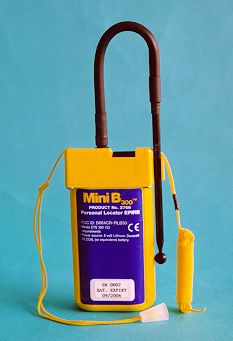
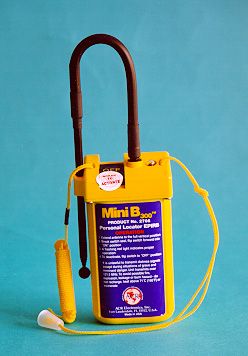
Waterproof ON-OFF Switch Hanked Lanyard Wrist Lanyard TransmittingIndicator Light (LED) Flexible Antenna(Factory Replaceable) Figure 1: ACR MINI B 300 ™ EPIRB - 1 - SECTION 1 — INTRODUCTION1.1 General This manual provides installation, operation and maintenanceinstructions for the ACR/MINI B 300 TM Emergency Position Indicating Radio Beacon (EPIRB), hereinafter referred to as the Beacon. Thissection describes the characteristics and details of the Beacon (SeeFigure 1). A Cognizant Authority Station License may be required tocarry this unit. The Beacon comes with a user replaceable6 volt Lithium, Duracell DL223A, (or equivalent) battery. Seeinstallation instructions page 5. 1.2 Purpose The Beacon is an item of survival equipment and is designed to becarried on a person or aboard vessels at sea and in port, so as to bereadily available in any emergency. It may be used on the deck ofvessels, on survival craft, or may be attached to the latter with theprovided lanyard, as well as attached to survival suits, etc. When turned“ON”, it transmits tone modulated signals (VHF) so that rescue aircraftor vessels equipped with suitable direction finding receiving equipmentcan “home” to the transmitting unit. This Beacon meets FCC Rules forimproved satellite detection. 1.3 Satellite Detection EPIRB use is directly affected by the COSPAS-SARSAT System.SARSAT is an acronym for Search and Rescue Satellite-AidedTracking. This international system has proven that satellites can beused to detect distress alerts and to determine position from 121.5 MHzand 406 MHz EPIRBs.COSPAS-SARSAT frequently plays a key role in many operationalSearch and Rescue decisions. Since the first recorded rescue in 1982,over 3,000 persons have been rescued as a direct result of SARSAT.These successes have brought more public awareness and an expandinggrowth in the use of EPIRBs. - 2 - Figure 2: Satellite Detection 1.4 Authorizations The ACR/MINI B 300 TM Emergency Position Indicating Radio Beacon meets the requirements of the European Telecommunications StandardsInstitute, ETS 300 152, for Marine use. 1.5 Characteristics The ACR/MINI B 300 TM Beacon is an o-ring sealed battery operated unit. The Beacon case, with its external antenna is waterproof. Thesemiconductor circuits are mounted within the case assembly, whichalso contains the battery power supply. An “ON-OFF” switch isinstalled on top of the Beacon, along with a light emitting diode (LED)operation indicator. The Beacon may be carried on a person, stowed inany convenient place, mounted in a special bracket aboard a vessel, ortied with its lanyard inside survival craft. The unit floats and iscompletely waterproof. - 3 - 1.6 Technical Data Pertinent technical data is listed below: ITEM CHARACTERISTICS Frequency 121.5 MHz Power Output Minimum 75 mW during 24 hours operation Operating Life 24 hours minimum at -10°C, (-14°F) longer in temperate climates Battery Lithium, 6 volt Duracell DL223A, (or equivalent). Sold with Beacon. Rated replacement life: 10 years. Emission Type A3X Modulation Downward sweeping tone between 1600 and 300 Hz at 2 to 4 sweeps persecond Frequency ± 3.5 kHz (Crystal controlled) StabilityOperating -20°C to +55°C (-14°F to +131°F) TemperaturesActivation Manual “ON-OFF” switch Size 127mm x 66mm x 41mm (5.0"H x 2.6"W x 1.6"D) excluding antenna Weight 215 g (7.6 ounces) Attachments Lanyards, Hanked and Wrist - 4 - SECTION 2 — INSTALLATION2.1 General The ACR/MINI B 300 M Beacon has been designed for multi-purpose installation for survival use, personnel, rafts, floats and survival craft. Itshould be carried with you or stowed where it will be readily availablein an emergency. 2.2 Battery Installation 1. Remove four (4) screws holding the top cap of the Beacon to the case. Use a no. 2 Phillips screwdriver. Remove top cap and PCboard from bottom case being careful not to disturb any electroniccomponents on the PC board. 2. Remove old battery and place new battery in battery clip with groove side of battery down and flat side of battery up. Caution:Make sure flat side of battery is up. Otherwise, the polarity of thebattery would be reversed and damage to the battery will occur.The battery also poses a possible fire, explosion, or burn hazardwhen placed in the battery clip upside down. A semiconductordiode protects the electronics from damage due to battery reversal. 3. Put the battery expiration date on the flat side of the battery and on the EPIRB case with ACR part no. A1-20-0857 or equivalentpermanent shield label. 4. Grease the top cap o-ring with Dow Corning number 4 SiliconeGrease, ACR Part no. A2-09-0069. 5. Replace the four (4) screws holding the top cap to the bottom case of the Beacon. Make sure screws are tight but do not use excessivetorque which could strip the threads in the top cap. 2.3 Battery Date Code A typical Duracell DL223A battery has a date code of 6J1313. The firstalphanumeric character of the code is always a number representing thelast digit of the year of manufacture. The second alphanumericcharacter of the code is always a letter, the position of which in thealphabet represents the number of the month of manufacture. That is: Arepresents January, B represents February, C represents March, etc. - 5 - The next two alphanumeric characters of the code represent the day ofthe month of manufacture. Therefore, the date of manufacture for thedate code 6J1313 is October 13, 1996. 2.4 Battery Expiry Date The battery Expiry Date is obtained by adding the batterymanufacturers rated replacement life of 10 years to the date ofmanufacture. For example, a date code of 6J1313 would have a BatteryExpiry Date of October 13, 2006. SECTION 3 — OPERATION3.1 General The EPIRB is designed to operate best when placed on a flat non-conductive surface or while over water at sea. It should be operated inan area free of obstructions which could absorb RF energy and limitradiation patterns.Position the antenna straight up (perpendicular to ground) and notpointing to…
Text truncated - open the document above for the full version.
Users Manual
12 Y1-03-0136 Rev. C 1 Y1-03-0136 Rev. C PRODUCTPRODUCT SUPPORTSUPPORT MANUALMANUAL Y1-03-0136 Rev. C ACR/MINI B300 TM Product No. 2766 Class B Emergency Position Indicating Radio Beacon (EPIRB) ETSI and FCC Approved ACR Electronics, Inc. 5757 Ravenswood Road Fort Lauderdale, Fl 33312 +1(954) 981-3333 • Fax +1 (954) 983-5087 http://www.acrelectronics.com Email: [email protected] 2 Y1-03-0136 Rev. C Foreword: Congratulations and thank you! You have just purchased the finest personal locator EPIRB available on the market. Other brands merely attempt to meet the requirements established by government regulatory agencies. ACR designed its Mini B300 to work in real life situations and to save lives. It, therefore, exceeds many of the requirements established by authorities. By purchasing this EPIRB you have distin- guished yourself as one of the safest persons in boating. To be a responsible EPIRB owner: • Read this manual. • Activate your EPIRB ONLY in an emergency. • Mount your EPIRB in an easily accessible spot or store it in your ditch/emergency kit. • Prepare an emergency evacuation plan and rehearse it. • In a grave and imminent situation, where you have ex- hausted all other means of rescue, activate your EPIRB and leave it “On”. Do not turn it off and on in the mis- guided belief that you are saving battery power. • NEVER set off a false alarm . Please call or write for answers to questions or for informa- tion on other safety products manufactured by ACR Elec- tronics, Inc. 11 Y1-03-0136 Rev. C 10 Y1-03-0136 Rev. C remove any salt build-up on case or exposed parts. NOTES: 3 Y1-03-0136 Rev. C TABLE OF CONTENTS SECTION 1 — INTRODUCTION.......................................5 1.1 General...............................................................................5 1.2 Purpose...............................................................................5 1.3 Authorizations....................................................................5 1.4 Characteristics....................................................................5 1.5 Technical Data...................................................................6 SECTION 2 — INSTALLATION........................................7 2.1 General...............................................................................7 2.2 Battery Installation.............................................................7 2.3 Battery Date Code..............................................................7 2.4 Battery Expiry Date............................................................8 SECTION 3 — OPERATION...............................................8 3.1 General...............................................................................8 3.2 Manual Deployment...........................................................8 SECTION 4 — MAINTENANCE........................................9 4.1 General...............................................................................9 4.2 Battery Check.....................................................................9 4.3 Inspection Check................................................................9 4 Y1-03-0136 Rev. C Waterproof ON-OFF Switch Hanked Lanyard Wrist Lanyard Transmitting Indicator Light (LED) Flexible Antenna (Factory Replaceable) Figure 1: ACR Mini B300 TM EPIRB 9 Y1-03-0136 Rev. C SECTION 4 — MAINTENANCE 4.1General The Beacon has been designed for use with a minimum of maintenance required. A check list is given in this section, and when accomplished periodically, should help to assure emer- gency operation and extended life use. 4.2Battery Check 1.The battery expiry date should always be placed on the battery and the outside of the Beacon case. See 2.2 Battery Installation. Replace the battery immediately after extended use or emergency and always on or before the battery expiry date. Use only a 6 volt Lithium Duracell DL223A (or equivalent) battery. 2.Safety Precautions: Warning: To avoid possible fire, explosion, leakage or burn hazard, do not open, recharge, disassemble, heat above 71°C (160°F) or incinerate. 4.3Inspection Check The following checks should be made during the periodic servicing: 1.Check the antenna tip and telescoping sections for any signs of damage or corrosion. 2.Check the plastic covered portion of the antenna for any signs of chafing, wear, cracks, or other damage, and signs of resultant corrosion beneath the covering. 3.Check the antenna socket at the cap surface for any sign of looseness or corrosion. 4.Check the Beacon housing for signs of damage or mishan- dling. Dents, or damage to the top end could result in an operational malfunction during an emergency. 5.Check the lanyards for chafing, fraying or any damage. Check the lanyard anchor points for chafing. Resecure the lanyards and check the knots for tightness. 6.Rinse the outside of the unit with fresh water frequently to 8 Y1-03-0136 Rev. C meric characters of the code represent the day of the month of manufacture. Therefore, the date of manufacture for the date code 6J1313 is October 13, 1996. 2.4Battery Expiry Date The battery Expiry Date is obtained by adding the battery manufacturers rated replacement life of 10 years to the date of manufacture. For example, a date code of 6J1313 would have a Battery Expiry Date of October 13, 2006. SECTION 3 — OPERATION 3.1General The EPIRB is designed to operate best when placed on a flat non-conductive surface or while over water at sea. It should be operated in an area free of obstructions which could absorb RF energy and limit radiation patterns. Position the antenna straight up (perpendicular to ground) and not pointing toward the receiving station. Note that the radiation field null occurs directly off the end of the antenna. Maintain a visual path where possible between the Beacon and the receiver, since beacons characteristically transmit “line of sight”. The Beacon transmits on 121.5 MHz. 3.2Manual Deployment Remove the Beacon from its storage posit…
Text truncated - open the document above for the full version.
Cover Letter(s)
October 18, 1999 Federal Communications Commission EQUIPMENT APPROVAL SERVICES P. O. Box 358315 Pittsburgh, Pa 15251-5315 Re: FCC ID: B66 ACR-RLB30 Gentlemen: We enclose completed form 731, application for equipment authorization, with supporting documentation. This product has been previously approved under European Telecommunication Standard ETS 300 152. We request Type Acceptance as Class B EPIRB under Part 80.1055 with waiver for operating life which is reduced to enable the equipment to be worn comfortably at all times. For reference, a waiver has recently been granted by FCC to Sea Marshall Systems, LTD. for similar equipment approved under European Telecommunication Standard ETS 300 152 (FCC ID #NWG SMR S8). Contact with USCG indicates that they will not oppose the requested waiver: Mr. J. Hersey, Chief Marine Radio Policy Branch Mr. R. Markle, Chief Survival Systems Branch Find supporting documentation enclosed: • Form 731 w/ Remittance Advice • Check in the amount of $610.00 • Certificate of Approval – Radiocommunications Agency (UK) • Certificate of Electromagnetic Compatibility – Radiocommunications Agency (UK) • RLB-30 Design Verification Test Report per ETS 300 152 • Report on the Radio Type Approval testing of Model RLB-30 EPIRB per ETS 300 152 • Supplementary Report on the EMC Testing of Model RLB-30 EPIRB per ETS 300 152 • MSA UK Acceptance letter Thank you for your kind attention in this matter. Very truly yours, ACR ELECTRONICS, INC. John Flood V.P. Engineering Encl.
Cover Letter(s)
October 18, 1999 Federal Communications Commission EQUIPMENT APPROVAL SERVICES P. O. Box 358315 Pittsburgh, Pa 15251-5315 Re: FCC ID: B66 ACR-RLB30 Gentlemen: We enclose completed form 731, application for equipment authorization, with supporting documentation. This product has been previously approved under European Telecommunication Standard ETS 300 152. We request Type Acceptance as Class B EPIRB under Part 80.1055 with waiver for operating life which is reduced to enable the equipment to be worn comfortably at all times. For reference, a waiver has recently been granted by FCC to Sea Marshall Systems, LTD. for similar equipment approved under European Telecommunication Standard ETS 300 152 (FCC ID #NWG SMR S8). Contact with USCG indicates that they will not oppose the requested waiver: Mr. J. Hersey, Chief Marine Radio Policy Branch Mr. R. Markle, Chief Survival Systems Branch Find supporting documentation enclosed: • Form 731 w/ Remittance Advice • Check in the amount of $610.00 • Certificate of Approval – Radiocommunications Agency (UK) • Certificate of Electromagnetic Compatibility – Radiocommunications Agency (UK) • RLB-30 Design Verification Test Report per ETS 300 152 • Report on the Radio Type Approval testing of Model RLB-30 EPIRB per ETS 300 152 • Supplementary Report on the EMC Testing of Model RLB-30 EPIRB per ETS 300 152 • MSA UK Acceptance letter Thank you for your kind attention in this matter. Very truly yours, ACR ELECTRONICS, INC. John Flood V.P. Engineering Encl.
Cover Letter(s)
August 3, 2000 Frank Coperich Federal Communications Commission Application Processing Branch Re: FCC ID B66ACR-RLB30 Applicant: ACR Electronics Inc. Correspondence Reference Number: 15248 731 Confirmation Number: EA95888 Dear Mr. Coperich: The “Product Manual” that was submitted with the ACR application for equipment authorization to the FCC is the old manual that is used for support of the product sold in Europe. A revised product manual is currently being submitted through Add Attachments that is applicable to the RLB-30 application. This manual will be used in all marketing after approval of the FCC is received for the RLB-30. This revised product manual for the RLB-30 makes no mention of satellite detectability. Very truly yours, ACR ELECTRONICS, INC. . John Flood V.P. Engineering
Cover Letter(s)
August 8, 2000 Federal Communications Commission Application Processing Branch Attn: Mr. Frank Coperich Re:FCC ID B66ACR-RLB30 Applicant: ACR Electronics, Inc. Correspondence Ref. No. 15450 731 Confirmation No. EA95888 Dear Mr. Coperich, Regarding your e-mail message of August 7, 2000. It was my intention to send the missing circuit diagram (our Y1-01-0619) in our original application, and to request that the circuit diagram be treated as confidential data. Please accept this letter with Y1-01-0619 as an amendment to our original application. Very truly yours, John Flood Vice President Engineering Encl. Y1-01-0619 - Circuit Diagram
ID Label/Location Info
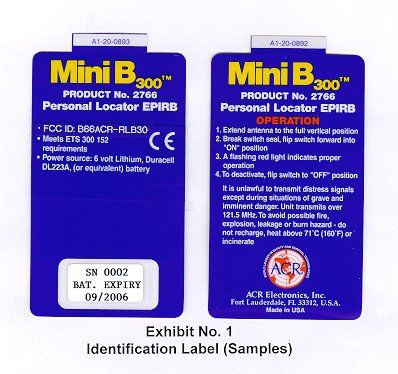
November 18, 1999 FCC Approval Processing Branch Attn: Linda Elliott Re:FCC ID B66ACR-RLB30 731 Confirmation #EA95888 Correspondence Ref.# 10668 Please find attached reproduction of requested FCC ID label and photographs of the product showing the label location on the product. As mentioned in the cover letter that accompanied our electronic application, this product has previously been approved by European national authorities under Telecommunications Standard ETS 300 152, and we are now applying for FCC approval. Thank you for your assistance in this matter. Regards, ACR ELECTRONICS, INC. John F. Flood Vice President, Engineering
Contact Information
Applicant
Dan Stankovic(Director, Certification and Test)
Technical Contact
ACR Electronics, Inc.Cal Havens
[email protected]954 981-3333
5757 Ravenswood Road · Ft. Lauderdale, Florida · United States
Non-Technical Contact
ACR Electronics, IncJohn Flood
[email protected]954 981-3333
Technical Specifications
| # | Rule Parts | Frequency Range | Power Output | Emission | Tolerance |
|---|---|---|---|---|---|
| 1 | 80.1055 | 121.5 MHz - 121.5 MHz | 75.00 mW | 3K20A3X | 0.0030000000 % |
Other Applications from ACR Electronics, Inc.

B66ACR-RLB44
Jan 25, 2023Marine AIS Transceiver with EPIRB
Equipment Class
AIS - Automatic Identification Systems
B66ACR-PLB-350
Aug 04, 2009Personal Locator Beacon
Equipment Class
PLB - Personal Locator Beacons
B66ACR-AIS-300
Oct 07, 2008Class B Automatic Identification System
Equipment Class
AIS - Automatic Identification Systems
B66ACR-PLB-300
Jan 11, 2007Personal Locator Beacon
Equipment Class
PLB - Personal Locator Beacons
B66ACR-RLB-33S
Dec 27, 2004Ship Security Alert System
Equipment Class
SSA - Ship Security Alert Systems (SSAS)