DMOSEK1G4Bodypack Mic/IEM
Sennheiser Electronic Corp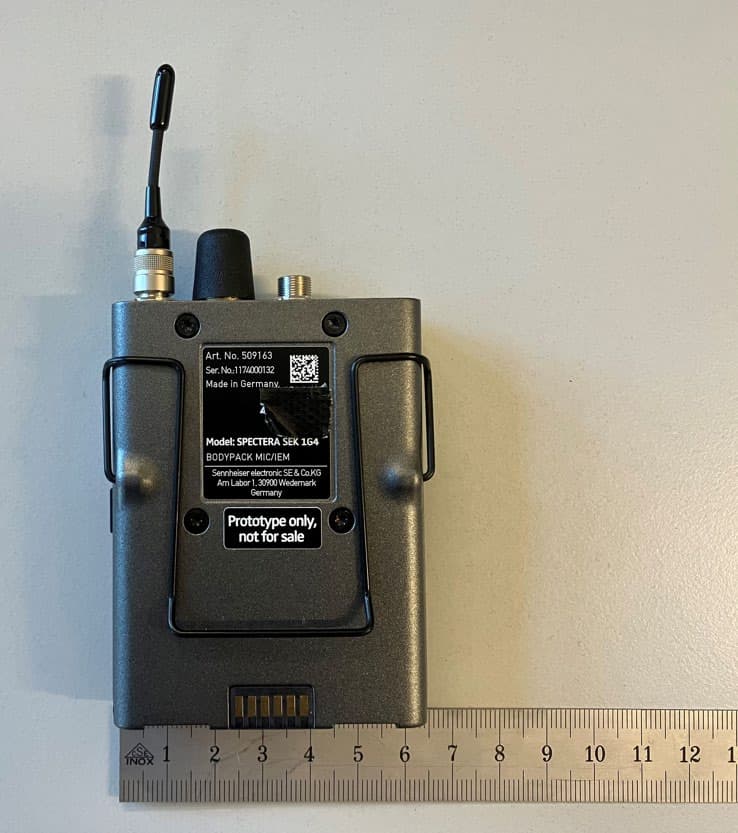
Click to zoom
Application Details
- Equipment Class
- TLD - Licensed LPAS Device
- Date of Grant
- Mar 11, 2026
- Application Purpose
- Original Equipment
- Equipment Note
- Bodypack Mic/IEM
- Frequency Range
- 1438.00000000 - 1522.00000000
- Company
- Sennheiser Electronic Corp
- Country
- United States
Documents & Files
Document Text
Text extracted from the exhibit documents filed with the FCC. Open a document above to read the original.
Users Manual
DE Rahmenbedingungen und Einschränkungen für die Nutzung von Frequenzen In Ihrem Land gelten möglicherweise gesonderte Rahmen- bedingungen und Einschränkungen für die Nutzung von Fre- quenzen. Informieren Sie sich vor der Inbetriebnahme des Produktes unter folgender Adresse: www.sennheiser.com/sifa Bestimmungsgemäße Verwendung Das Produkt darf gewerblich verwendet werden. Als nicht bestimmungsgemäßer Gebrauch gilt, wenn Sie das Produkt anders benutzen, als in der zugehörigen Bedie- nungsanleitung beschrieben. Sennheiser übernimmt keine Haftung bei Missbrauch oder nicht ordnungsgemäßem Gebrauch des Produkts sowie der Zusatzgeräte/Zubehörteile. Vor Inbetriebnahme sind die jeweiligen länderspezifischen Vorschriften zu beachten! Sennheiser haftet nicht für Schäden aus Verbindungsab- brüchen durch leere oder überalterte Akkus/Batterien oder Überschreiten des Sendebereichs. Herstellererklärungen Garantie Sennheiser electronic SE & Co. KG übernimmt für diese Pro- dukte eine Garantie von 24 Monaten. Die aktuell geltenden Garantiebedingungen können Sie über das Internet www.sennheiser.com oder Ihren Sennheiser- Partner beziehen. In Übereinstimmung mit den folgenden Anforderungen • Verordnung (EU) 2023/988 über die allgemeine Produktsicherheit • WEEE-Richtlinie (2012/19/EU) • Verordnung (EU) 2023/1542 über Batterien und Altbatterien Hinweise zur Entsorgung Das Symbol der durchgestrichenen Mülltonne auf dem Pro- dukt, Batterie/Akku (falls zutreffend) und/oder der Verpa- ckung weist Sie darauf hin, dass diese Produkte nicht über den normalen Hausmüll entsorgt werden dürfen, sondern am Ende ihrer Lebensdauer getrennt entsorgt werden müssen. Für die Verpackung beachten Sie die Abfalltrennung in Ihrem Land. Nicht sachgerechte Entsorgung von Verpackungsma- terialien kann Ihre Gesundheit und die Umwelt schädigen. Die getrennte Sammlung von Elektro- und Elektronik-Altge- räten, Batterien/Akkus (falls zutreffend) und Verpackungen dient dazu, die Wiederverwendung und das Recycling zu fördern und negative Auswirkungen auf Ihre Gesundheit und die Umwelt zu verhindern, z. B. durch potenziell gefährliche Stoffe, die in diesen Produkten enthalten sind. Führen Sie Elektro- und Elektronikgeräte und Batterien/Akkus am Ende ihrer Lebensdauer dem Recycling zu, um enthaltene Wert- stoffe nutzbar zu machen und eine Vermüllung der Umwelt zu vermeiden. Wenn Batterien/Akkus zerstörungsfrei entnommen werden können, haben Sie die Pflicht, diese getrennt der Entsorgung zuzuführen (zur sicheren Entnahme von Batterien/Akkus siehe Bedienungsanleitung des Produkts). Gehen Sie insbe- sondere mit lithiumhaltigen Batterien/Akkus vorsichtig um, da diese besondere Risiken beinhalten wie Brand- und/oder Verschluckungsgefahr bei Knopfzellen. Reduzieren Sie die Entstehung von Abfällen aus Batterien soweit wie möglich, indem Sie Batterien mit längerer Lebensdauer oder wieder- aufladbare Akkus einsetzen. Weitere Informationen über das Recycling dieser Produkte erhalten Sie bei Ihrer Gemeindeverwaltung, bei den kom- munalen Sammelstellen oder bei Ihrem Sennheiser-Partner. Elektro- oder Elektronikgeräte können Sie auch bei rück- nahmepflichtigen Vertreibern zurückgeben. Damit leisten Sie einen wichtigen Beitrag zum Schutz der Umwelt und der öffentlichen Gesundheit. Hinweis zur Verarbeitung personenbezogener Daten Das Gerät Spectera ist für die Aufzeichnung und Übertra- gung von Sprache und anderen akustischen Signalen aus- gelegt. Bitte beachten Sie, dass die Stimme einer Person als personenbezogene Daten im Sinne der Datenschutz-Grund- verordnung (DSGVO) gelten kann, insbesondere wenn sie aufgezeichnet oder zu Identifizierungszwecken verwendet wird. Wir als Hersteller verarbeiten keine Sprachdaten. In Verbin- dung mit Aufzeichnungsgeräten, Anwendungen oder Online- Diensten kann die Nutzung dieses Produkts jedoch die Ver- arbeitung personenbezogener Daten beinhalten. In solchen Fällen sind Sie als Nutzer dafür verantwortlich, die geltenden Datenschutzgesetze einzuhalten, z. B. Einholung der Einwil- ligung der Personen, bevor sie deren Stimmen aufzeichnen. Wir empfehlen Ihnen daher, sich mit den Datenschutzrichtli- nien der Anwendungen oder Dienste vertraut zu machen, die Sie in Verbindung mit diesem Produkt verwenden. EU-Konformitätserklärung • RoHS-Richtlinie (2011/65/EU) Hiermit erklärt Sennheiser electronic SE & Co. KG, dass der Funkanlagentyp SEK UHF, SEK 1G4 der Richtlinie 2014/53/ EU entspricht. Der vollständige Text der EU-Konformitätserklärung ist unter der folgenden Internetadresse verfügbar: www.sennheiser.com/download EN Conditions and restrictions for using fre- quencies There may be special conditions and restrictions for using frequencies in your country. Before putting the product into operation, find the informa- tion for your country at the following address: www.sennheiser.com/sifa Intended use The product can be used for commercial purposes. It is considered improper use when the product is used for any application not named in the corresponding instruction manual. Sennheiser does not accept liability for damage arising from improper use or misuse of this product and its attachments/ accessories. Before putting the products into operation, please observe the respective country-specific regulations! Sennheiser is not liable for damages resulting from the loss of connection due to flat or overaged (rechargeable) batte- ries or exceeding the transmission range. Manufacturer declarations Warranty Sennheiser electronic SE & Co. KG gives a warranty of 24 months on these products. For the current warranty conditions, please visit our website at www.sennheiser.com or contact your Sennheiser partner. Warranty FOR AUSTRALIA and NEW ZEALAND ONLY: Sennheiser Australia Pty Ltd provides a warranty of 24 months on these products. For the current warranty conditions, visit Sennheiser website: Australia: https://en-au.sennheiser.com/ New Zealand: https://en-nz.sennheiser.com/ Sennheiser goods come with guarantees that cannot be ex- cluded…
Text truncated - open the document above for the full version.
Users Manual
Sennheiser electronic SE & Co. KG Am Labor 1, 30900 Wedemark, Germany www.sennheiser.com Printed in Germany, Publ. 05/25, 597275/A03 SPECTERA SEK (UHF) SEK (1G4) Quick Guide Kurzanleitung Guide de démarrage rapide Guida rapida Instrucciones resumidas Instruções resumidas Beknopte gebruiksaanwijzing Krótka instrukcja obsługi Snabbguide Kort vejledning Pikaohje Σύντομες οδηγίες Kısa Kılavuz Краткая инструкция 快速指南 快速使用指南 クイックガイド 요약 안내서 www.sennheiser.com/download In the boxBattery and charging OverviewSetup Compliance Sheet Safety Guide Quick Guide SEK SEK SEK SEK SEKSEKSEK SEK SEK SEKSEK SEK LEDs Status LED ON/OFF / Pairing Display Antenna Phones 3.5 mm jack Microphone/ Instrument input Rotary encoder with push function PhonesCapAntennaMicrophone / Instrument BA 70* rechargeable battery SEK (UHF)SEK (1G4) OR + SEK (UHF)SEK (1G4) Instruction Manual Charging CHG 70N-C* 2 1 3 * optional accessory Display Pairing LEDsON/OFF E-labelAccessoriesVolume SEK SEK Detailed information Instruction Manual SEK SEK SPECTERA SEK is connected to Base Station LinkDesk or WebUI Detailed information SEK SEK VOLUME Status LED LEDs indicate Microphone/Instrument input level - Device is starting - Device switched off - Searching for a new Base Station to pair - Connected to new Base Station, waiting for confirmation - Identify of SEK in progress - Pairing to new Base Station in progress - Device on - Connected to Base Station - Searching for previously paired Base Station - Connecting to previous paired Base Station - Device in sleep mode - Firmware update in progress The display will stay on when the device is switched off. shorton SEK offSEK on longpairing off SPECTERA SEK Antenna (UHF) SPECTERA SEK Antenna (1G4) SPECTERA SEK Belt Clip 3pin protective cap MIC/LINE CHG 70N-C L 70 USB BA 70 Art. no. 700066 Art. no. 700067 Art. no. 700071 Art. no. 700072 Art. no. 700332 Art. no. 508861 Art. no. 508860 Press again for information screen Press long for E-label screen Press again to display subsequent E-labels Press for backlight 2 1 3 4 Press long for information screen 5 Meaning of the Status LED 2x Information screen1x Backlight SEK off: Press until LED flashes blue Confirmation 3 1 Switch Base Station into pairing mode (via LinkDesk or Spectera WebUI) 2 Instruction Manual Instruction Manual Display SEK
Users Manual
DE Wichtige Sicherheitshinweise 1. Lesen Sie diese Sicherheitshinweise und die Bedie- nungsanleitung des Produkts. 2. Bewahren Sie diese Sicherheitshinweise und die Bedie- nungsanleitung des Produkts auf. Geben Sie das Produkt an andere Nutzer stets zusammen mit diesen Sicher- heitshinweisen und der Bedienungsanleitung weiter. 3. Geben Sie das Produkt an Dritte stets zusammen mit der Bedienungsanleitung und den Sicherheitshinweisen weiter. 4. Verwenden Sie ausschließlich vom Hersteller zugelasse- ne Anbau-, Zubehör- und Ersatzteile. 5. Öffnen Sie das Gehäuse des Produktes nicht eigenmächtig. 6. Lassen Sie alle Instandsetzungen von qualifiziertem Ser- vicepersonal durchführen. Instandsetzungen müssen durchgeführt werden, wenn das Produkt auf irgendeine Weise beschädigt wurde, Flüssigkeiten oder Objekte in das Produkt gelangt sind, das Produkt Regen oder Feuchtigkeit ausgesetzt war, es nicht fehlerfrei funktio- niert oder fallen gelassen wurde. 7. Verwenden Sie das Produkt nur unter den in den techni- schen Daten angegebenen Betriebsbedingungen. 8. Nehmen Sie das Produkt nicht in Betrieb, wenn es beim Transport beschädigt wurde. 9. Verlegen Sie Kabel stets so, dass niemand darüber stol- pern kann. 10. Halten Sie Flüssigkeiten und elektrisch leitfähige Gegen- stände, die nicht betriebsbedingt notwendig sind, vom Produkt und dessen Anschlüssen fern. 11. Verwenden Sie zum Reinigen keine Lösungsmittel oder aggressiven Reinigungsmittel. 12. Vorsicht: Sehr hohe Signalpegel können Ihr Gehör und Ihre Lautsprecher schädigen! Reduzieren Sie an den an- geschlossenen Wiedergabegeräten die Lautstärke, be- vor Sie das Produkt anschließen, auch wegen der Gefahr der akustischen Rückkopplung. Gefahr durch hohe Lautstärke Das Produkt wird von Ihnen gewerblich eingesetzt. Daher unterliegt der Gebrauch den Regeln und Vorschriften der zu- ständigen Berufsgenossenschaft. Sennheiser als Hersteller ist verpflichtet, Sie auf möglicherweise bestehende gesund- heitliche Risiken ausdrücklich hinzuweisen. Mit dem Produkt können Schalldrücke über 85 dB (A) erzeugt werden. 85 dB (A) ist der Schalldruck, der laut Gesetz als ma- ximal zulässiger Wert über die Dauer eines Arbeitstages auf das Gehör einwirken darf. Er wird nach den Erkenntnissen der Arbeitsmedizin als Beurteilungspegel zugrunde gelegt. Eine höhere Lautstärke oder längere Einwirkzeit können das Gehör schädigen. Bei höheren Lautstärken muss die Hörzeit verkürzt werden, um eine Schädigung auszuschließen. Sichere Warnsignale dafür, dass man sich zu lange zu lau- tem Geräusch ausgesetzt hat, sind: • Man hört Klingel- oder Pfeifgeräusche in den Ohren. • Man hat den Eindruck (auch kurzzeitig), hohe Töne nicht mehr wahrzunehmen. Klären Sie alle Bediener über diese Zusammenhänge auf und fordern Sie sie ggf. auf, die Lautstärke auf einen mittleren Wert einzustellen. Sicherheitshinweise für Lithium-Ionen-Akkus • Sekundärzellen oder -batterien dürfen nicht zerlegt, ge- öffnet oder zerkleinert werden. • Zellen und Batterien von Kindern fernhalten. Kinder dür- fen Batterien nur unter Aufsicht verwenden. Kleine Bat- terien müssen außerhalb der Reichweite kleiner Kinder aufbewahrt werden. • Zellen oder Batterien dürfen weder Hitze noch Feuer aus- gesetzt werden. Die Lagerung im direkten Sonnenlicht ist zu vermeiden. • Zellen oder Batterien dürfen nicht kurzgeschlossen wer- den. Zellen oder Batterien dürfen nicht gefahrbringend in einer Schachtel oder in einem Schubfach gelagert wer- den, wo sie sich gegenseitig kurzschließen oder durch andere leitende Werkstoffe kurzgeschlossen werden können. • Eine Zelle oder Batterie darf erst aus ihrer Originalverpa- ckung entnommen werden, wenn sie verwendet werden soll. • Es dürfen keine anderen Ladegeräte verwendet werden als die, die speziell für den Gebrauch zusammen mit den Geräten vorgesehen sind. • Zellen oder Batterien, die nicht für den Gebrauch zusam- men mit dem Gerät ausgelegt sind, dürfen nicht verwen- det werden. • Immer die von Sennheiser empfohlene Zelle oder Batte- rie für ein Gerät kaufen. • Zellen und Batterien sauber und trocken halten. • Falls die Anschlüsse von Zellen oder Batterien ver- schmutzt werden, mit einem trockenen, sauberen Tuch reinigen. • Zellen und Batterien nicht über längere Zeit laden, wenn sie nicht gebraucht werden. • Die ursprünglichen Druckschriften und Informationen über die Produkte sind für zukünftige Informations- und Nachschlagezwecke aufzubewahren. • Ordnungsgemäß entsorgen. • Laden Sie die Akkus auch bei längerem Nichtgebrauch regelmäßig nach (ca. alle 3 Monate). • Entfernen Sie die Akkus bei offensichtlich defekten Pro- dukten. • Verwenden Sie defekte Akkus niemals weiter. EN Important safety instructions 1. Read these safety instructions and the instruction manu- al of the product. 2. Keep these safety instructions and the instruction ma- nual of the product. Always include all instructions when passing the product on to third parties. 3. Always include this instruction manual and the safety guide when passing the product on to third parties. 4. Only use attachments, accessories and spare parts spe- cified by the manufacturer. 5. Do not attempt to open the product housing on your own. 6. Refer all servicing to qualified service personnel. Ser- vicing is required when the product has been damaged in any way, liquid has been spilled or objects have fallen into the product, when the product has been exposed to rain or moisture, does not operate normally, or has been dropped. 7. Use the product only under the conditions of use listed in the specifications. 8. Do not operate the product if it was damaged during transportation. 9. Always run cables so that no one can trip over them. 10. Keep the product and its connections away from liquids and electrically conductive objects that are not necessa- ry for operating the product. 11. Do not use any solvents or aggressive cleaning agents to clean the product. 12. Caution: Very high signal levels can damage your hearing and your loudspeakers. Red…
Text truncated - open the document above for the full version.
Attestation Statements
Sennheiser Electronic Corp. 1 Enterprise Drive Old Lyme Connecticut 06371 United States Federal Communication Commission Authorization and Evaluation Division 7435 Oakland Mills Road Columbia, MD 21046 USA 2025-11-18 Attestation Statement according to 2.911(d)(7) FCC ID: DMODAD1G4, DMOSEK1G4 TO WHOM IT MAY CONCERN: This letter is to confirm that the applicant Sennheiser Electronic Corp. acts as th e U.S Agent for service of process as required by §2.911(d)(7). The Applicant further acknowledges acceptance to maintain an agent for no less than one year after the grantee has terminated all marketing and importation or the conclusion of any Commission-related proceeding involving the equipment. Applicant / U.S. Agent Si gnature: Signed by (printed name): Michael Lieske Corporate Secretary FRN: 0007220122 Address: 1 Enterprise Drive Old Lyme, Connecticut 06371, United States Telephone No: (860) 434-9190 154 Email: [email protected]
Cover Letter(s)
Antenna Information Model: SPECTERA SEK 1G4 Antenna Type: monopole antenna 1. S11 response of high-band antenna (including matching network) 2.The radiation and total antenna efficiency for the low-band bodypack 3. Realized gain of the high-band bodypack for three different farfield cuts: φ = 0◦ in (a) and (b), φ = 90◦in (c) and (d) and θ = 90◦ in (e) and (f). The cuts without HBM are shown in (a), (c) and (e) and the cuts with HBM are shown in (b), (d) and (f). All cases are simulated with matching network. 4. Maximum realized gain for the high-band monopole without the human body
Cover Letter(s)
Document Version 1.1 2020-10-30 LONG-TERM CONFIDENTIALITY REQUEST for Certification Service in the USA Federal Communication Commission Equipment Authorization Division, Application Processing Branch 7435 Oakland Mills Road Columbia, MD 21048 TO WHOM IT M AY CONCERN Pursuant to Paragraphs §0.457 and 0.459 of the Commission’s Rules (47 C.F.R.) and Section §552(b)(4) of the Freedom of Information Act, we request Long-Term Confidentiality for the following product: For the product stated above, we request Long-Term Confidentiality for exhibits which contain Block Diagram, Operational Description, Parts List/Tune Up Info, Schematics, SDR Software/Security Info. The above exhibits contain ou r trade secrets and proprietary information that could be of benefit to o ur competitors. This information will not be publicly available. If you have any questions, please feel free to contact us at the address shown below. Sincerely, Company Name: Phone: Company Address: Fax: E-mail: Contact Name: Signature: Signature Date: Check your GC here. Click Grantee Search. FCC I D: Grantee Code Equipment Product Code
External Photos
Page 1 EUT Photos EUT: Bodypack Transceiver Mic/IEM Model No.: SPECTERA SEK 1G4 Frequency Range: EU Lic 1435-1525 MHz Page 2 External Photos of EUT Front View Page 3 Back View Page 4 Bottom View T op View Page 5 Right Side View Left Side View
ID Label/Location Info
E-Label Information Example below is valid only for devices which are subject to Certification Procedure in USA. -co nnect SPECTERA SEK 1G4 to th e S PECTERA Base Station 1.Press for backlight 2.Press again for Information screen 3.Press long for E-Label screen
Internal Photos
Page 1 EUT Photos EUT: Bodypack Transceiver Mic/IEM Model No.: SPECTERA SEK 1G4 Frequency Range: EU Lic 1435-1525 MHz Page 2 Internal Photos of EUT Top View (Main PCB) Page 3 Bottom View (Main PCB) Page 4 Bottom View (Main PCB) Top View (Main PCB)
RF Exposure Info
© cetecom advanced GmbH Page 1 of 26 TEST REPORT Test Report No.: 1-0577-25-01-02_TR1-R01 Testing Laboratory Applicant cetecom advanced GmbH Untertuerkheimer Strasse 6 – 10 66117 Saarbruecken / Germany Phone: + 49 681 5 98 - 0 Fax: + 49 681 5 98 - 9075 Internet: https://cetecomadvanced.com e-mail: [email protected] Accredited Testing Laboratory: The testing laboratory (area of testing) is accredited according to DIN EN ISO/IEC 17025 (2018-03) by the Deutsche Akkreditierungsstelle GmbH (DAkkS). The accreditation is valid for the scope of testing procedures as stated in the accreditation certificate with the registration number: D-PL-12047-01-00. ISED Testing Laboratory Recognized Listing Number: DE0001 FCC designation number: DE0002 Sennheiser electronic SE & Co. KG Am Labor 1 30900 Wedemark/GERMANY Phone: +49 5130 600-0 Contact: Ouajdi Ochi e-mail: [email protected] Phone: +49 5130 600 1482 Fax: +49 5130 600 76 1465 Manufacturer Sennheiser electronic SE & Co. KG Am Labor 1 30900 Wedemark/GERMANY Test Standards IEC/IEEE 62209-1528-2020 Measurement procedure for the assessment of specific absorption rate of human exposure to radio frequency fields from hand-held and body-mounted wireless communication devices – Part 1528: Human models, instrumentation, and procedures (Frequency range of 4 MHz to 10 GHz) IEEE Std. C95-3-2002 IEEE Recommended Practice for the Measurement of Potentially Hazardous Electromagnetic Fields – RF and Microwave For further applied test standards please refer to section 3 of this test report. Test Item Kind of test item: Bodypack MIC/IEM Device type: portable device Model name: SPECTERA SEK 1G4 S/N serial number: 1075000600 FCC-ID: DMOSEK1G4 Hardware status: 404690 Software status: 1.0.0 Frequency / modulation: 1438-1522 MHz / WMAS / OFDM Antenna: 1 external antenna / 1.6 dBi antenna gain Battery option: BA 70 Li-ion Battery Pack 3.8V / 1720mAh Accessories: Headset and microphone Test sample status: identical prototype Exposure category: general population / uncontrolled environment This test report is electronically signed and valid without handwritten signature. For verification of the electronic signatures, the public keys can be requested at the testing laboratory. Test Report authorised: Test performed: Alexander Hnatovskiy Marco Scigliano Lab Manager Testing Manager Radio Labs Radio Labs Test report no.: 1-0577-25-01-02_TR1-R01 © cetecom advanced GmbH Page 2 of 26 1 Table of contents 1 Table of contents ............................................................................................................................................ 2 2 General information ....................................................................................................................................... 3 2.1 Notes and disclaimer .......................................................................................................................... 3 2.2 Application details ............................................................................................................................... 3 2.3 Statement of compliance .................................................................................................................... 3 3 Test standards/ procedures references ....................................................................................................... 4 3.1 RF exposure limits .............................................................................................................................. 4 4 Reporting statements of conformity – decision rule .................................................................................. 5 5 Summary of Measurement Results .............................................................................................................. 5 6 Test Environment ........................................................................................................................................... 5 7 Test Set-up ...................................................................................................................................................... 6 7.1 Measurement system .......................................................................................................................... 6 7.1.1 System Description ..................................................................................................................... 6 7.1.2 Test environment ........................................................................................................................ 7 7.1.3 Probe description ........................................................................................................................ 7 7.1.4 Phantom description ................................................................................................................... 8 7.1.5 Device holder description ........................................................................................................... 8 7.1.6 Scanning procedure .................................................................................................................... 9 7.1.7 Spatial Peak SAR Evaluation ................................................................................................... 13 7.1.8 Data Storage and Evaluation .................................................................................................... 15 7.1.9 Tissue simulating liquids: dielectric properties ......................................................................... 17 7.1.10 Tissue simulating liquids: parameters ...................................................................................... 17 7.1.11 Measurement uncertainty evaluation for SAR test ................................................................... 18 7.1.12 Measurement uncertainty evaluation for System Check .......................................................... 19 7.1.13 System check .....................…
Text truncated - open the document above for the full version.
RF Exposure Info
Page 1 of 26 Annex D Appendix No.: 1-0577-25-01-02_TR1-A201-R01 Testing Laboratory cetecom advanced GmbH Untertuerkheimer Strasse 6 – 10 66117 Saarbruecken/Germany Phone: + 49 681 5 98 - 0 Fax: + 49 681 5 98 - 9075 Internet: https://www.cetecomadvanced.com e-mail: [email protected] Appendix with Calibration data, Phantom certificate and system check information 2012-01-16 Test report no.: 1-0577-25-01-02_TR1-A201-R01 Page 2 of 26 1 Table of contents 1 Table of contents ....................................................................................................................................... 2 2 Calibration report “Probe EX3DV4” – SN: 7635 ..................................................................................... 3 3 Calibration report “1450 MHz System validation dipole” .................................................................... 12 4 Calibration certificate of Data Acquisition Unit (DAE) – SN: 413 ....................................................... 18 5 Certificate of “SAM Twin Phantom V4.0, V5.0, V8.0’’ .......................................................................... 19 6 Certificate of “ELI Phantom V8.0’’ ......................................................................................................... 20 7 Application Note System Performance Check ..................................................................................... 21 7.1 Purpose of system performance check ..................................................................................... 21 7.2 System Performance check procedure ...................................................................................... 21 7.3 Uncertainty Budget ...................................................................................................................... 22 7.4 Power set-up for validation ......................................................................................................... 25 7.5 Laboratory reflection ................................................................................................................... 26 7.6 Additional system checks ........................................................................................................... 26 Test report no.: 1-0577-25-01-02_TR1-A201-R01 Page 3 of 26 2 Calibration report “Probe EX3DV4” – SN: 7635 Test report no.: 1-0577-25-01-02_TR1-A201-R01 Page 4 of 26 Test report no.: 1-0577-25-01-02_TR1-A201-R01 Page 5 of 26 Test report no.: 1-0577-25-01-02_TR1-A201-R01 Page 6 of 26 Test report no.: 1-0577-25-01-02_TR1-A201-R01 Page 7 of 26 Test report no.: 1-0577-25-01-02_TR1-A201-R01 Page 8 of 26 Test report no.: 1-0577-25-01-02_TR1-A201-R01 Page 9 of 26 Test report no.: 1-0577-25-01-02_TR1-A201-R01 Page 10 of 26 Test report no.: 1-0577-25-01-02_TR1-A201-R01 Page 11 of 26 Test report no.: 1-0577-25-01-02_TR1-A201-R01 Page 12 of 26 3 Calibration report “1450 MHz System validation dipole” Test report no.: 1-0577-25-01-02_TR1-A201-R01 Page 13 of 26 Test report no.: 1-0577-25-01-02_TR1-A201-R01 Page 14 of 26 Test report no.: 1-0577-25-01-02_TR1-A201-R01 Page 15 of 26 Test report no.: 1-0577-25-01-02_TR1-A201-R01 Page 16 of 26 Test report no.: 1-0577-25-01-02_TR1-A201-R01 Page 17 of 26 Test report no.: 1-0577-25-01-02_TR1-A201-R01 Page 18 of 26 4 Calibration certificate of Data Acquisition Unit (DAE) – SN: 413 Test report no.: 1-0577-25-01-02_TR1-A201-R01 Page 19 of 26 5 Certificate of “SAM Twin Phantom V4.0, V5.0, V8.0’’ Test report no.: 1-0577-25-01-02_TR1-A201-R01 Page 20 of 26 6 Certificate of “ELI Phantom V8.0’’ Test report no.: 1-0577-25-01-02_TR1-A201-R01 Page 21 of 26 7 Application Note System Performance Check 7.1 Purpose of system performance check The system performance check verifies that the system operates within its specifications. System and operator errors can be detected and corrected. It is recommended that the system performance check is performed prior to any usage of the system in order to guarantee reproducible results. The measurement of the Specific Absorption Rate (SAR) is a complicated task and the result depends on the proper functioning of many components and the correct settings of many parameters. Faulty results due to drift, failures or incorrect parameters might not be recognized, since they often look similar in distribution to the correct ones. The Dosimetric Assessment System DASY incorporates a system performance check procedure to test the proper functioning of the system. The system performance check uses normal SAR measurements in a simplified setup (the flat section of the SAM Twin Phantom) with a well characterized source (a matched dipole at a specified distance). This setup was selected to give a high sensitivity to all parameters that might fail or vary over time (e.g., probe, liquid parameters, and software settings) and a low sensitivity to external effects inherent in the system (e.g., positioning uncertainty of the device holder). The system performance check does not replace the calibration of the components. The accuracy of the system performance check is not sufficient for calibration purposes. It is possible to calculate the field quite accurately in this simple setup; however, due to the open field situation some factors (e.g., laboratory reflections) cannot be accounted for. Calibrations in the flat phantom are possible with transfer calibration methods, using either temperature probes or calibrated E-field probes. The system performance check also does not test the system performance for arbitrary field situations encountered during real measurements of mobile phones. These checks are performed at SPEAG by testing the components under various conditions (e.g., spherical isotropy measurements in liquid, linearity measurements, temperature variations, etc.), the results of which are used for an error estimation of the system. The system performance check will indicate situations where the system uncertainty is exceeded due to drift o…
Text truncated - open the document above for the full version.
Test Report
Test Laboratory: 7layers GmbH Borsigstrasse 11 40880 Ratingen Germany Note: The following test results relate only to the devices specified in this document. This report shall not be reproduced in part s without the written approval of the test laboratory. 7layers GmbH Geschäftsfü…
Text truncated - open the document above for the full version.
Contact Information
Applicant
Michael Lieske
[email protected]Fax: 860-434-1759
Technical Contact
Sennheiser Electronic CorpMichael Lieske
1 Enterprise Drive · Old Lyme, Connecticut, 06371 · United States
Test Firm
cetecom advanced GmbHGerald Schmidt
[email protected]Fax: 49-681-598-8775
Technical Specifications
| # | Rule Parts | Frequency Range | Power Output | Emission | Tolerance |
|---|---|---|---|---|---|
| 1 | 74H | 1.44 GHz - 1.52 GHz | 39.00 mW | 5M46D7X | 1.7000000000ppm |
Other Applications from Sennheiser Electronic Corp
DMOSKM1G4
Aug 19, 2026Handheld Transmitter
Equipment Class
TLD - Licensed LPAS DeviceDMOSKMUHF
May 20, 2026Antenna Transceiver
Equipment Class
DWM - Part 15 Wireless Microphone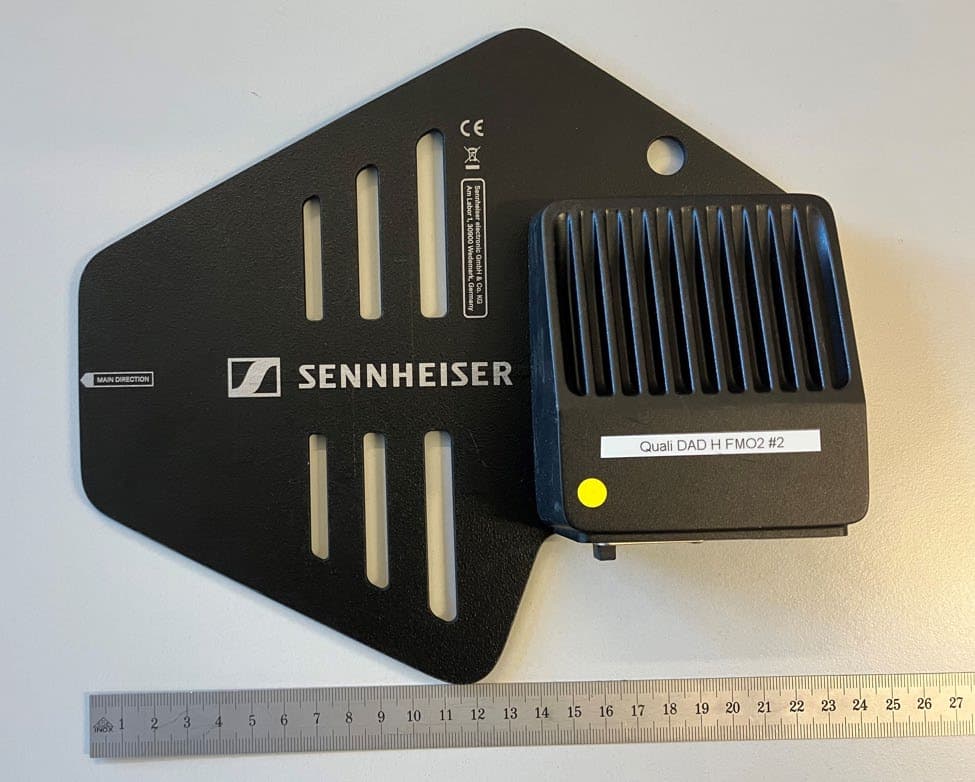
DMODAD1G4
Mar 11, 2026Antenna Transceiver
Equipment Class
TLD - Licensed LPAS DeviceDMOTSEWDX
Jan 30, 2024Wireless Table Stand
Equipment Class
TLD - Licensed LPAS DeviceDMOTSEWDX9
Jan 29, 2024OW50SL
Equipment Class
TLD - Licensed LPAS Device