HZB-8460802.11a/b/g WIRELESS LAN CARDBUS CARD
Proxim Wireless Corporation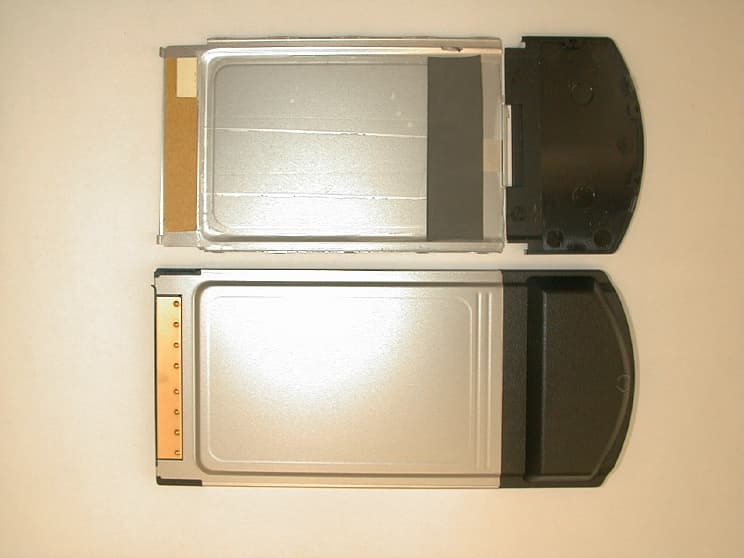
Click to zoom
Application Details
- Equipment Class
- NII - Unlicensed National Information Infrastructure TX
- Date of Grant
- Oct 30, 2002
- Application Purpose
- Original Equipment
- Date of Application
- Aug 11, 2002
- Equipment Note
- 802.11a/b/g WIRELESS LAN CARDBUS CARD
- Frequency Range
- 5180.00000000 - 5320.00000000
- Company
- Proxim Wireless Corporation
- Country
- United States
Documents & Files
Document Text
Text extracted from the exhibit documents filed with the FCC. Open a document above to read the original.
Users Manual
Harmony 802.11a/b Combo CardBus Card User's Guide 2 Copyright © 2002 Proxim Corporation, Sunnyvale, CA. All rights reserved. Covered by one or more of the following U.S. patents: 5,231,634; 5,875,179; 6,006,090 5,809,060; 6,075,812; 5,077,753; 5,231,634. This user’s guide and the software described in it are copyrighted with all rights reserved. No part of this publication may be reproduced, transmitted, transcribed, stored in a retrieval system, or translated into any language in any form by any means without the written permission of Proxim Corporation. Trademarks Harmony, the Harmony logo, 2X, Proxim, and the Proxim logo are trademarks of Proxim Corporation. All other trademarks are the property of their respective owners. Limited Warranty, Disclaimer, Limitation Of Liability For a period of three (3) years from the date of purchase by the retail customer, Proxim warrants the Harmony 802.11a/b Combo CardBus Cards (Model 8460) against defects in materials and workmanship. Proxim will not honor this warranty if there has been any attempt to tamper with or remove the product’s external foil label. This warranty does not cover and Proxim will not be liable for any damage or failure caused by misuse, abuse, acts of God, accidents, or other causes beyond Proxim’s control, or claim by any entity other than the original purchaser. If, after inspection, Proxim determines there is a defect, Proxim will repair or replace the Harmony 802.11a/b Combo CardBus Card at no cost to you. To return defective merchandise to Proxim, please call Proxim Technical Support at 1-408-731-2640 to obtain a Return Merchandise Authorization (RMA) number. In no event shall Proxim Corporation be responsible or liable for any damages arising: • From the use of the product • From the loss of use, revenue or profit of the product • As a result of any event, circumstance, action, or abuse beyond the control of Proxim Corporation Whether such damages be direct, indirect, consequential, special, or otherwise and whether such damages are incurred by the person to whom this warranty extends or a third party. Warranty Return Policy If you have a problem with a Harmony 802.11a/b Combo CardBus Card (Model 8460), please call Proxim Technical Support at 1-408-731-2640. Proxim Technical Support will assist with resolving any technical difficulties you may have with your Proxim product. After calling Proxim Technical Support, if your product is found to be defective, you may return the product to Proxim after obtaining an RMA (Return Merchandise Authorization) number. The product must be returned in its original packaging. The RMA number should be clearly marked on the outside of the box. Proxim cannot be held responsible for any product returned without an RMA number, and no product will be accepted without an RMA number. Harmony 802.11a/b Combo CardBus Card User’s Guide Part # 2050.xxxx Rev. D1 3 FCC WARNING This equipment has been tested and found to comply with the limits for a Class B digital device, pursuant to Part 15 of the FCC Rules. These limits are designed to provide reasonable protection against harmful interference in a residential installation. This equipment generates, uses, and can radiate radio frequency energy and, if not installed and used in accordance with the instructions, may cause harmful interference to radio communications. However, there is no guarantee that interference will not occur in a particular installation. If this equipment does cause harmful interference to radio or television reception, which can be determined by turning the equipment off and on, the user is encouraged to try to correct the interference by one or more of the following measures: • Reorient or relocate the receiving antenna. • Increase the separation between the equipment and the receiver. • Connect the equipment into an outlet on a circuit different from that which the receiver is connected. • Consult the dealer or an experienced radio/TV technician for help. This device complies with part 15 of the FCC Rules. Operation is subject to the following two conditions: (1) This device may not cause harmful interference, and (2) this device must accept any interference received, including interference that may cause undesired operation. For Indoor Use Only These products are for indoor use only. Uniquement pour usage d'intérieur. Somente para uso interno. Solamente para el uso interior. Per uso al coperto solamente. Für Innen Verwendung nur. Nemlig indendørs hjælp bare. For indoor bruk bare. För indoor användning enda. Voor overdekt toepassing uitsluitend. Indoor käyttöä varten vain. Product Approvals Proxim will only ship products that are type approved in the destination country. Refer to Proxim’s Web site at http://www.proxim.com/support/80211acertifications/ for a list of countries that have approved Proxim’s 802.11a products. This Web site also details any special requirements that govern the use of 802.11a products in a particular country. An 802.11a product purchased for use in one country may not necessarily comply with the RF regulations in another country. Για την εσωτερική χρήση μόνο. 4 Ta b l e o f C o n t e n t s Chapter 1 - Introduction ............................................................................................... 6 The Harmony Family .....................................................................................................7 The Product Package ...................................................................................................7 System Requirements ................................................................................................. 8 The IEEE 802.11 Specifications .................................................................................... 8 Chapter 2 - Installation ................................................................................................ 9 Pre-installation Considerations .................................................................…
Text truncated - open the document above for the full version.
Cover Letter(s)
From: [email protected] Sent: Monday, September 23, 2002 11:13 AM To: [email protected] Subject: SAR Issues To: STEVE CHENG, COMPLIANCE CERTIFICATION SERVICES From: Steve Dayhoff [email protected] FCC Application Processing Branch Re: FCC ID HZB-8460 Applicant: Proxim Corporation Correspondence Reference Number: 23990 731 Confirmation Number: EA241977 0) Please explain reasons and differences for "primary" and "supplemental" SAR reports (CCS response: Primary report refer to the report tested to the original version of the Atheros FCC ID: PPD-AR5BCB-00022 ( Grant date :09/11/2002) which has exact same hardware and firmware except that Proxim used a different antenna, and the Supplemental report represent the report that tested to the new added antenna by Proxim.) For example, at 5.8 GHz primary states 21.3 dBm with SAR=.08, secondary gives higher SAR=.65 with lower power 20 dBm. (P. Gandhi to answer) Likewise 2.4 GHz primary shows tests in 802.11b and g modes, but mode not shown in 2.4 GHz supplemental report. 2.4 GHz reports appear to use different notebook computers, but even with apparent increased spacing to phantom SARs are similar. (CCS response: For shorting the test time, 2.4G and 5 G has been scheduled to be tested by different SAR lab at same period and same Laptop is not available to the 2.4 G test. The similar reading with different spacing may due to the use of different antenna)(Atheros used .11b / .11g testing. Comparing this testing to Atheros on primary report it was determined that only .11b mode is the worst case mode) Indicate which if any of these reports are not applicable to this filing. ( CCS response: Primary ( Same as Atheros FCC ID:PPD-AR5BCB-00022) and Supplemental SAR report ( tested with alternate Proxim antenna ) both are applicable to this filing. 1) Please submit absolute power measurements for the device before/during/after the SAR test to demonstrate that the device was operating at maximum power as stated on page 4. Please include measurement procedures. Also additional clarification of maximum power. SAR report mentions 126mW, Form 731 has 90 mW. Please clarify, and revise, harmonize, re-submit all relevant exhibits accordingly. ( CCS response : pleaser refer to P. Gandhi summary which associated with Amended SAR test report dated 10/10/02) 2) Please submit details of the SAR test host device - dimensions, model number, distance from bottom of notebook to bottom of card, etc. Also, please provide additional photographs of the device setup underneath the phantom for reference purposes. ( CCS response : pleaser refer to P. Gandhi summary which associated with Amended SAR test report dated 10/10/02) 3) Please submit revised users manual with additional user operational information. The user should be made aware of the host(s) this device was evaluated as. Users should be informed how to use the device to assure they are not exposed to excessive levels consistent with the compliance testing results. How will 2.5 cm gap be maintained in the lapheld position? SAR test data does not support compliance at an arbitrarily close gap. Additionally, please add information instructing the user not to collocate/operate this transmitter with other transmitters for RF exposure compliance purposes. ( CCS response: Revised user manual has been uploaded to FCC.) 4) EMC report mentions a pulse duration of 2.1 msec on page 22. If not a constant power envelope signal, please give full timing information for the signals tested. (CCS response: the Proxim radio card cannot operate at 100% duty cycle. The active power control circuitry needs to reset periodically and this requires the transmitter to turn off. The test program is designed to produce the shortest off time (to keep the duty cycle as close as possible to 100%) and keep the power control circuitry operational. ) The full measured timing information is as follows: Pulse ON time = 2.1 msec Pulse OFF time = 44 usec Duty Cycle = 99.79 % ) 5) Please submit printout/raw data from dielectric parameter measurement system covering the entire operating frequency range of the device. The device appears to have two separate operating frequency bands. If parameters vary significantly please provide SAR results using separate liquid parameters for each band. ( CCS response : pleaser refer to P. Gandhi summary which associated with Amended SAR test report dated 10/10/02) 6) System validation information for each day of testing according to Supplement C. ( CCS response : pleaser refer to P. Gandhi summary which associated with Amended SAR test report dated 10/10/02) 7) Please submit coarse scan data used to locate peak SAR region for subsequent zoom scan. ( CCS response : pleaser refer to P. Gandhi summary which associated with Amended SAR test report dated 10/10/02) 8) Justification that hot spot was fully scanned during zoom scan. Data suggest peaks were not fully scanned. ( CCS response : pleaser refer to P. Gandhi summary which associated with Amended SAR test report dated 10/10/02) 9) New data contour plots including data, liquid parameters, temperatures, and probe conversion factors. Suppl C App. B II 7 c) states "description, illustration and SAR distribution plots showing the peak SAR locations with respect to the phantom and the test device." Please submit. ( CCS response : pleaser refer to P. Gandhi summary which associated with Amended SAR test report dated 10/10/02) 10) Probe was calibrated at 5.3 GHZ. What is expected change in probe cal factor and expected resulting change in SAR at 5.8 GHZ? ( CCS response : pleaser refer to P. Gandhi summary which associated with Amended SAR test report dated 10/10/02) 11) Discussion of how the EUT was operated/controlled during the test to assure the testing of all appropriate modes, maximum power, and any duty factor driven parameters, per Supplement C Appendix B part I 2. If possible provide post-test power data to confirm that the EUT was operating at full power throughout …
Text truncated - open the document above for the full version.
Cover Letter(s)
October 10, 2002 RESPONSES TO THE QUESTIONS ON THE SAR COMPLIANCE TESTING OF PROXIM CORPORATION MODEL 8460 (FCC ID# HZB-8460) CARDBUS CARD INSERTED INTO A LAPTOP COMPUTER An amended report that addresses all of the questions on the original SAR Compliance Test Report of August 12, 2002 is submitted herewith. Brief responses to the various questions are given in the following: 1. As given in Section VI (p. 7), the power output of the cardbus card was measured using the circuit given in Fig. 13. After the first 15 minutes of warm-up time, the power was stable at 20 ± 0.2 dBm for up to 60 minutes of observation time. We have also validated the stability of output power by repeated coarse as well as finer 1-g SAR measurements. Given in Tables 2a,b,c are the SAR distributions for the peak 1-g SAR region of volume 10 x 10 x 10 mm for three repeated runs each lasting a period of 20 minutes, for which the coarse SAR scans are given in Figs. 11a,b,c. 2. Details of the SAR measurement system are given in Section II (also see Fig. 3). A photograph of the plastic holder used to support the laptop computer including the Model 8460 Cardbus Card is shown in Fig. 4. This holder can be moved up or down so that the base of the laptop is pressed against the base of the flat phantom for "above-lap" placement (see Fig. 5) or used to support the laptop computer at 90 D angle so that the card edge is at a distance of 2.5 cm from the base of the flat phantom. Laptop Model is a Dell Latitude C600. 5. The desired dielectric parameters, the procedure used and the measured dielectric values of the body-simulant fluid are given in Section V. 6. The procedure for system validation is given in Section IV. System validation information for each of the three days of measurements are given in the new Appendix B. 7. A typical coarse scan data for three successive SAR measurement runs is given in Fig. 11 (parts a, b, c). 8. The procedure for identifying the hot spot from the coarse scan data is given in Section VI. Typical data for three repeated runs for peak 1-g SARs are given in Tables 2a, b, c. 9. Some typical contour plots are given in Figs. 11a,b,c. Position of the hot spot relative to the cardbus card is illustrated in Fig. 12. 10. The procedure for calibration of the E-field probe is detailed in Section III. Due to a fairly limited bandwidth of 0.6 GHz as compared to a recommended bandwidth of 2.2 GHz for the TE 10 mode for the WR159 waveguide, the calibration factor of the 2 E-field probe is 2.98 (mW/kg)/ μV with a variability of ± 2% over the measurement band. 12. Additional pictures attached in the amended report are Figs. 3 and 4. 13. The slot picked for Model 8460 Cardbus Card placement in the laptop computer was the bottom slot. This was selected because of more proximal placement of the card relative to the tissue-simulant phantom. For this situation, the vertical spacing between the bottom of the card to the base of the laptop computer is 1 cm. As explained in Sections I and VI of the amended report, the base of the laptop computer was pressed against the bottom of the flat phantom for SAR measurements.
External Photos
Top Cover Assembled: Back Side of PCB with Metal Cover:
ID Label/Location Info
8460 Label Dimensions and Placement Top Label: Label Dimensions = 2.48 x 1.55 in. Label Material = .002in TC/249 White Mylar. Label Adhesive = Permanent Adhesive. Label Placement: Both top and bottom labels must be centered in the recessed area of the top and bottom metal covers. Bottom Label: (Same Dimension as top label)
Internal Photos
8460 Detailed Assembly Photos Inside View of Covers and PCB: Top Side PCB without Shield: Back Side of PCB and Back Cover:
Operational Description
Technical Description The Proxim 8460 is a high performance 802.11a/b/g WLAN client product intended for laptop applications. It operates in the 2.4 – 2.4835 GHz, 5.15 - 5.35 GHz and 5.275 - 5.850 GHz bands with a maximum average Tx output power of 158 mW. The product uses two symmetric integral antennas for diversity operation. Each has approximately 2.6 dBi peak gain. The Proxim 8460 design is based on an Atheros AR5001X two chip solution. The three chips include: AR5211: Multiprotocol MAC/baseband processor, and CardBus/PCI bus interface. AR5111 Radio-on-a-Chip (RoC): An all-CMOS single-chip radio transceiver that includes a power amplifier, and integrated dual conversion filters to convert signals from 5 GHz to the baseband range for use by the AR5211. The AR5111 offers fully integrated transmitter, receiver, and frequency synthesizer functions; eliminating the need for external voltage controlled oscillators (VCOs) and surface acoustic wave (SAW) filters. AR2111 Radio-on-a-Chip (RoC): An all-CMOS single-chip radio transceiver that, when combined with the AR5111,implements a 2.4 GHz 802.11 b/g solution. The AR2111 offers fully integrated transmitter, receiver, and frequency synthesizer functions. Like the AR5111, the AR2111 does not require external VCOs or SAW filters.
Operational Description
8460 Product Description Description: Proxim 802.11a/b/g Wireless LAN CardBus Card. Model#: 8460 Revision: 1.0 Radio: Supports 5.15GHz - 5.85GHz (UNII 1,2 and 3) and 2.412 – 2.472GHz. Standards: PCMCIA – CardBus 32bit, IEEE 802.11a, 802.11b, 802.11g. Data Rates: 802.11a mode: 6, 9, 12, 18, 24, 36, 48, 54 Mbps 802.11g mode: 6, 9, 12, 18, 24, 36, 48, 54 Mbps 802.11b mode: 1, 2, 5.5, 11 Mbps 2X mode: 12,18,24,36,48, 72, 108 Mbps
RF Exposure Info
SAR COMPLIANCE TESTING OF PROXIM CORPORATION MODEL 8460 (FCC ID# HZB-8460) CARDBUS CARD WITH MONOPOLE ANTENNAS INSERTED INTO A LAPTOP COMPUTER July 3, 2002 Submitted to: Mr. Nathan Mueller Proxim Corp. Submitted by: Om P. Gandhi Professor of Electrical and Computer Engineering University of Utah 50 S Central Campus Dr., Rm. 3280 Salt Lake City, UT 84112-9206 2 SAR COMPLIANCE TESTING OF PROXIM CORPORATION MODEL 8460 (FCC ID#HZB-8460) CARDBUS CARD WITH MONOPOLE ANTENNAS INSERTED INTO A LAPTOP COMPUTER I. Introduction The U.S. Federal Communications Commission (FCC) has adopted limits of human exposure to RF emissions from mobile and portable devices that are regulated by the FCC [1]. The FCC has also issued Supplement C (Edition 97-01) to OET Bulletin 65 [2] and a more recent version of the same [3] defining both the measurement and the computational procedures that should be followed for evaluating compliance of mobile and portable devices with FCC limits for human exposure to radiofrequency emissions. We have used the measurement procedure for SAR compliance testing of the Proxim CardBus Card with Monopole Antennas (FCC ID: HZB-8460) inserted into a laptop computer. A photograph of the unit with the CardBus Card inserted into the laptop computer is given in Fig. 1. A picture of the Model 8460 Wireless CardBus Card placed on the laptop is given in Fig. 2. The Proxim Model 8460 Wireless CardBus Card operates with a nominal conducted RF power output of 21.3 dBm (136 mW) for the frequency band 5.18-5.825 GHz. For SAR measurements, two configurations of the wireless PC relative to the experimental phantom have been used: a. Since the wireless PC may possibly be placed on a user's lap where the RF antennas would be the closest to the body, a planar phantom model with inside dimensions 12" × 16.5" (30.5 × 41.9 cm) and a base thickness of 2.0 ± 0.2 mm (recommended in [3]) was used for SAR measurements and the wireless PC cards mounted in a portable computer (as in Fig. 1) pressed against the bottom of this phantom (see Fig. 3). b. For a bystander, the "end-on" SAR value is obtained for the PC and the card edge at 90° to the flat phantom with a spacing of 2.5 cm (see Fig. 4). 2 II. Experimental Measurements of SAR Distribution As aforementioned, the measurements of the SAR distributions for the Proxim Model 8460 Wireless CardBus Card inserted into a laptop computer (as in Fig. 1), both for the "above-lap" and "end-on" positions, were done with a planar rectangular box phantom made of acrylic of inside dimensions 12" × 16.5" (30.5 × 41.9 cm) shown in Figs. 3 and 4 for "above-lap" and "end-on" positions, respectively. This box phantom of external dimensions 13" × 17.5" (33 × 44.5 cm) is filled with a tissue-simulant fluid up to a depth of 15 cm. As recommended in [3], the base thickness of the box phantom is 2.0 ± 0.2 mm (0.079"). As seen in Figs. 3 and 4, a 1" thick Styrofoam block is used under the base, except for the region of the wireless laptop to prevent bending of the 2 mm thin base. Also for the SAR testing for the "end-on" position, a separation of 1" (2.5 cm) from the end of the PC card to the bottom of the planar phantom is used. The tissue-simulant fluid uses a composition developed at the University of Utah which consists of 68.0% water, 31.0% sugar and 1% HEC. For this composition, we have measured the dielectric properties using a Hewlett Packard (HP) Model 85070B Dielectric Probe in conjunction with HP Model 8720C Network Analyzer (50 MHz-20 GHz). The measured dielectric properties at a mid band frequency of 5.30 GHz are as follows: ε r = 48.5 ± 1.7 and σ = 5.40 ± 0.08 S/m. From the FCC Supplement C [3], we obtain the desired dielectric properties to simulate the body tissue at the midband frequency of 5.30 GHz to be ε r = 48.9 and σ = 5.42 S/m. Thus, the measured properties for the body-simulant fluid are close to the desired values. III. Calibration of the E-Field Probe Supplement C, Appendix D does not spell out a detailed procedure to use for system verification and electric field calibration for frequencies above 3000 MHz. However, the IEEE Draft Standard P1528 [4] does suggest a recommended procedure for probe calibration (see Section 4.4.1 of [4]) for frequencies above 800 MHz where waveguide size is manageable. Calibration using a rectangular waveguide is recommended. As in some previously reported 3 SAR measurements at 6 GHz [5], we have calibrated the Narda Model 8021 Miniature Broadband Electric Field Probe of tip diameter 4 mm (internal dipole dimensions on the order of 2.5 mm) using a rectangular waveguide WR 159 (of internal dimensions 1.590 × 0.795 inches) that was filled with the tissue-simulant fluid of composition given in Section II. The triaxial (3 dipole) E-field probe was originally developed by Howard Bassen and colleagues of FDA and has been manufactured under license by Narda Microwave Corporation, Hauppage, New York. The probe is described in detail in references 6 and 7. It uses three orthogonal pick up dipoles each of length about 2.5 mm with their own leadless zero voltage Schottky barrier diodes operating in the square law region. The sum of the three diode outputs read by three microvoltmeters [8] gives an output proportional to E 2 . As suggested in the Draft Standard P1526, the waveguide (WR 159) filled with the tissue-simulant fluid was maintained vertically. From microwave field theory [see e.g. ref. 9], the transverse field distribution in the liquid corresponds to the fundamental mode (TE 10 ) with an exponential decay in the vertical direction (z-axis). The liquid level was 15 cm deep which is deep enough to guarantee that reflections from the top liquid surface do not affect the calibration. By comparing the square of the decaying electric fields expected in the tissue from the analytical expressions for the TE 10 mode of the rectangular waveguide, we obtained a calibration factor of 2.99 (mW/kg)/μV with a variability of less than ± 2% for mea…
Text truncated - open the document above for the full version.
RF Exposure Info
System Validation - D2450V2 S/N:706 (Antenna input power: 250 mW) SAM-1; Flat Probe: ET3DV6 - SN1578; ConvF(4.50,4.50,4.50); Crest factor: 1.0 Head 2450MHz: σ = 1.88 mho/m ε r = 38.7 ρ = 1.00 g/cm 3 Cube 5x5x7: Peak: 29.8 mW/g, SAR (1g): 14.3 mW/g, SAR (10g): 6.55 mW/g, (Worst-case extrapolation) Penetration depth: 6.4 (6.2, 7.1) [mm] Powerdrift: -0.00 dB Ambient Temperature (degree C): 23.0 Liquid Temperature (degree C): 21.2 SAR Tot [mW/g] 1.59E+0 4.76E+0 7.93E+0 1.11E+1 1.43E+1 07/29/02 COMPLIANCE CERTIFICATION SERVICES System Validation - D2450V2 S/N:706 (Antenna input power: 250 mW) SAM-1; Probe: ET3DV6 - SN1578; ConvF(4.50,4.50,4.50); Crest factor: 1.0 Head 2450MHz: σ = 1.88 mho/m ε r = 38.7 ρ = 1.00 g/cm 3 : , , () Penetration depth: 6.5 (6.2, 7.1) [mm] Ambient Temperature (degree C): 23.0 Liquid Temperature (degree C): 21.2 07/29/02 COMPLIANCE CERTIFICATION SERVICES 0 10 20 30 010203040506070 SAR tot [mW/g] [mm]
RF Exposure Info
Atheros_CB22; Flat position; 2412 MHz Frequency: 2450 MHz; Crest factor: 1.0 Medium: Muscle 2450 MHz: σ = 2.04 mho/m ε r = 50.8 ρ = 1.00 g/cm 3 SAM-1 Phantom; Flat Section; Position: (90°,90°) Probe: ET3DV6 - SN1578; ConvF(4.10,4.10,4.10); SAR:Cube 5x5x7: Peak: 0.0611 mW/g, SAR (1g): 0.0343 mW/g, SAR (10g): 0.0194 mW/g, (Worst-case extrapolation) Penetration depth: 7.9 (7.8, 8.1) [mm]; Powerdrift: -0.06 dB Coarse: Dx = 14.0, Dy = 14.0, Dz = 10.0 Ambient Temperature (degree C): 23.0 Liquid Temperature (degree C): 20.1 SAR Tot [mW/g] 3.60E-3 1.08E-2 1.80E-2 2.52E-2 3.24E-2 07/29/02 COMPLIANCE CERTIFICATION SERVICES Atheros_CB22; Flat position; 2412 MHz Frequency: 2450 MHz; Crest factor: 1.0 Medium: Muscle 2450 MHz: σ = 2.04 mho/m ε r = 50.8 ρ = 1.00 g/cm 3 SAM-1 Phantom; Section; Position: Probe: ET3DV6 - SN1578; ConvF(4.10,4.10,4.10); SAR:: , , () Penetration depth: 8.2 (7.7, 9.2) [mm]; Z-Axis: Dx = 0.0, Dy = 0.0, Dz = 2.0 Ambient Temperature (degree C): 23.0 Liquid Temperature (degree C): 20.1 07/29/02 COMPLIANCE CERTIFICATION SERVICES -0.01 0.00 0.01 0.02 0.03 0.04 0.05 0.06 0.07 1020304050607080 SAR tot [mW/g] [mm] Atheros_CB22; Flat position; Frequency: 2412 MHz Frequency: 2450 MHz; Crest factor: 1.0 Medium: Muscle 2450 MHz: σ = 2.04 mho/m ε r = 50.8 ρ = 1.00 g/cm 3 SAM-1 Phantom; Flat Section; Position: (90°,90°) Probe: ET3DV6 - SN1578; ConvF(4.10,4.10,4.10); SAR:Cube 5x5x7: Peak: 0.536 mW/g, SAR (1g): 0.291 mW/g, SAR (10g): 0.157 mW/g, (Worst-case extrapolation) Penetration depth: 8.2 (7.7, 9.2) [mm]; Powerdrift: 0.03 dB Coarse: Dx = 14.0, Dy = 14.0, Dz = 10.0 Ambient Temperature (degree C): 23.0 Liquid Temperature (degree C): 20.2 SAR Tot [mW/g] 3.02E-2 9.06E-2 1.51E-1 2.11E-1 2.72E-1 07/29/02 COMPLIANCE CERTIFICATION SERVICES Atheros_CB22; Flat position; Frequency: 2412 MHz Frequency: 2450 MHz; Crest factor: 1.0 Medium: Muscle 2450 MHz: σ = 2.04 mho/m ε r = 50.8 ρ = 1.00 g/cm 3 SAM-1 Phantom; Section; Position: Probe: ET3DV6 - SN1578; ConvF(4.10,4.10,4.10); SAR:: , , () Penetration depth: 8.4 (7.7, 9.5) [mm]; Z-Axis: Dx = 0.0, Dy = 0.0, Dz = 2.0 Ambient Temperature (degree C): 23.0 Liquid Temperature (degree C): 20.2 07/29/02 COMPLIANCE CERTIFICATION SERVICES -0.1 0.0 0.1 0.2 0.3 0.4 0.5 0.6 1020304050607080 SAR tot [mW/g] [mm] Atheros_CB22; Flat position; Frequency: 2412 MHz Frequency: 2450 MHz; Crest factor: 1.0 Medium: Muscle 2450 MHz: σ = 2.04 mho/m ε r = 50.8 ρ = 1.00 g/cm 3 SAM-1 Phantom; Flat Section; Position: (90°,90°) Probe: ET3DV6 - SN1578; ConvF(4.10,4.10,4.10); SAR:Cube 5x5x7: Peak: 0.0778 mW/g, SAR (1g): 0.0431 mW/g, SAR (10g): 0.0247 mW/g, (Worst-case extrapolation) Penetration depth: 8.1 (7.7, 9.0) [mm]; Powerdrift: 0.06 dB Coarse: Dx = 14.0, Dy = 14.0, Dz = 10.0 Ambient Temperature (degree C): 23.0 Liquid Temperature (degree C): 21.1 SAR Tot [mW/g] 4.20E-3 1.26E-2 2.10E-2 2.94E-2 3.78E-2 07/30/02 COMPLIANCE CERTIFICATION SERVICES Atheros_CB22; Flat position; Frequency: 2412 MHz Frequency: 2450 MHz; Crest factor: 1.0 Medium: Muscle 2450 MHz: σ = 2.04 mho/m ε r = 50.8 ρ = 1.00 g/cm 3 SAM-1 Phantom; Section; Position: Probe: ET3DV6 - SN1578; ConvF(4.10,4.10,4.10); SAR:: , , () Penetration depth: 8.0 (7.4, 9.2) [mm]; Z-Axis: Dx = 0.0, Dy = 0.0, Dz = 2.0 Ambient Temperature (degree C): 23.0 Liquid Temperature (degree C): 21.1 07/30/02 COMPLIANCE CERTIFICATION SERVICES -0.01 0.00 0.01 0.02 0.03 0.04 0.05 0.06 0.07 0.08 1020304050607080 SAR tot [mW/g] [mm] Atheros_CB22; Flat position; Frequency: 2412 MHz Frequency: 2450 MHz; Crest factor: 1.0 Medium: Muscle 2450 MHz: σ = 2.04 mho/m ε r = 50.8 ρ = 1.00 g/cm 3 SAM-1 Phantom; Flat Section; Position: (90°,90°) Probe: ET3DV6 - SN1578; ConvF(4.10,4.10,4.10); SAR:Cube 5x5x7: Peak: 0.393 mW/g, SAR (1g): 0.207 mW/g, SAR (10g): 0.111 mW/g, (Worst-case extrapolation) Penetration depth: 7.7 (7.2, 8.8) [mm]; Powerdrift: -0.05 dB Coarse: Dx = 14.0, Dy = 14.0, Dz = 10.0 Ambient Temperature (degree C): 23.0 Liquid Temperature (degree C): 20.0 SAR Tot [mW/g] 2.05E-2 6.15E-2 1.03E-1 1.44E-1 1.85E-1 07/30/02 COMPLIANCE CERTIFICATION SERVICES Atheros_CB22; Flat position; Frequency: 2412 MHz Frequency: 2450 MHz; Crest factor: 1.0 Medium: Muscle 2450 MHz: σ = 2.04 mho/m ε r = 50.8 ρ = 1.00 g/cm 3 SAM-1 Phantom; Section; Position: Probe: ET3DV6 - SN1578; ConvF(4.10,4.10,4.10); SAR:: , , () Penetration depth: 7.9 (7.4, 8.9) [mm]; Z-Axis: Dx = 0.0, Dy = 0.0, Dz = 2.0 Ambient Temperature (degree C): 23.0 Liquid Temperature (degree C): 20.0 07/30/02 COMPLIANCE CERTIFICATION SERVICES -0.1 0.0 0.1 0.2 0.3 0.4 1020304050607080 SAR tot [mW/g] [mm]
RF Exposure Info
SAR COMPLIANCE TESTING OF PROXIM CORPORATION MODEL 8460 (FCC ID# HZB-8460) CARDBUS CARD INSERTED INTO A LAPTOP COMPUTER August 12, 2002 Submitted to: Mr. Nathan Mueller Design Engineer Proxim Corporation Inc. 71 North 490 West American Fork, UT 84003 Submitted by: Om P. Gandhi Professor of Electrical and Computer Engineering University of Utah 50 S Central Campus Dr., Rm. 3280 Salt Lake City, UT 84112-9206 2 SAR COMPLIANCE TESTING OF PROXIM CORPORATION MODEL 8460 (FCC ID# HZB-8460) CARDBUS CARD INSERTED INTO A LAPTOP COMPUTER I. Introduction The U.S. Federal Communications Commission (FCC) has adopted limits of human exposure to RF emissions from mobile and portable devices that are regulated by the FCC [1]. The FCC has also issued Supplement C (Edition 97-01) to OET Bulletin 65 [2] and a more recent version of the same [3] defining both the measurement and the computational procedures that should be followed for evaluating compliance of mobile and portable devices with FCC limits for human exposure to radiofrequency emissions. We have used the measurement procedure for SAR compliance testing of the Proxim Corporation…
Text truncated - open the document above for the full version.
Contact Information
Applicant
Ken Lim(Accounting Manager)
Technical Contact
COMPLIANCE CERTIFICATION SERVICESSTEVE CHENG
[email protected]4084630885
561F MONTEREY RD. · MORGAN HILL, California · United States
Non-Technical Contact
COMPLIANCE CERTIFICATION SERVICESCHRISTINE VU
[email protected]4084630885
Test Firm
Compliance Certification Services IncSteve Cheng
Technical Specifications
| # | Rule Parts | Frequency Range | Power Output |
|---|---|---|---|
| 1 | 15E | 5.18 GHz - 5.32 GHz | 90.00 mW |
Other Applications from Proxim Wireless Corporation
HZB-MEGA6
Aug 12, 2026EdgeAX 6GHz Radio Module
Equipment Class
6FC - 15E 6 GHz Fixed Client
HZB-GIGA5
Sep 21, 2023Startum X5 Gigabit 5 GHz Radio
Equipment Class
NII - Unlicensed National Information Infrastructure TX
HZB-NGPAP
Apr 26, 2021NGP LC 2.4 & 5 GHz Radios
Equipment Class
NII - Unlicensed National Information Infrastructure TX
HZB-NGPLC
Mar 04, 2021NGP LC 5 GHz Radio
Equipment Class
DTS - Digital Transmission System
HZB-NGP1058W
Nov 03, 2015802.11 ac PCIe Module
Equipment Class
DTS - Digital Transmission System