KHS800-0353GMX Series
White's Electronics Inc
Click to zoom
Application Details
- Equipment Class
- DCD - Part 15 Low Power Transmitter Below 1705 kHz
- Date of Grant
- Jan 20, 2020
- Application Purpose
- Original Equipment
- Date of Application
- Jan 20, 2020
- Equipment Note
- GMX Series
- Frequency Range
- 0.04800000 - 0.04800000
- Company
- White's Electronics Inc
- Country
- United States
Documents & Files
Document Text
Text extracted from the exhibit documents filed with the FCC. Open a document above to read the original.
Users Manual
GOLDMASTER® Series OWNER’S GUIDE GMX SPORT WATERPROOF GOLD DETECTOR with XGB Technology XGB TECHNOLOGY SPECIFICATIONS XGB TECHNOLOGY is a patent-pending automatic ground balance system. It is purpose-built for operating a high-frequency VLF gold nugget detector in difficult ground conditions. Traditional VLF detectors struggle to balance rapidly changing ground mineralization and hot rocks. With XGB technology, the GMX is able to track small changes in soil composition as well as longer-term shifts in both ground phase and strength. This allows it to operate in ground that traditional VLFs struggle in. Users have extended control over the range of XGB in the Goldmaster’s All-Metal mode. Simply enable Iron Cancel to expand the ground filter in moderate soils. In very challenging soil conditions, hold the Iron Cancel button and select a higher setting for maximum performance in variable ground. Detector TypeGold Nugget/Prospecting Frequency48kHz Weight4.0 lbs with batteries Length45 inches to 55 inches, Assembled Batteries8aa Included Battery Life20-40 hrs Search Coil6” Concentric included IP RatingIP 68 waterproof to 10 feet AudioSpeaker or 1/4” Headphone Ground BalanceXGB and TracLock Warranty2 Year Transferrable Unique FeaturesGround Scan, All-Metal Disc. Optional Coils4” x 6” GMX or 4” x 6” 24K Introduction White’s Electronics, Inc.’s Goldmaster® platform has served electronic prospectors well over the last 20 plus years, resulting in income for professional miners and diversion for hobbyists. With modern advances in DSP, improved ergonomics, and performance increases, the GMX SPORT represents the next generation of high-frequency induction-balance waterproof gold nugget detectors. When our engineers set out to build the GMX, the goal was simple: Improve the user’s chance to find gold by combining the electronics of the GM 24K with the waterproof, rugged design of the MX SPORT. The obvious way to achieve this goal is increased sensitivity. The GMX features a 54% increase in coil voltage over the GMT. You will see this in increased sensitivity to small nuggets. Even at lower gain settings the GMX is an extremely “hot” machine on small gold and specimen nuggets. Experienced electronic prospectors know that more sensitivity is not the only answer to increasing the odds of success in prospecting. A machine’s ability to track and cancel the ground is often the biggest challenge we face in our search for gold. That’s why the GMX Sport features the all-new ground tracking system we call “XGB” (Xtreme Ground Balance). This system works with multiple ground points to ensure stable oper- ation. The GMX also features Iron/Hot-Rock cancellation in both audio modes, expand- ing the ground range even more for quiet operation in the most challenging ground. When the nuggets are few and far between, prospectors often have more success at sluicing, panning, or dry washing. You will find an all-new mode in the GMX, called “Ground Scan” that can help you successfully track and mark black sand or other mineral deposits in stream beds, washes, or even under ground (where the backlight comes in handy). In addition to these new features, old standbys like Variable Self-Adjusting Threshold (vSAT), Ground Grab, TracLock, and adjustable audio options help users to setup the machine as they see fit based on ground conditions and personal preference. Where other companies rely on completely automatic operation for limited uses, White’s Electronics, Inc. believes in giving you the ability to adjust a machine for a wider variety of conditions, hopefully resulting in more gold in your pouch. With a combination of patience, research, and a little luck, you’ll get your GMX’s coil over gold. But be warned, if you don’t have gold fever yet you will after your first nugget! Good luck and happy hunting, White’s Electronics XGB TECHNOLOGY SPECIFICATIONS Quick Start Table of Contents Assembly ............................................................................................................2 Batteries, FCC and CE Compliance ........................................................4 Interface .............................................................................................................5 Quick Start .........................................................................................................6 Special Notice ..................................................................................................7 Controls Sensitivity ....................................................................................................8 Volume/Threshold .............................................................................10 V-Sat ..........................................................................................................11 Target ID ..................................................................................................12 Audio ..........................................................................................................12 Iron Cancel/Discrimination ............................................................12 Gound Controls .....................................................................................14 XGB ............................................................................................................14 TracLock ..................................................................................................15 Ground Grab ..........................................................................................15 Ground Scan ..........................................................................................15 Searching Pinpoint Technique ..............................................................................16 Non-Motion Pinpoint Mode .............................................................16 Headphones ...........................................................................................17 Field Use & Tuning ...…
Text truncated - open the document above for the full version.
Test Report
This report must not be used to claim product certification, approval, or endorsement by NVLAP, NIST, or any agency of the U.S. Government. This Report shall not be reproduced, except in full without written approval of the laboratory. EAR-Controlled Data - This document contains technical data whose export and reexport/retransfer is subject to control by the U.S. Department of Commerce under the Export Administration Act and the Export Administration Regulations. The Department of Commerce’s prior written approval may be required for the export or re- export/retransfer of such technical data to any foreign person, foreign entity or foreign organization whether in the United States or abroad. Whites Electronics, Inc. GMX FCC 15.209:2019 Inductive Radio Report # WHIT0074 NVLAP LAB CODE: 200630-0 CERTIFICATE OF TEST 2018-09-14 Product compliance is the responsibility of the client; therefore, the tests and equipment modes of operation represented in this report were agreed upon by the client, prior to testing. The results of this test pertain only to the sample(s) tested. The specific description is noted in each of the individual sections of the test report supporting this certificate of test. This report reflects only those tests from the referenced standards shown in the certificate of test. It does not include inspection or verification of labels, identification, marking or user information. As indicated in the Statement of Work sent with the quotation, Element’s standard process is to always use the latest published version of the test methods even when earlier versions are cited in the test specification. Issuance of a purchase order was de facto acceptance of this approach. Otherwise, the client would have advised Element in writing of the specific version of the test methods they wanted applied to the subject testing. Last Date of Test: November 20, 2019 Whites Electronics, Inc. Model: GMX Radio Equipment Testing Standards Specification Method FCC 15.209:2019 ANSI C63.10:2013 Results Method Clause Test Description Applied Results Comments 6.2 Powerline Conducted Emissions No N/A Not required for a battery powered EUT. 6.4 Field Strength of Fundamental Yes Pass 6.4, 6.5 Spurious Radiated Emissions Yes Pass Deviations From Test Standards None Approved By: Kyle Holgate, Operations Manager Report No. WHIT0074EAR-Controlled Data2/15 REVISION HISTORY 2018.07.17 Revision Number Description Date (yyyy-mm-dd) Page Number 00 None Report No. WHIT0074EAR-Controlled Data3/15 ACCREDITATIONS AND AUTHORIZATIONS 2019.03.08 United States FCC - Designated by the FCC as a Telecommunications Certification Body (TCB). Certification chambers, Open Area Test Sites, and conducted measurement facilities are listed with the FCC. A2LA - Accredited by A2LA to ISO / IEC 17065 as a product certifier. This allows Element to certify transmitters to FCC and IC specifications. NVLAP - Each laboratory is accredited by NVLAP to ISO 17025 Canada ISED - Recognized by Innovation, Science and Economic Development Canada as a Certification Body (CB) and as a CAB for the acceptance of test data. European Union European Commission – Within Element, we have a EU Notified Body validated for the EMCD and RED Directives. Australia/New Zealand ACMA - Recognized by ACMA as a CAB for the acceptance of test data. Korea MSIT / RRA - Recognized by KCC’s RRA as a CAB for the acceptance of test data. Japan VCCI - Associate Member of the VCCI. Conducted and radiated measurement facilities are registered. Taiwan BSMI – Recognized by BSMI as a CAB for the acceptance of test data. NCC - Recognized by NCC as a CAB for the acceptance of test data. Singapore IDA – Recognized by IDA as a CAB for the acceptance of test data. Israel MOC – Recognized by MOC as a CAB for the acceptance of test data. Hong Kong OFCA – Recognized by OFCA as a CAB for the acceptance of test data. Vietnam MIC – Recognized by MIC as a CAB for the acceptance of test data. SCOPE For details on the Scopes of our Accreditations, please visit: https://www.nwemc.com/emc-testing-accreditations Report No. WHIT0074EAR-Controlled Data4/15 FACILITIES 2019.03.08 California Labs OC01-17 41 Tesla Irvine, CA 92618 (949) 861-8918 Minnesota Labs MN01-10 9349 W Broadway Ave. Brooklyn Park, MN 55445 (612)-638-5136 Oregon Labs EV01-12 6775 NE Evergreen Pkwy #400 Hillsboro, OR 97124 (503) 844-4066 Texas Labs TX01-09 3801 E Plano Pkwy Plano, TX 75074 (469) 304-5255 Washington Labs NC01-05 19201 120 th Ave NE Bothell, WA 98011 (425)984-6600 NVLAP NVLAP Lab Code: 200676-0 NVLAP Lab Code: 200881-0 NVLAP Lab Code: 200630-0 NVLAP Lab Code:201049-0 NVLAP Lab Code: 200629-0 Innovation, Science and Economic Development Canada 2834B-1, 2834B-3 2834E-1, 2834E-3 2834D-1 2834G-1 2834F-1 BSMI SL2-IN-E-1154R SL2-IN-E-1152R SL2-IN-E-1017 SL2-IN-E-1158R SL2-IN-E-1153R VCCI A-0029 A-0109 A-0108 A-0201 A-0110 Recognized Phase I CAB for ISED, ACMA, BSMI, IDA, KCC/RRA, MIC, MOC, NCC, OFCA US0158 US0175 US0017 US0191 US0157 Report No. WHIT0074EAR-Controlled Data5/15 MEASUREMENT UNCERTAINTY TMU.2015.07.10 Measurement Uncertainty When a measurement is made, the result will be different from the true or theoretically correct value. The difference is the result of tolerances in the measurement system that cannot be completely eliminated. To the extent that technology allows us, it has been our aim to minimize this error. Measurement uncertainty is a statistical expression of measurement error qualified by a probability distribution. A measurement uncertainty estimation has been performed for each test per our internal quality document QM205.4.6. The estimation is used to compare the measured result with its "true" or theoretically correct value. The expanded measurement uncertainty (K=2) can be found included as part of the applicable test description page. Our measurement data meets or exceeds the measurement uncertainty requirements of the applicable specification; therefore, the test data can be compared directly …
Text truncated - open the document above for the full version.
Test Setup Photos
photo PSA-ESCI 2019.05.10 photos PSA-ESCI 2019.05.10 IMG_0385.JPG IMG_0386.JPG _0386 RADIATED TESTING photo PSA-ESCI 2019.05.10 photos PSA-ESCI 2019.05.10 IMG_0387.JPG IMG_0388.JPG _0388 RADIATED TESTING photo PSA-ESCI 2019.05.10 photos PSA-ESCI 2019.05.10 IMG_0389.JPG RADIATED TESTING
Contact Information
Applicant
Steve Howard(Customer Service Manager)
Test Firm
Element Materials TechnologyRenee Walker
Technical Specifications
| # | Rule Parts | Frequency Range | Power Output |
|---|---|---|---|
| 1 | 15C | 0.048 MHz - 0.048 MHz | - |
Other Applications from White's Electronics Inc

KHS800-0347
Nov 30, 2015MXSport
Equipment Class
DCD - Part 15 Low Power Transmitter Below 1705 kHz
KHS800-0343
Jan 27, 2014Bullseye TRX
Equipment Class
DCD - Part 15 Low Power Transmitter Below 1705 kHz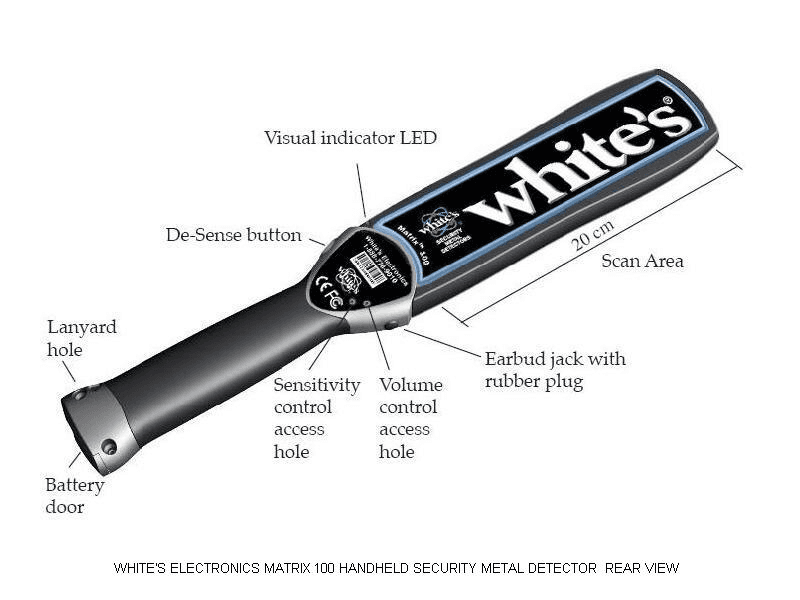
KHS900-0001
Feb 18, 2007Matrix 100
Equipment Class
DCD - Part 15 Low Power Transmitter Below 1705 kHzKHS624-0300
Feb 17, 1993Metal Detector
Equipment Class
DCD - Part 15 Low Power Transmitter Below 1705 kHz