LTQVTREM2Radio and Entertainment Module
Aptiv Services Deutschland GmbH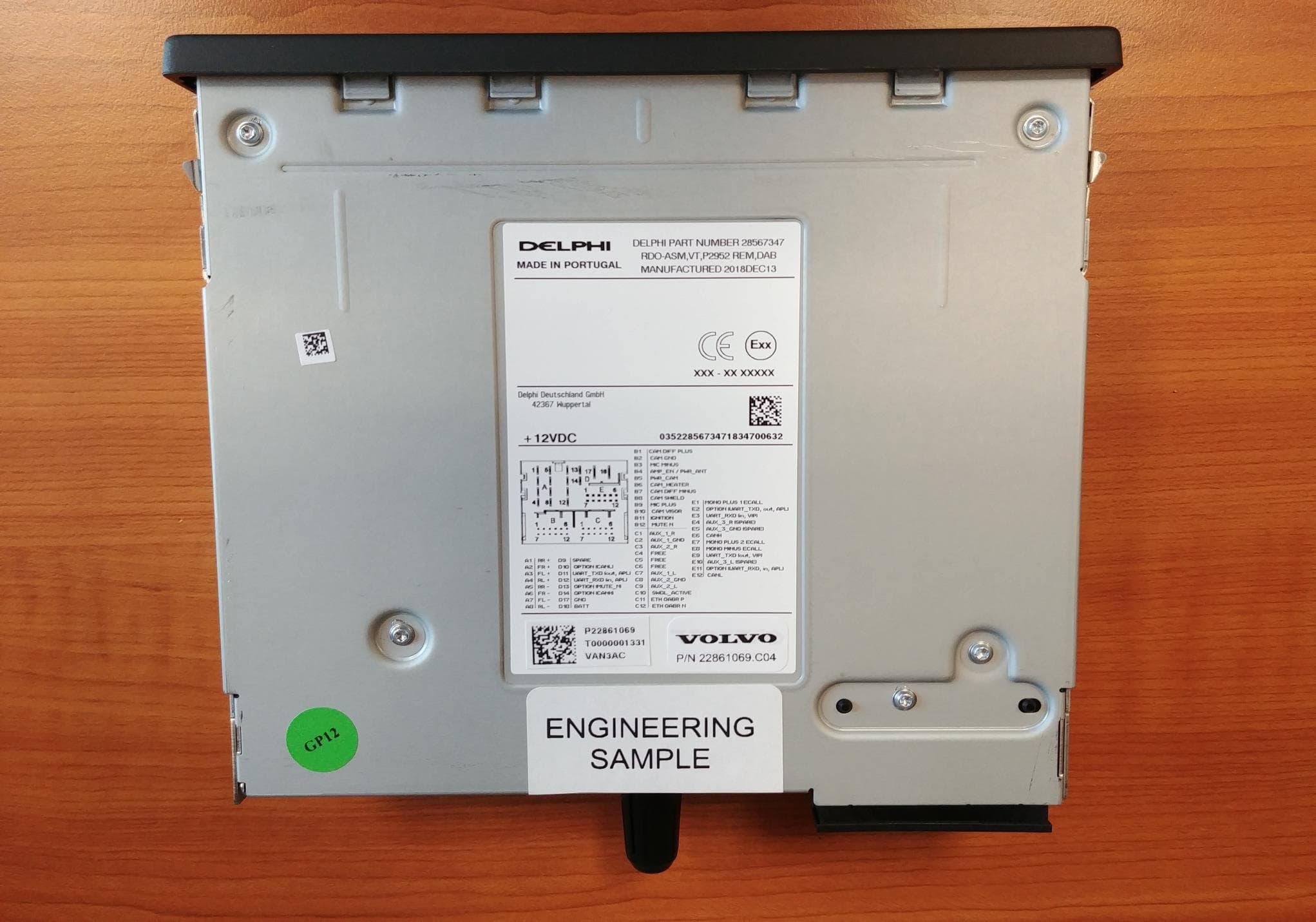
Click to zoom
Application Details
- Equipment Class
- DSS - Part 15 Spread Spectrum Transmitter
- Date of Grant
- Feb 12, 2020
- Application Purpose
- Original Equipment
- Date of Application
- Feb 10, 2020
- Equipment Note
- Radio and Entertainment Module
- Frequency Range
- 2402.00000000 - 2480.00000000
- Country
- Germany
Documents & Files
Document Text
Text extracted from the exhibit documents filed with the FCC. Open a document above to read the original.
Users Manual
TABLE OF CONTENTS 01 Infotainment Overview............................................. 2 PHONE............................................... 5 MEDIA................................................. 9 Specifications.................................... 14 Assembly date filter: w2037 (2020-09-07). Variant filter on: TYPE-FH,STWPOS-L,CRUISEC,HWSS-ACB,AUDIO,CO-USB,COD-BRA,COD-NS. Project filter: No Filter. 01 Infotainment Overview Overview of the infotainment system The infotainment system includes for example the truck's audio system and Bluetooth ® connectivity. 1 Display 2 USB port 3 Control panel 4 Steering wheel keypads 5 Microphone In the display you can see all the available menus and functions of the infotainment system. You can control the infotainment system with the steering wheel keypads or the control panel. There is one USB port in the instrument panel, for you to connect and charge a device. WARNING Do not use the infotainment system in such a way that it interferes with safe and attentive operation of the truck. When driving, keep your attention to the road. Infotainment tasks that require your attention should be done when the truck is stationary. Examples of such tasks are managing connected devices or adjusting the audio settings. 01 I nfotainment 2 Assembly date fi lter: w2037 (2020-09-07). Variant filter on: TYPE-FH,STWPOS-L,CRUISEC,HWSS-ACB,AUDIO,CO-USB,COD-BRA,COD-NS. Project filter: No Filter. X REM_draft_2019-06-10 Overview Controlling the infotainment system You can use the following controls to control the functions in the infotainment system: •The steering wheel keypads •The control panel Some functions can be controlled only by the steering wheel keypad. Steering wheel keypads 1Left. Navigate left in the display. 2Up. Navigate up in the display. 3Right. Navigate right in the display. 4Down. Navigate down in the display. 5OK. Select a highlighted item. 6Home. Return to the display's home screen. 7Menu. Open the main menu. 8Push to talk. Activate voice control. 9Accept. Open the app PHONE or answer an incoming call. 10End/reject. End a call or reject an incoming call. 11Back. Return to the previously viewed screen. 12Media. Open the app MEDIA. NOTE If there is no save option on the screen, any changes that have been done are automatically saved when you select Back. If there is a save option, and if you do not select Save before you select Back, any changes are disregarded. 1Mute. 2Reduce volume. 3Increase volume. 01 Infotainment 3 Assembly date filter: w2037 (2020-09-07). Variant filter on: TYPE-FH,STWPOS-L,CRUISEC,HWSS-ACB,AUDIO,CO-USB,COD-BRA,COD-NS. Project filter: No Filter. X REM_draft_2019-06-10 Overview Control panel 1Volume. Turn to adjust the volume. 2On/off. When in function mode Living, press On/off to start the infotainment system and long-press to turn it off. When listening to radio or media files, press On/off to mute or unmute. 3Media. Open the app MEDIA. 4Phone. Open the app PHONE. 5Vehicle. Open the app VEHICLE. 6Camera. Open the app CAMERA. 7Preset 1 to 4. When you listen to FM radio, press and hold one of the keys 1 to 4 to store the current station as a preset station. 8Previous. Switch to the previous radio station or skip to the previous media file. 9Next. Switch to the next radio station or skip to the next media file. 01 Infotainment 4 Assembly date filter: w2037 (2020-09-07). Variant filter on: TYPE-FH,STWPOS-L,CRUISEC,HWSS-ACB,AUDIO,CO-USB,COD-BRA,COD-NS. Project filter: No Filter. X REM_draft_2019-06-10 PHONE 01 Infotainment 5 Assembly date filter: w2037 (2020-09-07). Variant filter on: TYPE-FH,STWPOS-L,CRUISEC,HWSS-ACB,AUDIO,CO-USB,COD-BRA,COD-NS. Project filter: No Filter. X REM_draft_2019-06-10 PHONE A short introduction to Phone When a mobile phone or other device with a SIM card is connected to the truck by Bluetooth ® , the infotainment system in the truck works as a handsfree for the connected device. The audio is routed via the truck's loudspeakers and a microphone is fitted in the panel above the windscreen on the driver's side. Opening Phone To open the app PHONE, do any of the following: •Press the Accept key in the steering wheel keypad. •Press the Phone key in the control panel. Connecting your mobile phone PHONE works only when a device with a SIM card is connected to the truck by Bluetooth ® . If you open PHONE with no device connected, you must first connect a device. You can have up to two devices connected, but only one at a time can be used for phone. 1Make sure that the device you want to connect has Bluetooth ® on and that it is discoverable. 2Select Yes. The truck searches for available Bluetooth ® devices. 3Select the device from the list of available Bluetooth ® devices. 4Check that the number in the display and the number shown on the device matches. If they do, accept the paring on the device. If the infotainment system has paired devices saved, you can connect a device in two ways. You can either search for available Bluetooth ® devices or you can connect a previously paired device from the device history. Press the Down key to open the Options menu and select Search for Devices or Paired Devices. If you select Search for Devices, do as follows to connect a device: 1Make sure that the device you want to connect has Bluetooth ® on and that it is discoverable. 2Select the device from the list of available Bluetooth ® devices. 3Check that the number in the display and the number shown on the device matches. If they do, accept the paring on the device. If you select Paired Devices, do as follows to connect a device: 1Make sure that the device you want to connect has Bluetooth ® on. 2Select the device from the list of paired Bluetooth ® devices. 3Select Connect. The first device you connect will automatically be used for both phone and media. If you want to connect a second device, select Search for Devices or Paired Devices again. When you connect the second device, you choose if the second device should be used …
Text truncated - open the document above for the full version.
Cover Letter(s)
FCC, Request for non-disclosureDate:21-Nov-2018 RF_501, Issue8Page 1 of 1 Company Name:Aptiv Services Deutschland GmbH Address:Am Technologiepark 1 City:42119 Wuppertal Country:Germany To:Telefication B.V.,Dept. FCC TCB Edisonstraat 12A 6902 PK ZEVENAAR The Netherlands Subject:Request for confidentiality FCC ID:LTQVTREM2 Reference number:###### Dear FCC TCB, 1. Long-Term Confidentiality Pursuantto 47 CFR Section 0.459(a) & (b), we hereby requests non-disclosure and confidential treatment of the following materials submitted in support of FCC certificationapplication: Bill(s) of MaterialBlock Diagrams Operational DescriptionSchematic DiagramsTune-up Procedure Above materials contain secrets, proprietary and technical information, which would customarily be guarded from competitors under 47 CFR, section 0.457(d)(2). Disclosure or publication or any portion of this company confidential material to other parties could cause substantial competitiveharm and provide unjustified benefits for competitors. 2. Short-Term Confidentiality (STC) Pursuant toPublic Notice DA 04-1705 of the Commission’s policy, in order to comply with the marketing regulations in 47 CFR §2.803 and the importation rulesin 47 CFR §2.1204, applicanthereby requests Short-Term Confidential treatment of the following materials (Seenotesbelow): Internal PhotosUser’s ManualTest Set-up PhotosExternal Photos Justification:Above materials contain secrets, proprietary and technical information. Disclosure or publication or any portion of this company confidential material to otherparties could cause substantial competitive harm and provide unjustified benefits for competitors Date:29/11/2019Name and signature of applicant:Melanie Anastassiou Notes: 1) A document or type of document can only have ONE type of confidentiality! 2) Short-Term confidentiality is in principle for 45 days from date of grant; it can be extended max 3 times (total time 180 days max.)! Theplanneddate shouldstated in the RF731 application form. 3) FCC must be informed when marketing begins earlier. 4) Release takes place automatically thus extension must be requested in time. Telefication does not remind you of this! 5) Request for extension or for release must be received by Telefication at least 7 days before date of actual marketing or before expiration ofthe STC period
ID Label/Location Info
Document Name: VGTT P2952 Radio BT Technical Description Approved by:File: VGTT P2952 Radio BT Technical Description Issued by:Date:23 December 2019Page: 6/27 PlannedLabel drawing: Document Name: VGTT P2952 Radio BT Technical Description Approved by:File: VGTT P2952 Radio BT Technical Description Issued by:Date:23 December 2019Page: 7/27 Document Name: VGTT P2952 Radio BT Technical Description Approved by:File: VGTT P2952 Radio BT Technical Description Issued by:Date:23 December 2019Page: 8/27 NumberInformationCountryNumberInformationCountry 1 Certification South Africa27 Certification Israel 2Paraguay28EAC 3Pakistan29Japan 4Taiwan (Radio) 30Vietnam 5Moldova31Russia 6Taiwan32Malaysia 7Customer Bar Code-33Serbia 8Customer Traceability Number -34Philippines 9Customer Logo-35Ukraine 10ASMCustomer PN-36Australia 11HW Customer PN-37USB- Document Name: VGTT P2952 Radio BT Technical Description Approved by:File: VGTT P2952 Radio BT Technical Description Issued by:Date:23 December 2019Page: 9/27 12SW Customer PN-38Bluetooth- 13Model Name-39Removed- 14 Certification EU40Removed- 15USA41Removed- 16China42Removed- 17Brazil43Removed- 18Jordan44Removed- 19Argentina45Removed- 20UAE46Operating Current- 21Oman47Aptiv Identification - 22India48Traceability Code- 23Indonesia49Aptiv 2D Code- Document Name: VGTT P2952 Radio BT Technical Description Approved by:File: VGTT P2952 Radio BT Technical Description Issued by:Date:23 December 2019Page: 10/27 24 Certification Morocco50Aptiv Address- 25Singapore51 Certification Hong Kong 26South Korea52Belarus Label Location on Device:
RF Exposure Info
RF Exposure evaluation FCC ID: LTQVTREM2 IC: 3659A-VTREM2 RF Exposure Evaluation Standards OET Bulletin 65 Edition 97-01 August 1997 FCC 47 CFR §1.1307 FCC 47 CFR §1.1310 Test limits As specified in Table 1B of 47 CFR 1.1310 – Limits for Maximum Permissible Exposure (MPE), Limits for General Population/Uncontrolled Exposure. Frequency range (MHz) Power density (mW/cm²) 300 – 1,500 f/1500 1,500 – 100,000 1.0 Equation OET bulletin 65, page 18, edition 97-01: Where: S = power density P = power input to the antenna G = power gain of the antenna in the direction of interest relative to an isotropic radiator R = distance to the center of radiation of the antenna Following antenna gain values were considered as far as they apply: Band Mode Duty Cycle Frequency (MHZ) Maximum Conducted output power (dBm) Equivalent conducted output power (mW) FCC MPE Limit (mW/cm²) MPE Value using Max gain -0.6 dBi Separation distance (cm) Verdict Bluetooth GFSK 1- DH1 100.0% 2480.0 9.4 0.870963 1000 0.0015 20 PASS Yours sincerely, Imad Hjije
Test Report
Test Laboratory: 7layers GmbH Borsigstrasse 11 40880 Ratingen Germany Note: The following test results relate only to the devices specified in this document. This report shall not be reproduced in parts without the written approval of the test laboratory. 7layers GmbH Geschäftsführer/ Borsigstraße 11 Managing Directors: Registergericht/registered: a Bureau Veritas 40880 Ratingen, Germany Frank Spiller Düsseldorf HRB 75554 Group Company T +49 (0) 2102 749 0 Bernhard Retka USt-Id.-Nr./VAT-No. DE203159652 F +49 (0) 2102 749 350 Alexandre Norré-Oudard Steuer-Nr./TAX-No. 147/5869/0385 www.7layers.com Commerzbank AG Account No. 303 016 000 Bank Code 300 400 00 IBAN DE81 3004 0000 0303 0160 00 Swift Code COBADEFF FCC Measurement/Technical Report on Truck Infotainment Unit Radio and Entertainment Module FCC ID: LTQVTREM2 IC: 3659A-VTREM2 Test Report Reference: MDE_APTIV_1811_FCC01 TEST REPORT REFERENCE: MDE_APTIV_1811_FCC01 Page 2 of 52 Table of Contents 1 Applied Standards and Test Summary 4 1.1 Applied Standards 4 1.2 FCC-IC Correlation Table 5 1.3 Measurement Summary / Signatures 6 2 Revision History 10 3 Administrative Data 11 3.1 Testing Laboratory 11 3.2 Project Data 11 3.3 Applicant Data 11 3.4 Manufacturer Data 11 4 Test object Data 12 4.1 General EUT Description 12 4.2 EUT Main components 12 4.3 Ancillary Equipment 13 4.4 Auxiliary Equipment 13 4.5 EUT Setups 13 4.6 Operating Modes 14 4.7 Product labelling 14 5 Test Results 15 5.1 Occupied Bandwidth (20 dB) 15 5.2 occupied bandwidth (99%) 18 5.3 Peak Power Output 20 5.4 Spurious RF Conducted Emissions 22 5.5 Transmitter Spurious Radiated Emissions 24 5.6 Band Edge Compliance Conducted 30 5.7 Band Edge Compliance Radiated 32 5.8 Channel Separation 34 5.9 Dwell Time 36 5.10 Number of Hopping Frequencies 38 6 Test Equipment 40 7 Antenna Factors, Cable Loss and Sample Calculations 44 7.1 LISN R&S ESH3-Z5 (150 kHz – 30 MHz) 44 7.2 Antenna R&S HFH2-Z2 (9 kHz – 30 MHz) 45 7.3 Antenna R&S HL562 (30 MHz – 1 GHz) 46 7.4 Antenna R&S HF907 (1 GHz – 18 GHz) 47 7.5 Antenna EMCO 3160-09 (18 GHz – 26.5 GHz) 48 7.6 Antenna EMCO 3160-10 (26.5 GHz – 40 GHz) 49 TEST REPORT REFERENCE: MDE_APTIV_1811_FCC01 Page 3 of 52 8 Setup Drawings 50 9 Measurement Uncertainties 51 10 Photo Report 52 TEST REPORT REFERENCE: MDE_APTIV_1811_FCC01 Page 4 of 52 1 APPLIED STANDARDS AND TEST SUMMARY 1.1 APPLIED STANDARDS Type of Authorization Certification for an Intentional Radiator. Applicable FCC Rules Prepared in accordance with the requirements of FCC Rules and Regulations as listed in 47 CFR Ch.1 Parts 2 and 15 (10-1-18 Edition). The following subparts are applicable to the results in this test report. Part 2, Subpart J - Equipment Authorization Procedures, Certification Part 15, Subpart C – Intentional Radiators § 15.201 Equipment authorization requirement § 15.207 Conducted limits § 15.209 Radiated emission limits; general requirements § 15.247 Operation within the bands 902-928 MHz, 2400-2483.5 MHz Note: The tests were selected and performed with reference to the FCC Public Notice “Guidance for Compliance Measurements on Digital Transmission System, Frequency Hopping Spread Spectrum System, and Hybrid System Devices Operating under Section 15.247 of the FCC Rules, 558074 D01 15.247 Meas Guidance v05r02, 2019-04-02”. ANSI C63.10–2013 is applied. TEST REPORT REFERENCE: MDE_APTIV_1811_FCC01 Page 5 of 52 Summary Test Results: The EUT complied with all performed tests as listed in chapter 1.3 Measurement Summary / Signatures. 1.2 FCC-IC CORRELATION TABLE Correlation of measurement requirements for FHSS (e.g. Bluetooth ® ) equipment from FCC and IC FHSS equipment Measurement FCC reference IC reference Conducted emissions on AC Mains § 15.207 RSS-Gen Issue 5: 8.8 Occupied bandwidth § 15.247 (a) (1) RSS-247 Issue 2: 5.1 (b) Peak conducted output power § 15.247 (b) (1), (4) RSS-247 Issue 2: 5.4 (b) Transmitter spurious RF conducted emissions § 15.247 (d) RSS-Gen Issue 5: 6.13/8.9/8.10; RSS-247 Issue 2: 5.5 Transmitter spurious radiated emissions § 15.247 (d); § 15.209 (a) RSS-Gen Issue 5: 6.13 / 8.9/8.10; RSS-247 Issue 2: 5.5 Band edge compliance § 15.247 (d) RSS-247 Issue 2: 5.5 Dwell time § 15.247 (a) (1) (iii) RSS-247 Issue 2: 5.1 (d) Channel separation § 15.247 (a) (1) RSS-247 Issue 2: 5.1 (b) No. of hopping frequencies § 15.247 (a) (1) (iii) RSS-247 Issue 2: 5.1 (d) Hybrid systems (only) § 15.247 (f); § 15.247 (e) RSS-247 Issue 2: 5.3 Antenna requirement § 15.203 / 15.204 RSS-Gen Issue 5: 8.3 Receiver spurious emissions – - TEST REPORT REFERENCE: MDE_APTIV_1811_FCC01 Page 6 of 52 1.3 MEASUREMENT SUMMARY / SIGNATURES 47 CFR CHAPTER I FCC PART 15 Subpart C §15.247 § 15.247 (a) (1) Occupied Bandwidth (20 dB) The measurement was performed according to ANSI C63.10 Final Result OP-Mode Radio Technology, Operating Frequency Setup Date FCC IC Bluetooth BDR, high S01_AB01 2019-05-07 Passed Passed Bluetooth BDR, low S01_AB01 2019-05-07 Passed Passed Bluetooth BDR, mid S01_AB01 2019-05-07 Passed Passed Bluetooth EDR 2, high S01_AB01 2019-05-07 Passed Passed Bluetooth EDR 2, low S01_AB01 2019-05-07 Passed Passed Bluetooth EDR 2, mid S01_AB01 2019-05-07 Passed Passed Bluetooth EDR 3, high S01_AB01 2019-05-07 Passed Passed Bluetooth EDR 3, low S01_AB01 2019-05-07 Passed Passed Bluetooth EDR 3, mid S01_AB01 2019-05-07 Passed Passed 47 CFR CHAPTER I FCC PART 15 Subpart C §15.247 - Occupied Bandwidth (99%) The measurement was performed according to ANSI C63.10 Final Result OP-Mode Radio Technology, Operating Frequency Setup Date FCC IC Bluetooth BDR, high S01_AB01 2019-05-07 N/A Passed Bluetooth BDR, low S01_AB01 2019-05-07 N/A Passed Bluetooth BDR, mid S01_AB01 2019-05-07 N/A Passed Bluetooth EDR 2, high S01_AB01 2019-05-07 N/A Passed Bluetooth EDR 2, low S01_AB01 2019-05-07 N/A Passed Bluetooth EDR 2, mid S01_AB01 2019-05-07 N/A Passed Bluetooth EDR 3, high S01_AB01 2019-05-07 N/A Passed Bluetooth EDR 3, low S01_AB01 2019-05-07 N/A Passed Bluetooth EDR 3, mid S01_AB01 2019-05-07 N/A Pass…
Text truncated - open the document above for the full version.
Test Setup Photos
Test Laboratory: 7layers GmbH Borsigstrasse 11 40880 Ratingen Germany Note: The following test results relate only to the devices specified in this document. This report shall not be reproduced in parts without the written approval of the test laboratory. 7layers GmbH Geschäftsführer/ Borsigstraße 11 Managing Directors: Registergericht/registered: a Bureau Veritas 40880 Ratingen, Germany Frank Spiller Düsseldorf HRB 75554 Group Company T +49 (0) 2102 749 0 Bernhard Retka USt-Id.-Nr./VAT-No. DE203159652 F +49 (0) 2102 749 350 Alexandre Norré-Oudard Steuer-Nr./TAX-No. 147/5869/0385 www.7layers.com Commerzbank AG Account No. 303 016 000 Bank Code 300 400 00 IBAN DE81 3004 0000 0303 0160 00 Swift Code COBADEFF Photo Report on Test Setups FCC Measurement/Technical Report on Instrument Cluster Test Report Reference: MDE_APTIV_1811_FCC_Photo_Report Test report Reference: MDE_APTIV_1811_FCC_Photo_Report Page 2 of 3 Photo 1: Test setup for radiated measurements (9 kHz - 30 MHz) Photo 2: Test setup for radiated measurements (30 MHz – 1 GHz) Test report Reference: MDE_APTIV_1811_FCC_Photo_Report Page 3 of 3 Photo 3: Test setup for radiated measurements above 1 GHz
Test Setup Photos
Document Name: VGTT P2952 Radio BT Technical Description Approved by:File: VGTT P2952 Radio BT Technical Description Issued by:Date:23 December 2019Page: 1/27 Name and address ofresponsible development side: Aptiv Services Deutschland GmbH 42367 Wuppertal Germany Name of product:Radio and Entertainment Module Type designations/ Versions P2952REM Customer:VGTTCustomer’s Project: Volvo Trucks P2952 REM Document revision history: #DateNameDescription of the changes 12018 06 18Rev1.0.Initial release 2 2018 10 23 Rev2.0. Draft 3 2018 10 25 Rev 3.0 Release 4. 2019.05.24 Rev 3.0 Review 5. 2019.12.17 Rev 4.0Review Document Name: VGTT P2952 Radio BT Technical Description Approved by:File: VGTT P2952 Radio BT Technical Description Issued by:Date:23 December 2019Page: 2/27 Content: 1.Mission.................................................................................................................................3 2.General Product Specification..............................................................................................3 3.Feature Content...................................................................................................................3 4.Product photo.......................................................................................................................4 5.BT........................................................................................................................................7 6.Media /USB........................................................................................................................13 7.FM Tuner............................................................................................................................14 8.AM Tuner...........................................................................................................................15 9.DAB Tuner.........................................................................................................................15 10.Amplifier..........................................................................................................................16 11.Ethernet BRR.................................................................................................................17 12.Block diagram.................................................................................................................17 13.Vehicle environment:......................................................................................................18 14.Electrical Components on Main Board............................................................................19 15.Interfaces and connectors...............................................................................................19 16.Drawings.........................................................................................................................26 Document Name: VGTT P2952 Radio BT Technical Description Approved by:File: VGTT P2952 Radio BT Technical Description Issued by:Date:23 December 2019Page: 3/27 Mission The document shall describe theproduct, its functionalities and services in context to the car. The focus is for certification reasons. It shall give basic data and parameters. In order to handle the unit in certification tests, different scenarios are described and explained how to setup the unit accordingly. In order to keep handling and actuality, all these information are kept within one single document. General Product Specification This is an automotive radio head unit equipped with AM/FM tuner,DAB tuner, USB as media source and Bluetooth with audio streaming and voice call profiles.REM is remotely control by the web-based refernce application. The interaction with the application is achieved via a desktop browser. HW/SW-Variant VariantMarketHardwareSoftware under Test REMno DAB EU/RoW CM0 REMDAB EU/RoW CM0 REM NARNAR Feature Content -AM-FM Tuner with FM back ground tuner, weak signal processing in tuner DSP of Dirana 3 -DualDAB tunerSAF3602with background scanning -DSP Dirana3 for audio inputs (AUX and Microphone) -Antenna phantom supply with diagnosis (current measurement) -Power amplifier class AB with High efficiency mode and low operating voltage -CAN interface via TJA 1043 -2 AUX’sinput with adjustable gain -Microphonemono input -USB 2.0 for media playing -BRR Ethernet interface via TJA1100 Document Name: VGTT P2952 Radio BT Technical Description Approved by:File: VGTT P2952 Radio BT Technical Description Issued by:Date:23 December 2019Page: 4/27 Product photo Document Name: VGTT P2952 Radio BT Technical Description Approved by:File: VGTT P2952 Radio BT Technical Description Issued by:Date:23 December 2019Page: 5/27 Document Name: VGTT P2952 Radio BT Technical Description Approved by:File: VGTT P2952 Radio BT Technical Description Issued by:Date:23 December 2019Page: 6/27 PlannedLabel drawing: Document Name: VGTT P2952 Radio BT Technical Description Approved by:File: VGTT P2952 Radio BT Technical Description Issued by:Date:23 December 2019Page: 7/27 Document Name: VGTT P2952 Radio BT Technical Description Approved by:File: VGTT P2952 Radio BT Technical Description Issued by:Date:23 December 2019Page: 8/27 NumberInformationCountryNumberInformationCountry 1 Certification South Africa27 Certification Israel 2Paraguay28EAC 3Pakistan29Japan 4Taiwan (Radio) 30Vietnam 5Moldova31Russia 6Taiwan32Malaysia 7Customer Bar Code-33Serbia 8Customer Traceability Number -34Philippines 9Customer Logo-35Ukraine 10ASMCustomer PN-36Australia 11HW Customer PN-37USB- Document Name: VGTT P2952 Radio BT Technical Description Approved by:File: VGTT P2952 Radio BT Technical Description Issued by:Date:23 December 2019Page: 9/27 12SW Customer PN-38Bluetooth- 13Model Name-39Removed- 14 Certification EU40Removed- 15USA41Removed- 16China42Removed- 17Brazil43Removed- 18Jordan44Removed- 19Argentina45Removed- 20UAE46Operating Current- 21Oman47Aptiv Identification - 22India48Traceability Code- 2…
Text truncated - open the document above for the full version.
Contact Information
Applicant
Ljiljana Trivic(Certification Responsible)
Technical Contact
Aptiv Services Deutschland GmbHLjiljana Trivic
[email protected]0049 2261 971
Am Technologiepark 1 · Wuppertal · Germany
Non-Technical Contact
Aptiv Services Deutschland GmbHLjiljana Trivic
[email protected]0049 2261 971
Test Firm
7layers GmbHBernhard Retka
Technical Specifications
| # | Rule Parts | Frequency Range | Power Output |
|---|---|---|---|
| 1 | 15C | 2.40 GHz - 2.48 GHz | 8.71 mW |
Other Applications from Aptiv Services Deutschland GmbH
LTQSRR6PH
Mar 09, 2026SRR6+
Equipment Class
VRD - Part 95 Vehicular Radar SystemsLTQSRR6PT
Jan 14, 2026Radar Sensor
Equipment Class
VRD - Part 95 Vehicular Radar SystemsLTQIHU42
Sep 05, 2024Infotainment Head Unit
Equipment Class
CXX - Communications Rcvr for use w/ licensed Tx and CBsLTQFLR7B
Jan 28, 2024Radar Sensor
Equipment Class
VRD - Part 95 Vehicular Radar Systems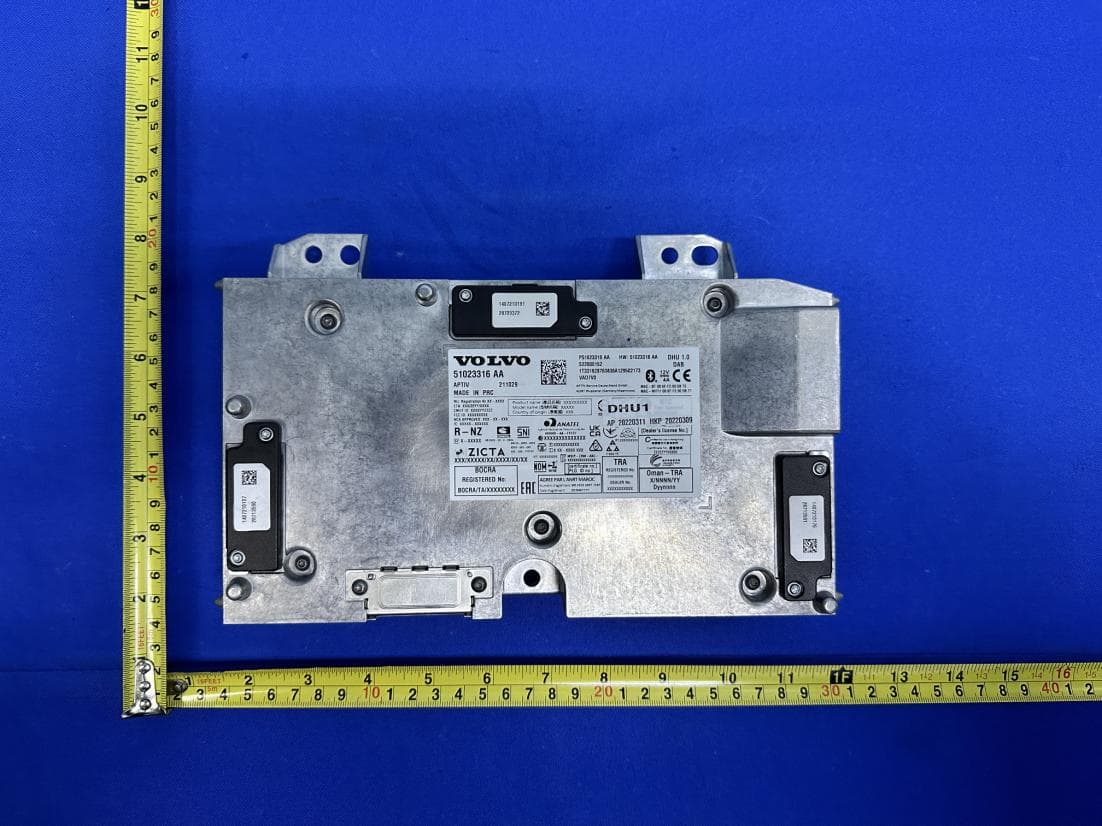
LTQDHU1
May 05, 2023Display Head Unit
Equipment Class
DTS - Digital Transmission System