LU9513049Mini Lalaloopsy RC Car (49MHz)
MGA Entertainment (HK) Ltd.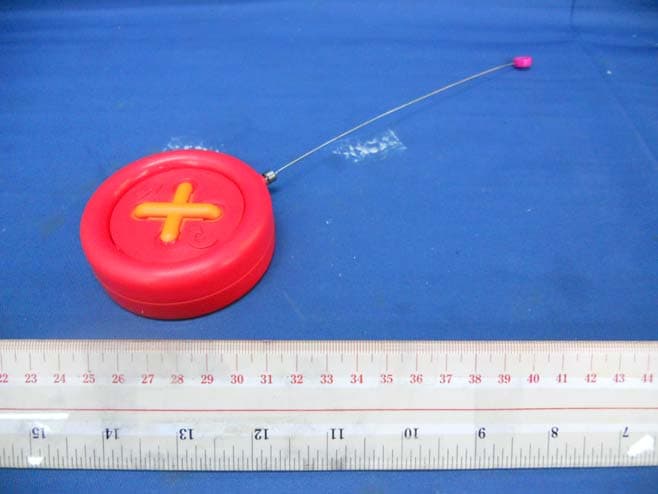
Click to zoom
Application Details
- Equipment Class
- DXX - Part 15 Low Power Communication Device Transmitter
- Date of Grant
- Aug 23, 2011
- Application Purpose
- Original Equipment
- Date of Application
- Aug 23, 2011
- Equipment Note
- Mini Lalaloopsy RC Car (49MHz)
- Frequency Range
- 49.86000000 - 49.86000000
- Company
- MGA Entertainment (HK) Ltd.
- Country
- Hong Kong
Documents & Files
Document Text
Text extracted from the exhibit documents filed with the FCC. Open a document above to read the original.
Users Manual
14 Start your engines! Because now your Mini’s can cruize to the silly, wonderful world of Lalaloopsy™ in their very own Cruiser! a) 1 Mini Lalaloopsy™ RC Cruiser b) 1 Remote Control c) 1 Mini Lalaloopsy™ Charlotte Charades™ Doll INTRODUCTION CONTENTS ‘Let’s care for the environment!’ The wheelie bin symbol indicates that the product must not be disposed of with other household waste. Please use designated collection points or recycling facilities when disposing of the item. Do not treat old batteries as household waste. Take them to a designated recycling facility. Age 4+ years Adult Battery Installation Required Item No. 513032 – 27 MHz Item No. 513049 – 49 MHz Please keep this manual as it contains important information. 0811-0-E Illustrations are for reference only. Styles may vary from actual contents. www.lalaloopsy.com © MGA Entertainment, Inc. LALALOOPSY™, MINI LALALOOPSY™ and LALALOOPSY LITTLES™ are trademarks of MGA in the U.S. and other countries. All logos, names, characters, likenesses, images, slogans, and packaging appearance are the property of MGA. 16300 Roscoe Blvd. Van Nuys, CA 91406 U.S.A. (800) 222-4685 Printed in China TROUBLESHOOTING: IF THERE IS NO FUNCTION BETWEEN THE REMOTE CONTROL AND THE CRUISER: • Make sure the Remote Control and the Cruiser switches are in the “ON” position. • Make sure the batteries are inserted properly. • Replace the old batteries with new alkaline batteries. • Move the Remote Control closer to the Cruiser to determine the best communication between the two. • Use alkaline batteries for best performance and longer life. • Use only the type battery recommended for the unit. • Batteries should be replaced only by an adult. • Insert batteries with the correct polarity ( + and – ). • Do not mix old and new batteries. • Do not mix alkaline, standard (carbon-zinc), or rechargeable(nickel-cadmium) batteries. • Do not short-circuit batteries. • When not used for an extended time, remove batteries to prevent possible leakage and damage to the unit. • Do not mix rechargeable and non-rechargeable batteries. • Rechargeable batteries are to be removed from the toy before charging. • Rechargeable batteries are to be recharged only under adult supervision. • Do not recharge non-rechargeable batteries. • Exhausted batteries are to be removed from the toy. • Do not dispose of batteries in fire as they may leak or explode. SAFE BATTERY USAGE FCC COMPLIANCE NOTE: This equipment has been tested and found to comply with the limits for a Class B digital device, pursuant to Part 15 of the FCC Rules. These limits are designed to provide reasonable protection against harmful interference in a residential installation. This equipment generates, uses and can radiate radio frequency energy and, if not installed and used in accordance with the instructions, may cause harmful interference to radio communications. However, there is no guarantee that interference will not occur in a particular installation. If this equipment does cause harmful interference to radio or television reception, which can be determined by turning the equipment off and on, the user is encouraged to try to correct the interference by one or more of the following measures: • Reorient or relocate the receiving antenna. • Increase the separation between the equipment and receiver. • Connect the equipment into an outlet on a circuit different from that to which the receiver is connected. • Consult the dealer or an experienced radio/TV technician for help. This device complies with Part 15 of the FCC Rules. Operation is subject to the following two conditions: (1) This device may not cause harmful interference. (2) this device must accept any interference received, including interference that may cause undesired operation. Warning : Changes or modifications to this unit not expressly approved by the party responsible for compliance could void the user’s authority to operate the equipment. TM a. b. c. 23 1. Slide the ON/OFF switch on the bottom of the Cruiser to the “ON” position. 2. Slide the ON/OFF switch on the back of the Remote Control to the “ON” position. 3. Place the Cruiser on a flat, level surface. 4. Straighten the Antenna. 5. Use the Remote Control to drive your Cruiser by doing the following: a. Press down on the left side of the Remote Control to go forward. (Fig. 5) b. Press down the right side of the Remote Control to back up and turn to the left. (Fig. 6) • When driving two RC Cruiser, they must be of different radio frequencies (e.g. one Cruiser 49MHz and one Cruiser 27MHz) or they may not perform as designed. • When Cruiser is not being played with, turn the ON/OFF switches on both the Cruiser and Remote “OFF” to save battery power. • Your Cruiser is controlled by radio frequency. It may interfere with nearby devices such as cordless phones, hair dryers, radios, walkie-talkies, or other radio controlled devices. If this occurs, move the Cruiser to a location away from the interference. • The Cruiser must remain in remote control range to operate correctly. The range depends on the surrounding area and on the strength of the battery. Obstructions such as buildings, fences, etc., between the remote control transmitter and the Cruiser, reduce the range. • If the Cruiser runs slowly, replace the batteries. • KEEP AWAY FROM WATER! Do not run your Cruiser through puddles, or expose it to liquid of any kind as moisture may damage the unit. • DO NOT sit or stand on any part of the Cruiser. • DO NOT lift and/or drop the Cruiser as doing so may cause bodily injury to the user and irreparable damage to the Cruiser. • Play with the Cruiser on the floor or ground only. • DO NOT operate this Cruiser during thunderstorms. • Keep hair, fingers, loose clothing and other items away from rotating wheels of the unit. Before going for a drive, make sure that your dolls are in place and buckled up: 1. Lift the elastic band. (Fig. 3) 2. Secure your doll in the seat under the elastic band. (Fig. 4) Ready …
Text truncated - open the document above for the full version.
Block Diagram
Tra n s m i tt er B l oc k D i ag ram Assortment Number: 510291 Product Description: Mini Lalaloopsy RC Car Item number: 513049 Antenna Matching Network (C1, C2, T1) RF IC W55RFS27T1B Encoder, mixer and amplifier (U1) Controller Keys (Key 1, Key 2) Oscillator 49.860MHz (Y1) 49.860MHz ANT
External Photos
INTERTEK TESTING SERVICE Report No.: HK11071418-1 FCC ID: LU9513049 Equipment Photographs Model : 513049 (External)
ID Label/Location Info
FCC ID: LU9513049 Model: 513049 Labeling Artwork 2.5 mm 5.0 mm mm mm mm 11.4 mm
Internal Photos
INTERTEK TESTING SERVICE Report No.: HK11071418-1 FCC ID: LU9513049 Equipment Photographs Model: 513049 (Internal) INTERTEK TESTING SERVICE Report No.: HK11071418-1 FCC ID: LU9513049 Equipment Photographs Model: 513049 (Internal)
Operational Description
FCC ID: LU9513049 Model: 513049 (Transmitter portion) Technical Description of Transmitter The transmitter operates at 49.860 MHz, and controls a receiver to move forward and backward-right. The circuit of the transmitter comprises of, 1. An Encoding circuit consisting: KEY1, KEY2 2. An RF Oscillator consisting: Y1 3. An Antenna Matching Network consisting: C1, C2, T1 4. An Encoder, Mixer and Amplifier consisting: U1 (W55RFS27T1B) 5. A Power Supply consisting: two 1.5V AAA batteries The transmitter uses an external, integral and non-detachable antenna.
Schematics
12345678 A B C D 87654321 D C B A FORWARD WINSOME IND. LTD. PROJECT NO: PROJECT NAME: PROJECTION: COMPONENT NO: COMPONENT NAME: SCALE:UNIT:MAT DWG.NO: DRN.BY:DATE: CKD.BY:DATE: APVD.BY:DATE: REV:SHEET NO: mm1:1 ENG-SC REV.MODIFIED DESCRIPTIONBY: / DATEAPR. / DATE SCHEMATIC INITAL RELEASE WJ Lai 1.All resistor values are indicated in "ohm" (1K=1000ohm),unless otherwise noted. Note: 2.All capacitance values are indicated in "uF",inductance in "uH",unless otherwise noted. 510291 Mini Lalaloopsy RC Car 51029-40 51029-3140 513049 (49MHz) TX NQ Chen NQ Chen 7/18/2011 1.01 of 1 C7 4.7nF Forward KEY1 Backward KEY2 R1 20K S3 1 S4 2 CKSEL 3 TEST 4 CKSEL1 5 ANT 6 VSS 7 VSPLY 8 S2 16 S1 15 TXOUT 14 ID0 13 ID1 12 X2 11 X1 10 RESET 9 U1 W55RFS27T1B L1 2.2uH L3 0.47uH T1 0.35uH C3 10pF C2 68pF C4 30pF C1 68pF C10 27pF C9 27pF Y1 49.860MHz C15 0.1uF C14 0.1uF C5 30pF L2 0.47uH C8 22pF C16 47nF BT1 2AA*2 C18 10uF C17 0.1uF ANTENNA 7/18/2011 7/18/2011 R2 10 T P 1 C12 47nF L4 1uH VDD VDD PTC1 500mA SW1 SW-SPDT VCC CK0 CK1 Tx Data R3 20 CK0 CK1 VCC FOR 49.860MHz C13 0.1uF PDF created with FinePrint pdfFactory Pro trial version www.pdffactory.com
Test Report
INTERTEK TESTING SERVICES Report No. : HK11071418-1 Sample No. : 1/4 Bandedge Plot – Pursuant to FCC Part 15 Section 15. 235 Requirement
Test Setup Photos
INTERTEK TESTING SERVICE Report No: HK11071418-1 FCC ID: LU9513049 Configuration Photographs Worst-Case Radiated Emissions (Front View) Model: 513049 INTERTEK TESTING SERVICE Report No: HK11071418-1 FCC ID: LU9513049 Configuration Photographs Worst-Case Radiated Emissions (Rear View) Model: 513049
Contact Information
Applicant
Julian Chung(QA Director)
Technical Contact
Intertek Testing Services Hong Kong LtdTerry Chan
[email protected]2173 8503
2/F Garment Centre · Kowloon · Hong Kong
Non-Technical Contact
Intertek Testing Services Hong Kong LtdTerry Chan
[email protected]2173 8503
Test Firm
Intertek Testing Services Hong Kong Ltd.Billy Chow
Technical Specifications
| # | Rule Parts | Frequency Range | Power Output |
|---|---|---|---|
| 1 | 15C | 49.86 MHz - 49.86 MHz | - |
Other Applications from MGA Entertainment (HK) Ltd.
LU9657719TX
Feb 24, 2022Rescue Tales Walk N Wiggle Daisy
Equipment Class
DXX - Part 15 Low Power Communication Device Transmitter
LU9657566
Jul 29, 2021Tobi 2 Interactive Karaoke Machine
Equipment Class
DSS - Part 15 Spread Spectrum Transmitter
LU9654824
Jun 06, 2021My Real Jam Drum Set
Equipment Class
DXX - Part 15 Low Power Communication Device Transmitter
LU9654794
Jun 06, 2021My Real Jam-Acoustic Guitar
Equipment Class
DXX - Part 15 Low Power Communication Device Transmitter
LU9654800
Jun 06, 2021My Real Jam-Electric Guitar
Equipment Class
DXX - Part 15 Low Power Communication Device Transmitter