NQW267-21
Lexent Technologies Inc
Click to zoom
Application Details
- Equipment Class
- DSC - Part 15 Security/Remote Control Transmitter
- Date of Grant
- Feb 15, 1999
- Application Purpose
- Original Equipment
- Date of Application
- Nov 18, 1998
- Frequency Range
- 418.00000000 - 418.00000000
- Company
- Lexent Technologies Inc
- Country
- United States
Documents & Files
Document Text
Text extracted from the exhibit documents filed with the FCC. Open a document above to read the original.
Schematics
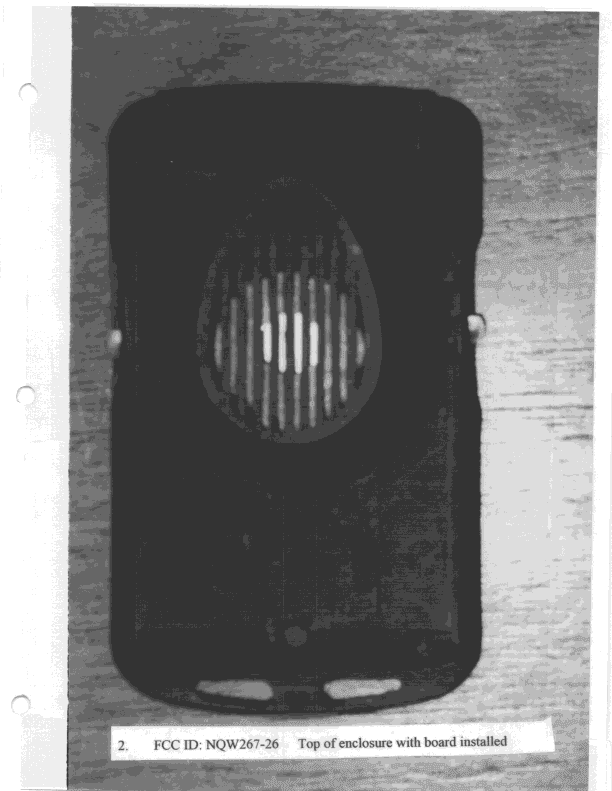
Lexent Technologies, Inc.07/05/01FCC # NQW267-21 UPDATE ATTACHMENT PSEUDO-PROXIMITY FUNCTION Re: FCC ID NQW267-21 Applicant: Lexent Technologies Inc Correspondence Reference Number: 6092 731 Confirmation Number: EA92741 Date of Original E-Mail: 02/12/1999 COMPANY PRODUCT NAME Lexent Technologies, Inc iSpy Detector Unit FCC ID: NQW267-21 FCC Part 15 Subpart 15.231 Periodic Operation in the Band 40.66-40.70 MHz and above 70MHz Compliance Lexent Technologies, Inc.07/05/01FCC # NQW267-21 Proximity Detection The iSpy system is not a real proximity detector. Instead we have developed a method whereby the alarm will not sound if the range is less than 10 or so feet. The proximity function may be turned on or off as desired by the user. This is done with the “SENSOR” switch on the iSpy Detector Unit. Here is how it works: The low strength “pseudo-proximity” signal is sent out from the iSpy Detector Unit (FCC ID: NQW267-26, pending) after motion is detected. If the iSpy Control Unit (current application) picks up the low strength signal then no action is taken. If it does not pick up the low strength signal then alarming action is taken. This is the manner in which proximity is checked. The low strength signal has been fully tested and reported with the report filed for the iSpy Detector Unit (FCC ID: NQW267-26, pending). There is no such signal emitted from the Control Unit (current application). Let me now go over the sequence of events depending on what Mode the system is operating in, i.e. Mode 1 or Mode 2. In Mode 1 upon detecting motion the iSpy Detector microprocessor commands the transmitter to send out a low-strength pseudo-proximity signal to the Control Unit. Upon receiving this low-strength signal, the Control Unit sends back a normal control signal instructing the iSpy Detector Alarm to do nothing. If the Detector Unit does not receive a normal control signal back from the Control Unit the iSpy Detector Alarm will automatically go off. In Mode 2 upon detecting motion the Detector microprocessor commands the transmitter to send out a low-strength pseudo-proximity signal to the Control Unit. Upon receiving this low-strength signal, the Control Unit sends back a normal control signal telling the iSpy Detector to do nothing. If the Detector Unit does not receive a normal control signal back from the Control Unit the iSpy Detector will send a normal control signal instructing the iSpy Control “Alert” to go off. This Alert is a very quiet chirp, as opposed to the siren on the Detector. Lexent Technologies, Inc.07/05/01FCC # NQW267-21 I have included two circuit diagrams; one for the Control and one for the Detector Unit, as requested. iSpy Control Unit Circuit Diagram Lexent Technologies, Inc.07/05/01FCC # NQW267-21 iSpy Detector Unit Circuit Diagram
Contact Information
Applicant
Michael R. D'Angelo(President)
Technical Contact
Chomerics IncPatricia Terilli
[email protected]781 935-4850
77 Dragon Court · Woburn, Massachusetts · United States
Test Firm
Chomerics Test ServicesDavid Inman
Technical Specifications
| # | Rule Parts | Frequency Range | Power Output | Tolerance |
|---|---|---|---|---|
| 1 | 15C | 418 MHz - 418 MHz | - | % |
Other Applications from Lexent Technologies Inc
NQW267-26
Feb 15, 1999DSC - Part 15 Security/Remote Control Transmitter
Equipment Class
DSC - Part 15 Security/Remote Control Transmitter