NT8-TX9Transmitter for Remote Keyless Entry System
Visteon Corporation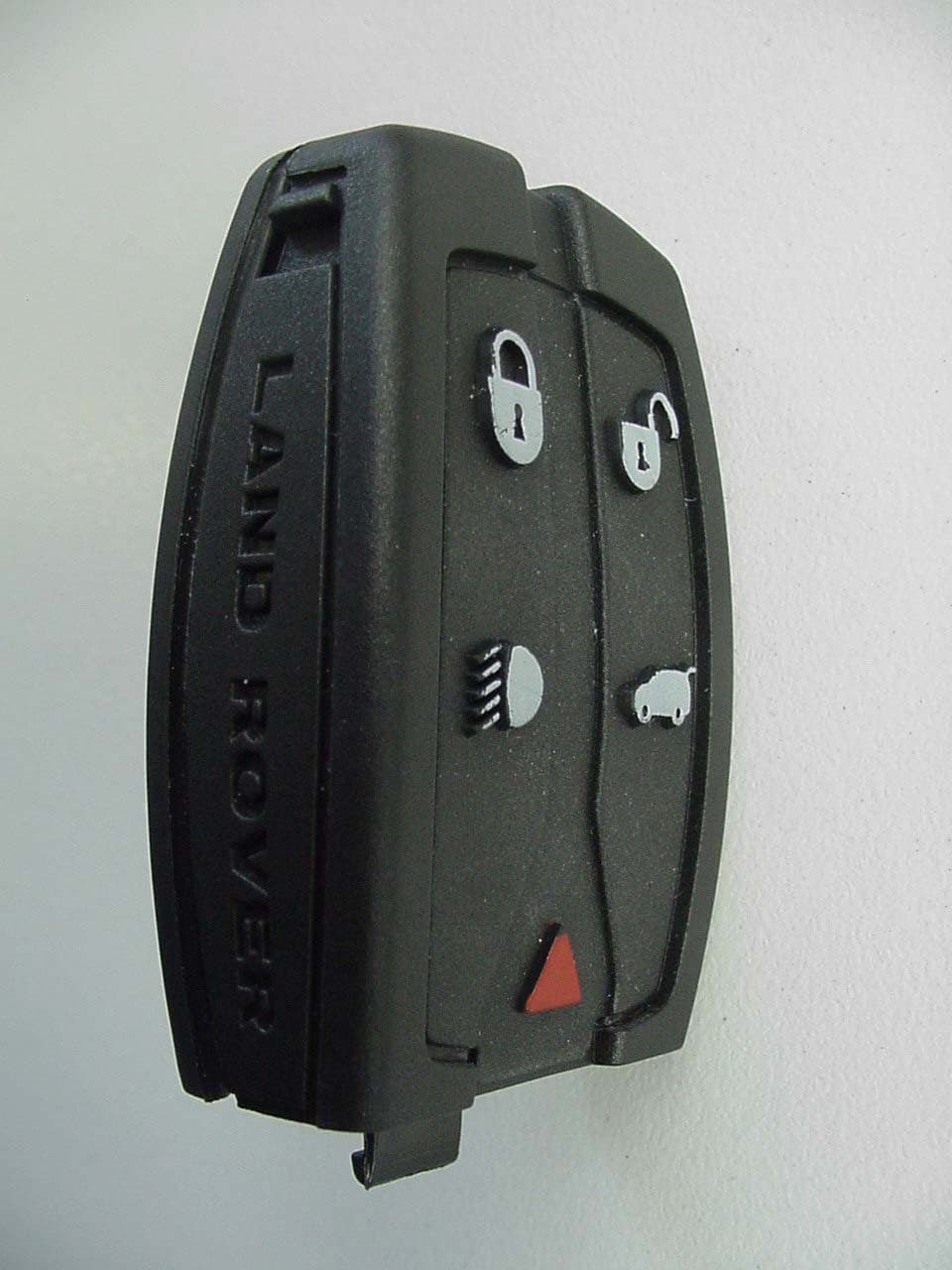
Click to zoom
Application Details
- Equipment Class
- DSC - Part 15 Security/Remote Control Transmitter
- Date of Grant
- Dec 18, 2006
- Application Purpose
- Original Equipment
- Date of Application
- Dec 18, 2006
- Equipment Note
- Transmitter for Remote Keyless Entry System
- Frequency Range
- 315.00000000 - 315.00000000
- Company
- Visteon Corporation
- Country
- United States
Documents & Files
Document Text
Text extracted from the exhibit documents filed with the FCC. Open a document above to read the original.
Users Manual
USING THE REMOTE CONTROL Remote control WARNING Never leave the remote control in the vehicle if children or animals are also left in the vehicle. The vehicle's systems and remote control functions could be operated, which may result in injury. Note:The operational range of the remote control will vary considerably depending on atmospheric conditions and interference from other transmitting devices. The vehicle is supplied with two remote controls, but up to six can be programmed to the vehicle at any one time. 1.Unlock. 2.Lock. 3.Tailgate release. 4.Approach lighting. 5.Emergency alarm. 6.Key blade release tab. 7.Key blade. FCC and Canadian warning statement This device complies with part 15 of the FCC rules. Operation is subject to the following two conditions: 1.This device may not cause harmful interference, and 2.this device must accept any interference received, including interference that may cause undesired operation. Any changes or modifications not expressly approved by the party responsible for compliance could void the user’s authority to operate the equipment. This device complies with RSS-210 of Industry Canada. Operation is subject to the following two conditions: 1.This device may not cause harmful interference, and 2.this device must accept any interference, including interference that may cause undesired operation of the device. Transmitter FCC ID: NT8-TX9 IC : 3043A-TX9 1 Using the remote control Unlocking Press briefly to unlock the vehicle, and deactivate the alarm. The hazard warning lamps will flash twice to indicate that the vehicle is unlocked and the alarm has been deactivated. The interior lamps will illuminate to assist entry to the vehicle. Single/Multi-point entry When you press the unlock button your vehicle will unlock in one of two ways: 1.Unlock the driver's door only. A second press is required to unlock the remaining doors and tailgate. 2.Unlock all doors, and the tailgate. This security feature unlocks only the driver’s door and tailgate. It can be disabled on individual remote controls by unlocking the vehicle then simultaneously pressing and holding the lock and unlock buttons for three seconds. The vehicle will lock and then unlock in the currently selected mode and the hazard warning lights will flash twice to confirm the change. You can now unlock all doors with a single press. Repeating the procedure will re-enable Single point entry. Locking Press briefly to lock the vehicle, and activate the alarm. The hazard warning lamps will flash to indicate that the vehicle is locked. Automatic relocking If a door, or the tailgate, are not opened within one minute of unlocking the vehicle, doors will lock again automatically. Approach lighting When approaching the vehicle during darkness press to switch on the approach illumination. Press again to turn the approach lamps off. The approach illumination period set at the factory is thirty seconds. This can be configured by a Land Rover Dealer to provide illumination lasting between Zero and 120 seconds. Tailgate Press briefly to release the tailgate. Emergency alarm Press and hold for three seconds, or press twice within three seconds, to activate the horn and the hazard lamps. Once active for more than five seconds the alarm can be cancelled by pressing the button and holding for three seconds, or pressing twice within three seconds. Note:The horn and hazard lamps will switch off automatically after two minutes and forty five seconds. 2 Using the remote control Remote battery The remote control batteries are recharged when the remote is docked and the engine is running. For this reason it is recommended that each remote is used periodically. This will ensure that the batteries are kept charged and ready for use. 3 Using the remote control
Test Report
7 layers AG Aufsichtsratsvorsitzenderh Registergerichth registered in: Borsigstrasse 11 Chairman of the Supervisory Board: Düsseldorf, HRB 44096 40880 Ratingen, Germany Markus Becker USt-IdNr h VAT Nr: Phone: +49 (0) 2102 749 0 Vorstandh Board: DE 203159652 Fax: +49 (0) 2102 749 350 Dr. Hans-Jürgen Meckelburg www.7Layers.com René Schildknecht InterLab ® is a registered trademark of 7 layers AG FCC Measurement/Technical Report on Transmitter for remote keyless entry Land Rover L359 Report Reference: 4_VISGE_0205_ERF_FCCc Test Laboratory: 7 layers AG Borsigstrasse 11 40880 Ratingen Germany email: [email protected] DAT-P-192/99-01 Note: The following test results relate only to the devices specified in this document. This report shall not be reproduced in parts without the written approval of the testing laboratory. Test report Reference: 4_VISGE_0205_ERF_FCCc Page 2 of 32 Table of Contents 0 Summary 3 0.1 Technical Report Summary 3 0.2 Measurement Summary 4 1 Administrative Data 5 1.1 Testing Laboratory 5 1.2 Project Data 5 1.3 Applicant Data 5 1.4 Manufacturer Data 5 2 Product labeling 6 2.1 FCC ID label 6 2.2 Location of the label on the EUT 6 3 Test object Data 7 3.1 General EUT Description 7 3.2 EUT Main components 8 3.3 Ancillary Equipment 8 3.4 EUT Setups 8 3.5 Operating Modes 8 4 Test Results 9 4.1 Spurious radiated emissions 9 4.2 Duty cycle measurement (based on dwell time measurement) 13 4.3 Peak power output 14 4.4 Occupied bandwidth 15 5 Test Equipment 16 6 Photo Report 19 7 Setup Drawings 22 8 Annex measurement plots 23 8.1 Radiated emissions (f<30MHz) 23 8.2 Duty cycle measurement (based on dwell time measurement) 25 8.3 Occupied bandwidth 31 Test report Reference: 4_VISGE_0205_ERF_FCCc Page 3 of 32 0 Summary 0.1 Technical Report Summary Type of Authorization Certification for an Intentional Radiator (Periodic operation in the band above 70 MHZ) Applicable FCC Rules Prepared in accordance with the requirements of FCC Rules and Regulations as listed in 47 CFR Ch.1 Parts 2 (10-1-05 Edition) and 15 (10-1-05 Edition). The following subparts are applicable to the results in this test report. Part 2, Subpart J - Equipment Authorization Procedures, Certification Part 15, Subpart C – Intentional Radiators § 15.201 Equipment authorization requirement § 15.207 Conducted limits § 15.209 Radiated emission limits; general requirements § 15.231 Periodic operation in the band 40.66-40.70 MHz, above 70 MHz Note: none Summary Test Results: The EUT complied with all performed tests as listed in chapter 0.2 Measurement Summary. Test report Reference: 4_VISGE_0205_ERF_FCCc Page 5 of 32 1 Administrative Data 1.1 Testing Laboratory Company Name: 7 Layers AG Address Borsigstr. 11 40880 Ratingen Germany This facility has been fully described in a report submitted to the FCC and accepted under the registration number 96716. The test facility is also accredited by the following accreditation organisation: - Deutscher Akkreditierungs Rat DAR-Registration no. DAT-P-192/99-01 Responsible for Accreditation Scope: Dipl.-Ing. Bernhard Retka Dipl.-Ing. Robert Machulec Report Template Version: 2006-08-31 1.2 Project Data Responsible for testing and report: Dipl.-Ing. Robert Machulec Date of Test(s): 2006-03-02 to 2006-09-15 Date of Report: 2006-09-21 1.3 Applicant Data Company Name: Visteon Deutschland GmbH Body & Security Electronics Core Design Address: Visteonstrasse 4-10 D-50170 Kerpen Germany Contact Person: Werner Löbach Tel.: +49-221-5406-274 1.4 Manufacturer Data Company Name: please see applicant data Address: Contact Person: Test report Reference: 4_VISGE_0205_ERF_FCCc Page 6 of 32 2 Product labeling 2.1 FCC ID label At the time of the report there was no FCC label available. 2.2 Location of the label on the EUT see above Test report Reference: 4_VISGE_0205_ERF_FCCc Page 7 of 32 3 Test object Data 3.1 General EUT Description Equipment under Test Transmitter for remote keyless entry Type Designation: Land Rover L359 Kind of Device: (optional) 315 MHz transmitter Voltage Type: DC Voltage level: 3.0 V General product description: The vehicle remote keyless entry transmitter is a wireless handheld remote control unit. (Transmitter only, periodic operation in the band above 70 MHz) the operating frequency is 315 MHz. The transmitter is activated manually by a switch and is deactivated automatically within 5 seconds after release of the switch. The EUT provides the following ports: Ports enclosure The main components of the EUT are listed and described in Chapter 3.2 Test report Reference: 4_VISGE_0205_ERF_FCCc Page 8 of 32 3.2 EUT Main components Type, S/N, Short Descriptions etc. used in this Test Report Short Description Equipment under Test Type Designation Serial No. HW Status SW Status Date of Receipt EUT A Transmitter for remote keyless entry Land Rover L359 No.7 VP6H5F- 15K601-B* - 2006-03-02 Remark: EUT A is equipped with an integral antenna. NOTE: The short description is used to simplify the identification of the EUT in this test report. 3.3 Ancillary Equipment For the purposes of this test report, ancillary equipment is defined as equipment which is used in conjunction with the EUT to provide operational and control features to the EUT. It is necessary to configure the system in a typical fashion, as a customer would normally use it. But nevertheless Ancillary Equipment can influence the test results. Short Description Equipment under Test Type Designation HW Status SW Status Serial no. FCC ID 3.4 EUT Setups This chapter describes the combination of EUTs and ancillary equipment used for testing. Setup No. Combination of EUT’s Description Setup_a01 EUT A setup for measurements 3.5 Operating Modes This chapter describes the operating modes of the EUT's used for testing. Op. Mode Description of Operating Modes Remarks op-mode 1 periodic operation Transmitter is sending a pulse coded signal op-mode 2 continuous operation Transmitter is sending a CW signal continuously. Special op mode for test purpo…
Text truncated - open the document above for the full version.
Contact Information
Applicant
Terry SanSouci(Product Assurance Test Engineer)
Technical Contact
Visteon Deutschland GmbHWerner Loebach
[email protected]+49-2273-595-2274
Visteonstrasse 4-10 · Kerpen · Germany
Test Firm
7layers AGRobert Machulec
Technical Specifications
| # | Rule Parts | Frequency Range | Power Output |
|---|---|---|---|
| 1 | 15.231 | 315 MHz - 315 MHz | - |
Other Applications from Visteon Corporation
NT8-BPCMFXE
Feb 20, 2026Battery Pack Control Module (BPCM)
Equipment Class
JAB - Part 15 Class B Digital DeviceNT8-BPCMSW
Dec 02, 2024Battery Pack Control Module (BPCM)
Equipment Class
DTS - Digital Transmission System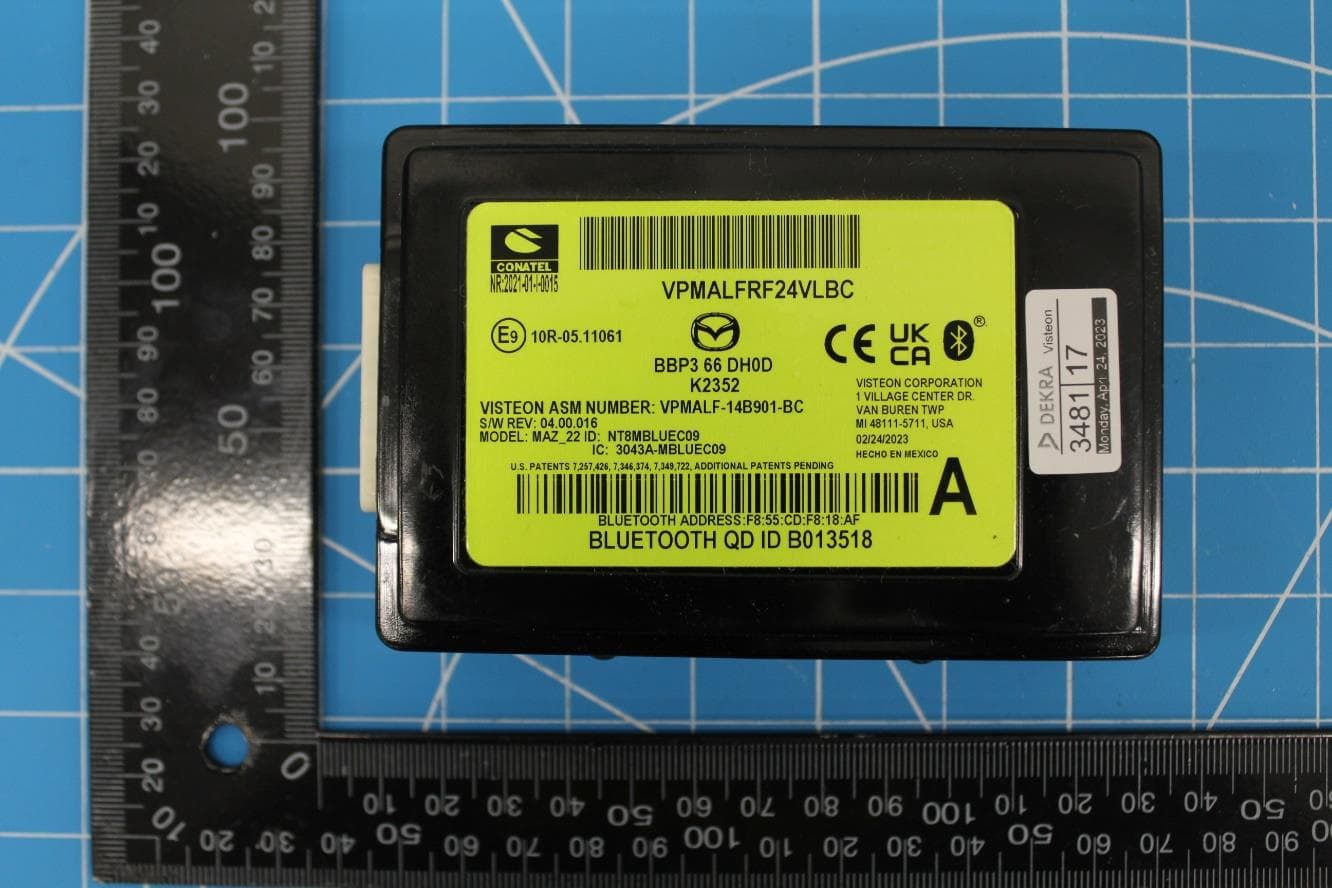
NT8-MAZ22HFT
Feb 15, 2024Bluetooth Telematics Device
Equipment Class
DSS - Part 15 Spread Spectrum Transmitter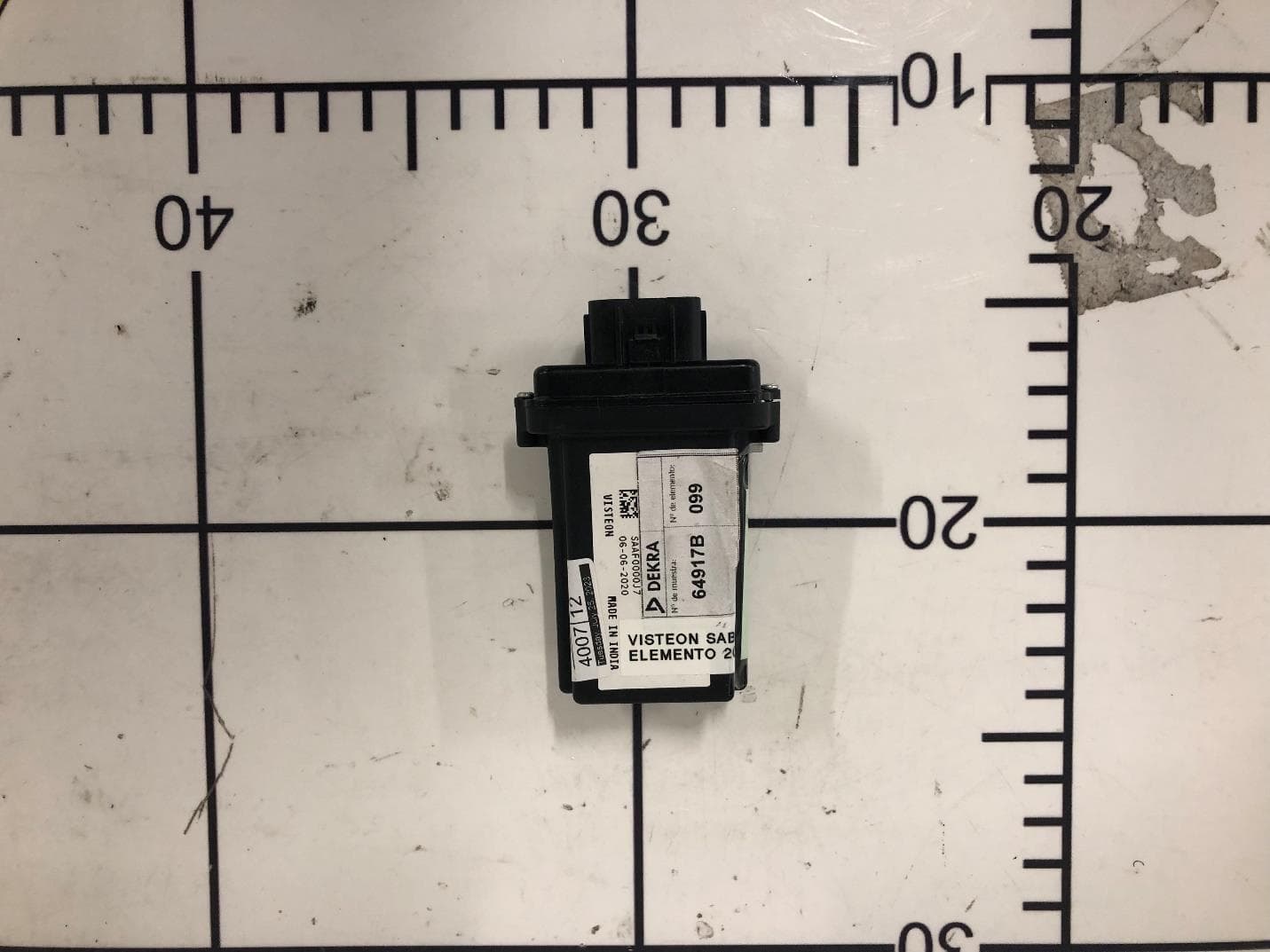
NT8-SAB01
Nov 01, 2023BT Unit
Equipment Class
DSS - Part 15 Spread Spectrum TransmitterNT8-SLA12
Jun 22, 2023Sense Line Assembly (SLA)
Equipment Class
JAB - Part 15 Class B Digital Device