O7B-BIRDDETER49Bird deterrent device activator
BirdDeter Pty. Ltd.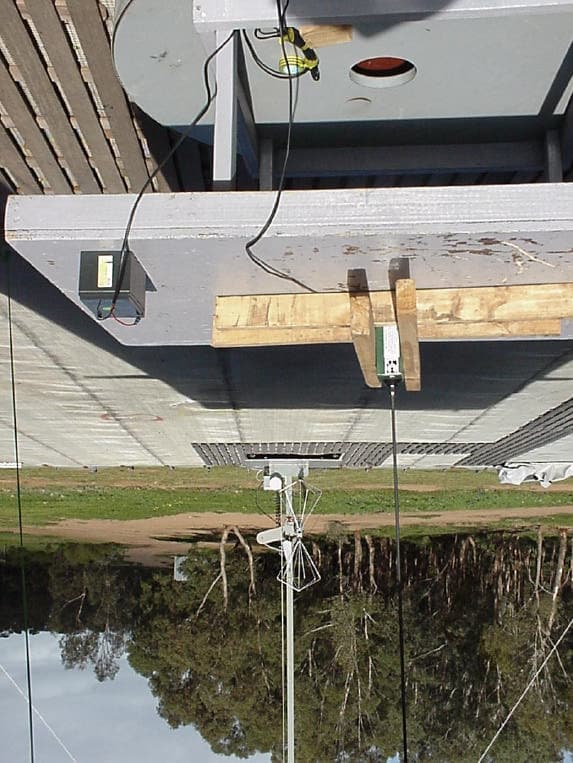
Click to zoom
Application Details
- Equipment Class
- DXX - Part 15 Low Power Communication Device Transmitter
- Date of Grant
- Mar 06, 2001
- Application Purpose
- Original Equipment
- Date of Application
- Mar 06, 2001
- Equipment Note
- Bird deterrent device activator
- Frequency Range
- 49.82000000 - 49.90000000
- Company
- BirdDeter Pty. Ltd.
- Country
- Australia
Documents & Files
Document Text
Text extracted from the exhibit documents filed with the FCC. Open a document above to read the original.
Users Manual
MAN—KS 2.0 November 1999 Copyright BirdDeter Pty Ltd Australia Kestrel Timer and Radio Control-activated bird scarer User Manual BirdDeter Pty Ltd A.C.N. 081 062 482 PO Box 1056 Warwick Queensland 4370 Australia (Deliveries: 53 Victoria Street Warwick Qld 4370) Tel (07) 4667 0491 Fax (07) 4667 0493 MAN—KS 2.0 November 1999 Copyright BirdDeter Pty Ltd Australia “Thank you for choosing BirdDeter’s pest control program!” Please read this page This Kestrel User Manual has been compiled to save you time and to help you get the best possible results. It is based on years of practical experience with the BirdDeter program and we therefore strongly recommend that you take the time to at least browse through it before you set up your Kestrel system! BirdDeter Customer Support Our company is dedicated to customer service. We provide a full range of consulting services and our experienced staff are happy to advise on the selection, installation, deployment and commissioning of BirdDeter systems. If urgently needed, our Customer Services Manager, Gavin Lake, can be contacted after hours at 0407 150 227. You can also obtain comprehensive technical support by contacting John Muehlebach, our Technical Manager, at the Customer Hotline numbers shown below, between 8.30 am and 5.30 pm, Monday to Friday. Your request for technical assistance will be serviced within 24 hours. For technical assistance after hours, call John at (07) 4661 9416. Customer Hotlines Tel (650) 610-7900 Fax (650) 593-0118 * * * MA - KS 2.0 November 1999 Copyright BirdDeter Pty Ltd Australia 1 Contents 1 INTRODUCTION A Unique Approach to Pest Control 2 2 HOW THE SYSTEM WORKS Overview 3 Kestrel Deterrent System 3 Remote Control 3 Optional Electric Hawk 3 Optional Strobe Lights 4 Where and when to install 4 3 SYSTEM COMPONENTS Kestrel Deterrent Module with inbuilt VHF radio receiver 5 Optional Electric Hawk 6 Key to System Components 6 Deterrent Module Control Box (illustration) 7 4 PARTS LIST Kestrel Deterrent Module 8 Optional Equipment 9 Electric Hawk 9 Strobe lights 9 Items to be supplied by you 9 Notes 10 5 UNPACKING AND ASSEMBLY Introduction 11 How to erect pole-mounted components 11 Kestrel Deterrent Module 15 Electric Hawk 16 How to erect complete assembly on poles 17 Battery connection 20 6 PACKING COMPONENTS FOR STORAGE OR RETURN Illustration – exploded view of Kestrel packaging 21 Dismantling Kestrel module mounted on pole 22 7 SOLVING TECHNICAL PROBLEMS Check the system daily 23 Control Box 23 System Test 24 Speakers not operating 24 9 FCC COMPLIANCE STATEMENT 25 MA - KS 2.0 November 1999 Copyright BirdDeter Pty Ltd Australia 2 INTRODUCTION 1 A Unique Approach to Pest Control Your Kestrel system is part of a unique control program for managing pest birds and flying foxes. It has been developed in Australia and many local growers have already used Kestrel to achieve excellent savings by minimising pest damage to their crops. In a nutshell, the BirdDeter program consists of the world’s most advanced equipment combined with deployment know-how. The Kestrel model incorporates the latest breakthroughs in deterrent technologies. Of course to produce the best results possible, the equipment has to be properly set up. This means it must be deployed strategically and, importantly, at the right time. BirdDeter advisers have gained this deployment know-how over years of fine-tuning the total program in a very wide range of situations. Kestrel’s method of deterring pests consists of scaring them away using their own alarm and distress calls, together with calls of predators. Visual deterrents can also be added if needed. Pests soon learn that flying into the protected area causes them distress and repeated stressful experiences train them to avoid such an area completely. In summary, the Kestrel system offers these unique features: 1 Computer controlled deterrents 2 Digital quality recordings of natural bird or fruit bat calls 3 Remote Control Unit for remote activation 4 VHF radio link (for remote control or to upgrade to radar activation) 5 Habituation less likely than continuous sounds 6 Solar power panel 7 Easily transportable 8 Low maintenance 9 Robust Construction MA - KS 2.0 November 1999 Copyright BirdDeter Pty Ltd Australia 3 HOW THE SYSTEM WORKS 2 Overview A standard Kestrel system consists of one major component: namely the Deterrent Module. It is powered by a twelve-volt battery and an optional solar panel. The deterrent module can deliver up to 120 watts of audio power thus providing coverage of at least four hectares (ten acres), depending on pest pressure. One person can normally install this system in approximately one hour. The performance of Kestrel units can be enhanced by the addition of optional visual deterrents such as an electro-mechanical hawk effigy, or strobe lights. Kestrel Deterrent System The deterrent or scaring system provides two ‘scaring’ strategies. The main one uses sounds recorded from nature (technically known as bioacoustics). The other scaring methods are visual and rely on the pests’ sense of sight. Here is a detailed explanation of both strategies. The acoustic or sound deterrent strategy utilises an electronic sound playback unit which is controlled by computer. Three audio amplifiers drive the outdoor-type loudspeakers. The miniature computer and electronic sound system are housed in the weatherproof Control Box, as are memory ‘chips’ which contain recordings of appropriate birdcalls. The chips are attached to a ‘sound card’ which can be changed over if necessary (for example, if new birds arrive later in the season). Each Kestrel module is switched on by computer-controlled electronic timer or by hand-held remote control. Every time the deterrent system is activated, the sounds are played for thirty seconds. The group of calls selected for playback is also varied at each activation. Remote Control The hand-held remote control unit can also be used to activate Kestrel modules. It operates usi…
Text truncated - open the document above for the full version.
External Photos
FCC ID: O7B-BIRDDETER49 Report No. M000763A-Tx ______________________________________________________________________________________________ 5292 This Laboratory is accredited by the National Association of Testing Authorities, Australia. The tests reported herein have been performed in accordance with its terms of accreditation for FCC Part 15. This document shall not be reproduced, except in full. APPENDIX B1 PHOTOGRAPHS OF TEST SETUP FCC ID: O7B-BIRDDETER49 Report No. M000763A-Tx ______________________________________________________________________________________________ 5292 This Laboratory is accredited by the National Association of Testing Authorities, Australia. The tests reported herein have been performed in accordance with its terms of accreditation for FCC Part 15. This document shall not be reproduced, except in full. APPENDIX B2 PHOTOGRAPHS OF TEST SAMPLE FCC ID: O7B-BIRDDETER49 Report No. M000763A-Tx ______________________________________________________________________________________________ 5292 This Laboratory is accredited by the National Association of Testing Authorities, Australia. The tests reported herein have been performed in accordance with its terms of accreditation for FCC Part 15. This document shall not be reproduced, except in full. APPENDIX B3 INTERNAL PHOTOGRAPHS OF TEST SAMPLE FCC ID: O7B-BIRDDETER49 Report No. M000763A-Tx ______________________________________________________________________________________________ 5292 This Laboratory is accredited by the National Association of Testing Authorities, Australia. The tests reported herein have been performed in accordance with its terms of accreditation for FCC Part 15. This document shall not be reproduced, except in full. APPENDIX B4 PHOTOGRAPHS OF TEST SAMPLE
Internal Photos
FCC ID: O7B-BIRDDETER49 Report No. M000763A-Tx ______________________________________________________________________________________________ 5292 This Laboratory is accredited by the National Association of Testing Authorities, Australia. The tests reported herein have been performed in accordance with its terms of accreditation for FCC Part 15. This document shall not be reproduced, except in full. APPENDIX B1 PHOTOGRAPHS OF TEST SETUP FCC ID: O7B-BIRDDETER49 Report No. M000763A-Tx ______________________________________________________________________________________________ 5292 This Laboratory is accredited by the National Association of Testing Authorities, Australia. The tests reported herein have been performed in accordance with its terms of accreditation for FCC Part 15. This document shall not be reproduced, except in full. APPENDIX B2 PHOTOGRAPHS OF TEST SAMPLE FCC ID: O7B-BIRDDETER49 Report No. M000763A-Tx ______________________________________________________________________________________________ 5292 This Laboratory is accredited by the National Association of Testing Authorities, Australia. The tests reported herein have been performed in accordance with its terms of accreditation for FCC Part 15. This document shall not be reproduced, except in full. APPENDIX B3 INTERNAL PHOTOGRAPHS OF TEST SAMPLE FCC ID: O7B-BIRDDETER49 Report No. M000763A-Tx ______________________________________________________________________________________________ 5292 This Laboratory is accredited by the National Association of Testing Authorities, Australia. The tests reported herein have been performed in accordance with its terms of accreditation for FCC Part 15. This document shall not be reproduced, except in full. APPENDIX B4 PHOTOGRAPHS OF TEST SAMPLE
Schematics
FCC ID: O7B-BIRDDETER49 REPORT NUMBER: M000763A-TX FCC ID: O7B-BIRDDETER49 REPORT NUMBER: M000763A-TX FCC ID: O7B-BIRDDETER49 REPORT NUMBER: M000763A-TX FCC ID: O7B-BIRDDETER49 REPORT NUMBER: M000763A-TX FCC ID: O7B-BIRDDETER49 REPORT NUMBER: M000763A-TX
Test Report
Page 1 of 17 EMI TEST REPORT for CERTIFICATION to FCC PART 15.235 TRANSMITTER FCC ID: O7B-BIRDDETER49 Manufacturer:BirdDeter Pty. Ltd. Test Sample:49 MHz BirdDeter Transmitter Report Number:M000763A-Tx Date: 18th January 2001 This document must not be copied or reproduced, except in full without the written permission of the Manager, EMC Technologies Pty Ltd 5292 This Laboratory is accredited by the National Association of Testing Authorities, Australia. The tests reported herein have been performed in accordance with its terms of accreditation for FCC Part 15. EMC Technologies Pty Ltd A.C.N. 057 105 549 57 Assembly Drive Tullamarine Victoria Australia 3043 Ph: + 613 9335 3333 Fax: + 613 9338 9260 email: [email protected] FCC ID: O7B-BIRDDETER49 Report No. M000763A-Tx Page 2 of 17 ______________________________________________________________________________________________ 5292 This Laboratory is accredited by the National Association of Testing Authorities, Australia. The tests reported herein have been performed in accordance with its terms of accreditation for FCC Part 15. This document shall not be reproduced, except in full. EMI TEST REPORT FOR CERTIFICATION TO FCC PART 15.235 TRANSMITTER FCC ID: O7B-BIRDDETER49 CERTIFICATION of COMPLIANCE with FCC PART 15 REGULATIONS. EMC Technologies Report Number: M000763A-TX Date:18 th January 2001 CONTENTS 1. SUMMARY of TEST RESULTS 2. GENERAL INFORMATION 3. SYSTEM TEST CONFIGURATION 4. RADIATED EMI MEASUREMENTS 5. RADIATED EMI RESULTS 6. CONDUCTED EMI RESULTS 7. CONCLUSION APPENDIX A. INSTRUMENTATION CALIBRATION DETAILS APPENDIX B. TEST SAMPLE PHOTOGRAPHS APPENDIX C. TEST SAMPLE SCHEMATICS APPENDIX D. FCC ID LABELLING -LOCATION APPENDIX E. USER INSTRUCTIONS (MANUAL) APPENDIX F. GRAPHS of EMI MEASUREMENTS FCC ID: O7B-BIRDDETER49 Report No. M000763A-Tx Page 3 of 17 ______________________________________________________________________________________________ 5292 This Laboratory is accredited by the National Association of Testing Authorities, Australia. The tests reported herein have been performed in accordance with its terms of accreditation for FCC Part 15. This document shall not be reproduced, except in full. EMI TEST REPORT FOR CERTIFICATION TO FCC PART 15.235 TRANSMITTER Report Number:M000763A-TX Test Sample:49 MHz BirdDeter Transmitter FCC ID:O7B-BIRDDETER49 Manufacturer:BirdDeter Pty. Ltd. PO Box 1056, Warwick, Queensland 4370 Australia Phone: + 61(7) 4667 0491 Fax:+ 61(7) 4667 0493 Responsible Party:John Muehlebach Technical Manager BirdDeter Pty. Ltd. Equipment Type:Intentional Radiator, Low Power Transmitter Test Standards:FCC Part 15 Section 235 Intentional Radiators. ANSI C63.4-1992 OET Bulletin No. 63, October 1993 Tested for:BirdDeter Pty. Ltd. Test Dates:24 th July 2000 Test Officer:Praveen Rao Attestation:I hereby certify that the device(s) described herein were tested as described in this report and that the data included is that which was obtained during such testing. Authorised Signature:Praveen Rao EMC Technologies Pty Ltd FCC ID: O7B-BIRDDETER49 Report No. M000763A-Tx Page 4 of 17 ______________________________________________________________________________________________ 5292 This Laboratory is accredited by the National Association of Testing Authorities, Australia. The tests reported herein have been performed in accordance with its terms of accreditation for FCC Part 15. This document shall not be reproduced, except in full. EMI TEST REPORT FOR CERTIFICATION to FCC PART 15.235 REQUIREMENTS on the 49 MHz BirdDeter Transmitter 1.0 SUMMARY of RESULTS. This report details the results of EMI tests and measurements performed on the 49 MHz BirdDeter Transmitter (non-home built) in accordance with the Federal Communications Commission (FCC) regulations as detailed in Title 47 CFR, Part 15 Rules for intentional radiators. The results and photographs of all the EUT are detailed in this report. The EUT complied with requirements for fundamental frequencies and spurious emissions of section 15.235. Transmitter Fundamental Frequency:49.88 MHz, Complied, margin of 2.0* dB. Transmitter Spurious:worst case, Complied, margin of 1.0* dB. The measurement procedure was in accordance with ANSI C63.4-1992, and OET Bulletin No. 63. The instrumentation conformed to these requirements. * Refer to Secion 7.0 Conclusion 2.0GENERAL INFORMATION 2.1 General Description of Test Setup Test Sample:49 MHz BirdDeter Transmitter FCC ID:O7B-BIRDDETER49 Equipment Type:Intentional Radiator, Low Power transmitter 2.2 Technical Specifications • Purpose : To remotely activate an electronic bird scaring device • Centre frequency : 49.88 MHz • Transmit Power : 10 dBm • Modulation : FM ± 3 kHz deviation • Modulation Type : DTMF • Antenna : 37 inch braided whip, 50 Ohm • Enclosure : Die cast aluminium 170x120x50mm • Antenna Mounting : Via antenna base mounted on the die cast box • Power supply : 12 V lead acid battery • On/Off Control : Via push button momentary contact switch • Transmit time out : 30 seconds • Transmitter Board output : BNC Connector FCC ID: O7B-BIRDDETER49 Report No. M000763A-Tx Page 5 of 17 ______________________________________________________________________________________________ 5292 This Laboratory is accredited by the National Association of Testing Authorities, Australia. The tests reported herein have been performed in accordance with its terms of accreditation for FCC Part 15. This document shall not be reproduced, except in full. 2.3Test Sample Functional Description The 49 MHz transmitter is a non-home built device used in open fields to activate an electronic bird scaring device A standard BirdDeter system consists of three separate components: a radar transmitter, a radar receiver and one deterrent module. These components are each powered by twelve-volt battery and solar panel. The deterrent module can deliver up to 120 watts of audio power thus providing coverage of between four and forty hectares (ten to one hundred acres…
Text truncated - open the document above for the full version.
Test Report
EMC Technologies Pty. Ltd. - Global Product Certification FCC 15.235 Project No:M000763 Test Date: 3-10-00 GRAPH No. 4 \\server\plotting\pcf\00763_4.PCF Melbourne- 57 Assembly Drv Tullamarine, 3043, Vic, Australia Ph+(613) 9335 3333 Fax+(613) 9338 9260 Sydney---- 16,6 Gladstone Rd Castle Hill, 2154, NSW, Australia Ph+(612) 9899 4599 Fax+(612) 9899 4019 BirdDeter 49 MHz Transmitter 3 kHz resolution bandwidth out of band emissions Electric Field Strength dBuV/m Peak analdata # = Ambient ~ = QP Level Limits:Legend: Source: _ FCC235 FCC PART 15.235 TX LMTS FOR 49 MHz AT 10mtrs __ EUT on 7 Equipment: HP8574B TST 99B Transducers: C190997 a1330201NOPREAMP Site ID: Melb Room#3 Test Officer:Chieu Huynh Frequency (MHz) 49.8 49.92 0 10 20 30 40 50 60 70
Test Report
QUESTIONS: Chris, We have conducted our review and the following issues have been identified: 1. Please confirm that a fully charged new battery was used for the tests. 2. Please supply a plot of the modulated carrier to document compliance with 15.235(b). 3. We are going to consult with the FCC on the how the antenna connector meets the requirements of 15.203. 4. Please supply separate files for the following: Test setup photos, external photos and internal photos. 5. Please supply the request for confidentiality. 6. Please supply details of the label material. Best regards Barry C. Quinlan Certification Manager Curtis-Straus LLC ADDITIONAL FROM FCC: Chris, Please see the email below I got from the FCC regarding the antenna connection issue. Best regards Barry C. Quinlan Certification Manager Curtis-Straus LLC ----- Original Message ----- From: "TCBINFO TCBINFO" <[email protected] > To: <[email protected]> Sent: Tuesday, January 23, 2001 1:44 PM Subject: Re: TCB question We don't think the grubscrew is permanent but we are not sure what that is. You can use permanent loctite or permanent industrial epoxy. ANSWERS: Dear Jon/Barry In response to your request for information (email 23rd January) we provide the following: 1. We confirm that a fully charged battery was used for the tests 2. Modulated carrier plot to document compliance with 15.235(b) attached 3. Manufacturer has forwarded documentation regarding the connector (refer to attachment) 4. Photo files attached 5. BirdDeter Pty Ltd does not reques confidentiality for the 49 MHz transmitter - only the 2.45 GHz transmitter 6. Label Material - Lexan, a UV stable polycarbonate. Adhesive is 3M high strength number 9471 I have also included amended Test Report, ie photos removed, page numbering updated. Regards Donna Cleary EMC Technologies Pty Ltd
Test Setup Photos
FCC ID: O7B-BIRDDETER49 Report No. M000763A-Tx ______________________________________________________________________________________________ 5292 This Laboratory is accredited by the National Association of Testing Authorities, Australia. The tests reported herein have been performed in accordance with its terms of accreditation for FCC Part 15. This document shall not be reproduced, except in full. APPENDIX B1 PHOTOGRAPHS OF TEST SETUP FCC ID: O7B-BIRDDETER49 Report No. M000763A-Tx ______________________________________________________________________________________________ 5292 This Laboratory is accredited by the National Association of Testing Authorities, Australia. The tests reported herein have been performed in accordance with its terms of accreditation for FCC Part 15. This document shall not be reproduced, except in full. APPENDIX B2 PHOTOGRAPHS OF TEST SAMPLE FCC ID: O7B-BIRDDETER49 Report No. M000763A-Tx ______________________________________________________________________________________________ 5292 This Laboratory is accredited by the National Association of Testing Authorities, Australia. The tests reported herein have been performed in accordance with its terms of accreditation for FCC Part 15. This document shall not be reproduced, except in full. APPENDIX B3 INTERNAL PHOTOGRAPHS OF TEST SAMPLE FCC ID: O7B-BIRDDETER49 Report No. M000763A-Tx ______________________________________________________________________________________________ 5292 This Laboratory is accredited by the National Association of Testing Authorities, Australia. The tests reported herein have been performed in accordance with its terms of accreditation for FCC Part 15. This document shall not be reproduced, except in full. APPENDIX B4 PHOTOGRAPHS OF TEST SAMPLE
Contact Information
Applicant
John Muehlebach(Technical Manager)
Test Firm
EMC Technologies Pty. Ltd.Chris Zombolas
Technical Specifications
| # | Rule Parts | Frequency Range | Power Output |
|---|---|---|---|
| 1 | 15C | 49.82 MHz - 49.9 MHz | - |
Other Applications from BirdDeter Pty. Ltd.
O7B-BIRDDETER-245
Mar 11, 2001Bird deterrent device activator
Equipment Class
DXX - Part 15 Low Power Communication Device Transmitter