O8F-PIXEWCDMA/1x EVDO Rel 0 / EVDO Rev. A with WiFi and Bluetooth Phone
Palm Inc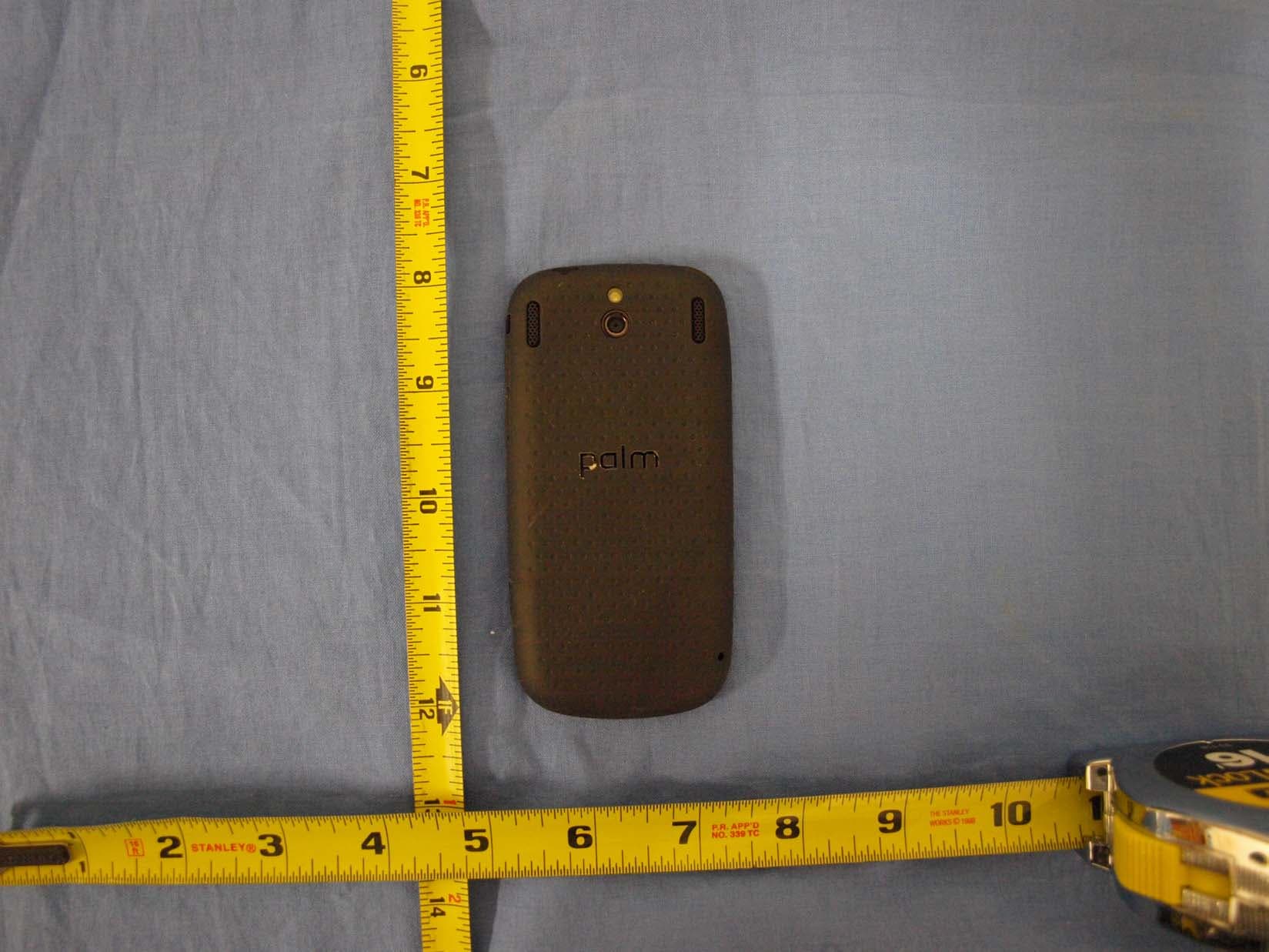
Click to zoom
Application Details
- Equipment Class
- DTS - Digital Transmission System
- Date of Grant
- Dec 12, 2009
- Application Purpose
- Original Equipment
- Date of Application
- Dec 12, 2009
- Equipment Note
- CDMA/1x EVDO Rel 0 / EVDO Rev. A with WiFi and Bluetooth Phone
- Frequency Range
- 2402.00000000 - 2480.00000000
- Company
- Palm Inc
- Country
- United States
Documents & Files
Document Text
Text extracted from the exhibit documents filed with the FCC. Open a document above to read the original.
Users Manual
Palm Pixi User Guide Intellectual property notices © 2009 Palm, Inc. All rights reserved. Palm, Pixi, Synergy, Touchstone, and the Palm and Pixi logos are among the trademarks or registered trademarks owned by or licensed to Palm, Inc. Microsoft and Outlook are trademarks of the Microsoft group of companies. Exchange ActiveSync Enabled. Facebook ® is a registered trademark of Facebook, Inc. Google and Google Maps are trademarks of Google, Inc. Amazon, Amazon MP3, and the Amazon MP3 logo are trademarks of Amazon.com, Inc. or its affiliates. Doc View and PDF View are provided by Documents To Go ® , a product of DataViz, Inc. (dataviz.com). All other brand and product names are or may be trademarks of, and are used to identify products or services of, their respective owners. Disclaimer and limitation of liability Palm, Inc. and its suppliers assume no responsibility for any damage or loss resulting from the use of this guide. Palm, Inc. and its suppliers assume no responsibility for any loss or claims by third parties that may arise through the use of this software. Palm, Inc. and its suppliers assume no responsibility for any damage or loss caused by deletion of data as a result of malfunction, dead battery, or repairs. Be sure to make backup copies of all important data on other media to protect against data loss. Patent pending. This product also is licensed under United States patent 6,058,304. Use of this device requires providing a valid email address, mobile phone number, and related information for account setup and activation. A data plan is also required. An unlimited-usage data plan is strongly recommended, or additional data charges may apply. Open Source License information You can view the Open Source License terms on your phone. Tap the center of the gesture area, and then tap the Launcher icon. Swipe left until the PDF View icon appears. Tap PDF View, then tap Open Source Information.pdf. You can also view the file on your computer. Connect your phone to your computer with the USB cable. On your phone, tap USB Drive. On your computer, locate and double-click the Palm Pixi drive. To locate the drive, do the following for your operating system: •W indows Vista: Open Computer. •Windows XP: Open My Computer. •Mac: Open Finder. • Linux (Ubuntu): The drive is displayed on the desktop. • Other Linux distribution: The location of the drive may vary by system. After you open the Palm Pixi drive, double-click the file Open Source Information.pdf. R ecycling and disposal This symbol indicates that Palm products should be recycled and not be disposed of in unsorted municipal waste. Palm products should be sent to a facility that properly recycles electrical and electronic equipment. For information on environmental programs visit palm.com/environment or recyclewirelesss.com/. As part of Palm’s corporate commitment to be a good steward of the environment, we strive to use environmentally friendly materials, reduce waste, and develop the highest standards in electronics recycling. v. 0.0 Contents3 Contents Chapter 1Basics 6Get to know your phone 8Set up your phone 8Turn the phone on/off 9Open applications 10Work with applications 11Enter and save information 12Use the menus 13Search to find info and make calls 14View and Respond to Notifications Chapter 2Phone 16Make calls 17Receive calls 17Use voicemail 17What can I do during a call? 18Set up and use a Bluetooth ® hands-free device Chapter 3Email and other messages 20Email 21Messaging Chapter 4Personal information 24Contacts 25Calendar Chapter 5Photos, videos, and music 28Camera 28Photos 28Videos 29Music Chapter 6Web and wireless connections 32Wi-Fi 32Web 32Bluetooth ® wireless technology Chapter 7Documents 34Doc View 34PDF View Chapter 8Preferences 38Screen & Lock 38Sounds & Ringtones Chapter 9Learn More 42While using your phone 42If you need more information 4Contents Regulatory and Safety Information Index Chapter 1 : Basics5 Basics You’re about to discover the many things about your Palm ® Pixi™ phone that can help you better manage your life and have fun, too. As you become more familiar with your phone, you’ll want to personalize the settings and add applications to make it uniquely yours. But first, take the few easy steps in this chapter to set up your phone and get it running. Then learn about the key features that make moving around on your phone and accessing your information easy: gestures, menus, search, notifications, and more. In this chapter 6Get to know your phone 8Set up your phone 8Turn the phone on/off 9Open applications 10Work with applications 11Enter and save information 12Use the menus 13Search to find info and make calls 14View and Respond to Notifications 6Chapter1:Basics Get to know your phone Front view 1Earpiece 2Touchscreen: Tap and make other gestures directly on the screen. See To u c h s c r e e n. 3Gesture area: Make the back gesture and begin other gestures here. 4Keyboard: See Use the keyboard. 5Microphone 6Ringer switch: Slide to turn the ringer and notification sounds on or off. (Red means off.) The ringer switch does not affect music or video playback sounds. 7Vo l u m e 8Charger/microUSB connector IMPORTANTBe careful not to scratch, crush, or apply too much pressure on the touchscreen. Do not store your phone in a place where other items might damage it. Keyboard 1Option: Press to enter numbers, punctuation, and symbols that appear above the letters on the keys. See Enter alternate keyboard characters. 2Shift: See Enter uppercase letters. 3Space 4Backspace 5Enter: Press to enter a line return (for example, in a memo or in an email message you are composing) or to accept information you entered in a field. See Enter information in a field. 6Sym: Press to enter symbols and accented characters that don't appear on the keys. See Enter characters from the symbols table. Chapter 1 : Basics7 Touchscreen 1Application name: Displays the name of the currently open application. Tap the name to open the appli…
Text truncated - open the document above for the full version.
Cover Letter(s)
Federal Communications Commission November 12, 2009 7435 Oakland Mills Road Columbia MD 21046 Subject: Request for Confidentiality FCC ID: O8F-PIXEW To Whom It May Concern: Pursuant to the provisions of Sections 0.457 and 0.459 of the Commission’s rules (47 CFR §§ 0.457, 0.459), we are requesting the Commission to withhold the following attachments as confidential document from public disclosure indefinitely. Schematic Diagram Block Diagram Theory of Operation Tune-Up Procedure Above mentioned document contains detailed system and equipment description are considered as proprietary information in operation of the equipment. The public disclosure of above documents might be harmful to our company and would give competitor an unfair advantage in the market. In additional to above mentioned documents, pursuant to Public Notice DA 04-1705 of the Commission’s policy, in order to comply with the marketing regulations in 47 CFR §2.803 and the importation rules in 47 CFR §2.1204, while ensuring that business sensitive information remains confidential until the actual marketing of newly authorized devices. We are requesting the commission to grant short-term confidentiality request on the following attachments for 180 days from the date of the Grant of Equipment Authorization: External Photos Internal Photos Test Setup Photos User Manual It is our understanding that all measurement test reports, FCC ID label format and correspondent during certification review process cannot be granted as confidential documents and those information will be available for public review once the grant of equipment authorization is issued. Best Regards, Manthos Economou Sr. Mgr. Corporate Compliance [email protected] Office: 408-617-8304 Palm, Inc. 950 W. Maude Avenue M/S 21R11 Sunnyvale, CA 94085-2801 USA
ID Label/Location Info
FCC ID and location The FCC ID on your Palm phone is located on a label inside the battery compartment. FCC ID label inside battery compartment
RF Exposure Info
Date/Time: 10/13/2009 8:37:14 AM Test Laboratory: Compliance Certification Services System Performance Check - D1900V2 DUT: Dipole; Type: D1900V2; Serial: 5d043 Communication System: System Check Signal - CW; Frequency: 1900 MHz;Duty Cycle: 1:1 Medium parameters used: f = 1900 MHz; σ = 1.52 mho/m; ε r = 53.6; ρ = 1000 kg/m 3 Phantom section: Flat Section Room Ambient Temperature: 24.0 deg. C; Liquid Temperature: 23.0 deg. C DASY4 Configuration: - Area Scan setting - Find Secondary Maximum Within: 2.0 dB and with a peak SAR value greater than 0.0012W/kg - Probe: EX3DV4 - SN3686; ConvF(6.85, 6.85, 6.85); Calibrated: 3/23/2009 - Sensor-Surface: 3mm (Mechanical Surface Detection) - Electronics: DAE3 Sn427; Calibrated: 10/20/2008 - Phantom: Flat Phantom ELI4.0; Type: QDOVA001BA; Serial: SN:XXXX - Measurement SW: DASY4, V4.7 Build 80; Postprocessing SW: SEMCAD, V1.8 Build 186 d=10mm, Pin=250mW/Area Scan (7x7x1): Measurement grid: dx=15mm, dy=15mm Maximum value of SAR (measured) = 9.98 mW/g d=10mm, Pin=250mW/Zoom Scan (7x7x7)/Cube 0: Measurement grid: dx=5mm, dy=5mm, dz=5mm Reference Value = 91.2 V/m; Power Drift = -0.130 dB Peak SAR (extrapolated) = 69.7 W/kg SAR(1 g) = 38.5 mW/g; SAR(10 g) = 20.3 mW/g Normalized to target power = 1 W and actual power = 0.25 W Maximum value of SAR (measured) = 48.7 mW/g 0 dB = 48.7mW/g Date/Time: 10/13/2009 8:48:23 AM Test Laboratory: Compliance Certification Services System Performance Check - D1900V2 DUT: Dipole; Type: D1900V2; Serial: 5d043 Communication System: System Check Signal - CW; Frequency: 1900 MHz;Duty Cycle: 1:1 d=10mm, Pin=250mW/Z Scan (1x1x34): Measurement grid: dx=20mm, dy=20mm, dz=3mm Maximum value of SAR (measured) = 12.1 mW/g Date/Time: 10/15/2009 4:59:21 PM Test Laboratory: Compliance Certification Services System Performance Check - D1900V2 DUT: Dipole; Type: D1900V2; Serial: 5d043 Communication System: System Check Signal - CW; Frequency: 1900 MHz;Duty Cycle: 1:1 Medium parameters used: f = 1900 MHz; σ = 1.5 mho/m; ε r = 53.5; ρ = 1000 kg/m 3 Phantom section: Flat Section Room Ambient Temperature: 24.0 deg. C; Liquid Temperature: 23.0 deg. C DASY4 Configuration: - Area Scan setting - Find Secondary Maximum Within: 2.0 dB and with a peak SAR value greater than 0.0012W/kg - Probe: EX3DV4 - SN3686; ConvF(6.85, 6.85, 6.85); Calibrated: 3/23/2009 - Sensor-Surface: 3mm (Mechanical Surface Detection) - Electronics: DAE3 Sn427; Calibrated: 10/20/2008 - Phantom: Flat Phantom ELI4.0; Type: QDOVA001BA; Serial: SN:XXXX - Measurement SW: DASY4, V4.7 Build 80; Postprocessing SW: SEMCAD, V1.8 Build 186 d=10mm, Pin=250mW/Area Scan (7x7x1): Measurement grid: dx=15mm, dy=15mm Maximum value of SAR (measured) = 9.89 mW/g d=10mm, Pin=250mW/Zoom Scan (7x7x7)/Cube 0: Measurement grid: dx=5mm, dy=5mm, dz=5mm Reference Value = 90.5 V/m; Power Drift = -0.281 dB Peak SAR (extrapolated) = 69.0 W/kg SAR(1 g) = 38.1 mW/g; SAR(10 g) = 19.9 mW/g Normalized to target power = 1 W and actual power = 0.25 W Maximum value of SAR (measured) = 48.2 mW/g 0 dB = 48.2mW/g Date/Time: 10/15/2009 5:08:26 PM Test Laboratory: Compliance Certification Services System Performance Check - D1900V2 DUT: Dipole; Type: D1900V2; Serial: 5d043 Communication System: System Check Signal - CW; Frequency: 1900 MHz;Duty Cycle: 1:1 d=10mm, Pin=250mW/Z Scan (1x1x34): Measurement grid: dx=20mm, dy=20mm, dz=3mm Maximum value of SAR (measured) = 12.0 mW/g Date/Time: 10/14/2009 8:32:13 AM Test Laboratory: Compliance Certification Services System Performance Check - D835V2 DUT: Dipole; Type: D835V2; Serial: 4d002 Communication System: System Check Signal - CW; Frequency: 835 MHz;Duty Cycle: 1:1 Medium parameters used: f = 835 MHz; σ = 0.969 mho/m; ε r = 55.9; ρ = 1000 kg/m 3 Phantom section: Flat Section Room Ambient Temperature: 24.0 deg. C; Liquid Temperature: 23.0 deg. C DASY4 Configuration: - Area Scan setting - Find Secondary Maximum Within: 2.0 dB and with a peak SAR value greater than 0.0012W/kg - Probe: EX3DV4 - SN3686; ConvF(8.7, 8.7, 8.7); Calibrated: 3/23/2009 - Sensor-Surface: 3mm (Mechanical Surface Detection) - Electronics: DAE3 Sn427; Calibrated: 10/20/2008 - Phantom: Flat Phantom ELI4.0; Type: QDOVA001BA; Serial: SN:1003 - Measurement SW: DASY4, V4.7 Build 80; Postprocessing SW: SEMCAD, V1.8 Build 186 d=15mm, Pin=250mW/Area Scan (7x9x1): Measurement grid: dx=15mm, dy=15mm Maximum value of SAR (measured) = 2.95 mW/g d=15mm, Pin=250mW/Zoom Scan (7x7x7)/Cube 0: Measurement grid: dx=5mm, dy=5mm, dz=5mm Reference Value = 55.8 V/m; Power Drift = -0.025 dB Peak SAR (extrapolated) = 15.1 W/kg SAR(1 g) = 10.1 mW/g; SAR(10 g) = 6.62 mW/g Normalized to target power = 1 W and actual power = 0.25 W Maximum value of SAR (measured) = 11.9 mW/g 0 dB = 11.9mW/g Date/Time: 10/14/2009 8:41:25 AM Test Laboratory: Compliance Certification Services System Performance Check - D835V2 DUT: Dipole; Type: D835V2; Serial: 4d002 Communication System: System Check Signal - CW; Frequency: 835 MHz;Duty Cycle: 1:1 d=15mm, Pin=250mW/Z Scan (1x1x34): Measurement grid: dx=20mm, dy=20mm, dz=3mm Maximum value of SAR (measured) = 2.95 mW/g Date/Time: 10/15/2009 8:25:31 AM Test Laboratory: Compliance Certification Services System Performance Check - D2450V2 DUT: Dipole ; Type: D2450V2; Serial: 748 Communication System: System Check Signal - CW; Frequency: 2450 MHz;Duty Cycle: 1:1 Medium parameters used: f = 2450 MHz; σ = 1.92 mho/m; ε r = 52.1; ρ = 1000 kg/m 3 Phantom section: Flat Section Room Ambient Temperature: 24.0 deg. C; Liquid Temperature: 23.0 deg. C DASY4 Configuration: - Area Scan setting - Find Secondary Maximum Within: 2.0 dB and with a peak SAR value greater than 0.0012W/kg - Probe: EX3DV4 - SN3686; ConvF(6.48, 6.48, 6.48); Calibrated: 3/23/2009 - Sensor-Surface: 3mm (Mechanical Surface Detection) - Electronics: DAE3 Sn427; Calibrated: 10/20/2008 - Phantom: Flat Phantom ELI4.0; Type: QDOVA001BA; Serial: SN:1003 - Measurement SW: DASY4, V4.7 Build 80; Postprocessing SW: SEMCAD, V1.8 Build 186 d=10mm, Pin=250mW/Area…
Text truncated - open the document above for the full version.
RF Exposure Info
Date/Time: 10/13/2009 10:36:02 AM Test Laboratory: Compliance Certification Services Left Hand Side DUT: Palm; Type: N/A; Serial: N/A Communication System: CDMA PCS band; Frequency: 1851.25 MHz;Duty Cycle: 1:1 Medium parameters used (interpolated): f = 1851.25 MHz; σ = 1.35 mho/m; ε r = 40.5; ρ = 1000 kg/m 3 Phantom section: Left Section Room Ambient Temperature: 24.0 deg. C; Liquid Temperature: 23.0 deg. C DASY4 Configuration: - Area Scan setting - Find Secondary Maximum Within: 2.0 dB and with a peak SAR value greater than 0.0012W/kg - Probe: EX3DV4 - SN3686; ConvF(7.51, 7.51, 7.51); Calibrated: 3/23/2009 - Sensor-Surface: 3mm (Mechanical Surface Detection) - Electronics: DAE3 Sn427; Calibrated: 10/20/2008 - Phantom: SAM 2 (Twin); Type: SAM 2; Serial: 1050 - Measurement SW: DASY4, V4.7 Build 80; Postprocessing SW: SEMCAD, V1.8 Build 186 Touch position - Low-ch/Area Scan (7x10x1): Measurement grid: dx=15mm, dy=15mm Maximum value of SAR (measured) = 1.56 mW/g Touch position - Low-ch/Zoom Scan (7x7x9)/Cube 0: Measurement grid: dx=5mm, dy=5mm, dz=3mm Reference Value = 11.0 V/m; Power Drift = -0.188 dB Peak SAR (extrapolated) = 1.90 W/kg SAR(1 g) = 1.31 mW/g; SAR(10 g) = 0.776 mW/g Maximum value of SAR (measured) = 1.53 mW/g 0 dB = 1.53mW/g Date/Time: 10/13/2009 11:27:57 AM Test Laboratory: Compliance Certification Services Left Hand Side DUT: Palm; Type: N/A; Serial: N/A Communication System: CDMA PCS band; Frequency: 1880 MHz;Duty Cycle: 1:1 Medium parameters used: f = 1880 MHz; σ = 1.38 mho/m; ε r = 40.2; ρ = 1000 kg/m 3 Phantom section: Left Section Room Ambient Temperature: 24.0 deg. C; Liquid Temperature: 23.0 deg. C DASY4 Configuration: - Area Scan setting - Find Secondary Maximum Within: 2.0 dB and with a peak SAR value greater than 0.0012W/kg - Probe: EX3DV4 - SN3686; ConvF(7.51, 7.51, 7.51); Calibrated: 3/23/2009 - Sensor-Surface: 3mm (Mechanical Surface Detection) - Electronics: DAE3 Sn427; Calibrated: 10/20/2008 - Phantom: SAM 2 (Twin); Type: SAM 2; Serial: 1050 - Measurement SW: DASY4, V4.7 Build 80; Postprocessing SW: SEMCAD, V1.8 Build 186 Touch position - Mid-ch 2/Area Scan (7x10x1): Measurement grid: dx=15mm, dy=15mm Maximum value of SAR (measured) = 1.67 mW/g Touch position - Mid-ch 2/Zoom Scan (7x7x9)/Cube 0: Measurement grid: dx=5mm, dy=5mm, dz=3mm Reference Value = 11.2 V/m; Power Drift = 0.005 dB Peak SAR (extrapolated) = 2.14 W/kg SAR(1 g) = 1.43 mW/g; SAR(10 g) = 0.835 mW/g Maximum value of SAR (measured) = 1.69 mW/g 0 dB = 1.69mW/g Date/Time: 10/13/2009 11:02:02 AM Test Laboratory: Compliance Certification Services Left Hand Side DUT: Palm; Type: N/A; Serial: N/A Communication System: CDMA PCS band; Frequency: 1908.75 MHz;Duty Cycle: 1:1 Medium parameters used (extrapolated): f = 1908.75 MHz; σ = 1.41 mho/m; ε r = 40.1; ρ = 1000 kg/m 3 Phantom section: Left Section Room Ambient Temperature: 24.0 deg. C; Liquid Temperature: 23.0 deg. C DASY4 Configuration: - Area Scan setting - Find Secondary Maximum Within: 2.0 dB and with a peak SAR value greater than 0.0012W/kg - Probe: EX3DV4 - SN3686; ConvF(7.51, 7.51, 7.51); Calibrated: 3/23/2009 - Sensor-Surface: 3mm (Mechanical Surface Detection) - Electronics: DAE3 Sn427; Calibrated: 10/20/2008 - Phantom: SAM 2 (Twin); Type: SAM 2; Serial: 1050 - Measurement SW: DASY4, V4.7 Build 80; Postprocessing SW: SEMCAD, V1.8 Build 186 Touch position - High-ch 2/Area Scan (7x10x1): Measurement grid: dx=15mm, dy=15mm Maximum value of SAR (measured) = 1.70 mW/g Touch position - High-ch 2/Zoom Scan (7x7x9)/Cube 0: Measurement grid: dx=5mm, dy=5mm, dz=3mm Reference Value = 11.1 V/m; Power Drift = -0.063 dB Peak SAR (extrapolated) = 2.19 W/kg SAR(1 g) = 1.47 mW/g; SAR(10 g) = 0.857 mW/g Maximum value of SAR (measured) = 1.75 mW/g 0 dB = 1.75mW/g Date/Time: 10/13/2009 11:25:27 AM Test Laboratory: Compliance Certification Services Left Hand Side DUT: Palm; Type: N/A; Serial: N/A Communication System: CDMA PCS band; Frequency: 1908.75 MHz;Duty Cycle: 1:1 Touch position - High-ch/Z Scan (1x1x34): Measurement grid: dx=20mm, dy=20mm, dz=3mm Maximum value of SAR (measured) = 0.168 mW/g Date/Time: 10/15/2009 5:57:17 PM Test Laboratory: Compliance Certification Services Left Hand Side DUT: Palm; Type: N/A; Serial: N/A Communication System: CDMA PCS band; Frequency: 1851.25 MHz;Duty Cycle: 1:1 Medium parameters used (interpolated): f = 1851.25 MHz; σ = 1.33 mho/m; ε r = 40.2; ρ = 1000 kg/m 3 Phantom section: Left Section Room Ambient Temperature: 24.0 deg. C; Liquid Temperature: 23.0 deg. C DASY4 Configuration: - Area Scan setting - Find Secondary Maximum Within: 2.0 dB and with a peak SAR value greater than 0.0012W/kg - Probe: EX3DV4 - SN3686; ConvF(7.51, 7.51, 7.51); Calibrated: 3/23/2009 - Sensor-Surface: 3mm (Mechanical Surface Detection) - Electronics: DAE3 Sn427; Calibrated: 10/20/2008 - Phantom: SAM 2 (Twin); Type: SAM 2; Serial: 1050 - Measurement SW: DASY4, V4.7 Build 80; Postprocessing SW: SEMCAD, V1.8 Build 186 Touch position - Low-ch/Area Scan (7x10x1): Measurement grid: dx=15mm, dy=15mm Maximum value of SAR (measured) = 1.48 mW/g Touch position - Low-ch/Zoom Scan (7x7x9)/Cube 0: Measurement grid: dx=5mm, dy=5mm, dz=3mm Reference Value = 11.8 V/m; Power Drift = 0.057 dB Peak SAR (extrapolated) = 1.88 W/kg SAR(1 g) = 1.29 mW/g; SAR(10 g) = 0.765 mW/g Maximum value of SAR (measured) = 1.52 mW/g 0 dB = 1.52mW/g Date/Time: 10/15/2009 6:22:13 PM Test Laboratory: Compliance Certification Services Left Hand Side DUT: Palm; Type: N/A; Serial: N/A Communication System: CDMA PCS band; Frequency: 1880 MHz;Duty Cycle: 1:1 Medium parameters used: f = 1880 MHz; σ = 1.36 mho/m; ε r = 39.9; ρ = 1000 kg/m 3 Phantom section: Left Section Room Ambient Temperature: 24.0 deg. C; Liquid Temperature: 23.0 deg. C DASY4 Configuration: - Area Scan setting - Find Secondary Maximum Within: 2.0 dB and with a peak SAR value greater than 0.0012W/kg - Probe: EX3DV4 - SN3686; ConvF(7.51, 7.51, 7.51); Calibrated: 3/23/2009 - Sensor-Surface: 3mm (Mechanical Surface Detecti…
Text truncated - open the document above for the full version.
RF Exposure Info
Date/Time: 10/14/2009 10:00:08 AM Test Laboratory: Compliance Certification Services Left Hand Side DUT: Palm; Type: N/A; Serial: N/A Communication System: CDMA; Frequency: 824.7 MHz;Duty Cycle: 1:1 Medium parameters used: f = 825 MHz; σ = 0.89 mho/m; ε r = 41.9; ρ = 1000 kg/m 3 Phantom section: Left Section Room Ambient Temperature: 24.0 deg. C; Liquid Temperature: 23.0 deg. C DASY4 Configuration: - Area Scan setting - Find Secondary Maximum Within: 2.0 dB and with a peak SAR value greater than 0.0012W/kg - Probe: EX3DV4 - SN3686; ConvF(8.72, 8.72, 8.72); Calibrated: 3/23/2009 - Sensor-Surface: 3mm (Mechanical Surface Detection) - Electronics: DAE3 Sn427; Calibrated: 10/20/2008 - Phantom: SAM 2 (Twin); Type: SAM 2; Serial: 1050 - Measurement SW: DASY4, V4.7 Build 80; Postprocessing SW: SEMCAD, V1.8 Build 186 Touch position - Low-ch/Area Scan (7x10x1): Measurement grid: dx=15mm, dy=15mm Maximum value of SAR (measured) = 1.03 mW/g Touch position - Low-ch/Zoom Scan (7x7x9)/Cube 0: Measurement grid: dx=5mm, dy=5mm, dz=3mm Reference Value = 9.58 V/m; Power Drift = 0.069 dB Peak SAR (extrapolated) = 1.16 W/kg SAR(1 g) = 1.01 mW/g; SAR(10 g) = 0.829 mW/g Maximum value of SAR (measured) = 1.08 mW/g 0 dB = 1.08mW/g Date/Time: 10/14/2009 9:35:17 AM Test Laboratory: Compliance Certification Services Left Hand Side DUT: Palm; Type: N/A; Serial: N/A Communication System: CDMA; Frequency: 836.52 MHz;Duty Cycle: 1:1 Medium parameters used (interpolated): f = 836.52 MHz; σ = 0.9 mho/m; ε r = 41.7; ρ = 1000 kg/m 3 Phantom section: Left Section Room Ambient Temperature: 24.0 deg. C; Liquid Temperature: 23.0 deg. C DASY4 Configuration: - Area Scan setting - Find Secondary Maximum Within: 2.0 dB and with a peak SAR value greater than 0.0012W/kg - Probe: EX3DV4 - SN3686; ConvF(8.72, 8.72, 8.72); Calibrated: 3/23/2009 - Sensor-Surface: 3mm (Mechanical Surface Detection) - Electronics: DAE3 Sn427; Calibrated: 10/20/2008 - Phantom: SAM 2 (Twin); Type: SAM 2; Serial: 1050 - Measurement SW: DASY4, V4.7 Build 80; Postprocessing SW: SEMCAD, V1.8 Build 186 Touch position - Mid-ch/Area Scan (7x10x1): Measurement grid: dx=15mm, dy=15mm Maximum value of SAR (measured) = 0.985 mW/g Touch position - Mid-ch/Zoom Scan (7x7x9)/Cube 0: Measurement grid: dx=5mm, dy=5mm, dz=3mm Reference Value = 9.15 V/m; Power Drift = -0.103 dB Peak SAR (extrapolated) = 1.12 W/kg SAR(1 g) = 0.984 mW/g; SAR(10 g) = 0.802 mW/g Maximum value of SAR (measured) = 1.05 mW/g 0 dB = 1.05mW/g Date/Time: 10/14/2009 10:25:52 AM Test Laboratory: Compliance Certification Services Left Hand Side DUT: Palm; Type: N/A; Serial: N/A Communication System: CDMA; Frequency: 848.31 MHz;Duty Cycle: 1:1 Medium parameters used (interpolated): f = 848.31 MHz; σ = 0.908 mho/m; ε r = 41.5; ρ = 1000 kg/m 3 Phantom section: Left Section Room Ambient Temperature: 24.0 deg. C; Liquid Temperature: 23.0 deg. C DASY4 Configuration: - Area Scan setting - Find Secondary Maximum Within: 2.0 dB and with a peak SAR value greater than 0.0012W/kg - Probe: EX3DV4 - SN3686; ConvF(8.72, 8.72, 8.72); Calibrated: 3/23/2009 - Sensor-Surface: 3mm (Mechanical Surface Detection) - Electronics: DAE3 Sn427; Calibrated: 10/20/2008 - Phantom: SAM 2 (Twin); Type: SAM 2; Serial: 1050 - Measurement SW: DASY4, V4.7 Build 80; Postprocessing SW: SEMCAD, V1.8 Build 186 Touch position - High-ch/Area Scan (7x10x1): Measurement grid: dx=15mm, dy=15mm Maximum value of SAR (measured) = 1.07 mW/g Touch position - High-ch/Zoom Scan (7x7x9)/Cube 0: Measurement grid: dx=5mm, dy=5mm, dz=3mm Reference Value = 8.60 V/m; Power Drift = 0.102 dB Peak SAR (extrapolated) = 1.27 W/kg SAR(1 g) = 1.08 mW/g; SAR(10 g) = 0.885 mW/g Maximum value of SAR (measured) = 1.15 mW/g 0 dB = 1.15mW/g Date/Time: 10/14/2009 10:56:44 AM Test Laboratory: Compliance Certification Services Left Hand Side DUT: Palm; Type: N/A; Serial: N/A Communication System: CDMA; Frequency: 836.52 MHz;Duty Cycle: 1:1 Medium parameters used (interpolated): f = 836.52 MHz; σ = 0.9 mho/m; ε r = 41.7; ρ = 1000 kg/m 3 Phantom section: Left Section Room Ambient Temperature: 24.0 deg. C; Liquid Temperature: 23.0 deg. C DASY4 Configuration: - Area Scan setting - Find Secondary Maximum Within: 2.0 dB and with a peak SAR value greater than 0.0012W/kg - Probe: EX3DV4 - SN3686; ConvF(8.72, 8.72, 8.72); Calibrated: 3/23/2009 - Sensor-Surface: 3mm (Mechanical Surface Detection) - Electronics: DAE3 Sn427; Calibrated: 10/20/2008 - Phantom: SAM 2 (Twin); Type: SAM 2; Serial: 1050 - Measurement SW: DASY4, V4.7 Build 80; Postprocessing SW: SEMCAD, V1.8 Build 186 Tilt position - Mid-ch/Area Scan (7x10x1): Measurement grid: dx=15mm, dy=15mm Maximum value of SAR (measured) = 0.564 mW/g Tilt position - Mid-ch/Zoom Scan (7x7x9)/Cube 0: Measurement grid: dx=5mm, dy=5mm, dz=3mm Reference Value = 16.5 V/m; Power Drift = 0.013 dB Peak SAR (extrapolated) = 0.623 W/kg SAR(1 g) = 0.543 mW/g; SAR(10 g) = 0.442 mW/g Maximum value of SAR (measured) = 0.575 mW/g 0 dB = 0.575mW/g Date/Time: 10/14/2009 12:48:34 PM Test Laboratory: Compliance Certification Services Right Hand Side DUT: Palm; Type: N/A; Serial: N/A Communication System: CDMA; Frequency: 824.7 MHz;Duty Cycle: 1:1 Medium parameters used: f = 825 MHz; σ = 0.89 mho/m; ε r = 41.9; ρ = 1000 kg/m 3 Phantom section: Right Section Room Ambient Temperature: 24.0 deg. C; Liquid Temperature: 23.0 deg. C DASY4 Configuration: - Area Scan setting - Find Secondary Maximum Within: 2.0 dB and with a peak SAR value greater than 0.0012W/kg - Probe: EX3DV4 - SN3686; ConvF(8.72, 8.72, 8.72); Calibrated: 3/23/2009 - Sensor-Surface: 3mm (Mechanical Surface Detection) - Electronics: DAE3 Sn427; Calibrated: 10/20/2008 - Phantom: SAM 2 (Twin); Type: SAM 2; Serial: 1050 - Measurement SW: DASY4, V4.7 Build 80; Postprocessing SW: SEMCAD, V1.8 Build 186 Touch position - L-ch/Area Scan (7x11x1): Measurement grid: dx=15mm, dy=15mm Maximum value of SAR (measured) = 1.21 mW/g Touch position - L-ch/Zoom Scan (7x7x9)/Cube 0: Measurement grid: dx=5mm, dy=5mm, dz=…
Text truncated - open the document above for the full version.
RF Exposure Info
Date/Time: 10/16/2009 8:20:21 PM Test Laboratory: Compliance Certification Services Left Hand Side DUT: Palm; Type: N/A; Serial: N/A Communication System: 802.11bg; Frequency: 2437 MHz;Duty Cycle: 1:1 Medium parameters used (interpolated): f = 2437 MHz; σ = 1.82 mho/m; ε r = 39.3; ρ = 1000 kg/m 3 Phantom section: Left Section Room Ambient Temperature: 24.0 deg. C; Liquid Temperature: 23.0 deg. C DASY4 Configuration: - Area Scan setting - Find Secondary Maximum Within: 2.0 dB and with a peak SAR value greater than 0.0012W/kg - Probe: EX3DV4 - SN3686; ConvF(6.81, 6.81, 6.81); Calibrated: 3/23/2009 - Sensor-Surface: 3mm (Mechanical Surface Detection) - Electronics: DAE3 Sn427; Calibrated: 10/20/2008 - Phantom: SAM 2 (Twin); Type: SAM 2; Serial: 1050 - Measurement SW: DASY4, V4.7 Build 80; Postprocessing SW: SEMCAD, V1.8 Build 186 Touch position - Mid-ch/Area Scan (7x10x1): Measurement grid: dx=15mm, dy=15mm Maximum value of SAR (measured) = 0.062 mW/g Touch position - Mid-ch/Zoom Scan (7x7x9)/Cube 0: Measurement grid: dx=5mm, dy=5mm, dz=3mm Reference Value = 5.66 V/m; Power Drift = 0.106 dB Peak SAR (extrapolated) = 0.099 W/kg SAR(1 g) = 0.050 mW/g; SAR(10 g) = 0.026 mW/g Maximum value of SAR (measured) = 0.064 mW/g 0 dB = 0.064mW/g Date/Time: 10/16/2009 10:29:11 PM Test Laboratory: Compliance Certification Services Left Hand Side DUT: Palm; Type: N/A; Serial: N/A Communication System: 802.11bg; Frequency: 2437 MHz;Duty Cycle: 1:1 Medium parameters used (interpolated): f = 2437 MHz; σ = 1.82 mho/m; ε r = 39.3; ρ = 1000 kg/m 3 Phantom section: Left Section Room Ambient Temperature: 24.0 deg. C; Liquid Temperature: 23.0 deg. C DASY4 Configuration: - Area Scan setting - Find Secondary Maximum Within: 2.0 dB and with a peak SAR value greater than 0.0012W/kg - Probe: EX3DV4 - SN3686; ConvF(6.81, 6.81, 6.81); Calibrated: 3/23/2009 - Sensor-Surface: 3mm (Mechanical Surface Detection) - Electronics: DAE3 Sn427; Calibrated: 10/20/2008 - Phantom: SAM 2 (Twin); Type: SAM 2; Serial: 1050 - Measurement SW: DASY4, V4.7 Build 80; Postprocessing SW: SEMCAD, V1.8 Build 186 Tilt position - Mid-ch/Area Scan (7x10x1): Measurement grid: dx=15mm, dy=15mm Maximum value of SAR (measured) = 0.045 mW/g Tilt position - Mid-ch/Zoom Scan (7x7x9)/Cube 0: Measurement grid: dx=5mm, dy=5mm, dz=3mm Reference Value = 5.71 V/m; Power Drift = -0.025 dB Peak SAR (extrapolated) = 0.098 W/kg SAR(1 g) = 0.048 mW/g; SAR(10 g) = 0.024 mW/g Maximum value of SAR (measured) = 0.061 mW/g 0 dB = 0.061mW/g Date/Time: 10/16/2009 9:12:13 PM Test Laboratory: Compliance Certification Services Right Hand Side DUT: Palm; Type: N/A; Serial: N/A Communication System: 802.11bg; Frequency: 2437 MHz;Duty Cycle: 1:1 Medium parameters used (interpolated): f = 2437 MHz; σ = 1.82 mho/m; ε r = 39.3; ρ = 1000 kg/m 3 Phantom section: Right Section Room Ambient Temperature: 24.0 deg. C; Liquid Temperature: 23.0 deg. C DASY4 Configuration: - Area Scan setting - Find Secondary Maximum Within: 2.0 dB and with a peak SAR value greater than 0.0012W/kg - Probe: EX3DV4 - SN3686; ConvF(6.81, 6.81, 6.81); Calibrated: 3/23/2009 - Sensor-Surface: 3mm (Mechanical Surface Detection) - Electronics: DAE3 Sn427; Calibrated: 10/20/2008 - Phantom: SAM 2 (Twin); Type: SAM 2; Serial: 1050 - Measurement SW: DASY4, V4.7 Build 80; Postprocessing SW: SEMCAD, V1.8 Build 186 Touch position - M-ch/Area Scan (7x11x1): Measurement grid: dx=15mm, dy=15mm Maximum value of SAR (measured) = 0.124 mW/g Touch position - M-ch/Zoom Scan (7x7x9)/Cube 0: Measurement grid: dx=5mm, dy=5mm, dz=3mm Reference Value = 5.83 V/m; Power Drift = -0.030 dB Peak SAR (extrapolated) = 0.246 W/kg SAR(1 g) = 0.099 mW/g; SAR(10 g) = 0.045 mW/g Maximum value of SAR (measured) = 0.129 mW/g 0 dB = 0.129mW/g Date/Time: 10/16/2009 11:00:08 PM Test Laboratory: Compliance Certification Services Right Hand Side DUT: Palm; Type: N/A; Serial: N/A Communication System: 802.11bg; Frequency: 2437 MHz;Duty Cycle: 1:1 Medium parameters used (interpolated): f = 2437 MHz; σ = 1.82 mho/m; ε r = 39.3; ρ = 1000…
Text truncated - open the document above for the full version.
Contact Information
Applicant
Helen Zhao(Sr. Regulatory Compliance Engineer)
Test Firm
Compliance Certification ServicesThu Chan
Technical Specifications
| # | Rule Parts | Frequency Range | Power Output |
|---|---|---|---|
| 2 | 15C | 2.40 GHz - 2.48 GHz | 1.71 mW |
Other Applications from Palm Inc

O8F-BROY
Feb 21, 2011Phone
Equipment Class
PCE - PCS Licensed Transmitter held to ear
O8F-BROU
Feb 10, 2011Phone
Equipment Class
DXX - Part 15 Low Power Communication Device Transmitter
O8F-ROAE
Oct 18, 2010CDMA/1x EVDO phone with 802.11 b/g and Bluetooth
Equipment Class
DTS - Digital Transmission System
O8F-ROAU
Oct 18, 2010UMTS Phone with 802.11b/g and Bluetooth
Equipment Class
PCE - PCS Licensed Transmitter held to ear
O8F-ROAY
Oct 05, 2010GSM phone with 802.11a/b/g and Bluetooth
Equipment Class
DTS - Digital Transmission System