O8FBWTreo 600 CDMA PDA Phone
Palm Inc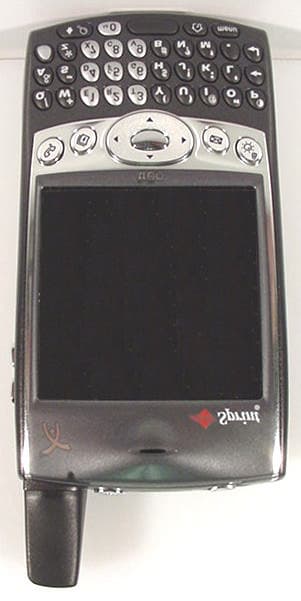
Click to zoom
Application Details
- Equipment Class
- PCE - PCS Licensed Transmitter held to ear
- Date of Grant
- Jul 20, 2003
- Application Purpose
- Original Equipment
- Date of Application
- Jul 20, 2003
- Equipment Note
- Treo 600 CDMA PDA Phone
- Frequency Range
- 1851.25000000 - 1908.75000000
- Company
- Palm Inc
- Country
- United States
Documents & Files
Document Text
Text extracted from the exhibit documents filed with the FCC. Open a document above to read the original.
Users Manual
Start Here to Activate a Guide to Your Treo 600 Smartphone Start Here.book Page a Thursday, July 17, 2003 4:43 PM Start Here.book Page b Thursday, July 17, 2003 4:43 PM PCS Service www.sprintpcs.com Copyright © 2003 Sprint Spectrum L.P. All rights reserved. No reproduction in whole or in part without prior written approval. Sprint and the diamond logo design are trademarks of Sprint Communications Company L.P. All other trademarks are the property of their respective owners. Portions copyright © 2003 Handspring, Inc. All rights reserved. Handspring, Treo, and the Treo logo are trademarks of Handspring, Inc., and may be registered in some jurisdictions. Blazer Web Browser and the Handspring logo are registered trademarks of Handspring, Inc., are registered trademarks in the U.S.A., and may be registered in other jurisdictions. Palm OS and HotSync are registered trademarks, and Palm and the Palm Powered logo are trademarks, of PalmSource, Inc., and are used by Handspring under license. This product contains ACCESS Co., Ltd.’s NetFront 3.0 Internet browser software. © 1996-2003 ACCESS Co., Ltd. and ACCESS Systems America, Inc. NetFront is the trademark or registered trademark of ACCESS Co., Ltd. in Japan and in other countries except the United States of America. NetFront is a registered trademark of NetFront Communications, Inc. in the United States of America and is used under a license. All other trademarks and trade names are the property of their respective owners. Printed in the U.S.A. 50-0118-00 Start Here.book Page c Thursday, July 17, 2003 4:43 PM Start Here.book Page d Thursday, July 17, 2003 4:43 PM Table of Contents How to Use This Guide . . . . . . . . . . . . . . . . . . . . . . . . . . . . . . . . . . . . . . . . . . . . . . . . . . . . . . . . . . . . . . . . i Where to learn more . . . . . . . . . . . . . . . . . . . . . . . . . . . . . . . . . . . . . . . . . . . . . . . . . . . . . . . . . . . . . . . . . . ii Setting Up . . . . . . . . . . . . . . . . . . . . . . . . . . . . . . . . . . . . . . . . . . . . . . . . . . . . . . . . . . . . . . . . . . . . . . . . . . . 1 Getting Started . . . . . . . . . . . . . . . . . . . . . . . . . . . . . . . . . . . . . . . . . . . . . . . . . . . . . . . . . . . . . . . . . . . . . . . 7 Connecting . . . . . . . . . . . . . . . . . . . . . . . . . . . . . . . . . . . . . . . . . . . . . . . . . . . . . . . . . . . . . . . . . . . . . . . . . 17 Basics of Your PCS Phone . . . . . . . . . . . . . . . . . . . . . . . . . . . . . . . . . . . . . . . . . . . . . . . . . . . . . . . . . . . . 23 Your New PCS Phone . . . . . . . . . . . . . . . . . . . . . . . . . . . . . . . . . . . . . . . . . . . . . . . . . . . . . . . . . . . . . . 24 Your Phone’s Features: Top View . . . . . . . . . . . . . . . . . . . . . . . . . . . . . . . . . . . . . . . . . . . . . . . 24 Your Phone’s Features: Front View . . . . . . . . . . . . . . . . . . . . . . . . . . . . . . . . . . . . . . . . . . . . . . 25 Your Phone’s Features: Back View . . . . . . . . . . . . . . . . . . . . . . . . . . . . . . . . . . . . . . . . . . . . . . 26 Turning Your Phone On and Off . . . . . . . . . . . . . . . . . . . . . . . . . . . . . . . . . . . . . . . . . . . . . . . . . . . . . 27 Turning Wireless Mode ON . . . . . . . . . . . . . . . . . . . . . . . . . . . . . . . . . . . . . . . . . . . . . . . . . . . . 27 Turning Wireless Mode OFF . . . . . . . . . . . . . . . . . . . . . . . . . . . . . . . . . . . . . . . . . . . . . . . . . . . . 27 Turning the Screen On and Off . . . . . . . . . . . . . . . . . . . . . . . . . . . . . . . . . . . . . . . . . . . . . . . . . 27 Launching Applications . . . . . . . . . . . . . . . . . . . . . . . . . . . . . . . . . . . . . . . . . . . . . . . . . . . . . . . . . . . . 28 Moving Around the Treo Screen . . . . . . . . . . . . . . . . . . . . . . . . . . . . . . . . . . . . . . . . . . . . . . . . . . . . 30 Scrolling Through Screens . . . . . . . . . . . . . . . . . . . . . . . . . . . . . . . . . . . . . . . . . . . . . . . . . . . . . 30 Highlighting Items . . . . . . . . . . . . . . . . . . . . . . . . . . . . . . . . . . . . . . . . . . . . . . . . . . . . . . . . . . . 31 Accessing Command Buttons . . . . . . . . . . . . . . . . . . . . . . . . . . . . . . . . . . . . . . . . . . . . . . . . . . . 32 Choosing or Activating Items . . . . . . . . . . . . . . . . . . . . . . . . . . . . . . . . . . . . . . . . . . . . . . . . . . . 32 Selecting Menu Items . . . . . . . . . . . . . . . . . . . . . . . . . . . . . . . . . . . . . . . . . . . . . . . . . . . . . . . . . 32 Choosing Options in a Pick List . . . . . . . . . . . . . . . . . . . . . . . . . . . . . . . . . . . . . . . . . . . . . . . . . 33 Using the Keyboard . . . . . . . . . . . . . . . . . . . . . . . . . . . . . . . . . . . . . . . . . . . . . . . . . . . . . . . . . . . . . . . . 34 Using the Keyboard Backlight . . . . . . . . . . . . . . . . . . . . . . . . . . . . . . . . . . . . . . . . . . . . . . . . . . 34 Entering Lowercase and Uppercase Letters . . . . . . . . . . . . . . . . . . . . . . . . . . . . . . . . . . . . . . . 34 Entering Numbers, Punctuation, and Symbols that Appear Above the Letters on the Keys . . 35 Entering Other Symbols and Accented Characters . . . . . . . . . . . . . . . . . . . . . . . . . . . . . . . . . . 35 Using Your Treo Phone, Web, and Messaging Features . . . . . . . . . . . . . . . . . . . . . . . . . . . . . . . . . 37 Making Calls . . . . . . . . . . . . . . . . . . . . . . . . . . . . . . . . . . . . . . . . . . . . . . . . . . . . . . . . . . . . . . . . . . . . . 38 Dialing With the Keyboard . . . . . . . . . . . . . . . . . . . . . . . . . . . . . . . . . . . . . . . . . . . . . . . . . . . . . 38 Dialing by Contact Name . . . . . . . . . . . . . . . . . . . . . . . . . . . . . . . . . . . . . . . . . . . . . . . . . . . . . . 38 Start Here.book Page e Thursday, July 17, 2003 4:43 PM Dialing With a Favorites Button . .…
Text truncated - open the document above for the full version.
Cover Letter(s)
To: Mr. Tim Johnson American Telecommunications Certification Body Inc. 6731 Whittier Ave, McLean, VA 22101 From: David Waitt Sr. Regulatory Engineer, Handspring, Inc July 15, 2003 RE: FCC ID: O8FBW Mr. Johnson, The additional information you requested regarding our recent FCC certification application (FCC ID: O8FBW) is below. I hope this addresses your concerns. If you would like any further information, please do not hesitate to contact me at [email protected] . Your questions are included for your reference below, along with the reply Best Regards David Waitt ATCB 1) Please provide a parts list for this device. If necessary, please update the confidentiality letter. Handspring) The parts list was inadvertently omitted form the application when it was uploaded. The parts list has been uploaded to the site. A revised confidentiality letter has also been uploaded. ATCB 2) Please provide internal photograph of the following: a) Area underneath the shield located next to the camera and underneath the Radio Module. Handspring) The area you are referring to here is not shielding any components. It is the back if the metal SD card housing that is soldered to the main PC board. b) Area underneath the insulation material located on the back of the main board. Handspring) An additional photo has been uploaded to the ATCB site ATCB 3) Information in the artwork for the label appears to show the FCC logo. Please explain if this is being utilized on the device and for what approval it pertains. Handspring) This lower left corner of the drawing is simply being used as a “Logo Storage Bin” for various foreign regulatory marks in case future foreign certifications require a regulatory mark. The marks do not appear on the device being certified. The only marks appearing on the device currently being certified are those shown on the back of the unit in the drawing. ATCB 4) Please provide the DC voltages/currents applied into the transmitter module for normal operation over the power range. Handspring) The RF module operates on a nominal voltage of 3.6 Volts. The maximum operating voltage range of the RF module is 3.5VDC to 4.6VDC Handspring, Inc. 189 Bernardo Ave. Mountain View, CA 94043 ATCB 5) The users manual appears to be missing information required by 15.21. Although portions of this information appears (relative to the antenna), it does not appear to be complete. Handspring) The manuals will be edited to include the statement below. ATCB 6) Due to the information given in the users manual (page 20), this device may also be considered a PC peripheral. Please comment on if appropriate testing has been performed (under a DoC) and note that additional labeling and manual statements may be necessary. Please call to discuss. EMC Report - 800 MHz CDMA Handspring ) Handspring will certify the unintentional radiator portion of the cellphone, thus only requiring the FCC ID on the device. Pertinent DoC documentation will be uploaded to the ATCB site 800MHz ATCB 7) I believe that CDMA 800 MHz allows for channels in the 824.7 - 848.31 MHz, However the test report page 3 of 17 states 825.25 - 847.75 MHz. Note that the FCC requires testing at the lowest/highest available channels in each block. Please explain. Handspring) 824.7 – 848.31 MHz is correct. The report has been updated to reflect the correct frequency range of operation. ATCB 8) The test report page 4 of 17 mentions the EUT is an amplifier regarding Frequency Stabilization which does not apply to this device. Please correct. Handspring) The reference to the EUT being an amplifier has been removed. ATCB 9) In the Substitution Methods (page 6 of 31 of 800 MHz CDMA) Note 1 explains that the EIRP = Pin + reduced by db Value + Gain. However it appears that the Pin value may already be corrected by the "reduced by dB value" instead of factored in the calculation as the note implies. Please confirm that the data is correct and provide further clarification regarding the calculations. Please correct the table if necessary. Handspring) The statement has been modified to reflect the values stated on the substitution table. Also a new table summarizing the data has been included on the report. The revised report has been uploaded to the ATCB site. ATCB 10) Please correct or add the ERP value for power output to the results in page 7 of 17. Note that the FCC uses ERP for Part 22. Handspring) Power has been included as ERP in the report page 7 of 17 of the revised report ATCB 11) Compliance with the low end of the B* block can not be determined from the plot provided on page 17 of 31 (800 MHz CDMA) since the block edge starts at 846.5. Please provide a new plot for this bandedge. Handspring) A new plot showing the correct bandedge at 846.5 MHz has been provided. New revised report has been uploaded. ATCB 12) The frequency stability results for temperature look unusually small (page 46 & 47). Please check results to see if they are actually listed properly and the correct units is given in the table (Hz). Handspring) The units of the number reported initially should have been MHz. The revised the report shows the drift in Hz. Antenna Care / Unauthorized Modifications Use only the supplied integral antenna. Unauthorized antenna modifications or attachments could damage the unit and may violate FCC regulations. Any changes or modifications not expressly approved by the party responsible for compliance could void the user's authority to operate the equipment. ATCB 13) FYI. As of February 2003, the FCC implements revisions to Part 22. For future reports, please follow the requirements of these revisions, as it will make reviewing the reports much easier since many section references are different than previously. Attached is a copy of the changes to Part 22. EMC Report - 1900 MHz CDMA Handspring) Noted, and Thank you 1900MHz ATCB 14) The test report page 4 of 17 mentions the EUT is an amplifier regarding Frequency Stabilization which does not apply to this device…
Text truncated - open the document above for the full version.
Cover Letter(s)
To: Mr. Tim Johnson American Telecommunications Certification Body Inc. 6731 Whittier Ave, McLean, VA 22101 From: David Waitt Sr. Regulatory Engineer, Handspring, Inc July 21, 2003 RE: FCC ID: O8FBW Mr. Johnson, The additional information you requested regarding our recent FCC certification application (FCC ID: O8FBW) is below. I hope this addresses your concerns. If you would like any further information, please do not hesitate to contact me at [email protected] . Your questions are included for your reference below, along with the reply Best Regards David Waitt Part 15 Class B review ATCB 1) The cover page and explanation of limits in the front of the report all show FCC Class B. However, all limits and test distances applied are per the EN55022 Class standard without any explanation. Please explain. Handspring ) The limits of CISPR 22 were used during the testing. Notes indicating this have been added to the report. A revised report has been uploaded to the ATCB site. ATCB 2) Please provide the test photographs as part of a separate exhibit. Handspring ) The test setup pictures have been uploaded to the ATCB site as a separate file. ATCB 3) From looking at the operational description, it appears that this device (not including the transceivers) has a 144 MHz clock. According to 15.33(b)(1), this requires digital device emissions testing to be performed up to 2 GHz. It does not appear that this testing was performed. Note that EN55022 does not have this requirement. Handspring ) A radiated emissions scan of the device was conducted from 1 to 2 GHz. The highest emissions measured was at 1216.729GHz @ 14.1 dB below the limit. A note indicating this has been added to the revised report. ATCB 4) Please provide the RBW and VBW settings used for the following: a) 30 - 1000 MHz Radiated b) > 1000 MHz Radiated c) 0.15 - 30 MHz Conducted Handspring ) a) 30 - 1000 MHz Radiated RBW=120KHz VBW=300kHz b) > 1000 MHz Radiated RBW=1MHz VBW=1MHz c) 0.15 - 30 MHz Conducted RBW=9kHz VBW=30kHz Notes indicating these values have been added to the revised report. Handspring, Inc. 189 Bernardo Ave. Mountain View, CA 94043
Cover Letter(s)
July 16, 2003 Federal Communications Commission Office of Engineering and Technology Equipment Authorization Division 7345 Oakland Mills Road Columbia, Maryland 21046 Subject: Confidentiality request for FCC ID: O8FBW To whom it may concern, Handspring requests that the following documents contained in this certification application be withheld from public disclosure. All schematic diagrams (”Treo_600_Schematic.pdf”) All electrical block diagrams (“Treo_600_Block_Diagram.pdf”) All Theory of operations (“Treo_600_Hardware_Spec.pdf”) All Parts Lists (“Parts_list_Treo600_CDMA.pdf”) Handspring also certifies that no party to this application is subject to denial of benefits, including FCC benefits, pursuant to section 5301 of the anti-drug abuse act of 1988, 21 U.S.C 853(a) Sincerely David Waitt Sr. Regulatory Engineer Handspring, Inc. 189 Bernardo Ave. Mountain View, CA 94043
Cover Letter(s)
American Telecommunications Certification Body Inc. 6731 Whittier Ave, McLean, VA 22101 July 11, 2003 RE: Handspring Inc. FCC ID: O8FBW After a review of the submitted information, I have a few comments on the above referenced Application. General 1) Please provide a parts list for this device. If necessary, please update the confidentiality letter. 2) Please provide internal photograph of the following: a) Area underneath the shield located next to the camera and underneath the Radio Module. b) Area underneath the insulation material located on the back of the main board. 3) Information in the artwork for the label appears to show the FCC logo. Please explain if this is being utilized on the device and for what approval it pertains. 4) Please provide the DC voltages/currents applied into the transmitter module for normal operation over the power range. 5) The users manual appears to be missing information required by 15.21. Although portions of this information appears (relative to the antenna), it does not appear to be complete. 6) Due to the information given in the users manual (page 20), this device may also be considered a PC peripheral. Please comment on if appropriate testing has been performed (under a DoC) and note that additional labeling and manual statements may be necessary. Please call to discuss. EMC Report - 800 MHz CDMA 7) I believe that CDMA 800 MHz allows for channels in the 824.7 - 848.31 MHz, However the test report page 3 of 17 states 825.25 - 847.75 MHz. Note that the FCC requires testing at the lowest/highest available channels in each block. Please explain. 8) The test report page 4 of 17 mentions the EUT is an amplifier regarding Frequency Stabilization which does not apply to this device. Please correct. 9) In the Substitution Methods (page 6 of 31 of 800 MHz CDMA) Note 1 explains that the EIRP = Pin + reduced by db Value + Gain. However it appears that the Pin value may already be corrected by the "reduced by dB value" instead of factored in the calculation as the note implies. Please confirm that the data is correct and provide further clarification regarding the calculations. Please correct the table if necessary. 10) Please correct or add the ERP value for power output to the results in page 7 of 17. Note that the FCC uses ERP for Part 22. 11) Compliance with the low end of the B* block can not be determined from the plot provided on page 17 of 31 (800 MHz CDMA) since the block edge starts at 846.5. Please provide a new plot for this bandedge. 12) The frequency stability results for temperature look unusually small (page 46 & 47). Please check results to see if they are actually listed properly and the correct units is given in the table (Hz). 13) FYI. As of February 2003, the FCC implements revisions to Part 22. For future reports, please follow the requirements of these revisions, as it will make reviewing the reports much easier since many section references are different than previously. Attached is a copy of the changes to Part 22. EMC Report - 1900 MHz CDMA 14) The test report page 4 of 17 mentions the EUT is an amplifier regarding Frequency Stabilization which does not apply to this device. Please correct. 15) In the Substitution Methods (page 6 of 31 of 800 MHz CDMA) Note 1 explains that the EIRP = Pin + reduced by db Value + Gain. However it appears that the Pin value may already be corrected by the "reduced by dB value" instead of factored in the calculation as the note implies. Please confirm that the data is correct and provide further clarification regarding the calculations. Please correct the table if necessary. --- Continued on Next Page --- z Page 2July 15, 2003 16) The high channel block C 1270 on page 15 appears over 2 MHz below the band edge. Please confirm if this is the actual highest channel used in this block. Otherwise pleas provide a new plot for this bandedge. 17) Please explain the 0.0631 ppm listed for 1900 MHz CDMA. It appears from the report this should be 0.0551 ppm based on 102 Hz at 1851.25 MHz. SAR Report 18) The frequencies listed in the SAR report for CDMA 800 MHz are 824.7 - 848.31 MHz. However the EMC test report page 3 of 17 states 825.25 - 847.75 MHz. Note that the FCC requires testing at the lowest/highest available channels in each block. Please explain. 19) The FCC asks that we compare the EMC and SAR power measurements for purposes of ensuring the power during SAR was set to maximum. However the EMC reports only listed ERP and EIRP power measurements while the SAR report included conducted measurements. Please explain how a comparison between the 2 can be shown. Timothy R. Johnson Examining Engineer mailto: [email protected] The items indicated above must be submitted before processing can continue on the above referenced application. Failure to provide the requested information may result in application termination. Correspondence should be considered part of the permanent submission and may be viewed from the Internet after a Grant of Equipment Authorization is issued. Please do not respond to this correspondence using the email reply button. In order for your response to be processed expeditiously, you must submit your documents through the AmericanTCB.com website. Also, please note that partial responses increase processing time and should not be submitted. Any questions about the content of this correspondence should be directed to the sender.
Cover Letter(s)
American Telecommunications Certification Body Inc. 6731 Whittier Ave, McLean, VA 22101 July 20, 2003 RE: Handspring Inc. FCC ID: O8FBW After a review of the submitted information, I have a few comments on the above referenced Application. Part 15 Class B review 1) The cover page and explanation of limits in the front of the report all show FCC Class B. However, all limits and test distances applied are per the EN55022 Class standard without any explanation. Please explain. 2) Please provide the test photographs as part of a separate exhibit. 3) From looking at the operational description, it appears that this device (not including the transceivers) has a 144 MHz clock. According to 15.33(b)(1), this requires digital device emissions testing to be performed up to 2 GHz. It does not appear that this testing was performed. Note that EN55022 does not have this requirement. 4) Please provide the RBW and VBW settings used for the following: a) 30 - 1000 MHz Radiated b) > 1000 MHz Radiated c) 0.15 - 30 MHz Conducted Timothy R. Johnson Examining Engineer mailto: [email protected] The items indicated above must be submitted before processing can continue on the above referenced application. Failure to provide the requested information may result in application termination. Correspondence should be considered part of the permanent submission and may be viewed from the Internet after a Grant of Equipment Authorization is issued. Please do not respond to this correspondence using the email reply button. In order for your response to be processed expeditiously, you must submit your documents through the AmericanTCB.com website. Also, please note that partial responses increase processing time and should not be submitted. Any questions about the content of this correspondence should be directed to the sender.
External Photos
© 2003 Celltech Labs Inc. HANDSPRING INC. FCC ID: O8FBW Treo 600 Dual-Band PCS/Cellular CDMA Phone EXTERNAL EUT PHOTOGRAPHS © 2003 Celltech Labs Inc.HANDSPRING INC. FCC ID: O8FBW Treo 600 Dual-Band PCS/Cellular CDMA Phone EXTERNAL EUT PHOTOGRAPHS © 2003 Celltech Labs Inc. HANDSPRING INC. FCC ID: O8FBW Treo 600 Dual-Band PCS/Cellular CDMA Phone EXTERNAL EUT PHOTOGRAPHS Leather Side Case with Belt-Clip Accessory (P/N: SKU3155WW) © 2003 Celltech Labs Inc.HANDSPRING INC. FCC ID: O8FBW Treo 600 Dual-Band PCS/Cellular CDMA Phone EXTERNAL EUT PHOTOGRAPHS Fitted Leather Case with Belt-Clip & Ear-Microphone Accessories (P/N:SKU3154WW)
ID Label/Location Info
A B R ev-02 E V T -2 Artwork DAT E R ev-03 DV T -1 C olor C ha nge to P a ntone 8402C C ha nged a rtwork, remoed S D a nd C E R ev-04 DV T -2 a nd C V T Artwork, Added F C C a nd IC numbers . 5. 02. 03 R ev-05 C ha nged -00 C olor to N ypro-Da rk G ra y 5. 07. 03 Artwork, B ottom H ous ing, P a d P rint, C DMA, S print 51-0627-X X , R ev-05 Ma y 7, 2003 C rea ted by: Da vid H oenig 10.0 25.0 R egula tory a nd P a lm P owered P a d P rinted C olor: S E E C O L O R T AB L E N 217 P a tents P ending O R IG IN A L A R T WO R K C U S FCC ID O8FBW IC:3959BW Assembled in Mexico C olor T a ble 51-0627-X X -00 N ypro-Da rk G ra y/P a ntone 8402C R oa drunner
Internal Photos
© 2003 Celltech Labs Inc.HANDSPRING INC. FCC ID: O8FBW Treo 600 Dual-Band PCS/Cellular CDMA Phone INTERNAL EUT PHOTOGRAPHS © 2003 Celltech Labs Inc.HANDSPRING INC. FCC ID: O8FBW Treo 600 Dual-Band PCS/Cellular CDMA Phone INTERNAL EUT PHOTOGRAPHS © 2003 Celltech Labs Inc.HANDSPRING INC. FCC ID: O8FBW Treo 600 Dual-Band PCS/Cellular CDMA Phone INTERNAL EUT PHOTOGRAPHS © 2003 Celltech Labs Inc.HANDSPRING INC. FCC ID: O8FBW Treo 600 Dual-Band PCS/Cellular CDMA Phone INTERNAL EUT PHOTOGRAPHS © 2003 Celltech Labs Inc.HANDSPRING INC. FCC ID: O8FBW Treo 600 Dual-Band PCS/Cellular CDMA Phone INTERNAL EUT PHOTOGRAPHS © 2003 Celltech Labs Inc.HANDSPRING INC. FCC ID: O8FBW Treo 600 Dual-Band PCS/Cellular CDMA Phone INTERNAL EUT PHOTOGRAPHS © 2003 Celltech Labs Inc.HANDSPRING INC. FCC ID: O8FBW Treo 600 Dual-Band PCS/Cellular CDMA Phone INTERNAL EUT PHOTOGRAPHS © 2003 Celltech Labs Inc.HANDSPRING INC. FCC ID: O8FBW Treo 600 Dual-Band PCS/Cellular CDMA Phone INTERNAL EUT PHOTOGRAPHS
Internal Photos
Handspring, Treo 600, Internal Photo, Main PC board, Foam removed. Reply to ATCB inquiry # 2B
Parts List/Tune Up Info
July 7, 2003 Federal Communications Commission Office of Engineering and Technology Equipment Authorization Division 7345 Oakland Mills Road Columbia, Maryland 21046 Subject: Tune Up procedure for the CDMA Treo 600 Gentlemen, The CDMA RF module within the Treo 600 CDMA version is simply a purchased component. The module is calibrated and adjusted at the manufacturers facility. The calibration / tune up procedure is a confidential document of the manufacturer of the module. Handspring does not perform any additional calibration or adjustments to the module after it is delivered to Handspring nor does Handspring have access to the calibration procedure. If there are any questions, please do not hesitate to contact me at [email protected] Sincerely David Waitt Sr. Regulatory Engineer Handspring, Inc. 189 Bernardo Ave. Mountain View, CA 94043
RF Exposure Info
Test Report S/N:062303-394O8F Test Date(s):June 23-25, 2003 Test Type:FCC SAR Evaluation © 2003 Celltech Labs Inc.1 of 26 DECLARATION OF COMPLIANCE SAR EVALUATION Test Lab CELLTECH LABS INC. Testing and Engineering Lab 1955 Moss Court Kelowna, B.C. Canada V1Y 9L3 Phone:250-448-7047 Fax:250-448-7046 e-mail:[email protected] web site:www.celltechlabs.com Applicant Information HANDSPRING INC. 189 Bernardo Avenue Mountain View, CA 94043-5203 FCC Rule Part(s):47 CFR §2.1093 Test Procedure(s):FCC OET Bulletin 65, Supplement C (01-01) IEEE Standard 1528-200X (Draft) FCC ID: O8FBW Model(s):Treo 600 Device Type:Dual-Band PCS/Cellular CDMA Phone FCC Classification:PCS Licensed Transmitter held to ear (PCE) Mode(s) of Operation:PCS CDMA / Cellular CDMA Tx Frequency Range(s):1851.25 - 1908.75 MHz (PCS CDMA) 824.70 - 848.31 MHz (Cellular CDMA) Max. RF Conducted Power Tested:24.1 dBm (PCS CDMA) 24.1 dBm (Cellular CDMA) Antenna Type:Fixed Stubby Battery Type:3.6V Lithium-ion (1800mAh) Body-Worn Accessories Tested:Leather Side Case with Belt-Clip (P/N: SKU3155WW) Leather Case with Removable Belt-Clip (P/N: SKU3154WW) Ear-Microphone Max. SAR Measured:PCS Band: 1.53 W/kg (Head) / 0.861 W/kg (Body) Cellular Band: 1.53 W/kg (Head) / 0.822 W/kg (Body) Celltech Labs Inc. declares under its sole responsibility that this device was found to be in compliance with the Specific Absorption Rate (SAR) RF exposure requirements specified in FCC 47 CFR §2.1093. The device was tested in accordance with the measurement standards and procedures specified in FCC OET Bulletin 65, Supplement C (Edition 01-01), and IEEE Standard 1528-200X (Draft) for the General Population / Uncontrolled Exposure environment. All measurements were performed in accordance with the SAR system manufacturer recommendations. I attest to the accuracy of data. All measurements were performed by me or were made under my supervision and are correct to the best of my knowledge and belief. I assume full responsibility for the completeness of these measurements and vouch for the qualifications of all persons taking them. This test report shall not be reproduced partially, or in full, without the prior written approval of Celltech Labs Inc. The results and statements contained in this report pertain only to the device(s) evaluated. Russell W. Pipe Senior Compliance Technologist Celltech Labs Inc. Test Report S/N:062303-394O8F Test Date(s):June 23-25, 2003 Test Type:FCC SAR Evaluation © 2003 Celltech Labs Inc.2 of 26 TABLE OF CONTENTS 1.0INTRODUCTION.....................................................................3 2.0DESCRIPTION OF EUT............................................................3 3.0SAR MEASUREMENT SYSTEM ...............................................4 4.0MEASUREMENT SUMMARY.....................................................5-8 5.0DETAILS OF SAR EVALUATION...............................................9-10 6.0EVALUATION PROCEDURES...................................................11 7.0SYSTEM PERFORMANCE CHECK............................................12 8.0EQUIVALENT TISSUES...........................................................13 9.0SAR LIMITS...........................................................................13 10.0SYSTEM SPECIFICATIONS......................................................14 11.0SAM PHANTOM......................................................................15 12.0DEVICE HOLDER....................................................................15 13.0PROBE SPECIFICATION.........................................................15 14.0TEST EQUIPMENT LIST...........................................................16 15.0MEASUREMENT UNCERTAINTIES............................................17-18 16.0REFERENCES........................................................................19 APPENDIX A - SAR MEASUREMENT DATA...........................................20 APPENDIX B - SYSTEM PERFORMANCE CHECK DATA.........................21 APPENDIX C - SYSTEM VALIDATION...................................................22 APPENDIX D - PROBE CALIBRATION..................................................23 APPENDIX E - MEASURED FLUID DIELECTRIC PARAMETERS...............24 APPENDIX F - SAM PHANTOM CERTIFICATE OF CONFORMITY.............25 APPENDIX G - SAR TEST SETUP PHOTOGRAPHS................................26 Test Report S/N:062303-394O8F Test Date(s):June 23-25, 2003 Test Type:FCC SAR Evaluation © 2003 Celltech Labs Inc.HANDSPRING I…
Text truncated - open the document above for the full version.
Contact Information
Applicant
Helen Zhao(Sr. Regulatory Compliance Engineer)
Technical Contact
Handspring Inc.David Waitt
[email protected]650 862 3629
189 Bernardo Ave. · Mt View, California · United States
Non-Technical Contact
Handspring Inc.David Waitt
[email protected]650 862 3629
Test Firm
Elliott Laboratories LLCDavid Bare
Technical Specifications
| # | Rule Parts | Frequency Range | Power Output | Emission | Tolerance |
|---|---|---|---|---|---|
| 2 | 24E | 1.85 GHz - 1.91 GHz | 251.00 mW | 1M30F9W | 0.06 ppm |
Other Applications from Palm Inc

O8F-BROY
Feb 21, 2011Phone
Equipment Class
PCE - PCS Licensed Transmitter held to ear
O8F-BROU
Feb 10, 2011Phone
Equipment Class
DXX - Part 15 Low Power Communication Device Transmitter
O8F-ROAE
Oct 18, 2010CDMA/1x EVDO phone with 802.11 b/g and Bluetooth
Equipment Class
DTS - Digital Transmission System
O8F-ROAU
Oct 18, 2010UMTS Phone with 802.11b/g and Bluetooth
Equipment Class
PCE - PCS Licensed Transmitter held to ear
O8F-ROAY
Oct 05, 2010GSM phone with 802.11a/b/g and Bluetooth
Equipment Class
DTS - Digital Transmission System