OIIDTSA1900-2
Omnipoint Technologies, Incorporated
Click to zoom
Application Details
- Equipment Class
- PCB - PCS Licensed Transmitter
- Date of Grant
- Aug 30, 1999
- Application Purpose
- Original Equipment
- Date of Application
- May 12, 1999
- Frequency Range
- 1850.20000000 - 1909.80000000
- Country
- United States
Documents & Files
Document Text
Text extracted from the exhibit documents filed with the FCC. Open a document above to read the original.
Users Manual
This document is in DRAFT format and is subject to change at Omnipoint Technologies sole discretion at any time. .......... . . . . . . . . . . Wireless Solutions Division Omnipoint Technologies, Inc. Redhawk TM User’s Guide and Technical Manual GSM Wireless Terminal Wireless Solutions Division Omnipoint Technologies, Inc. 1365 Garden of the Gods Road Colorado Springs, CO 80907 www.omnipoint-tech.com This document is in DRAFT format and is subject to change at Omnipoint Technologies sole discretion at any time. 2 Important Safety Information Some of the following information may not apply to all devices described in this manual. However, precautions should be observed when handling any electrical device. ♦ Save this manual, it contains important safety information and operating instructions. ♦ Do not expose this product to open flames. ♦ Care should be taken so that liquids do not spill into the devices. ♦ Connection to AC power should only be performed by a qualified electrician. ♦ Do not attempt to disassemble the product. Doing so will void warranty. This product does not contain consumer serviceable components. (This does not apply to Subscriber Identification Modules (SIMs)). Guidelines for Safe Use The Redhawk TM products are a radio transmitter and receiver intended for fixed and mobile uses only. They comply with the RF hazard requirements applicable to fixed PCS equipment operating under the authority of 47 CFR Part 24, Subpart E of the FCC Rules and Regulations when installed properly. The Redhawk TM products comply with FCC requirements for Human Exposure by meeting these requirements: 1. The device’s antenna must be installed no closer than 20 cm to any person. 2. Only fixed and mobile applications are permitted. 3. Portable applications (within 20 cm of any person) are strictly prohibited. 4. Antenna gain is limited to a maximum of 7 dBi for fixed applications. 5. Antenna gain is limited to a maximum of 3 dBi for mobile applications. This document is in DRAFT format and is subject to change at Omnipoint Technologies sole discretion at any time. 3 . . . . Redhawk TM User’s Guide and Technical Manual GSM Wireless Modem INTRODUCTION ........................................................................................................................................... 5 GSM Overview ................................................................................................................................ 6 TECHNICAL SPECIFICATIONS.................................................................................................................. 7 Physical ............................................................................................................................................ 7 Environmental .................................................................................................................................. 9 Interfaces ....................................................................................................................................... 10 Status Indication............................................................................................................................. 12 MODES OF OPERATION .......................................................................................................................... 13 Circuit Switched Data ..................................................................................................................... 13 SMS ............................................................................................................................................... 13 USSD ............................................................................................................................................. 14 VOICE ............................................................................................................................................ 14 SOFTWARE INTERFACE.......................................................................................................................... 15 AT Command Set .......................................................................................................................... 15 DTM Initialization and Setup Examples ......................................................................................... 18 TROUBLESHOOTING ............................................................................................................................... 22 GLOSSARY/ACRONYMS.......................................................................................................................... 23 APPENDIX A: REGULATORY INFORMATION ..................................................................................... 25 FCC Registration............................................................................................................................ 25 Human Exposure Compliance .......................................................................................................25 NRTL Approval............................................................................................................................... 26 GSM 1900 Type Approval / Type Certification ............................................................................... 26 This document is in DRAFT format and is subject to change at Omnipoint Technologies sole discretion at any time. 4 APPENDIX B: DTM INSTALLATION AND SERVICE ............................................................................ 27 Scope ............................................................................................................................................. 27 DTM On-Site Installation, Connectivity and Provisioning Requirements ....................................... 27 Care and Maintenance................................................................................................................... 35 Applicable Documents ......................…
Text truncated - open the document above for the full version.
Users Manual
Redhawk User’s Guide & Technical Specification v.00H7/2/99 This document is in DRAFT format and is subject to change at Omnipoint Technologies sole discretion at any time. .......... . . . . . . . Wireless Solutions Division Omnipoint Technologies, Inc. Redhawk TM User’s Guide and Technical Manual GSM Wireless Terminal Wireless Solutions Division Omnipoint Technologies, Inc. 1365 Garden of the Gods Road Colorado Springs, CO 80907 www.omnipoint-tech.com Redhawk User’s Guide & Technical Specification v.00I7/2/99 This document is in DRAFT format and is subject to change at Omnipoint Technologies sole discretion at any time. 2 Important Safety Information Some of the following information may not apply to all devices described in this manual. However, precautions should be observed when handling any electrical device. ♦ Save this manual, it contains important safety information and operating instructions. ♦ Do not expose this product to open flames. ♦ Care should be taken so that liquids do not spill into the devices. ♦ Connection to AC power should only be performed by a qualified electrician. ♦ Do not attempt to disassemble the product. Doing so will void warranty. This product does not contain consumer serviceable components. (This does not apply to Subscriber Identification Modules (SIMs)). Guidelines for Limiting RF Exposure The Redhawk TM products are a radio transmitter and receiver intended for fixed and mobile uses only. They comply with the RF hazard requirements applicable to fixed PCS equipment operating under the authority of 47 CFR Part 24, Subpart E of the FCC Rules and Regulations when installed properly. The Redhawk TM products comply with FCC requirements for Human Exposure by meeting these requirements: 1. The device’s antenna must be installed no closer than 20 cm to any person. 2. Only fixed and mobile applications are permitted. 3. Portable applications (within 20 cm of any person) are strictly prohibited. 4. Antenna gain is limited to a maximum of 7 dBi for fixed applications. 5. Antenna gain is limited to a maximum of 3 dBi for mobile applications. NOTE: Care must be taken by the installer and/or user of the Redhawk TM products to ensure proper antenna selection and installation. Adherence to the above conditions is necessary to comply with FCC requirements for safe operation regarding exposure to RF radiation. The Redhawk TM products may be operated in a desktop environment. The user must take special precautions to ensure the 20 cm proximity limit for distance from the antenna to any person is maintained. Redhawk User’s Guide & Technical Specification v.00H5/21/99 This document is in DRAFT format and is subject to change at Omnipoint Technologies sole discretion at any time. 3 Redhawk TM User’s Guide and Technical Manual GSM Wireless Modem INTRODUCTION ........................................................................................................................................... 5 GSM Overview ................................................................................Error! Bookmark not defined. TECHNICAL SPECIFICATIONS.................................................................................................................. 7 Physical ............................................................................................................................................ 7 Environmental .................................................................................................................................. 9 Interfaces ....................................................................................................................................... 10 Status Indication............................................................................................................................. 12 MODES OF OPERATION .......................................................................................................................... 13 Circuit Switched Data ..................................................................................................................... 13 SMS ............................................................................................................................................... 13 USSD ............................................................................................................................................. 14 VOICE ............................................................................................................................................ 14 SOFTWARE INTERFACE.......................................................................................................................... 15 AT Command Set .......................................................................................................................... 15 DTM Initialization and Setup Examples ......................................................................................... 18 TROUBLESHOOTING ............................................................................................................................... 22 GLOSSARY/ACRONYMS.......................................................................................................................... 23 APPENDIX A: REGULATORY INFORMATION ..................................................................................... 25 FCC Registration............................................................................................................................ 25 Human Exposure Compliance .......................................................................................................25 NRTL Approval............................................................................................................................... 26 GSM 1900 Type Approval / Type Certification ............................................................................... 26 Redhawk User’s Guide & Technical Specification v.00I7/2/99 …
Text truncated - open the document above for the full version.
Attestation Statements
Omnipoint Technologies, Inc.Attestation FCC ID: OIIDTSA1900-2Page 1 of 1 This document contains PROPRIETARY and CONFIDENTIAL information of Omnipoint Technologies, Inc. ATTESTATION OF COMPLIANCE TESTING The Omnipoint DTSA (FCC ID: OIIDTSA1900-2 ) has been tested in accordance with the requirements of the Federal Communications Commission to obtain a CERTIFICATION grant of equipment authorization as described in Parts 2 and 24 of the FCC Rules and Regulations, namely 47 CFR Part 2, Subpart J, which details equipment authorization procedures, and 47 CFR Part 24, Subpart E, which sets out the regulations governing broadband personal communications services (PCS) operating in the 1850-1910 and 1930-1990 MHz bands. All tests were performed using measurement procedures and practices consistent with the aforementioned regulations and with industry standards. Each unit manufactured and marketed will conform to the sample tested and the data reported in this filing is representative of the equipment being produced, within the variations that can be expected due to quantity production and testing on a statistical basis. To the best of our knowledge, we certify that the facts set forth in this document and the accompanying technical data are true and correct. We further certify that the measurements described in this document were performed under our direction and supervision at the following locations: Omnipoint Technologies, Inc. 1365 Garden of the Gods Road Colorado Springs, CO 80907 Criterion Technology 1350 Country Road 16 Rollinsville, CO 80474 NAME:Kelly RogersJames Youngman COMPANY:Omnipoint Technologies, Inc.Omnipoint Technologies, Inc. TITLE:Product Design EngineerRegulatory Compliance Consultant SIGNED:____________________________________________________ DATE:May 13, 1999_________ ____May 13, 1999 ______________
Cover Letter(s)
May 13, 1999 Federal Communications Commission Equipment Authorization Division Application Processing Branch 7435 Oakland Mills Road Columbia, MD 21046 ATTN:Mr. Greg Czumak RE:Certification Application for FCC ID: OIIDTSA1900-2 Dear Greg, In fulfillment of the requirements to obtain a CERTIFICATION grant of equipment authorization for equipment operating under 47 CFR Part 24, Subpart E—Broadband PCS, Omnipoint Technologies, Inc. (OTI) respectfully submits for your consideration the attached filing for FCC ID: OIIDTSA1900-2. Included in this electronic submittal are Form 731, Application for Equipment Authorization; Form 159, Remittance Advice and payment in the amount of $655.00; and the documentation and technical information required by 47 CFR Part 2, Subpart J—Equipment Authorization Procedures, Section 2.1033 Application for Certification. Pursuant to Section 0.459 of the Commission's Rules, Omnipoint Technologies, Inc. respectfully requests confidentiality for the following exhibits, and that they be withheld from public inspection at the conclusion of the authorization process: Exhibit 4Tune-Up Procedure Exhibit 5Schematic Diagrams These exhibits contain material considered to be trade secrets of OTI and, as considerable effort has been expended in the development of this product, it is imperative that our competitors do not receive an unfair advantage in the marketplace at the expense of OTI. Should you require any further or additional information to process this application, please do not hesitate to contact me directly. I can be reached by any of the following means: Telephone:(719) 548-1201 X1218 Fax::(719) 448-9683 email:[email protected] Sincerely, Steve Parker Project Manager, Core Development Wireless Solutions Division
ID Label/Location Info
Omnipoint Technologies, Inc.Exhibit 7 FCC ID: OIIDTSA1900-2Page 1 of 1 This document contains PROPRIETARY and CONFIDENTIAL information of Omnipoint Technologies, Inc. EXHIBIT 7 FCC LABELING INFORMATION As required by § 2.1033(c)(11), this exhibit details the FCC Identifier label and its placement on the DTSA. A drawing representative of the actual FCC Identifier label is shown in Figure E7.1; the label itself will be permanently affixed to the DTSA itself as shown in the photo presented as Figure E7.2. Figure E7.1 FCC Label. Figure E7.2. Photograph of DTSA showing FCC Identifier label placement.
Internal Photos
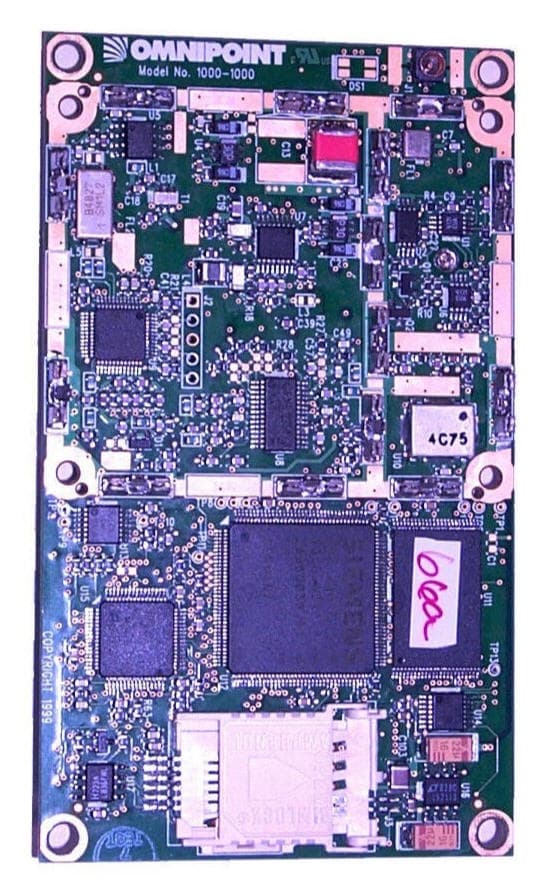
Omnipoint Technologies, Inc.Exhibit 8 FCC ID: OIIDTSA1900-2Page 1 of 6 This document contains PROPRIETARY and CONFIDENTIAL information of Omnipoint Technologies, Inc. EXHIBIT 8 EQUIPMENT PHOTOGRAPHS This exhibit contains a series of digital photographs, as required by § 2.1033(c)(12) which reveal equipment construction and layout, including internal views showing component placement and chassis assembly. Table E18.1. Equipment photographs—photo numbers and description. Photo Number Description 1Top of DTSA PCB 2Bottom of DTSA PCB 3Top of DTSA PCB with RF shields covering radio circuitry removed 4Bottom of DTSA PCB with RF shields covering radio circuitry removed 5Overview of DTM (DTSA with plastic housing) Omnipoint Technologies, Inc.Exhibit 8 FCC ID: OIIDTSA1900-2Page 2 of 6 This document contains PROPRIETARY and CONFIDENTIAL information of Omnipoint Technologies, Inc. Photo 1. Top of DTSA PCB. Omnipoint Technologies, Inc.Exhibit 8 FCC ID: OIIDTSA1900-2Page 3 of 6 This document contains PROPRIETARY and CONFIDENTIAL information of Omnipoint Technologies, Inc. Photo 2. Bottom of DTSA PCB. Omnipoint Technologies, Inc.Exhibit 8 FCC ID: OIIDTSA1900-2Page 4 of 6 This document contains PROPRIETARY and CONFIDENTIAL information of Omnipoint Technologies, Inc. Photo 3. Top of DTSA PCB with RF shields covering radio circuitry removed Omnipoint Technologies, Inc.Exhibit 8 FCC ID: OIIDTSA1900-2Page 5 of 6 This document contains PROPRIETARY and CONFIDENTIAL information of Omnipoint Technologies, Inc. Photo 4. Bottom of DTSA PCB with RF shields covering radio circuitry removed. Omnipoint Technologies, Inc.Exhibit 8 FCC ID: OIIDTSA1900-2Page 6 of 6 This document contains PROPRIETARY and CONFIDENTIAL information of Omnipoint Technologies, Inc. Photo 5. Overview of DTM.
Operational Description
Omnipoint Technologies, Inc. FCC ID: OIIDTSA1900-2Page 1 of 1 This document contains PROPRIETARY and CONFIDENTIAL information of Omnipoint Technologies, Inc. LIST OF EXHIBITS EXHIBIT47 CFR §§CONTENTS 1:2.1033(a) & (c)General Information for Certification 2:2.1033(c)(3)/24.52Installation and Instruction Manual including Human Exposure Compliance Statement 3:2.1033(c)(8)DC Voltages Applied to and Currents into Final Amplifying Device *4:2.1033(c)(9)Tune-up Procedure *5:2.1033(c)(10)Schematic Diagrams 6:2.1033(c)(10)Means for Determining and Stabilizing Frequency, Suppression of Spurious Radiation, Limiting Modulation, and Limiting Power 7:2.1033(c)(11)FCC Labeling Information 8:2.1033(c)(12)Equipment Photographs 9:2.1033(c)(13)Detailed Description of Modulation System 10:2.1033(c)(14)General Measurement Information 11:2.1046/24.232(a)RF Output Power Measurements 12:2.1049Occupied Bandwidth Measurements 13:2.1051/24.238(a)Conducted Spurious Emissions Measurements 14:2.1053Radiated Spurious Emissions Measurements 15:2.1055/24.235Frequency Stability Measurements * = Exhibit filed confidentially with the FCC Omnipoint Technologies, Inc.Exhibit 1 FCC ID: OIIDTSA1900-2Page 1 of 6 This document contains PROPRIETARY and CONFIDENTIAL information of Omnipoint Technologies, Inc. EXHIBIT 1 GENERAL INFORMATION FOR CERTIFICATION The information provided in this exhibit is submitted in response to the requirements of § 2.1033 Application for a certification grant of equipment authorization. General Description of Equipment (Informative) The Omnipoint Technologies, Inc. (OTI) Redhawk 2000 DTSA (Data Terminal Shielded Assembly), Model Number 2000-1001, FCC ID: OIIDTSA1900-2 , is a compact wireless modem which operates under the authority of Part 24, Subpart E—Broadband PCS. The DTSA allows an application to access the Global System for Mobility, or GSM, network, and ultimately the Public Switched Telephone Network (PSTN) or the internet. As a GSM terminal, the DTSA complies with applicable national (PCS-1900) and international (GSM-900) standards including, for example, J-STD-007, PCS Air Interface Specification, and the family of international standards for GSM equipment. Initially intended for fixed uses, the DTSA may be used to wirelessly transmit and receive data, enabling a variety of applications from Automated Meter Reading (AMR) to wireless alarms, e-mail and internet access. These types of PCS applications were made possible by the FCC's adoption in June 1996 of rules permitting flexible service offerings in the commercial mobile radio services (WT Docket No. 96-6, FCC 96-83, "Amendment of the Commission's Rules to Permit Flexible Service Offerings in the Commercial Mobile Radio Services, First Report and Order and Further Notice of Proposed Rulemaking," released August 1, 1996, ¶ 29). The Commission's ruling in this proceeding concluded that fixed services, such as those made possible by the DTSA, are permissible service offerings on spectrum allocated for broadband PCS. An overview of DTSA deployment in a GSM network is shown in Figure E1.1. Functional capabilities of the DTSA include circuit switched data up to 9.6 kpbs, as well as other GSM services for transmitting and receiving data (Short Message Service— SMS, and Unstructured Supplementary Service Data—USSD). The DTSA has been designed to operate over an industrial temperature range (-20 ° C to +60 ° C) and a wide DC input voltage range (+7 VDC to +32 VDC). Communication between the host application and the DTSA is via an RS-232 interface using the GSM AT command set. Physically, the DTSA consists of a single printed circuit board (PCB) of approximate dimensions 6.25" x 3.25". Major components include power regulation, system controller, RS-232 interface, GSM radio, and Subscriber Identity Module (SIM). The equipment described in this application is functionally equivalent to the DTSA previously authorized under FCC ID: OIIRED20001991 , encompassing model numbers RED20001991 and RED20001990. Omnipoint Technologies, Inc.Exhibit 1 FCC ID: OIIDTSA1900-2Page 2 of 6 This document contains PROPRIETARY and CONFIDENTIAL information of Omnipoint Technologies, Inc. User Application Server INTERNET Data Terminal Shielded Assembly (DTSA) Base Transceiver Station (BTS) GSM-1900 RS-232 w/ hw flow control “AT” Commands T1 Mobile Switching Center (MSC) Short Message Service Center (SMSC) VLR - Visitor Location Register HLR - Home Location Register GMSC - Gateway MSC (SMS Out) IWMSC - Inter-working MSC (SMS in) SS7, T1, etc. Base Station Controller (BSC) T1 PSTN User MODEM Voice USER EQUIPMENT SMS DATA PATH CIRCUIT SWITCHED DATA PATH Figure E1.1. DTSA Deployment in a GSM Network. The "Redhawk" product line is a family of wireless (GSM) modem products, of which the DTSA is the first offering, as well as the core module on which all other products are based. As described in the product installation and instruction manual, the "Redhawk" product line currently consists of the following models: • 2000-1001 DTSAOEM version of a GSM modem implemented on a single PCB and the subject of this filing (FCC ID: OIIDTSA1900-2 ). Functionally equivalent to the Redhawk Model RED20001991 (FCC ID: OIIRED20001991 ), the subject of a previous authorization application. • 2000-1000 DTMDTSA supplied with optional plastic housing. No physical, functional or performance differences from, and electrically identical to, the DTSA. FCC labeling and identification of the DTM is the same as that for the DTSA as described in this filing. • 2001-1001 DTUDTSA housed in an environmental (Hoffman) enclosure with internal AC/DC power supply and optional internal patch antenna. Omnipoint Technologies, Inc.Exhibit 1 FCC ID: OIIDTSA1900-2Page 3 of 6 This document contains PROPRIETARY and CONFIDENTIAL information of Omnipoint Technologies, Inc. Section 2.1033(a)Application for certification A completed FCC Form 731 “Application for Equipment Authorization” accompanies this document, both of whic…
Text truncated - open the document above for the full version.
Operational Description
Omnipoint Technologies, Inc.Exhibit 3 FCC ID: OIIDTSA1900-2Page 1 of 1 This document contains PROPRIETARY and CONFIDENTIAL information of Omnipoint Technologies, Inc. EXHIBIT 3 DC VOLTAGES AND CURRENTS INTO FINAL RADIO AMPLIFYING DEVICE As required by § 2.1033(c)(8), presented in Table E3.1 are the DC voltages applied to and the corresponding DC currents into the final RF power amplifier, over the entire range of nominal RF output powers that the DTSA normally operates. Table E3.1 Final power amplifier—DC voltages and currents NominalFinal PA Output Power (dBm) Input Voltage (Volts) Input Current (mAmps) 302.8971230 282.2381040 261.740850 241.382755 221.131710 200.946697 180.800690 160.681678 140.590667 120.522649 100.457636 80.403624 60.362586 40.325548 20.301530 00.272492
Operational Description
Omnipoint Technologies, Inc.Exhibit 6 FCC ID: OIIDTSA1900-2Page 1 of 3 This document contains PROPRIETARY and CONFIDENTIAL information of Omnipoint Technologies, Inc. EXHIBIT 6 MEANS FOR DETERMINING AND STABILIZING FREQUENCY, SUPPRESSION OF SPURIOUS RADIATION, LIMITING MODULATION, AND LIMITING POWER As required by § 2.1033(c)(10), this Exhibit details the methods employed within the DTSA transmitter to determine and stabilize frequency, suppress spurious radiation and to limit both modulation and power Means for Determining and Stabilizing Frequency No absolute frequency stability requirements are levied against broadband PCS equipment operating under the authority of Part 24, Subpart J. However, per § 24.235, the frequency stability of the DTSA shall be sufficient to ensure that the fundamental emission stays within the authorized frequency block. Specifically, this is accomplished as follows: The transmit RF carrier of the DTSA is generated by a voltage controlled oscillator (VCO) which is phase locked to a 13 MHz master reference source. This 13 MHz source is synchronized to the GSM network and, within the DTSA, is controlled by an 11 bit DAC to keep the carrier to within ±0.1 ppm of the network reference. Measurements of the stability of the fundamental emission of the DTSA, over variations in temperature and input voltage, are presented in Exhibit 14. As a GSM-compliant terminal, the stability of the DTSA carrier is to within 0.1 ppm of the received frequency from a base station, in accordance with GSM performance requirements (see J-STD-007, Personal Communications Services, Air Interface Specification; Volume 1, Radio Path Physical Layer, Section 7.4.1). Means for Suppression of Spurious Radiation Suppression of spurious and harmonic radiation in the DTSA is ensured through proper transmitter design, lay-out, and construction. 1. Transmitter Architecture and Design • Frequency plan of the transmitter—local oscillator frequencies were selected to minimize spurious products. • Use of an upconversion loop architecture to minimize spurious and noise power level in the PCS1900 receive band (1930-1990 MHz). • Additional filtering in the T/R switch to further reduce harmonics. Omnipoint Technologies, Inc.Exhibit 6 FCC ID: OIIDTSA1900-2Page 2 of 3 This document contains PROPRIETARY and CONFIDENTIAL information of Omnipoint Technologies, Inc. 2. Physical Realization of the Transmitter Module • Fully shielded GSM radio module construction with filtering on all signal (data, control, clock) and power supply leads. • Localized shielding over the GSM radio sections. • Careful component placement and layout, multi-layer circuit board construction, microstrip signal routing, and construction techniques to eliminate cavity moding and resonances. Means for Limiting Modulation Per GSM specifications, the modulation scheme implemented by the DTSA is Gaussian MSK (GMSK), with a bandwidth-time product of BT=0.3. Modulation rate is 1625/6 kbps, or approximately 280.83 kbps. To minimize spreading of the spectrum, GSM standards require that the RF output spectrum meet the mask shown in Figure E6.1. In the DTSA radio module, modulation accuracy is maintained through the use of direct digital synthesis techniques. -70 -60 -50 -40 -30 -20 -10 0 10 0500100015002000 Frequency Offset from Carrier (kHz) Power Relative to Carrier in 30 kHz BW (dB) Figure E6.1. GSM terminal modulation mask. Means for Limiting Power Omnipoint Technologies, Inc.Exhibit 6 FCC ID: OIIDTSA1900-2Page 3 of 3 This document contains PROPRIETARY and CONFIDENTIAL information of Omnipoint Technologies, Inc. As a GSM-compliant terminal, the DTSA will transmit at any of the 15 defined nominal RF output power levels, from 30 dBm to 0 dBm, during its assigned TDMA frame. Transmitter operation (power level and frame) is controlled by the GSM network, specifically by the base station to which the unit is in communication. Maximum RF output power of the DTSA is set at the factory and cannot be altered or increased. Furthermore, the temporal variation in power level within each transmission (i.e., transmission burst time mask) is in accordance with GSM requirements. This is accomplished by adjusting transmitter gain through a discrete time power control loop and ramping the transmitter on and off at the beginning and ending of each burst. The power control loop is implemented using an open loop technique proven to have little effect on output power versus temperature. Maximum RF power is adjusted to within the specified tolerance during each burst, at the output power level specified by the base station.
Operational Description
Omnipoint Technologies, Inc.Exhibit 9 FCC ID: OIIDTSA1900-2Page 1 of 2 This document contains PROPRIETARY and CONFIDENTIAL information of Omnipoint Technologies, Inc. EXHIBIT 9 DETAILED DESCRIPTION OF MODULATION SYSTEM A detailed description of the modulation system employed is provided in this exhibit, per the requirements of § 2.1033(c)(13). The following description is taken directly from Chapter 4 of Volume 1, Radio Path Physical Layer, in the Personal Communications Services, Air Interface Specification, J-STD-007. 4.0Modulation This chapter defines the theoretical requirements o…
Text truncated - open the document above for the full version.
Contact Information
Applicant
Steven J Parker(Project Manager, Core Development)
Test Firm
Criterion Technology Corp.Lou Schornack
Technical Specifications
| # | Rule Parts | Frequency Range | Power Output | Emission | Tolerance |
|---|---|---|---|---|---|
| 1 | 24E | 1.85 GHz - 1.91 GHz | 2 W | 250KGXW | 2.5000000000 ppm |
Other Applications from Omnipoint Technologies, Incorporated
OIIRM1900-1
Jan 05, 2000GSM (PCS1900) Radio Module(data) for fixed and mob
Equipment Class
PCB - PCS Licensed Transmitter